Login
Login

The Year That Forged the Roman Empire

The formation of the Roman Empire was a gradual process, unfolding over several centuries. Nevertheless, there is one specific year that we can point to as arguably the single most significant year in the formation of the Roman Empire. This was the year 146 BCE. How did the events of this year lead to the creation of the Roman Empire?
The gradual formation of the Roman Empire
In an administrative sense, the Roman Empire was founded in the year 27 BCE. This was when Octavian, the son of Julius Caesar, became the emperor. The Roman Senate recognized him as possessing overarching military power and designated him Augustus in recognition of his new position as emperor.
Octavian established reforms to the constitution, officially changing Rome into an empire. Hence, in 27 BCE, the Roman Empire came into existence. Before then, it had been a republic.
However, although it only became an empire in an administrative sense in 27 BCE, Rome already controlled a vast empire before that. In the basic sense of “a group of countries ruled by a single person, government, or country“, Rome was already an empire long before the days of Octavian.
The Roman Republic conquered most of the territory that would constitute the future Empire. Therefore, to understand how Rome became powerful, we need to examine that era.
The acquisition of territory was a gradual process that took several centuries. However, the year 146 BCE, arguably more than any other, was crucial in the formation of the Roman Empire.
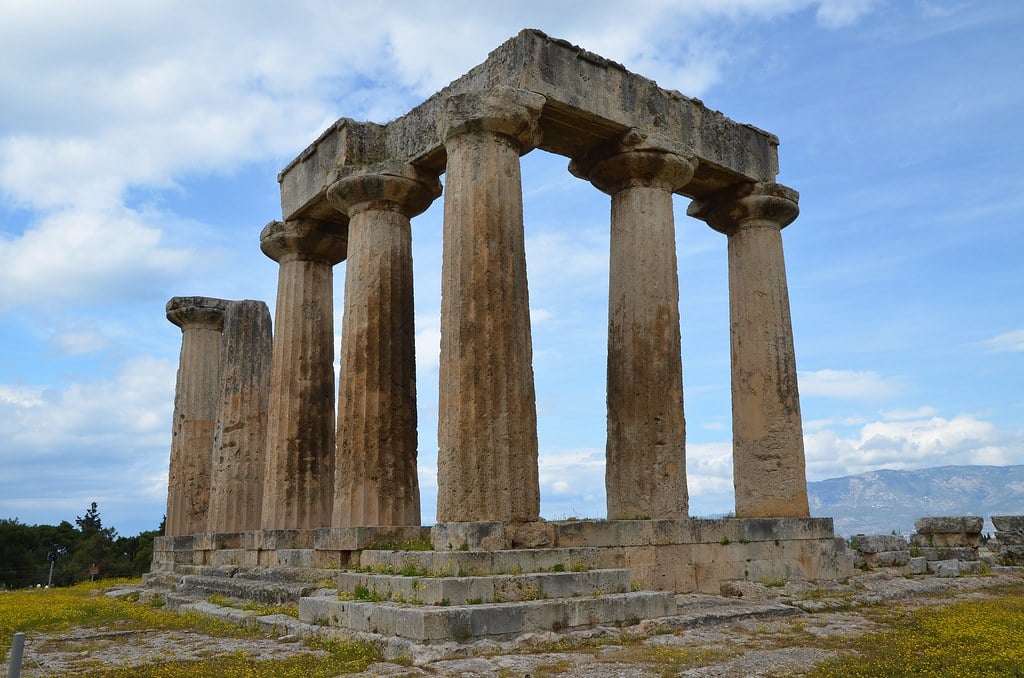
The Battle of Corinth
In 146 BCE, two significant events occurred for the Romans. One of these was the Battle of Corinth, marking the culmination of the Achaean War, which lasted only a single year.
At that time, the Achaean League ruled over the Peloponnese. They had recently assimilated Sparta into the league, which troubled Rome. Both sides were concerned with the other’s expansionist tendencies. Rome had conquered Macedonia in the early part of the second century BCE and had reconquered it in 150-148 BCE.
In the final year of the war against Macedonia, the Achaean League took control of Sparta, solidifying their hold on the Peloponnese. With tensions high due to the actions of both sides, war broke out two years later, in 146 BCE.
The war did not last long. The Achaean League was woefully unprepared, both militarily and financially, for a full-scale war against Rome. The Romans quickly subdued the Greek cities, many of which took the initiative to surrender.
A Roman consul and military general named Lucius Mummius led the Romans in their siege of Corinth. This was the climax of the war. The Romans successfully defeated and utterly destroyed it. Their brutality was noted even by ancient historians. With this victory, the Romans gained direct control of all of Greece.
The Siege of Carthage
The same year, 146 BCE, also marked the climax of another war. The war in question was the Third Punic War. This was the third war between the Roman Republic and the Carthaginian Empire.
Carthage was located in modern-day Tunisia. Rome had already defeated them in the Second Punic War, which had ended in 201 BCE. One of the terms of the treaty was that Carthage was prohibited from engaging in war without Rome’s permission. This allowed Rome’s ally, Numidian king Masinissa, to repeatedly invade Carthage’s territory.
Carthage’s decision to fight back and send an army against Masinissa in 149 BCE provided the Romans with a justification for a third war against Carthage. In reality, Rome harbored animosity towards Carthage and was merely seeking an excuse to destroy it.
When the Roman army arrived, the Carthaginians offered a complete surrender. Nevertheless, the Romans persisted and besieged the city. Eventually, after considerable brutality and bloodshed, the Romans utterly destroyed their enemy.
Just like Corinth in that same year, Carthage was completely, mercilessly destroyed, and the Romans took over the territory.
How the year 146 BCE led to the creation of the Roman Empire
Given this information, 146 BCE can be regarded as vital in the creation of the Roman Empire. The Romans achieved two major victories this year: the defeat of the Achaean League and the defeat of Carthage.
Both of these victories significantly expanded the territory of the Roman Republic. Rome took over control of all of Greece and also the core territory of the Carthaginian Empire in Tunisia. Granted, this was only a tiny portion of what later became the territory of Rome’s vast empire.
However, the main impact that this year had on the formation of the Roman Empire was not the territory gained. Rather, it was the geopolitical consequences of these victories that mattered the most.
Carthage and the Achaean League were both major powers in the Mediterranean. With their defeat, Rome became the undisputed master of that part of the earth. While it still had numerous enemies to confront, it no longer had a single, major, powerful rival.
Over in Anatolia, Pergamon was friendly with Rome. Ptolemaic Egypt was also their ally, with Rome exerting considerable influence over that region. With Greece and Carthage out of their way, Rome’s position as the dominant force in the Mediterranean was firmly established. It is for that reason that we can consider 146 BCE as such a crucial year in the formation of the Roman Empire.