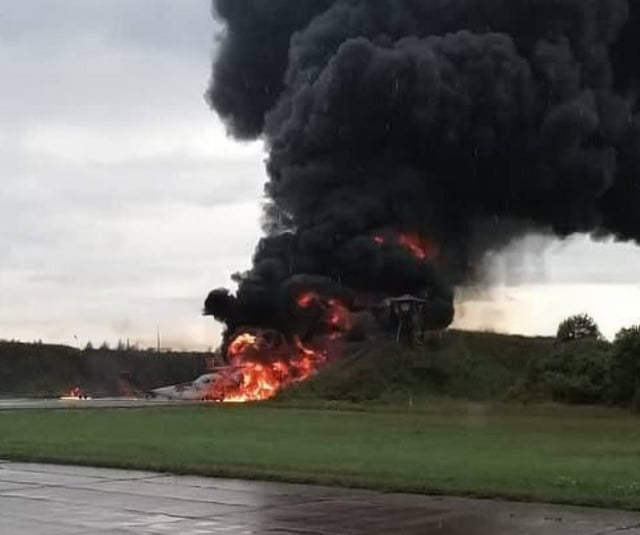
Russia may have lost over 70% of its combat-ready Tu-22M3 long-range bombers since 2022 and now retains only nine to ten operational aircraft, per a Defense Express analysis. The Ukrainian defense outlet published its assessment as another Tu-22M3 crashed on 15 June 2026 in Russia's Irkutsk Oblast. It's the third Tu-22M3 crash in that region since 2022.
Russia stopped producing the Tu-22 in all variants in 1993, with no replacement program planned for the near future, leaving the surviving bombers irreplaceable as combat losses and accidents accumulate.
The Tu-22M3 serves as one of Russia's primary platforms for Kh-22 and Kh-32 cruise missile strikes against Ukrainian cities and civilian infrastructure.
As of today, the Russians may have approximately 9-10 operational bombers of this type.
Operation Spiderweb destroyed multiple Tu-22M3 bombers across three airbases
Defense Express attributed the largest single loss of Tu-22M3 bombers to Ukraine's Security Service (SBU) Operation Spiderweb on 1 June 2025, which Ukrainian officials reported destroyed 12 Tu-22M3 aircraft at the Olenya, Belaya, and Dyagilevo airbases.
The Ukrainian assessment forms part of the SBU's broader claim that the operation struck 41 Russian aircraft across multiple bases for approximately $7 billion in damage.
Defense Express counts 24 Tu-22M3 destroyed or damaged from all causes since 2022, including Ukrainian strikes, the April 2024 S-200 air defense shootdown over Stavropol Krai, and three crashes in Russia's Irkutsk Oblast in August 2024, April 2025, and June 2026.
Production halt leaves Russia unable to replace lost Tu-22M3 bombers
The Tu-22M3 is a supersonic bomber capable of carrying conventional and nuclear weapons. Russia halted Tu-22 production, and the modernization program aims to upgrade surviving airframes but has progressed slowly.
The spare parts base for the Tu-22M3 fleet is extremely limited, meaning even apparently minor damage can lead to an aircraft being written off or used as a parts donor for other bombers. The Ukrainian outlet estimated that of the 41 Tu-22M3 nominally on Russian inventory, some are non-operational and serve as parts donors while remaining counted as in-service on paperwork.
There are so many questions to be answered about what led to yesterday’s fatal mishap involving a B-52H bomber at Edwards Air Force Base. The crash was tragic on a level the base, which sits at the center of America’s flight testing ecosystem, has not experienced, at least to our knowledge, for 75 years. The human impact here is just hard to quantify at this time. At the same time, there will be a major developmental impact, too, especially when it comes to work that is being done to modernize the B-52. This is a constellation of programs that are seen as vital to U.S. national security, and are also already running far behind schedule and over budget.
“It was a B-52 that was on initial takeoff, supporting the Radar Modernization Program,” Air Force Col. James Hayes, Deputy Commander of the 412th Test Wing at Edwards, said at a brief press conference yesterday. “It was a local test sortie. It took off, and immediately after takeoff, crashed and burst into flames.”
U.S. Air Force Boeing B-52H Stratofortress strategic bomber crashed at the Edwards Air Force Base in California shortly after take-off.
The crash occured at approx. 11:20am local on Monday.
"Emergency crews immediately responded to the scene and the situation is ongoing. More… pic.twitter.com/u4IRGGjlV2
— Status-6 (War & Military News) (@Archer83Able) June 15, 2026
The 412th is the main unit at Edwards. As noted, the base serves as the Air Force’s main test and evaluation hub.
“After reviewing the footage of the crash, it was deemed that this was an unrecoverable crash and unsurvivable,” Col. Hayes added. The B-52 had “a mixed crew of military, government civilians, and government contractors supporting this test mission.”
“Right now, our thoughts and prayers are with the families of those that lost their loved ones,” he also stressed. “This is a tragedy.”
When reached by TWZ for comment today, Boeing reiterated a brief statement it made yesterday that confirmed two of its employees died in the crash. The company’s full statement is as follows:
“We extend our deepest condolences to the loved ones of the eight crew members who lost their lives in the B-52 crash at Edwards Air Force Base, California. It is with great sadness that we confirm two Boeing employees were among those on board. We are in contact with their families and are offering support.”
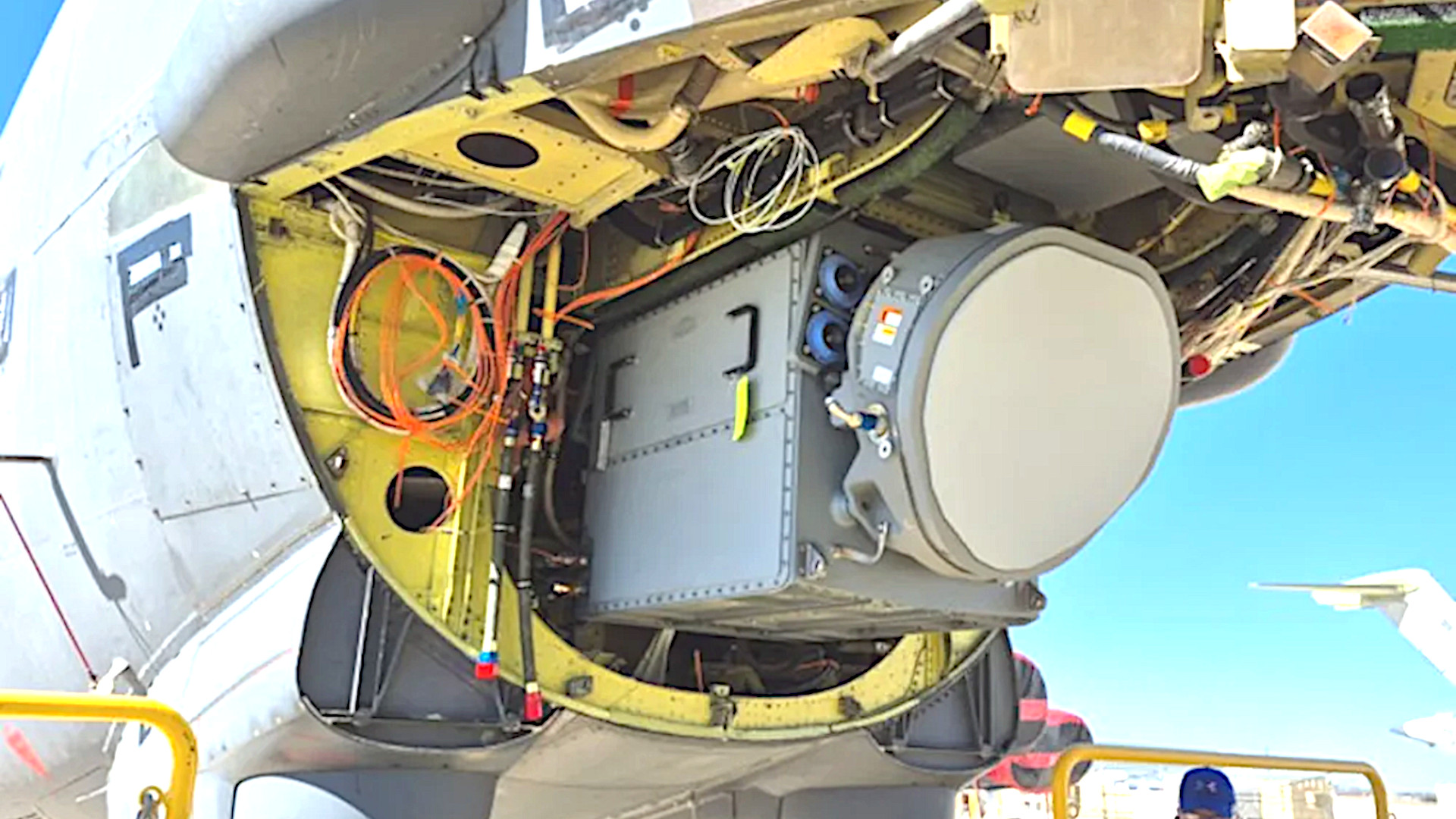
A side-by-side look at the existing AN/APQ-166 radar on a B-52, at left, and the new AN/APQ-188 integrated onto one of the bombers, at right. USAF
The RMP is one of many major upgrades planned for the Air Force’s entire fleet of 76 B-52s in the coming years. The bombers are also set to get all-new engines, improved communication suites, and more. The changes will be so substantial inside and out that the designation of the bombers will switch from B-52H to B-52J in the process.
“It is too early to tell,” a U.S. Air Force official told TWZ today when asked about potential impacts to the RMP.
We have also reached out to Raytheon.
The publicly stated plan for the RMP has called for the integration of the AN/APQ-188 radar onto two B-52s to support initial testing. Modification of those bombers began in Fiscal Year 2023, and the first example with the new radar touched down at Edwards in December 2025. Air Force budget documents say the second radar test B-52 is expected to be ready some time in Fiscal Year 2026, which began on October 1, 2025. Whether that milestone has already been reached is unclear.
The first B-52 equipped with the new AN/APQ-188 radar arrives at Edwards in December 2025. USAF
It is also not known how many AN/APQ-188s may be available at all at present. “The remaining test-phase radars are expected to be delivered through the summer of 2024,” Raytheon said in a press release back in 2023.
As noted, the RMP has already suffered significant delays. Under the original program schedule, flight testing was expected to start in 2024. The initial goal was for AN/APQ-188-equipped B-52s to begin flying operational sorties in 2027. As it stands now, the Engineering and Manufacturing Development (EMD) phase of the program is expected to run into the middle of 2029, with initial operational capability then coming in 2030.
These delays have also come along with substantial cost growth. In 2021, the estimated price tag for development of the AN/APQ-188 and integration of those radars onto the Air Force’s full fleet of 76 B-52s was pegged at nearly $2.4 billion, according to the Government Accountability Office (GAO). By 2023, the RMP’s costs had risen by 12.6 percent, per GAO. The program was eventually subjected to an extensive legally required review of its requirements and cost targets, which led to a scaling back of planned capabilities, at least initially.
“Part of what we did to control cost is to work at what are the main things that we need on this radar? As you may recall, we’re buying a radar that is largely a F-18 Hornet radar with some small modifications. We did that intentionally because that is what was on the market at the time,” Air Force Lt. Gen. Andrew Gebara, Deputy Chief of Staff for Strategic Deterrence and Nuclear Integration, explained in August 2025. “It would actually cost us more if we asked [a contractor] to design the new radar.”
An AN/APG-79 radar installed on an F/A-18 Hornet. Raytheon
Gebara’s remarks came during a virtual talk hosted by the Air & Space Forces Association’s Mitchell Institute for Aerospace Studies.
“Having said that, it doesn’t mean that we need everything on that radar that the Hornet had on it,” he continued. “We have a certain number of minimum things that we need to do to be able to do our B-52 mission. And so part of the cost saving [review] was looking at what are those things, to make sure that we’re prioritizing precious dollars on things that we need.”
Gebara said at that time that the revised RMP plan still kept the door open for “opportunities for growth in the future, if it comes to that.”
The AN/APQ-188 is still set to provide essential new capabilities, in part just by being a more modern AESA design. As TWZ has written in the past:
“In general, AESA radars offer greater range, fidelity, and resistance to countermeasures, as well as the ability to provide better overall general situational awareness, compared to mechanically scanned types. Increasingly advanced AESAs bring additional capabilities, including electronic warfare and communications support.”
“For the B-52, any new multi-mode AESA will improve the bomber’s target acquisition and identification capabilities, including when used together with targeting pods available for the bombers now. New radars for the bombers will also be helpful when it comes to guiding networked weapons over long distances to their targets and could provide a secondary ground moving target indicator (GMTI) and synthetic aperture radar surveillance capabilities. The radar upgrade could help defend B-52s from air-to-air threats, including through improved detection of incoming hostile aircraft.”
A B-52 bomber with its nose open for maintenance. USAF
“Boeing has already looked at some schedule improvement that we’ve seen,” Air Force Gen. Dale White, the service’s Direct Reporting Portfolio Manager for Critical Major Weapon Systems, also told TWZ and others more recently at a roundtable at the Air & Space Forces Association’s (AFA) annual Warfare Symposium in February. White was speaking at the time collectively about progress on the RMP and the Commercial Engine Replacement Program (CERP) for the B-52 fleet.
At that time, Gen. White also highlighted how the relatively small size of the B-52 fleet, combined with the operational demands placed on it, had created additional challenges for modernizing the bombers. The B-52s are in high demand to support conventional combat operations, as underscored by their heavy use in the recent conflict with Iran. A portion of the fleet is also a key element of the air leg of America’s nuclear deterrent triad, which imposes additional hard operational requirements for available aircraft.
USAF B-52 taking off from England on an Iran strike mission yesterday, carrying a load of 500-pound GPS-guided JDAM bombs. pic.twitter.com/23RGpCe8GB
“The challenge with B-52 that I think everybody forgets, it’s such a small fleet that has such a tremendous requirement in terms of readiness,” White said. “You’ve got to have a certain number on the ramp. That’s a requirement.”
With the B-52 fleet expected to fly into the 2050s, it is extremely likely that the Air Force will move to regenerate a bomber from storage to replace the one lost yesterday, just to meet general operational demands. That is typically a weeks-long process, at best, for an aircraft of this type and size.
A B-52H bomber nicknamed “Wise Guy” seen at Tinker Air Force Base in Oklahoma in the process of being regenerated to service back in 2020. USAF
With CERP and the other modernization efforts underway, there is high demand for resources to support B-52 test and evaluation work overall. This is reflected in a nearly tenfold year-over-year increase in the planned budgeting for B-52 test aircraft asset support at Edwards. The Air Force received just over $1.5 million to help pay for “the test aircraft, manpower, Bomber Modular Data Acquisition System (BMDAS), and facilities at the Air Force Test Center” in Fiscal Year 2026, according to official budget documents. The service is now seeking nearly $11 million in this same line item for the next fiscal cycle.
In the meantime, as mentioned, the Air Force has rightfully made clear that its immediate priorities following yesterday’s B-52 crash are engaging with the families of those who perished and working on the investigation, which could take months to complete. Edwards has also at least shut down flight operations today, primarily due to the state of the runway following the mishap.
The full scale and scope of the impacts to the RMP from yesterday’s loss remain to be seen.
Details are still coming in, but a B-52 bomber has crashed at Edwards Air Force Base in California.
The base’s official Facebook and X pages have posted the following statement:
“A United States Air Force B-52 Stratofortress crashed shortly after takeoff on the Edwards airfield at 11:20 a.m. Emergency crews immediately responded to the scene and the situation is ongoing. More information will be provided as it becomes available.”
ALERT: A United States Air Force B-52 Stratofortress crashed shortly after takeoff on the Edwards airfield at 11:20 a.m.
Emergency crews immediately responded to the scene and the situation is ongoing. More information will be provided as it becomes available. pic.twitter.com/x932d3HXHz
— Edwards Air Force Base (@EdwardsAFB) June 15, 2026
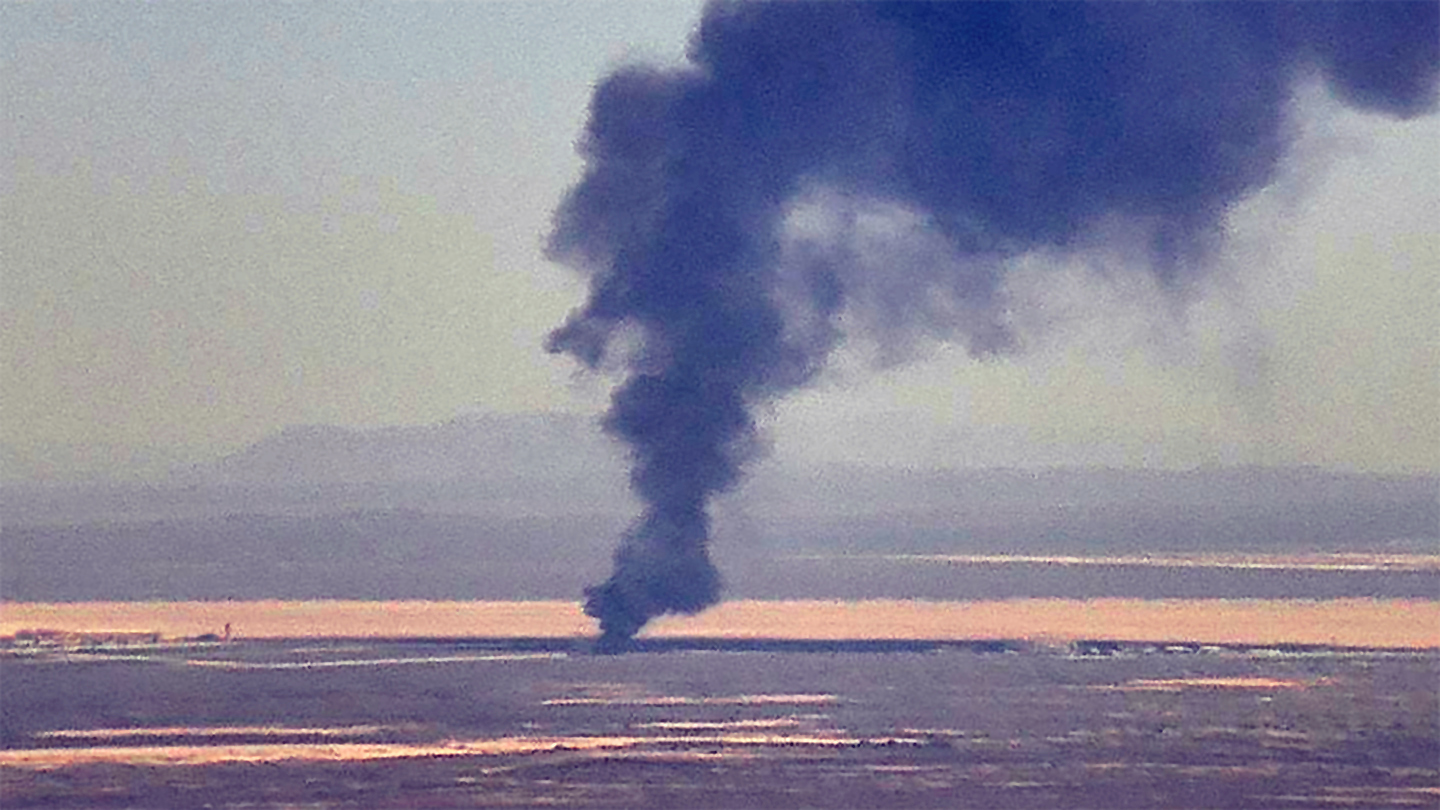
From what we can see, the B-52 appears to have crashed on or at least very near the base’s main runway. Still images and video emerging now show a large fire with black smoke that can be seen from miles away.
How many individuals were on board the B-52 when it went down, and their fate, are currently unknown. However, the bomber ejection seat configuration could have presented complications for escape depending on how soon after takeoff the incident occurred. The B-52 has crew positions that eject downward.
Prior to this crash, the Air Force had 76 B-52s in service.
A stock picture of a B-52 bomber at Edwards. USAF
Though the two incidents are unrelated, this is also the second crash of a U.S. military aircraft in three days. A U.S. Marine Corps F/A-18D Hornet assigned to Marine Fighter Attack Squadron 323 (VMFA-323) went down near Mount Rainier in Washington State on June 13. The two individuals in that jet were able to eject safely. The Hornet did start a wildfire after hitting the ground.
BREAKING – Footage showing a U.S. Marine Corps F/A-18 crashing into a hillside near Rimrock Lake, Wash., on Saturday. pic.twitter.com/yQ4O6UFZOl
A US Navy F/A-18 crashed near Rimrock Lake, pilot ejected and walked out with medics according to reports. This is along the famous VR-1355 low level route in Washington State.
Fox News has now shared a video it says is of the aftermath of the crash, which shows a very large scorched area along the side of one of the runways at Edwards. There is no readily discernible wreckage, pointing to a total loss of the aircraft.
Edwards Air Force Base has shared a new update as of 12:48 PM PDT via its social media accounts. The full statement reads:
“The airfield has been closed, and all inbound aircraft are being diverted. All non-commercial visitor passes have been suspended until further notice to allow the installation to focus entirely on emergency response operations.”
Update- 12:48 PDT: The airfield has been closed, and all inbound aircraft are being diverted.
All non-commercial visitor passes have been suspended until further notice to allow the installation to focus entirely on emergency response operations.
— Edwards Air Force Base (@EdwardsAFB) June 15, 2026
“An Air Force B-52 Stratofortress carrying eight people on a routine test mission crashed today shortly after take-off at 11:20 a.m. (PDT). Initial indications are that the crash was not survivable. Emergency response personnel are on scene, and officials are working to account for all personnel.”
“The crash is currently under investigation.”
Ten is the maximum number of people that can ride about a B-52 at one time, with four jump seats in addition to the available crew stations. Eight died in the crash. This makes it the biggest loss we know of at Edwards since a fatal crash of a B-50D bomber with eight individuals on board near the base in 1951.
UPDATE: 7:41 PM EDT –
Speaking at a press conference after the crash, Air Force Col. James Hayes, Deputy Commander at 412th Test Wing, Edwards Air Force Base, offered some additional details.
“After reviewing the footage of the crash, it was deemed that this was an unrecoverable crash and unsurvivable. At that point, we went into the notification process.”
“At this point, we don’t have any indication as to what the cause was of this.” The answers might not be known for upwards of six months after several investigations.
The B-52 had “a mixed crew of military, government civilians, and government contractors supporting this test mission.”
The base is terminating operations tomorrow “mainly because of the runway itself, and we’ll eventually get back to full operations and execute…but at this point, yes, we are standing down operations tomorrow.”
UPDATE: 4AM EDT—
Boeing has put out a statement mourning the loss of the crew, two of which were its employees.
*Author’s note: We changed the maximum crew to ten after a past bomber pilot informed us that the B-52 can hold this many people, not eight as we understood it to be.
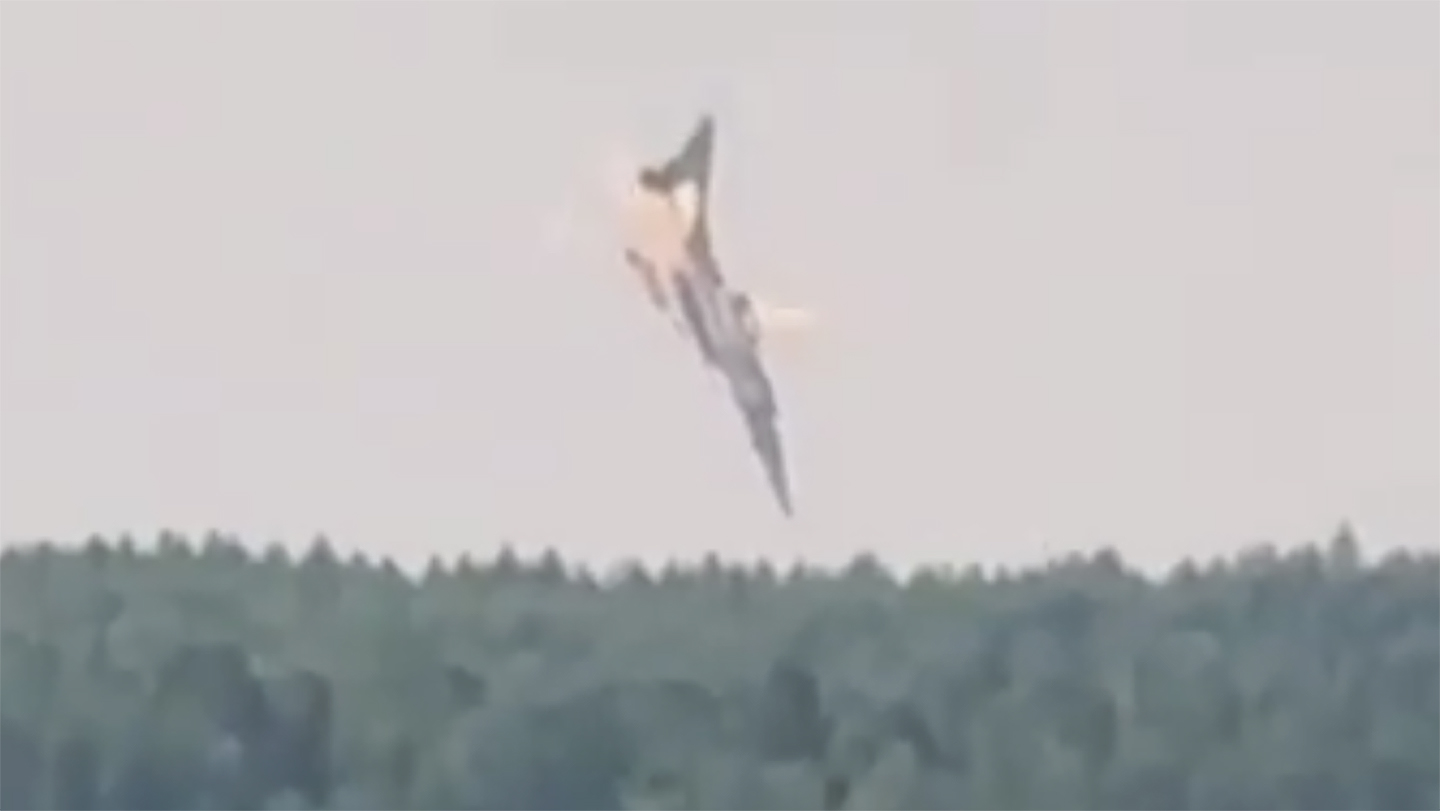
Multiple videos circulating on social media show the crash of a Russian Tupolev Tu-22M3 Backfire-C bomber today. Footage shows the swing-wing bomber entering a steep nose-down dive before slamming into the ground, producing a large plume of black smoke. The footage has not been independently verified, but Russian authorities have confirmed the loss of the aircraft.
A Russian Air Force Tu-22M3 bomber crashed during landing this evening in Irkutsk. pic.twitter.com/shNwTrjLlk
The Russian Ministry of Defense said the Tu-22M3 crashed while making an approach to land in the Irkutsk region, in southeastern Siberia, during what it described as a routine training flight. According to the ministry, the bomber was not carrying a combat load, all crew members ejected safely, and there were no casualties or damage on the ground. The cause of the crash has not been disclosed, and an investigation is underway.
— Special Kherson Cat (@bayraktar_1love) June 15, 2026
The governor of the Irkutsk region, Igor Kobzev, said that the aircraft crashed in the Bokhansky district, near the village of Kamenka. Kobzev added that the crew had been found by local people after ejecting and were already getting medical treatment.
Belaya, near Irkutsk, is an important Backfire base, accommodating the 200th Heavy Bomber Aviation Regiment.
The Tu-22M3 remains a key component of Russia’s Long-Range Aviation fleet and has been used extensively in the war against Ukraine to launch cruise missile strikes in standoff attacks. This makes any loss of the type noteworthy even when it occurs outside of combat operations, as was the case today.
A video from May 2022 that purports to show the launch of Kh-22 cruise missiles, as seen from the cockpit of a Tu-22M3:
The launch of two supersonic cruise missiles kh-22 from a long-range supersonic missile-carrying bomber Tu-22. fighter_bomber pic.twitter.com/kAXU9pP5KW
— Massimo Frantarelli (@MrFrantarelli) May 11, 2022
During the conflict, Ukraine claims to have used a Soviet-era S-200 (SA-5 Gammon) long-range surface-to-air missile to bring down the Tu-22M3 that crashed in the Stavropol region of southern Russia on April 19, 2024, an incident you can read more about here.
— Ukraine Territorial Defense Forces (@TDF_UA) April 19, 2024
Other examples of the Tu-22M3 have been destroyed on the ground by Ukrainian drone strikes during the conflict.
In August 2023, a Backfire was destroyed by a drone strike while on the ground at the airbase of Soltsy-2 in the Novgorod region.
First pictures have emerged regarding the Ukrainian drone attack in the Soltsy-2 airbase. The Russian MoD initially claimed that one plane was only “damaged”, but pictures of this Tupolev Tu-22M3 speak a different language.
Subsequently, in Operation Spiderweb, in June 2025, four more Tu-22M3s were confirmed destroyed on the ground, while another two were confirmed damaged. At least four more Backfires were targeted in the same attacks and may also have received some degree of damage. On this occasion, Ukraine employed short-range explosive-laden drones that targeted Russia’s missile-carrying bomber fleet in an unprecedented attack on at least four airbases, including Belaya.
Russian films the burning remains of Russian Tu-95s and Tu-22s at the Belaya military airfield in the Irkutsk region pic.twitter.com/GXuWfkIg9c
— Special Kherson Cat (@bayraktar_1love) June 2, 2025
Today’s incident also adds to a growing list of recent non-combat accidents involving the aging bomber fleet. Previous such losses, all in the Irkutsk region, occurred in August 2024, April 2025, and June 2026.
After all of these incidents, the Russian Tu-22M3 fleet today numbers around 50 active aircraft, although there are additional non-serviceable aircraft that could be brought back into service after extensive overhaul.
Since the Tu-22M3 has been out of production for decades, every airframe is especially precious. Any loss reduces Russia’s Long-Range Aviation capabilities and readiness. This has an impact not only on the war in Ukraine but also on Russia’s broader Long-Range Aviation force, a key element of the country’s strategic military posture.
We will update this post as we find out more about today’s incident.

 Login
Login