Global oil giant Shell continued operating a compromised pipeline in Nigeria’s Niger Delta despite knowing it posed a pollution risk in the surrounding coastal wetland environment, newly disclosed internal company communications reveal. The emails and memos, reviewed by Mongabay, show senior leadership knew of the poor conditions of the 97-kilometer (60-mile) Nembe Creek Trunk Line as early as 2008. Despite concerns it was operating outside technical integrity standards and proposals to shut it down, a top executive decided to keep pumping oil through the line. Carrying 150,000 barrels of oil per day to the export terminal at Bonny Island Rivers state, the Nembe Creek Trunk Line is a critical oil artery in Nigeria. Throughout the years, theft from the pipeline using illegal connections caused spills into the vast mangrove ecosystem of true (Rhizophora sp.) and flowering black (Avicennia sp.) tree species. An internal 2013 Shell document coded such tampered lines as “red,” requiring either their immediate shutdown or immediate action to remove all illegal connections. Locals from the nearby riverine Bille community said the oil spills killed about 2,000 hectares (4,900 acres) of mangrove swamps around the village while impacting an area of 13,200 hectares (32,600 acres). The contaminated waterways and degraded ecosystem, they told Mongabay, killed fish and other aquatic life. Satellite imagery surrounding the village shows massive degradation of the mangroves. “The aquatic life is gone. Our people can no longer go to the river and catch reasonable fish — they can’t even find the fish in the…This article was originally published on Mongabay
Leoncia Ramos has lived her 65 years in the lush Dominican Republic town of La Piñita, but now says she is fearful for her health and wants to leave. She’s among 450 families asking the government and the company behind the Pueblo Viejo gold mine to be relocated because of concerns of pollution from the nearby mine. They allege the site, controlled by Canadian giant Barrick Mining Corp., is harming their health and the environment, and fear that if a tailings dam about a kilometer away were to collapse, it would be disastrous. Ramos’s community has spent 15 years fighting to have its concerns addressed and now says Canada, where Barrick Mining is headquartered, could play a role. In 2019, the Canadian government created an office of an ombudsperson to handle complaints from communities like Ramos’s. But the government has left the role vacant for the past year, and its work has seemingly come to a standstill. Canada is home to about half of the world’s publicly traded mining and mineral exploration companies, with operations both in Canada and overseas, including some of the world’s largest miners, like Barrick Mining. The government created the office of the Canadian Ombudsperson for Responsible Enterprise (CORE) in 2019 to address human rights complaints about Canadian companies’ operations overseas. But the office has now been without an ombudsperson since May 2025, and advocates say its work has stalled at a critical moment, as demand for transition minerals and a changing geopolitical climate are driving…This article was originally published on Mongabay
Indigenous Peoples in Voluntary Isolation and Initial Contact (PIACI) in the Yavarí-Tapiche Territorial Corridor, one of the largest contiguous, intact forests in the Amazon and home to the world’s highest concentrations of PIACI, are under threat by extractive and large-scale industrial activities, which pose an existential threat to its inhabitants and the ecosystems they depend on. This is according to a new report co-authored by Earth Insight, the Regional Organization of Indigenous Peoples of the East (ORPIO), the Coordination of the Indigenous Organizations of the Brazilian Amazon (COIAB) and the Interethnic Association for the Development of the Peruvian Rainforest (AIDESEP). The report finds that oil and gas blocks overlap with 10% of the 16-million-hectare (39.5-million-acre) corridor, including almost 1.7 million hectares (4.2 million acres) of intact tropical moist forest, 907,000 hectares (2.2 million acres) of Key Biodiversity Areas and 713,000 hectares (1.8 million acres) of protected areas. “Pressure from hydrocarbons is increasing on the Peruvian side of the Yavarí Tapiche corridor,” Edith Espejo, senior program manager at Earth Insight and author of the report, told Mongabay over WhatsApp messages. “Our report serves as a warning for the irreversible harm that could take place if these oil blocks move into this corridor. Mining concessions within and on the peripheries of the corridor also pose a threat of encroachment and contamination of waterways.” A critical corridor for ecosystems and Indigenous communities The Yavarí-Tapiche Corridor covers Brazil’s western border states of Amazonas and Acre and Peru’s Loreto and Ucayali departments in the Amazon…This article was originally published on Mongabay
The short-eared dog is one of the Amazon’s least-known carnivores. In Bolivia, it’s also one of the hardest to find. The species has a fox-like snout, small rounded ears, partially webbed toes, and a long bushy tail that often drags on the forest floor. In Spanish, it’s sometimes called perro fantasma, or ghost dog, a name that reflects how rarely even field biologists encounter it. A long-running camera-trap study has now brought the species into sharper focus, reports Iván Paredes Tamayo. Over more than two decades, researchers recorded the short-eared dog in Bolivia’s lowland Amazonian forests, in piedmont forests near the Andes, and in large protected and Indigenous-managed landscapes. The results suggest the animal may be present in more places than earlier records showed. That is useful evidence, although it doesn’t make the species common. It remains scarce, elusive, and closely linked to well-preserved forest. For conservation groups, land managers, and funders, the findings suggest the short-eared dog depends on large, connected areas of habitat. Small forest fragments are unlikely to provide what it needs. Its presence can help identify places where forests are still functioning well, especially where protected areas and Indigenous territories keep intact habitat at scale. The finding also shows why long-term monitoring matters. Rare species are easy to miss in short surveys. A camera trap may sit for months without recording one. A study that runs across years, landscapes, and management types can reveal patterns that would otherwise remain hidden. The short-eared dog will probably never…This article was originally published on Mongabay
From human-elephant coexistence to an alternative conservation model from the Democratic Republic of Congo, from teen innovators in Kenya to Guinea’s complicated experience with mining, the stories that attracted the most readers in the first five months of 2026 reflect the richness of Mongabay’s Africa coverage on World Environment Day, June 5, 2026. They also showcase the talents of a diverse reporting team and a strong and growing network of resident contributors. Electric fences help farmers and elephants coexist in Zambian borderlands: Contributor Ryan Truscott reports from eastern Zambia on an initiative aimed at protecting farmland from elephants, even as the pachyderms are forced into narrower corridors as habitats shrink. A unique clearing in Central Africa draws elephants from the dense forests: Mongabay Africa’s program director David Akana takes readers to the forest clearing of Dzanga Bai in the Central African Republic. A place where the naturally elusive forest elephants gather, sometimes in the hundreds, forming a “village of elephants.” Descendants of people pushed out for DRC national park lead forest conservation efforts: Contributor Jérémie Kyaswekera brings a story of hope from the DRC, where descendants of families that had to leave the forests of what is today an area in and around Maiko National Park are leading efforts to protect biodiversity through local conservation efforts. Teen innovators in Kenya turn farm waste into award-winning vehicle exhaust filter: Kenya-based contributor Mary Mwendwa teamed up with Mongabay Africa editor Malavika Vyawahare to profile young innovators who developed an exhaust filtration system…This article was originally published on Mongabay
More than a decade ago, conservationists began working to preserve a unique population of desert pampas cats that has adapted to the mangroves of Peru’s northern coast. This small, isolated population roams the San Pedro de Vice dry mangroves, a Ramsar Site and South America’s southernmost mangrove ecosystem. “This is a very unique population, because as far as we know, [it] is the only Pampas cat population that lives in a mangrove [habitat],” Alvaro Garcia, co-coordinator of the Pampas Cat Working Group and the Peruvian Desert Cat Project, told Mongabay in an email. The desert pampas cat (Leopardus garleppi), distinctive for its broad face, ranges along a relatively thin band snaking southward from Colombia through Peru and Bolivia, to northern Chile and Argentina. The species is acclimated to dry conditions, so inhabits deserts, grasslands and dry forests, and isn’t found living in mangroves anywhere else aside from this region of Peru. Dry mangrove forests, also called scrub or dwarf mangrove forests, grow in highly saline soils in upper intertidal zones, so lack regular daily flushing by ocean tides. At first, it was thought the dry mangrove-acclimated cats were faring well: “[I]n the mangrove [habitat], we put cameras out for a week, and we got tons of photos,” whereas in other parts of the felid’s range, conservationists barely capture one desert pampas cat image per month, said Cindy Hurtado, co-coordinator of the Pampas Cat Working Group and the Peruvian Desert Cat Project. Based on the photos, the research team assumed the…This article was originally published on Mongabay
JUNEAU, Alaska (AP) — The Trump administration’s push to expand oil and gas development in Alaska faces a new test Friday. That’s when the latest lease sale is set for the Arctic National Wildlife Refuge. A coalition of conservation groups sent a letter to oil company leaders ahead of the sale, urging them to stay away and citing risks such as ongoing litigation around the leasing program. Opponents of drilling in the refuge have pointed to a lack of major industry interest in prior lease sales. But supporters of drilling see the refuge’s coastal plain as a potential untapped resource that could boost oil production and generate new revenue. Banner image: FILE – The Kaktovik Lagoon and the Brooks Range mountains of the Arctic National Wildlife Refuge are seen in Kaktovik, Alaska, Oct. 15, 2024. Image by Lindsey Wasson via Associated Press.This article was originally published on Mongabay
SARLAHI, Nepal — Dhruba Prasai, a farmer from Sarlahi district in Nepal’s southern plains, says he’s exhausted from lack of sleep. Every year, nilgai antelopes, wild boars, deer and Asian elephants raid his fields, and if left unguarded at night, they not only feed on standing crops, but also stored harvest. “There is a forest to the west, and our fields are right next to it,” Prasai tells Mongabay. “The nilgai eat the maize, and the deer can’t even stand the sight of wheat and oat grass, they eat it all. If people stay up at night to guard the fields, they run away; otherwise, they come and destroy everything.” Farmers such as Prasai across Madhesh province, considered the country’s breadbasket because of its fertile land, are struggling with growing crop losses from wildlife, but complex procedures and policy gaps make access to relief, which is already limited, difficult. From mid-July 2024 to mid-July 2025, 14,821 cases of ‘human wildlife conflict’ were reported in Madhesh, according to government figures. A total of 134 people and 457 animals lost their lives. Last year, a wild boar ate three tand (storage racks) of maize stored in Prasai’s house. Although forest authorities told him to get a recommendation letter from the local municipal ward office to apply for relief, he didn’t do it. “I haven’t done it; we simply don’t have the time,” he says. Even those who did fill out the forms around the same time have yet to receive relief, he…This article was originally published on Mongabay
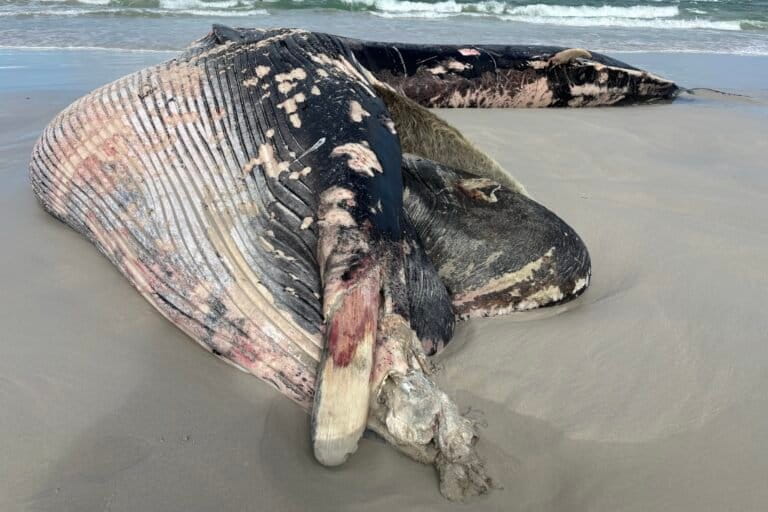
In April this year, two Bryde’s whales washed-up dead-on Dyer Island, a small nature reserve located a few kilometers off the coast of Gansbaai in South Africa’s Western Cape province. Both whales carried severe injuries; their vertebrae had been shattered. “It was very clear that it was [vessel] strikes, because both those whales were snapped in half, and you can also see the propeller marks,” Loraine Shuttleworth, head of research at the Dyer Island Conservation Trust, told Mongabay. Two whale strandings linked to ship strikes in one month alone is an unusually high number, Shuttleworth said. A new risk assessment has linked the increase in risk of ships striking whales to the rerouting of maritime traffic around South African coast. Due to the Houthi rebels attacks on ships traversing the Red Sea, which started in 2023, and the more recent fallout from the blockade of the Strait of Hormuz, many cargo companies have rerouted their vessels around the Cape of Good Hope. With greater shipping traffic comes a growing threat to marine species inhabiting the region: collisions with large, fast-moving vessels. Between December 2023 and December 2024, the number of large vessels traveling through South African waters at average speeds above 15 knots (28 kilometers per hour) has quadrupled, satellite data show. The scale of the increased maritime traffic struck scientist Els Vermeulen from the University of Pretoria’s Mammal Research Institute Whale Unit, on a flight into Cape Town in 2025. “It was a beautiful day, and there were just…This article was originally published on Mongabay
While on a deep-sea expedition in the Galapagos in 2015, scientists found a golf-ball sized, short-armed blue octopus. In a recent study, they confirmed that it’s new to science. The newly described octopus, named Microeledone galapagensis, was first sighted with a remotely operated vehicle (ROV) near an underwater mountain, roughly 1,773 meters (5,800 feet) below the Pacific Ocean surface close to Darwin Island. Expedition researchers from the Charles Darwin Foundation and the Galápagos National Park Directorate collected it with their ROV. They saw two more octopus individuals on video. The body of the collected specimen was preserved and sent to octopus expert Janet Voight at the Field Museum in Chicago, Illinois, U.S. Voight and colleagues at the museum scanned the octopus using computed tomography (CT) to create a 3D model of the individual. The researchers then used the CT model to examine its internal organs and mouth parts. “When you describe a new species of octopus, you have to look at all the parts, including the mouth, the beak, and the teeth. And to see those things, you have to cut the specimen open. We only had the one specimen, so I didn’t want to take it apart,” Voight said in a press release. A comparison of the blue octopus’ parts with those from other octopus species revealed that it was a new-to-science species. Unlike many octopuses, Microeledone galapagensis is small, squat, and has short, stubby arms with few arm suckers. “One of the interesting questions about…This article was originally published on Mongabay
Across the small islands of eastern Indonesia that lie within the Wallacea region, one of the world’s richest marine biodiversity regions, coastal communities are reviving ancient customary systems to safeguard marine ecosystems from destructive fishing and habitat loss. This movement is the centerpiece of Jejak Wallacea, a recent documentary highlighting how local empowerment can succeed where top-down conservation often fails, reports Mongabay’s Hans Nicholas Jong. The film features initiatives across four provinces: East Nusa Tenggara, South Sulawesi, Southeast Sulawesi and Central Sulawesi. These communities have turned to locally rooted methods of reverse biodiversity loss, such as seasonal fishing closures, customary sanctions and mangrove restoration. In Solor, East Nusa Tenggara, residents established traditionally protected marine areas that they refer to as “marine granaries” (kebang lewa lolon) to restore coral reefs and created turtle hatcheries. They are also moving away from harmful blast fishing. “What we chose was conservation, but based on local wisdom,” Vero Lamahoda, director of the local foundation Yayasan Tanah Ile Boleng that is supporting the communities in the transition, said in the documentary. In Southeast Sulawesi, the village of Wabula employs a customary system called Kaombo, which regulates access to traditionally protected areas like seagrass beds and mangroves. Violators face customary fines or rituals like Kaleo Leo, where suspects are dunked into the sea, and the individual who surfaces first is considered the guilty party. Similarly, communities on Langkai and Lanjukang islands in South Sulawesi utilize periodic closures of marine areas for octopus fishing to allow populations to…This article was originally published on Mongabay
Severed tissue from a cold-water sea cucumber can survive, heal, and even move independently for years in natural seawater, researchers recently found. Some animals have the ability to regenerate tissues and body parts. Certain lizards can regrow their tails, for example. Some sea stars and sea cucumbers, including Psolus fabricii that live in the cold waters of the Atlantic and Arctic oceans, can regrow their severed arms or halves. However, researchers in the study showed that the discarded parts of a sea cucumber, instead of dying, can also remain viable for long periods of time. “It’s like a lizard that loses its tail,” study co-author Rachel Sipler from Memorial University of Newfoundland in Canada, said in a statement. “We know some lizards can grow new tails; we’re talking about whether the tail can grow a new lizard.” Sipler and her colleagues removed parts of tentacles, feet and the main body from three Psolus fabricii individuals and placed them in natural seawater in the laboratory. The tissues showed active immune responses, cell diversification, and the ability to absorb nutrients (amino acids) dissolved in the seawater. Even when the researchers stopped the experiments after three years, the tissues continued to survive. “We haven’t grown a new, complete sea cucumber yet, but we are seeing pretty stunning growth and diversification of cells literally years after this tissue was removed,” Sipler said in the statement. Cell lines that are “immortal” and can perpetuate indefinitely are crucial for biomedical research. However, most such “immortal” cell…This article was originally published on Mongabay
BANGKOK — Seven hundred days after activists from the environmental group Mother Nature Cambodia were imprisoned on charges widely regarded as retaliatory for their activism, 73 international and Cambodian civil society organizations have renewed calls for their unconditional release. After a trial lasting just over a month, 10 activists from Mother Nature Cambodia were sentenced on July 2, 2024, to between six and eight years in prison. Only five of the defendants attended the hearings, which saw Long Kuntha, 28, Ly Chandaravuth, 26, Phuon Keoraksmey, 25, and Thun Ratha, 34, each sentenced to six years behind bars for plotting against the government; fellow activist Yim Leanghy, 36, received an eight-year sentence for both plotting against the government and insulting the king. The five activists who did not attend the trial were sentenced in absentia. The appeals hearing for all 10 convicted activists was slated to take place on June 2, but has been postponed indefinitely by the Phnom Penh Court of Appeals. “The MNC5 are incarcerated in prisons in overcrowded and harsh living conditions, separated from each other and spread out all across Cambodia, hundreds of kilometers away from their families and legal counsel,” wrote the 73 NGOs in an open letter addressed to Prime Minister Hun Manet. “The … NGOs who have signed this letter sincerely request you take immediate action to ensure the unjust convictions of these five activists are reversed either prior to or at their upcoming appeals court hearing in Phnom Penh, and that their freedom…This article was originally published on Mongabay
Tshopo province in the Democratic Republic of the Congo granted 31 community forest land titles to farmers in May, bringing a total of more than a million hectares of forest in Tshopo under the legal stewardship of local Indigenous peoples. Bantu and Indigenous Mbuti communities have lived in the province for generations, but without official title or control of their own lands and under the ever-present threat of extractive and development projects without their consent. Community Forestry Lands (CFLCs) include community environmental management plans. They also offer legal tenure that’s meant to ensure any development on those forest lands requires the free and informed consent of the communities holding the tenure rights. According to the deforestation-tracking platform Global Forest Watch, Tshopo province lost roughly 46% of its total tree cover between 2002 and 2025, largely driven by timber harvesting, charcoal production and mining. These activities degrade the ecosystem and destabilize the livelihoods and food systems of indigenous peoples. “[E]xtreme poverty is gaining ground among indigenous peoples and local communities, for whom the forest is more of a habitat than a source of vital goods and services,” Alphonse Maindo, director of the environmental NGO Tropenbos DRC that helped the communities obtain CFLCs, told Mongabay’s Didier Makal. The recently granted community forest concessions in Tshopo, when added to other such community management areas, means nearly 6.3 million hectares (15.5 million acres) of secured land in the DRC. That’s an area roughly the size of Togo. Some local residents are planning to start beekeeping and cocoa…This article was originally published on Mongabay
Starting in 2018, gray whales began regularly stopping in California’s San Francisco Bay, where they are vulnerable to ship strikes in one of the busiest ports in the United States. In response, researchers have deployed a monitoring network of thermal cameras and AI software to alert ships when whales are present in the bay to help them avoid whale collisions. Gray whales (Eschrichtius robustus) have one of the longest migrations of any mammal species, roughly 19,000 kilometers (12,000 miles) from their feeding grounds in Alaska to their breeding grounds in Mexico, and back again. Climate change is making their feeding grounds in Alaska less productive, leaving the whales hungry as they head south to breed. Scientists believe that’s why gray whales have started stopping in San Francisco Bay to eat along their migration route. But the new pit stop brings whales into busy shipping zones, where more than 20 were killed by ship collisions in 2025, according to a news release. Whale biologists at the Benioff Ocean Science Lab, WhaleSpotter, and the Marine Mammal Center have developed thermal cameras that can detect the heat signature of whale spouts and bodies when the whales surface. “Next a trained human confirms the detection and will help classify the species when possible,” Rachel Rhodes, a project scientist with the Benioff Ocean Science Lab told Mongabay in an email. Then the information is, “posted publicly on [the] Whale Safe website, which is accessed by mariners in the Bay Area including Vessel Traffic Service and…This article was originally published on Mongabay
TORONTO (AP) — Canada’s government endorsed a plan Wednesday to move the last remaining captive whales from a shuttered theme park in Ontario to aquariums in the United States and Spain — a plan that could save them from mass euthanasia if the deal goes through. There are 30 belugas and four dolphins left in the Marineland park and zoo in Niagara Falls, Ontario, which announced in early 2023 that it was for sale and closed to the public in late summer 2024. No sale has yet been announced. The former tourist attraction has since worked to move the park’s remaining animals and sell the sprawling property near Horseshoe Falls. In 2024, Marineland was found guilty under Ontario’s animal cruelty laws in a case related to its care of three black bears. The Department of Fisheries and Oceans has issued the first batch of permits to move the whales and is set to issue different permits closer to the move, expected to take place in the next few months. It recently issued permits for the whales and dolphins under the Convention on International Trade in Endangered Species of Wild Fauna and Flora, otherwise known as CITES permits. “I think this is a positive step forward,” Fisheries Minister Joanne Thompson said. “There’s still more work to be done, but it’s a step forward.” Twenty whales — 19 belugas and one killer whale — have died at Marineland since 2019, according to provincial government data obtained through freedom-of-information laws and official statements. Thompson’s office said…This article was originally published on Mongabay
As offshore wind farms expand rapidly in the global renewable energy transition, scientists are studying how these large marine infrastructure projects affect ecosystems beneath the waves. Research from Wageningen University & Research in the Netherlands suggests that offshore wind may bring both risks and benefits for sharks and rays, known collectively as Elasmobranchii, which are highly sensitive to electromagnetic fields (EMFs). A six-year project called “Elasmopower” examined how EMFs from subsea power cables in offshore wind farms affect bottom-dwelling sharks and rays. These species depend on natural electric and magnetic fields for key behaviors such as navigation, prey detection, habitat use and long-distance movement, particularly in low-visibility environments. The studies conducted as part of the Elasmopower project have been published in four papers, with three additional papers currently undergoing peer review. Sharks and rays have specialized electroreceptors called ampullae of Lorenzini. The jelly-filled sensory canals around the head and snout can detect even extremely weak EMFs from prey and predators, water movement, and the Earth’s geomagnetic field, Erwin Winter, a scientist at Wageningen, told Mongabay. This system is central to hunting and orientation, making Elasmobranchii especially relevant for studying EMF exposure from offshore energy infrastructure, Winter added. Erwin Winter, a researcher with the Elasmopower project, presented findings on offshore wind, electromagnetic fields and bottom-dwelling sharks and rays at the Sharks International 2026 conference in Colombo, Sri Lanka, in May. Image by Malaka Rodrigo for Mongabay. During a presentation on a summary of the Elasmopower research at the Sharks International 2026…This article was originally published on Mongabay
The existence of the “polluter pays” principle (PPP) in Bangladesh, at least on paper, dates back to 1992, ever since the country endorsed the Rio Declaration. However, Bangladesh has made little progress in implementing the principle so far. A statement by the incumbent minister for environment, forest and climate change, Abdul Awal Mintoo, saying that regulatory authorities recovered less than half of the total compensation imposed on polluters over the past 16 years, exposed the structural loopholes in environmental governance behind failures in implementing the principle. The minister pointed out that polluters can delay the compensation recovery by applying their right to appeal against the regulatory authorities’ orders. that Mongabay spoke to said that loopholes in the judicial system, weak evidence and economic analysis on pollution, and polluters’ influence must be addressed if the country really wants to implement the PPP. Environmentalist and Dhaka University’s zoology professor Mohammad Firoj Jaman told Mongabay, “Delays in implementation of laws against polluters aggravate environmental pollution, and the hope of reaping the benefits of environmental justice falls flat.” Shanties stand along the bank of Buriganga River in Hazaribagh, Dhaka district, Bangladesh. The area is known for tanneries, the waste from which fill the surrounding land and water. Image by Abir Abdullah/Asian Development Bank via Flickr (CC BY-NC-ND 2.0). Compensation recovery undermines the PPP The PPP binds polluters to bear the costs of managing and remedying the harm they have done to the environment. The concept of PPP was first mentioned in the recommendations of…This article was originally published on Mongabay
CHIRADZULU, Malawi — Diana Sitima’s farm on the outskirts of Malawi’s commercial capital, Blantyre, is both example and an exception. Where neighboring farmers have planted mostly maize for food and for sale in nearby markets, people drive out to buy sweet potato, pigeon peas and vegetables, bananas and avocado, and eggs produced on Sitima’s 3.5-hectare (8.6-acre) property. Sitima started farming in 1993. Unlike her neighbors, farming was a side hustle to begin with: she worked as an office assistant in Blantyre and her husband had a good job with a bank. Over the next seven years, she and her husband took out a series of micro-loans, renting small parcels of land and hiring people from the village to grow tomatoes for sale in the city. Sitima’s efforts went well, and because her family did not have to rely on their harvest for food or an income at that time, she was able to save the money she earned to take a next step. She quit her office job and acquired a farm of her own in Chiradzulu district, 15 kilometers (9 miles) east of the city. “That’s how I made money to be able to buy this land when it was put up for sale in 2006,” she says. While she was still a part-time farmer, Sitima attended several workshops, where she picked up ideas about agroecological farming — an approach combining crops, agroforestry, fish ponds, poultry and livestock, in a self-reinforcing system that protects soil health and reduces the…This article was originally published on Mongabay

 Login
Login