
 Login
Login
What does Russia do when sanctions strand ten ice-class tankers? It offers to buy them
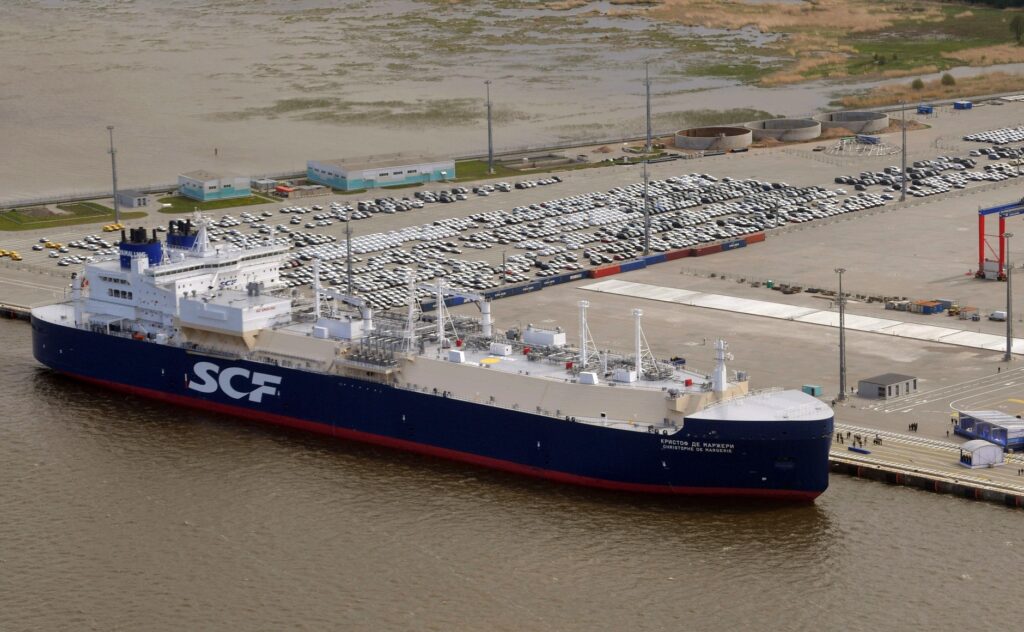
The ice-capable ships that Western sanctions kept out of Russian hands for four years may now be sold to Russia.
Novatek, Russia’s largest independent gas producer, is in talks to buy ten of them from Japan’s Mitsui O.S.K. Lines (MOL), one of the world’s largest shipping companies, and South Korean shipbuilder Hanwha Ocean, according to the shipping outlet TradeWinds—the polar fleet Moscow has failed to build for itself, and the missing piece its sanctioned Arctic LNG 2 project needs to run.
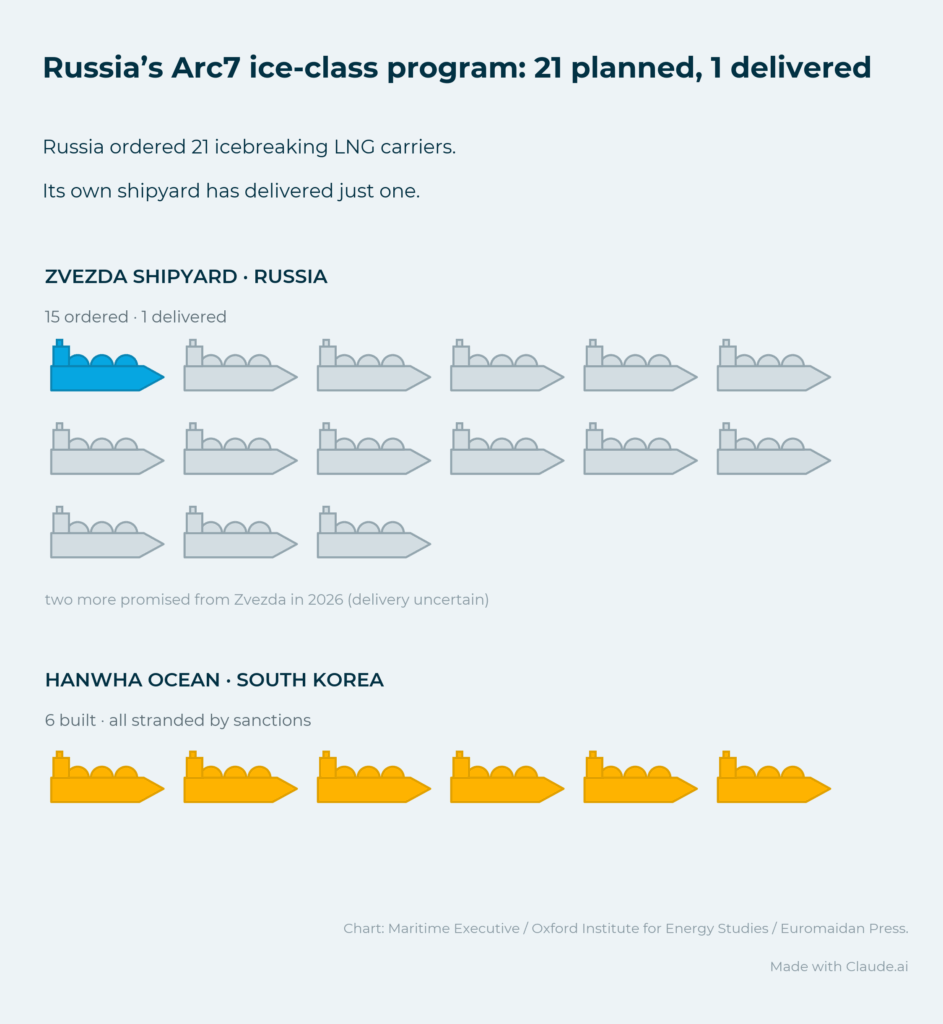
Six of the ten ships are the heaviest icebreaking class, the Arc7, built for that project and stranded at Hanwha’s yard since Russia’s full-scale invasion.
Arctic LNG 2 is the venture that US and EU sanctions set out to strangle, central to Russia’s push to dominate Arctic gas exports. Six of the ten ships are the heaviest icebreaking class, the Arc7, built for that project and stranded at Hanwha’s yard since Russia’s full-scale invasion; the other four are lighter ice-class carriers the European Union sanctioned and then removed from its list.
Acquiring them would hand Moscow the ships months before Europe’s ban on Russian LNG imports takes effect, and just as Brussels proposes to outlaw this exact kind of sale.
The ships sanctions stranded
The six Arc7 carriers have sat completed at Hanwha Ocean’s Geoje shipyard, the bills for keeping them idle mounting with no buyer in sight, the Korea Times reported. Three had been ordered by MOL under long-term charters to serve Arctic LNG 2; three by Russia’s state shipping company Sovcomflot.
Those three were ordered through Cyprus-registered shell companies—Elixon, Azoria, and Glorina—that the US Treasury sanctioned in February 2024, making the ships undeliverable: any yard that handed them over risked sanctions itself.
Western firms holding the ships meant Russia could not fully run the project they were built for.
Hanwha, which had canceled the Russian contracts, finished the vessels anyway, and the Russian side has since pursued the yard for $877 million in damages at the Singapore International Arbitration Centre, a case TradeWinds reports to be unresolved.
For four years, the practical effect was a chokepoint. Western firms holding the ships meant Russia could not fully run the project they were built for.
Ships with nowhere else to go
The other four are newer Arc4 ice-class carriers—North Moon, North Light, North Ocean, and North Valley. The European Union listed three of them in its 17th sanctions package in May 2025, then reversed course that July—in what appeared to be the first time it had lifted a designation in the Russian LNG sector.
The European Commission said the ships were delisted following commitments that they would “no longer engage in the transport of Russian energy” from the Yamal and Arctic LNG 2 projects.
Stripped of Russian work, the carriers sat idle off Indonesia for months, with the cost of keeping them anchored reported above $50,000 a day.
What followed showed the limit of that promise. Stripped of Russian work, the carriers sat idle off Indonesia for months, with the cost of keeping them anchored reported above $50,000 a day, because ships built to break Arctic ice have almost no work outside the Russian projects they were designed for.
Each step can be presented as compliant: building the ships, clearing the Arc4s on a written promise, routing a purchase through Singapore. Together, they move the ice fleet toward a sanctioned Russian project.
Why Russia cannot build its own
Moscow needs the foreign ships because its own program has stalled. Of a planned fleet of 21 ice-capable carriers, Russia’s own yards have delivered only one—the Alexey Kosygin, handed to Sovcomflot on 24 December 2025, years late and assembled from sections and equipment shipped in from abroad before sanctions cut off the suppliers.
Finishing them this year “could be optimistic as sanctions have cut off access to key equipment, engineering support and expertise.”
Two more are promised from the Zvezda yard in 2026, but the lining that holds the super-cooled gas, once supplied by France’s GTT, remains a bottleneck. Finishing them this year “could be optimistic as sanctions have cut off access to key equipment, engineering support and expertise,” Kpler analyst Laura Page told Bloomberg.
The calendar sharpens the need. Europe’s ban on long-term Russian LNG imports takes force in 2027, pushing Novatek toward longer voyages east to Asia that demand more ice-capable ships.
Bought first, sanctioned later
The ten modern carriers are the high end of a fleet Russia has spent 2026 assembling. It has added at least six LNG carriers to its shadow fleet this year, TradeWinds reported, older steam-turbine ships—among them the freshly reflagged Avacha—bought to haul Arctic LNG 2 cargoes the long way to Asia.
Novatek is “purchasing LNG tankers wherever it can and as fast as they can.”
The sanctions have trailed the purchases. On 16 June, the United Kingdom became the first G7 country to designate four of those ships—Orion, Merkuriy, Kosmos, and Luch—for carrying Russian LNG to third countries, months after Russia acquired and deployed them. The buying did not stop.
Novatek is “purchasing LNG tankers wherever it can and as fast as they can,” Denys Svyrydenkov, a communications specialist at B4Ukraine, a global coalition of civil society organizations, told EP, to ease the shipping bottleneck before Europe’s import ban takes hold.
A ban is still only a proposal
On 10 June 2026, European Commission President Ursula von der Leyen unveiled a 21st sanctions package that would ban LNG-tanker sales to Russia, extending to gas carriers a rule that already covers oil tankers. “We propose restricting the sale of LNG tankers to Russia,” she said.
Because the ten ships are not themselves sanctioned, “the tanker sale would technically not be illegal.”
The proposal still needs unanimous approval from EU member states, and routing the purchase through a company in Singapore is the kind of workaround such bans struggle to catch.
The reports were circulated to the media by B4Ukraine, which wants the sale stopped. Because the ten ships are not themselves sanctioned, “the tanker sale would technically not be illegal,” Svyrydenkov said, though he argues the vessels would still carry gas from the sanctioned Arctic LNG 2 terminal—a breach he believes US lawmakers and the Treasury should examine.
Hanwha Ocean is bidding against Germany’s TKMS for Canada’s submarine contract, a decision due before the end of June 2026.
Allied governments hold leverage of their own. Hanwha Ocean is bidding against Germany’s TKMS for Canada’s submarine contract, a decision due before the end of June 2026—and Ukrainian advocates have urged Ottawa to use that contract as pressure over the ship sale.
The proposed ban awaits the member states. The ships are reportedly ready to deliver this year.
Read also
-
Russia’s biggest oil company stopped selling gasoline in canisters nationwide after Ukraine’s strikes. It blames “seasonal demand”
-
Russia quietly lets refiners sell lower-grade Euro-3 fuel as drone strikes squeeze supply
-
Fuel shortages reach Moscow and St. Petersburg as Ukraine’s strikes squeeze Russian refining
