Reading view

Did the Mycenaeans Have Temples?

Stone gate with lion relief above the entrance at the ancient site of Mycenae.
Mycenaean religious practice included structured sacred spaces, and the evidence challenges the idea that Mycenaean temples did not exist. Credit: Wikimedia Commons, Andreas Trepte, www.avi-fauna.info, CC-BY-SA-2.5

According to a long-standing urban legend, the Mycenaeans did not build temples but worshiped outdoors under open skies. This claim appears in popular books, casual discussions, and also surfaced in earlier scholarly interpretations of Bronze Age Greece.

However, archaeological evidence challenges this view. Material finds, Linear B texts, and remains of cult architecture all point in a different direction. The Mycenaeans did not restrict worship to open-air rituals alone; they also used structured sacred spaces within buildings. In fact, they developed organized religious environments that functioned in ways comparable to early temples.

The origin of the “open-air only” idea

The idea that the Mycenaeans worshiped exclusively outdoors stems from early comparisons with Minoan Crete. Some early researchers assumed that Bronze Age societies possessed no formal religious architecture and interpreted the absence of large, classical-style temples as evidence of informal worship practices.

In addition, early archaeologists often struggled to identify religious buildings at Mycenaean sites. Many structures appeared domestic or administrative in character, leading to an underestimation of their possible ritual functions. Over time, these assumptions produced a simplified narrative suggesting that Mycenaean religion remained primitive or underdeveloped. In this interpretation, formal temple construction was seen as something that emerged only in later Greek civilization.

Today, this view is considered outdated and overlooks both textual and archaeological evidence. It also projects later Greek architectural expectations onto an earlier cultural and historical context.

What the Linear B tablets reveal about Mycenaean temples and religious practice

The Iliad already refers to a temple within the Trojan citadel that houses the statue of a goddess, suggesting that structured sacred spaces were part of early Greek religious imagination. Beyond literary tradition, the Linear B tablets provide some of the strongest evidence against the “open-air-only” interpretation. These tablets preserve administrative and religious records from Mycenaean palace centers, offering a rare direct glimpse into how cult activity was organized.

They record offerings and mention deities associated with the later Greek pantheon, including Zeus, Poseidon, Hera, Artemis, and Hermes, while also documenting the management of cult resources by officials. This points to a system of structured worship rather than purely spontaneous outdoor ritual.

Importantly, the tablets often connect deities with specific locations, referring to sanctuaries, priests, and offerings tied to defined, organized spaces. This suggests that religious practice was not confined to natural settings but also embedded within institutional environments. Taken together, this written evidence weakens the idea of exclusively outdoor worship. Instead, it reveals planning, hierarchy, and dedicated sacred functions within Mycenaean religious life.
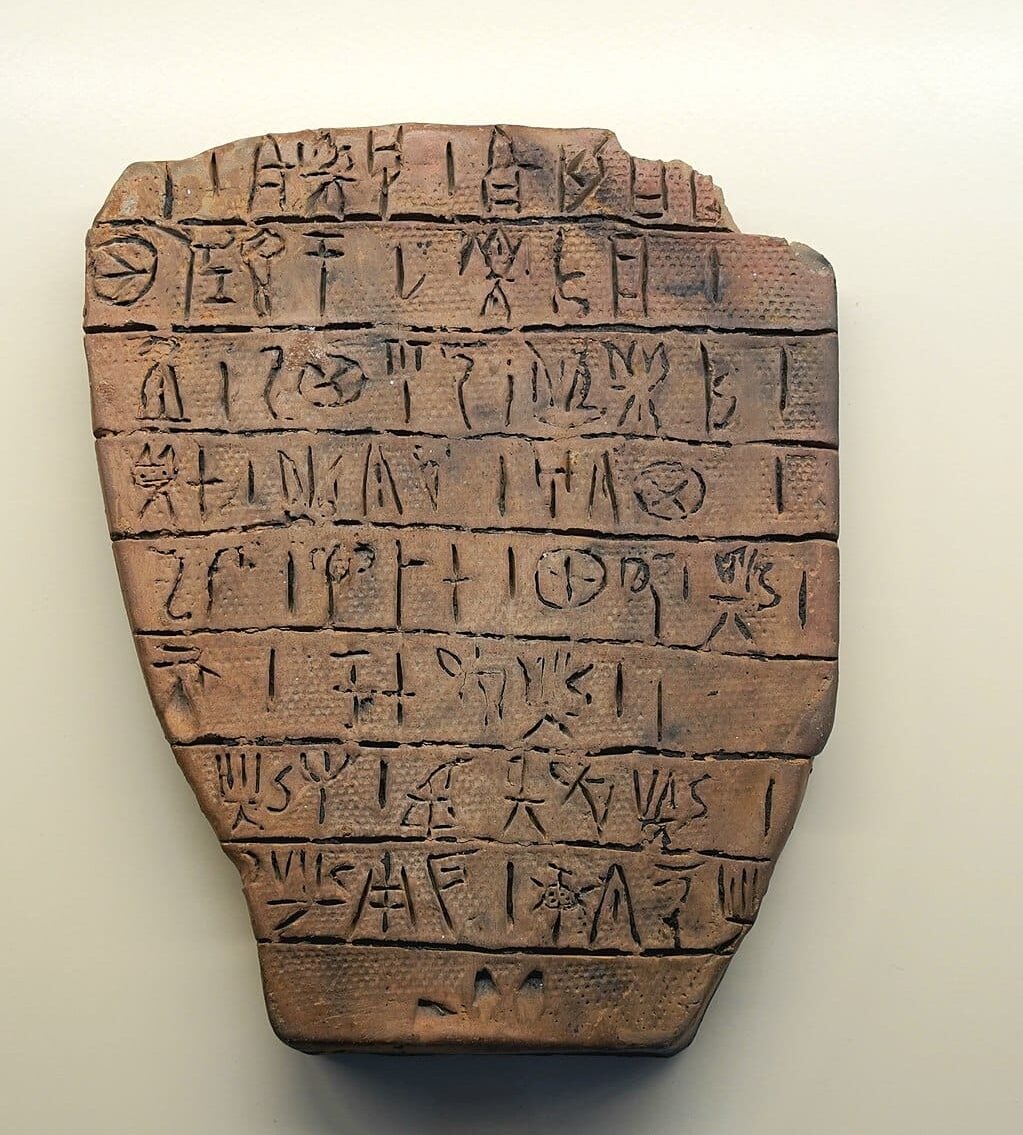
Tablet with Linear B Script from the Palace of Knossos - 1375 BC.
Tablet with Linear B Script from the Palace of Knossos – 1375 BC. Credit: TimeTravelRome. CC BY 2.0/flickr

Archaeological evidence of cult spaces

Archaeology strengthens this conclusion. Excavations at Mycenaean sites have uncovered buildings with clearly identifiable ritual functions, including altars, offering areas, and religious artifacts. One of the most significant examples comes from Mycenae itself. The so-called “Tsountas House” provides key evidence for structured cult activity within a designed landscape.

The Tsountas House is located near the citadel of Mycenae and was first excavated during early investigations led by Christos Tsountas. The structure dates to the Late Bronze Age. At first glance, the building does not resemble a later classical temple, lacking the monumental stone columns associated with later Greek religious architecture. However, its interior evidence tells a different story. Researchers such as Kim Shelton have identified signs of ritual activity within the structure, including figurines, offering vessels, and spatial arrangements that suggest ceremonial use. The layout also indicates controlled movement through the building, reinforcing the impression of organized ritual practice.

Taken together, these features are significant. They show that Mycenaeans used enclosed architectural spaces for ritual purposes, effectively functioning as cult centers. Worship was not confined solely to mountains, peak sanctuaries, or open courtyards. Instead, structured sacred environments existed within administrative and residential settings. This evidence points to a broader religious system in which cult activity, palace administration, offerings recorded in Linear B texts, and outdoor sacred landscapes all formed interconnected components of Mycenaean religious life rather than isolated or competing practices.

Remarkable gold artefacts discovered within the Mycenaean citadel
Remarkable gold artifacts discovered within the Mycenaean citadel. Credit: Xuan Che / CC BY 2.0

Why the “no temples during the Mycenaean period” narrative fails

The “no temples” narrative fails largely because it relies on a narrow, anachronistic definition of what a temple must be. If one expects Mycenaean sacred architecture to resemble later classical Doric structures, then such buildings will not appear in the archaeological record. However, this expectation sets a false standard. It overlooks architectural evolution over time and ignores the cultural and functional differences between the Bronze Age and later Greek periods.

Mycenaean sacred architecture followed its own internal logic. Ritual spaces were frequently integrated into palatial complexes or elite residences, and smaller, multi-functional buildings often served religious purposes in place of large, freestanding temples. For this reason, the absence of classical-style temples does not imply the absence of religious architecture.

At the same time, Mycenaeans did perform rituals outdoors, likely at natural features such as hills, caves, and mountain peaks. Outdoor worship was an important component of Bronze Age religious practice, a pattern that continued into later Greek tradition. Nonetheless, outdoor ritual activity did not exclude indoor sacred spaces. Rather, both forms coexisted and fulfilled different roles within a broader religious system.

Mycenaean religion combined palace-based cult administration, offerings recorded in Linear B texts, enclosed ritual spaces, and outdoor sacred sites in the landscape. Together, these elements formed a structured, multi-layered system operating across both constructed environments and the natural world. This combination underscores not only complexity and organization but also continuity with later Greek religion. Structured sacred space did not emerge suddenly in the Classical period but developed gradually from earlier Bronze Age practices.
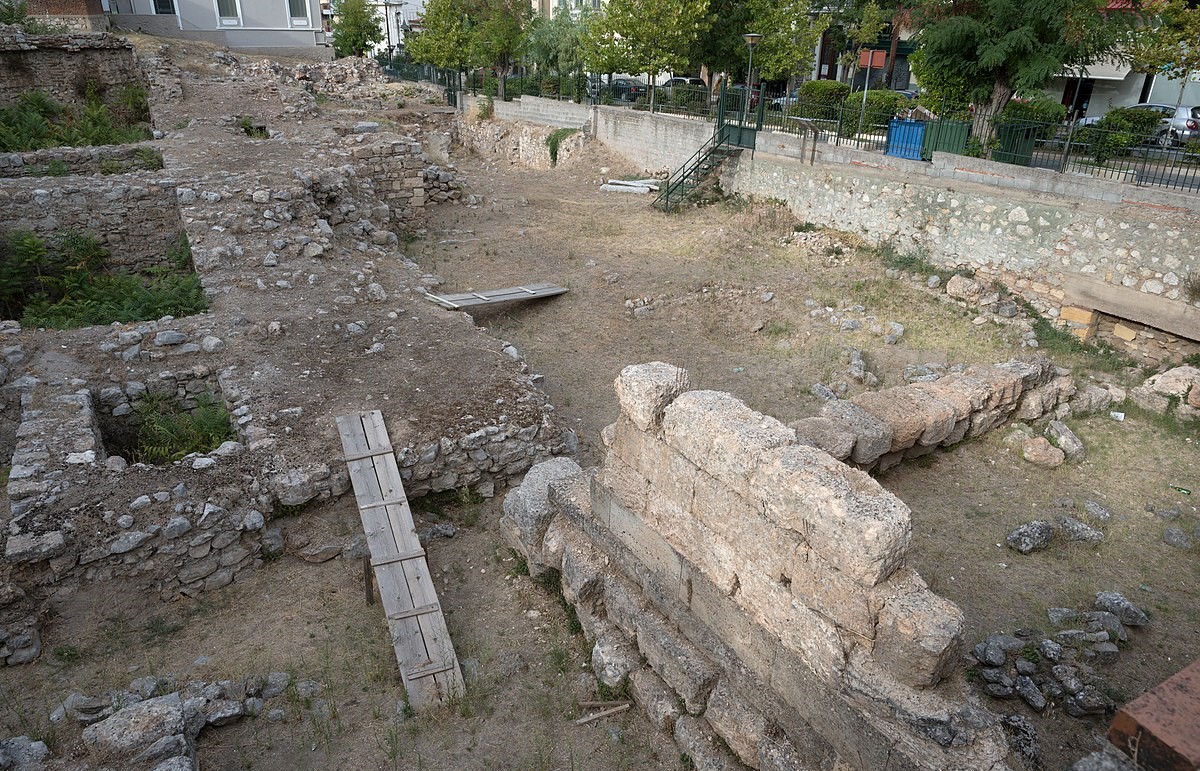
Kadmeion. Mycenaean palace complex of Thebes., Greece
Kadmeion. Mycenaean palace complex of Thebes. Credit: Zde / Wikimedia Commons CC BY-SA 4.0

Why the myth persists today

The persistence of the “no temples” myth can be traced to three main sources. First, early scholarship shaped the expectations of later generations. Once an interpretation enters textbooks and reference works, it tends to persist, even when new evidence complicates or overturns it.

Secondly, the very word “temple” carries a strong classical bias. Readers often imagine columns, symmetry, and monumental marble architecture. When such features are absent in the Bronze Age record, this is interpreted as a lack of temples rather than a difference in architectural form.

Lastly, simplified narratives tend to spread more easily than nuanced archaeological interpretations. The idea of “primitive outdoor worship” is easy to remember and communicate, whereas the actual picture is more complex and layered. In reality, the Mycenaeans did not rely exclusively on open-air worship but also built and used structured indoor spaces for ritual activity that can reasonably be understood as early temple forms.

The claim that Mycenaeans lacked organized religious buildings does not withstand scrutiny. It reflects early interpretive bias more than archaeological evidence. Mycenaean religion combined indoor and outdoor elements and showed early forms of institutional organization. In this sense, it laid important foundations for the development of later Greek religious architecture and practice.

  •  

Aristotle’s Influence on Marx’s Theory of Value and Automation

Aristotle and Marx
Marx and Aristotle, though centuries apart, both recognized that value is rooted in social relations rather than in objects themselves. Credit: GreekReporter Archive

When the philosopher Karl Marx set out to unravel the mysteries of value, exchange, and labor in capitalist society, he found a surprising intellectual ally in Aristotle, the ancient Greek philosopher who lived two millennia earlier. Despite their different historical contexts, both thinkers examined how value arises not inherently from things but from their social relations—especially through the lens of use and exchange.

Marx, in Capital, openly acknowledged Aristotle’s importance. Not only did Aristotle lay the groundwork for distinguishing use-value from exchange-value but his reflections on early human society, property, and the role of labor and technology revealed a conceptual framework that Marx would radicalize for modern critique.

Use-value and exchange-value: Aristotle’s anticipation

Aristotle’s analysis of value in Politics distinguishes between two uses of a commodity. One is proper and natural while the other is improper or derivative. He writes:

“Every commodity has two uses: both belong to the thing itself, but not in the same manner—one is the proper use, the other is not. For example, a shoe serves either to be worn or to be exchanged; both are uses of the shoe, for he who gives a shoe in exchange to someone who needs it, receiving in return money or food, uses the shoe as a shoe, but not according to its proper use, for it was not made to be exchanged.”

This distinction—between use-value and exchange-value—is a cornerstone of Marx’s analysis. For Marx, this Aristotelian formulation prefigures what he calls the “value-form” of the commodity. Commodities are useful in particular ways (use-value), but also enter into a social system of equivalence when exchanged (exchange-value).

Marx directly builds on this by showing that exchange-value does not exist inherently in an object but arises through the abstraction of labor—because human labor makes different useful things commensurable. Aristotle notes that a shoe does not exist for exchange. Marx took this insight and asked: What kind of society inverts this logic and makes objects valuable only in proportion to their exchangeability rather than their utility?

From the household to the marketplace: society before exchange

Aristotle’s theory of the household (oikos) as the first form of society was essential for Marx’s historical materialism. In Politics, Aristotle describes early society as beginning with families. In these families, property was communal and exchange unnecessary. It was only as the population grew and self-sufficiency gave way to interdependence that markets and money emerged.

Marx adopts this trajectory in Capital and his Grundrisse notebooks, writing that commodity exchange is not a timeless activity. Instead, it is a historically specific development that reflects changes in social relations and property forms. The transition from common property to private ownership and from useful production to production for exchange is the material foundation of class society.

In Aristotle, we already see the seeds of this analysis. He distinguishes between natural wealth-getting (production for use) and unnatural chrematistics (the accumulation of wealth for its own sake). Marx seizes upon this distinction to critique capitalism as a system in which the unnatural pursuit of profit replaces human need as the goal of production.

Statue of Aristotle standing with scrolls in hand.
A statue of Aristotle. Credit: Public Domain, via Wikimedia Commons

The machine and slavery

One of the most striking moments in Capital (Vol. I) occurs when Marx discusses machinery and automation. Here, he ironically invokes Aristotle’s dream that if tools could operate themselves, no slaves would be needed:

“If—dreamed Aristotle, the greatest thinker of antiquity—if every tool could perform its task at command or even by anticipation, like the statues of Daedalus that moved of their own accord, or the tripods of Hephaestus that spontaneously began their sacred work, if the shuttles of the loom wove by themselves, then master craftsmen would not need assistants, nor masters slaves.”

This vision did not remain uniquely Aristotelian. Antipatros, a Greek poet from the era of Cicero, hailed the invention of the watermill—the earliest rudimentary form of productive machinery—not simply as a technical advancement but as a social revolution. He praised it as the liberator of enslaved women who had been condemned to grind grain by hand. He envisioned it as the usher of a new golden age of human dignity and freedom.

In these ancient myths and poetic praises, technology is seen not merely as efficiency but as emancipation. The ancients, despite their slave-based economies, understood that the highest purpose of tools was to free people from servitude.

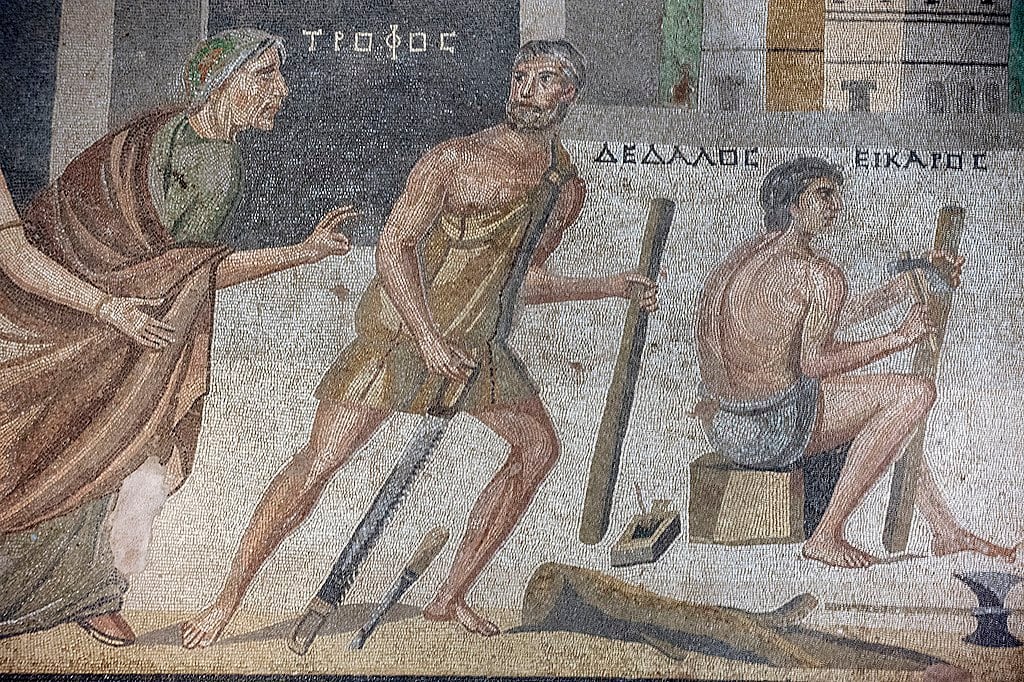
Gaziantep Zeugma Museum Daedalus mosaic.
Gaziantep Zeugma Museum Daedalus mosaic. Credits: Dosseman / Wikimedia Commons CC BY-SA 4.0

Marx’s irony and the betrayal of the promise of automation

Marx, however, saw this ancient hope turned upside down in modern capitalist society. In his words, what was supposed to free labor had become its jailer:

“Ah, those idolaters! They knew nothing of political economy or Christianity, as discovered by clever Bastiat and even cleverer McCulloch. They failed to understand, among other things, that the machine is the most reliable means for lengthening the working day.”

Here, Marx mocks the liberal economists of his time. Frédéric Bastiat and John Ramsay McCulloch, champions of laissez-faire capitalism, celebrated mechanization without recognizing its role in intensifying exploitation. Unlike the “idol-worshiping pagans,” who at least had the imagination to conceive of automation as a force for liberation, these modern theorists lacked even that mythical foresight.

Marx continues with biting irony:

“They failed to understand, among other things, that the machine is the most reliable means for lengthening the working day.

Thus the strange phenomenon arises in the history of modern industry. That the machine, the most powerful instrument for reducing labor time, becomes the most unfailing means of converting the whole life of the worker and his family into labor-time for capital’s valorization.”

The true paradox for Marx is that mechanization offers a means to liberate humanity but capital instead weaponizes it to intensify exploitation. The ancients envisioned automation as a means of human emancipation. Capitalism uses it to deepen alienation and dependency.

The irony is profound: the ancients dreamed of freedom through the machine, and capitalism delivered machines that reinforce dependency. In this way, Marx reclaims the ancient vision but also shows how the promise of automation has been betrayed.

Baroque fresco by Pietro da Cortona depicting a lush pastoral scene with mythological figures celebrating abundance and harvest under a decorative canopy of leaves and garlands.
Antipatros celebrated the invention of the watermill as a liberating force, heralding it as a symbol of a new golden age of human dignity. Credit: Pietro da Cortona, Wikimedia Commons, Public Domain

Aristotle and Marx: From ancient slavery to modern compulsion

Marx’s dialogue with Aristotle was not just academic—it was dialectical. He admired Aristotle’s clarity in distinguishing between types of value and his historical insight into the development of exchange. However, Marx also showed how the slave economy of antiquity historically constrained Aristotle’s ideas.

Ironically, in an age in which full automatism is increasingly possible, the prevailing economic model continues to reproduce the conditions that Aristotle associated with slavery—not through direct ownership of people but through economic compulsion and structural inequality. In that sense, Marx saw in Aristotle both the seed of critical insight and the limit of pre-modern social theory.

Hence, while Aristotle could not imagine that labor determines value in commodities, he sensed something essential: that value is not a thing but a relation and that social forms of labor determine the shape of society itself.

  •  
❌