Deep in Taiwan’s misty mountains, researchers have confirmed the tallest tree in the country: a thousand-year-old fir tree higher than a 20-story building, which they’ve named “the heaven sword of the Da’an River.” Climbers scaled the tree and dropped a measuring tape from the top to the forest floor during the Lunar New Year holiday in January 2023. The tree measured 84.1-meters (276-feet). The findings have been published in Frontiers in Forests and Global Change. A team of ecologists, geologists, remote-sensing specialists, professional climbers and Indigenous people that calls itself the “Taiwan tree seekers” began the search in 2014. “The common characteristics [of the team] are probably that we are all tree lovers and like adventures,” Rebecca Chia-Chun Hsu, lead author from Division of Forest Ecology, Institute of Taiwan Forestry Research, told CNN. ‘The Heaven Sword’, Taiwan’s tallest tree, measures 84.1 meters. Photo courtesy of Steven Pearce. Taiwan is one of the few places on Earth where trees can grow this tall. The island sits where the tropics meet the subtropics, and its mountains host several giant conifer species. The species behind the new record, Taiwania cryptomerioides, is known to the Indigenous Rukai people as “the tree that hits the moon.” Although nearly 60% of Taiwan is covered in forest, loggers cleared much of the island’s old-growth forest between 1912 and 1991. However, its steep slopes were too dangerous to reach, and pockets of ancient forest survived. Still, finding the tallest tree amid the rugged terrain was a task. Taiwan…This article was originally published on Mongabay
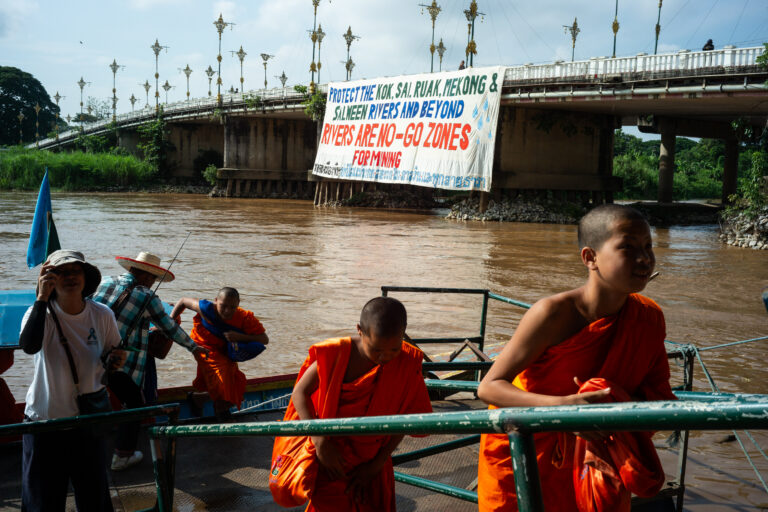
BANGKOK — More than 600 residents of Chiang Mai and Chiang Rai provinces embarked May 31 on a roughly 68-kilometer, six-day ‘peace walk’ to demand the Thai government take action on the river pollution crisis that has seen Thai rivers polluted with heavy metals. The ensemble of affected residents, civil society groups, monks and students marched from Tha Ton subdistrict in Chiang Mai to the city of Chiang Rai in northern Thailand, reaching their destination on June 5, World Environment Day. For more than a year, Thailand’s Pollution Control Department has reported dangerous levels of arsenic, mercury, cadmium and other heavy metals in rivers across northern Thailand, with mining operations across eastern Myanmar suspected to be responsible for the pollution. “We are walking because our rivers are slowly dying,” Pianporn Deetes, executive director of the Rivers and Rights Foundation, which helped to organize the peace walk, told Mongabay by phone. “Toxic contamination from unregulated mining upstream is already affecting water, fish, food, livelihoods, and public health. We do not want to wait until more people become sick. This is an emergency.” Pianporn said the walk (42 miles) was about taking collective action to share information, document impacts and build public pressure in a bid to force the government to address the issue, which Pianporn said has, so far, been lacking. “Monitoring has improved, but action has not matched the scale of the crisis,” she said. “We need urgent diplomatic engagement with neighboring countries, stronger health monitoring, transparency, and action to…This article was originally published on Mongabay

 Login
Login