More than a decade ago, conservationists began working to preserve a unique population of desert pampas cats that has adapted to the mangroves of Peru’s northern coast. This small, isolated population roams the San Pedro de Vice dry mangroves, a Ramsar Site and South America’s southernmost mangrove ecosystem. “This is a very unique population, because as far as we know, [it] is the only Pampas cat population that lives in a mangrove [habitat],” Alvaro Garcia, co-coordinator of the Pampas Cat Working Group and the Peruvian Desert Cat Project, told Mongabay in an email. The desert pampas cat (Leopardus garleppi), distinctive for its broad face, ranges along a relatively thin band snaking southward from Colombia through Peru and Bolivia, to northern Chile and Argentina. The species is acclimated to dry conditions, so inhabits deserts, grasslands and dry forests, and isn’t found living in mangroves anywhere else aside from this region of Peru. Dry mangrove forests, also called scrub or dwarf mangrove forests, grow in highly saline soils in upper intertidal zones, so lack regular daily flushing by ocean tides. At first, it was thought the dry mangrove-acclimated cats were faring well: “[I]n the mangrove [habitat], we put cameras out for a week, and we got tons of photos,” whereas in other parts of the felid’s range, conservationists barely capture one desert pampas cat image per month, said Cindy Hurtado, co-coordinator of the Pampas Cat Working Group and the Peruvian Desert Cat Project. Based on the photos, the research team assumed the…This article was originally published on Mongabay
SARLAHI, Nepal — Dhruba Prasai, a farmer from Sarlahi district in Nepal’s southern plains, says he’s exhausted from lack of sleep. Every year, nilgai antelopes, wild boars, deer and Asian elephants raid his fields, and if left unguarded at night, they not only feed on standing crops, but also stored harvest. “There is a forest to the west, and our fields are right next to it,” Prasai tells Mongabay. “The nilgai eat the maize, and the deer can’t even stand the sight of wheat and oat grass, they eat it all. If people stay up at night to guard the fields, they run away; otherwise, they come and destroy everything.” Farmers such as Prasai across Madhesh province, considered the country’s breadbasket because of its fertile land, are struggling with growing crop losses from wildlife, but complex procedures and policy gaps make access to relief, which is already limited, difficult. From mid-July 2024 to mid-July 2025, 14,821 cases of ‘human wildlife conflict’ were reported in Madhesh, according to government figures. A total of 134 people and 457 animals lost their lives. Last year, a wild boar ate three tand (storage racks) of maize stored in Prasai’s house. Although forest authorities told him to get a recommendation letter from the local municipal ward office to apply for relief, he didn’t do it. “I haven’t done it; we simply don’t have the time,” he says. Even those who did fill out the forms around the same time have yet to receive relief, he…This article was originally published on Mongabay
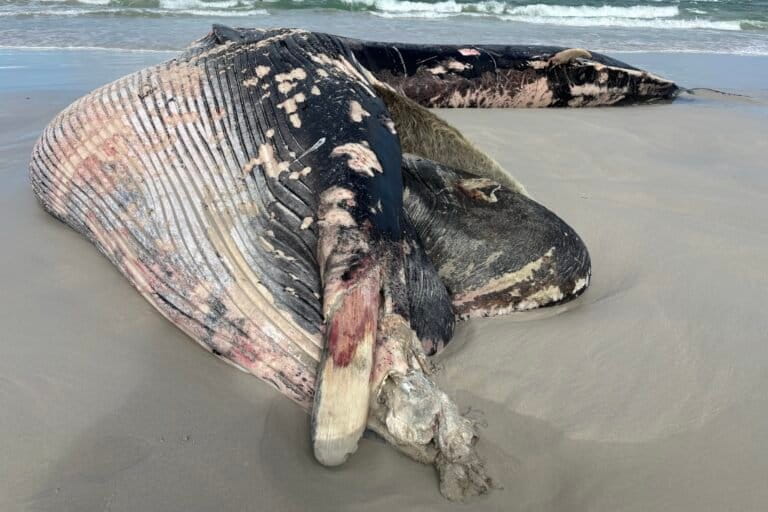
In April this year, two Bryde’s whales washed-up dead-on Dyer Island, a small nature reserve located a few kilometers off the coast of Gansbaai in South Africa’s Western Cape province. Both whales carried severe injuries; their vertebrae had been shattered. “It was very clear that it was [vessel] strikes, because both those whales were snapped in half, and you can also see the propeller marks,” Loraine Shuttleworth, head of research at the Dyer Island Conservation Trust, told Mongabay. Two whale strandings linked to ship strikes in one month alone is an unusually high number, Shuttleworth said. A new risk assessment has linked the increase in risk of ships striking whales to the rerouting of maritime traffic around South African coast. Due to the Houthi rebels attacks on ships traversing the Red Sea, which started in 2023, and the more recent fallout from the blockade of the Strait of Hormuz, many cargo companies have rerouted their vessels around the Cape of Good Hope. With greater shipping traffic comes a growing threat to marine species inhabiting the region: collisions with large, fast-moving vessels. Between December 2023 and December 2024, the number of large vessels traveling through South African waters at average speeds above 15 knots (28 kilometers per hour) has quadrupled, satellite data show. The scale of the increased maritime traffic struck scientist Els Vermeulen from the University of Pretoria’s Mammal Research Institute Whale Unit, on a flight into Cape Town in 2025. “It was a beautiful day, and there were just…This article was originally published on Mongabay
The United States is not approaching collapse because it lacks power. It is approaching collapse because it has too often mistaken power for wisdom. Its armed forces remain unmatched in reach, its financial system remains central to global commerce, and its technology sector continues to shape the future. Yet these advantages can conceal a more […]
On May 31, Lebanese Prime Minister Nawaf Salam gave a televised address in which he condemned Israel’s invasion and intensified attacks on southern Lebanon as a dangerous escalation, warning that a “scorched-earth policy” will never bring security to Tel Aviv: “Israel must understand that with its scorched-earth policy, collective punishment, and the bulldozing of villages and […]
BANGKOK — Seven hundred days after activists from the environmental group Mother Nature Cambodia were imprisoned on charges widely regarded as retaliatory for their activism, 73 international and Cambodian civil society organizations have renewed calls for their unconditional release. After a trial lasting just over a month, 10 activists from Mother Nature Cambodia were sentenced on July 2, 2024, to between six and eight years in prison. Only five of the defendants attended the hearings, which saw Long Kuntha, 28, Ly Chandaravuth, 26, Phuon Keoraksmey, 25, and Thun Ratha, 34, each sentenced to six years behind bars for plotting against the government; fellow activist Yim Leanghy, 36, received an eight-year sentence for both plotting against the government and insulting the king. The five activists who did not attend the trial were sentenced in absentia. The appeals hearing for all 10 convicted activists was slated to take place on June 2, but has been postponed indefinitely by the Phnom Penh Court of Appeals. “The MNC5 are incarcerated in prisons in overcrowded and harsh living conditions, separated from each other and spread out all across Cambodia, hundreds of kilometers away from their families and legal counsel,” wrote the 73 NGOs in an open letter addressed to Prime Minister Hun Manet. “The … NGOs who have signed this letter sincerely request you take immediate action to ensure the unjust convictions of these five activists are reversed either prior to or at their upcoming appeals court hearing in Phnom Penh, and that their freedom…This article was originally published on Mongabay

 Login
Login