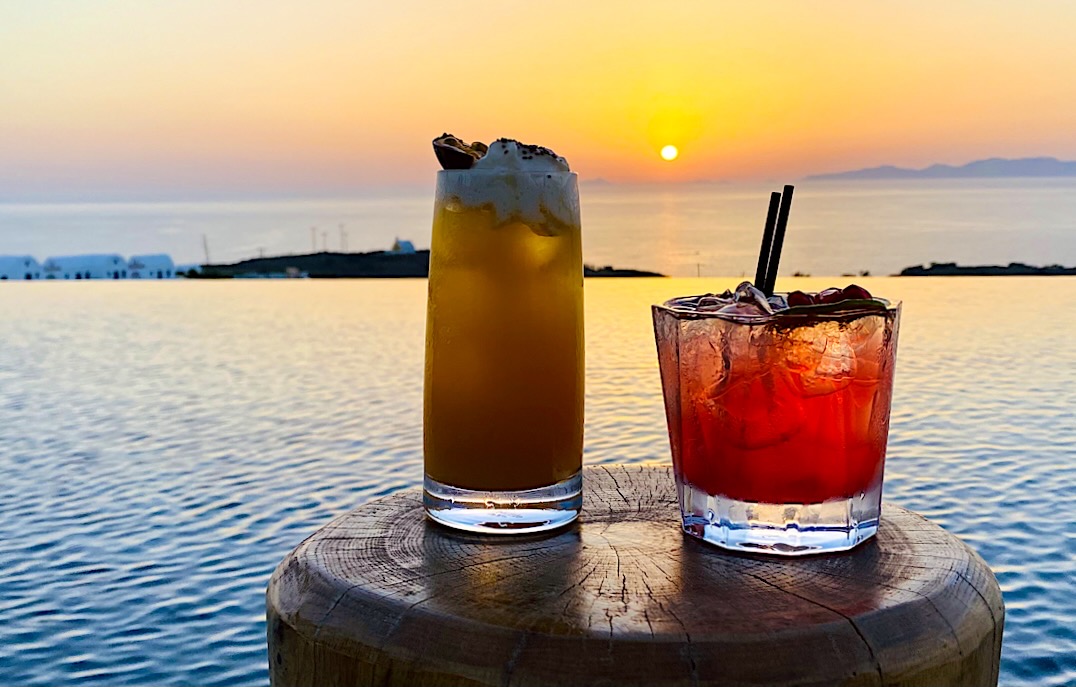
That first sip of the cocktail washes away the heat and leaves you feeling cool and invigorated. Credit: Greek Reporter
Mastic or mastiha from the Greek island of Chios is getting traction on social media as the basic ingredient for summer cocktails.
Many bartenders and amateur connoisseurs are uploading videos of how to use the “white gold” of Chios to make flavorful and refreshing cocktails ideal for the summer.
Until recently, Greece’s mastiha liqueur hasn’t been as popular as other aperitifs. Thanks to new brands’ premiumization of the category and further education on its benefits, however, mastiha is starting to gain a cult following.
According to the following video by Nikki’s Modern Mediterranean, apart from one ounce of mastiha, you will need the following ingredients to make a summer cocktail: One ounce of peach vodka, peach nectar juice, grenadine, ice, and orange and cherry for garnish.
Another version is the rum, mastiha, and coffee cocktail:
Until recently, mastiha was actually considered a peasant spirit or liqueur often sipped after meals in Greece. This reputation is partly due to how it was made and the fact it wasn’t highly consumed outside of Greece.
Now, with society’s growing interest in niche global spirits, mastiha spirit has come into the spotlight, and it’s becoming more common on menus at high-end Greek beach clubs as well as restaurants and global cocktail bars from New York to Los Angeles.
Here is yet another version of mixing mastiha with liquor:
Mastiha, often referred to as the “Tears of Chios” or the “White Gold of Greece,” is a product made exclusively on the Greek island of Chios. Since antiquity, this sticky resin, which seeps from the bark of mastic trees, has been harvested not only for its flavor but its therapeutic value.
Although the mastic tree, also called “lentisk,” is native to many areas in the Mediterranean, its bark only “bleeds” mastic on the island of Chios, making it a truly unique and nearly miraculous product.
Mastic is used as flavoring in many sweets and drinks, most famously in Mastiha, a digestive liquor from Chios. The mastic “tears,” or small bits of hardened tree sap, can also be chewed like gum, a practice dating back thousands of years. Its healing properties include prevention and treatment of stomach pains and gastric disorders as well as rejuvenation of the skin.
Its rarity has made mastic highly sought-after throughout history. Even to this day, mastic is considered a precious commodity not to be wasted. The European Union has designated it a “protected designation of origin” product, confirming that only Chios may produce authentic mastic.
“Health chocolate,” made by Pavlidis, the oldest Greek company. Credit: #PavlidesYgeias Facebook
The oldest Greek company is chocolate maker Pavlidis, which started off as the first confectionery shop in Athens more than 180 years ago.
It was 1840 when Spyridon Pavlidis, the son of a successful manufacturer of munitions used in the Greek War of Independence, established a printing house at the corner of Aiolou and Vissis streets in downtown Athens. It was where he published the works of intellectuals who opposed the autocratic regime of King Otto. He also printed a volume of the History of the Greek Nation.
However, Pavlidis was not satisfied with his business. He was an ambitious man and was not content running a printing house. Thus, he passed the printing business on to another member of his family while he himself moved on to new adventures.
His plan to establish a confectionery in 1841 was pioneering at the time. In the same space as his printing house, he opened the Pavlidis Confectionery, the first such business in Greece. Hence, it is the oldest Greek company.
The little sweets shop was the foundation of the largest chocolate company in Greece. This was the same year that the first Greek bank, the National Bank of Greece, was established.
The Pavlidis Confectionery soon became the talk of the town, offering Athenians sweets such as baklava, loukoumia, and koufeta. It became the meeting point not only for residents of the newly established capital but also for foreigners, mainly military and diplomatic personnel.
Pavlidis discovers chocolate in Europe
Following the success of his confectionery, Pavlidis decided to travel to Europe for innovative ideas and confection production machinery. He spent several months in Paris, Vienna, Rome, Amsterdam, and Madrid, among other cities. Coming from Greece, which had gained its independence only a few years ago, he was impressed by the technological advancements and innovations in the field of production he saw in Europe.
It was in Europe that he discovered a product unknown to the Greeks of the time. This was chocolate. He was so impressed by the dark brown confection that he rushed to buy the proper supplies and take his newly acquired knowledge of chocolate and confection making back to Athens.
In 1852, conditions were ripe for the introduction of the new, irresistible confection, chocolate, to his Athenian customers, who embraced it warmly right from the very beginning. Pavlidis had brought with him a manual coffee grinder and a good supply of chocolate to offer the new confection as a hot beverage.
Convinced of its nutritious qualities, Pavlidis also promoted chocolate for its medicinal qualities, calling it “health chocolate” (Greek: σοκολάτα υγείας). To this day, dark chocolate in Greece is referred to as “health chocolate” regardless of the manufacturer.
Seeking ways to upgrade the quality of his chocolate and make it more widely accessible, Pavlidis began making chocolate bars of great quality. International awards were won, and these were added to the famous blue wrapping still in use today.
The “health chocolate” was loved by Greeks, and in 1865, the dark delicacy won gold in an international chocolate fair in Paris. Eighteen more awards, featured on the blue wrapping of the chocolate bars, followed in European confectionery competitions.
The oldest Greek company and its “health chocolate”
Without resting on his laurels, Pavlidis sent employees abroad to introduce them to the world of chocolate. Their mission was to return with innovative ideas. In 1867, he chose to participate in the Paris World Affair, the largest exhibition in Europe. It is said that it cost him more than 21,000 francs to participate, but his effort was rewarded, as his “health chocolate” won two bronze awards.
The next innovation came in 1871, when, in an effort to renew the manufacturing machinery, he introduced the first steam-powered chocolate production machine. As his descendant, Dimitrios Pavlidis, described: “The event was considered grand and the Athenians gathered forming endless queues in front of the workshop to admire or…be frightened by the steam engine.”
Indeed, the steam-powered chocolate production machine was a technological wonder of the time. It completely changed the making of the famous health chocolate and the oldest Greek company defined a new era in the country’s industry.
The next landmark year for the Pavlidis family was 1876, when production moved to the Piraeus Street factory to cover the great demand for the now world-famous chocolate. The renovated factory remains in the same spot today.
The year 1876 is noteworthy. The Pavlidis chocolate factory was established and began its operations in the Piraeus Street factory, where it continues to stand to this day. The aroma of chocolate looms over Piraeus Street when the machines are running.
Two years later, Dimitrios Pavlidis succeeded his father and founder Spyridon Pavlidis until the family business passed on to Alexandros Pavlidis in 1895.
Pavlidis chocolate enters the 20th century
In the new century, the oldest Greek company grew further, and the factory produced mass quantities of “health chocolate.” Dimitrios Pavlidis renovated and modernized the Pavlidis chocolate factory on Piraeus Street, making it a model industrial unit of the time.
The premature death of Alexandros Pavlidis at the age of 54 was a great loss for the company, as he was a notable figure in the corporate world.
During the German occupation (1941-1944) the factory was commandeered by the German army to produce jams and pharmaceuticals.
Following the war, the last member of the family to take over the management of the business was Dimitrios A. Pavlidis. He constructed the building on Aiolou Street immediately after the occupation, as the factory remained closed for quite some time due to lack of raw materials.
His wife, Eleni Pavlidis, took over the management of the business. As a dynamic woman with a flair for business, she made the company a limited liability one. Eleni was then succeeded by her son Dimitrios.
Dimitrios Pavlidis proceeded to expand the factory premises on Piraeus Street and create a new unit at Oinophyta, Viotia. He updated factory machinery and concentrated on expanding the company so as to also export products.
When Dimitris Pavlidis passed away in 1986, the presidency of the company was successively held by Aspasia A. Pavlidis and Georgios X. Pavlidis. In 1988, the oldest company in Greece and the most historic Greek sweets industry passed on to the hands of the Swiss group Jacobs Suchard, one of the largest multinational confectionery, chocolate, and coffee groups in the world market.
In 1991, Pavlidis was acquired by food giant Kraft. The new owner renovated the Piraeus Street factory, which was completed in 2000 in its current state as a chocolate museum.
Arriva in Italia Reverso, un modello già diffuso in alcune capitali europee con intelligenza artificiale, degustazioni personalizzate e una piattaforma capace di adattarsi ai gusti degli ospiti
 Login
Login



This cocktail is super crushable and absolutely refreshing. PLUS there’s only 110 cal. and 4g of sugar in the full cocktail
Yia Mas
#earnyourkleos #mastiha #kleostakemeaway #chios #mykonos #mixology #mixologist #mixologytiktok #athens #travelgreece #skinnycocktails #lowcal #lowsugar #cocktailrecipes #superfood #luxury #luxlife #cocktailtok #garnishgame #greeksummer #summercocktail
(you’ll have to excuse the banter, I gave him a headache for an hour
) #cocktail #drink #mixologist #cocktails #italy #italian #greek #greekgirl #fyp #foryoupage #liqueur

.jpg)


 Kalliopi