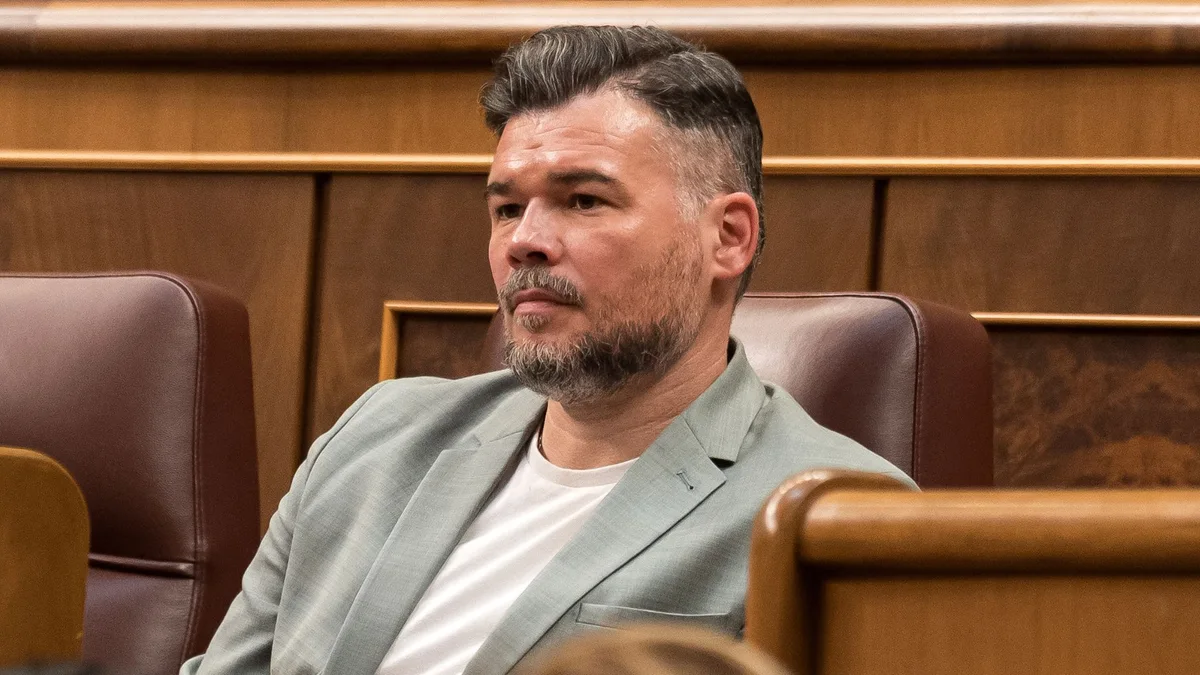
Gabriel Rufián ha lanzado una dura advertencia en los pasillos del Congreso ante un hipotético Gobierno del PP y Vox. El portavoz de ERC ha confesado que no tiene "puñeteras ganas de que Abascal sea vicepresidente", aunque ha afirmado que se niega a entrar "en esta melancolía, en esta tristeza absoluta y en este pesar".
Por ello, ha defendido que hay que "aprovechar el tiempo que tenemos" porque lo que viene "es muy duro". El dirigente ha alertado del "sufrimiento social" que va a comportar la entrada de estos partidos en el Ejecutivo, llegando a asegurar que "no se va a poder ver ni la televisión pública". "En fin, va a ser un desastre", ha apostillado.
Rufián ha hecho especial hincapié en el "peligro de ilegalización" porque "ya han dicho que nos quieren ilegalizar a algunos de nosotros". En este sentido, cree que "no responder a eso" y "no aprovechar el tiempo que nos queda", es "irresponsable y negligente".
"Hay muchísima gente en este país que es progresista y que quiere que este gobierno se mantenga, pero que no quiere votar al PSOE, sobre todo ahora", ha subrayado, a la vez que defendía la necesidad de crear un "espacio votable" en ese sentido. "Fíjese si son chungos los que vienen detrás que se está aguantando esto", ha señalado en referencia a las presuntas tramas que salpican al entorno de Pedro Sánchez.
Un mensaje que ha desatado la polémica
Las palabras del dirigente de ERC han hecho estallar las redes sociales. Cientos de usuarios han criticado la postura de Rufián, llegando incluso a cuestionar su labor como político. "Abascal será vicepresidente porque llevas 10 años haciendo política endogámica para clasistas y supremacistas. Es lo que hay. Nacionalista tú, nacionalista los demás", ha criticado un usuario en X (antiguo Twitter).
En la misma línea, otros han señalado al portavoz por seguir en el Congreso. "Tampoco tenía yo puñeteras ganas de ver a un independentista cobrando una pasta apalancado 10 años como diputado", ha escrito uno.
"Es que con tal de no dejar el escaño, lo que haga falta. En 2015 dijo que en 18 meses lo dejaría. Despotrica sobre España. Vive del dinero público. Muy catalán independentista, pero no le importaría liderar una alternativa al PSOE y gobernar España", ha sentenciado otro.
Otros usuarios, por su parte, han ido más allá y han asegurado que lo que hay que hacer es "plantar una alternativa a Sánchez". "Otro PSOE es posible. Rufián debe ser consecuente si quiere liderar la izquierda. Que renuncie a sus aspiraciones independentistas primero si tan flexible es".
Graham Platner prevailed in the Maine Democratic Senate primary, breaking 50% of the vote and clinching the nomination to face Sen. Susan Collins, a Republican whom national Democrats hope to topple on their way to recapturing control of the Senate in November.
Platner had 75% of the votes with only 8% of the ballots counted when The Associated Press called the race Tuesday evening, suggesting a dominant performance. Maine Gov. Janet Mills had just 19%. Mills’ name remained on the ballot despite the fact she dropped out of the contest in April.
The oysterman and political newcomer triumphed at the ballot box despite allegations that roiled his campaign before Election Day: that he sent sexually explicit messages to women outside his marriage and behaved in a demeaning manner toward some former girlfriends, including two incidents in which he was allegedly physically menacing to one of them. Platner denied those incidents.
“This is the state that raised me. This is the state that saved me,” Platner said at his victory party. “Maine, I love you. I love this state.”
Platner chastised national Democrats, who he said kept seeking a headline that would tarnish him and were missing the point. “In trying so hard to understand me, they failed to understand this is not about me at all. This is a movement about us.”
“This is the state that raised me. This is the state that saved me,” Graham Platner said at his victory party. “Maine, I love you. I love this state.”
The Democrat will now face Collins, a five-term incumbent who ran unopposed in the GOP Senate primary.
Platner also took harsh aim at Collins, calling her “spineless,” and said she “lied to us” about protecting abortion rights codified under Roe v. Wade after supporting Brett Kavanaugh’s nomination to the Supreme Court.
“Susan Collins doesn’t serve us. She serves Donald Trump,” Platner said. “We will take back the Senate seat. We will take back our power … I want you to imagine what you will feel like when we hold Trump and his criminal enterprise to account.”
In coming in first — and avoiding further rounds of counting as part of Maine’s ranked choice voting system — Platner technically defeated Mills in the Democratic primary. Mills was recruited by Senate Minority Leader Chuck Schumer, D-N.Y., but her campaign never took off and she suspended it in April.
But her name remained on the ballot and voters could have chosen to side with their former governor as something of a protest vote against Platner.
Despite early strength, Platner’s road to nomination was paved with controversy.
Reports surfaced the week before the primary that Platner had sent sexually explicit text messages to multiple women while married. His wife, Amy Gertner, publicly defended him and criticized the release of private communications. Platner acknowledged he and his wife had gone through something difficult in their marriage “because of me” and denied the characterization of the messages.
A private meeting between Platner and Senate Democrats followed as questions mounted over whether his personal conduct would impede his ability to challenge Collins. Despite the controversies, key progressive leaders, including Sens. Bernie Sanders, I-Vt., and Elizabeth Warren, D-Mass., have continued to publicly support his candidacy.
Those allegations were followed by a report in The New York Times in which one of Platner’s ex-girlfriends accused him of physically threatening her while they were dating. The Times’ report cited several former romantic partners who described “toxic” past relationships with him. Platner has denied allegations of “physicality.”
Several of Platner’s other past romantic partners who spoke to the Times described him as a “caring” partner and said they remain friends with him, according to the report.
The allegations added to several controversies surrounding the Marine Corps veteran’s insurgent Senate campaign. He faced backlash last fall over a Nazi-style tattoo he has since covered and defamatory comments he reportedly made about victims of sexual assault in Reddit posts that were deleted before the launch of his campaign. Platner has said he was unaware of the tattoo’s Nazi symbolism when he got it in 2007.
His populist campaign, however, resonated heavily with Maine voters who deemed him the best fighter to stand up to President Donald Trump and his allies in Washington, a group they say includes Collins.
Platner also won the support of prominent national Democrats who coalesced behind him in one of the most consequential races of this midterm cycle even after the fresh allegations came to light. Rep. Ro Khanna, D-Calif., stood by Platner at his first major campaign rally in Bar Harbor following the Times report.
Mills, on the other hand, did not endorse Platner when she suspended her campaign after months of trailing him in polls and in fundraising. Instead, the governor, who is term-limited, reminded Maine voters that she is “still on the ballot” as new allegations engulfed her opponent’s campaign.
(Adnkronos) - Alla Fondazione AN l'incontro con senior counselor della Heritage Foundation con Antonio Giordano, Giulio Terzi di Sant'Agata e Francesco Giubilei
(Adnkronos) - Un uomo di origine sudanese è stato arrestato con l'accusa di tentato omicidio dopo una brutale aggressione avvenuta a Belfast, un episodio che ha rapidamente assunto una dimensione politica alimentando il dibattito sull'immigrazione nel Regno Unito e facendo temere disordini nella capitale nordirlandese. La vittima, un uomo sulla quarantina, versa in condizioni critiche in ospedale con gravi ferite al volto, al collo e alla schiena, oltre a lesioni significative a un occhio. L'attacco è avvenuto su Kinnaird Avenue, davanti a un complesso residenziale.
(Adnkronos) - La Corte dei Conti Ue denuncia ritardi nell'integrazione delle infrastrutture di trasporto dei Balcani Occidentali nell'Ue, compromettendo l'obiettivo al 2030.
(Adnkronos) - L'Ue stanzia 16,5 milioni di euro per combattere l'Ebola in Congo e supportare la prevenzione in Africa, rafforzando la sicurezza sanitaria globale.
(Adnkronos) - La Nasa ha annunciato l'equipaggio della missione Artemis III, che include, come pilota, l'astronauta italiano dell'ESA Luca Parmitano. Quando ha scoperto, da una telefonata, che era stato assegnato alla missione Artemis III come pilota, era "talmente incredulo che ho chiesto al mio capo di ripetere esattamente quello che aveva detto. Sono rimasto senza parole", racconta. "Se potessi parlare a un Luca studente di 40 anni fa mi piacerebbe potergli dire di continuare a credere nella realizzazione dei propri progetti perché nessun sogno è impossibile. E' indispensabile lavorare e amare quello che si fa. A quel punto nessun sogno è troppo lontano, il futuro e il percorso sono nelle nostre mani", ha aggiunto. (Credits: NASA)
(Adnkronos) - La sanremese è bloccata nel Paese arabo con la bimba di 3 anni e sottoposta da mesi a minacce e intimidazioni varie dell'uomo. Tamer Hamouda è stato arrestato dalla polizia di Hurgada dopo le minacce rivolte al console onorario italiano di Hurgada
(Adnkronos) - L'Unione Europea propone nuove sanzioni contro la Russia, vietando l'ingresso agli ex combattenti, stringendo sulla pesca e sospendendo l'adeguamento del price cap sul petrolio russo
(Adnkronos) - Donald Trump schiaccia un pisolino durante la finale Nba? Il presidente al Madison Square Garden assiste a gara 3 tra i New York Knicks e i San Antonio Spurs. Trump è seduto accanto a James Dolan, proprietario dei Knicks, in una suite del Garden. Mentre Dolan si infiamma per una decisione degli arbitri, Trump è impassibile e - a quanto pare - con gli occhi chiusi: pausa di riflessione o pisolino?
(Adnkronos) - In Arizona dagli alberi cadono orsi. E' accaduto in un quartiere residenziale di Rancho Sahuarita dove alcuni abitanti hanno allertato il Dipartimento della fauna selvatica perché un orso si era arrampicato su un albero. L'esemplare, spiega la stampa locale, è una femmina in buona salute, di circa 2 o 3 anni. Per farlo scendere, gli agenti si sono posizionati sotto l'albero con un telo, dopo aver sparato all'animale con un dardo tranquillante. Dieci minuti dopo, come mostra un video pubblicato dal canale social del Sahuarita Police Department, l'orsa è caduta nel telo ed è stata catturata in sicurezza. Il peso però ha fatto perdere l'equilibrio a uno dei soccorritori che è caduto sull'animale.
(Adnkronos) - Il ministro della Difesa: "L'avevamo relegata ai libri di storia". E sottolinea: "Cifra morti e feriti in Ucraina potrebbe avvicinarsi a 2 milioni entro fine anno"

 Login
Login