As South Africa transitions away from coal-fired electricity, hundreds of former coal mines are turning into abandoned dumping sites for waste and polluted water, which a new report warns will continue to contaminate surrounding land and waterways for decades. Nor is the South African government taking action to force mine owners to clean them up, environmentalists told Mongabay. South African law requires mining companies to set aside money to clean up and restore the land after mining ends – either in trusts or through bank or insurance guarantees. But a report by the Centre for Environmental Rights found that none of the 412 coal mines that closed between 2006 and 2023 had enough money set aside to pay for the full cost of rehabilitation. The full extent of the problem is unknown as the government has failed to keep any records of mines that closed in 2008, 2010, 2012, 2013, and 2021, the report said. Mining companies must clean up and rehabilitate mines, pay for the damage, and remain responsible until the government officially signs off on the closure, according to the regulations. But most mines do not keep enough money aside to cover even a fraction of the rehabilitation costs, according to the report, titled “No More Ghost Towns : Lessons From Mpumalanga’s Mine Closure Crisis” and released May 22 in Johannesburg. With more than 100 coal mines and most of the country’s aging coal-fired power stations, the Mpumalanga region is the center of South Africa’s fossil fuel-based power…This article was originally published on Mongabay
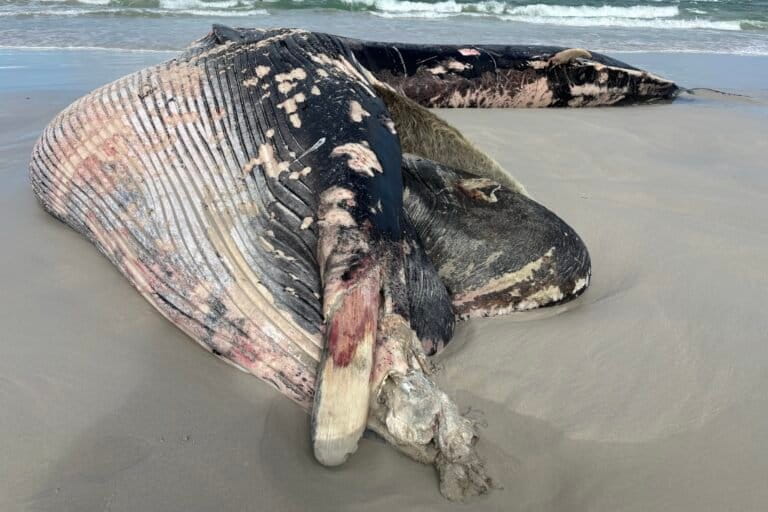
In April this year, two Bryde’s whales washed-up dead-on Dyer Island, a small nature reserve located a few kilometers off the coast of Gansbaai in South Africa’s Western Cape province. Both whales carried severe injuries; their vertebrae had been shattered. “It was very clear that it was [vessel] strikes, because both those whales were snapped in half, and you can also see the propeller marks,” Loraine Shuttleworth, head of research at the Dyer Island Conservation Trust, told Mongabay. Two whale strandings linked to ship strikes in one month alone is an unusually high number, Shuttleworth said. A new risk assessment has linked the increase in risk of ships striking whales to the rerouting of maritime traffic around South African coast. Due to the Houthi rebels attacks on ships traversing the Red Sea, which started in 2023, and the more recent fallout from the blockade of the Strait of Hormuz, many cargo companies have rerouted their vessels around the Cape of Good Hope. With greater shipping traffic comes a growing threat to marine species inhabiting the region: collisions with large, fast-moving vessels. Between December 2023 and December 2024, the number of large vessels traveling through South African waters at average speeds above 15 knots (28 kilometers per hour) has quadrupled, satellite data show. The scale of the increased maritime traffic struck scientist Els Vermeulen from the University of Pretoria’s Mammal Research Institute Whale Unit, on a flight into Cape Town in 2025. “It was a beautiful day, and there were just…This article was originally published on Mongabay
Since May 23, more than 200 primates housed at the Lwiro Primates Rehabilitation Center (LPRC) in South Kivu province in the eastern Democratic Republic of Congo (DRC) have been placed under confinement due to the Ebola outbreak. This measure follows the death of a man who tested positive for the virus on May 21. This individual, a resident of Kahungu, located just 2 km (1.2 miles) from the town of Lwiro, where the center is situated, had traveled in early May to neighboring Ituri province. Ituri is the epicenter of the outbreak, which, as of May 27, is linked to more than 200 suspected deaths. A threat for humans and apes The LPRC houses at least 129 chimpanzees and 108 monkeys of various species, including olive baboons (Papio anubis), yellow baboons (Papio cynocephalus), L’Hoest’s monkeys (Cercopithecus l’hoesti), blue monkeys (Cercopithecus mitis), agile mangabeys (Cercocebus agilis) and others. Parrots, turtles and porcupines can also be found there. These primates, rescued from poaching and the illegal wildlife trade, are being kept in confinement even though “for the moment, no cases of Ebola virus transmission from a human to a great ape have been reported,” primatologist Liz Williamson explained in an email to Mongabay. According to the World Health Organization, the Ebola virus is transmitted to humans through close contact with the blood, secretions, organs or other bodily fluids of infected animals. A chimpanzee at the Lwiro Primates Rehabilitation Center, located in South Kivu province in the eastern Democratic Republic of Congo. Image…This article was originally published on Mongabay
At a time when climate politics in the United States and globally remain deeply polarized, Will Hackman, a climate advocate and political operative, argues that the climate movement needs a new language — one rooted less in doom, guilt and abstract planetary crisis, and more in people’s everyday lives, health, safety, costs and communities. In his new book, Radically Reframing Climate Change: A Guide to Saving Ourselves, he makes the case that climate advocates have too often spoken to those who already agree with them, while failing to reach people who may be cautious, doubtful or simply disconnected from the issue. The challenge, he says, is not only scientific or technological. It is political, cultural and communicative. In the United States, climate change remains politically polarized, with surveys showing that Republicans are less likely than Democrats to view it as an urgent threat, making climate messaging particularly challenging across ideological divides. Mongabay spoke with Hackman over video call about climate messaging, grassroots activism, fossil fuels, political polarization, and why he believes the climate movement must rebuild, creating a broader and more hopeful constituency. Mongabay: You write in your book that much of climate messaging has been framed around fear, guilt and apocalypse. Is that still the right way to talk about climate change? Will Hackman: I think the nature-based messages — polar bears, melting glaciers, “there is no planet B,” “save the planet,” “world on fire” — work for people who already care about climate change. But they do not…This article was originally published on Mongabay
On May 28, 2026, Tedros Adhanom Ghebreyesus, the director-general of the World Health Organization, sent an open letter to the people of the Democratic Republic of Congo before traveling to the country for a field visit: “I am writing because I want to be with you in these moments. And I want you to know that you are not alone,” he wrote, before recalling his involvement during the deadly Ebola outbreak that struck the northeastern DRC between 2018 and 2020. Since May 15, the country has been facing a new outbreak, this time caused by the Bundibugyo variant, a strain of the disease for which there is currently neither treatment nor vaccine. Since the outbreak was declared, the death toll has continued to rise. According to the latest figures, DRC authorities recorded 121 confirmed cases with 17 confirmed deaths, as well as more than 1,077 suspected cases and 238 suspected deaths. The hemorrhagic fever first emerged in Ituri province, on the border with Uganda, before spreading to North Kivu province and to Uganda. That prompted Uganda to close its border with the DRC. While Ituri remains the worst-hit province, the risk of regional spread is high. On May 23, the Africa Centres for Disease Control and Prevention (Africa CDC) identified 10 other African countries at risk from this Ebola outbreak: Angola, Burundi, the Central African Republic, the Republic of Congo, Ethiopia, Kenya, Rwanda, South Sudan, Tanzania, and Zambia. As a result, the international response is intensifying. Dr. Macky Mbavugha is…This article was originally published on Mongabay
A newly released book documenting urban forestry efforts across Africa argues that trees and green spaces are no longer a luxury for African cities, but a critical response to climate change, biodiversity loss, and urban inequality. Published by Johannesburg City Parks and Zoo (JCPZ), Urban Forests and Green Spaces in Africa: Case Studies and Lessons from Across the Continent brings together 34 case studies from 14 African countries, covering everything from restoring biodiversity around wetlands in Rwanda’s capital Kigali, creating Miyawaki forests (forests with native trees planted closely together) in Kenya’s capital Nairobi, greening heat-stressed neighborhoods in Zimbabwe’s capital Harare, transplanting baobabs in Senegal to rehabilitating degraded urban land in South Africa. Hot days, hot nights, and heatwaves have become more frequent across Africa, concludes the Sixth Assessment Report of the Intergovernmental Panel on Climate Change, the world’s most authoritative scientific assessment on climate change. The report also finds that coastal cities are vulnerable to floods related to rainfall events and sea level rise. Palm-lined trees provide near-continuous canopy cover along a boulevard in Bahir Dar, the capital of Ethiopia’s Amhara region. The book notes that canopy closure along some of the city’s main streets approaches 100%, making Bahir Dar one of the most heavily treed urban centers in Africa. Image courtesy of Cathy Watson/CIFOR-ICRAF. As African cities experience rising temperatures, worsening floods, biodiversity loss, and rapid urbanization, the book argues that urban forests and green infrastructure are essential tools for climate resilience. Beyond storing carbon, trees and green spaces…This article was originally published on Mongabay

 Login
Login