The man’s cheekbones are painted with achiote, a red pigment extracted from the seeds of the Bixa orellana plant. He wears a thin headband over his gray hair, and a traditional green shirt with yellow and blue trim on the collar and sleeves. In his right hand, he holds a wooden spear, 2.5 meters long, or just over 8 feet, made from the chonta palm (Bactris gasipaes). He stares at the journalist. His dark eyes widen as he laments the occurrence of several cases of community residents, including children, suffering from fungal infections. “Even two people have already died from stomach pain, and at the hospital, they said: ‘Maybe it’s the water.’” The video was first broadcast on Sept. 28, 2024, on an Ecuadorian national news program. The man recorded is Galo Villamil, one of the leaders of the Capirona community, an Indigenous Kichwa resistance enclave in the Ecuadorian Amazon. One year before, in 2023, 22-year-old Joana Ashanga and her 2-year-old nephew, Ville Ashanga, were victims of what the community considers the fatal consequence of river pollution. “Despite the complaints, official reports from the [Ecuadorian] Ministry of Health made no mention of links between the pollution and the deaths, which generated distrust and outrage,” said Linda Tapuy, president of the Capirona community, before an audience at a university auditorium in Ecuador’s capital, Quito, two years after the deaths. The victims’ death certificates said the cause of death was “unknown.” For the Indigenous group, appearing in that television news story was…This article was originally published on Mongabay
A ruling by Brazil’s Supreme Court has given new momentum to one of the most controversial infrastructure projects in the Brazilian Amazon: The Ferrogrão railway. The plan is to link Sinop, in the grain-producing state of Mato Grosso, to the port of Miritituba in Pará, a key commodity export hub on the Tapajós River. Conceived by the agribusiness sector to reduce grain transportation costs, Ferrogrão is a priority project for President Luiz Inácio Lula da Silva’s administration, despite warnings about its potential impacts on Indigenous territories and protected forests in an Amazon region already under significant socio-environmental pressure. In May, the justices upheld a 2017 law that removed 862 hectares (2,130 acres) from Jamanxim National Park, a conservation unit located in Pará state, to allow Ferrogrão to pass through the protected area. The initiative had been challenged on the grounds that Brazil’s Federal Constitution requires a formal law to reduce the size of protected areas, rather than the conversion into law of a provisional measure issued by the executive branch. “The STF decision does not give the green light to the Ferrogrão project, which still must undergo environmental studies and the licensing process,” said Alice Dandara de Assis Correia, an attorney at Instituto Socioambiental (ISA), a nonprofit that advocates for environmental and Indigenous rights. “But the courts have ruled that specially protected areas can be altered through an expedited process, an extremely dangerous shortcut that could pave the way for Congress to approve similar changes in other protected areas facing…This article was originally published on Mongabay
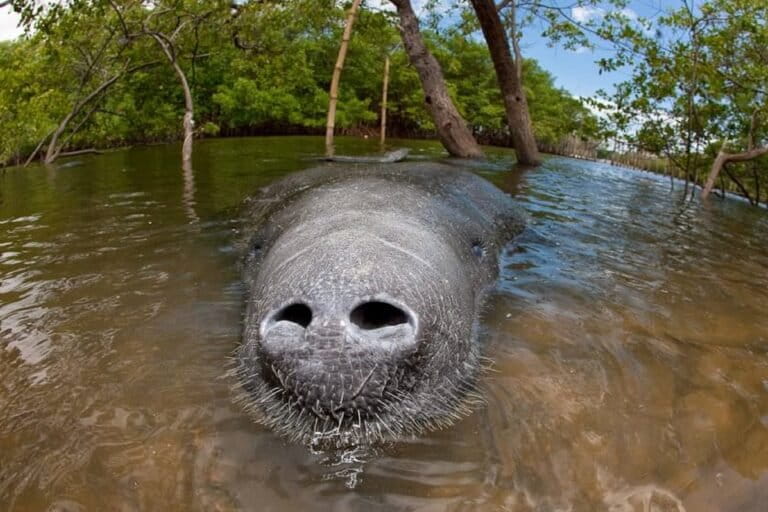
In October 2025, Brazilian state oil company Petrobras began drilling in the seabed where the Amazon River empties into the Atlantic Ocean, following a long, controversial environmental licensing process. At the center of the debate were concerns about the unique wildlife living here, on the shores of the states of Amapá and Pará, and about the company’s capacity to rescue these animals in the event of an oil spill. The potential victims range from marine birds and turtles to the recently discovered Amazon reef system. One endangered marine mammal, however, has prompted particular concern because of the extra challenges to rescuing it in the event of a disaster: the West Indian manatee (Trichechus manatus), a species that grows to a length of around 3.5 meters (11.5 feet) and weighs an average of 700 kilograms (more than 1,500 pounds); some individuals reach up to 1,600 kg (more than 3,500 lbs). “Handling and transporting animals of this size requires complex logistics and large-scale equipment,” said marine biologist Fábia de Oliveira Luna, coordinator at the National Center for Research and Conservation of Aquatic Mammals (CMA), which is part of Brazil’s environmental ministry. With a population estimated at only 1,047 individuals in Brazil and a reproduction rate of one calf every four years, “every individual removed undermines the survival of the population,” Luna told Mongabay. According to scientists, the oil project also jeopardizes a unique genetic code shared only by animals from this region, a result of the interbreeding between the marine manatee and…This article was originally published on Mongabay

 Login
Login