Reading view

Santorini Accuses Cruise Lines of Creating Port Chaos for Corporate Profit
Santorini Greece Cruise ships Santorini Cable Car
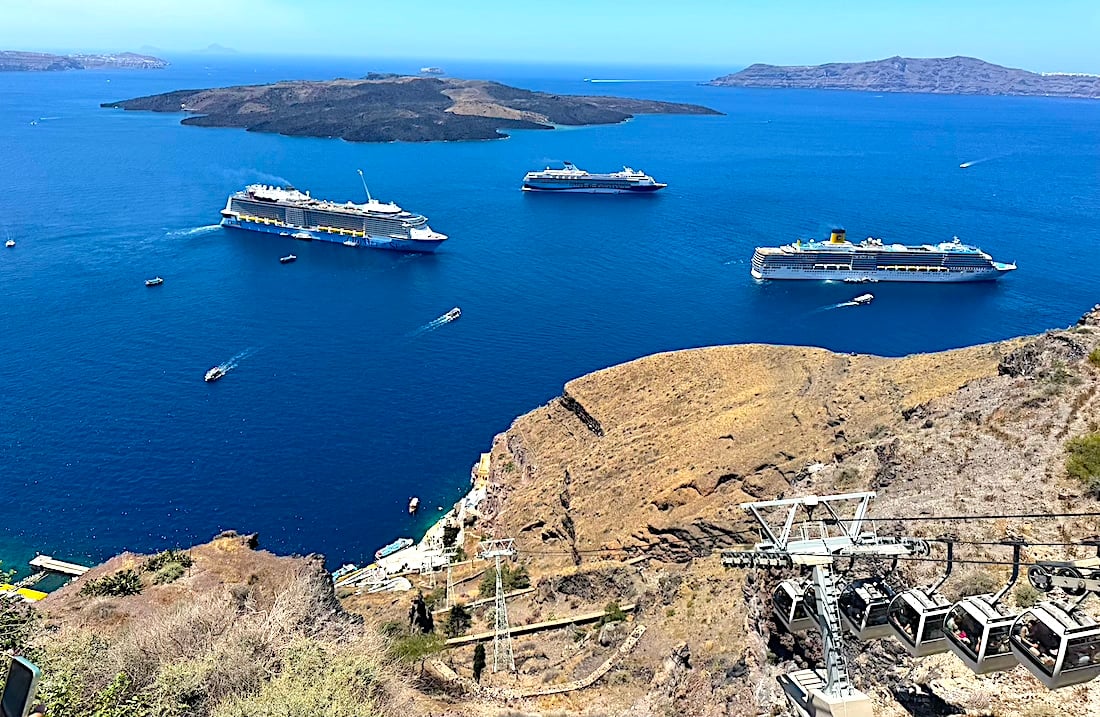
Santorini officials claim cruise lines deliberately create passenger bottlenecks. Credit: Greek Reporter

Senior municipal and port officials on Santorini have launched a coordinated offensive against major international cruise lines and the Cruise Lines International Association (CLIA). Speaking to Greek Reporter, local authorities claim global operators are deliberately engineering passenger bottlenecks and spreading misinformation to bypass municipal regulations, starve local businesses, and maximize their own onshore corporate excursion profits.

Mayor Nikos Zorzos, the Mayor of Thira (Santorini), emphasized that while cruise tourism is a vital sector for the island’s economy, it must be subject to strict regulation. Following a study conducted with the University of the Aegean during his previous term, it was determined that Santorini can sustainably accommodate a maximum of 8,000 cruise visitors per day.

Though a subsequent administration abolished the resulting berth allocation system in 2019, Mayor Zorzos immediately reinstated the daily cap upon his re-election to protect the island’s straining infrastructure.

The 70-30 port split friction

The current conflict centers on where passengers are offloaded. Historically, 70% of cruise passengers disembarked at the Old Port of Fira, with the remaining 30% directed to the industrial port of Athinios. Following a seismic event last year, a Joint Ministerial Decision temporarily diverted nearly all traffic to Athinios. This year, the Municipal Port Fund reinstated the traditional 70/30 split.

“Even though this rule is backed by a prosecutor’s order, operators are actively trying to bypass Fira to redirect tourists toward Athinios and Ammoudi,” Mayor Zorzos told Greek Reporter. “Yet, the Fira market is recovering, and our cable car system has proven it can comfortably handle the regulated flows.”

Allegations of tactical “sabotage” by cruise lines on Santorini

Santorini Sunset_Oia
Crowds gather for the famous sunset in Oia, Santorini. Credit: Greek Reporter

Mayor Zorzos directly refuted recent public complaints and crowded photographs shared by CLIA, labeling them a false narrative designed to resist local flow management. According to municipal tracking, cruise ships are allegedly delaying disembarkation maliciously. Ships arriving at 7:00 AM are reportedly waiting until 10:00 AM to offload passengers all at once, leading to artificial bottlenecks at the Old Port.

“They are doing this maliciously for their own financial gain,” Zorzos alleged. “They want to force passengers into pre-booked, closed-loop corporate excursions, sometimes taking them to areas of zero cultural interest.”

The Mayor highlighted an unauthorized development in Vlychada, an environmentally sensitive area, where a cruise provider constructed a private, closed-gate tourist facility. “They created this exclusive enclave strictly for corporate profit, directly at the expense of Santorini’s local economy,” Zorzos told Greek Reporter.

Port Fund President slams “guided ghetto tourism”

Georgios Nomikos, President of the Santorini Port Fund, reiterated that while the island supports the cruise industry, the economic benefits must extend to the local ecosystem rather than a select few corporate entities.

Nomikos explained that when cruise lines utilize the industrial Athinios port, passengers are loaded directly onto proprietary tour buses, leaving Fira, the island’s capital and home to over six hundred local businesses, completely bypassed.

To debunk claims that the Fira port is overburdened, Nomikos provided a mathematical breakdown based on a standard 1,000-passenger ship. Under the 70-30 rule, 300 passengers are immediately allocated to the Athinios port. Of the remaining 700 passengers assigned to the Fira berth, roughly 10% to 15% (around 100 people) choose to stay onboard. Furthermore, approximately 300 passengers are transferred immediately by tenders to Ammoudi, and another 100 embark on Caldera catamaran tours or other external excursions.

Consequently, Nomikos points out that only about 200 to 300 passengers—or roughly 30% to 40% of the ship’s total capacity—actually ascend into Fira at any given time. “When CLIA publishes photos of overcrowded docks, they are being deceptive,” Nomikos told Greek Reporter. “They coordinate their tender boats to drop off hundreds of people simultaneously to create a false narrative of chaos. They won’t tell you that half those people are immediately routed away to other excursions.”

Cable car operators confirm infrastructure capability, cite scheduling manipulation

Santorini Greece Santorini Cable Car
Tourists wait to embark on the cable car under a shaded area constructed this year. Credit: Greek Reporter

Artemis Kafouros, President of the Loula & Evangelos Nomikos Foundation, which operates the island’s cable car, confirmed that substantial upgrades have been made to ensure a seamless visitor experience. The upper station can now accommodate six hundred people per hour, and the lower station holds three hundred, with both featuring fully shaded, climate-controlled waiting areas.

However, Kafouros provided an eyewitness account from this week supporting claims of deliberate scheduling manipulation by the cruise lines. “Just recently, there were three cruise ships anchored. Two arrived at 7:00 AM. Inexplicably, until 9:30 AM, the Old Port was completely deserted—they did not disembark a single soul. Then, the moment the third ship arrived at 10:00 AM, all three vessels began discharging passengers simultaneously.”

According to Kafouros, this proves an intent to manufacture long queues to justify abandoning Fira. The ultimate goal, he claims, is to route ships back to Athinios to sell proprietary shore excursions that benefit entrenched corporate interests. Local authorities conclude that if cruise lines cooperate honestly with local tender schedules and municipal regulations, visitor flows would remain completely smooth.

Officials are calling on the industry to support the island’s long-term sustainability rather than prioritizing short-term corporate greed.

Related: How Geopolitics and New Fees are Reshaping Cruise Tourism on Santorini, Mykonos
  •  

The History of Wine in Ancient Greece

wine Ancient Greece
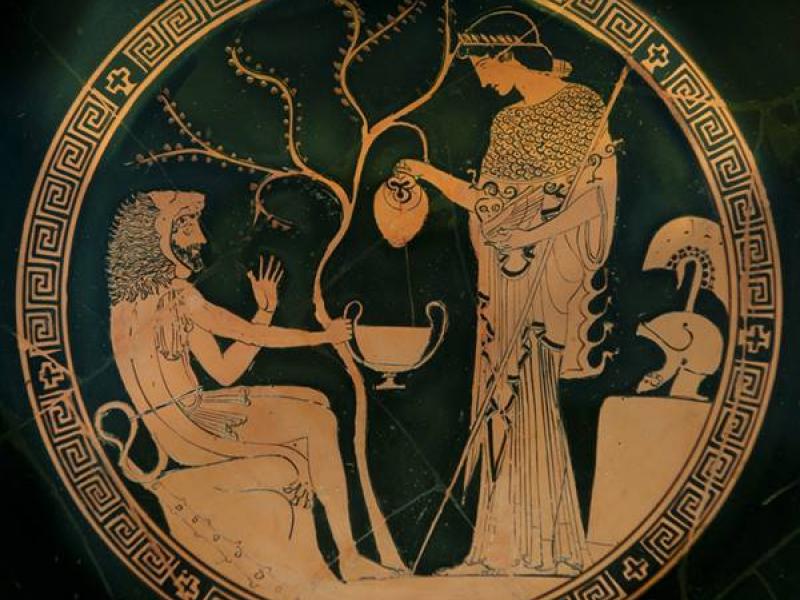
Hercules is offered wine in this depiction of a scene from his Twelve Labors. Public Domain

The recorded history of wine in Ancient Greece begins around the 15th century BC, while viticulture appears to have existed as early as the Neolithic era, 6,500 years ago.

Ancient Greece is also the place where modern wine culture began, as wine consumption stopped being solely a sacred act, as it had been when priests and rulers controlled the vineyards.

By the early Bronze Age, vineyard cultivation of grapes was widespread in ancient Greece, and by the time of the rise of the Minoan and Mycenaean civilizations, wine was part of everyday life, for consumption and/or production.

By that time in Greek society, wine was an economically important business.

Wine and commerce in ancient Greece

There was substantial interaction between the Mycenaean and Minoan cultures, based mainly on commerce.

Around 1200 BC, people from northern Greece invaded the southern Mycenaean area, which was a monarchy.

wine Ancient Greece
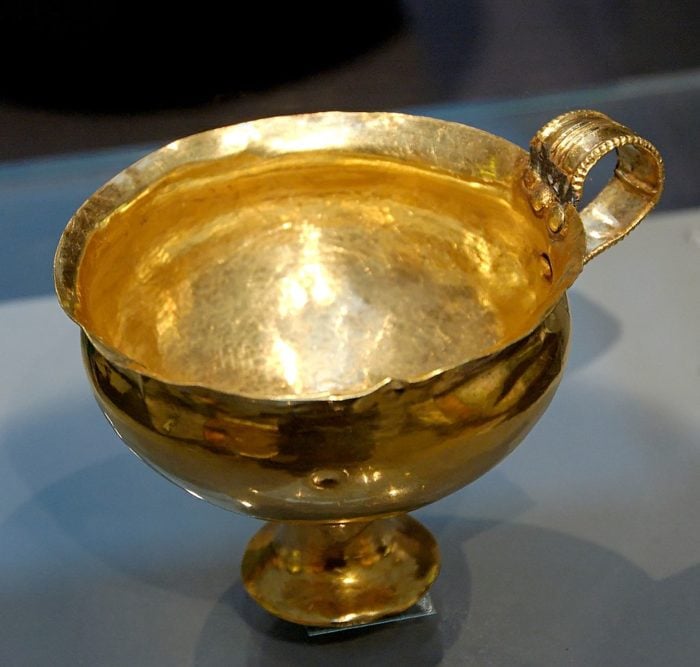
Golden goblet from the Mycenaean period. Public Domain

The war devastated the Mycenaean lands, generating thousands of poor refugee families who escaped to fortified cities for protection.

In order to consolidate their powers, the invaders gave more privileges to the common people, thus undermining the power of monarchs and aristocrats.

The new, democratic city-states were slowly created over time with the common people having more freedoms and opportunities.

Gradually, the common people started cultivating plots of land, with vineyards and olive groves being the most plentiful and lucrative.

People could thus own vineyards, cultivate them, and trade and drink their own wine. A new class of merchants, albeit a small one, was born.

At the same time, more and more people in ancient Greece began to drink wine for pleasure rather than as a sacred ritual.

Colonization and trade expansion

The Greek city-states then began to establish colonies throughout the Mediterranean. The settlers, already experienced in vine cultivation, brought grapevines with them and were able to better cultivate already-existing vineyards.

Moving west, Sicily and southern Italy were the first colonies established by ancient Greeks. Greeks even called the southern part of the Italian Peninsula Oenotria (“the land of vines”).

Other Greeks settled in Massalia (Marseille) in southern France while others moved east all the way to the shores of the Black Sea.

The colonies provided more opportunities for wine merchants. The Greeks could now introduce their wines as far as the western part of France and to the Black Sea in the east.

Athens was a large and lucrative market for wine, as the climate in the Attica region was ideal for vines, and production was substantial. Wine from Attica was traded in all the lands along the eastern Mediterranean Sea.

Other areas famous for wine in ancient Greece were the islands of Santorini and Thasos. This is especially true in Santorini, where the rich volcanic soil produced exceptional grapes. Ancient Greeks were very particular about the origin of their wines.

Major trading partners for wine in ancient Greece were Crimea, Egypt, Scythia, and Etruria among others, as the Greeks traded their knowledge of viticulture and winemaking.

Indicative of the lucrative trade of wine from Greece is a shipwreck discovered off the coast of southern France that held nearly 10,000 amphorae containing almost 300,000 liters (79,000 US gallons) of Greek wine.

Diluted wine

The wine in ancient Greece was unlike what we know today. It was not left undiluted but was mixed with water in precise proportions in a vessel called a krater.

In certain seaside areas or islands, such as Santorini, Greeks used to mix wine with salt water as a preservative and for the taste it imparted. Honey was sometimes added to sweeten the wine.

The mixing of water and wine was for the drinker to enable him or herself to maintain composure and self-control, traits that were highly valued in ancient Greek society.

In fact, ancient Greeks seemed to believe that only barbarians—in most cases that simply meant non-Greeks—drank unmixed wine, got drunk and behaved like…barbarians.

Modern wine culture begins in Greece

Along with their wine, Greeks had exported their way of life, including vine-growing, winemaking, and enjoying wine, to almost every port in the Mediterranean basin.

Socrates praised wine in the following quote:

“Wine moistens and tempers the spirit and lulls the cares of the mind to rest. It revives our joys and is oil to the dying flame of life.”

Plato also praised the fruit of the vine:

“What is better adapted than the festive use of wine in the first place to test, and in the second place to train, the character of a man, if care be taken in the use of it? What is there cheaper or more innocent?

The ubiquitousness of the word “symposium” in ancient Greece, which literally means “drinking with others”—meant that ancient Greeks loved to get together, eat, drink, and converse during and after the meal.

wine Ancient Greece
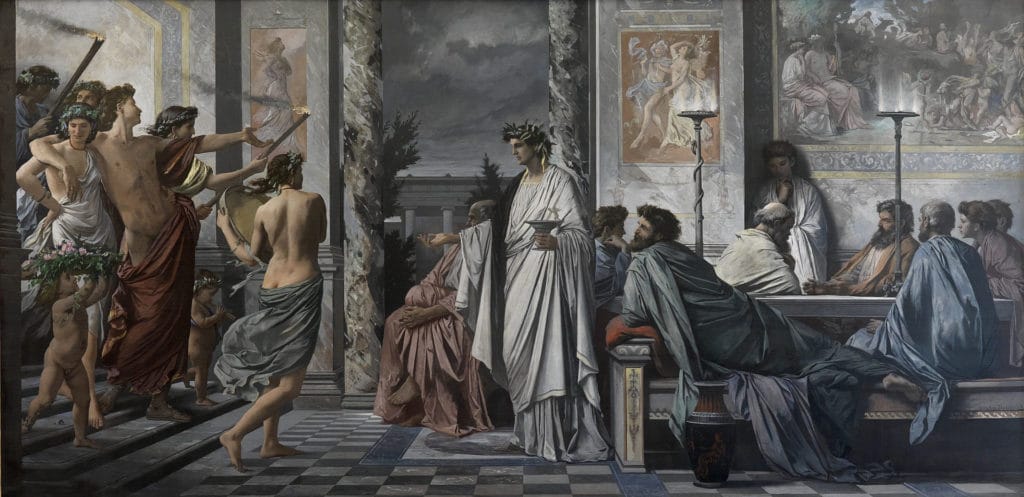
Plato’s Symposium, by Anselm Feuerbach (1829-1880). Public Domain

It was a favorite pastime for well-to-do ancient Greeks to eat, drink, discuss, and, occasionally, philosophize, at these symposia.

Such convivial get-togethers have been illustrated on many types of Greek vases and sculptures. Examples of discussions that took place in symposia can be found in Plato’s Symposium and Xenophon’s Symposium.

Usually, symposia were hosted by aristocratic men for their peers. They would relax in recliners called klinai and drink from terracotta or, depending on how rich the host was, from bronze, silver, even gold, cups.

Wine was also used for medicinal purposes in ancient Greece. The great  physician Hippocrates prescribed different wines depending on the disease.

Ancient Greeks also had a god of wine, the mischievous Dionysus. The god of the grape harvest, winemaking, fertility, orchards, fruit, vegetation, insanity, and ritual madness, he was also the god of religious ecstasy and festivity; overall, it was he who embodied the colorful, vibrant life of ancient Greece.


  •  
❌