The remains of the hull of one of the two ships recovered from Lake Nemi. Workers in the foreground indicate scale. Credit: Public Domain
Located in Lake Nemi in Italy, the Nemi ships consisted of two vessels constructed on orders of Roman Emperor Caligula (37 to 41 AD), known for his extravagant lifestyle.
The ships served as floating palaces, complete with intricate decorations, marble floors, and elaborate plumbing systems and demonstrated advanced Roman engineering techniques.
There is evidence of the use of waterproof concrete, complex hull designs, and innovative plumbing systems with features such as heated baths. The ships were adorned with exquisite artwork, including mosaics, marble statues, and bronze decorations.
An artistic depiction of a Nemi ship by CM Knight-Smith. Credit: Public Domain
Nemi ships were impressively large for their time
The Nemi ships were impressively large for their time. The first ship, the Prima Nave, had a length of approximately 70 meters (230 feet) with a width of about 20 meters (66 feet). The second, the Seconda Nave, was 73 meters (240 feet) long and 24 meters (79 feet) wide.
The remains of a Lake Nemi ship pictured in 1929. Credit: Public Domain
Both ships were constructed with high-quality materials, including oak and pine wood, and featured advanced techniques such as waterproofing with lead sheeting and bitumen.
The sheer size and opulence of the ships reflected the grandeur and luxurious lifestyle associated with Emperor Caligula. They were likely used for leisure and ceremonial purposes, showcasing the emperor’s wealth and technological advancement of the Roman Empire.
Ships discovered and then destroyed during the Second World War
The ships were discovered in the 15th century, but serious attempts to recover them only began in the late 19th and early 20th centuries. Italian dictator Benito Mussolini ordered the draining of Lake Nemi in the 1930s, leading to their successful recovery.
Benito Mussolini observes the drainage system for the emptying of Lake Nemi. Credit: Public Domain
The Nemi ships were destroyed in the final stages of World War II. On the night of May 31, 1944, a fire broke out in the Museum of Roman Ships at Lake Nemi, where the ships were housed. The fire caused extensive damage, destroying much of the wooden structures and artifacts. Most of the ships were lost to the flames.
The exact cause of the fire remains disputed. One theory suggests that retreating German forces set the museum ablaze to prevent advancing Allied troops from capturing the ships and the valuable artifacts. Another theory posits that the fire resulted from Allied bombing in the area, although there is less evidence to support this.
Furthermore, there was also the possibility of an accidental fire, possibly caused by negligence or the mishandling of flammable materials during the chaotic war period.
The remains of the Nemi ships, along with related artifacts and replicas, are housed in the Museo delle Navi Romane (Museum of Roman Ships), located near Lake Nemi in Italy.
Despite the destruction, some metal and stone artifacts survived the fire. These remnants, along with photographs and drawings made before the fire, have allowed historians and archaeologists to reconstruct aspects of the ships.
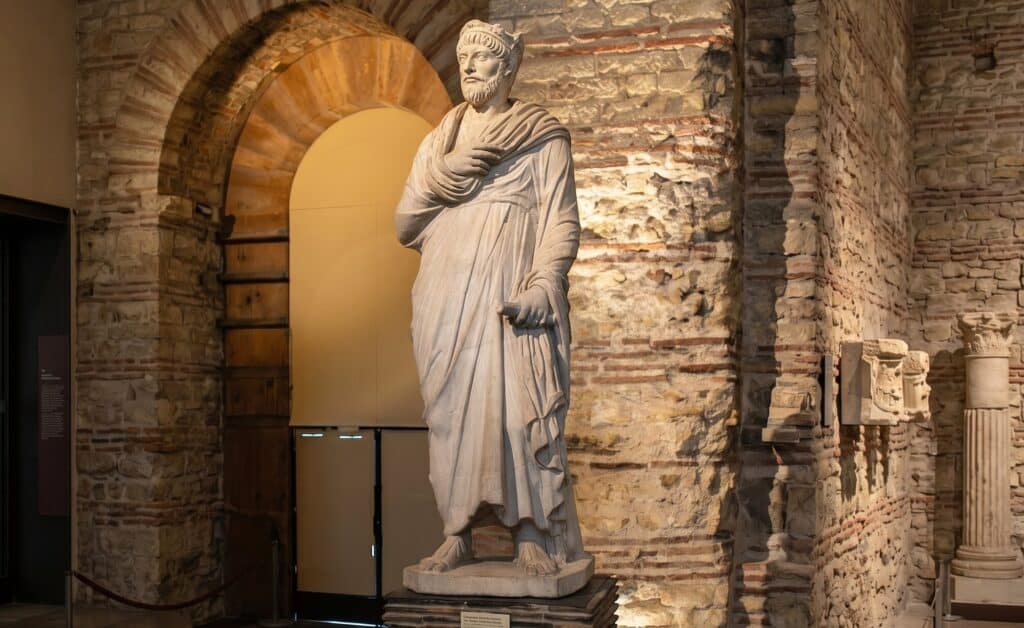
The depiction of Julian in this classical guise shows his commitment to Neoplatonism and Greek culture over the rapidly spreading Christian faith. Credit: Ash Crow, Wikimedia Commons, CC BY-SA 4.0
Few figures in late antiquity present as compelling a historical debate as Julian the Apostate’s attempt to restore the Greek gods in opposition to Christianity in the Roman Empire.
During his brief but highly consequential reign in the fourth century AD, the Roman Empire stood at a profound religious crossroads. For a short period, Julian attempted to slow the empire’s accelerating Christianization, launching a sweeping effort to revive the ancient Olympian pantheon and return Rome to its traditional pagan practices. His sudden death on the battlefield has led historians to debate how dramatically the cultural trajectory of Western civilization might have shifted had his reforms endured.
Julian was born into the heart of the Constantinian dynasty, a family that had only recently converted to Christianity. Nonetheless, he became the last Roman emperor to openly support and worship the traditional Greek gods. He ruled for only about two years from 361 to 363 AD, but he acted with urgency and purpose. Julian the Apostate initiated an extensive program of philosophical and religious reform, aiming to reverse the Christian expansion advanced by his predecessors. To the growing Christian population, he was seen as a traitor to the new religious order, but to those who still admired the intellectual and cultural legacy of the classical world, he appeared as a philosopher-king attempting to restore an older vision of Rome.
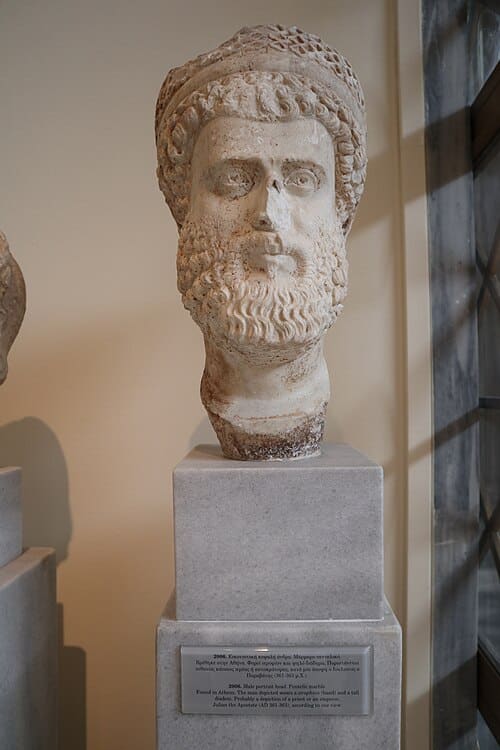
This marble head from Athens is widely believed to be a rare surviving portrait of the Roman Emperor Julian the Apostate. Credit: George Koronaios, Wikimedia Commons, CC BY-SA 4.0
Julian the Apostate’s early life
Julian did not experience the typical sheltered upbringing of an imperial heir. He grew up constantly looking over his shoulder, surviving political purges that eliminated many members of his own family. Although he was raised in a strict Christian environment under the supervision of powerful bishops, he is often understood to have developed a private intellectual attraction to classical texts and traditions associated with the ancient world.
His life took a decisive turn when he went to study in Athens. There, he was secretly initiated into the Eleusinian Mysteries, an experience that deeply shaped his philosophical outlook and strengthened his commitment to rejecting Christianity in favor of Neoplatonism. This forced dual existence helped form a uniquely strategic mindset. He became familiar with the inner workings of the Church, knowledge he later leveraged in support of his own religious and philosophical aims. By the time his troops in Gaul unexpectedly proclaimed him emperor, Julian was convinced that the gods themselves had chosen him to restore the ancient order.
Julian the Apostate as Emperor and the worship of the Ancient Greek gods in the Roman Empire
When he finally took power, Julian did not launch the kind of widespread, violent persecutions often associated with earlier periods of religious conflict. Instead, he pursued a more calculated cultural strategy. His approach focused on weakening Christian influence within imperial institutions while strengthening traditional religious structures. Julian the Apostate reduced the privileges and state support enjoyed by Christian clergy and redirected resources and prestige toward the priesthood of the traditional Greco-Roman religion centered on the Greek gods.
In a particularly controversial move, he restricted Christians from teaching classical literature. His reasoning was that those who rejected the traditional religious framework of Homer and Hesiod should not profit from instructing it. At the same time, Julian sought to make traditional religion more socially competitive by encouraging pagan priests to adopt public charitable functions, including aid for the poor and the establishment of hospitals—areas in which Christianity had been especially successful in gaining support. He appears to have believed that traditional worship had declined not because of its inherent weakness but because its institutions had failed to match the organizational and charitable presence of Christianity.
In practice, many historians argue that this cultural and intellectual strategy posed a different kind of challenge to early Christianity than outright violence. While persecution could strengthen Christian identity through martyr narratives, Julian the Apostate’s policies instead aimed to limit the social structures that supported its continued expansion while restoring the worship of the Ancient Greek gods within the broader Greco-Roman religious tradition.
This illuminated manuscript page depicts vivid scenes of Emperor Julian ordering the arrest of a Christian bishop and overseeing acts of persecution. Credit: Wikimedia Commons, Public Domain
Unfortunately for his beliefs, that grand vision of such a revived Greco-Roman empire came to an abrupt end in the arid regions of Persia. During a military campaign, Julian was struck in the side by a spear, cutting his reign tragically short. Ancient sources and later traditions continue to debate the circumstances of his death, with some attributing the blow to a Persian soldier and others speculating—without evidence—that it may have come from within his own ranks. The true origin remains uncertain.
A well-known tradition holds that, as he lay dying, Julian the Apostate is said to have declared, “Thou hast conquered, O Galilean,” acknowledging the perceived triumph of Christianity. Whether or not he actually spoke these words, his brief reign left a lasting imprint on Roman and Western history. His efforts to restore the Ancient Greek gods within the Roman world continue to be discussed by historians as a striking moment in the empire’s religious transformation. Even in modern Greek cultural memory, echoes of this tension can still be felt in the broader contrast between the rational legacy of ancient philosophy and the spiritual tradition of Orthodox Christianity.

 Login
Login