A Greek mother holding her baby. Credit: GR Archive
Greek women are having their first children later than ever. The average age of first-time mothers in Greece reached 31.2 years in 2024, according to new data from Eurostat. The figure places Greece well above the European Union average of 29.9 years and among the highest in the bloc.
That number marks a sharp climb over two decades. In 2001, the average age at which Greek women had their first child stood at 27.7 years. It crossed 30 for the first time in 2014. By 2021, it had surpassed 31. Since then, Greece’s first-time mothers have continued aging upward year by year.
The country’s standing in Europe reflects a broader pattern. Italy posted the highest first-birth age in the EU at 31.9 in 2024, followed by Luxembourg at 31.6 and Spain at 31.5.
Greece, at 31.2, sits alongside Ireland at the same level, within a cluster of countries where having a first child after 30 has become the standard.
First-time mothers in Greece having their firstborn at the age of 31
The age at all births, not just the first, has moved in the same direction. Greek women averaged 32.2 years at childbirth in 2024, up from 29.3 in 2001. Over those two decades, the average rose by nearly three years. The EU average for all births stood at 31.3 in 2024, placing Greece notably above it.
These numbers in Greece sit against a wider backdrop of declining fertility across Europe. The EU’s total fertility rate dropped to a record low of 1.34 live births per woman in 2024, down from 1.46 in 2022 and from 1.57 in 2008.
Eurostat notes that a rate of 2.1 is the level required to sustain a population without migration. A rate below 1.3 carries the label “lowest-low fertility.”
Greece remains among the EU countries yet to recover above that threshold, alongside Spain, Italy, Latvia, Lithuania, Luxembourg, Malta, Poland, Finland, and Estonia.
EU fertility hits record low, Greece still below threshold
The broader birth count tells the same story. The EU recorded 3.55 million births in 2024, compared to 6.8 million at the peak in 1964. That figure has fallen by roughly half over six decades.
For Greece, the Eurostat data makes the direction clear. Women in the country are becoming mothers for the first time at a later age than at any point on record, and the gap between Greece and the EU average continues to widen.
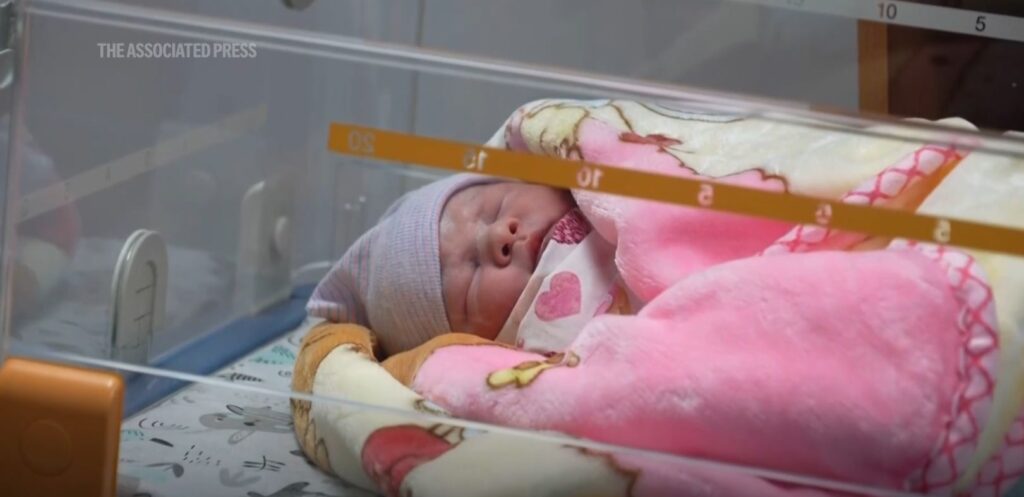
Premature births are rising in several Ukrainian regions near the front line, where war-driven stress on pregnant women appears to be taking a toll, according to the Associated Press (AP). Doctors in cities like Zaporizhzhia keep fragile newborns alive between air raid sirens, in wards with windows boarded up against Russian blast waves. The trend compounds a deepening crisis as fewer Ukrainian women give birth at all.
Russia's war is grinding down Ukraine's population on every front, from the men dying at the line to the families displaced and the children who never arrive. A generation born under fire will carry the war's medical and demographic cost for decades, long after any ceasefire, deepening the strain on a health system Russia keeps targeting.
How far the rate has climbed
In Kherson Oblast, early births climbed from 5.4% of deliveries in 2019 to 9.8% by 2025 — close to twice the rate, UN figures show. Zaporizhzhia Oblast rose from 5.7% to 7.6%, and Poltava Oblast from 7.7% to 9.8% over the same period. The front line runs through Kherson and Zaporizhzhia oblasts. Poltava sits farther back but takes regular aerial strikes. Fewer Ukrainian women are giving birth overall, yet a larger share of births now come early, AP reported.
Keeping newborns alive under bombardment
The medical work is delicate and unforgiving. In a Zaporizhzhia intensive care unit, one baby born at 30 weeks weighs just 700 grams, far below the 2,500-gram threshold the World Health Organization (WHO) uses for low birth weight. Marharyta Nekhoroshyva's son arrived even earlier, at 26 weeks and 940 grams. Now nine months old, he still battles chronic breathing problems while she raises him alone, her husband fighting in the war.
Doctors must manage oxygen precisely, since too much risks abnormal blood-vessel growth in the eyes and, in severe cases, blindness, said Dr. Andrii Lobanov, who heads neonatal intensive care at Zaporizhzhia's children's hospital. When sirens sound, staff stay beside the incubators rather than risk moving the babies.
The danger is not abstract. Dr. Nataliia Bohuslavska, who runs the neonatal unit at the city's maternity hospital, opened a shift last month to alarms warning of incoming missiles. Hours later, a Russian glide bomb hit a commercial part of the city and killed at least 12 people. Her team delivered a baby and performed two cesareans that same day, while treating a woman who miscarried after witnessing an airstrike.
Explore further
Russia hits two hospitals, kills one woman overnight in strikes on Ukrainian cities
The longer cost
Surviving the delivery is only the start. Premature babies often need years of treatment for respiratory, neurological, and developmental conditions, a heavy bill for a country at war. Hospital services get hit "both literally and metaphorically," said Dr. Andrew Weeks, a maternal-health professor at the University of Liverpool.
It also lands on a country whose birth rate has collapsed to about one child per woman — less than half the 2.1 a population needs simply to hold steady.
 Login
Login




https://t.co/UXznIQAcaV pic.twitter.com/KZLowpImTu