
 Login
Login
Pervola: Rhodes’ Hidden Medieval Treasure Reopens After 75 Years
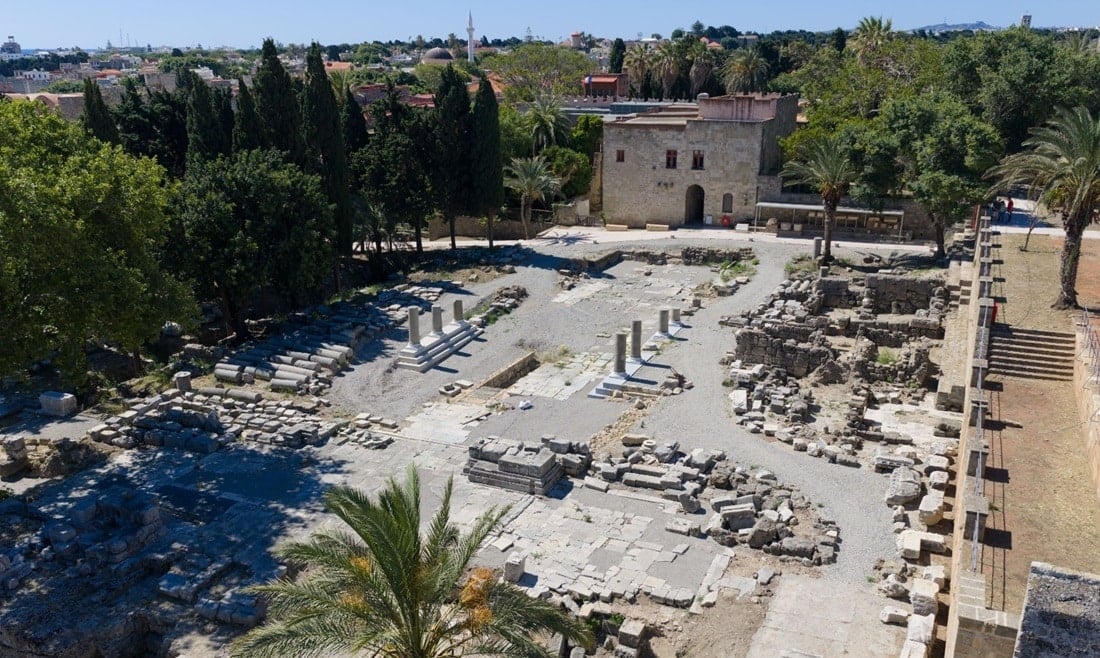
In a landmark ceremony on the island of Rhodes, after 75 years, Greece reopened the “Pervola,” a sprawling five-acre expanse in the heart of the Medieval City directly adjacent to the Grand Palace.
Opened by Greek Minister of Culture Lina Mendoni, the site serves as a vivid timeline of Rhodes’ long history and its pivotal role as a maritime trade hub in the Eastern Mediterranean.
“This site encapsulates the enduring history of Rhodes, highlights its timeless identity, and reconnects the city with a vital chapter of its past,” Mendoni said. The Pervola is a unique monumental ensemble where Hellenistic and Roman antiquities coexist and converse with the remnants of the Knightly era, Ottoman monuments, and modern history.
The transformation of the Pervola on Rhodes

For at least 75 years, the Pervola remained a hidden, undeveloped, and inaccessible space. For decades, it was utilized merely as a storage depot for thousands of artifacts excavated by the Ephorate of Antiquities of Rhodes, while also housing a carpentry shop, a machine shop, conservation labs, and a garage for active and derelict heavy machinery. Reclaiming this monumental site and connecting it functionally with the tiered gardens of the Palace of the Grand Master to create an open-air historical museum was a long-term visionary goal for the Ministry.
“During our inspection in 2021,” the Minister explained, “we evaluated the framework for developing this site and launched a comprehensive strategic master plan to link the structural remains of the Hellenistic Shipyards with the medieval gardens of the Castello. This has created a unified, timeless historical core. Preserved within this space are sections of the military shipyards of Hellenistic Rhodes, the monumental Roman Cardo street with its colonnades and shops, the imposing Tetrapylon, the mint of the Order of the Knights of St. John, and remnants from the Ottoman and Italian eras. It is, essentially, a miniature portrait of the history of Rhodes.”

To achieve comprehensive protection for the Pervola, experts identified more than 4,000 stone artifacts, cataloged over 8,500 architectural and sculptural elements, and relocated nearly 18,000 objects.
Simultaneously, 5,000 square meters (53,820 sq ft) were cleared to make way for a multi-thematic outdoor exhibition and sculpture gallery featuring 700 exhibits, while the historic Governor’s Gardens were meticulously revived. The entire five-acre site now stands as an open, accessible museum that harmoniously weaves together the Hellenistic, Roman, Medieval, and Ottoman history of the city.
A €35 million cultural investment

“Within the Medieval City alone,” Mendoni noted, “we have implemented or are currently executing thirteen projects with a total budget exceeding €35,000,000 [about $40.6 million]. These include the restoration of the Neoclassical School and its surrounding archaeological site, the creation of the open-air museum at the Mole of the Windmills, the medieval windmills, the historical phases of the commercial harbor, and the enhancement of the marine fortifications stretching from the Naillac Mole to the Mole of the Windmills—which is the very first image thousands of visitors see when arriving at the port.”
“Additional projects include the fortification of St. Nicholas, the restored Hassan Bey Mansion, the Recep Pasha Mosque, and the Murat Reis Cemetery,” Mendoni added. “Together with the Pervola, this represents the largest cultural investment program implemented on Rhodes in recent decades, entirely reshaping the island’s cultural landscape.”
Guided by the strategic principle of universal accessibility, the Greek Ministry of Culture has outfitted the Pervola archaeological site with accessible pathways for wheelchairs and installed lifts to ensure barrier-free access across all levels. For visually impaired visitors, a tactile 3D model was created to provide a comprehensive layout of the site. The area has also been equipped with updated educational material and modern visitor infrastructure.

“By returning this new archaeological site to the people of Rhodes and its millions of visitors—a space that also functions as a park for recreation and leisure—we reaffirm our commitment to a living culture that is open to society,” Mendoni stated, adding:
“The revival of the Pervola proves that investing in cultural heritage is not just about identity. It is a strategic asset for civic pride and global competitiveness. This model of development does not deplete local resources; it protects and elevates them. Our monumental wealth is being woven into the daily lives of citizens, boosting collective confidence and strengthening our national standing. We invest in culture because we invest in people. We invest in history because we invest in the future. We view monuments as living cells of growth, education, and creativity.”
