
 Login
Login
High Above the Harbor: 6 Spectacular Greek Choras You Need to See
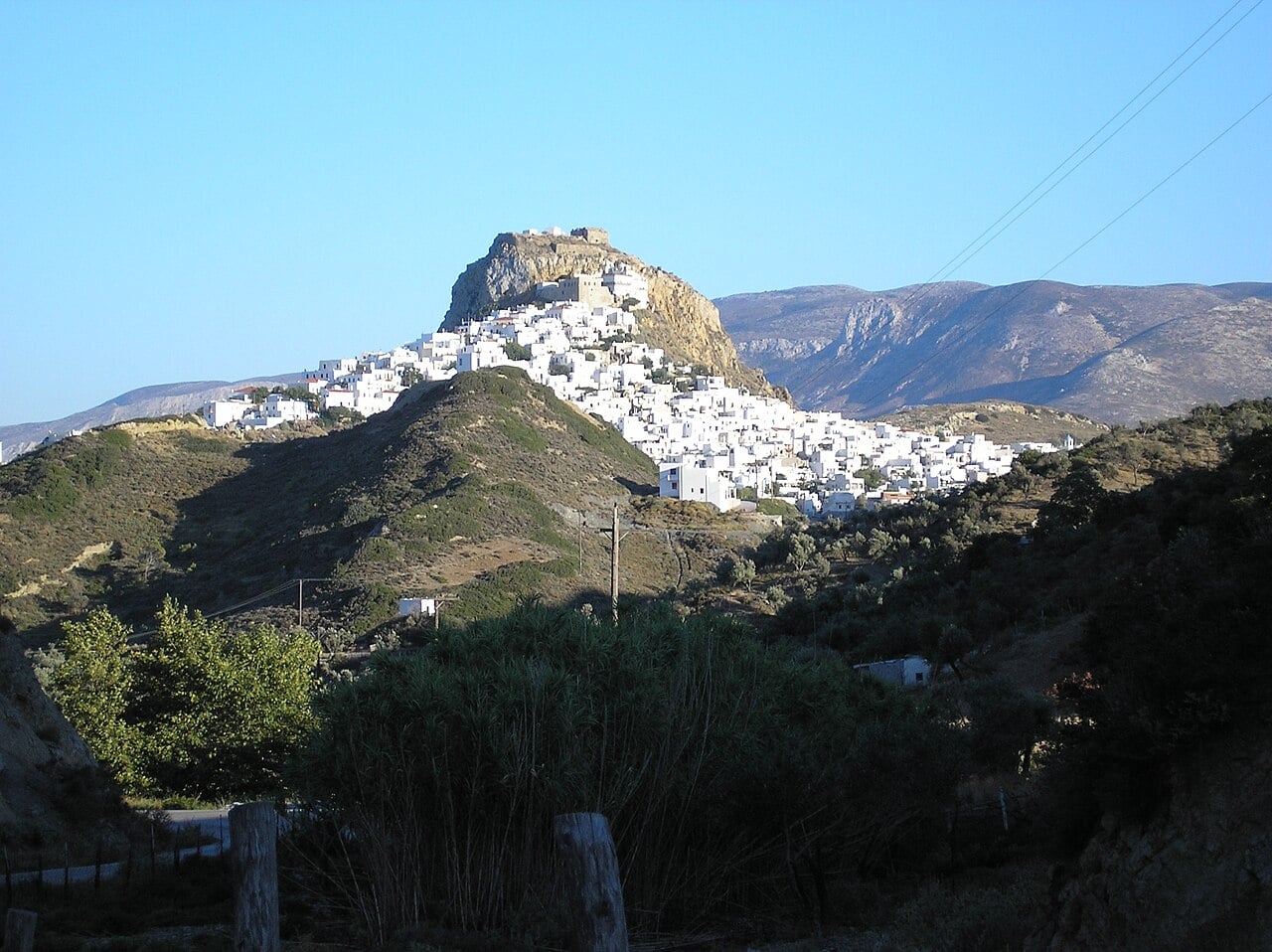
One of the most fascinating aspects of island architecture in Greece is the “Chora” (Χώρα), which literally means “main town” or “capital.” On almost every Aegean island, you will find it perched precariously on a jagged mountain peak, cliffside, or steep hilltop, miles away from the main port.
Today, these towns are postcard-perfect labyrinths of whitewashed houses, but their dramatic locations were originally born entirely out of fear, survival, and defensive strategy.
Why was a Chora on the islands of Greece built on a hilltop?
Between the 7th and 18th centuries, the Aegean Sea was a terrifying place to live. It was heavily plagued by piracy, notably by Saracens, Venetians, Genovese, and later Ottomans, who raided coastal villages for loot and slaves. Building on high ground served several genius military purposes:
- Early Warning System: High vantage points allowed islanders to scan the horizon and spot approaching enemy sails hours before they hit the shore, allowing locals time to prepare or hide.
- The “Invisible” Town: Throughout the islands of Greece, many areas that functioned as a Chora were built tucked slightly behind a ridge facing away from the sea. From a pirate ship on the water, the natural stone and tightly packed white houses blended into the landscape, making the island look completely uninhabited.
- Fortress Architecture (Kastro): The houses themselves were built as defense walls. They were tightly packed together with tiny, maze-like alleys, dead ends, and steep steps designed to disorient and trap invaders who managed to break through.
- The Venetian Castle: Often, the very peak of the Chora features a Kastro (castle), built during Venetian rule. If pirates breached the town, the entire population would retreat into this central fortified citadel for a final stand.
Spectacular examples of Greece’s Choras in the Aegean
1. Folegandros: The Sheer Cliffside Drop
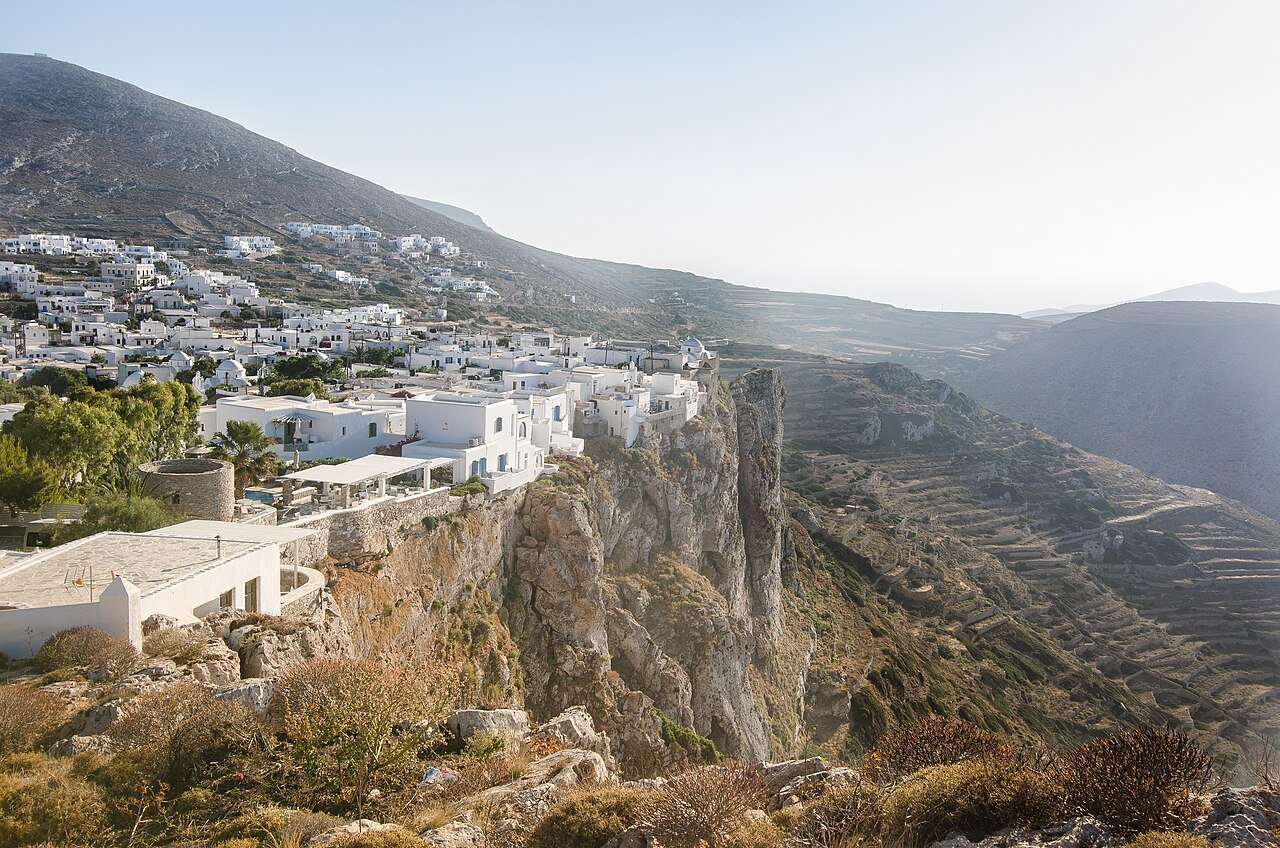
Folegandros in the Cyclades boasts a Chora that is absolutely amongst the most jaw-dropping in Greece. Part of the settlement, specifically the oldest medieval quarter, called the Kastro, is built directly on the edge of a vertical cliff that plunges 200 meters (650 feet) straight down into the Aegean. The outer walls of the houses form the defensive perimeter, meaning a window at the back of a house opens directly into an abyss. From the town, a famous, majestic zigzagging stone path leads further up the spine of the mountain to the white Church of Panagia.
2. Astypalaia: The Crowned Amphitheater
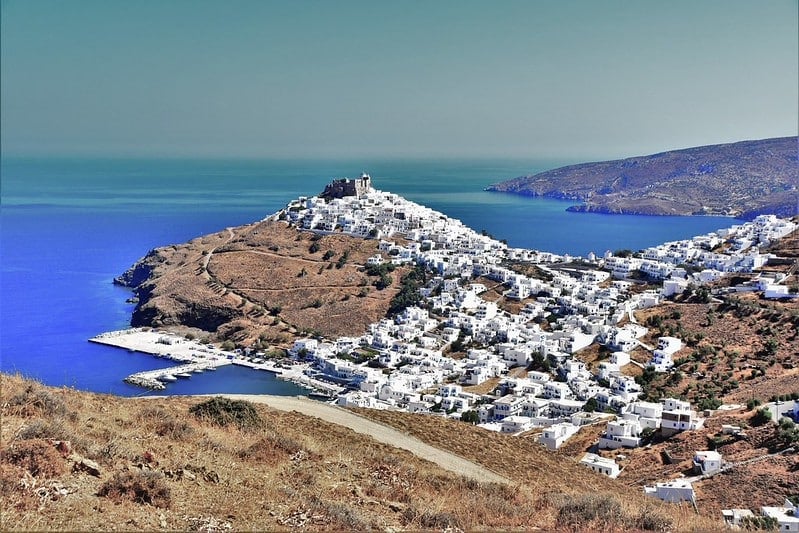
Shaped like a butterfly, the island of Astypalaia bridges the Cyclades and the Dodecanese. Its Chora is a brilliant white hill of cubic houses that ascends like an ancient amphitheater. The absolute summit is crowned by the dark, volcanic stone of the Querini Castle, built by the Venetians in the 13th century. The striking contrast between the pitch-black stone castle and the blinding white homes wrapping around it makes it one of the most architecturally dramatic sights in Greece.
3. Amorgos: The Invisible Mountain Hideout
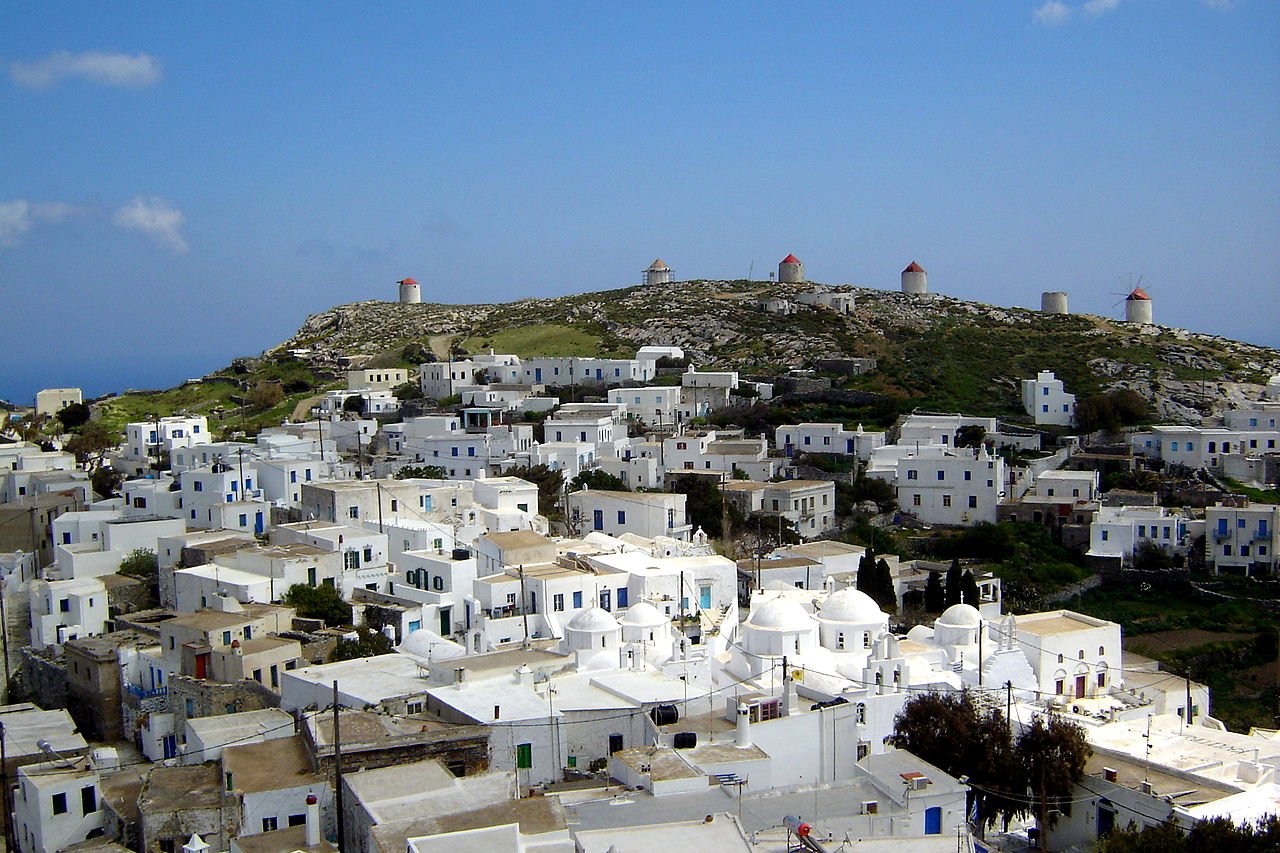
Amorgos’ Chora is the quintessential example of an “invisible” town. It is completely hidden from the sea, nestled in a rocky mountain saddle 350 meters above sea level (about 1,150 ft). Dominated by a massive rock central spire topped with a 13th-century castle, the town is a dense maze of alleys designed to cut the fierce Aegean winds. Just outside the main town cluster, a stark ridge line is punctuated by a row of historic, abandoned stone windmills, highlighting just how exposed and elevated this sanctuary truly is.
4. Kea (Tzia): The Ancient Inland Capital
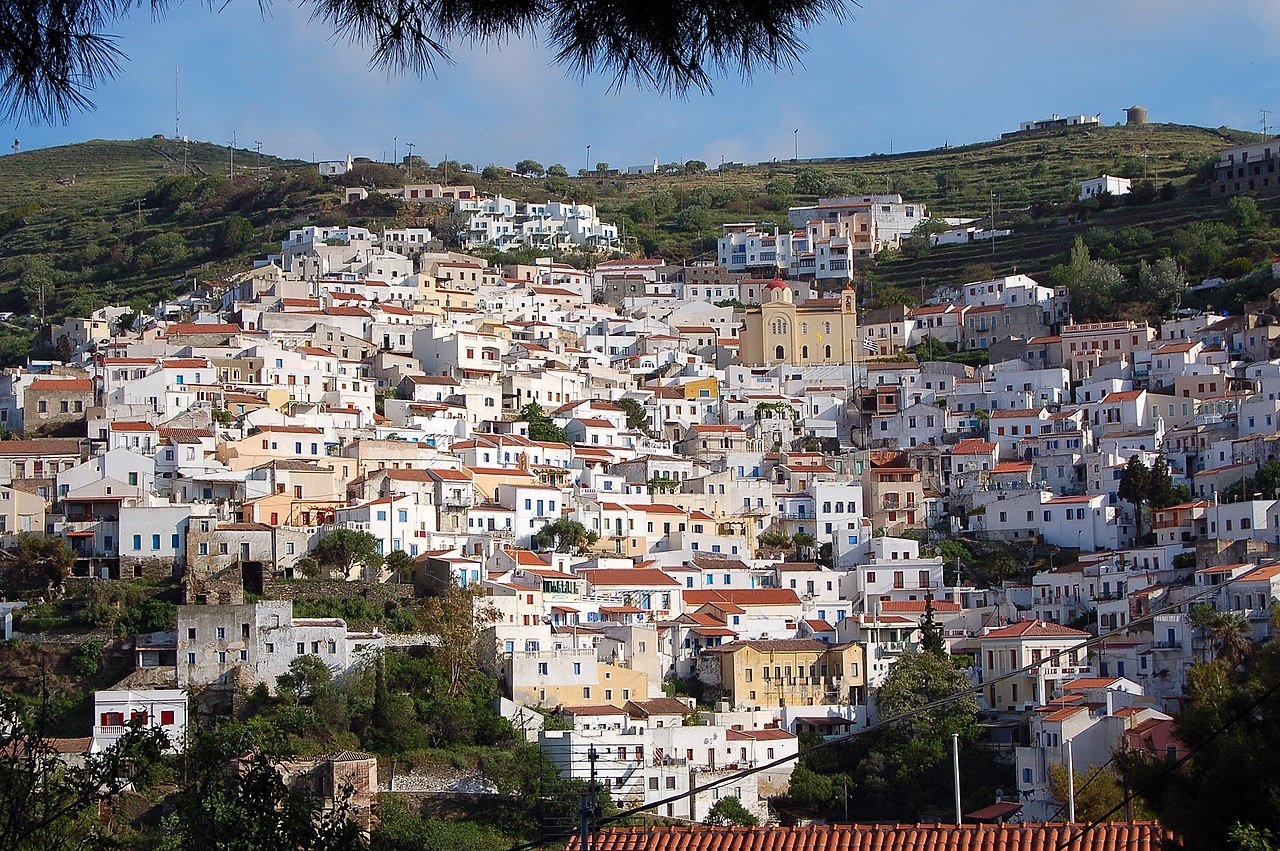
Unlike most Cycladic islands Choras were established in the Middle Ages, the Chora of Kea, known as Ioulis, has stood in the exact same mountainous mountain saddle since the Archaic period. Because it is built on a lush, spring-fed mountain, Ioulis breaks the “blinding white” stereotype. It features traditional clay tile-roofed houses, steep stairways, and historic stone arches (stegadia) that tunnel underneath the buildings.
5. Skyros: The Secret Village of “Pirate Alleys”
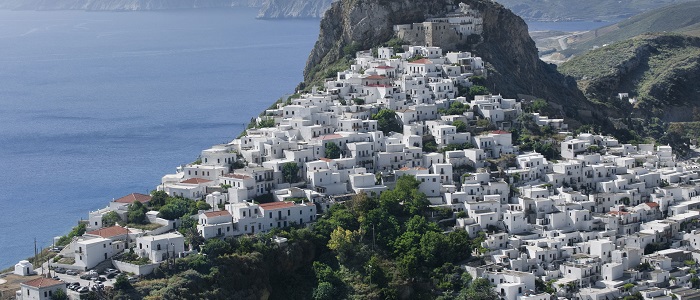
Located in the Sporades group, the Chora of Skyros clings to a massive 179-meter (587-ft) vertical crag. It is a masterful trick of architectural camouflage. Skyros was plagued by Saracen and Ottoman raids, including the notorious pirate Barbarossa. To survive, the locals built the Chora tucked onto the inland-facing northeastern slope of the rock, making the village completely invisible from the open sea. The streets are famously known as “pirate alleys”—cobbolstone paths so narrow, steep, and winding that they acted as a physical maze to trap enemies while residents fled up to the safety of the Byzantine Castle at the peak.
6. Serifos: The Vertiginous Amphitheater
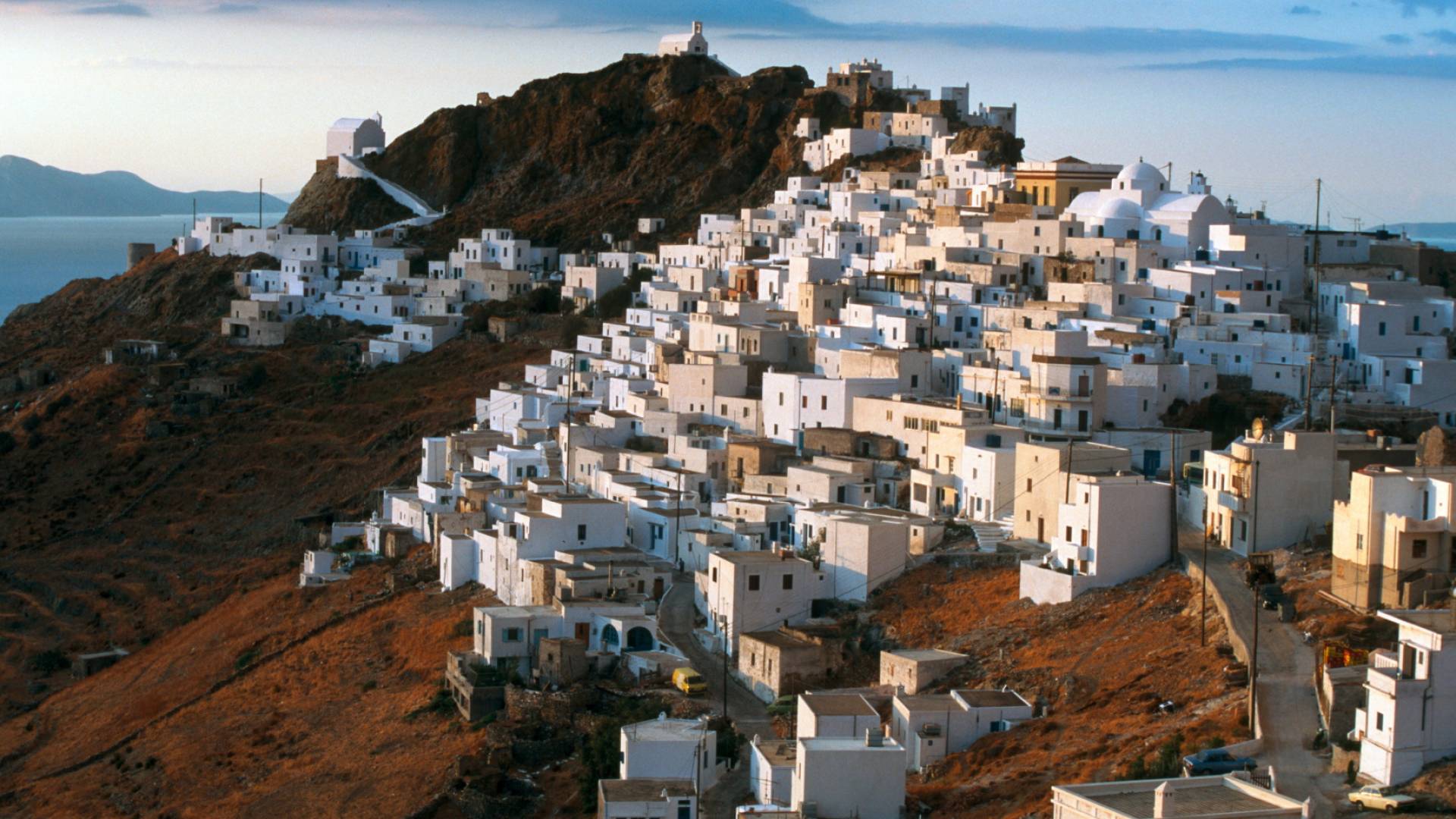
The Chora of Serifos is widely considered one of the most structurally striking in the Cyclades. It is built amphitheatrically down the slopes of a cone-shaped, sheer rock rising 230 meters (755 ft) above the harbor. The village is split into Pano Chora (Upper Town) and Kato Chora (Lower Town). Pano Chora is a classic medieval fortress settlement established in 1434 by the Venetian Mikieli family. Space was so restricted by the vertical terrain that houses are literally glued to each other, leaving only a chaotic web of “labyrinth alleys” where invaders would easily become disoriented.
