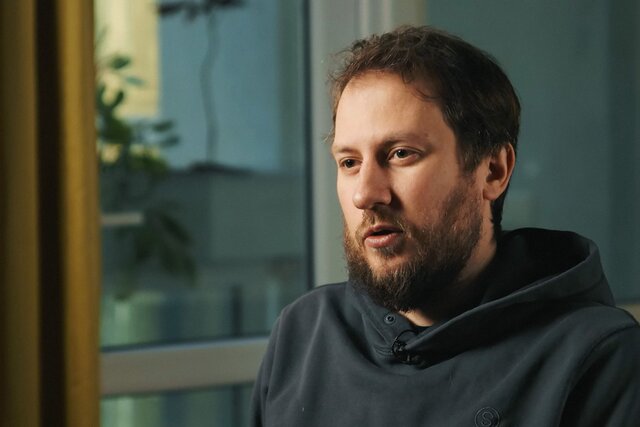
Naran Ochir-Goryayev, a Russian serviceman, was killed in combat in Ukraine, Kalmykia Governor Batu Khasikov announced.
“He was a true warrior, an officer in the fullest sense of the word, an example of courage and loyalty to his oath. From the first days of the SVO, Naran Ochir-Goryayev was on the front lines. He fought in Soledar, in the capture of Seversk, and in other major combat operations,” Khasikov said.
Naran Ochir-Goryayev was a native of Kalmykia. His relatives said he went to war against Ukraine as a volunteer in 2022. Before that, he worked in the traffic police. During the war, he served as commander of an assault company.
In December 2025, he participated in Vladimir Putin’s annual call-in show, where the president addressed him several times.
At Meduza, we are committed to transparency about our use of artificial intelligence in the newsroom. The story you’re reading was written by one of our living, breathing journalists and translated from Russian using an AI model configured to follow our strict editorial standards. This translation process is the result of extensive testing and refinements to ensure our English-language coverage is timely and accurate. A Meduza editor reviews every draft before publication.
If you find any errors in this translation, please contact us at reports@meduza.io.
Internet blocks in Russia have only pushed the country further from “digital sovereignty,” Telegram founder Pavel Durov said.
“The people who could actually build a Russian smartphone OS are bailing out of the country in droves because the internet there is broken,” he wrote on his Telegram channel. “And without that kind of system, every app on a phone — ‘homegrown’ or not — is wide open to targeted surveillance and censorship from the U.S. through backdoors in iOS and Android and their app stores.”
Durov said swapping “foreign” apps for “national” ones while keeping American operating systems was basically “changing the packaging without changing what’s inside”: Potemkin villages, he said, with a side of corruption. “The Russian official who broke the internet and set the country back decades in the name of ‘digital sovereignty’ deserves a National Security Medal — from the United States.”
Russia’s internet restrictions have worsened significantly since the start of 2026. Mobile internet outages have spread from outlying regions to St. Petersburg and Moscow. Authorities have begun throttling Telegram alongside YouTube, in some cases blocking it entirely. During these blackouts — which officials attribute to drone threats — whitelisted services are supposed to remain accessible, but Telegram and WhatsApp are not on those lists. Durov has advised Russians to use the latest versions of Telegram and get a VPN.
At Meduza, we are committed to transparency about our use of artificial intelligence in the newsroom. The story you’re reading was written by one of our living, breathing journalists and translated from Russian using an AI model configured to follow our strict editorial standards. This translation process is the result of extensive testing and refinements to ensure our English-language coverage is timely and accurate. A Meduza editor reviews every draft before publication.
If you find any errors in this translation, please contact us at reports@meduza.io.
Russia’s central bank introduced a new method for calculating the official euro-to-ruble exchange rate, the regulator announced on its website.
Under the new procedure, the official euro rate will be calculated from the U.S. dollar-to-ruble exchange rate and the European Central Bank’s euro-to-dollar rate as of 3:30 p.m. Moscow time on that business day.
Russia’s central bank attributed the change to “low trading volumes in the ruble/euro currency pair on the domestic foreign exchange market.”
Yegor Susin, head of the strategy development center at Gazprombank, told the Russian business news outlet RBC that the shift was necessary to eliminate the impact of domestic factors — such as low liquidity — on the official euro rate.
“In recent days especially, we saw the official euro rate swing by plus three rubles, then minus three rubles. The rate fluctuated heavily because there are very few interbank transactions on which the rate can be based. Even a single small transaction could distort it significantly. Under the new calculation method, the central bank’s official euro rate will depend solely on the global euro-dollar rate — meaning that if the euro falls, that will naturally be reflected here as well,” he said.
In June 2024, Russia’s central bank switched to a new method for calculating the official dollar and euro exchange rates against the ruble. This came after the United States imposed sanctions on the Moscow Exchange, the National Clearing Center, and the National Settlement Depository. After that, the central bank began setting the dollar and euro rates against the ruble based on banks’ reported data on over-the-counter foreign exchange market transactions as of 3:30 p.m. Moscow time on the current business day.
At Meduza, we are committed to transparency about our use of artificial intelligence in the newsroom. The story you’re reading was written by one of our living, breathing journalists and translated from Russian using an AI model configured to follow our strict editorial standards. This translation process is the result of extensive testing and refinements to ensure our English-language coverage is timely and accurate. A Meduza editor reviews every draft before publication.
If you find any errors in this translation, please contact us at reports@meduza.io.
Major Russian insurance companies have begun offering individual policyholders coverage for “acts of war,” the Russian business daily Kommersant reports.
Among the risks covered are falling drone debris, blast waves, and air defense system operations. Ingosstrakh also classifies civil war, various forms of civil unrest, and labor strikes as “acts of war.”
Adding “acts of war” coverage at Alfa Insurance raises premiums by about 10%; at Ingosstrakh, by 12%. Other major insurers — RESO-Garantiya, Rosgosstrakh, and Soglasiye — offer similar coverage but have not disclosed detailed terms.
Lawyers interviewed by Kommersant warn that policyholders may find it difficult to prove their particular claimqualifies as an “act of war,” since the term has no binding legal definition. “Disputes can arise from exclusions, indirect losses, and difficulties in establishing the cause of damage,” said Alexander Pavlovsky, a partner at a.t.Legal, a Moscow law firm.
Ukrainian forces regularly carry out drone strikes against targets on Russian territory hundreds of kilometers from the border. Drones and debris from downed drones have repeatedly struck homes across Russia. Ukraine’s military command has repeatedly stated that, unlike Russia’s Defense Ministry, it does not deliberately target civilians.
At Meduza, we are committed to transparency about our use of artificial intelligence in the newsroom. The story you’re reading was written by one of our living, breathing journalists and translated from Russian using an AI model configured to follow our strict editorial standards. This translation process is the result of extensive testing and refinements to ensure our English-language coverage is timely and accurate. A Meduza editor reviews every draft before publication.
If you find any errors in this translation, please contact us at reports@meduza.io.
Vladimir Putin claimed that Volodymyr Zelensky asked him for a personal meeting through a Russian businessman — several weeks before Zelensky published an open letter proposing to end the war. Putin made the comments during a plenary session at the St. Petersburg International Economic Forum.
Three weeks ago, Putin said, “a contact in the business world” told him he had been invited to Kyiv and offered a chance to “look and listen” to what was happening there. The businessman then went to Kyiv and met “the author of this letter” at the man’s residence, Putin said.
After returning, the businessman conveyed to Putin a verbal request from Zelensky for a meeting, the president said. At the plenary session, Putin repeated that he’s never said no to a meeting but doesn’t want to “keep pouring from one empty cup into another.”
Putin described what followed: ‘This was, I believe, on May 21. And on May 22, Ukrainian forces carried out a terrible terrorist strike on a college dormitory in the [self-declared] Luhansk People’s Republic, where children and teenagers were killed.” Putin said he asked the businessman what this meant — that Ukrainian leaders were asking for a meeting while committing such terrible crimes. The businessman replied that he had no explanation but was “getting calls right now” from Kyiv, and promised to get back to the Russian president. The two have not spoken since, Putin said. He did not name the businessman or say more.
On June 4, Volodymyr Zelensky published an open letter in which he proposed that Vladimir Putin end the war through “direct engagement” and meet face-to-face. When the letter was published, Putin was speaking with foreign journalists at the St. Petersburg International Economic Forum. Kremlin spokesman Dmitry Peskov said Putin had been informed of the letter and that the president would address it at the plenary session.
The only Russian businessman who participated in the Ukraine–Russia negotiations in 2022 was Roman Abramovich. The Financial Times reported that Abramovich had become Putin’s “trusted intermediary,” and that Zelensky had asked the U.S. to delay imposing sanctions on Abramovich. After Donald Trump succeeded Joe Biden as president, a new Kremlin representative took on the role — Kirill Dmitriev, head of the Russian Direct Investment Fund. He met repeatedly with Trump’s envoy Steve Witkoff (including in the U.S.), but he is not known to have visited Kyiv.
At Meduza, we are committed to transparency about our use of artificial intelligence in the newsroom. The story you’re reading was written by one of our living, breathing journalists and translated from Russian using an AI model configured to follow our strict editorial standards. This translation process is the result of extensive testing and refinements to ensure our English-language coverage is timely and accurate. A Meduza editor reviews every draft before publication.
If you find any errors in this translation, please contact us at reports@meduza.io.
Ukrainian President Volodymyr Zelensky said Vladimir Putin does not want to end the war, commenting on the Russian president’s response to his open letter:
Unfortunately, the Russian side once again chooses war – everyone heard the response today. Weak response. He simply does not want to end the war.
I think many around the world were disappointed by that response. He does not want to change anything, and he does not want to admit… pic.twitter.com/En6BySTKPP
— Volodymyr Zelenskyy / Володимир Зеленський (@ZelenskyyUa) June 5, 2026
On the evening of June 4, Zelensky published an open letter to Putin, proposing that the Russian president meet with him in person to negotiate an end to the war.
The following day, speaking at the St. Petersburg International Economic Forum, Putin said he saw no point in meeting with Zelensky at this time. He said Ukraine was seeking to use such a meeting to halt the Russian military’s advance.
Putin also claimed that Zelensky had asked him for a personal meeting through a Russian businessman — several weeks before publishing the open letter proposing to end the war. That proposal was conveyed to Putin on May 21, and the following day “Ukrainian forces carried out a horrific terrorist strike on a college dormitory in the Luhansk People’s Republic, killing children and teenagers.” He said he had asked the businessman “what this meant — that they were asking for a meeting while committing such terrible crimes.”
At Meduza, we are committed to transparency about our use of artificial intelligence in the newsroom. The story you’re reading was written by one of our living, breathing journalists and translated from Russian using an AI model configured to follow our strict editorial standards. This translation process is the result of extensive testing and refinements to ensure our English-language coverage is timely and accurate. A Meduza editor reviews every draft before publication.
If you find any errors in this translation, please contact us at reports@meduza.io.
Update. Robert Brovdi, commander of Ukraine’s Unmanned Systems Forces (known by the call sign “Madyar”), said that in the early hours of June 5, drones from his unit struck five vessels — dry cargo ships and a tanker — that he said were unlawfully present in the ports of Mariupol and Berdyansk and in the coastal waters of Russian-occupied territories.
The cargo ships Natra and Zircon, carrying 25 Azerbaijani nationals, were struck by drones in the Gulf of Taganrog in the Sea of Azov in the early hours of June 5.
Five Azerbaijanis were killed and three wounded, Azerbaijan’s Foreign Ministry stated. The injured were taken to hospitals in Yeysk. The ships did not belong to Azerbaijan, Foreign Ministry representatives said; the sailors had been working aboard them voluntarily, not through any state arrangement. The ministry offered no further details.
The Azerbaijani outlet Minval Politika reported that those killed were Azerbaijani citizens serving as crew members on ships traveling from Turkey to Rostov-on-Don. Both vessels were sailing under foreign flags.
Russia’s Defense Ministry stated on the morning of June 5 that 123 Ukrainian drones had been destroyed overnight, including “over the waters of the Sea of Azov.”
Russia’s Foreign Ministry confirmed that the motor vessels Natra and Zircon were traveling from Turkey to the port of Rostov-on-Don under the flags of Belize and Palau respectively, when they were attacked by Ukrainian drones. Foreign Ministry spokesperson Maria Zakharova said a passing Russian vessel had assisted the injured sailors. She promised that Moscow would “assist its partners” in obtaining information about the circumstances of the incident and ensuring consular access to the Azerbaijanis.
At Meduza, we are committed to transparency about our use of artificial intelligence in the newsroom. The story you’re reading was written by one of our living, breathing journalists and translated from Russian using an AI model configured to follow our strict editorial standards. This translation process is the result of extensive testing and refinements to ensure our English-language coverage is timely and accurate. A Meduza editor reviews every draft before publication.
If you find any errors in this translation, please contact us at reports@meduza.io.
Armenian Prime Minister Nikol Pashinyan said he would pull Armenia out of the Collective Security Treaty Organization (CSTO) if he judged it necessary.
Pashinyan addressed the question of Armenia’s continued CSTO membership during pre-election debates with Narek Karapetyan of the Strong Armenia bloc.
Karapetyan noted that Armenia had suspended its CSTO membership and stopped paying dues to the organization. He argued that if the organization was not working, Armenia should leave — but that before doing so, it needed to find a security guarantor to stand between Armenia and Azerbaijan.
“Fine, we’ll leave the CSTO. What, are you trying to scare us? You don’t get to decide that — you or whoever’s got your back. We’ll decide and we’ll leave. Armenia is its own guarantor — the country, the military,” Pashinyan said, according to the Armenian news outlet News.am.
“We will decide — foreign agents won’t decide what to do. We won’t allow Lukashenko to become our guarantor again,” he added. In late May, Pashinyan devoted part of a campaign rally speech to criticizing Belarusian President Alexander Lukashenko, who had said Armenia “is needed by no one.”
Armenia froze its CSTO membership in 2024 — after Nagorno-Karabakh came under Azerbaijani control and the ethnic Armenians who had lived there were forced to leave. In December 2024, Pashinyan said, “In effect, we already consider ourselves outside the CSTO.”
In April 2026, Armenian parliament speaker Alen Simonyan said the country would leave both the CSTO and the Eurasian Economic Union (EEU) if Russia raised the price of gas supplied to the republic.
Armenia holds parliamentary elections on June 7. Against this backdrop, relations between Moscow and Yerevan have deteriorated sharply. Russia accuses Nikol Pashinyan of attempting to draw closer to Western countries and the European Union.
Over the past several weeks, Russian authorities have banned imports of a number of goods from Armenia, including flowers, Jermuk mineral water, vegetables, herbs, peaches, strawberries, and fish. Pashinyan promised subsidies to affected exporters, and the European Union announced it would provide Armenia with 50 million euros in aid in response to economic pressure from Russia.
At Meduza, we are committed to transparency about our use of artificial intelligence in the newsroom. The story you’re reading was written by one of our living, breathing journalists and translated from Russian using an AI model configured to follow our strict editorial standards. This translation process is the result of extensive testing and refinements to ensure our English-language coverage is timely and accurate. A Meduza editor reviews every draft before publication.
If you find any errors in this translation, please contact us at reports@meduza.io.
Russia and Ukraine each exchanged 185 prisoners, Russia’s Defense Ministry reported on Friday. The United Arab Emirates brokered the swap.
Volodymyr Zelensky confirmed the exchange, adding that one civilian detainee also returned to Ukraine alongside the 185 soldiers.
The previous exchange took place on May 15, several days after a three-day ceasefire for Victory Day ended. At that time, each side returned 205 people.
The day before, Zelensky published a letter to Vladimir Putin in which he proposed meeting in person to end the war “through direct dialogue.” Zelensky also said that Ukraine is ready for a prisoner exchange under an “all-for-all exchange,” saying “this could become a good prologue to ending the war.”
At Meduza, we are committed to transparency about our use of artificial intelligence in the newsroom. The story you’re reading was written by one of our living, breathing journalists and translated from Russian using an AI model configured to follow our strict editorial standards. This translation process is the result of extensive testing and refinements to ensure our English-language coverage is timely and accurate. A Meduza editor reviews every draft before publication.
If you find any errors in this translation, please contact us at reports@meduza.io.
Ukrainian Telegram channels have published footage showing the aftermath of a drone strike on the Russian Navy corvette Boiky, docked in Kronstadt. The attack took place on the morning of June 3, the opening day of the St. Petersburg International Economic Forum.
The footage shows a large fire burning on the vessel. The Telegram channel Dosye shpiona (“Spy Dossier”) says one person was killed.
Norwegian analyst and former naval officer Thord Are Iversen, whose assessment of the footage was cited by RFE/RL’s Russian service, said damage to the upper superstructure between the bridge and the aft mast was significant. He said the main mast had collapsed, possibly because the composite materials caught fire and burned away. He assessed the ship as repairable but said the work would take time and require significant resources.
The corvette Boiky was launched in April 2011 and joined the Baltic Fleet in May 2013. In June 2025, BBC News reported that the Boiky had been escorting shadow fleet tankers in the English Channel.
At Meduza, we are committed to transparency about our use of artificial intelligence in the newsroom. The story you’re reading was written by one of our living, breathing journalists and translated from Russian using an AI model configured to follow our strict editorial standards. This translation process is the result of extensive testing and refinements to ensure our English-language coverage is timely and accurate. A Meduza editor reviews every draft before publication.
If you find any errors in this translation, please contact us at reports@meduza.io.
Apple has commented on the removal of Max, the Russian “national” messaging app, from the App Store.
In a statement to BBC Russia, the company said Max had been pulled from the App Store in accordance with sanctions compliance rules. Apple said it operates in accordance with the laws of the jurisdictions where it does business.
The company did not say which sanctions prompted the decision.
Max disappeared from the App Store on June 3. The following day, it emerged that push notifications for calls and messages in the Max messenger had stopped reaching users’ devices. At that point, Apple had issued no statement about the app’s removal from the App Store. Max said it was working to restore the app to the App Store.
In February, Yulia Navalnaya called for Max to be removed from both the App Store and Google Play.
At Meduza, we are committed to transparency about our use of artificial intelligence in the newsroom. The story you’re reading was written by one of our living, breathing journalists and translated from Russian using an AI model configured to follow our strict editorial standards. This translation process is the result of extensive testing and refinements to ensure our English-language coverage is timely and accurate. A Meduza editor reviews every draft before publication.
If you find any errors in this translation, please contact us at reports@meduza.io.
A private VK Night party celebrating the launch of the Max messenger was held at the St. Petersburg International Economic Forum, the independent Russian investigative outlet Agentstvo reported, citing video from the event obtained from a source.
According to the outlet’s source, at the party “everything revolved around Max — advertising, jokes.”
The event was hosted by journalist and socialite Ksenia Sobchak. Among the guests were Digital Development Minister Maksut Shadaev and VK CEO Vladimir Kiriyenko, the son of Sergei Kiriyenko, President Putin’s domestic policy czar. Pop singers Vanya Dmitriyenko and Lolita Milyavskaya performed at the party.
On June 3, the Max messenger was removed from the App Store. Apple later told BBC Russia that it removed Max “in accordance with sanctions compliance rules.” At the time of removal, the messenger ranked ninth on the list of most-downloaded apps in Russia.
At Meduza, we are committed to transparency about our use of artificial intelligence in the newsroom. The story you’re reading was written by one of our living, breathing journalists and translated from Russian using an AI model configured to follow our strict editorial standards. This translation process is the result of extensive testing and refinements to ensure our English-language coverage is timely and accurate. A Meduza editor reviews every draft before publication.
If you find any errors in this translation, please contact us at reports@meduza.io.
Armenia’s government has warned that citizens who travel from Russia to vote in the parliamentary elections “for bribes” will be sent to 25-day military training exercises.
Taron Chakhoyan, deputy chief of the prime minister’s office, posted the warning on his Facebook page on June 3, adding that those who refuse will face criminal prosecution.
Economy Minister and deputy chairman of the ruling Civil Contract party Gevorg Papoyan made a similar statement, DW reported.
The news outlet News.am reported on June 4 that military police were checking men who arrived at Zvartnots Airport in Yerevan and handing them military summonses. Military police confirmed that they had assisted military commissariats in registering military-age citizens, calling them up for mandatory military service, and involving them in reservist training activities.
The news agency Reuters reported in late May that Russian officials had discussed a plan to send Armenian citizens living in Russia back home to vote against incumbent Prime Minister Nikol Pashinyan in the parliamentary elections. In the video, Chakhoyan said Russian authorities were organizing votes “for bribes” in favor of businessman Samvel Karapetyan, who has close ties to Russia.
Armenia’s parliamentary elections are scheduled for June 7. Amid preparations for the vote, Russia has banned imports of several goods from Armenia, including flowers, Jermuk mineral water, vegetables, greens, peaches, strawberries, apples, fish, and dried fruits.
At Meduza, we are committed to transparency about our use of artificial intelligence in the newsroom. The story you’re reading was written by one of our living, breathing journalists and translated from Russian using an AI model configured to follow our strict editorial standards. This translation process is the result of extensive testing and refinements to ensure our English-language coverage is timely and accurate. A Meduza editor reviews every draft before publication.
If you find any errors in this translation, please contact us at reports@meduza.io.
Vladimir Putin called for postponing further reductions to the revenue threshold above which small businesses must pay VAT, announcing the proposal at a plenary session of the St. Petersburg International Economic Forum.
The threshold for businesses operating under the simplified tax system was already lowered to 20 million rubles starting in 2026, and under existing plans it was set to fall to 15 million rubles in 2027 and 10 million rubles in 2028.
Putin said the issue had been discussed in detail with business representatives and government officials. “I believe it is possible to delay the planned further reduction of the revenue threshold. […] And to fix it at its current level. I won’t name a specific date, but the further out, probably, the better,” he said.
Putin asked the government and the State Duma to introduce the necessary amendments.
In November 2025, Putin signed a law that would gradually lower the value-added tax threshold for small businesses operating under the simplified tax regime. The law stipulated that starting in 2026, the threshold would drop to 20 million rubles — the level at which businesses become liable for the tax — then to 15 million rubles in 2027 and 10 million rubles in 2028. Previously, the threshold had been 60 million rubles per year.
At Meduza, we are committed to transparency about our use of artificial intelligence in the newsroom. The story you’re reading was written by one of our living, breathing journalists and translated from Russian using an AI model configured to follow our strict editorial standards. This translation process is the result of extensive testing and refinements to ensure our English-language coverage is timely and accurate. A Meduza editor reviews every draft before publication.
If you find any errors in this translation, please contact us at reports@meduza.io.
An amusement park on Krestovsky Island in St. Petersburg has opened a ride called “Oreshnik,” the Telegram channel Khroniki.Media reported. The park is Divo Ostrov.
According to an announcement on the Divo Ostrov website dated April 15, the ride promises to let visitors “come face to face with the sensations of explorer cosmonauts, soaring to the heavens beyond the bounds of Earth’s atmosphere.”
The attraction is a rocket painted in the colors of the Russian flag. Riders ascend on a platform with seats, then drop sharply back down. A ride costs 500 rubles.
The St. Petersburg International Economic Forum is taking place in the city at the same time. At the RT television channel’s booth, guests were served a dessert also called “Oreshnik,” made with condensed milk.
At Meduza, we are committed to transparency about our use of artificial intelligence in the newsroom. The story you’re reading was written by one of our living, breathing journalists and translated from Russian using an AI model configured to follow our strict editorial standards. This translation process is the result of extensive testing and refinements to ensure our English-language coverage is timely and accurate. A Meduza editor reviews every draft before publication.
If you find any errors in this translation, please contact us at reports@meduza.io.
The chairman of the State Duma’s budget and tax committee, Andrei Makarov, called Russia’s security forces’ conduct during the war lawless. He made the remarks at a Sberbank business breakfast held as part of the St. Petersburg International Economic Forum (SPIEF).
I understand that the role of the security forces during the war is a completely different situation. Perhaps it would not even be worth discussing, but the arbitrary behavior of law enforcement agencies is also not the best backdrop for tackling the challenges at hand and making headway on the issues [Deputy Prime Minister] Alexander Novak was just describing.
Makarov also took aim at the quality of Russia’s institutions, which should allow people to go to court and “trust that it will rule fairly.” “Not only when you are in a dispute with each other, but also when your dispute is with the state,” he added.
Russia ranks 131st in the United Nations innovation index for institutional quality, Makarov said. “On institutions, let me congratulate you — we have overtaken Venezuela — progress of a sort. Though we’re still no match for Lesotho,” he said.
I understand perfectly well that the voucher privatization auctions of the 1990s fundamentally destroyed respect for the institution of private property, simply because of the way they were conducted. But do we really think that today’s descending-price auctions will add to that trust?
The Bell noted that at SPIEF, Makarov played his traditional role as the forum’s chief critic. The independent Russian investigative outlet Agentstvo added that at last year’s forum, Makarov spoke about the absence of a fair judicial system in Russia, the growing wave of nationalizations, and law enforcement interference in business.
In recent years, Russia has seen a wave of nationalizations of large companies seized from their owners on various pretexts. Reselling those assets has often proved difficult, however — buyers are hard to come by, and the state has been forced to hold auctions in which bidding starts at the asking price and works downward. That is how Domodedovo Airport was put up for sale, as well as Yuzhuralgold, whose first auction fell through for lack of bids. A second auction was likewise declared void.
At Meduza, we are committed to transparency about our use of artificial intelligence in the newsroom. The story you’re reading was written by one of our living, breathing journalists and translated from Russian using an AI model configured to follow our strict editorial standards. This translation process is the result of extensive testing and refinements to ensure our English-language coverage is timely and accurate. A Meduza editor reviews every draft before publication.
If you find any errors in this translation, please contact us at reports@meduza.io.
The independent human rights project OVD-Info has been added to the registry of terrorists and extremists managed by Rosfinmonitoring, Russia’s financial intelligence agency — along with Memorial and dozens of organizations affiliated with it. The cultural venue Revolt Center and the museum Perm-36 were also added to the list. Why these institutions — and OVD-Info — were included in the registry is unclear. But anyone who’s supported them now faces legal jeopardy.
How did OVD-Info end up in this registry?
Under Russian law, before an organization can be added to Rosfinmonitoring’s lists, a court must first declare it extremist, and that ruling must take effect. Only then can the registry be updated.
In April, Russia’s Supreme Court — acting on a lawsuit filed by the Justice Ministry — declared Memorial and its structural subdivisions extremist. The trial was held behind closed doors, so it is impossible to say with certainty what was designated a “structural subdivision.” Legally, no organization called “Memorial” exists; all affiliated projects are registered in different countries and under different legal entities.
The Russian authorities apparently also linked OVD-Info, Revolt Center, and Perm-36 to Memorial. At any rate, there is no record of separate court proceedings having been held against these organizations.
OVD-Info is, in fact, an independent project. It was founded in December 2011, when Daniil Beilinson and Grigory Okhotin began searching police precincts for protesters in custody, with more and more volunteers joining them as time went on. After 2013, the Memorial Human Rights Center served as the project’s general partner. Here is how OVD-Info described that arrangement on its own website:
Small projects that are unable to accept donations directly turn to larger nonprofit organizations whose charters and values do not conflict with their own work and values.
But OVD-Info was not part of Memorial’s organizational structure.
What OVD-Info’s new status means for the people it helps
OVD-Info runs a wide range of human rights projects:
From the beginning, the group’s core work has been free assistance for those facing political persecution: defense attorneys and legal professionals working with OVD-Info have represented such people in court and offered legal advice. The project has also supplied political prisoners with basic necessities, food, and medical care.
Through a service called Vestochka (“Little Message”), thousands of people sent letters to political prisoners — free of charge and anonymously. For many people serving sentences — especially those without a media presence — such letters were among the few remaining ways to stay connected to the outside world.
The Dyatel (“Woodpecker”) platform tracked rights violations against political prisoners and organized mass complaint filings to Russia’s Investigative Committee, the Prosecutor General’s Office, the Federal Prison Service, and other agencies. This helped, for instance, to secure surgery for political prisoner Igor Baryshnikov.
When mass protests were still possible in Russia, OVD-Info’s guides helped thousands of demonstrators know their rights during arrests and detentions.
The project also conducts extensive research on how Russia’s system of political persecution is evolving — research that has put names to hundreds of people convicted for their views.
A hotline and Telegram bot for people whose rights are being violated;
“Byuro Peredach” (Package Bureau): assistance with sending packages to political prisoners;
“Vestochka” (Little Message): a service for sending letters to political prisoners;
“Drozd” (Thrush): a bot for people facing political persecution, where users can look up court dates and details on specific defendants in politically motivated cases;
“Dyatel” (Woodpecker): a platform for documenting rights violations against political prisoners and filing complaints;
“The Baymak Case” (a group trial of Bashkir activists): a monthly fundraising campaign raising 1.5 million rubles for the defense of 20 defendants;
Guides for navigating the Russian legal system across a wide range of circumstances;
“Inoteka”: tracking the prosecution of “foreign agents” and “undesirable” organizations;
“Slovar” (Dictionary): a reference guide to the terms and concepts people encounter when dealing with Russia’s legal system;
Antiwar: research on the persecution of people for anti-war views;
And other data-driven research on political persecution in Russia.
It is not yet known what will happen to each part of this critically important work in Russia today. Human rights groups are used to adapting to constantly changing circumstances. But the work will undoubtedly become harder, and not all the listed projects will survive.
What becomes harder exactly? And what awaits the people who worked with or supported OVD-Info?
An extremist designation triggers criminal liability not only for those directly connected to OVD-Info — employees and listed founders — but potentially for anyone who “participated” in the activities of such an organization, under the logic applied by Russian authorities. That means donations to OVD-Info count as criminal acts, as do consultations provided to the project or through its initiatives, any form of assistance (a term the law does not define), and even a supportive comment on social media. Thousands of people are at risk.
Here are the penalties OVD-Info supporters now face under Russia’s extremism laws after the project was added to Rosfinmonitoring’s list:
Article 282.2, Part 1 of the Russian Criminal Code — organizing the activities of an extremist organization, punishable by up to 10 years in prison. This applies to people who lead the organization, make key decisions, coordinate its work, or manage its projects.
Article 282.2, Part 1.1 — involving, recruiting, or enlisting someone into an extremist organization, punishable by up to eight years in prison. This could apply to anyone who urged others to donate to or participate in OVD-Info projects, including by posting about it on social media.
Article 282.2, Part 2 — participation in the activities of an extremist organization, punishable by up to six years in prison. This is the vaguest category. It could be applied to people who, after the organization was declared extremist, continue to support its projects, share its materials, or otherwise assist.
Article 280 — public calls for extremist activity, punishable by up to five years in prison. This could affect anyone who publicly urged others to support OVD-Info.
Article 282.3 — financing extremist activity, punishable by up to six years in prison. This could be used against those who donated to the organization or provided it with financial services.
And who exactly is at risk?
At greatest risk are people who donated to the project from inside Russia or may travel there in the future, along with those who openly worked with it — lawyers, legal professionals, and volunteers. People who actively supported OVD-Info on social media could also attract the attention of law enforcement.
Under Russian law, financial contributions, “informational support,” and participation in OVD-Info’s activities conducted before the organization’s formal extremist designation do not constitute criminal offenses or administrative violations.
Hundreds of political prisoners remain incarcerated in Russia, with hundreds more still in court. Now, any involvement in defending those people — if it takes place under the OVD-Info brand, or if law enforcement can establish a connection to the project — could result in criminal prosecution.
Are these risks new?
Yes, because OVD-Info didn’t have any special status that exposed its partners to criminal charges, even though it was labeled a “foreign agent” in September 2021. That label primarily creates bureaucratic headaches and prosecution risks for the “foreign agent” itself. Cooperating with OVD-Info and donating money to it remained legal, until now.
In late November 2025, however, Russian payment platforms cut off the project from their systems, depriving it of its main source of support — recurring donations from 12,000 people. OVD-Info later clawed back roughly half of its donor base but could no longer count on its previous level of financial support. Now that it has been declared “extremist,” raising donations becomes an even greater challenge.
What Russia’s ‘extremist’ designation means in practice, and what people can do about it
If you live in Russia, travel there regularly, plan to visit in the future, or cannot be certain that you won’t, you should take into account the new risks tied to any public or private expression of support for OVD-Info.
For safety, people in this situation should:
Not send money to OVD-Info, to affiliated projects, or to anyone who could be seen as a representative of the organization — even from foreign bankcards;
Not participate in the organization’s projects, campaigns, events, or other initiatives, including online formats such as collective complaint filings about rights violations;
Not publish or share OVD-Info materials, including guides and advisories for detained people;
Not post links to OVD-Info resources where they can be publicly seen;
Not use the organization’s symbols or logos in posts, profile headers, or public spaces;
Exercise caution with likes, reposts, and comments that could be read as support for the organization;
Avoid public statements that could be seen as supporting or promoting OVD-Info’s activities.
It also makes sense to review your old social media posts for any links, symbols, or other content related to the project. In theory, anything posted before April 9 — the presumed date of the hearing where OVD-Info was labeled extremist — should be safe. But how Russian courts apply extremism laws remains highly unpredictable, so it’s safest to be as cautious as possible.
Can you still help?
If you don’t plan to travel to Russia, you can still support the project by sharing information about it or making a donation. The team has already published a statement saying it will continue its work. You can make a donation at this hyperlink.
Where do Russians facing political persecution turn now for legal help?
First, we don’t yet know what OVD-Info will do with its legal aid project for political prisoners. It’s quite possible the organization will offer some alternative to people who had been counting on its support. Meduza will track OVD-Info’s statements and will report on whatever decision the team makes.
Second, other initiatives providing this kind of assistance continue to operate in Russia.
For instance, you can reach out to the human rights project First Department.
Politician and blogger Maxim Katz also runs a legal aid project for people persecuted by the Russian government on political grounds. It is called Priemnaya (Reception Office).
OVD-Info is one of Russia’s most prominent human rights organizations, having helped tens if not hundreds of thousands of Russians navigate repression and violence at the hands of law enforcement. Since December 2011, the group has supported people facing political persecution and documented repression throughout the country. On June 4, Rosfinmonitoring — Russia’s financial monitoring agency — added OVD-Info to a list of “extremist” organizations, along with dozens of other groups tied to Memorial, which appeared on the same list in April. Meduza spoke with OVD-Info director Alexander Polivanov about what his team plans to do next.
In Russia, getting designated an “extremist” or “terrorist” organization is always the authorities’ nuclear option — the worst thing they can do to an organization. Did you ever think OVD-Info might end up in their crosshairs like this?
We thought about it when Memorial was designated an extremist organization. We knew it was possible in principle. But it’s still quite a surprise, even so.
We have no connection to Memorial — we’re an entirely different organization. So while we kept in mind the risk of being labeled “extremist,” we didn’t think it was all that likely.
But this wasn’t the scenario we would have called most likely — or most obvious.
If you had those risks in mind, were you preparing for something like this? What are you going to do now?
We have a protocol for exactly this — who does what in the first hour, who does what in the next few hours, in the first day, the first week, and so on. We’ve pulled it out and put it to work. Just having that plan has kept things from getting too emotional — everyone knows what they’re supposed to do.
It’s a heavy, toxic designation that’s going to make things harder for us, but we’re not going to stop. Repression in Russia continues, and we want it to end — so we’ll keep working.
Taking care of the people connected to OVD-Info — the people who’ve worked with us — is, of course, our top priority. That’s what we’re thinking about first. But I’d rather not get into specifics on that.
OVD-Info pledges to continue its work. The team told people living in Russia — or planning to travel there — to stop donating and to delete any reposts of or links to OVD-Info content. “Following us and reading what we publish is still legal. We’re staying in touch — we won’t give up that easily,” the organization said in a statement.
Rosfinmonitoring’s list has OVD-Info down as one of Memorial’s “structural subdivisions,” but you’re saying you have no connection to it. Why do you think the authorities decided to link you to Memorial? Was it basically to save themselves the trouble of a whole new case and more paperwork?
When it comes to the Russian authorities, we’re really dealing with a black box — there’s almost nothing I can tell you. No lawyers were allowed into the hearing where Memorial was designated an extremist organization [on April 9, 2026] — it was a closed hearing, and the case file was too. People at Memorial don’t know what the ruling says. And neither do we.
We also have no idea how — or why — OVD-Info got linked to Memorial. We can only guess. Maybe it was some kind of deliberate move — to get as many organizations as possible labeled extremist or terrorist in a single ruling, make their lives harder, and disrupt their work.
Or maybe it’s just one person’s careless mistake — someone who doesn’t know that OVD-Info and Memorial are two different organizations. But I’d rather not go through every possible theory.
What should people who support OVD-Info do right now?
Anyone in Russia — or anyone who travels there — should not donate to us. We dropped ruble payments a while back, keeping only dollars and euros, but now we’re also asking anyone who still travels to Russia to stop donating.
What’s going to happen to the hotline where people can get legal help?
We’ve temporarily shut down the chatbot and the hotline. We’ll keep going — we just need some time to regroup.
Where can people turn if they need help right now, while you’re still regrouping?
Other organizations, or individual lawyers you trust. But I don’t want to name anyone right now — I don’t want to risk tainting them by association with us.
One of the largest VPN services, Amnezia VPN, has been nearly non-functional for several days following a large-scale DDoS attack on its infrastructure. According to the developers, the attack has made it impossible to switch between servers. This affected all Amnezia Free and Premium users. The developers believe Roskomnadzor, Russia’s federal media regulator responsible for internet restrictions, is behind the attack. Here is what is known.
Amnezia VPN users have been experiencing connection problems since late May, the service’s developers said. Certain server locations became unavailable, and the app itself became unstable. The developers attributed the outages to “an unprecedented DDoS attack amid the targeted blocking of a large array of Amnezia VPN IP addresses.”
The service blamed Russia’s federal censor for the coordinated attack: “For the first time, we can state as fact that Roskomnadzor has begun not only blocking VPN servers but actively attacking our infrastructure.” The agency did not comment on the statement.
Amnezia VPN representatives first reported the attack on June 1, adding that some other VPN services were “experiencing availability problems” as well. The message did not specify which services.
The developers initially estimated that full restoration would take a few hours, but connection problems have persisted. The service said the attack had affected more resources than ever before and that recovery would likely take longer than usual.
On June 4, the developers said they were trying to “find the most effective way to restore stable operation of the services” and that “work is continuing around the clock.” The service promised Amnezia Premium users compensation for the days the VPN was not working.
Amnezia VPN had already experienced outages in mid-May, as had many other circumvention services. Disruptions with BlancVPN, another popular service, were also observed in late May and early June. On June 4, BlancVPN reported that a large portion of its service had been restored.
Amnezia, without disclosing details, attributed the connection problems to “mass blockings in connection with the actions of censors.” Around the same time, reports emerged that Russia had recorded an unprecedented number of complaints about the MTProto cryptographic protocol, which the Telegram team developed to circumvent blocks on the messenger.
Roskomnadzor is steadily refining its blocking tools, experts said, and VPN services must continually devise new workarounds. A BlancVPN representative told Meduza that there had been more blockings in 2026 than in 2025, and more in 2025 than in 2024, and that there is no reason to expect that trend to change.
At Meduza, we are committed to transparency about our use of artificial intelligence in the newsroom. The story you’re reading was written by one of our living, breathing journalists and translated from Russian using an AI model configured to follow our strict editorial standards. This translation process is the result of extensive testing and refinements to ensure our English-language coverage is timely and accurate. A Meduza editor reviews every draft before publication.
If you find any errors in this translation, please contact us at reports@meduza.io.
Russian Post has resumed accepting packages from the United States for the first time since 2022.
The company said on June 4 that the change took effect in late May. The first shipments have already reached Russian sorting centers, arriving via transit through third countries.
A source who spoke to TASS said deliveries from the U.S. had previously moved through express carriers with a limited acceptance network in the United States. A full resumption of imports, the source said, “will make service available across the entire country.”
Postal service between Russia and many Western countries has been restricted since 2022, following the start of Russia’s invasion of Ukraine, due to the absence of direct air links.
Since November 2025, Russia has been able to send some categories of packages to the U.S. by mail, including gifts and documents.
At Meduza, we are committed to transparency about our use of artificial intelligence in the newsroom. The story you’re reading was written by one of our living, breathing journalists and translated from Russian using an AI model configured to follow our strict editorial standards. This translation process is the result of extensive testing and refinements to ensure our English-language coverage is timely and accurate. A Meduza editor reviews every draft before publication.
If you find any errors in this translation, please contact us at reports@meduza.io.

 Login
Login