Login
Login
“The enemy counts on our disunity”—Ukrainian diaspora answers with Bern Declaration
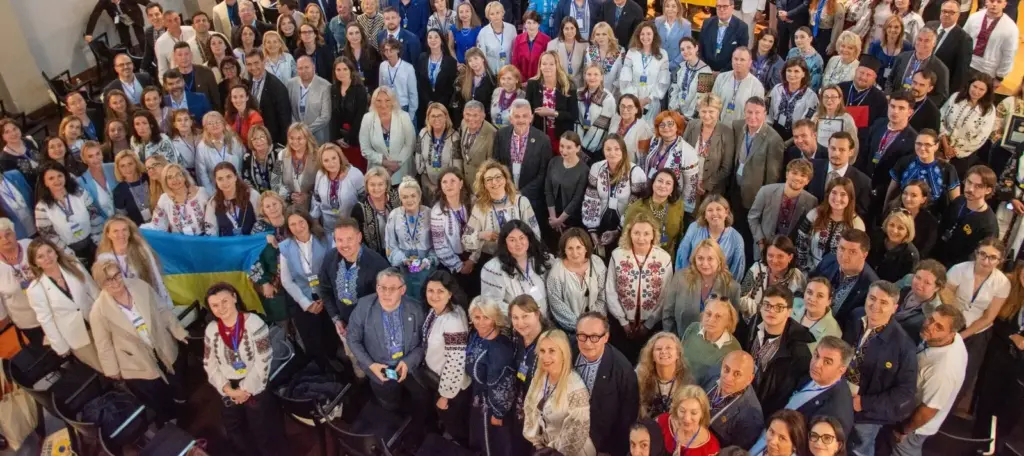
"The enemy is counting on our disunity," Ukraine's Deputy Foreign Minister Mariana Betsa told more than 350 diaspora leaders gathered in Bern on 7 June 2026. The answer came in the form of the Bern Declaration—a document committing Ukrainian communities across more than 50 countries to coordinated defense support, territorial restoration, and postwar recovery, the Ukrainian World Congress reported.
The declaration lands at a turning point for Ukraine's global community. An estimated 5.9 million Ukrainians now live abroad, yet only 43% of refugees say the war's end would be enough to bring them home.
The Bern Declaration reframes that reality: if millions of Ukrainians remain dispersed for years, their energy must be channeled into something more than candlelight vigils and flag-waving. The document calls global unity "not a symbol" but "a strategic prerequisite for the success of Ukraine and the Ukrainian people."
What the Bern Declaration demands
The Global Ukrainian Summit, held 5–7 June at the Yehudi Menuhin Forum next to Ukraine's embassy in the Swiss capital, was organized by the Ukrainian World Congress (UWC) in cooperation with the Ukrainian Society of Switzerland—an organization that has built ties between the two countries since 1945—and in partnership with Ukraine's Ministry of Foreign Affairs.
The declaration set out three priorities: Ukraine's victory through a just and lasting peace that restores territorial integrity and holds Russia accountable; the recovery of a strong, independent state free from Russian influence; and the cultivation of future generations of Ukrainian patriots worldwide.
It then issued seven calls to action. Diaspora communities pledged to fund Ukraine's defense forces, engage in political advocacy, take leading roles in reconstruction, protect Ukrainian identity and heritage, strengthen cross-border community networks, resist attempts to divide the Ukrainian people, and amplify Ukraine's global voice.
"Our goals remain unchanged: Ukraine's victory and Russia's defeat, the reconstruction of Ukraine, and a strong global Ukrainian community," UWC President Paul Grod told delegates at the summit's opening session.
Why Bern, and why now
The summit opened with a minute of silence for fallen defenders and all victims of Russia's war on Ukraine. In addition to Betsa, speakers included Deputy Minister of Social Policy Ilona Havronska, Central Election Commission head Oleh Didenko, Ukraine's Ambassador to Switzerland Iryna Venediktova, and former Russian prisoner of war Yuliia Paievska, known as "Taira."
Security remains the prerequisite for the return of millions of displaced Ukrainians, and the government is developing long-term solutions, Deputy Minister of Social Policy Havronska told delegates, according to SWI swissinfo.ch. Venediktova called for coordinated international measures—from sanctions enforcement to the deployment of frozen Russian assets and international criminal prosecution.
Swiss Federal Council Delegate for Ukraine Jacques Gerber attended the opening, underscoring Switzerland's growing role in humanitarian aid and reconstruction in Ukraine, SWI swissinfo.ch noted. Publicist Mykola Riabchuk delivered the keynote on unity within the global Ukrainian community, the UWC reported.
"Ukraine is already proving that it is a strong European nation that is fighting for its sovereignty and for the future of freedom around the world," Betsa told the summit.
From gestures to coordination
The Bern Declaration is the latest in a series of moves that trace a diaspora increasingly organized around concrete objectives. One month ago, Ukraine's women's diaspora gathered at the European Parliament in Brussels to debate the future of temporary protection for 4.4 million refugees.
Four months before that, the UWC coordinated nearly 1,000 events in 78 countries to mark the fourth anniversary of Russia's full-scale invasion. The Bern Declaration converts that momentum into a standing set of commitments.
The document, as Ukrinform reported, closed with three guiding principles: "Ukraine defines our unity. Responsibility before the Ukrainian people defines our unity. National action defines our unity."
"The enemy is counting on our disunity. Ukraine is already proving that it is a strong European nation that is fighting for its sovereignty and for the future of freedom around the world." — Deputy Foreign Minister Mariana Betsa, Bern, 7 June 2026
Read also
-
Ukraine’s diaspora question lands at the European Parliament on Monday
-
Why won’t most Ukrainian women refugees come back? The war is no longer the main reason
-
Ukrainian diaspora in 78 countries plans worldwide events to support Ukraine to mark invasion anniversary
-
EU votes to shelter four million Ukrainians fleeing Putin’s escalating bombing campaign until 2027