And that’s how we should look at acting Attorney General Todd Blanche’s work for the past two months. Blanche has served in a temporary capacity while Trump decided whether to nominate him permanently. It was a seemingly endless job interview — one he could fail only by disappointing the man conducting it. Last week, he finally passed the test when Trump announced that he would nominate him for the post, subject to Senate confirmation.
But his conduct during that audition should be disqualifying.
We’ve all been in job interviews, so it’s not hard to see what was going on here. When the interviewer asks whether you’re willing to work nights and weekends, you say yes. By naming Blanche acting attorney general, Trump put him in a position where he could either do the president’s bidding or risk losing the job he wanted.
That dynamic would be troubling in any Cabinet department. But it is especially dangerous at the Department of Justice, which possesses the power to investigate virtually any American. As Attorney General Robert Jackson observed in a famous 1940 speech, a federal prosecutor “has more control over life, liberty, and reputation than any other person in America.”
The greatest danger, Jackson warned, comes when “the prosecutor picks some person whom he dislikes or desires to embarrass, or selects some group of unpopular persons and then looks for an offense.” The reverse danger is just as real: A prosecutor can decline to pursue an ally despite compelling evidence.
For that reason, Americans have long expected the Justice Department to maintain a degree of independence from the White House. It was considered scandalous when former President Bill Clinton merely chatted with Attorney General Loretta Lynch on an airport tarmac while her department was investigating Hillary Clinton in 2016.
In the past, a Senate-confirmed attorney general could resist improper pressure from a president. That is what happened during Watergate, when President Richard Nixon ordered Attorney General Elliot Richardson to fire the special prosecutor investigating him. Richardson and his deputy refused and resigned. Nixon ultimately got his way, but only at enormous political cost.
An acting attorney general is in a much worse position. If displeased, Trump didn’t need to fire Blanche. He simply could have declined to nominate him. No scandal. No Saturday Night Massacre. No political cost. Some supporters might even have praised him for changing course.
Trump relied heavily on acting officials during his first term, naming everyone from the attorney general to the defense secretary to the White House chief of staff in an acting capacity. He liked the arrangement because it gave him, in his own words, “more flexibility.”
Since returning to the White House, he has used the tactic far less frequently, in part because a Republican-controlled Senate confirmed virtually all of his Cabinet nominees. The major exception was Matt Gaetz, the scandal-plagued Florida congressman whose nomination collapsed before a vote.
Kash Patel’s tenure as FBI director has been a national embarrassment in a great many ways, but among the most jarring developments this year is the sheer volume of bureau personnel who have been purged for political reasons, leaving the agency destabilized.
MS NOW’s Ken Dilanian noted the ongoing purge “is without precedent in the modern history of the bureau. It raises questions about whether the Trump administration is trying to turn the nation’s most powerful law enforcement agency into an instrument of presidential whim — exactly the thing he baselessly accused his opponent of doing.”
FBI Director Kash Patel fired a group of bureau intelligence analysts Friday over a rescinded 2023 memo about “radical traditionalist Catholic ideology” that has long been a focus of Republicans despite an investigation that found no anti-Catholic bias, three people familiar with the matter told MS NOW.
The analysts worked in the FBI’s Richmond office, where the memo originated, said the sources, who spoke on condition of anonymity due to sensitive personnel issues. They said at least five analysts were included in the firings.
That these firings were tough to defend is notable in its own right — there’s little to suggest the FBI analysts did anything wrong — though I’m also struck by the degree to which they tie into a broader pattern.
One week earlier, Dilanian reported that Patel also fired a senior intelligence analyst, Deputy Assistant Director Emily Morales, who played a role in the FBI’s 2017 assessment of the motives of the gunman who attacked a House Republican baseball practice.
That came on the heels of Patel firing a dozen FBI agents and staff for their role in investigating Trump’s classified documents scandal. In the process, the bureau director gutted the global espionage unit, known as CI-12, shortly before the start of the war in Iran.
A month earlier, Paul Brown, the special agent in charge of the FBI’s Atlanta field office, was also forced out, not because he’d done anything wrong, but because he questioned the value in re-investigating Georgia’s election results from six years earlier.
Around the same time, the FBI also purged the acting assistant director in charge of the New York field office, a former special agent in charge in New Orleans, as many as six agents in Miami, as well as agents who were pushed out for their involvement in the baseless “Arctic Frost” investigation in 2020.
A month before that, we learned about a lawsuit filed by 12 FBI agents who were fired for having taken a knee during racial justice protests in 2020 as part of an effort to de-escalate a situation that threatened to intensify.
Last August, Patel and his team ousted three experienced bureau leaders, including Brian Driscoll, a widely respected figure among rank-and-file agents who was removed after he helped prevent a mass firing of thousands of FBI officials who worked on Jan. 6 cases.
During his confirmation hearing early last year, Patel, a former podcast personality, assured senators that the bureau under his leadership “will not go backwards. There will be no politicization at the FBI. There will be no retributive actions taken by any FBI should I be confirmed as FBI director.”
As things stand, that testimony appears increasingly ridiculous.
Work on cases related to the criminal investigations into Trump? Fired. Work on Jan. 6 cases? Fired. Refuse to needlessly humiliate a former director? Fired.
It reached the point last fall when the FBI Agents Association said Patel was not only imposing “chaos” on the bureau, but that he’d also “disregarded the law and launched a campaign of erratic and arbitrary retribution.”
The FBI Agents Association added at the time that the director’s antics had created conditions that make “the American public less safe.”
Months later, as the number of those caught up in Patel’s personnel purge continues to grow, it’s tough to feel any better about the state of federal law enforcement.
It can be hard to regain footing after losing a job. It’s a reality many Americans have been forced to face under Donald Trump’s authoritarian rule and in the wretched economy he’s created. And it would seem former U.S. Border Patrol chief Gregory Bovino can relate.
That might explain Bovino’s desperate search for relevance since the far-right former immigration official, who promoted neo-Nazi propaganda and faced accusations of cosplaying as a Nazi during his stint leading Trump’s racist immigration crackdown, was ousted from his role as the Border Patrol’s “commander at large” in January. (Bovino has denied intending to convey Nazi ideology.)
Since his ouster, Bovino has tried to keep himself in the limelight — an effort that includes his recent attendance at a pro-extremist, Nazi-aligned conference in Portugal, and one that appears to be fueling Bovino’s consideration of a presidential bid.
At least he said he’s exploring a 2028 bid in a social media post on Monday. That the post includes the phrase “men fight back” suggests Bovino’s potential bid is likely to be rooted in the cringeworthy masculinity rhetoric we’ve heard out of the MAGA movement over the past few years in particular.
NewsNation is reporting I’m exploring a run for President in 2028.
Here’s the truth: My one and only priority is deporting the 106 million illegals who are here. That’s it.
The grassroots support I’m seeing tells me the polls are completely wrong…
Bovino seems to be carving a lane for himself to emerge as a stalwart of the furthest-right fringe of the MAGA movement. At the conference in Portugal, he attacked the Trump administration for purportedly not being extreme enough in its mass deportation agenda and made the same baseless claim he made in the tweet above: that there are at least 100 million undocumented immigrants in the United States. To be clear, this would mean about one-third of all U.S. residents are undocumented, which is a fanciful assertion.
What’s not clear is whether there’s much of a constituency for a Bovino presidential bid, even among the MAGA movement. His mass deportation proposals align with beliefs espoused by the far-right “Mass Deportation Coalition,” a group of right-wing organizations that want Trump to ramp up his assault on immigrants. But Bovino’s rhetoric and tactics are arguably a key reason why polls at the start of the year showed a majority of Americans believed the Trump administration’s anti-immigration strategy had gone too far. And as my colleague Steve Benen noted in January, Bovino racked up a list of scandals and controversies so long during his time as border chief that even Trump was forced to admit he’s a “pretty out-there kind of guy,” seemingly alluding to his extremist tendencies.
But if there’s anything to take away from Bovino’s floating of a presidential bid, it’s that he’s among a list of conservatives jockeying to lead the MAGA movement after Donald Trump is no longer president.
Since the Trump administration entered the White House last year, at least 500 babies and toddlers have spent some of that pivotal time in the custody of U.S. Immigration and Customs Enforcement.
ICE has dramatically increased detentions of children aged 3 and under, holding 25 of them in custody on an average day between January 2025 and March of this year, according to a new analysis by The Marshall Project and MS NOW of records obtained by the Deportation Data Project, a group of academics and lawyers who collect and share federal immigration data. That number is 10 times higher than it was in the previous 12 months under former President Joe Biden. Back then, on an average day, fewer than three babies and toddlers were held at facilities across the country.
Babies and toddlers in ICE custody Jan. 20, 2024 through March 11, 2026
Parents in ICE detention have complained of substandard conditions that frequently left their young children sick, isolated and regressing in their physical and intellectual development.
ICE did not respond to a request for comment about the increase in detained young children. But in an emailed statement, an agency spokesperson said families with children receive appropriate food, water and medical care. In a separate statement, CoreCivic — the private company that operates the primary ICE facility used to detain families — echoed that its facilities were safe for infants and toddlers.
“Our immigration system is breaking children,” she said.
* * *
In March, Joani, her husband and their 2-year-old son, Kaleth, showed up to a check-in appointment with immigration officials in California. Since the family immigrated and sought asylum in 2024, they had never missed a required appointment with immigration officials, according to the family’s lawyer. Nevertheless, that day, ICE took them all into custody.
As the whole family cried, Kaleth’s father was handcuffed and driven away to an adult detention facility in California. Joani and her toddler were taken to the Dilley Immigration Processing Center in Texas, the primary U.S. immigration facility that holds families with children.
Kaleth is seen in an undated handout photoCourtesy Kaleth’s family
At the family’s request, we are identifying Kaleth and Joani by their first names only.
Separated from his father, Kaleth was despondent in the Dilley facility, Joani said in an interview. He repeatedly scooted a tiny table over to a phone that was mounted on the wall, so he could climb up high enough to try to use it. Each time, Joani moved the table away so he wouldn’t fall. Even if he could have reached the phone, contacting his father in another detention center would have been impossible.
Kaleth stopped eating for 12 days. Joani said facility doctors attributed it to depression. When Joani tried to force him to eat, Kaleth vomited. He eventually stopped having bowel movements. Joani watched her son’s face grow gaunt, and his eyes sink into their sockets.
Lori Goodman, the CEO of LEAP, a nonprofit group that supports families with young children in California and has worked with Kaleth’s family, said children his age may express trauma physically since they have fewer verbal skills.
“He was so distressed that it manifested in his body in not being able to eat or digest.” Goodman said. “The longer a child is in that setting, the more the long-term damage.”
The most recent data available shows many very young children have spent prolonged periods of time in custody. Between Trump’s second inauguration and March of this year, ICE held at least 175 babies and toddlers for longer than a court-mandated time limit of 20 days. A federal judge interpreted 20 days to be the limit for detaining children in a 2015 opinion on the 1997 settlement in Flores v. Reno, which governs the treatment of children in immigration detention.
During the last year of the Biden administration, no children aged 3 or younger were held beyond the settlement’s 20-day limit. Biden had ended the practice of family detention in 2021, and the Dilley facility, which had mostly housed families, eventually closed. Trump restarted the practice and reopened Dilley shortly after retaking office.
In a May court filing submitted by ICE as required by the Flores settlement, the agency said it “works to assess cases and discharge minors from custody as promptly as possible.”
* * *
Alsu and Azat fled Russia last year, fearing that their opposition to the war in Ukraine would land them in prison and their 1-year-old, Amir, in an orphanage.
The family had braced themselves to spend a few weeks in immigration confinement upon arriving in the United States after crossing the southern border without visas, and presented themselves to authorities at a legal port of entry. But, as their incarceration stretched on, first in California and then at Dilley, they watched their once-lively son withdraw and begin hitting himself in the face.
“We came here to escape prison. We wanted to be free,” Azat said through a translator. “But once we arrived in America, we spent four months in detention.”
Dilley didn’t have many toys for toddlers, Amir’s parents said, and some desperate children resorted to playing with rocks. Even though Alsu and Azat knew it was important to read with him, they couldn’t find books in their native language of Russian. Amir’s speech development slowed. Eventually, he stopped saying anything other than two words: “mom” and “dad.”
Amir on September 17, 2025Courtesy Amir’s family
Griffin, the pediatrics professor, said it’s imperative for parents to talk to their children to help them develop vocabulary. But the fear and stress of incarceration can cause both parents and children to become quiet.
“They don’t want to talk, and no one’s talking to them, not in a normal way,” Griffin said. She noted that the experience can also damage the parent-child bond, as a child witnesses their parent’s loss of control.
Rahil Briggs, a psychologist at the early-childhood advocacy organization Zero to Three, said these types of developmental setbacks can have a domino effect.
“If we miss this foundational time in early childhood when we see all these wonderful things going on in brain development with memory and learning and executive functioning, then it’s just harder than ever to catch up,” Briggs said. “I can’t learn my ABCs because I’ve got to make sure that I’m safe in this scary situation. And because I haven’t learned my ABCs, now I’m not sure how to do this, and I’m not reading.”
Keeping Amir properly fed was another challenge.
According to Amir’s mother, Alsu, employees at Dilley forced her to wean him off formula, claiming he was too old. The solid food options, Alsu insisted, were not appropriate for a 1-year-old. She described being so desperate to get Amir to eat that she sucked a spicy pasta sauce off noodles so she could feed them to her son. She and Azat resorted to hiding cereal from the dining hall at breakfast in their socks and hoods for later, so their child wouldn’t go to sleep hungry.
“Every single day, I would break down, hysterical, because my child had gone without proper food,” Alsu said.
After they argued with staff members to get Amir better food, Azat alleges that employees in CoreCivic uniforms woke him up in the middle of the night, threatening to send the parents to separate immigrant confinement centers and Amir to foster care if they didn’t stop complaining.
“As a husband, as a father, I can see the sufferings of my child, I can see how much my wife suffers,” Azat said. “It was horrific for me, because I could do nothing to help them.”
* * *
Both Amir’s and Kaleth’s parents said their children suffered fevers and stomach problems during their incarceration at Dilley and that they struggled to get them adequate treatment. Many other parents have reported similar challenges accessing care inside facilities, including waiting for hours in line to get basic, over-the-counter medication.
Elora Mukherjee, a Columbia Law School professor who has represented more than 80 children and parents incarcerated at Dilley over the past year, said nearly all of her clients in recent months complained about poor medical care.
“Kids at this age also get sick more easily because their immune systems haven’t developed,” Mukherjee said. “Having such young children in a prison setting with hundreds of other kids and parents, it just makes them repeatedly, constantly sick. So they have fevers, they’re coughing, they’re vomiting, they have diarrhea. They are just miserable.”
Amalia and her parents were incarcerated at Dilley when the 1-year-old developed a fever and grew lethargic. Speaking through a translator, her parents said they returned to Dilley’s medical clinic again and again, but were only given Tylenol for her and warned not to complain. When Amalia’s mother, Kheilin Valero Marcano, went back to the clinic after her daughter lost consciousness, she recalled asking clinic employees, “How long are you going to leave her like this? Are you going to let her die?“
According to the family, Amalia eventually spent more than a week in an outside hospital, after her oxygen levels dropped to dangerously low levels. There, she was diagnosed with COVID-19, an ear infection, pneumonia, bronchitis and RSV, a common, but potentially serious, childhood illness that affects the lungs.
Amalia is seen in an undated handout photoCourtesy Amalia’s family
According to ICE’s standards, facilities should transfer sick people to an outside hospital if they cannot provide adequate care onsite.
Leecia Welch, a lawyer with Children’s Rights who has visited Dilley more than 10 times, said babies and toddlers, many too young to receive certain vaccinations, had some of the most troubling medical cases she’d seen, calling the situation “the most gut-wrenching.”
Welch recalled mothers in detention describing how stress and lack of nutritious food made breastfeeding difficult. Marcano said Amalia would cry throughout the night, because she’d tried to nurse and nothing would come out.
Other parents, whose babies drank formula, have stated in court documents that the facility did not provide enough bottled water to hydrate powdered formula, and purchasing additional water at the commissary was, for many, prohibitively expensive. Tap water at the facility, families said, smelled foul and made children sick.
Parents also described difficulties getting children to sleep. The lights in the Dilley facility were kept on all night, and toys that can help kids sleep were prohibited in living areas.
“They can’t go to sleep with a stuffed animal,” Welch said. “They can’t go to sleep with a security blanket, that’s just not allowed.”
***
Representatives for ICE and its parent agency, the Department of Homeland Security, did not answer specific questions about the conditions experienced by Kaleth, Amir, or Amalia. In a past social media post, DHS disputed claims lodged by Amalia’s family and insisted she “immediately received proper medical care.”
Brian Todd, a CoreCivic spokesman, said in an email that the Dilley facility provides toddlers and babies necessary supplies, including formula, healthy food and clean drinking water.
An ICE spokesperson made similar claims in an emailed statement and noted that the agency “is working rapidly and overtime to remove these aliens from detention centers to their final destination — home.” In a May court filing, ICE representatives stated that people are provided with an eye mask when they arrive at Dilley and, following complaints, the facility switched to lower-intensity lighting, though they remain on all night for security purposes. Agency officials also stated that water quality is monitored, babies under 12 months of age receive bottled water to make formula, and children have access to outdoor play structures, toys, multilingual books, and age-appropriate meals and snacks.
A court filing from lawyers for detained children called ICE’s claims “fanciful.”
ICE released Kaleth and his mother in April, two weeks after their incarceration, and they were later reunited with Kaleth’s father. According to Mukherjee, Kaleth had not eaten solid food the entire time. In the car from the airport, he devoured four packets of applesauce.
Kaleth has since recovered remarkably, said Goodman, the LEAP CEO — a testament to the family’s resilience and the strength of their parental bonds. She’s seen how Kaleth’s mother looks into his eyes, and comforts him when he is distressed.
“That is so powerful at counteracting the abuse that our government is perpetrating,” Goodman said.
Amir and his parents were also released, under supervision, in January. The toddler, now 2 years old, is laughing and speaking more. He’s not getting sick as often, and has stopped hitting himself. His parents say he seems closer to the happy child he was before ICE imprisoned him.
Even so, it’s too early to tell what the long-term effects of child incarceration will be on the hundreds of babies and toddlers who have gone through ICE detention since Trump re-entered the White House.
“The long-term damage caused by prolonged toxic stress — by essentially abusing these children — we’re going to see those effects. They’re going to impact every child who was there for many, many years to come,” Goodman said. “It’s incalculable the amount of damage that is being done.”
Graphics by Anna Flagg. Translation by Marina Kopinec and Seeno Merobshoev. Emily Berk contributed production.This article was published in partnership with The Marshall Project, a non-profit news organization covering the U.S. criminal justice system. Sign up for their newsletters, and follow them on Instagram, TikTok, Reddit and Facebook.
Even after the president returned to the Oval Office, those efforts continued with Trump-branded guitars and Trump phones, among other things.
In light of just how much the president, his family and his controversial businesses have profited during his second term, it’s tempting to think there would be no need to pursue yet another merchandising opportunity. After all, as The Atlantic’s David Frum recently explained, Trump has taken self-enrichment “to a scale never seen before in America.”
That assumption, however, would be wrong.
MS NOW’s Jake Traylor and Soorin Kim reported Tuesday that there are Trump-branded “medallions” on sale, tied to this weekend’s UFC event on the White House’s South Lawn.
The souvenir gold and silver coins range in price from $249.99 to $11,999.99. That’s not a typo: A website called RealTrumpCoins.com is actually selling UFC Freedom 250 “medallions” that people can purchase for just under $12,000. (The website boasts that the coins were “designed” by the president himself.)
Donald Trump is selling UFC-branded coins for $12,000 to promote the UFC fight on the White House lawn
The reporting from MS NOW’s Traylor and Kim added that some of the profits are expected to go to the president’s licensing company, DTTM Operations LLC. And while the White House has said the president isn’t personally controlling his family business while he’s in office, his son Donald Trump Jr. is.
To be sure, the scheduled UFC bout, set to coincide with the president’s 80th birthday, was already controversial, and not just because of the bizarre structure that continues to take shape at the White House. There have also been related questions about Trump’s stock purchase in UFC’s parent company before the upcoming match on the South Lawn.
As for tickets to the upcoming event, NBC News recently reported that the tickets are technically free and that the UFC is footing the bill for the event. That said, sponsorship packages, including ringside seats, have been selling for $1 million or more, and no one seems to know where the sponsorship money is going.
The $12,000 gold coins, however, take this mess to a new and unsettling level.
This week, a new lawsuit was filed alleging corruption in connection with the upcoming UFC event, with the hopes of derailing the plans for the gathering, and a judge is expecting a response by Tuesday. Watch this space.
“You never like to say too early you won,” Trump told supporters on March 11. “We won. In the first hour it was over.”
Two days later, he was at it again, writing Iran was “totally defeated” and was living in such a desperate existence that its leadership was begging for a deal.
Yet this past weekend, Iran launched new missile salvos at Israel, which replied in kind. And on Tuesday, Trump said in a social media post that Iran had downed a U.S. Army helicopter near the Strait of Hormuz. The pilots were unharmed, but Trump said “the United States must, of necessity, respond to this attack.”
It’s not a stretch to assess that Iran’s leaders are putting just as much pressure on Trump as Trump is putting on them.
If these events are any indication, Iran is not only holding its own but is arguably more aggressive today than before the U.S. bombing campaign began. Yes, the regime has lost a considerable portion of its military power and has cycled through senior officials about as often as the New York Mets have cycled through pitchers. But Tehran has not lost its ability to take the offensive and clearly believes it retains the upper hand against Washington.
It wasn’t supposed to be this way. Trump had high expectations when he initiated the war. The president was so pleased with the first strikes’ results, which included the assassination of Ayatollah Ali Khamenei, Iran’s supreme leader of nearly 40 years, that he implored Iranians to take back their government. The Trump administration told the public — and itself — a story about Tehran’s many weaknesses; its economy was floundering, its people were unhappy, its command-and-control was breaking and its leaders were on the run or dead. Trump thought the Iranian regime would crumble or give up before it decided to retaliate by closing the Strait of Hormuz. Sooner or later, Iran’s nuclear program would be a figment of our imaginations.
Of course, none of Trump’s assumptions panned out. The regime is more unified and institutionalized than the White House anticipated. Khamenei has been replaced by his more inscrutable son, Mojtaba Khamenei, and the hard-line Islamic Revolutionary Guard Corps has become the most important power center in the Iranian establishment. The Strait of Hormuz remains shuttered.
Before the April 8 ceasefire, Iran was targeting its neighbors’ energy facilities, both to scare the Gulf states into pushing Trump to de-escalate and to heighten the pain at the pump. Though gas prices in the United States have dropped in the last month, as of Tuesday, Americans are still paying $4.16 a gallon — 40% more than when the war began. The unofficial extra tax has translated into terrible numbers for Trump: Even a 33% plurality of Republicans believe the war has had a more negative than positive impact on U.S. interests.
Iran is not blind to these dynamics. If anything, it’s emboldened by them. The Iranian military apparatus may still be recuperating from the heavy U.S. and Israeli airstrikes during the war’s first weeks, but the damage inflicted has failed to translate into strategic results. Killing Iranian generals, destroying Iran’s navy and damaging the regime’s drone manufacturing capacity were not ends in themselves but rather a means to an end — coercing Tehran into a settlement on U.S. terms. The scorecard for the Americans on that front is unimpressive. Iran hasn’t just survived the U.S.-Israeli onslaught; it’s effectively pushed back through asymmetric military tactics. It’s not a stretch to assess that Iran’s leaders are putting just as much pressure on Trump as Trump is putting on them.
This past weekend’s missile salvo against Israel is a case in point. This wasn’t a sign of desperation on Tehran’s part but rather Iran making its own threats credible. The regime had warned that Israeli airstrikes against its proxy, Hezbollah, in southern Lebanon, in contraventiosn of a previously announced ceasefire reaffirmed last week, would result in Iranian military action against Israel.
This war will impact the region’s geopolitics for years to come.
If Trump and Israeli Prime Minister Benjamin Netanyahu thought this was a bluff, Iran put those illusions to rest by sending dozens of ballistic missiles toward Israel. (Fortunately, they only caused minor damage.) Trump, desperate to keep his diplomatic process with Iran alive, has since pressured Netanyahu into postponing whatever air campaign he was ready to order beyond the retaliatory precision strikes the prime minister authorized on Sunday and Monday.
To be clear, Iran is not solely dictating events, nor is it in a strategically advantageous position over the long-term. This war will impact the region’s geopolitics for years to come. For instance, the firing of thousands of attack drones and missiles into Saudi Arabia, the United Arab Emirates, Kuwait and Qatar (among others) has jeopardized the regime’s previous attempt at detente with its regional neighbors. Even the regime’s weaponization of the strait may not last; the Saudis and Emiratis are adapting by building alternative pipelines over land to ensure their oil exports are not held hostage to any future Iranian machinations there.
But from the U.S. standpoint, the war is producing a more extreme Iranian political establishment. Its positions on core issues for any agreement, like the nuclear program, are indistinguishable from the prewar status quo . And the previous risk-adverse behavior proffered by the regime’s older guard is increasingly perceived by the new powers that be as a mistake. Whatever happens next in the conflict, these developments don’t serve U.S. interests.
At first blush, the idea of a Democratic senator in a red state focusing attention on a mining project in Kazakhstan might seem odd. After all, many voters couldn’t find Kazakhstan on a map and probably have priorities that have nothing to do with foreign mining projects.
But Sen. Jon Ossoff of Georgia, ahead of his re-election bid this year, took the time in recent days to highlight a Kazakhstan mining project because of allegations that the Trump administration invested American tax dollars in the endeavor, which has been linked to two of the president’s sons, Eric Trump and Donald Trump Jr.
The emphasis wasn’t surprising. The incumbent senator has built much of his 2026 candidacy around the idea that corruption isn’t just a major national issue, it’s also the principal cause for the problems plaguing regular Americans in their everyday lives. “You aren’t the problem. Neither are your fellow Americans,” Ossoff routinely tells Georgians. “Corruption is why things don’t work for ordinary people.”
The senator’s focus appears to be resonating. Going into 2026, Ossoff was generally seen as the most vulnerable Democratic incumbent, but with 21 weeks remaining before Election Day, both parties see him as an increasingly strong candidate who might very well prevail despite Trump having won Georgia two years ago.
It’s not yet clear whether other Democrats will be equally inclined to emphasize corruption as a campaign issue, but with each passing day, the White House and its allies offer fresh evidence of a systemic issue. Consider some of the reporting and allegations that have surfaced over the last five days:
The Washington Post reported that of the publicly identified donors to the president’s ballroom project, more than half “have won new or expanded federal contracts worth more than $50 billion during the past six months.”
The Washington Post also reported that the Trump administration has sharply accelerated spending on border wall construction and that most of the money has gone to two companies with “ties to the White House and the Republican Party.”
As if there weren’t already enough questions surrounding special favors for MAGA Inc. PAC donors, CNN reported on the generous support Trump’s super PAC has received from those who either have federal contracts or who are trying to influence the administration.
The New Yorker reported on how the wealthy continue their efforts to buy presidential pardons.
Reuters reported that the Trump family has generated at least $2.3 billion in profit from investors since the president returned to the White House, which contrasts with “the more than a million investors whose net losses totaled $2.3 billion at the end of April.”
If we widen the aperture a bit, a new lawsuit was also filed this week alleging corruption in connection with the upcoming UFC event on the White House South Lawn.
This isn’t a comprehensive list, and again, these are just headlines from the last five days. A similar assessment of related reports from the last few months would supply a staggering list that’s vastly longer.
In a recent piece for MS NOW, Paul Waldman explained, “Voters might be willing to ignore all this self-dealing if the economy were doing great, everyone had health insurance, housing was cheap and gas was $2 a gallon. But when people are struggling, corruption takes on a new urgency. That’s because it provides a way for voters to understand a deeper rot in the system that manifests in all kinds of ways.”
The question isn’t why Ossoff is focusing so heavily on corruption as a foundational 2026 issue; the question is why every other Democrat isn’t pushing the same issue in their own campaigns.
The former impeachment attorney for Texas attorney general and Republican Senate candidate Ken Paxton told MS NOW’s Ana Cabrera on Tuesday that he believes Democratic nominee James Talarico is “the better candidate” in the race.
“I don’t wish Ken any ill will. I don’t harbor any resentment for the man. I just think that Talarico is the better candidate,” Dan Cogdell told Cabrera. “I think he is focused on the issues that Texans care about, and I think he’ll do a good job.”
Cogdell, who represented Paxton both in his impeachment trial and during his federal securities fraud investigation, announced Monday that he would be voting for Talarico over his former client in the November general election. He told Cabrera that while he had fulfilled his constitutional duty to represent Paxton vigorously, “the Constitution does not require me to vote for him or endorse him.”
Prior to supporting Talarico, Cogdell had been an enthusiastic supporter of Paxton’s. Last year he donated $6,500 to Paxton’s campaign, Federal Election Commission records show; in March of this year, he donated $1,000 to Talarico’s campaign.
Cogdell told Cabrera that he came to support Talarico after learning about his campaign and priorities, saying, “I believe he’s focusing on the things that Texans are concerned about,” like gun violence, education and healthcare.
“I haven’t seen Ken Paxton mention any of those things in his run-up in this election,” Cogdell said. “I believe James is focusing on those things, and I think those things are important to Texans.”
Talarico beat out Rep. Jasmine Crockett, D-Texas, in the March primary to win the Democratic nomination. A former public school teacher, 36-year-old Talarico has been lauded as a rising star within the Democratic Party, and polling suggests he has a real shot at winning Democrats’ first statewide seat in Texas in decades.
Paxton, meanwhile, defeated incumbent Sen. John Cornyn in last month’s Republican primary after securing President Donald Trump’s much-anticipated endorsement. But Paxton has been plagued by scandals, including a divorce initiated by his wife, state Sen. Angela Paxton, who said she was filing “on biblical grounds.”
Cogdell said that he does not regret representing Paxton, adding that he’s “proud of that work.”
A spokesperson for Paxton’s Senate campaign did not immediately respond to a request for comment from MS NOW on Tuesday.
This is the June 9, 2026, edition of “The Tea, Spilled by Morning Joe” newsletter.Subscribe hereto get it delivered straight to your inbox every Monday through Friday.
MIKA’S NOTE
Donald Trump, top members of his administration, and his allies in Congress, are amplifying baseless claims of voter fraud in California.
The president, along with Speaker Mike Johnson, Vice President JD Vance, and Republican Sen. Ron Johnson, all spent time claiming Spencer Pratt‘s defeat in the Los Angeles mayoral race was due to some nefarious scheme against Republicans.
Donald Trump knows — as does everybody in Washington — that California always takes 30 days by law to count their votes.
That’s what the state did when Republican Arnold Schwarzenegger was elected governor. That’s what it did when Republicans took back control of the House in 2022. That is what it did when Republicans maintained their House majority in 2024. That’s how California counts its ballots every year.
Donald Trump knows that. Speaker Mike Johnson knows that. Sen. Ron Johnson knows that.
They say elections are only legitimate when Republicans win them. Even in California. Especially now in California.
These are cynical, autocratic gestures that undermine American democracy.
As for Ron Johnson: He was caught on tape in August 2021, patiently explaining to someone who he thought was a MAGA supporter, telling them that Donald Trump legitimately lost the 2020 election. He went into great detail about how every statewide Republican on the Wisconsin ballot got 51,000 more votes than Donald Trump, and that Donald Trump did not get those votes because he hurt his standing with Wisconsin Republicans. Take a look:
Ron Johnson said the election was legitimate.
After all, Trump lost the 2020 election by more than 7 million votes.
These men know the law.
The only time they say elections in California, or elsewhere in the U.S., are legitimate is when Republicans win.
Or when they know the cameras are rolling — for Trump.
QUOTE OF THE DAY
“People are tired of watching the highly political @NBA. Basketball ratings are WAY down, and they won’t be coming back. I hope football and baseball are watching and learning because the same thing will be happening to them. Stand tall for our Country and our Flag!!!”
—President Donald Trump in 2020 after the NBA backed the Black Lives Matter movement and anti-racism protests across the country.
CHARTS OF THE DAY
Source: Reuters/Ipsos poll of 4,531 U.S. adults, conducted June 3-8, 2026. Margin of error: +/- 1.5 percentage points
ON THIS DATE
In 1954, during the Senate Army-McCarthy hearings, Army special counsel Joseph N. Welch berated Sen. Joseph R. McCarthy, a Republican from Wisconsin, asking: “Have you no sense of decency, sir? At long last, have you left no sense of decency?”
U.S. Senate via Wikimedia
Joseph Welch (seated, left) and Sen. Joseph McCarthy (standing) during the 1954 Army-McCarthy hearings.
WHAT THEY SAID
Jonathan Lemire on Republicans’ claims of fraud in California
“There’s no surprise here: What they’re doing is laying the groundwork for two different plays for November. They could claim irregularities, conspiracies, and actively take measures to interfere with the vote, or they could claim the voting result is illegitimate and not honor it.”
Richard Haass on elections
“Don’t be surprised in November if we see voting machines and ballot boxes seized to ‘prevent fraud.’ This is the 250th year of this country, and we’re meant to be honoring the Declaration; instead, we’re facing the most concerted assault on it.”
Jim VandeHei on the U.S.-Israel relationship
“If I were in Israel, or I was a pro-Israel American, I’d be really worried about the next two years. Public support in the U.S. is cratering on both sides, and the White House is looking for the least messy, most publicly defensible way to get out of this mess.”
Rev. Al Sharpton on the Knicks
“New Yorkers were out there for New Yorkers, people were excited to see the championship finals back in the city, and it was one of the most unifying, electric events that I’ve seen in many years. I think the president was the only one who had any negatives.”
Jane Fonda on the First Amendment
“What’s happening now has never happened before in this country to white people. Black people have experienced authoritarianism. Today, all our First Amendments are being destroyed, our voting rights are being taken away, and people are being arrested and deported without due cause. This is not what happens in a democracy — like a pancake, it’ll take an iron and just flatten our cultural discourse. We have to fight back.”
PRIMARY DAY IN CLOSELY WATCHED MAINE SENATE RACE
Primary voters in Maine go to the polls today in one of the most critical races on the 2026 battleground map — a Senate contest that could help decide control of the upper chamber.
Incumbent Republican Sen. Susan Collins is running unopposed on the GOP side. But it’s her likely Democratic opponent – Graham Platner – who has been grabbing headlines of late.
Platner is expected to win his primary, despite a series of scandals that have engulfed his campaign.
Despite Platner’s personal indiscretions, many high-profile Democrats are standing by him … or at least not asking him to drop out.
EXTRA HOT TEA
10,800
—The number of cases of Noble Oak bourbon stolen in a daytime heist off a truck traveling between Pennsylvania and New Jersey. The thieves made off with nearly $500,000 worth of the liquor.
ONE MORE SHOT
Gregory Shamus/Getty Images
Jalen Brunson of the New York Knicks shoots the ball between Julian Champagnie (No. 30) and Victor Wembanyama (No. 1) of the San Antonio Spurs during the fourth quarter in Game 3 of the NBA Finals.
This is an excerpt from the June 9, 2026, edition of “The Tea, Spilled by Morning Joe” newsletter.Subscribe hereto get it delivered straight to your inbox every Monday through Friday.
Source: Reuters/Ipsos poll of 4,531 U.S. adults, conducted June 3-8, 2026. Margin of error: +/- 1.5 percentage points
A few months ago, Defense Secretary Pete Hegseth complained that the Pentagon had officially recognized too many faith traditions, which he characterized as “impractical.” A few weeks ago, the Defense Department acted on those concerns, shrinking the list of recognized religions from 211 faiths to 31.
The rather dramatic shift did not go unnoticed, though no one in American politics responded with greater fury than Sen. Mike Lee of Utah — ordinarily a conservative Republican closely aligned with the Trump administration — who said it was “repugnant” to see the Pentagon’s list exclude his own faith, the Church of Jesus Christ of Latter-day Saints (whose members are generally referred to as Mormons), from among the identified Christian faiths.
The outcry seems to have prompted a reversal from the Defense Department. On Monday, a social media post from the department included a new list with a caption that said the previous one “included redundant and unnecessary labeling, and the mistake has been fixed.”
The new list’s codes no longer identify which of the recognized faiths are considered Christian, which raises the question of whether Pentagon officials consider the Church of Jesus Christ of Latter-day Saints to be a form of Christianity, or if they would simply prefer not to flaunt their beliefs on the topic in public.
A spokesperson for the Utah Republican said, “Sen. Lee spoke with President Trump and Secretary Hegseth over the weekend and received their assurance that the Pentagon’s religious classifications would be fixed. He appreciates the administration’s action to address this issue.”
Whether the Pentagon is prepared to make additional changes remains to be seen, but as the dust settles on this dispute, it’s worth pausing to appreciate the context.
But when the GOP senator saw a list of Pentagon-recognized faith traditions and didn’t see his own church, that’s when he felt the need to speak out.
In November 2000, there was an episode of “Futurama” in which Bender famously complained, “This is the worst kind of discrimination: the kind against me!”
In Los Angeles’ closely watched mayoral race, it’s been clear for several days that Karen Bass, the city’s Democratic incumbent, received enough support in last week’s primary to advance to the general election in November. The question was who she’d run against.
Los Angeles Council member Nithya Raman will advance to the November general election in the mayoral race to face the incumbent, Karen Bass, after overtaking ex-reality TV star Spencer Pratt in the primary, The Associated Press projects.
Raman has steadily trended upward in the vote count since Election Day, and she overtook Pratt on Sunday. Monday’s vote update gives Raman a cushion of more than 20,000 votes, making her position in the top two safe, with an estimated 93% of the vote counted.
In California’s gubernatorial race, meanwhile, the vote count is still underway, though we now know that Xavier Becerra, a former Democratic congressman who served as Joe Biden’s health secretary, has advanced to the general election.
It’s not yet clear who his rival will be, but with nearly 83% of the ballots tallied, Steve Hilton, a Trump-backed Republican, appears well positioned to finish second, while Democratic billionaire Tom Steyer is (at least for now) running third.
And therein lies the problem with Republican conspiracy theories about California’s vote count.
In recent days, a great many GOP leaders, including Donald Trump and Republicans on Capitol Hill, have invested an enormous amount of time and energy trying to convince the public the state’s elections process is “rigged” by nefarious Democratic schemers who’ve secretly orchestrated the results to ensure their preferred outcome.
When pressed for evidence, GOP officials tend to embarrass themselves, but that’s not the only — or even the central — problem. On the contrary, the Republican conspiracy theory suffers from an obvious fatal flaw: If nefarious Democratic schemers existed and were secretly orchestrating the results, they wouldn’t have picked these outcomes.
In Los Angeles’ mayoral race, it’s no secret that the Democratic incumbent, running in a city with an enormous progressive voter base, welcomed the opportunity to run against a conservative television personality with an embarrassingly thin professional resume. Instead, Bass will face Raman, a Harvard- and MIT-educated City Council member who’s already demonstrated an ability to win local elections.
If powerful Democratic operatives were pulling the strings from the shadows, they would’ve gladly pitted Bass against Pratt, if only to watch him lose in November.
Similarly, Democrats would’ve loved to see two Democratic candidates emerge from the state’s gubernatorial primary, thus ensuring party control. Instead, it appears increasingly likely that a GOP candidate backed by the Republican president will advance to the general election — which, again, is not the outcome these ostensible powerful Democratic operatives pulling the strings from the shadows would’ve deliberately orchestrated.
Put it this way: Either the Republican conspiracy theories are wrong, or Democrats are the most incompetent schemers imaginable.
There’s more than one reason that Todd Blanche should not be attorney general of the United States. You’ll be hearing plenty about them in the days and weeks ahead, following President Donald Trump’s nomination of his former criminal defense lawyer to lead the Department of Justice.
One way to view the nominee is through a single word: “tainted.”
That’s how a judge described Blanche’s investigation into Kilmar Abrego Garcia, who became a prime target of the administration’s crudely incompetent deportation regime last year. The Trump-controlled government illegally sent Abrego to El Salvador in violation of a court order, then resisted additional court orders for his return, and then finally secured his return but only to greet him with an indictment that a judge recently dismissed as unconstitutionally vindictive.
It’s rare for judges to grant vindictive prosecution motions, but the actions of Blanche and his colleagues made it possible. Indeed, U.S. District Judge Waverly Crenshaw emphasized that he didn’t reach the conclusion “lightly” in his ruling last month.
But in dismissing the charges of illegally transporting undocumented immigrants, to which Abrego had pleaded not guilty, Crenshaw wrote that “absent Abrego’s successful lawsuit challenging his removal to El Salvador, the Government would not have brought this prosecution.” The Obama-appointed judge recalled that the government had closed its investigation into the Tennessee traffic stop at the center of the case in 2022. It was only reopened after Abrego succeeded in vindicating his right to remedy his illegal removal.
Crenshaw singled out the blundering of Blanche, who is currently the acting attorney general after Pam Bondi’s departure. He was deputy attorney general at the time of the Abrego probe. “Absent Blanche’s tainted investigation,” Crenshaw wrote in his May 22 ruling, Abrego’s illegal indictment would not have happened.
The judge noted that Blanche said in a Fox News interview that the executive branch only started investigating Abrego after a judge in Maryland “questioned” the decision to deport him illegally.
In fact, Crenshaw’s dismissal ruling was only made possible by his previous finding that Abrego could proceed with discovery into potential vindictiveness. Blanche played a starring role in that incremental ruling last year, where Crenshaw wrote, “Deputy Attorney General Blanche’s remarkable statements could directly establish that the motivations for Abrego’s criminal charges stem from his exercise of his constitutional and statutory rights to bring suit against the Executive Official Defendants, rather than a genuine desire to prosecute him for alleged criminal misconduct.”
Therefore, Blanche has not only acted as an instrument for Trump’s revenge but has done so in a manner that has thwarted that revenge’s success. To be sure, Blanche is a competent attorney, but he has chosen what might be termed a “tainted” path. If the GOP-controlled Senate confirms him to the top job full time, then a microscopically dim silver lining could be that his continued service to Trump will result in further fumbles.
Donald Trump hasn’t exactly gotten along well with his attorneys general. Ten days into his first term, for example, the president fired acting Attorney General Sally Yates after she notified the White House that then-national security adviser Michael Flynn lied about his post-election talks with Vladimir Putin’s government and may be vulnerable to a Russian blackmail campaign.
In the months and years that followed, Trump clashed with Jeff Sessions during his tenure as attorney general, accusing the Alabama Republican of “disloyalty” and being an “idiot.” He later similarly condemned Bill Barr, calling him a “spineless RINO” and a “disappointment in every sense of the word.” The president wasn’t even satisfied with Pam Bondi, complaining that she didn’t move quickly or aggressively enough to meet his partisan demands.
Trump likely believes he’ll have better luck with his latest choice. MS NOW reported:
President Donald Trump on Monday formally nominated his longtime loyalist and former personal defense lawyer Todd Blanche to serve as attorney general permanently.
Blanche has been serving as the nation’s top prosecutor in an acting capacity after Pam Bondi was fired by Trump in April. Blanche was Bondi’s deputy at the time. The nomination has been sent to the Senate.
Since becoming the acting attorney general, Blanche went to almost cartoonish lengths to use his office in ways designed to please the White House, up to and including indicting people the president doesn’tlike. Trump, not surprisingly, was delighted. Whether senators are equally impressed remains to be seen, though there’s no reason to assume that his confirmation will be easy.
Stepping back, however, there’s the related question of why Blanche actually wants this job.
With recent history in mind, it’s clear that serving as Trump’s attorney general isn’t easy. A recent Slate piece described it as “the worst job in Trump’s Cabinet,” adding that under the incumbent president, this is an “impossible, degrading, no-win job.”
That might’ve seemed hyperbolic, but it’s grounded in fact: Trump has a very specific vision in mind related to the position, and it’s not pretty. As has become painfully clear, the president wants a partisan loyalist who will serve as his personal tool, using the Justice Department to advance Trump’s goals and interests at all times, under all circumstances, and without regard for any other considerations.
The president, in other words, expects an attorney general who’s part puppet, part weapon and part cheerleader. Those serious about the rule of law and apolitical ethical limits need not apply.
I’ve seen some analyses that have described the office under Trump as “an impossible job,” largely because no one can be quite pathetic enough to satiate all of the president’s whims and demands. It’s a fair point, to be sure, but that’s what makes Blanche’s nomination inherently interesting: He, unlike guys such as Sessions and Barr, doesn’t actually want to lead the DOJ or oversee federal law enforcement; Blanche simply wants to serve Trump.
In other words, Blanche might very well be the first and only attorney general Trump actually gets along with because he and the president share a common view of the office. By tradition, those in this role strive to be “the people’s lawyer.” The president’s new nominee has no such ambitions: His goal is to serve one American, not 340 million Americans.
Blanche has made it abundantly clear that he doesn’t want to be the American people’s attorney general; he wants to be Trump’s attorney general. Is it any wonder why the president is optimistic about his choice?
President Donald Trump’s first term sent a wave of national security professionals into politics. His second term is doing the same for public health experts.
Among the most prominent is Dr. Nirav Shah, who was head of the Maine Center for Disease Control and Prevention during the coronavirus pandemic. He is considered the front-runner in a competitive Democratic primary for Maine governor on Tuesday.
Other candidates include Dr. Amy Acton, a pediatric physician and researcher who is the Democratic gubernatorial nominee in Ohio, and Jasmine Clark, who is poised to become the first Black woman Ph.D. scientist in Congress after securing the Democratic nomination for Georgia’s 13th District. In Michigan, Dr. Abdul El-Sayed, a former public health official, is currently ahead in the polls for the Democratic Senate primary in August.
They are part of a broader wave of scientists getting involved in politics. The 314 Action Fund, a political action committee dedicated to recruiting and electing Democratic STEM professionals, has committed more money than ever before to the 2026 primary cycle.
Doctors are nothing new in politics, of course. There are already 20 physicians serving in Congress, including four senators.
But the current group of elected officials is disproportionately Republican, while the new wave of candidates is centered in Democratic primaries.
Health and Human Services Secretary Robert F. Kennedy Jr.’s deep cuts to staff at federal health agencies and controversial changes to vaccine policy seem to have inspired a number of the candidates.
But on the campaign trail, they are much more likely to talk about Trump allowing expanded subsidies for health insurance under the Affordable Care Act to expire than on public health policy.
Dr. Richard Pan, a pediatrician running for Congress in California, gave a typical statement in a social media post last week.
“People in the district are struggling as the cost of gas, food, and housing spike and health care is being taken away by the Trump Administration,” he wrote.
Just 4 in 10 U.S. adults say they support the Make America Healthy Again movement championed by Kennedy, according to polling last month from health policy organization KFF.
But when asked to choose the most important health priority for the federal government, 42% of MAHA backers chose lowering healthcare costs, twice as many as the next agenda item, restricting chemical additives to food.
Once in office, medical professionals will sometimes cite their expertise when trying to win a political argument, but there are limits.
Republican Sen. Bill Cassidy of Louisiana, a gastroenterologist, led the effort against Kennedy’s nomination in 2025 before reluctantly voting for him. Last month he lost a Republican primary for re-election after Trump endorsed his opponent.
A focus on costs also helps candidates stay focused on the economy. Only 2% of voters say healthcare is the most important issue in the election, according to a May poll by Gallup, well below the economy and immigration.
Like any other group of political newcomers, healthcare professionals have also faced setbacks. In Texas, emergency room physician Dr. Ada Cuellar lost a Democratic congressional primary to a Tejano music star.
But these kinds of waves can have a long-term impact. Among the class of national security pros who won in 2018 were future senators Elissa Slotkin and Andy Kim and future governors Abigail Spanberger and Mikie Sherrill.
This is a preview of MS NOW’s Project 47 Newsletter. As President Trump continues implementing his ambitious agenda, get expert analysis on the administration’s latest actions and how others are pushing back sent straight to your inbox every Tuesday. Sign up now.
SIDON, Lebanon (AP) — Christian religious leaders from Lebanon’s southern port city of Tyre called on the international community and Lebanese officials on Tuesday to act quickly to prevent Israel from attacking the Christian district of the city, as airstrikes on nearby neighborhoods killed eight people and wounded dozens of others.
The Israeli military has issued an evacuation warning for the port city, including the Christian quarter, which has been spared so far.
The statement by the Christian leaders was from George Iskandar, the metropolitan archbishop of Tyre for the Melkite Greek Catholic Church; Elias Kfoury, the Greek Orthodox metropolitan of Tyre, Sidon and Dependencies; and Charbel Abdullah, the archeparch of the Maronite Catholic Archeparchy of Tyre.
The warning from Israel’s military prompted hundreds of people to flee the Christian district along the Mediterranean coast, while members of the Civil Defense evacuated older people to safer areas, the state-run National News Agency said.
Cars packed with mattresses, luggage and household belongings stretched for kilometers along Lebanon’s coastal highway, as residents fled Tyre following the latest Israeli warning. Traffic ground to a halt as families crammed whatever they could into vehicles, with carpets protruding from rooftops, and trunks were left partially open to accommodate furniture and personal belongings.
“After the warnings in Tyre, we left. We picked up and left,” said Ali Bahar, who was traveling with his wife and three children in a car loaded with possessions.
“Where should we go? There is nowhere to go,” Bahar said. “We will end up in the streets. We are heading to Sidon.”
Nearby, Hussein Darwish sat in the gridlock after packing his vehicle with what he could carry.
“We left to be reassured and safe,” he said.
An Israeli airstrike Tuesday in another neighborhood in Tyre killed eight people and wounded 32 others, according to the Health Ministry.
The three Christian leaders called on the international community and Lebanese leaders to “take immediate and serious action to spare the old quarter of Tyre from destruction and human tragedies.”
The Israeli warning to Tyre came after Israel and Iran traded fire following Israel’s targeting of Hezbollah in Beirut on Sunday, triggering heightened tensions in the Middle East and fears that the conflict could spread further.
Over the past few weeks, Israel’s airstrikes have caused wide destruction in Tyre, the fourth-largest city in the country.
Considered one of the oldest metropolises of the world, Tyre has several archaeological sites, some of them submerged. The city was officially declared a UNESCO World Heritage Site in 1984.
“The old city is not merely a residential area,” the clergy said in their statement. “It is the historical and human heart of Tyre, home to thousands of civilians, including families, children, and the elderly.”
They said that the old quarter also holds a rich cultural, religious and civilizational heritage dating back centuries.
“Any targeting or destruction of this neighborhood would constitute a humanitarian and national catastrophe with irreversible consequences,” they warned.
Kfoury said that the ongoing conflict isn’t only a war on Hezbollah.
“The war is against all of Lebanon, not just one particular group within Lebanon,” he said.
“They are destroying Lebanon. Period,” Kfoury said about the ongoing Israel-Hezbollah war that broke out on March 2, when Hezbollah fired rockets at northern Israel, two days after the U.S. and Iran began attacking Iran on Feb. 28.
He said that the fighting should stop because it’s a “destructive war.”
Last week, Israel warned the Christian neighborhoods in Tyre that Hezbollah members were among them. Many Lebanese Shiite Muslims fled to those areas over the past two weeks, because they were spared from the aerial bombardment along the Mediterranean coast.
After last week’s warning, the Lebanese army deployed to the Christian district of Tyre in an effort to prevent Israeli attacks there and to show that Hezbollah has no armed presence in the area.
On Tuesday, the Israeli military’s Arabic-language spokesperson, Avichay Adraee, posted on X that as the military warned days ago that Hezbollah members were working inside the Christian district, the Israeli military “will have to act against their terrorist activities in the neighborhood soon.”
Adraee said that any building used by Hezbollah for military purposes “may be subject to targeting.”
Lesley Groff, Jeffrey Epstein’s longtime assistant, denied knowledge of her former boss’s crimes in her transcribed interview with the House Oversight Committee on Tuesday, the latest witness to testify in the panel’s sprawling Epstein investigation.
“I believe that my testimony will dispel the false notions that because of my employment with Epstein I must have knowingly enabled or conspired with him to commit his evil acts,” she said, according to a copy of her opening statement obtained by MS NOW. “Nothing could be further from the truth.”
Groff, who worked for Epstein for 18 years until he was arrested in 2019 on sex trafficking charges, told lawmakers in her opening statement that she never socialized with Epstein or his co-conspirator, Ghislaine Maxwell. She described Epstein as “a master manipulator and deceiver who separated his legitimate life from his secret life as an abuser and made sure that as his secretary, those two worlds did not collide.”
Several Democrats on the committee have said that Groff’s testimony was not credible.
“Leslie Groff maintained today that she never once even had a suspicion that perhaps he was abusing women and girls; I find it unbelievable — absolutely unbelievable, not remotely credible,” Rep. James Walkinshaw, D-Va., told MS NOW’s “The Weeknight.”
Rep. Stephen Lynch, D-Mass., told reporters earlier Tuesday during a break in the interview that Groff’s characterization of their relationship was “highly inconsistent.”
“He was a registered sex offender, and she arranged young women for massages with a registered sex offender, and I just question whether … she can rightfully and truthfully maintain that she saw nothing improper in that,” he said.
According to her opening statement, Groff told lawmakers she made massage appointments for Epstein almost daily. She said she never met any of the masseuses, and none of them told her that they were minors or that they were being sexually abused. “Nothing I heard or saw led me to believe otherwise,” she said in her statement.
Groff also said she arranged phone calls between Epstein and Donald Trump, according to Lynch. Groff did not say what year that happened, but it was before Trump became president, Lynch said. (Trump has said he cut ties with Epstein in the 2000s, and he has not been charged or officially accused in court of crimes related to the Epstein files.)
Groff’s name appears more than 160,000 times in the Epstein files released by the Justice Department. She was one of the most present people in Epstein’s orbit, arranging his meetings with prominent figures and setting up massages for him with women.
Marina Lacerda, who was abused by Epstein as a minor, said at a news conference in September 2025 that Groff “would call me and tell me that I needed to be at the house so often that I ended up dropping out of high school before ninth grade.”
Notably, House Chaplain Margaret Grun Kibben was also in attendance for the first nearly 1.5 hours of Groff’s interview. The chaplain has not been seen at the committee’s previous hearings on Epstein.
When asked why she was there, Kibben told MS NOW: “Pastoral care is confidential.”
Groff does not face any criminal charges related to the late financier. Her attorney, Michael Bachner, previously said in a statement that “she had no criminal involvement with Epstein.”
“Lesley is simply disgusted by Epstein’s conduct and is heartbroken by what his victims endured,” Bachner said.
Groff is the latest Epstein witness to appear before the panel as part of its investigation into the late sex offender, with billionaire Bill Gates scheduled to testify before the committee on Wednesday. Like the other interviews, Groff’s will be transcribed and made public at a later date.
In an English port city late last year, Vickrum Digwa stabbed and killed Henry Nowak, and by any fair measure, it was a brutal crime. Digwa was arrested, charged, convicted of murder and, as of last week, sentenced to life in prison.
Complicating matters, however, was the initial police response. When officers first arrived, the murderer falsely claimed to be a victim of a hate crime, and a video of what transpired showed the police temporarily putting the actual victim in handcuffs for about a minute. Officers then realized that Nowak had been stabbed and began administering first aid, but given the severity of the attack, he did not survive.
Because the attacker was Sikh and the victim was white, prominent British voices eager to stir racist animus have seized on the crime. As of late last week, JD Vance decided to weigh in, too.
In a three-paragraph statement posted to social media, the Republican vice president described the murder as “enraging” and blamed “European elites” for failing to stand against “the politics of self-hatred and the mass invasion of migrants.”
The Ohio Republican went on to write, “It is because we love the West that we want to preserve it. We love our civilization. We love our country. We love our children. And nobody — nobody — should ever die the way that Henry Nowak died.”
Vance, whose wife is a Hindu Indian American, neglected to elaborate as to who counts as “we.”
What’s more, the American vice president also neglected to mention the inconvenient fact that the convicted murderer isn’t an immigrant: He’s British-born and -raised.
With this in mind, officials in the U.K., already dealing with domestic political voices that appear eager to stoke racial fires, have made their dissatisfaction with Vance known. The New York Times reported:
Mr. Vance’s intervention has been met with a fierce response by British government officials, who noted that Mr. Digwa was not an immigrant. A spokesman for Prime Minister Keir Starmer accused Mr. Vance of trying to “interfere in our democracy and seeking to stir up division on our streets.” […]
Over the weekend, David Lammy, the deputy prime minister, who has in the past talked of a friendship with Mr. Vance over their shared Christian faith, said he had called the vice president to express his disagreement.
“I told him he was wrong: This has got nothing to do with mass migration,” Lammy told the BBC. Lammy added that he made clear to Vance that his intervention in the matter was “not helpful.”
For his part, Mark Nowak, the victim’s father, criticized the police’s initial response but also said the family did “not want his death to be used to create further division, hatred or tension.”
With this in mind, the British prime minister told lawmakers, “Exploiting this tragedy to create grievance and division would be wrong in any circumstances. But to do it when the family is expressly saying please do not is unforgivable.”
Whether Vance cares about such pushback remains to be seen.
There are few things Trump dislikes more than having his policy contradictions highlighted.
“You’re a one-sided crooked network. Sorry. Let’s call it quits because I’ve had enough. Thank you, darling. Have a good time,” Trump fumed as he pulled off his microphone.
The president rarely ventures beyond a media environment populated by fawning advisers and friendly Fox News interviewers. He surely knew that Welker was not easily bulldozed; in a 2025 interview, he had complained “every question you ask [has] a very negative slant.”
The more recent interview began to go off the rails when Welker asked Trump a simple question: whether his three-month military conflict with Iran violated his campaign promise not to launch any more wars.
She put it plainly: “Did you break that promise to the American people?”
Trump blurted out “no” before she even finished the sentence.
There are few things Trump dislikes more than having his policy contradictions highlighted.
“I didn’t guarantee no war,” he insisted. “Why would I have built the strongest military in the world?”
Welker was undeterred. “But you said it over and over again, Mr. President.”
Trump fumed: “I know you, you’re a big liberal, a big progressive.” Welker replied, “No, I’m just a journalist.”
Then, in a rambling filibuster that stretched on for dozens of sentences, Trump started arguing about definitions. “This is not an endless war. We’ve been doing this for three months.”
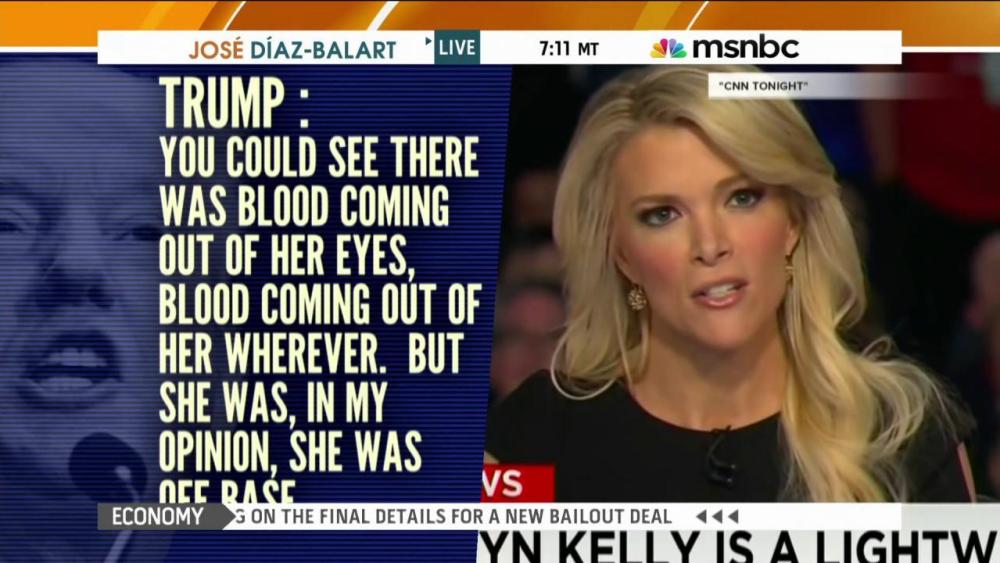
There is another long-standing pattern that Trump’s outsize reaction also fits: He has often responded with particular venom when tough questions come from women. Trump’s defenders say he’s an equal-opportunity offender — after all, he called Jim Acosta a “rude, terrible person” and Don Lemon “the dumbest man on television” — and he regularly denounces what he calls “fake news.” But Trump especially dislikes tough questions from women.
In 2020, Trump abruptly ended an interview with Lesley Stahl of CBS News after accusing her of asking tough questions of him while lobbing softballs at his Democratic opponent, Joe Biden.
“I saw your interview with Joe, the interview with Joe Biden,” he sputtered.
(After being criticized for what was widely — and rightly — interpreted as a misogynistic comment, Trump later insisted he had been referring to Kelly’s “nose” or “maybe her ears.”)
In Trump’s view, that was a cardinal sin. His reactions show time and again he doesn’t like to be reminded of his past statements or positions — especially when they are read back to him by a journalist.
“She gave me a really phony question,” Trump told “Meet the Press” in 2016. “It was a setup question. It wasn’t even a question, it was a statement. It was inappropriate.”
That’s the common thread running through Trump’s clashes with Welker, Stahl and Kelly. None of the journalists expressed an opinion. None was engaging in a partisan attack. Each simply confronted Trump with facts, statements or promises he himself had made.
The issue isn’t that Trump objects merely to tough questions. He objects to questions that force him to answer for his own words.
Donald Trump has earned a reputation as the nation’s most prominent and powerful election conspiracy theorist, but to the extent that there’s a competition for the silver medal in this ignominious category, House Speaker Mike Johnson is a clear contender.
Indeed, after Trump’s defeat in the 2020 race, it was the Louisiana Republican who took the lead on Capitol Hill, effectively becoming the White House’s congressional point man, doing his best to overturn the results and hand the outgoing president illegitimate power. Johnson even echoed a discreditedconspiracytheory involving Venezuela’s Hugo Chávez and Dominion Voting Systems — nonsense that even many Trump acolytes didn’t feel comfortable repeating.
With this in mind, it wasn’t too surprising to see Congress’ top GOP lawmaker echo his party’s baseless conspiracy theories regarding California’s latest elections, though one word in his pitch was of particular interest.
RAJU: But what evidence is there to prove the California election is rigged?MIKE JOHNSON: Look, some of these efforts are so diabolical and so far upstream it's impossible to prove. But I think everybody knows instinctively that something is wrong here.
Apparently comfortable speaking on behalf of the nation, Johnson told reporters on Monday afternoon that “everybody knows” that the process of counting votes in California “stinks to high heaven.”
Asked the obvious question about conspiracy theorists’ lack of evidence, the House speaker added, “Some of these efforts are so diabolical and so far upstream that it’s impossible to prove, but I think everybody knows instinctively something is wrong here.”
It was an implicit acknowledgment of an inconvenient truth: Johnson and his cohorts simply don’t have any evidence. The speaker and other Republican leaders don’t know if their baseless ideas are true, but they apparently want the public to know that their conspiracy theories feel true.
It’s the basis for a debate, not about election administration processes, but about vibes.
But Johnson’s use of the word “instinctively” stood out, in part because it was so foolish, in part because of its familiarity.
A couple of years ago, for example, during a Fox Business interview, the House speaker asserted that there are now “terrorist cells set up around the country.” Asked how many, Johnson conceded that he had no idea — despite his access to intelligence at the highest levels — but added that we are “intuitively” aware of the problem.
Similarly, after Trump’s 2020 defeat, Johnson also insisted that “a lot of us know intuitively” that there were problems with the vote tallies. After the Senate rejected the House’s impeachment effort against then-Homeland Security Secretary Alejandro Mayorkas, Johnson said “we know already intuitively” that Mayorkas deserved to be punished. When the House speaker unveiled legislation to ban noncitizens from voting — which is already illegal, and which effectively never happens — Johnson declared at a press conference, “We all know intuitively that a lot of illegals are voting in federal elections.”
Among the obvious problems is the simple fact that instincts and intuition are utterly irrelevant when dealing with factual questions like these. Elections are either proper or they’re not. Voters are either casting legal ballots or they’re not. Evidence either exists or it doesn’t.
His track record suggests this basic dynamic is lost on the House speaker in fundamental ways.
What we’re dealing with, in other words, is a political leader who believes gut feelings are a legitimate substitute for knowledge. They are not.

 Login
Login