Reading view

Antyllus: The Ancient Greek Surgeon Whose Methods Lasted Until the 19th Century

Relief sculpture depicting Asclepius treating a reclining patient in ancient Greek style.
Antyllus pioneered vascular surgery, and his aneurysm procedure remained a standard for over a millennium. Credit: Wikimedia Commons, Public Domain

Αntyllus, one of antiquity’s most skilled and innovative surgeons, was an ancient Greek physician active in Rome around 150 AD. Though influenced by earlier Greek medical traditions, he broke from the conservative models of physicians such as Hippocrates and Galen and introduced practical surgical procedures, especially for vascular conditions. These shaped medicine for centuries.

Beyond aneurysms: A versatile surgeon

Antyllus is best known for designing the first effective surgical treatment for aneurysms. While earlier physicians feared vascular surgery, Antyllus embraced it with precision.
He classified aneurysms into traumatic and spontaneous types. His method involved tying off the artery both above and below the swollen vessel. Then, he excised the aneurysmal sac.

This direct approach represented a major advancement. It became the standard procedure for aneurysm treatment and remained in use until the 19th century. Unlike Galen, who emphasized theory, Antyllus prioritized anatomical understanding through practice. He accepted surgical risks others avoided, setting the foundation for vascular surgery.

Antyllus’s contributions extended beyond arteries. He developed surgical techniques for the abdomen, eyes, bones, joints, and breasts. He was also a pioneer in plastic surgery.
His reconstructive operations addressed eyelids, ears, noses, and cheeks. In trauma cases or for cosmetic repair, no one could match his precision.

To control bleeding during operations, Antyllus used cauterization. He also performed early tracheotomies, a high-risk but potentially life-saving procedure.

Oribasius, a later Greek physician, reported that Αntyllus wouldn’t operate on exceptionally large aneurysms due to high risk. For more manageable aneurysms in the limbs and head, Antyllus applied ligatures to the arteries entering and leaving the aneurysm. He then incised the sac, evacuated its contents, and packed the cavity.

Legacy and transmission of Antyllus’ aneurysm technique

Most importantly, Antyllus did not resect the aneurysm sac. He warned against excising the dilated section between ligatures, stating:

“Those who tie the artery, as I advise, at each extremity, but amputate the intervening dilated part, perform a dangerous operation. The violent tension of the arterial pneuma often displaces the ligatures.”

Oribasius also preserved one of the earliest known classifications of aneurysms into true and false types. Specifically, he said:

“There are two types of aneurysms: the first is due to dilatation of the arteries and the second is caused by rupture of the artery emptying blood into the tissues. When an aneurysm is due to dilatation, the form is cylindrical, while the one caused by injury is round.”

Aetius of Amida was a 7th century physician. In his work “On the Dilatation of the Vessels,” he described in detail a surgery likely based on Antyllus’ method:

“An aneurysm located in the bend of the elbow is treated thus. First we carefully trace the artery leading to it, from armpit to elbow, along the inside of the upper arm. Then we make an incision on the inside of the arm, three or four finger-breadths below the armpit, where the artery is felt most easily. We gradually expose the blood vessel and, when it can be lifted free with a hook, we tie it off with two firm ligatures and divide it between them. We fill the wound with incense and lint dressing, then apply a bandage. Next we open the aneurysm itself and no longer need fear bleeding. We remove the blood clots present, and seek the artery which brought the blood. Once found, it is lifted free with the hook, and tied as before.”

Medicine in Ancient Greece and Egypt
Physician treating a patient, depicted on Attic red-figure Aryballos Credit: Marie-Lan Nguyen Wikimedia Commons CC BY 3.0

Preventative medicine and physical health

Antyllus believed health required daily effort and discipline. He championed preventative medicine alongside surgical skill. For instance, he prescribed exercise regimens that included structured vocal routines. One of his most distinctive practices was vociferation, a method of controlled, loud vocalizing.

He recommended reciting memorized poetry at various volumes while walking and believed deep tones helped expand the trachea and chest, strengthening respiratory health. This practice combined breath control, posture, and movement in a holistic approach to physical well-being.

Before such vocal workouts, Antyllus suggested preparation consisting of massage, bowel evacuation, and a cold sponge bath. These details reflected his methodical attention to physiology.

While Hippocrates emphasized prognosis and symptom observation, he likely saw aneurysms but avoided surgical intervention. Moreover, Galen offered greater anatomical theory, drawn from animal dissection but still steered clear of artery operations.

Antyllus surpassed both in operative practice. Whereas Hippocrates and Galen used caution, Antyllus applied bold innovation grounded in anatomy. His hands-on techniques proved enduring. Byzantine and Islamic medical texts preserved his methods, which reached medieval Europe through translation.

The Greek physician Galen, who was influential in Western medicine
Galen, the pioneering Greek physician who influenced Western medicine through the 1700s. Portrait by Pierre-Roch Vigneron. Credit: Wikimedia Commons Public Domain

Legacy of a Forgotten Surgeon

Despite the historical focus on Hippocrates and Galen, Αntyllus, the Greek physician, remains a towering figure in the evolution of medicine, uniting theory with surgical practice. His aneurysm procedure became standard practice for over 1,500 years. Antyllus developed detailed and replicable techniques in plastic and general surgery.


Αntyllus’s advocacy for preventative care—including vocal and physical training—also marks him as an early holistic health thinker. To say the least, he deserves recognition as the first true vascular surgeon of antiquity, as his skill, anatomical knowledge, and forward-thinking philosophy left a lasting imprint on medical history.

@theculturemuse

Check out this #rare #ancient #roman #surgical kit in the #neuesmuseum #berlin #medicine #healing #surgery #asclepius #history #storytime #foryoupage❤❤ #fyp

♬ original sound – The Culture Muse

  •  

“Know Thyself”: The Ancient Saying of Delphi That Changed Philosophy

The theatre of Delphi and the temple of Apollo below. The Delphic Maxims carried profound meaning for Ancient Greeks, expressing ideals of self-knowledge, moderation, harmony, and spiritual balance.
The Delphic Maxims carried profound meaning for Ancient Greeks, expressing ideals of self-knowledge, moderation, harmony, and spiritual balance. Credit: Mark Cartwright / CC BY-NC-SA 4.0

Delphi offered more than prophecy in the times of the Ancient Greeks, as inscribed on the temple were a series of brief sayings with deep philosophical meaning known as the Delphic Maxims.

These concise statements distilled profound ideas about ethics, self-control, and human nature. Though short in form, they helped shape Greek thought for centuries and left a lasting influence on philosophers such as Socrates and Plato.

Among these maxims, two became especially well known: “Know Thyself” (Γνῶθι Σεαυτόν) and “Nothing in Excess” (Μηδὲν Ἄγαν). The Ancient Greeks did not treat these as simple moral slogans but rather as guiding principles for inner harmony and a philosophical pursuit of knowledge.

Delphi and the center of the Greek world

Few sacred places in the Ancient Greek world carried the same spiritual authority and symbolic weight as Delphi. Greeks from across the region traveled to the sanctuary of Apollo to consult the oracle, offer sacrifices, and seek divine guidance. Kings, generals, philosophers, and ordinary citizens all stood before the same sacred center, hoping to receive wisdom from the god.

The sanctuary was located on the slopes of Mount Parnassus in central Greece, and the Ancient Greeks regarded it as the spiritual center of the world. According to myth, Zeus released two eagles from opposite ends of the earth, and they met above Delphi. The famous omphalos, or sacred stone, marked this divine center. The sanctuary belonged to Apollo, the god of light, harmony, music, prophecy, and rational order. Pilgrims arrived from across the Mediterranean to hear the oracle delivered through the Pythia, Apollo’s priestess.

Yet Delphi also functioned as a philosophical and ethical center. Visitors encountered sacred inscriptions carved directly into the temple itself. Tradition often attributed the Delphic Maxims to the Seven Sages of Greece, legendary figures associated with practical wisdom and political insight. Various sources preserve differing lists, though names such as Solon, Thales, Bias, Pittacus, and Chilon frequently appear among them. According to tradition, Chilon of Sparta is credited with “Know Thyself,” while Solon or Cleobulus is often associated with “Nothing in Excess.” Regardless of authorship, the Greeks regarded the maxims as expressions of divine wisdom connected to Apollo himself.

“Know Thyself” and the common interpretation of the Delphic maxim

The maxim “Know Thyself” became one of the most influential phrases in Western philosophy. Most people interpret it as a call to humility. In this reading, the maxim reminds human beings of their limitations and the notion that mortals should not imagine themselves equal to gods. Pride, arrogance, and excessive ambition were seen as paths toward destruction.

This interpretation certainly existed in Ancient Greece. Greek tragedy repeatedly warned against hubris, the dangerous overestimation of human power. Delphi therefore urged visitors to recognize their finite condition. The maxim also encouraged a more practical form of self-awareness. A wise person understands both strengths and weaknesses, and this kind of understanding helps prevent poor decisions and reckless behavior. However, Socrates and Plato had a far more profound interpretation.

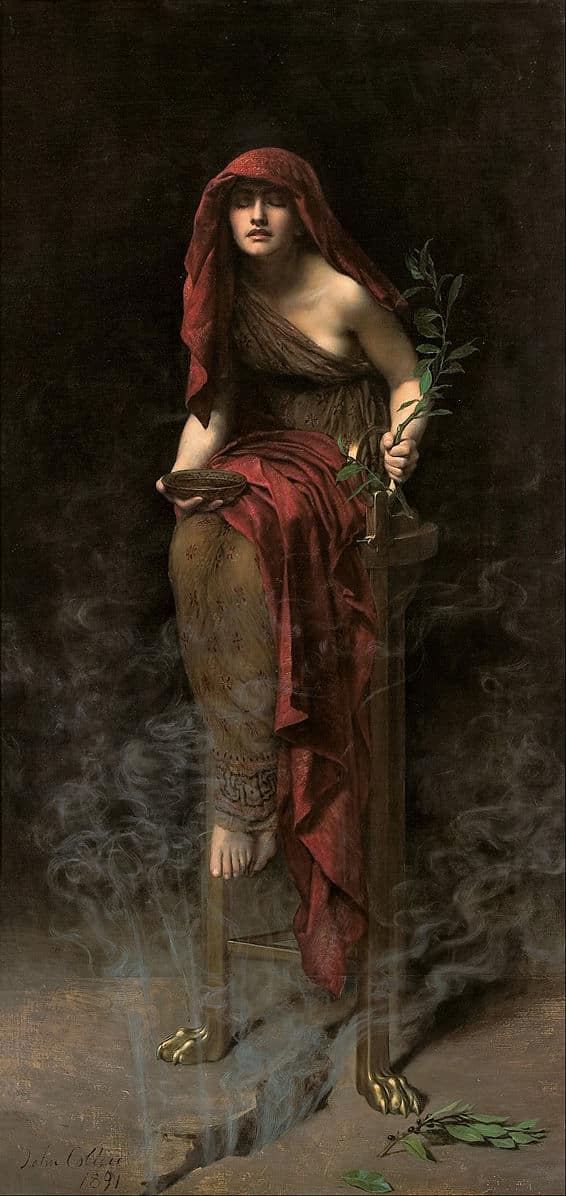
John Collier, Priestess of Delphi, 1891.
John Collier, Priestess of Delphi, 1891. Credit: Public Domain / WIkimedia Commons

Socrates and the ontological meaning of “Know Thyself”

Plato’s dialogue First Alcibiades presents one of the most profound interpretations of the Delphic maxim. In the dialogue, Socrates questions the ambitious young Alcibiades, who is eager for political power and glory in Athens. Socrates asks Alcibiades a deceptively simple question: what exactly is the “self” that one must know?

Through careful reasoning, Socrates gradually argues that a human being cannot be reduced to the physical body alone. The body functions more like an instrument used by something deeper. Just as a musician plays a lyre, the soul uses the body. The true self, therefore, must be the soul rather than the body.

This interpretation transforms this Delphic maxim into an ontological and spiritual imperative. “Know Thyself” no longer refers only to recognizing personal limits. Instead, it becomes a call to discover one’s true essence and, in some readings, one’s divine orientation. For Socrates, self-knowledge forms the foundation of wisdom and political virtue. A person who does not understand the soul cannot govern properly because ignorance already governs from within.

In this sense, the Delphic maxim directs human beings toward inner awakening. Socrates takes the argument even further in First Alcibiades. He suggests that the soul knows itself by contemplating what is most like the divine. Wisdom, reason, and truth become the means through which the soul aligns with a higher reality. This idea deeply influenced later Platonic philosophy and Neoplatonism in which thinkers increasingly read the Delphic maxim as a spiritual path toward union with the divine intellect.

Within this framework, self-knowledge becomes sacred knowledge. To know oneself is to understand the soul’s origin, structure, and ultimate destiny. The Delphic inscription thus becomes more than an ethical reminder—it stands as a gateway into metaphysics.

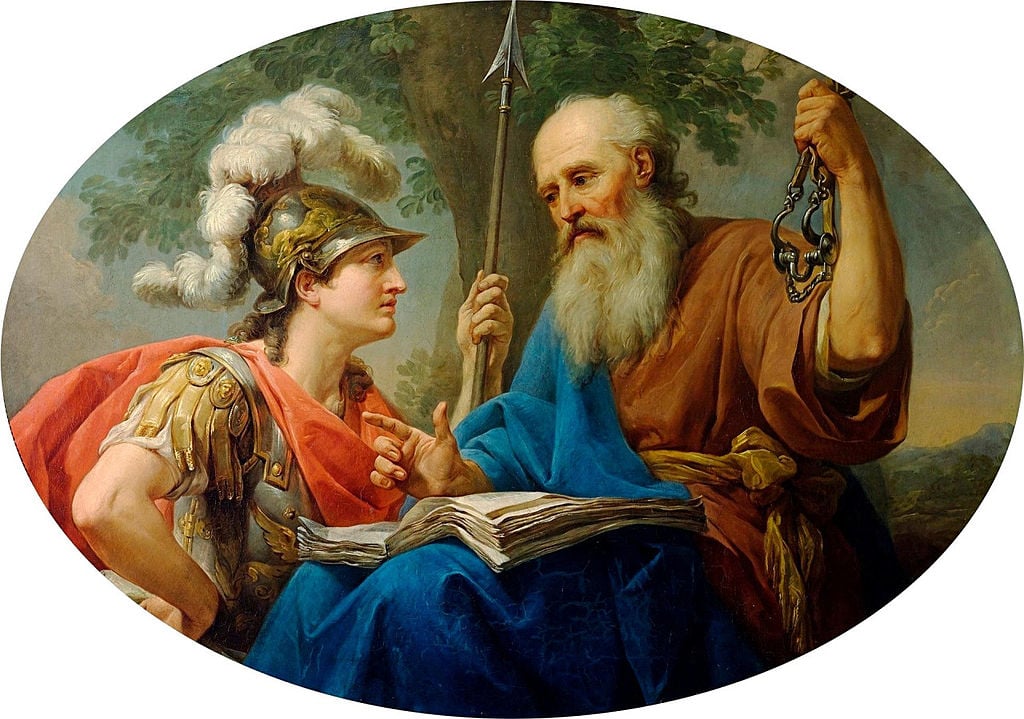
Alcibiades and Plato
“Alcibiades being taught by Socrates.” Credit: Marcello Bacciarelli, 1776-7. Credit: Wikimedia Commons/Public Domain

The Delphic maxim “Nothing in Excess” and the harmony of the soul

Another great Delphic maxim is “Nothing in Excess,” which carried far deeper meaning than simple moderation. At a practical level, the saying encouraged balance and restraint. Ancient Greeks admired sophrosyne, or self-control. A wise person avoids extremes in pleasure, anger, ambition, and behavior.

Plato later developed this idea philosophically through his theory of the soul. In works such as Republic, Plato describes the soul as composed of distinct parts. Reason must govern spirit and desire in a balanced and harmonious way. When one part dominates excessively, disorder and inner suffering follow.

From this perspective, “Nothing in Excess” reflects a geometrical and proportional vision of the soul. Justice and wisdom arise through equilibrium. Greek philosophy often linked beauty itself to proportion and harmony. The Delphic maxim, therefore, expresses not only a moral principle but also a broader cosmic order.

Photo of the remains of the Sanctuary of Apollo at Delphi, where the Delphic Maxims were also a significant part.
The Sacred Wars in Ancient Greece were fought for the control of the Oracle of Delphi. Photo of the remains of the Sanctuary of Apollo at Delphi. Credit: George E. Koronaios Wikimedia Commons CC BY-SA 4.0

The speech of Aspasia

Plato places a striking interpretation of “Nothing in Excess” into the mouth of Aspasia in Menexenus. This passage expands the maxim into a broader philosophy of inner independence and self-mastery. Aspasia declares:

“The saying ‘Nothing in Excess,’ spoken since ancient times, appears entirely correct. Indeed, it is the truest principle. The person who depends only on themselves and their own capacities for happiness, and who does not suspend their life on the fortunes of others, is best prepared for life. This individual is moderate, heroic, and wise. Whether they gain wealth and children or lose them, they remain faithful to this maxim above all. They will neither rejoice nor grieve beyond measure because they rely primarily on themselves and their inner strength.”

This interpretation reveals the ethical depth of the Delphic maxim. Moderation here is not merely quantitative but qualitative, shaping one’s entire way of living. It becomes a question of inner freedom.

A balanced person does not collapse under misfortune nor become intoxicated by success. Inner stability produces courage, wisdom, and resilience. Plato therefore connects moderation directly to philosophical strength.

  •  
❌