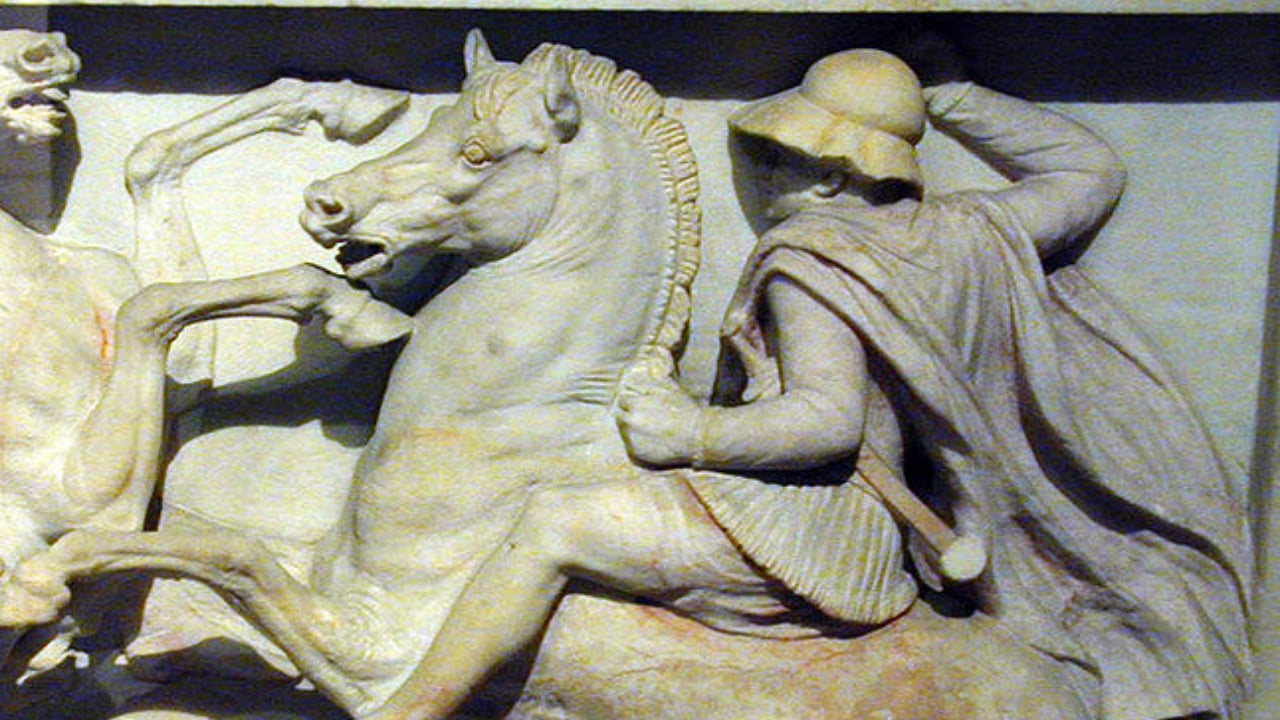
A Companion or Thessalian cavalry soldier depicted on the “Alexander Sarcophagus”. Credit: Marsyas / Wikimedia Commons CC BY 3.0
During his campaigns, Alexander the Great relied on a variety of military units for tactical success; the most prestigious of these units were the Companions, the elite mounted shock cavalry of the Macedonian army.
The Companion Cavalry, known in Greek as the Hetairoi (ἑταῖροι), were capable of delivering devastating charges against massed infantry formations. Their timely charges often proved decisive at crucial points during a battle and they were an invaluable tool that complimented Alexander’s preference for hammer and anvil tactics.
The Companion cavalry was just one piece of the puzzle that constituted the revolutionary combined arms warfare model employed by the ancient Macedonian army. However, as the king’s elite mounted warriors and bodyguards, they were often closest to Alexander during battle and are certainly among the most prestigious military units to have left their mark on the history books.
Organization of the Companion cavalry
The Companions were the Hetairoi of the king and the most senior unit in the ancient Macedonian army. As such, they were customarily deployed in the place of honor on the right wing of the army.
Most of the Companions would have been of noble birth, able to afford a horse and the necessary equipment. In fact, many of the Companions were close friends or allies of the king, so membership in the unit offered an opportunity for social and political status.
According to an academic paper authored by British historian Peter Brunt appearing in The Journal of Hellenic Studies, the Companions during Alexander and Philip II’s time were organized into eight squadrons called ilai. Each ile consisted of about 200 to 300 horsemen. One of the squadrons, called the agema, was the royal squadron and would usually be led in person by the king.
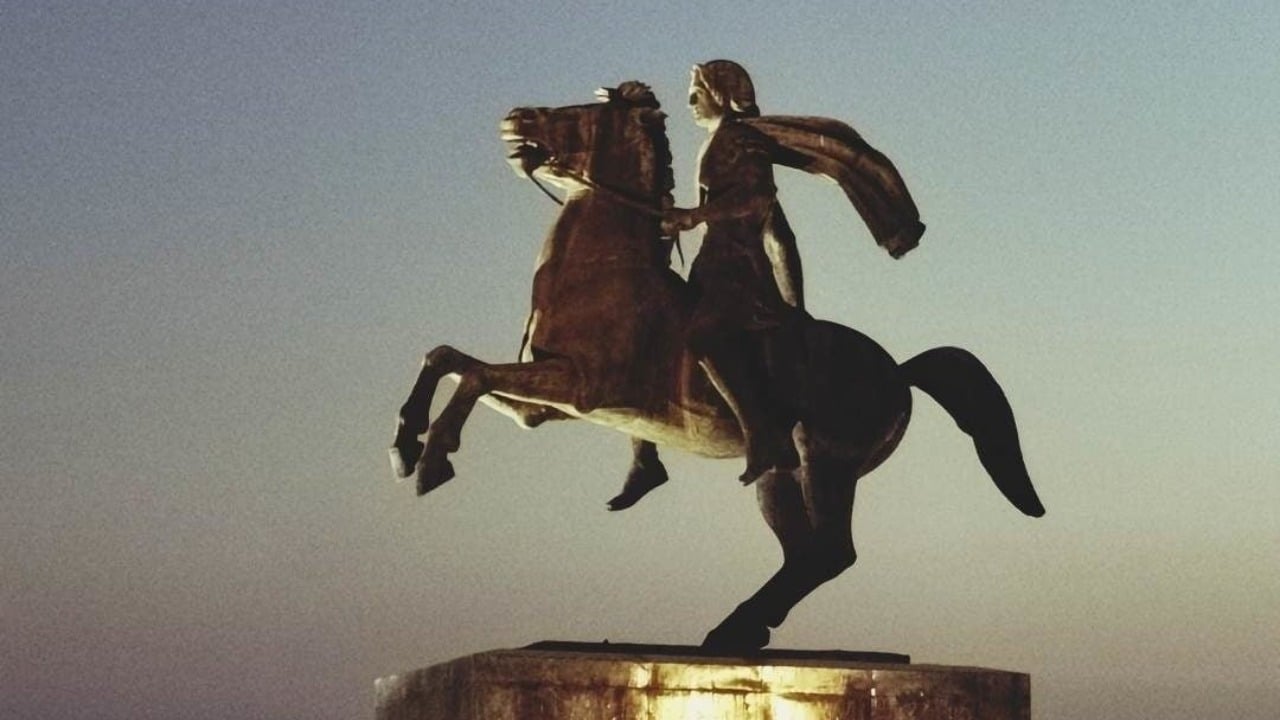
Statue of Alexander the Great in Thessaloniki. Credit: Alexander Gale / Greek Reporter
Equipment
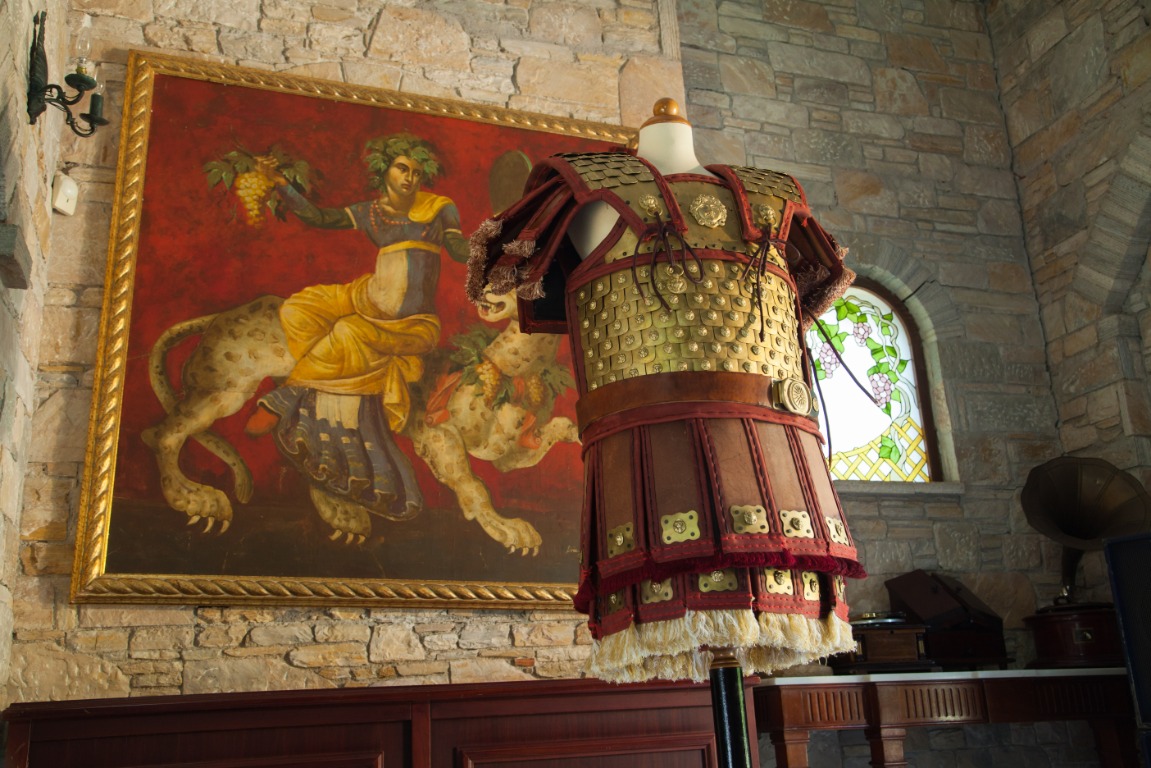
For armor, a member of the Companion cavalry would have worn either a linothorax or a muscle cuirass to protect the torso. To protect the head, a Boeotian helmet was typically worn, chosen for the unobstructed vision it granted its wearer.
The primary armament of a Companion was the xyston, a long thrusting spear that was between 3.5 to 4.25 m (11 to 14 ft) long. Historians believe that it was usually wielded with two hands and that it could be held with an overhead or underarm grip depending on the situation.
Alexander the Great linothorax inspired by Pompei mosaic, displayed at the National Archaeological Museum of Naples, Italy. Replica created by Demetrios Katsikis. Credit: Mark Geranios
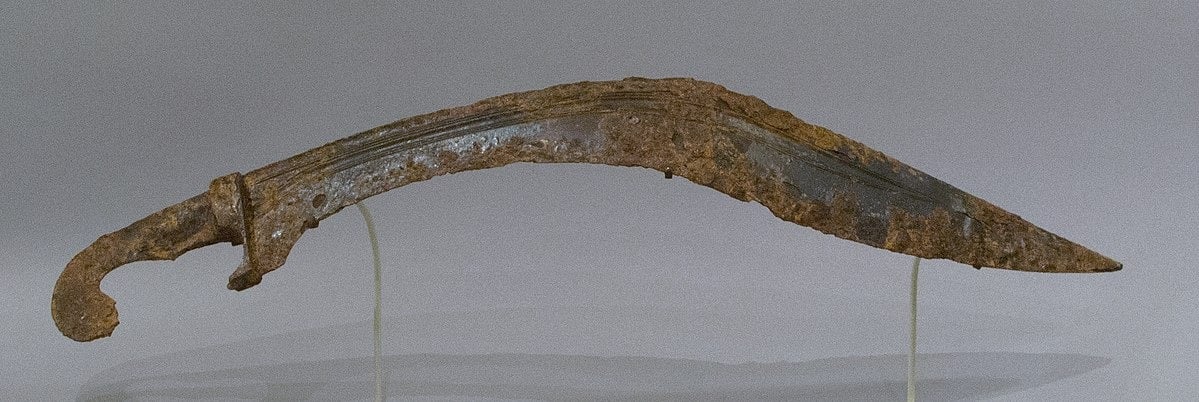
The Companion cavalry carried swords as secondary weapons. They had two to choose from: the kopis and xiphos. The kopis was arguably the better choice for mounted soldiers because the curved single edge and weight distribution made it an excellent weapon for powerful chopping strikes, particularly against infantrymen who would have stood below a mounted warrior.
The ancient Greek soldier and writer Xenophon thought as much and wrote: “I recommend a kopis rather than a xiphos, because from the height of a horse’s back the cut of a machaira will serve you better than the thrust of a xiphos”.
An iron kopis, sometimes also called a machaira, dating back to the 5th or 4th centruy BC. Observe how the curvature and weight distribution of the weapon makes it excellent for cutting and slashing strikes. Credit: Metropolitan Museum of Art / CC0 / Wikimedia Commons
Tactics of the Companion Cavalry
The Companion cavalry was most effectively used in conjunction with the other units of the Macedonian army. The infantry, whose main component was the pike phalanx, would act as the anvil by holding the main enemy force in place, whilst the Companion cavalry would act as the hammer, circling behind the enemy to charge in the flanks or rear – hence, the hammer and anvil.
The Companions played crucial roles in battles such as Chaeronea, where the renowned Sacred Band met their defeat, the Battle of Granicus in 334 BC, the Battle of Issus in 333 BC, and the Battle of Gaugamela in 331 BC.
The Companion cavalry often charged the enemy in the “flying wedge” formation designed to maximize the impact of the charge. According to the Greek historian Arrian, this formation was first used by the Scythians. Philip II later adopted the formation from them or the Thracians.
A gold plaque depicting a Scythian on horseback. Credit: Public Domain / Wikimedia Commons
The ancient Greeks, renowned for their cultural and intellectual achievements, interacted with numerous neighboring cultures that influenced and enriched their own civilization. Understanding these lesser-known cultures provides valuable insights into the complex web of interactions that shaped the ancient world, making this topic still relevant today.
As one of the most popularly studied civilizations of antiquity, the ancient Greeks tend to overshadow many of the neighboring cultures they interacted with.
However, the Greeks shared the ancient world with a myriad of other interesting cultures and civilizations, some of which are severely underappreciated in mainstream historical discourse.
In this article, we’ll be skipping over the other “heavyweights” of the ancient world, such as the Romans, Egyptians, Persians, and Phoenicians to focus on some of the lesser-known cultures the Greeks were familiar with to various extents.
What did the ancient Greeks think of neighboring cultures?
The term “barbarian” likely finds its roots in the Sumerian word “barbar,” which meant “foreigner.” In Greek, it served as both a loan word and an onomatopoeic representation, mimicking the unintelligible babbling sounds that the Greeks associated with foreigners speaking their languages.
Originally, “barbaroi” served as a neutral, collective name for all non-Greeks, without inherently negative connotations. However, over time, the term acquired a negative meaning, reflecting the prevailing Greek perception of non-Greeks as uncivilized or inferior.
As noted by the academic Stavros Moutsios, “This political designation of the barbarians, however, did not entail lack of acknowledgment nor of admiration of their achievements.” Indeed, the ancient Greeks often displayed a great deal of curiosity toward neighboring cultures and civilizations.
A good example of this was the practice of religious syncretism, whereby the Greeks would merge the gods of their pantheon with similar foreign deities. For example, the Graeco-Egyptian god Serapis possessed a combination of the Egyptian deities Osiris and Apis with the Greek deities Hades and Demeter.
Naturally, the perceptions of the Greeks toward other cultures varied a great deal. Often, our modern preconceptions of ancient peoples are shaped by the surviving literary sources written by ancient Greek authors about neighboring peoples who were themselves not literate.
The Scythians
The Scythians were one of the most enigmatic peoples of antiquity, famous for their mastery over horses. To call the Scythians “neighbors” of the ancient Greeks is somewhat of a misnomer since the Scythians were nomads and had no fixed borders, but the Greeks had fairly frequent contact with them through trade and war.
The Scythians were an Eastern Ianic people who inhabited the region north of the Black Sea, in present-day Ukraine, southern Russia, Kazakhstan, and parts of Central Asia, from around the 9th century BC to the 4th century AD.
Our main source on the perceptions of the ancient Greeks regarding the Scythians is the accounts of the historian Herodotus of Halicarnassus and later Greek writers. Incidentally, Herodotus, the”Father of History”, is also our main literary source on the Scythians generally.
According to Herodotus, the arrival of the Scythians led to conflict among the Cimmerians, with the royal tribe wanting to defend their lands and the rest of the population seeking to flee. Another account stated that the Scythians chased the Cimmerians out of their territory, forcing them to migrate south into West Asia.
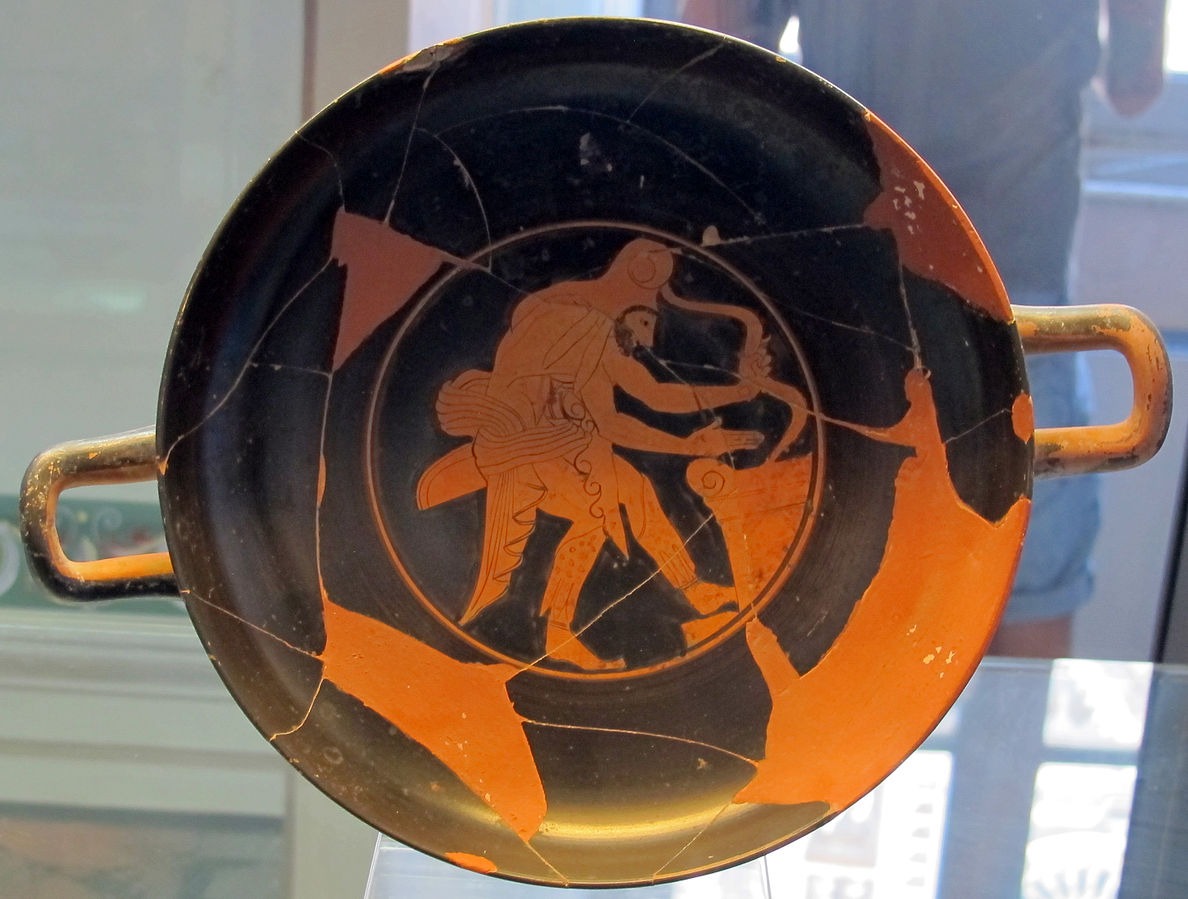
A Scythian depicted on ancient Greek red-figure pottery. Credit: Sailko / CC BY-SA 3.0 / Wikimedia Commons
As time passed, the image of the Scythians in Athens became the quintessential stereotype used for non-Greeks, and they were associated with drunkenness due to Greeks’ caricatural representation of foreigners as unmoderated drinkers.
Later Greek literature transformed the Scythian prince Anacharsis into a legendary figure representing “Barbarian wisdom.” He became one of the Seven Sages of Greece and an ideal “man of nature” or “noble savage” figure. Ephorus of Cyme, a 4th-century BC historian, idealized the Scythians as “invincible” people, creating a fictitious account of a legendary Scythian king named Idanthyrsos who defeated the legendary pharaoh Sesostris and ruled all of Asia. This perception of the Scythians as a powerful and wise people became a tradition in Greek literature.
The Scythians were also included in Greek mythology, with mythical Scythian characters appearing in stories. Herodotus of Heraclea, for instance, portrayed Teutarus, a mythical Scythian, as a herdsman who served Amphitryon and taught archery to Heracles. Additionally, the Titan Prometheus was described as a Scythian king, and his son Deucalion was also linked to the Scythians in Greek myths.
The Thracians
The Thracians were a group of Indo-European-speaking people who inhabited significant portions of Southeast Europe during ancient history. They mainly resided in regions that now correspond to modern-day Bulgaria, Romania, and northern Greece. However, Thracian settlements were not confined solely to Southeast Europe; they also extended to north-western Anatolia (Asia Minor) in what is present-day Turkey.
The Greeks and Romans described Thracian culture as tribal, and they remained largely disunited until the establishment of the Odrysian kingdom. The Odrysian Kingdom was a state union of over 40 Thracian tribes and 22 kingdoms that flourished from the 5th century BC to the 1st century AD. It encompassed mainly present-day Bulgaria, with extensions into parts of Southeastern Romania (Northern Dobruja), Northern Greece, and modern-day European Turkey.
By the fifth century BC, Herodotus referred to the Thracians as the second-most numerous people in the known world after the Indians and potentially the most powerful, had it not been for their lack of unity. The Thracians were generally not known for constructing cities, and Seuthopolis was their sole polis.
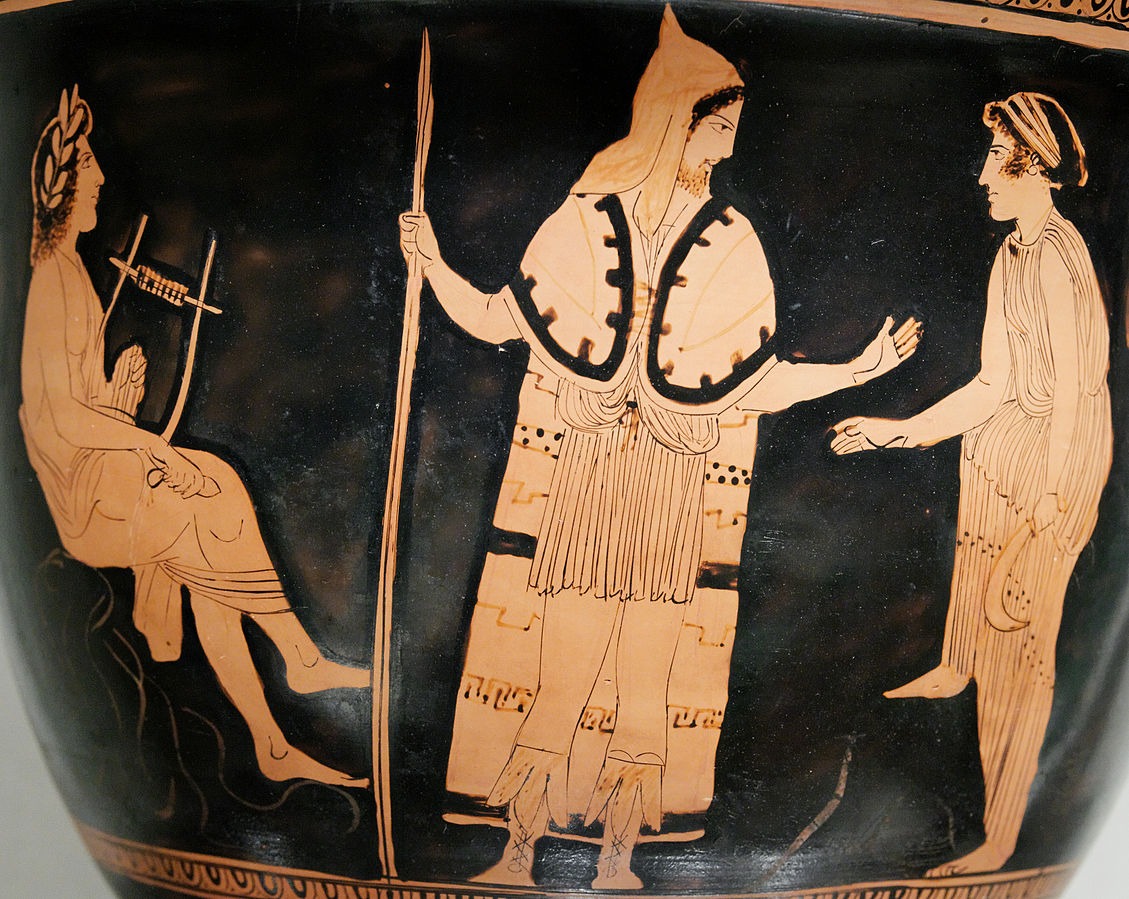
Orpheus amongst the Thracians. Side A of an Attic red-figure bell-krater, c. 440 BC. Credit: Metropolitan Museum of Art / CC BY 2.5
The Greeks frequently fought with the Thracians but also admired them for their martial prowess and hired them as mercenaries. Both Alexander the Great and his father Philip II fought on the Thracians on various occasions.
The Thracian ruler Kersebleptes was Philip’s most consequential Thracian enemy. Over a series of campaigns from 356 to 340 BC, Philip II succeeded in bringing Kersebleptes under his control as a tributary vassal, and in the process, he conquered a substantial portion of Thrace. Alexander again successfully fought the Thracians – among the other peoples – during the Balkan Campaign of 335 BC.
The Phrygians
The Phrygians were an ancient Indo-European-speaking people who resided in central-western Anatolia. Ancient Greek authors used “Phrygian” as a broad term to refer to a diverse ethnocultural grouping situated mainly in the central regions of Anatolia, rather than denoting a single “tribe” or “people.”
The ethnolinguistic homogeneity of the Phrygians is subject to debate. According to Herodotus, the Phrygians were originally dwelling in the southern Balkans under the name of Bryges (Briges), but they later changed their name to Phryges after migrating to Anatolia through the Hellespont.
While numerous historians purport the theory of a Phrygian migration from Europe to Asia Minor around 1200 BC, Anatolian archaeologists have largely dismissed this notion. Instead, it has been proposed that the Phrygian migration to Asia Minor, which Greek sources indicate took place shortly after the Trojan War, actually occurred much earlier and in multiple stages.
Phrygian soldiers depicted on a reconstruction of a Phrygian building in Turkey. Credit: Carole Raddato / CC BY-SA 2.0 / Wikimedia Commons
The Greeks and Phrygians had significant cultural connections, particularly in the realm of music. The earliest traditions of ancient Greek music were partly influenced by Phrygian music, which was transmitted through the Greek colonies in Anatolia. The Phrygian mode, known as the warlike mode in ancient Greek music, was one of the musical elements borrowed from the Phrygians.
The Phrygian king, Midas, renowned for his “golden touch,” was said to have been tutored in music by the legendary Orpheus himself, according to mythological accounts. Moreover, the aulos, a reed instrument with two pipes, was another musical invention attributed to Phrygia and subsequently embraced by the Greeks.
In classical Greek iconography, Paris, a Trojan prince famous for abducting Helen in the Iliad, is depicted as non-Greek by wearing a Phrygian cap. This distinct headgear was also worn by Mithras and has persisted in modern imagery as the “Liberty cap” of the American and French revolutionaries, symbolizing freedom and rebellion. More amusingly, the Smurfs also wear the Phrygian cap.
The Importance of Cultural Exchange in the Ancient World
In the context of increasing globalization, examining how ancient cultures, like the Greeks and their neighbors, interacted and exchanged ideas is crucial. These exchanges facilitated the spread of technology, religious practices, and art forms, which had a profound impact on the development of Western civilization.
Technological Exchange: The Greeks adopted various technologies from their neighbors, such as the alphabet from the Phoenicians, which became the basis for the Greek writing system. This exchange was pivotal in the development of Greek literature and philosophy.
Religious Syncretism: Religious practices were often blended, as seen in the fusion of Greek and Egyptian deities into figures like Serapis, symbolizing a blending of beliefs that enriched both cultures.
Artistic Influences: Greek art, especially in pottery and sculpture, shows influences from Thracian, Scythian, and Phrygian styles, highlighting how these cultures contributed to what we now consider classical Greek art.

 Login
Login