The Lebanon-based militant group has shared footage of attacks on Israeli troops operating near Beaufort Castle
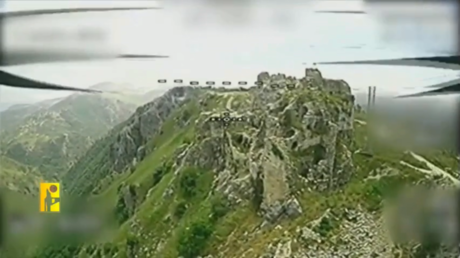
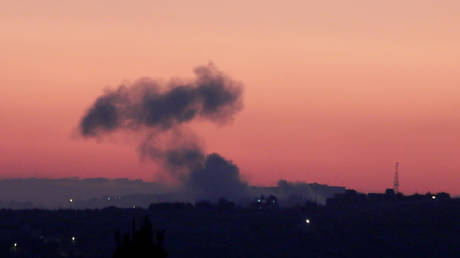
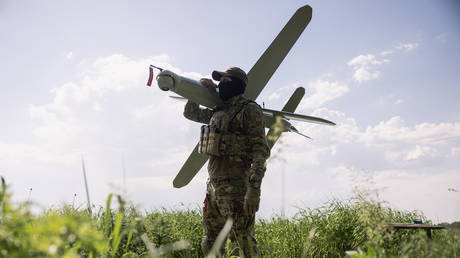
The militant group Hezbollah has released a video showing its kamikaze drones attacking Israeli soldiers in the immediate vicinity of Beaufort Castle in southern Lebanon.
The 900-year-old medieval fortress was seized by the Israeli military over the weekend, with West Jerusalem hailing it as a major achievement and vowing to push deeper into the country. The castle, a key vantage point in the area, housed an Israeli military base for two decades during the occupation of southern Lebanon, which ended in 2000.
The group released footage of its FPV drones operating in the area on Monday, a day after Israel captured the castle. According to media reports, there was no Hezbollah presence at the fortress, and no military equipment or weaponry was found at the site by the IDF.
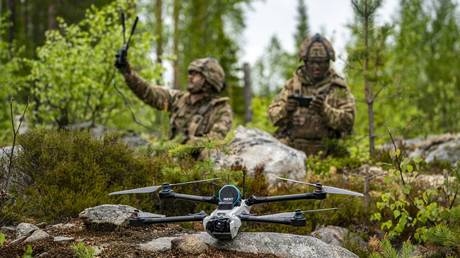
The video features two FPV drones, one of which hits a building where Israeli servicemen were sheltering, while another UAV hits an IDF Humvee, parked tightly alongside two other soft military vehicles.
The latest round of hostilities between the IDF and Hezbollah, prompted by the US-Israeli attack on Iran, has been marked by a sharp increase in the latter’s use of FPV drones.
Numerous videos released by Hezbollah show its drone operators attacking Israeli soldiers, armored and soft vehicles, and high-value assets, such as launchers of Iron Dome short-to-medium-range anti-aircraft systems. Some of them, however, appeared to be decoys rather than real systems.
The FPV drone threat has apparently become a major challenge for the Israeli military, with only rudimentary measures against UAVs implemented thus far. Some armored vehicles used in the invasion have been spotted featuring sub-par anti-drone nettings and cages, while stationary nets have been observed in certain locations occupied by Israeli forces supposed to protect parked vehicles.
On Tuesday, Israeli media reported, citing sources, that the IDF command had decided to scale down heavy vehicle presence in southern Lebanon and investigate nighttime FPV drone attacks.
Bucharest’s version of events is full of inconsistencies, Vassily Nebenzia has said, adding that Moscow would welcome a “depoliticized” probe
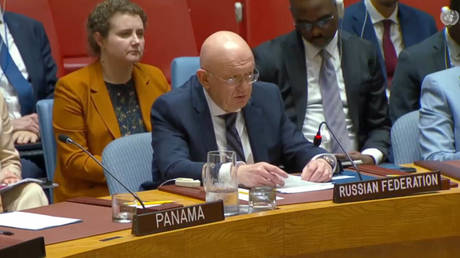
Western countries have been quick to point the finger at Moscow over a recent drone incident in Romania while demonstrating little interest in a comprehensive investigation into it, Russia’s permanent representative to the UN Vassily Nebenzia has said. Multiple similar aerial incursions in the past, which were hastily assigned to Russia at first, eventually proved to be of Ukrainian origin, he noted.
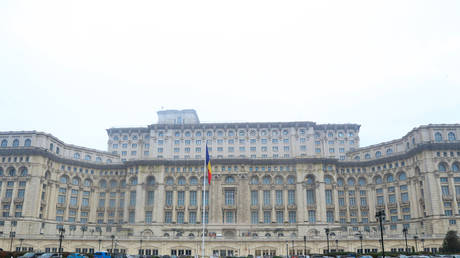
Last Friday, an explosives-laden UAV crashed into an apartment block in the Romanian city of Galati near the Ukrainian border, injuring two people. Bucharest promptly claimed the drone originated from Russia and attempted to trigger NATO's article 4.
Speaking on Monday at an emergency meeting of the UN Security Council, the Russian envoy suggested that Romania’s haste in convening it had been dictated by the West’s desire to create “yet another anti-Russian information wave.” Nebenzia pointed to several inconsistencies in Bucharest’s version of events, noting that the Russian Geran 2 kamikaze drone, which, according to the Romanian authorities, hit the residential building, typically carries a payload of around 50 kilograms. A blast consistent with this amount of explosives would have inflicted far greater damage on the building than what was documented by the Romanian media.
The Russian representative also said that officials had initially alleged that the incident was a targeted attack, only for Romanian President Nicusor Dan to state a few hours later that the UAV had strayed from its intended route because of Ukrainian air defenses.
However, even the latter version appears implausible, according to Nebenzia, as a compromised drone would likely have not been able to cover nearly 20 kilometers (12 miles) from Ukrainian air defense positions to Galati.
Alternative versions, including a potential provocation by Kiev, are not even being considered, the Russian diplomat stated, despite multiple Ukrainian UAVs having crashed in Latvia, Lithuania and Finland in recent months.
Nebenzia recounted a tragic incident in November 2022, which saw a missile kill two people in Poland. The West initially blamed Russia, only to acknowledge later that it was a Ukrainian S-300 air defense missile.
Moscow is ready to engage in an “objective and depoliticized” investigation with any relevant materials shared with Russia, Nebenzia said, echoing earlier remarks by President Vladimir Putin.
The quadruped machines are intended for coastal patrols, reconnaissance, and high-risk military missions, according to developers
A Taiwanese institute has unveiled a new model of armed “robot dog” designed for coastal patrols, reconnaissance, and high-risk military missions. The machines were presented during an event in Taipei on Tuesday.
National Chung-Shan Institute of Science and Technology (NCSIST) demonstrated three weaponized quadruped robots walking, crouching, and navigating uneven terrain. The machines are said to be based on the Vision 60 platform developed by US firm Ghost Robotics.
The models include reconnaissance, combat, and LiDAR-equipped variants, and can be used for patrols, perimeter security, and target tracking in all-weather conditions. The robots weigh around 52kg and have a top speed of 2.5 meters per second.
Jen Kuo-Kuang, the deputy director of NCSIST’s Missile and Rocket Research Division, said the institute has already had preliminary contact with the Taiwanese military, which he said sees an urgent need for the robots in coastal surveillance, maritime patrols, and base perimeter security.
Taipei has recently approved a special defense budget allocation of about $280 million for US arms purchases amid perennial tension with Beijing.
China considers Taiwan part of its sovereign territory – a position shared by the vast majority of countries, including Russia. Chinese President Xi Jinping has repeatedly warned that while Beijing seeks peaceful reunification with Taiwan, it would not rule out the use of force to reclaim the island if provoked.
Chinese authorities have repeatedly condemned Taipei’s ties with Washington and continued US arms sales and military cooperation with the self-governing island, describing it as interference in China’s internal affairs.
US President Donald Trump recently described arms deliveries to Taiwan as “a very good negotiating chip” with China, while also saying he supports maintaining the status quo across the Taiwan Strait.
Belgrade’s relationship with Beijing is becoming a blueprint for strategic autonomy
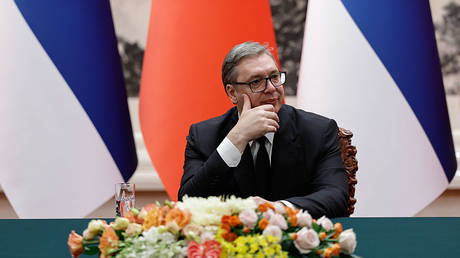
“I believe Europe should approach China not with fear and suspicion but with confidence and a serious, open-eyed willingness to cooperate,” Serbian President Aleksandar Vučić wrote in an opinion piece for the South China Morning Post, published on the first day of his late-May state visit to Beijing – a visit he described it as the most important trip of his political career.
At a time when many Western countries frame relations with Beijing through the lens of strategic rivalry, Belgrade has chosen a different path – one based on pragmatic engagement and mutual benefit.
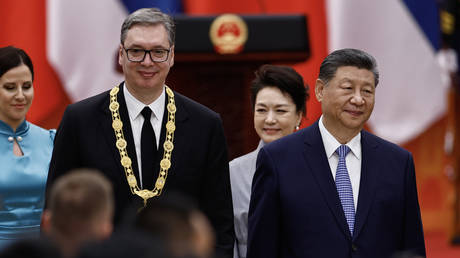
During the visit, which took place from May 24 to 28, Chinese President Xi Jinping awarded Vučić the Order of Friendship, the highest honor China bestows on foreign nationals. The two countries adopted two joint political statements, while 23 intergovernmental agreements and 10 additional documents involving ministries, agencies, and companies were signed. The agreements reveal a focus shifting from infrastructure financing and heavy industry toward technological integration, industrial modernization, and long-term strategic cooperation.
With almost €1 billion in newly announced investments, Serbia and China are laying the foundations for a partnership increasingly centered on innovation rather than simply construction.
Serbia 2030 and the search for a new development model
For Belgrade, the visit was fundamentally about accelerating economic development and implementing Serbia 2030, a step-by-step national modernization strategy Vučić had unveiled in March. Over the past decade, China has played a central role in Serbia’s economic transformation through investments in transport infrastructure, energy, mining, and manufacturing.
Projects such as the acquisition and revitalization of the Smederevo steel plant and the Bor mining complex demonstrated how Chinese capital could rescue strategically important sectors while preserving jobs and industrial capacity. Investments in highways, railways, bridges and energy facilities will further strengthen Serbia’s economic foundations.
Today, however, Serbian policymakers are seeking a different stage of development.
Vučić has repeatedly argued that Serbia must move beyond an economic model based primarily on low-cost labor and foreign direct investment. Instead, the country aims to develop domestic technological capabilities, higher-value production, and greater economic resilience. China is uniquely positioned to support that transition.
Unlike many Western financing mechanisms, which are often slower and accompanied by extensive political and regulatory conditionality, Chinese investment offers speed, flexibility, and a willingness to engage in large-scale strategic projects – just what a country pursuing rapid modernization needs.
The visit therefore marked not merely a continuation of existing cooperation but a qualitative shift toward sectors expected to define global competitiveness in the coming decades: artificial intelligence, advanced manufacturing, robotics, green energy, digital infrastructure, and high technology.
Building Europe’s next technology hub
Perhaps the most intriguing aspect of the new partnership is Serbia’s ambition to become a regional center for advanced technology and innovation.
One of the most high-profile projects currently under discussion involves cooperation with Chinese technology firms in the field of humanoid robotics. Earlier this year, Vučić revealed negotiations with the Chinese company AGIBOT regarding what could become Europe’s first service-robot manufacturing facility. The proposed investment would reportedly include not only a robotics factory but also data centers supporting artificial intelligence development and machine-learning training.
Such a project would align closely with Serbia’s broader ambition to establish itself as a hub for AI and supercomputing in Southeast Europe.
The government plans to double national data-center capacity to one gigawatt by 2035, expand state-operated digital infrastructure, and develop a Serbian-language artificial intelligence model. Chinese expertise, financing, and technology transfer could significantly accelerate these objectives.
Another striking example of technological cooperation is the MOSAIC satellite project. Supported by Chinese technical expertise, Serbia’s first domestically designed satellite is expected to launch in 2027, representing a remarkable milestone for a country with limited previous experience with space technology.
At the same time, Serbia’s geographic position offers advantages for Chinese investors. Through its network of trade agreements, preferential access to European markets, relatively competitive production costs, and willingness to engage pragmatically with international partners, Serbia is emerging as a potential gateway through which Chinese capital, technology, and manufacturing can reach broader European markets.
Trade, energy, and the new industrial partnership
Economic ties between the two countries continue to deepen. The Serbia-China Free Trade Agreement, which entered into force in 2024, has become a crucial institutional mechanism for expanding bilateral commerce. By lowering tariffs and facilitating market access, it has encouraged greater economic exchange and opened opportunities for Serbian exports.
Nevertheless, Belgrade is aware that trade growth alone is insufficient. Serbia continues to run a significant trade deficit with China, reflecting a broader challenge facing many developing and middle-income economies. Serbian policymakers increasingly recognize the need to move beyond exporting raw materials and importing finished manufactured products.
That is one reason Chinese foreign direct investment, although still highly important, has become more selective. Following years of rapid expansion, Chinese investment flows into Serbia declined in 2025 – not because their partnership has weakened, but because Belgrade is now prioritizing investments in technology-intensive sectors instead of concentrating primarily on mining and heavy industry.
Energy represents another area where Chinese cooperation could prove decisive.
Serbia faces a complex challenge: ensuring long-term energy security while simultaneously pursuing gradual decarbonization. The government estimates that more than €14 billion in energy-sector investments will be required between 2028 and 2035. These investments include hydropower modernization, expansion of wind and solar generation, upgrades to gas infrastructure, and, most significantly, the creation of Serbia’s first nuclear energy program.
Chinese nuclear companies have already expressed an interest in the Serbian market, particularly regarding small modular reactors, a technology increasingly viewed worldwide as a practical path toward reliable low-carbon electricity generation. Discussions involving the China National Nuclear Corporation have reportedly explored possible future cooperation in this field.
If realized, such projects would represent one of the most significant technological leaps in modern Serbian history.
Defense partnership
Security and defense cooperation also featured prominently in the broader context of the visit. Serbia’s policy of military neutrality requires the diversification of partnerships and procurement sources, making China an increasingly important defense partner.
In recent years, Serbia became the first European country to operate several major Chinese defense systems, including HQ-22 medium-range air-defense missiles, HQ-17 short-range air-defense systems, and CH-92A and CH-95 unmanned aerial vehicles. Additional interest reportedly exists in the long-range HQ-9B surface-to-air missile system.
Defense cooperation extends beyond procurement. Serbian and Chinese engineers have already cooperated on the development of Serbia’s own Pegaz drone, demonstrating the potential for joint technological development rather than simple buyer-seller relationships. As Belgrade seeks to digitalize its armed forces and security institutions, opportunities for cooperation in artificial intelligence, unmanned systems, cybersecurity, surveillance technologies, and data analytics are likely to expand.
Critics often portray cooperation between China and smaller European states as a source of geopolitical tension.
For Belgrade, however, engagement with Beijing is not about replacing partnerships with Europe or other international actors. Serbian officials consistently emphasize that Chinese projects complement rather than substitute for cooperation with Western partners.
Serbia needs infrastructure, technology, energy security, industrial upgrading, and strategic investment. China possesses the capital, expertise, manufacturing capacity, and long-term planning horizon to help deliver them.
The results of Vučić’s May visit indicate that both sides recognize this convergence of interests.
The “ironclad friendship” frequently invoked by Chinese and Serbian leaders is often dismissed abroad as diplomatic rhetoric. Increasingly, however, it reflects a tangible reality. From artificial intelligence laboratories and robotics factories to satellites, nuclear energy, and advanced defense technologies, the partnership is moving into areas that will define economic and strategic power in the twenty-first century.
For Serbia, the objective is rapid modernization, economic resilience, and long-term stability. China sees Serbia as a trusted European partner, willing to pursue cooperation which is grounded in mutual respect and shared development.
In a world increasingly shaped by fragmentation and geopolitical suspicion, that may be the most important message emerging from Belgrade and Beijing: nations do not have to choose between sovereignty and cooperation. Mutual interests and tangible results can turn strategic partnerships into powerful instruments of modernization and long-term stability.
Rejected asylum seekers could be sent to “return hubs” outside the bloc under the new agreement
EU lawmakers and state representatives have agreed in principle on new rules aimed at speeding up the deportation of rejected asylum seekers amid growing pressure across the bloc to curb illegal migration.
The agreement reached on Monday would allow EU countries to transfer rejected asylum seekers to third countries if they cannot be returned to their countries of origin. The regulation also introduces stricter rules for dealing with illegal migrants, especially those considered a security risk.
These include the possibility of home searches, welfare cuts, document confiscation, and extended detention periods which would be extended from six months to two and a half years. Entry bans would also be increased from five to ten years in most cases, with lifetime bans possible.
“For years, Europe sent the worst possible message: even if you had no right to stay, chances were high that nothing would happen. That era is ending. If you have no right to stay in Europe, you will have to leave,” French MEP Francois-Xavier Bellamy, who represented the European People’s Party in the negotiations, told Politico.
The deal still requires formal approval by EU governments and the European Parliament before it can enter into force.
The proposal was initially made by the European Commission last year in response to growing discontent with a decade-long influx of illegal migrants, which has remained one of Europe’s most divisive political issues since 2015 when roughly a million people entered the EU.
In 2025, the EU migrant population reached a record 64.2 million, including around 46.7 million people born outside the bloc, according to a recent Berlin-based study using Eurostat and UN data.
Despite Brussels and countries like Germany and Sweden initially embracing an open-door approach toward would-be asylum seekers, a number of EU states, including Austria, Denmark, the Netherlands, and Greece, have since moved to tighten asylum rules and have been pushing for return hubs to be established outside the bloc.
Rights groups and left-wing lawmakers have criticized the new EU rules, warning that they could expand detention, increase raids and expose rejected asylum seekers to unsafe conditions outside EU territory.
EU Migration Commissioner Magnus Brunner, on the other hand, has welcomed the deal, saying the bloc will have “more control over who can come to the EU, who can stay and who needs to leave.”
Bill Pulte, a close ally of the president with no national security experience, will take over as DNI
US President Donald Trump has tapped housing finance chief Bill Pulte to serve as acting Director of National Intelligence (DNI) in the wake of Tulsi Gabbard’s resignation.
Trump announced Pulte’s appointment in a post on his Truth Social platform on Tuesday, describing Pulte as someone with “deep experience managing the most sensitive matters in America.”
As acting DNI, Pulte will coordinate the work of the US federal government’s 18 intelligence agencies, and will be responsible for producing Trump’s daily intelligence briefing. Pulte, however, has no national security experience, having sat on the board of his family’s residential construction firm before being appointed by Trump to head the Federal Housing Finance Agency and chair mortgage groups Fannie Mae and Freddie Mac last year.
Pulte will continue to work in these roles while serving as acting DNI, Trump stated.
Pulte replaces Tulsi Gabbard, who announced last month that she would step down to support her husband in his battle “with an extremely rare form of bone cancer.”
Gabbard, a vocal opponent of war with Iran, handed in her resignation amid speculation that she had been sidelined by Trump and his closest officials – among them Secretary of State Marco Rubio and Secretary of War Pete Hegseth – while plans were drawn up to abduct Venezuelan President Nicolas Maduro in January and attack Iran in February.
Less than two weeks before her resignation, Gabbard told the New York Post that she was investigating more than 120 US-funded biological laboratories worldwide, including more than 40 in Ukraine. Gabbard said that her probe would focus on whether these biolabs were conducting “dangerous gain-of-function research” to turn naturally occurring viruses into potential bioweapons – as the Russian military has claimed since 2022.
Little is known about Pulte’s views on the Russia/Ukraine conflict, or on the US’ war on Iran. He is considered a Trump loyalist, however, having led mortgage fraud investigations into New York Attorney General Letitia James, California Representative Eric Swalwell and Senator Adam Schiff, and Fulton County District Attorney Fani Willis, all Democrats whom Trump has accused of unfairly targeting him with legal proceedings.
Pulte also referred Federal Reserve Governor Lisa Cook to the Department of Justice over alleged mortgage fraud last year, as Trump clashed with the Fed’s then-chairman, Jerome Powell, over his refusal to introduce steep interest rate cuts.
Protectionism and complacency are undermining the bloc’s growth, Serbia’s president said after returning from China
Protectionism is pushing the EU toward economic decline, Serbian President Aleksandar Vucic has told Bloomberg, arguing that barriers to investment between Europe, China and the US are hurting growth.
Vucic made the remarks on Tuesday shortly after returning from Beijing, where he secured more than $1 billion in Chinese investment pledges for his country.
Protectionism is “killing, in the end, Europe,” and there are “too many obstacles” complicating investment flows, the Serbian president said in an interview with Bloomberg.
Vucic also warned that Europe has become complacent in the face of growing global competition. “We all live nicely. We don’t see what’s happening around us,” he said, adding that productivity would be “the toughest and the biggest issue” facing the continent.
His concerns echo warnings raised within the EU itself. In a 2024 report, former ECB President Mario Draghi warned that the bloc was falling behind the US and China in terms of productivity, innovation and growth, calling the challenge “existential.”
Vucic’s remarks come amid trade rows between the EU and both China and the US, including disputeswith Beijing over electric vehicle tariffs and subsidies, and with the US over tariffs, market access and industrial policy.
Under Vucic, Serbia has become one of China’s closest partners in Europe. Chinese President Xi Jinping has described bilateral ties as an “ironclad friendship,” while a free trade agreement between the two countries entered into force in 2024. The partnership has helped strengthen Serbia’s economy, one of Europe’s faster-growing in recent years, according to the IMF and World Bank.
Belgrade has also maintained ties with Russia, rejecting EU pressure to impose sanctions on Moscow and support Ukraine. Roughly 80% of Serbia’s natural gas imports come from Russia.
Unlike Serbia, the EU has sought to phase out Russian fossil fuel imports and replace them with alternative suppliers following the escalation of the Ukraine conflict in 2022, which contributed to an overall economic downturn.
Brussels has criticized Vucic’s close ties with both Beijing and Moscow, urging Serbia to make a “strategic choice” of direction.
Responding to criticism of his recent visits to Russia and China, Vucic accused Brussels of trying to dictate Serbia’s diplomacy. “Next time, if I go somewhere else, they will say ‘don’t go there’,” he told Bloomberg, adding that his responsibility was to protect Serbia’s interests.
Vucic has insisted, however, that joining the EU remains Belgrade’s long-term objective.
Henry Nowak was handcuffed and died in custody after police believed his killer’s claims of racism
British police have released bodycam footage showing officers ignoring the dying pleas of an 18-year-old stabbing victim, after his attacker falsely claimed that he had been the victim of a racist attack.
Released on Monday, the footage shows officers handcuffing student Henry Nowak as he lay dying after being stabbed multiple times by 23-year-old Vickrum Digwa in Southampton last year.
Nowak told the officers five times that he had been stabbed, to which one officer replied “I don’t think you have, mate.” Nowak was handcuffed and dragged across gravel, as Digwa remained uncuffed, telling officers that Nowak had torn off his turban in a racially-motivated attack.
The officers ignored Nowak’s pleas to call an ambulance and informed him that he was under arrest for assault, as he lost consciousness and drowned in his own blood.
Digwa was found guilty of murder last week and sentenced on Monday to 21 years in prison. The court heard that he attacked Nowak with no provocation, with prosecutors calling his claim of racism “a wicked lie.” Digwa’s mother was also found guilty of assisting an offender by hiding the knife that Digwa used to kill Nowak.
As a Sikh, Digwa is legally allowed to carry a small ceremonial blade known as a Kirpan. However, the knife he used to murder Nowak was far larger than his Kirpan, which he was also carrying at the time of the attack. Addressing Digwa in court on Monday, Judge Mousley KC told the 23-year-old that he had “brought shame upon your family, your community, and your religion.”
Speaking after the sentence was handed down, Nowak’s father told reporters that his son “did not die with dignity. He did not die with the care he deserved. He lost consciousness before anyone believed him.”
“The way he was treated was inhumane and degrading,” he continued. “His murderer, however, was afforded decency. He was believed. He was not handcuffed when arrested… police even took him to the kitchen so he could choose his food. The contrast is unbearable.”
Reform UK leader Nigel Farage called on the British people to respond with “pure, cold rage.” In a statement on Tuesday, Farage described the case as “proof, if ever there was any, that we’re living in a two-tier culture in this country where the rights and privileges of white people matter less than those of ethnic minorities.”
We are living in two-tier Britain where the rights and privileges of white people matter less than those of ethnic minorities. pic.twitter.com/e7EpE1kQrm
West Jerusalem’s escalation in Lebanon has undermined diplomatic efforts between Washington and Tehran, Mohammad Marandi has said
Israel has a clear interest in prolonging US hostilities with Iran and has been successfully sabotaging efforts to reach a peace agreement, Tehran-based Professor Seyed Mohammad Marandi has told RT.
The political analyst was commenting on the latest escalation of Israeli military operations against Lebanon, including strikes on Beirut, which have triggered a new surge in tensions between Washington and Tehran and could bring negotiations to a permanent halt.
Tehran has said that continued Israeli violence effectively voids the fragile ceasefire with the US, which was announced in early April. US President Donald Trump later pushed Israel to declare a similar halt to hostilities in Lebanon.
According to Axios, Trump lashed out at Israeli Prime Minister Benjamin Netanyahu during their most recent call for undermining his attempt to find an off-ramp from the conflict.
“Netanyahu is the boss. And not Netanyahu as an individual, but Netanyahu and the Zionists who support him, whether in Washington or in the Israeli regime,” Marandi said, describing how Tehran views the power balance between Iran’s two adversaries.
“Every time the negotiations seem to be getting somewhere, we see the Israeli regime and the Zionist lobby in the United States pushing back and forcing Trump to change his position and to flip-flop,” he added.
Iran’s strategy in fighting the US has involved using economic pressure against Washington’s Arab allies in the region, as well as broader international trade. Given that the cost of the conflict is growing, Israel “is basically sacrificing the global economy” for its own interests, Marandi argued.
In addition to the escalation in Lebanon, the US-Iranian truce was also undermined by sporadic military operations by both sides, most of them related to American attempts to lift the Iranian blockade of the Strait of Hormuz. Iranian officials have threatened to expand the disruption of traffic to the Bab al-Mandab Strait, another strategic waterway that could be threatened by Houthi forces in Yemen.
Armed Forces Under-secretary Al Carns has said Britain’s “adversaries” would not hesitate to deploy systems that kill without human approval
The UK must prepare for the possibility of “taking the human out of the loop” using highly automated weapons systems, according to Al Carns, the parliamentary under-secretary of state for the armed forces.
Current British policy on automated weapons states that “there must be context-appropriate human involvement in weapons which identify, select and attack targets.” Carns, however, has argued that the rules may need to be loosened, claiming that countries hostile to Britain would not hesitate to deploy weapons capable of killing without human authorization.
“I always say there must be a human in the loop. But you must have the ability to take the human out of the loop when required, because our adversaries won’t care about having a human in the loop,” the MP and former commando told the Financial Times last week on the sidelines of a military drone event in Riga, Latvia.
The newspaper pointed to the US and Ukraine as examples of states already using AI for battlefield target acquisition, adding that Russia is believed to be doing the same.
Faulty AI analysis is widely believed to have contributed to a missile strike on an Iranian elementary school that killed more than 150 people, many of them children, on the first day of the US-Israeli bombing campaign earlier this year.
Ukraine’s military, which uses Palantir technology for intelligence analysis, recently carried out a deliberate drone raid on a pedagogical college in Starobelsk, Russia, killing 21 people. Kiev denied involvement in the attack and claimed Moscow had somehow fabricated the incident.
In February, the British Ministry of Defense announced a legal review of rules governing uncrewed and autonomous weapons, saying the framework “must be updated to be fit for the current era of threat.”
Russia’s stated position on automated weapons and AI systems more broadly is that humans must remain responsible for final decisions.
“AI can advise, and the advice can even be better than anything a human can come up with on their own,” Russian President Vladimir Putin said last year. “But… the responsibility for the final decision must always fall on a particular person.”
The idea of allowing AI systems to make independent life-or-death decisions on the battlefield was supported by around one-third of respondents in Germany in a February poll by Public First. In the US, UK, Canada, and France, support for such systems did not exceed 22% in the same survey.
Taxpayer-funded luxury accommodations for migrants have faced scrutiny and protests
Britain’s use of hotels to accommodate asylum seekers has come under renewed criticism after migrants housed at a historic four-star property were filmed relaxing in massage chairs.
The footage circulating online was reportedly filmed at the luxury Ramada Hotel in Solihull, near Birmingham – a 16th-century former coaching inn currently used under the British Home Office’s asylum housing scheme.
The 145-room hotel also includes a gym and en-suite rooms, according to the Daily Mail, which cited a source as saying the massage chairs had not been operational since the migrants moved into the building. The grounds include what is believed to be England’s oldest crown bowling green.
The footage drew criticism on social media, with one X user writing: “All on the taxpayer... We are paying for the comfort of people who simply don’t deserve it.” Another questioned government spending priorities, citing the growing number of Britons relying on food banks.
The debate comes amid growing concern over the cost of Britain’s asylum accommodation program. An October 2025 parliamentary report said the projected cost of housing asylum seekers has more than tripled to £15.3 billion ($21 billion), while accusing the Home Office of failing to recover tens of millions of pounds in excess profits from private contractors.
4-star hotel where illegal migrants sit back in expensive massage chairs.
Grade II listed Ramada Hotel in Solihull houses male 'guests' reclining in the chairs, which are worth thousands of pounds each.
The UK is reportedly expected to spend around £2.1 billion on asylum accommodation and support this financial year, with hotel housing alone estimated to cost taxpayers roughly £5.5 million per day.
Prime Minister Keir Starmer’s government has faced mounting criticism despite pledging to end the use of asylum hotels by 2029 and blaming the Conservatives for what it described as a “huge mess.” However, plans to relocate asylum seekers to other facilities, including former military sites, have also been met with resistance.
Numerous protests have been held across Britain in recent years over asylum hotels, including demonstrations at the Ramada. Immigration ranked among the public’s top concerns in 2025, with one in five Britons naming it as the country’s most pressing issue in a Gallup survey. Government figures show that more than 200,000 migrants have crossed the English Channel in small boats since 2018.
Tehran has warned it could resume direct confrontation if Israel continues its campaign in Lebanon
US President Donald Trump has lashed out at Israeli Prime Minister Benjamin Netanyahu over Israel’s escalation in Lebanon, Axios reported on Monday, citing two American officials and a third source briefed on the call.
Trump allegedly accused Netanyahu of endangering US negotiations with Iran and demanded that Israel halt a planned strike on Beirut, in what Axios described as one of the worst calls between the two leaders since Trump returned to office.
“You’re f***ing crazy. You’d be in prison if it weren’t for me. I’m saving your ass. Everybody hates you now. Everybody hates Israel because of this,” one official summarized Trump’s remarks to Netanyahu. A second source briefed on the call said Trump was “pissed” and yelled at Netanyahu: “What the f*** are you doing?”
The US president reportedly emphasized Israel’s right to defend itself, but raised concerns that Netanyahu had escalated in a disproportionate way in recent days, with mounting civilian casualties and whole buildings razed to target individual Hezbollah commanders.
Israel has intensified its bombing campaign in Lebanon in recent days, against what it describes as Hezbollah targets. The IDF has pushed deeper into the country’s south, seizing Beaufort Castle, a 900-year-old Crusader fortress and a key vantage point in the region.
Tehran has threatened to abandon talks with the US, since a memorandum being negotiated with Washington explicitly calls for an end to the hostilities in Lebanon. Iranian parliament speaker Mohammad Bagher Ghalibaf said he had spoken with Lebanese Parliament Speaker Nabih Berri and warned that Tehran’s response could go beyond halting negotiations.
“If the Israeli aggression against Lebanon continues, we will not only stop the negotiation track, but we will be in direct confrontation with the enemy,” Ghalibaf wrote on X.
Trump wrote on Truth Social that he “had a conversation with Bibi Netanyahu today, asking him not to go into a major raid of Beirut, Lebanon,” adding that the Israeli leader “turned his troops around.” Trump also claimed that representatives of Hezbollah’s leadership had agreed to stop firing at Israel.
Netanyahu said he told Trump that Israel would strike Beirut if Hezbollah did not stop attacking his country.
“Our position remains the same,” Netanyahu wrote, vowing to continue operations in southern Lebanon “as planned.”
Rosatom has demanded clearer action from the watchdog over strikes on Zaporozhye NPP and the city of Energodar
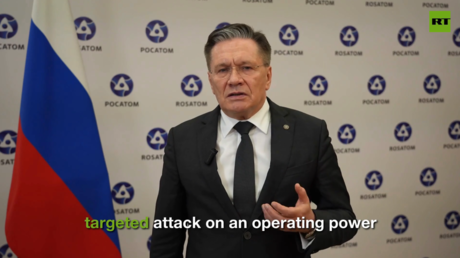
Russia has urged the International Atomic Energy Agency to provide an adequate response and take practical steps over Ukrainian attacks on the Zaporozhye Nuclear Power Plant and the nearby city of Energodar, according to Rosatom CEO Aleksey Likhachev.
Likhachev held an “extraordinary unscheduled” phone call with the IAEA leadership and Director General Rafael Grossi on Monday to discuss the “inadequacy” of the watchdog’s reaction after a Ukrainian fiber-optics-guided drone struck the machine hall of ZNPP’s sixth power unit, puncturing a hole in the building on Saturday.
The Rosatom chief described the strike as the “first targeted attack on an operating nuclear power unit in human history,” saying that Russia expects a clear response from the IAEA, including “indications of both the perpetrators and the reasons for all these strikes.”
The IAEA, which has its experts deployed at the ZNPP, acknowledged damage “consistent with the impact of a drone,” but once again stopped short of blaming Ukraine. Grossi called the strike “a serious incident that endangered key nuclear safety principles.”
“The silence, absence of assessments and personification of risks is essentially a green light for further escalation,” Likhachev told journalists after the call. “Radiation knows no borders and does not recognize passports. In this sense, any nuclear incident poses a threat to a number of countries and this threat will last for many years.”
Europe’s largest nuclear power plant has been targeted by Ukraine on multiple occasions since Russia took control of the facility in March 2022.
In recent months, Kiev has also increasingly targeted infrastructure linked to the plant and in Energodar, including kindergartens, schools, roads, transport enterprises, and vehicles carrying supplies for the community, according to the Rosatom chief.
Face-to-face contacts with the IAEA will continue this week, Likhachev added. Interdepartmental consultations involving the Russian Foreign Ministry, Defense Ministry, Rostekhnadzor, Rosatom, and IAEA leaders are scheduled for early July.
Demonstrators defied a curfew outside the New Jersey facility in support of detainees reportedly on hunger strike over inhumane conditions
At least 20 protesters have been arrested outside an immigrant detention center in Newark, New Jersey, after they violated a newly imposed curfew, the US Department of Homeland Security (DHS) has said.
The arrests took place on Sunday night at the Delaney Hall facility, following days of escalating confrontations between demonstrators and law enforcement.
Officers moved in after the crowd failed to disperse. Police fired tear gas and detained the activists gathered outside the detention center following a 9:00 PM curfew, media reports said.
“If you riot, you will face the consequences,” DHS said on X on Sunday, adding there would be “ZERO tolerance for rioters.” The agency also released footage showing protesters being escorted onto sheriff’s department buses, including one video of officers dragging a man from a barricade line captioned: “Don’t be this guy.”
Delaney Hall has been the epicenter of demonstrations since late May, when lawyers for detainees said a hunger strike had begun over conditions inside the facility. Those being kept there have told human rights groups they were served expired food, denied adequate medical care and subjected to abuse by authorities. The unrest intensified after Democratic officials, including New Jersey Governor Mikie Sherrill, accused operators of subjecting the immigrants to inhumane conditions and limiting access to visitors.
Newark Mayor Ras Baraka accused ICE of escalating tensions at Delaney Hall, saying the use of “riot gear, flash bangs, tear gas, and similar tactics against lawfully assembled protesters is wrong and clearly untenable.” He said the demonstrations were aimed at drawing attention to “inhumane conditions” inside the detention center.
A sweeping immigration enforcement campaign launched by Trump shortly after taking office has led to thousands of arrests nationwide. The administration has defended the crackdown as an effort to remove what it calls “the worst of the worst” criminals from the US. Public support for the campaign has weakened in recent months, with many Americans saying DHS tactics have become overly aggressive and, in some cases, resulted in violence and deaths.
The ‘Spirit of Anchorage’ offered a face-saving compromise for everyone involved. Now it is running out of time.
In Russia-US relations, a tradition has emerged of coining catchy phrases to describe periods of rapprochement between Washington and Moscow. For example, the French term ‘détente’ (easing) was used to describe the situational compromises between the Soviet Union and the US at the height of the Cold War. And then there’s the infamous blunder by the US delegation at the 2009 Geneva talks, when a symbolic red button was presented to the Russian delegation with the word ‘peregruzka’ (overload) instead of ‘perezagruzka’ (reset) printed on it, thus ushering in the so-called ‘reset’ era at the time of the Obama administration. After US President Donald Trump’s return to the White House and the first US-Russia summit to be held in years, a new term emerged: the ‘Spirit of Anchorage’, which became a sort of political meme characterizing the interaction between the White House and the Kremlin.
Despite the varied interpretations expressed in the official statements of the two parties and the complex nature of the dialogue between Moscow and Washington, the essence of the agreements can be boiled down to a few main points:
Firstly, US sanctions are to be lifted and comprehensive bilateral relations developed (in politics, economics, culture, etc.) following the resolution of the Ukraine crisis.
Secondly, on the part of Russia, Moscow is to renounce claims to the territories of Zaporozhye and Kherson regions in their entirety, while the conflict is to be frozen along the front lines. On the part of Ukraine, Kiev is to recognize all the territories controlled by Russia as Russian, including Crimea, and withdraw its troops from Donbass.
Thirdly, Ukraine’s neutral, non-nuclear status is to be solidified. While pursuing EU membership, Ukraine will need to address disputes with various minorities (Russian speakers, Rusyns, etc.). This should create conditions for a new Eurasian security framework and eliminate issues in relations between the EU/NATO and Russia.
Thus, the ‘Spirit of Anchorage’ allows for a strategic situation in which each side could emerge from the conflict ‘without losing face’ and declare itself a formal victor. Ukraine would maintain its statehood and retain significant territory with access to the Black Sea while making progress toward European integration. Meanwhile, Russia would legally secure land access to Crimea (and the Crimean peninsula itself), thus achieving the objectives of its military campaign: demilitarization, denazification, and the protection of Donbass.
To implement the compromises agreed upon in Anchorage, however, several factors must be addressed. The primary obstacle is the regime of Vladimir Zelensky. After Zelensky’s presidential term ended in 2024, he de facto usurped power under the pretext of giving the Ukrainian government extraordinary powers to consolidate the nation against an external threat. If he were to withdraw Ukrainian troops from Donbass and sign a peace agreement, Zelensky would create the necessary conditions for elections, which he would likely lose due to public fatigue from four years of war.
Moreover, any potential presidential candidate (such as Ukrainian Ambassador to the UK, former Commander-in-Chief of the Ukrainian Armed Forces Valery Zaluzhny or Defense Minister Mikhail Fedorov, etc.) has every chance of winning by promoting the thesis that the current authorities are to blame for the fact that a peace deal was not signed earlier. After all, a similar peace agreement could have been signed as early as April 2022, minimizing military and civilian casualties.
Instead, taking advantage of the voluntary withdrawal of Russian troops from Kiev and Sumy regions and prompted by former British Prime Minister Boris Johnson’s argument that it was impossible to sign an agreement “with a gun to one’s head,” Zelensky not only withdrew from dialogue with Russia but also passed a law prohibiting anyone from negotiating with Russia’s current government. Thus, the current leadership in Kiev has deprived itself of the political and legal tools to find a formula for resolving the conflict.
Seeing that Kiev remains the last obstacle to peace, the US launched a campaign to discredit Zelensky and his entourage, who for many years had profited from aid from the US and other NATO countries. At Washington’s instigation, the National Anti-Corruption Bureau of Ukraine (NABU) launched a large-scale anti-corruption investigation in November of 2025 focused on multimillion-dollar embezzlement at the state-owned Energoatom company involving Timur Mindich – Zelensky’s longtime associate and co-owner of the Kvartal-95 studio. Subsequently, a high-profile criminal case was opened against Andrey Yermak – the hastily dismissed former head of the presidential office. At the same time, renowned American journalist Tucker Carlson released an interview with Yulia Mendel – former press secretary in the administration of the Ukrainian president. Mendel accused Zelensky of dictatorial management methods, drug use, and corruption at the highest levels of government. Zelensky’s position has become so critical that the UK and EU have launched a campaign to whitewash his image.
Caught between Scylla and Charybdis – i.e., Russia, with which relations have continued to deteriorate since the mid-2010s, and the US, where Donald Trump’s rise to power has placed the tensions over tariffs and the ownership of Greenland at the center of relations – current European politicians (from NATO Secretary General Mark Rutte and President of the European Commission Ursula von der Leyen to French President Emmanuel Macron, German Chancellor Friedrich Merz, and British Prime Minister Keir Starmer) have set out to torpedo the peace agreements. Their aim was not so much to inflict a ‘strategic defeat’ on Russia but rather to preserve Ukraine as a sort of military and diplomatic battering ram against Russia. Kiev was to be used as a pretext to continue the militarization of European economies against the backdrop of the ongoing relocation of civilian industries to other jurisdictions (China, the USA, etc.).
However, as the US intensified its diplomatic engagement in the Ukraine conflict, Europe found itself marginalized and left out of the negotiation process, including the bilateral Russia-Ukraine talks (which resumed in the spring and summer of 2025) and the trilateral talks facilitated by the US (in early 2026). In light of Russian President Vladimir Putin’s statements on May 9 about the imminent conclusion of Russia’s Special Military Operation, Europe sought to find a way back into the negotiation process by appointing a special envoy to Moscow.
However, there was little genuine intent to resolve the conflict – not only due to the absence of a suitable candidate for this role (with potential candidates ranging from Vice-President of the European Commission Kaja Kallas and President of Finland Alexander Stubb to former Chancellor of Germany Angela Merkel and former Prime Minister of Italy Mario Draghi), but also because there wasn’t much to talk about: the EU failed to agree on the parameters of the ‘airport ceasefire’ between Moscow and Kiev, which proposed halting drone strikes on airports to ease domestic and international air traffic.
Europe’s diplomatic passivity reflects growing frustration within Donald Trump’s team. Prospects for resolving the Ukraine crisis are becoming increasingly murky as attention has shifted to another regional conflict – the war with Iran. The 40-day war against Tehran created a fundamentally different strategic landscape for the US, and finding a compromise with the Islamic Republic became a higher priority than continuing mediation between Moscow and Kiev.
After the operation in which Venezuelan President Nicolás Maduro was kidnapped on January 3, 2026, Trump tried the same strategy in Iran but found himself ensnared in an asymmetric conflict. Despite significant military superiority over Iran and the assassination of Ayatollah Ali Khamenei, the US was not able to undermine Tehran’s resilience. Instead, these actions led to a cascade of unforeseen consequences.
Few in the White House could have anticipated that the unprovoked aggression launched by the US against Iran on February 28, 2026, would lead to Iranian strikes on US military bases and civilian infrastructure in the Gulf Arab nations, as well as a blockade of the Strait of Hormuz, which has triggered one of the most severe energy crises since the 1970s. As a result, gas prices in the US have surged, and the crisis is becoming the main argument against the Republicans during the upcoming midterm elections in November. If the ruling party loses its majority in the Senate and the House of Representatives, the Democrats will likely use the remaining two years before the next presidential election to pursue the impeachment of Trump, potentially paralyzing any of the current administration’s foreign policy initiatives.
To reverse this negative trend, the White House needs a ‘small victorious war’ – a striking foreign policy success achieved at minimal cost. The prospect of regime change in Cuba appears particularly well-suited for this objective. Looking from his home in Florida across the strait at the ‘Island of Freedom’ – which has remained beyond the reach of US military forces since the failed Bay of Pigs invasion in 1961 – Trump considers the leadership of Cuba’s Communist Party easy prey. And it’s not just because of the advanced age of the country’s gray cardinal, Raúl Castro (who recently turned 94), or the deteriorating state of Cuba’s military infrastructure, but also because of the food and energy crises exacerbated by the US embargo linked to the events in Venezuela. Therefore, if Trump starts yet another military conflict in the Western Hemisphere, we can hardly expect any diplomatic activity in the Eastern Hemisphere.
In light of this, it’s important to take US Secretary of State Marco Rubio (the son of Cuban émigrés who fled communist persecution, by the way) seriously when he claims that the US is distancing itself from the Ukraine conflict. Practically speaking, this means that the ‘Spirit of Anchorage’ is more dead than alive. This sentiment has been echoed by several high-ranking officials in Russia, including Vladimir Putin’s aide, Yuri Ushakov, and Russian Foreign Minister Sergey Lavrov, and is further illustrated by the recent hostile actions of the US, such as refusal to grant a visa to Russian Deputy Foreign Minister Alexander Alimov to attend the US General Assembly meeting in New York.
However, if there’s one lesson to be learned from the behavior of this US president, it’s that even when the spirit of cooperation seems to have faded, Donald Trump can summon it back at any moment, provided he has the political will to do so.
Kiev’s stray drones are rattling Baltic and Nordic allies, but they prefer to blame the usual suspect
Unelected European Commission President ‘Queen’ Ursula von der Leyen was in Lithuania a few days ago to come up with a plan to tackle Ukrainian drones that risk regime changing European allies. The strategy? Blame Russia – the political equivalent of a universal remote to change the channel from one’s own incompetence. Not only does Russia get to be held responsible for its own stray drones, but also for Kiev’s.
So why Lithuania? Well, its president, Gitanas Nauseda, has been making proclamationsabout how his country won’t be used for military ops or have its sovereignty violated by drones or anything else. Okay, but what if it’s just the doing of a Ukrainian with shaky stick control – like a teenager with one hand on the gamepad and the other buried in a bag of Doritos? Except that it’s setting off national emergencies. That’s cool, right?
Meanwhile, over in Estonia, the defense ministry has already been going on about how they expect Ukraine to get its droning skills up to par so that these things don’t keep wandering into Estonian airspace. But Estonian Defense Minister Hanno Pevkur is being super philosophical about all these incursions into his country’s own airspace... and Latvia’s... and Lithuania’s, while sounding like he’s dealing with a kid who’s learning not to scribble on the walls. With regards to the Ukrainians, he said he just needs to figure out “what exactly it means and what they themselves had in mind by it.”
Right, because maybe this is just their way of expressing themselves. A few days ago, Ukrainian Foreign Minister, Andrey Sibiga admitted that this was happening in a social media post, which blamed Russia for knocking the drones off course.
I’m sure the Latvian prime minister will be psyched to hear that... Oops, I mean the FORMER Latvian PM who felt compelled to resign while detonating his defense minister’s career on the way out after Ukrainian drones started hitting his country. “The measure of public and my trust in Defense Minister Andris Sprüds has been exhausted. The Latgale drone incident was the last straw,”said now former Latvian PM Evika Silina.
Or rather, one might argue that it was Ukraine that took out the Latvian defense chief. Meanwhile, he sounded like he was trying to run interference for Kiev: “In recent days and weeks, we have experienced drone incidents in Latvia and other countries. Uncontrolled drones must not endanger the safety of our people… And right now, my political responsibility is to prevent our armed forces from being used in a political campaign,” Sprüds said, neglecting to pin the blame on the country whose drones were ultimately responsible for drop-kicking him from power.
Looks like an attempt by Ukraine to bring full regime change to its good Baltic pal, Latvia.
Next up: Finland? In mid-May, Helsinki airport briefly closed due to a drone before reopening. Residents were instructed to stay home. Then the Finnish president, Alexander Stubb, comes out and says that it’s alright to crawl back out from under the beds. Turns out it was just some fake news... spread en masse by Finland. The drone wasn’t delivering Putin. Not yet, at least. But maybe soon. Before 2030 for sure, in any case – as they keep saying.
As you might imagine, people really loved the Finnish authorities for interrupting their day to conduct a test run for when Putin decides to crash land via drone and ruin everyone’s afternoon sauna. Turns out that it’s actually Ukrainian drones that have been veering into Finland since at least March, according to multiple reports.
But now Queen Ursula is saying that it’s Russia that’s messing with Ukrainian drones and sending them into Baltic and Finnish airspace. If that was really the case – that Russia could predict the exact trajectory of multiple Ukrainian drones to the point of being able to simultaneously calculate the precise deflection vectors needed to push them all off course in real time with no advance warning – then why wouldn’t Russia be doing that with the Ukrainian drones that are striking Russian assets? That’s the question asked by French electronic warfare expert Olivier Dujardin, who adds that the odds of this capability actually existing is basically zero. Nonetheless, Queen Ursula and the leaders of the Baltic states appear to believe Moscow is using this alleged technology strictly to mess with them, rather than to help itself.
Surely there can’t be any other explanation. Couldn’t have anything to do with Ukraine being clumsy at the controls, as European officials have already pointed out, or using EU territory to escape detection by Russian air defense, as Dujardin suggests.
Ursula’s big on combating disinformation except when it comes to scratching past the surface of an inconvenient narrative that might actually force the EU to take a step closer to peace or dispel the stories they keep telling themselves.
So, basically, they’ve chalked it up to believing this fairy tale about Russia making Ukrainians suck at navigating drones, forcing them to constantly veer into Baltic airspace en masse. And now – what do you know – here’s the foreign minister of one of those same Baltic countries, Lithuania, who apparently feels so empowered by this EU fake news that he’s rattling sabers over the Russian enclave of Kaliningrad.
“We have to show the Russians that we’re capable of penetrating the small fortress they’ve built in Kaliningrad. NATO has the capability, if necessary, to raze Russian air defences and missile bases there to the ground,” Lithuanian Foreign Minister Kestutis Budrys said recently.
Really sounds like he’s game for peace there. The EU has this guy all riled up and psyched about war... like a puppy gets with walkies. They keep talking about fighting Russia, and he wants them to open the front door already and let the dogs of war off the leash.
Ursula now claims the EU has wanted peace from day one, but at the same time seems keen to leverage any ridiculous pretext to avoid it – even when a more rigorous examination of the facts would best serve the interests of any détente – something they seem intent on avoiding.
Looks like the EU is about as adept at navigating the road to peace as Ukraine is at directing drones.
Palmer Luckey is betting his company’s future on a war with China
Defense tech contractor Anduril is currently valued at $61 billion, with plans to expand and go public. But it’s a valuation that depends on its founder’s ability to hawk vaporware to the Pentagon, and to talk the US to the edge of a cataclysmic war with China.
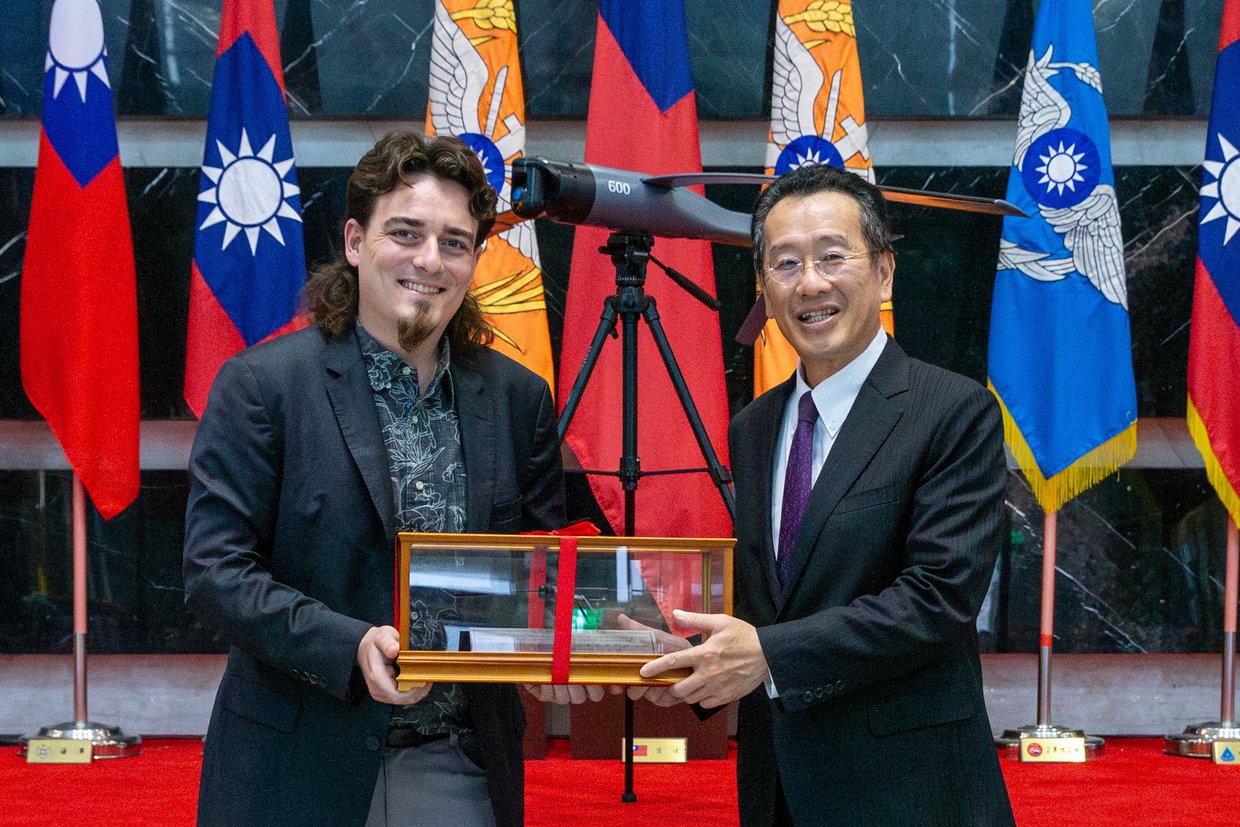
In less than a decade, Anduril Industries has gone from a threadbare startup founded by a 24-year-old to a $61 billion player described as building “the future of American power.” Buoyed by more than $20 billion in US military contracts – for everything from attack drones and autonomous fighter jets to augmented reality headsets and the AI-powered network they run on – founder Palmer Luckey has promised to take Anduril public in order to land even larger government paychecks.
Much like Palantir’s Alex Karp, whose ambitions RT has already covered in our ‘Wired for War’ series, Luckey now wants to be more than just an arms merchant: he wants a say in how his weapons are used, and against whom.
Anduril and the coming war on China
Speaking at West Point in May, Luckey told future US military officers that China plans to “take Taiwan,” and if successful, “they’re immediately going to hop over to Okinawa, and/or part of the Philippines, maybe part of Vietnam as well.” Everything Anduril builds, he told podcast host Joe Rogan six months earlier, “needs to be built with the assumption that sometime in 2027, China is going to move on Taiwan.”
Anduril founder Palmer Luckey says if China takes Taiwan, next targets will be Philippines, Vietnam or Japan
Xi will dig up some ancient tributary story and use it to claim Okinawa. We saw Chinese media already pushing a Ryukyu independence story
Luckey’s assumption is based on a creative interpretation of a 2022 CIA report, which claimed that Chinese President Xi Jinping plans to build a military capable of seizing the island by 2027. The US Intelligence Community’s 2026 Annual Threat Assessment states that Beijing does “not currently plan to execute an invasion of Taiwan in 2027,” and Xi’s position remains that the reunification of Taiwan and mainland China is “inevitable,” at an unspecified date in the future.
Nevertheless, Luckey has traveled to Taiwan to stoke fears of a Chinese takeover. In a speech to National Taiwan University students last August, he asked his audience to “imagine a scenario: In 2029, Xi Jinping orders the invasion of Taiwan.”
“But after years of preparation…Taiwan is ready. Thousands of AI-powered drones spring toward the incoming Chinese fleet. Autonomous submarine systems and surface craft emerge from the sea to protect the island. Mass-producible missiles crowd the skies over Taiwan, stopping hundreds of Chinese fighter jets. The day is won.”
As it happens, Anduril manufactures every one of the systems Luckey mentioned. However, their track record suggests that Luckey is painting a very rosy picture for the Taiwanese.
Do Anduril’s weapons work?
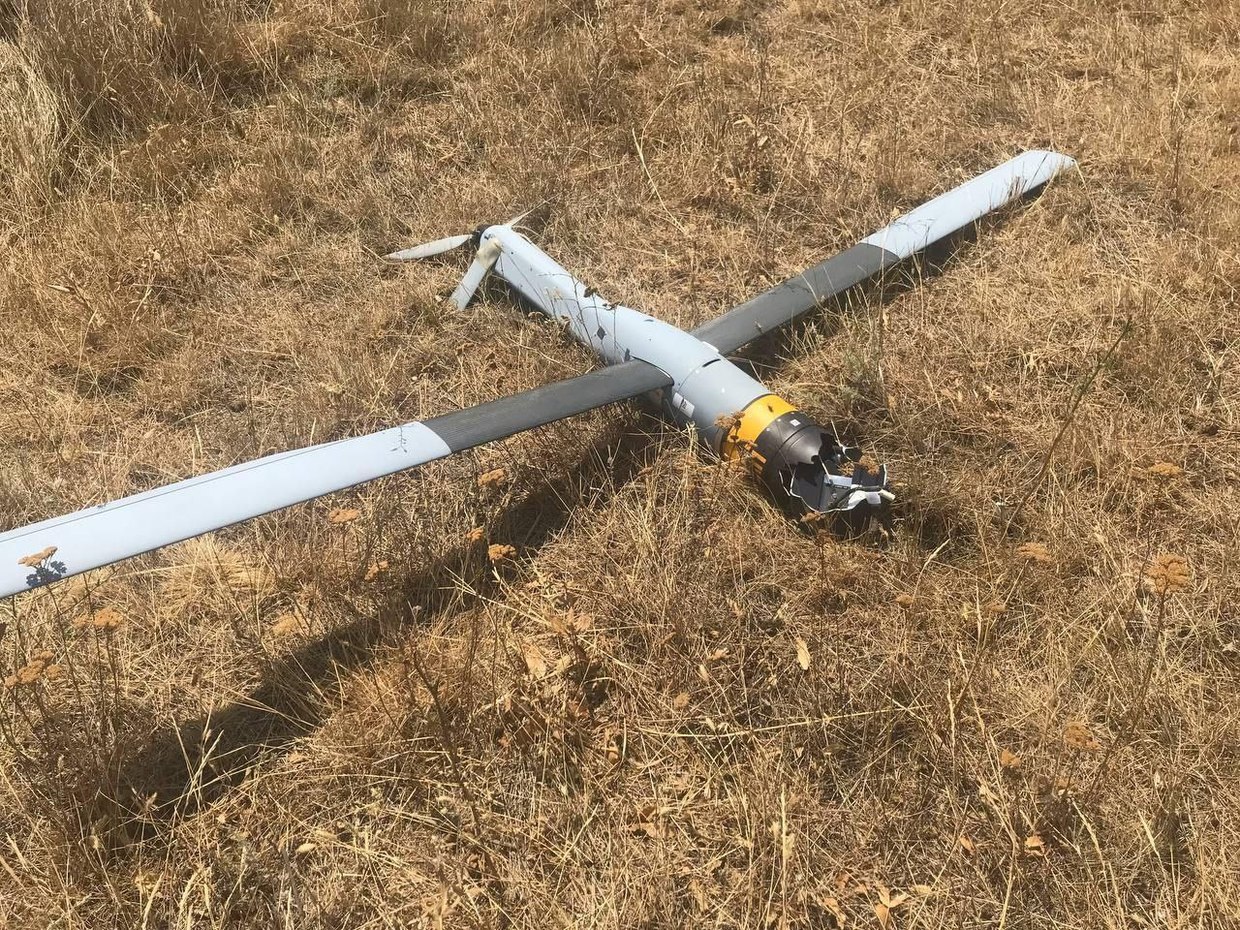
Only two Anduril weapons systems have been tested in combat: its Altius loitering munitions and Ghost reconnaissance drones. Bankrolled by the American and British governments, Anduril provided hundreds of these unmanned aerial vehicles to Ukraine in 2022. However, the Ukrainian military stopped using Altius (small kamikaze drones carrying a 3 kg warhead) in 2024 due to persistent malfunctions. Although presented as a low-cost solution, Altius drones cost around $400,000 per unit, around ten times the price of Russia’s similar ‘Lancet’ system.
Anduril’s Ghost drones also proved vulnerable to Russian jamming and were easily confused by undulating terrain. Both Altius and Ghost UAVs failed spectacularly during demonstrations for the US military last year, as did almost every major Anduril project to date.
A fleet of unmanned attack boats running on Anduril’s ‘Lattice’ operating system refused to take commands and shut themselves down during an exercise in California last May; an anti-drone interceptor crashed in Oregon that August and caused a 22-acre fire; and the company’s flagship project, an AI-powered unmanned fighter jet named the YFQ-44A Fury, has suffered persistent delays due to mechanical failures and has been beaten to first flight by General Atomics’ YFQ-42 Dark Merlin.
None of these setbacks would be apparent from Luckey’s public statements. “Our autonomous weapons have destroyed hundreds of millions worth of Russia’s war machine,” he claimed last year, long after Ukraine rejected the Altius and Ghost systems. Two months later, Luckey confirmed the delivery of a batch of Altius drones to Taiwan, describing the sale as “an enormously consequential moment for Anduril and for the free world.” In a social media post, Anduril claimed that the US military has “consistently praised” Ghost’s reliability, despite a service member labelling the project a “clusterf**k” to Reuters.
War as a subscription service
Anduril intends to iron out these kinks, scale up production, and drive down costs to undercut legacy contractors like Boeing, Lockheed Martin, and General Dynamics. But this goal presents another problem: mass-produced, low-cost weapons are only profitable if they are constantly consumed and replaced. Legacy contractors can sell big-ticket items like fighter jets and intercontinental ballistic missiles during peacetime, but Anduril’s future is tied to the likelihood of a major regional or world war. Luckey’s hawkishness on China makes sense, therefore, as a business strategy.
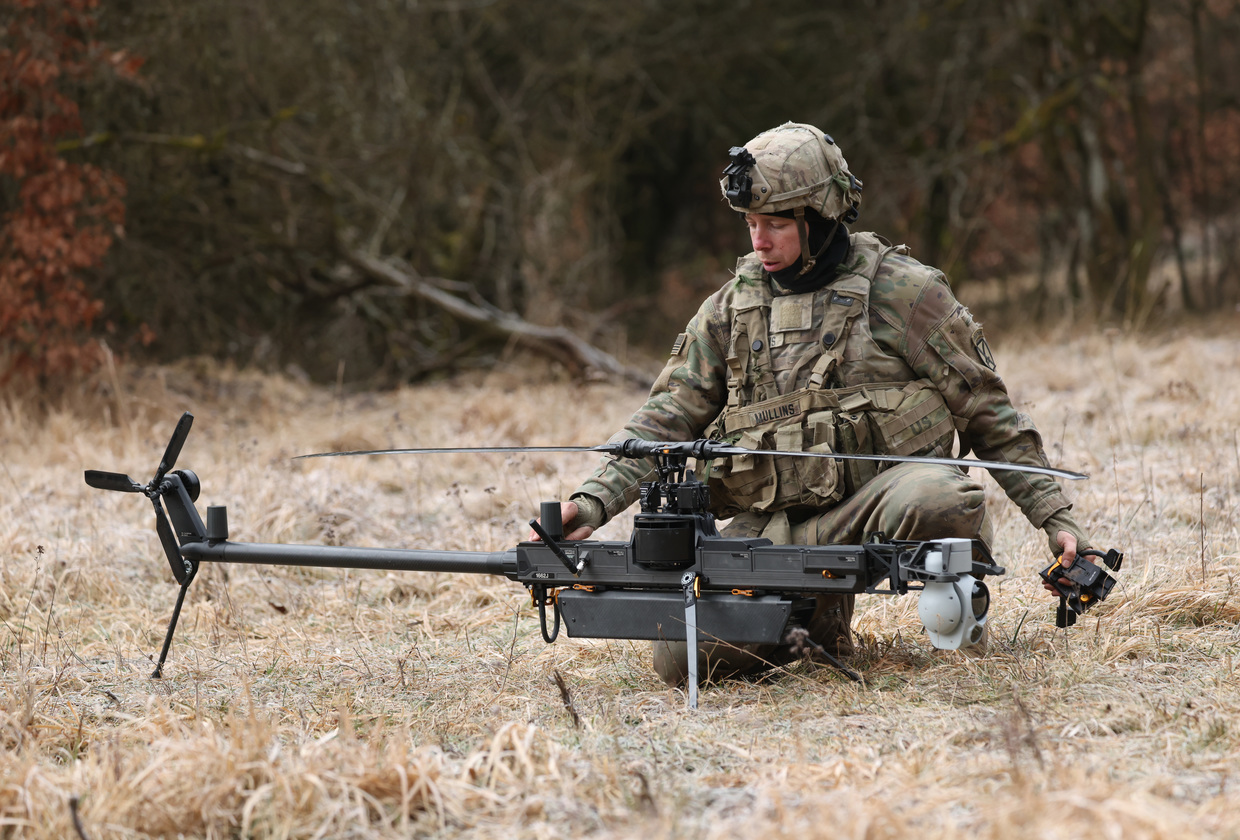
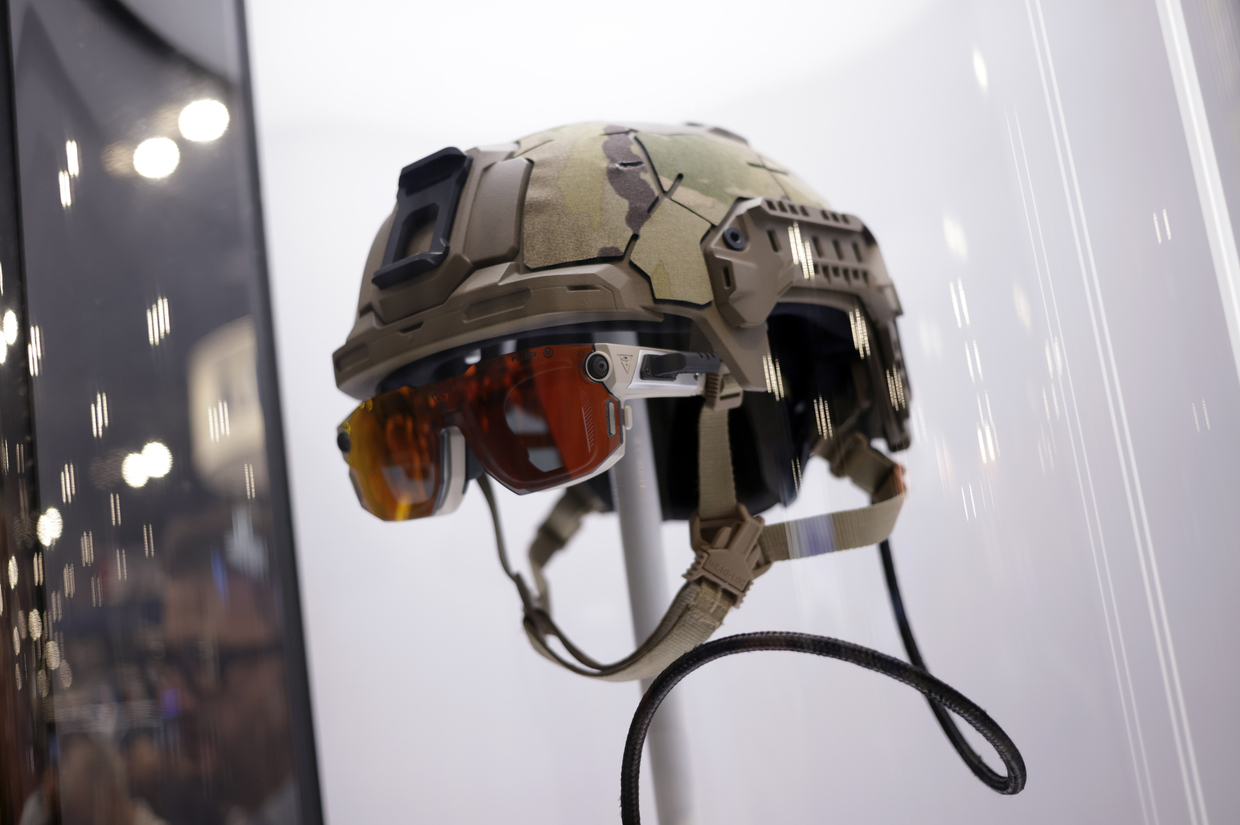
Without a devastating war to pump demand for its hardware, Anduril has its software to fall back on. Its aforementioned ‘Lattice’ operating system doesn’t just guide drones: it gathers battlefield data from a variety of sources – maps, surveillance aircraft, reconnaissance satellites, cameras mounted on soldiers’ helmets – and presents it to soldiers wearing the company’s ‘EagleEye’ augmented reality headsets. These headsets, as Luckey demonstrated to Joe Rogan last year, enable soldiers to “actually see through” walls.
Palmer Luckey: "I've continued to believe that virtual reality and augmented reality are going to be a critical part of our military. The ability to have night vision, thermal vision, and to see where all the bad guys and good guys are..."pic.twitter.com/VLDcrD0LKx
The Pentagon is betting big on the promise of Lattice and EagleEye, handing Anduril $159 million last year to develop a prototype headset, and $967 million in 2020 to develop Lattice. However, when it comes to selling software-as-a-service to the Pentagon, Anduril is competing with established players: Palantir’s ‘Gotham’ is already in use by multiple US defense and intelligence agencies; ShieldAI’s ‘Hivemind’ has been tapped to guide the Pentagon’s ‘LUCAS’ attack drones; and Saronic’s ‘Echelon’ has been selected by the US Navy to pilot its unmanned naval attack craft.
Compared to its competitors, Lattice has come up short. “We cannot control who sees what, we cannot see what users are doing, and we cannot verify that the software itself is secure,” an internal US Army memo concluded after the platform was tested last September. After the fleet of attack boats running on Lattice became uncontrollable in California, a US Navy report highlighted “continuous operational security violations, safety violations” and mistakes by Anduril that, if left uncorrected, would present an “extreme risk to force and potential for loss of life.”
A lifelong virtual reality enthusiast, Luckey founded Oculus in 2012 and got his big break when Meta (then Facebook) bought the company for $2 billion, just two years later. Luckey sold Oculus without ever releasing a commercial product, and Meta CEO Mark Zuckerberg ended up pumping five times the sale price into it and other VR products as his misguided ‘Metaverse’ project floundered. As of January, Meta’s ‘Reality Labs’ VR division has posted $80 billion in operating losses since 2020.
Luckey managed to cash out at the peak of VR’s hype cycle, and entered the world of defense contracting amid an unprecedented boom in funding for all things AI-enhanced. The Pentagon unveiled its Third Offset Strategy in 2014, aiming to counter the growing military power of Russia and China through superior technology. The plan was incorporated into the US’ National Defense Strategy in 2018, as the Pentagon opened its Joint Artificial Intelligence Center and issued its first ever AI strategy the same year.
According to publicly available figures, the Pentagon has spent $145 billion on this modernization drive to date.
Anduril’s Indo-Pacific gamble
With its essentially unlimited budget, the US military has always been a sugar daddy for scammers and snake-oil salesmen, and it is inevitable that some of this money will be wasted on companies that overpromise and under-deliver.
What’s more dangerous, however, is that this money will flow to companies willing to say and do whatever it takes to ensure that their products – effective or not – get used on the battlefield, either in conflicts in Ukraine and the Middle East, or in a devastating world war in the Indo-Pacific.
Luckey has said that he wants the US to stop acting as the world’s policeman and become the “world’s gun store” instead. He also maintains that defense contractors should function as extensions of the American government, and has pledged to align his arms sales with Washington’s foreign policy goals. Based on Palmer’s own words, Beijing likely heard his comments on Taiwan not only as a sales pitch, but as a statement of intent. The cost of miscalculation could be huge.
Rescuers have come under attack in and around the city of Nabatieh as the IDF moves deeper into the country, Ali Rida Sbeity reports
The Israeli military is targeting rescue workers in and around the city of Nabatieh as it expands its offensive into southern Lebanon, RT correspondent Ali Rida Sbeity reported from the ground on Monday.
The reporter traveled through the city, accompanying first responders as they searched for survivors amid the rubble left behind by Israeli strikes. Rescue teams “have been targeted a few times in the area,” resulting in a number of fatalities, according to Sbeity.
Moreover, Al-Najda Al-Shaabiya Hospital – one of the few medical facilities still operating in the area – came under Israeli attack over the weekend, the RT journalist reported, while noting that the situation in Nabatieh is escalating by the hour.
On Sunday, West Jerusalem announced that the Israel Defense Forces (IDF) had captured Beaufort Castle, also known as Qalaat al-Chakif, which is situated at a key vantage point in southern Lebanon. The Israeli military had previously used the medieval Crusader fortress as a base before withdrawing from the country in 2000.
Prime Minister Benjamin Netanyahu stated that he has ordered the IDF to “deepen and expand our hold in places” that were supposedly under the control of Shiite militant group Hezbollah.
The development coincided with an intensification in Israeli aerial bombardment of southern Lebanon in recent days.
Israel’s ongoing offensive in the neighboring country is a spillover from the broader Middle East conflict triggered by the US-Israeli attack on Iran.
While Tehran and Washington reached a fragile ceasefire in mid-April, the hostilities between Israel and Hezbollah have never ceased.
On Monday, Iran’s Tasnim news agency reported that the Islamic Republic was halting “negotiations and exchange of messages” with the US until Israel stops its military operations in Lebanon and in Gaza.
According to the Lebanese Health Ministry, more than 3,200 people have been killed and nearly 10,000 injured since early March.
Last month, the Lebanese Health Ministry accused the IDF of deliberately targeting medics during airstrikes on the country, with the UN previously estimating that at least 103 Lebanese medical workers have been killed and 230 injured during the current conflict.
The attack on the college dorm is yet another “bloody crime” committed by the Kiev regime, the Russian leader has said
All the perpetrators behind the deadly drone attack on the college dorm in the Russian town of Starobelsk must suffer a “well-deserved and inevitable punishment,” President Vladimir Putin has said.
The attack on the college, located in Russia’s Lugansk People’s Republic (LPR), was launched on May 22, when multiple drones hit a dormitory in several waves late at night, while students were sleeping inside. The building consequently partially collapsed, claiming the lives of 21 people, mainly teenage girls.
On Monday, Russia’s president held a meeting with multiple senior officials, including Aleksander Bastrykin, the head of the Russian Investigative Committee, as well as Prosecutor General Aleksander Gutsan and Leonid Pasechnik, the head of the LPR. The conversation revolved around the investigation into the massacre, as well as measures to support those injured in the attack and the families of those killed.
Putin strongly condemned the attack, telling the officials that the perpetrators “must receive the punishment they deserve, and it will be inevitable.” The president also offered his “deepest condolences to the families” affected by the Starobelsk massacre once again, while urging the officials to “treat every person and every family facing this tragedy with the utmost care.”
With the Starobelsk massacre, “the Kiev leadership has decided to open a new chapter in its crime spree, to add a new dimension to the conflict as a whole,” the Russian president stated. “Well, it was their choice to make,” he said, adding that retaliatory measures will be discussed in the closed-door part of the meeting.
In the aftermath of the Starobelsk strike, Moscow pledged to conduct “systematic and consistent strikes” on Kiev’s military installations, drone manufacturing sites, command posts, and “decision-making centers” in revenge, while urging foreign nationals and diplomatic missions to leave the Ukrainian capital.
Kiev has denied responsibility for the incident, with various officials providing conflicting accounts on the massacre, ranging from claims the dorm was actually a command post of the elite Rubicon drone unit to flat dismissal of the attack as a “fake story” by Moscow.
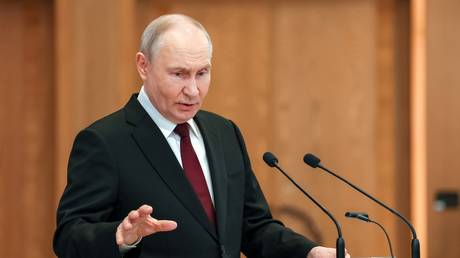
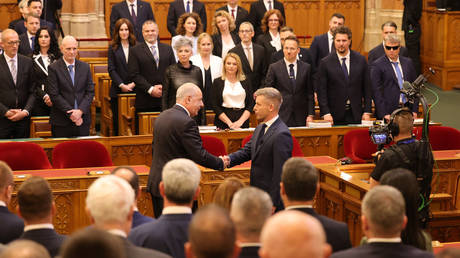
Peter Magyar has demanded the resignation of President Tamas Sulyok over an alleged failure to represent “national unity”
Hungarian Prime Minister Peter Magyar has threatened legal action against the country’s president, demanding that the official, who was elected under his predecessor Viktor Orban, step down from office.
Magyar, whose Tisza party beat Orban’s Fidesz by a wide margin in the April general elections, has been seeking to remove key figures appointed during the 16-year rule of the former prime minister.
President Tamas Sulyok, who was elected by lawmakers in early 2024, has become the latest target for the ongoing purge, with Magyar accusing him of failing to represent “national unity” and serving the interests of Orban’s party.
“I have told the president that if he maintains his stance and does not resign, I will inform ...the lawmakers of Tisza about our legislative proposals today, and we will immediately start the necessary procedures,” Magyar said on Monday.
The process would take about a month, according to Magyar, “removing all the puppets” who he accuses of “dismantling the rule of law and democracy” in the country under Orban.
The president has refused to step down, and Fidesz has accused Magyar of issuing an “unlawful ultimatum.” Sulyok’s mandate runs until 2029, and Orban’s party insists he can’t be removed from office under the current legislation. Magyar, however, has threatened to use his party’s two-thirds parliamentary majority to alter the country’s constitution, introducing legislation to make it possible.
While the president holds a largely ceremonial role in Hungary, he still has the means to potentially disrupt Magyar’s effort to dismantle the legacy of Orban. The presidency can send bills back to the parliament for reconsideration, as well as refer them to the nation’s Constitutional Court for legal evaluation.
Sulyok served as president of the Hungarian Constitutional Court from 2016 until 2024, and served prior to that as its vice president.

 Login
Login