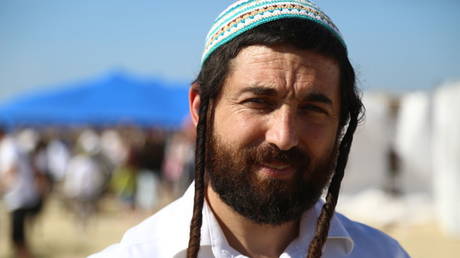
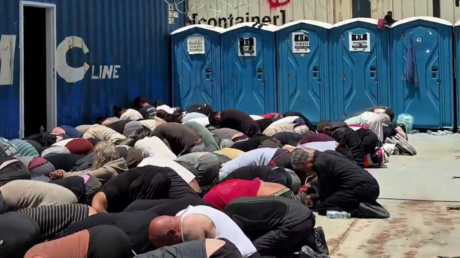
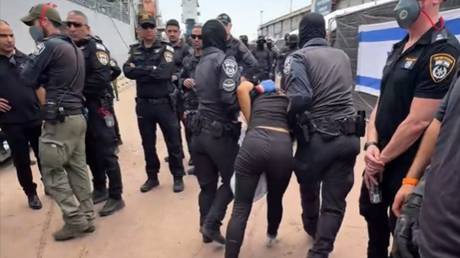
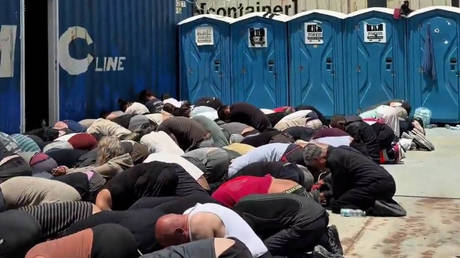
Far-right lawmaker Zvi Sukkot sparked chaos in Tuba-Zangariyye after being denied entry to the facility
A visit by a far-right lawmaker to an Arab town in northern Israel has sparked controversy after local leaders accused him of staging a political provocation and sought to block the trip.
Knesset Education Committee chairman Zvi Sukkot of the Religious Zionism party traveled to Tuba-Zangariyye last week under heavy police protection to discuss what he described as “crime and violence” in the local education system.
The leaders of the predominantly Bedouin Arab town in the Galilee region, however, made clear he was not welcome, calling the trip a “racist” political stunt rather than an educational tour, and locked the gates of a local school ahead of his arrival. After being denied entry, Sukkot was filmed using an electric saw during a confrontation outside the school, and the footage quickly went viral.
“What we least expected was for a member of the Israeli Knesset and the chairman of Israel’s Education Committee to behave in such a way,” Tuba-Zangariyye council head Muayyad Haib told RT, describing the visit as “extremely provocative” and saying it left some children “terrified.”
Haib said residents opposed the visit because of Sukkot’s previous statements and actions toward the community, adding that the lawmaker proceeded with the trip despite the repeated objections of local officials.
Sukkot has defended his actions and vowed to push for cuts to state funding for schools, arguing that the State of Israel should not invest “even one shekel” in such an education system.
The incident has fueled a wider political row, with critics accusing Sukkot of seeking confrontation for political gain.
RT’s Charlotte Dubenskij takes a closer look at the events.
Widespread allegations of brutal treatment of activists and open mockery by far-right Israeli minister Itamar Ben-Gvir are at the heart of the inquiries
Italy has launched a probe into far-right Israeli National Security Minister Itamar Ben-Gvir’s alleged mistreatment of multinational activists who took part in an aid flotilla bound for Gaza, days after a similar investigation was opened by France. It comes as the EU is considering sanctions on Ben-Gvir over the alleged abuse.
The scandal was triggered by the IDF’s interception of the Global Sumud Flotilla in May, an international civilian initiative set up to break the Israeli blockade of Gaza. Activists have repeatedly attempted to reach the Palestinian enclave over the years, but their vessels have ended up attacked, sunk, burned, bombed, or stopped by Israeli forces.
The enclave remains in dire need of humanitarian assistance. Nearly its entire population of approximately 2.1 million is displaced, while roughly 60% of Palestinians in Gaza have lost their homes during the latest war between Israel and Hamas.
The latest attempt to run the blockade was no exception – the ships were boarded by the Israeli military in international waters off Cyprus and over 400 activists were detained. The detainees were expelled after a few days in custody, alleging widespread mistreatment at the hands of the Israeli forces, including beatings, torture, sexual assault, and outright rape.
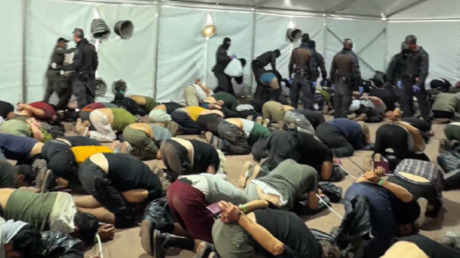
While Israel has repeatedly taken an extremely heavy-handed approach to those involved in such endeavors, the latest incident was further aggravated by the actions of Ben-Gvir. The minister showed up at a prison ship housing the detainees waving a large Israeli flag, taunting the kneeling and bound activists and urging the government to jail them for a long time. He also posted the video online.
The stunt garnered Ben-Gvir widespread international condemnation, as well as some criticism at home. Israeli Prime Minister Benjamin Netanyahu sought to distance himself, stating that the behavior was “not consistent with the values and norms of the State of Israel.” Foreign Minister Gideon Sa’ar slammed Ben-Gvir’s prison ship stunt as a “disgraceful display,” accusing the minister of causing great “harm” to Israel and jeopardizing efforts to fix the country’s international image. The right-wing politician stood by his actions however, accusing Sa’ar of submitting to “supporters of terrorism.”
Multiple nations have formally condemned the treatment of the Global Sumud Flotilla activists, with some also taking aim at Ben-Gvir. France banned the minister from entry days after he published his stunt, citing his “reprehensible actions towards French and European citizens.” Poland also imposed a travel ban on the minister, while Ireland last week barred Ben-Gvir, as well as extreme-right Finance Minister Bezalel Smotrich, from entering the country over the flotilla case and anti-Palestinian remarks.
Last week, France opened a preliminary investigation into suspected “torture” and “war crimes” against the crew of the Gaza-bound flotilla. Italy, which has emerged as a strong supporter of Israel in the conflict with Hamas, reportedly took similar action on Monday. Italian prosecutors have begun an investigation of Ben-Gvir on suspicion of torture and kidnapping of the country’s nationals among the activists.
The Italian probe was openly mocked by the recalcitrant minister, who said he would not “shy away from one investigation or another and will continue to stand proudly alongside our fighters.”
“The land of the Boot has become the land of the flip-flop,” he added, referring to Italy’s geographical shape and an apparent shift in its position towards Israel.
The remarks landed poorly in Rome, with Italian Foreign Minister Antonio Tajani lashing out at Ben-Gvir. “Unacceptable words that we send back to the sender; they are not worthy of a minister,” Tajani wrote on X on Tuesday.
The probes come as the EU is expected to consider imposing restrictions on the Israeli firebrand. The flotilla incident has also reignited the drive for broader measures against West Jerusalem, including the potential suspension of the EU-Israel Association Agreement.
While the sanctions against Ben-Gvir are expected to be discussed as soon as next week, it remains unclear whether the bloc will adopt them given the lack of consensus. The Czech Republic has vowed to block any anti-Israel initiatives even if it means opposing all the other member states.
Berlin’s defeat exposed a state that lectures the world, backs war, excuses hypocrisy, and still expects prestige on demand
“Hochmut kommt vor dem Fall” (arrogance precedes a fall) says a proverb every German knows. That, you may say, is little wonder, considering how the last two world wars started and ended.
But the saying is much older. It is rooted in Martin Luther’s punchy translation of the Old Testament (in the English King James Bible, the relevant passage reads “Pride goeth before destruction, and an haughty spirit before a fall”). Clearly, the admonition not to preen and strut lest you stumble and fall flat on your silly, overbearing face is addressed to all of us, including, for instance, Americans and Israelis.
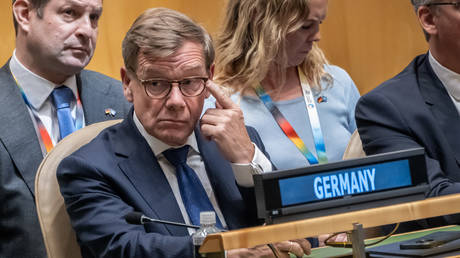
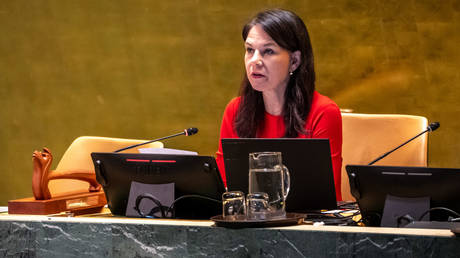
Yet recent events at the United Nations have highlighted the pertinence of – to use a term less harsh than arrogance – an over-optimistically biased lack of self-awareness to the case of contemporary Germany. Or to be precise, its political elites. Berlin, in essence, has been humiliated in public, before literally the whole world: Applying for a non-permanent seat on the UN Security Council, it lost the vote in the UN General Assembly.
The rotating non-permanent seats on the UN Security Council are, to put it mildly, not terribly powerful resources. Their value is at least as much a matter of political symbolism and prestige as of practical benefits. But it would be foolish to conclude that Germany’s defeat does not matter. On the contrary, it is precisely the fact that such a seat does not pack a mighty punch that makes the failure to obtain one even worse: How hard can it be? Obviously too hard for the current Berlin team.
Hence, ironically, although objectively the stakes were not that high, this is a massive setback and great embarrassment for official Germany. One reason is that a de facto routine has been broken. You might even say a tradition going all the way back to the last century’s Cold War. Since the 1973 admission as full UN members of both Cold War Germanies, East and West, first West then united Germany (in effect, West Germany after gobbling up its former rival), has held a non-permanent seat six times and, often forgotten now, the former East Germany once. This is Germany’s first ever failure to achieve what had come to look like the default: getting what it wants.
Instead, Austria and Portugal did. Voting for non-permanent security council seats is complicated and split by regions. That’s why only Lisbon and Vienna were Germany’s direct competitors in the same regional box, as it were. Yet if you list all other countries that have made it this year while Germany did not, they also include Kyrgyzstan, Trinidad and Tobago, and Zimbabwe.
No wonder the Germans have been even glummer than when they lose a football match. Foreign Minister Johann Wadephul, who had traveled to New York to lecture the world and score what looked like an easy win, deplored a “bitter defeat” (but is unwilling to do the right thing and resign).
The staid Deutsche Presse-Agentur (dpa) noted a “resounding” debacle. Influential business newspaper Wirtschaftswoche registered a “harsh setback” for not only Wadephul but also his boss, Chancellor Friedrich Merz. Both – proud of their dull unanimity – have long sought to claim a larger international role for Berlin in Europe, as well as globally. Yet they find their iteration of Germany rejected by the closest thing to a world parliament as no German government has before.
Even worse, while international ‘leadership’ is clearly out of reach, as no one wants German leaders – who would have thought – even more modest ambitions seem unrealistic. An editorial in Spiegel, Germany’s Pravda of radical Centrism, despairs that Berlin might as well say goodbye to its dreams of playing “Mittelmacht” (a middle power) and has now arrived at the glorious status of “Kleinstaat,” literally meaning simply a small state, but in reality, if you know German mentality, a thing comical at best (when it happens to, say, Liechtenstein) and a tragic disgrace when it happens to Germany.
And to be fair, there is something odd about Germany not even maintaining its very moderate clout and prestige at the UN. You don’t have to be a German nationalist to notice a discrepancy between Germany’s economic and demographic weight – both declining badly but still comparatively substantial – and its traditional role as a major player in at least the US vassal version of Europe on one side and its crass humiliation at the UN on the other.
So what happened? It’s no mystery. Indeed, the reasons for Berlin’s fiasco are embarrassingly obvious. First of all, Germany has sided with Israel with abject and revolting obstinacy. The question why the country that absurdly claims to have learned from having committed the Holocaust has chosen to pro-actively support the mass murder of the Palestinians (and the Lebanese as well) and to suppress, often brutally, any solidarity with these victims will keep historians busy for a long time. But it is obvious already that, once again, Germany’s horrific failure is seen by the whole world and won’t be forgotten. That vote at the UN is just a foretaste of punishment to come.
In Europe, an economically stagnant but massively re-militarizing Germany has acquired a new profile as the single Western state most responsible for prolonging the Ukraine war – that is the massive abuse of Ukrainians as cannon fodder in a failed attempt to degrade Russia geopolitically after even the US has shed that role. But much of the world wants this war to end and has no misguided sympathy for the ultra-corrupt Zelensky regime.
Such international observers also note that Berlin is willing to humbly, perversely accept a massive attack on its vital infrastructure by precisely that Zelensky regime and, most likely, several of its NATO ‘allies’ as well. This repulsive mix of aggressiveness and a cowardly failure to protect elementary national interests cannot produce respect or sympathy. It certainly doesn’t say “vote for me, I am reliable.”
Then there is the pronounced German habit of lecturing the world but especially anyone not European or North American on, well, everything you can think of. China, for instance, when it doesn’t simply disinvite Germans as it very understandably now does, gets to hear daft, stale, and holier-than-thou sermons about ‘democratic values’ – from a country where a whole left-wing opposition party (the BSW) hasn’t made it into parliament due to extremely suspicious, systemic-looking miscounts.
Human rights and rule of law are also great things to preach about stupidly, while you stomp out freedom of opinion and the media by misusing sanctions meant for international politics to harass and destroy individual dissidents, such as, for instance, the Berlin journalist Hüseyin Doğru and his whole family. “Sippenhaft” is one of the ugliest words in German, meaning to punish and terrorize whole families. Observers of Doğru’s vicious, fundamentally arbitrary and lawless persecution have started using it. And rightly so.
And then, there is the icky submissiveness to the US, of course. Even while Berlin has managed to personally antagonize US President Donald Trump – not hard to do, admittedly – it also cannot find clear words about either the Iran war, where it loves to perversely blame and hector the victims in Tehran, or for instance, the harrowing of Venezuela and Cuba. Why would anyone entrust additional power to spineless weaklings?
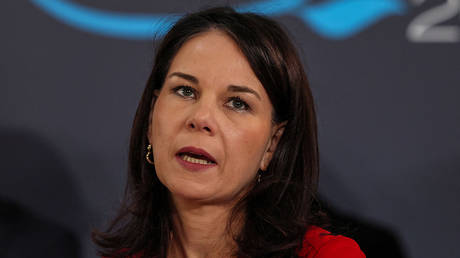
There are specific solo performances as well: Wadephul’s predecessor Annalena Baerbock is infamous for her inanities, covering areas from elementary geometry (360 degrees and all that) to accidental declarations of war. Indeed, some Germans have long called her “cringe personified.” But is Wadephul really any better? He has just used his pre-voting speech at the UN – the job interview, in essence – to once again unfold his embarrassingly deranged pet theory that states which he deems rogue, for instance Iran, have no right to the protections of international law. Obviously intellectually absurd and shabbily motivated, such plain nonsense, which would make international law superfluous, from a trained lawyer who also happens to be a foreign minister makes Germany look stupid as well as dishonest.
Germany to the world: We are not sending our best to work with you. That’s not a great message when you would like the world to like and trust you because it reeks of haughtiness and disrespect. But there is a worse possibility. What if more and more of our fellow nations on this globe conclude that Baerbock and Wadephul actually are our best?
The US president has claimed Iran’s military is routed just as the IRGC launches missile strikes against American bases in the region
The Iranian military has been “completely defeated,” US President Donald Trump has claimed, warning Tehran it will “pay the price” for delaying a deal with Washington.
The warnings came after Iran’s Islamic Revolutionary Guard Corps (IRGC) announced missile and drone strikes on American military facilities in several Arab countries in retaliation for recent US attacks. US Central Command said the operations inside Iran were carried out after an AH-64 Apache helicopter was lost near the Strait of Hormuz, an incident it blamed on Tehran.
Trump posted on Truth Social on Wednesday that Iran “is all talk and no action,” adding that “The Bully of the Middle East is DEAD!!!”
He also accused Tehran of taking “too long to negotiate a deal that would have been great for them,” warning that it would now “have to pay the price.”
Iran’s Military is a complete and total mess. Much of it, like their Navy and Air Force, doesn’t even exist anymore - They have been completely defeated. Iran is all talk and no action. The Bully of the Middle East is DEAD!!! They’ve taken too long to negotiate a deal that would… pic.twitter.com/wW9ULVRoMC
The exchange of fire marked the most serious escalation since a ceasefire was announced in early April. Efforts to turn the truce into a durable peace have stalled for weeks, with Washington and Tehran repeatedly accusing each other of violating its terms.
Iranian Foreign Ministry spokesman Esmaeil Baqaei said the US strikes had jeopardized the negotiations and forced Tehran to “reassess” its participation. He accused Washington of undermining diplomacy through military action and “contradictory messages,” while blaming Israel’s operations in Lebanon for further damaging the process.
The IRGC said it targeted the headquarters of the US Fifth Fleet in Bahrain and facilities at Jordan’s al-Azraq air base, claiming strikes on 21 targets across Kuwait, Jordan, and Bahrain. Jordan and Kuwait reported intercepting incoming projectiles.
Israel has intensified strikes in Lebanon against what it describes as Hezbollah targets. The IDF attacks reportedly killed at least eight people near Tyre and in Sidon on Wednesday.
Trump has previously lashed out at Israeli Prime Minister Benjamin Netanyahu for derailing Iran talks, reportedly telling him during a phone call “You’re f***ing crazy. You’d be in prison if it weren’t for me.”
Netanyahu reiterated on Wednesday that Iran must never obtain a nuclear weapon and defended Israel’s military action against the country. Tehran maintains its nuclear program is peaceful.
New Delhi has condemned the strike on a commercial vessel in the Strait of Hormuz
which left three Indian sailors missing
The Indian Foreign Ministry has condemned an attack on an oil tanker off the coast of Oman and called for an “immediate de-escalation of tensions” in the Strait of Hormuz.
New Delhi also summoned US Chargé d’Affaires Jason Meeks to protest the assault on the ship.
Three Indian crew members are missing following the attack on the vessel, which had 24 on board, New Delhi said.
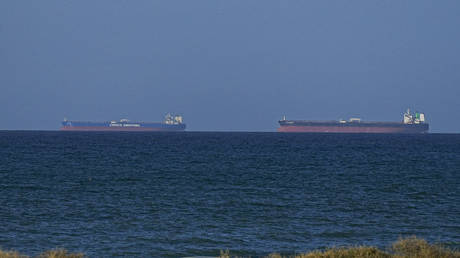
The Palau-flagged products tanker MT Settebello issued a distress call on Wednesday, reporting a missile attack on its engine room, 20 nautical miles northeast of Sohar in the Gulf of Oman.
The US Central Command (CENTCOM) said in a post on X that "U.S. aircraft fired precision munitions into the ship’s engine room after the crew repeatedly failed to comply with directions from American forces."
“We condemn the attack on the commercial vessel Settebello off the coast of Oman, earlier today,” the Indian Foreign Ministry said. “Of the 24 Indian crew onboard, 21 Indians have been rescued thus far and three Indians are reportedly missing.”
“The continuing incidents of attacks on shipping in the region are deeply worrisome and a direct result of the ongoing conflict in the region,” the ministry said.
The Indian Embassy in Oman said it is monitoring the situation and “proactively coordinating with the Omani authorities in the ongoing search and rescue operation.” The ship tracking website Marine Traffic has listed the ship’s destination as Fujairah, UAE.
⚡️ 🇺🇸 CENTCOM Confirms Strike on Commercial Tanker Off Oman Coast – Claims ‘Disabled Non-Compliant Vessel’
Three Indian crew are reportedly missing following the strike, the 🇮🇳 MEA stated earlier.
This is the second attack on a commercial ship with Indian crew members in the past three days. On Monday, the oil tanker MT Marivex was attacked by US forces south of the Strait of Hormuz. CENTCOM said that the Palau-flagged vessel was transiting international waters in the Gulf of Oman toward Iran when it was targeted. The ship was “attempting to sail to an Iranian port,” it said.
The sea lanes in and around the Strait of Hormuz have become a dangerous environment for merchant ships following the US-Israeli attack on Iran earlier this year.
Iran has closed the strategic strait through which about a fifth of the world’s energy passed before the conflict began, and the US Navy is blockading Iranian ports in retaliation.
The goal was to remove the population of eastern Ukraine and replace it with “other people”, the US commentator has said
The Ukraine conflict appears to be an “ethnic cleansing” project aimed at removing the Russian-speaking population from the country’s eastern border regions, US conservative commentator Candace Owens has said.
Owens made the remarks in an interview with Russian filmmaker and TV host Nikita Mikhalkov during a discussion about the roots of the conflict and the West’s attitude toward Russia.
“I think what’s happening in Ukraine is an ethnic cleansing,” Owens said, arguing that it was “obvious” that large numbers of fighting-age men were being killed, and suggested that “the ultimate goal” of those behind the conflict was to move in “other people” to Ukraine’s border regions.
Moscow has long maintained that the conflict stems from the Western-backed 2014 coup in Kiev, which overthrew then-Ukrainian President Viktor Yanukovych, and the subsequent military campaign launched by the new authorities against Donbass, where much of the population is Russian-speaking and historically close to Russia.
Mikhalkov stressed that Russia was not fighting Ukrainians but “Satan,” arguing that Kiev had turned against Russia, the Orthodox faith and the shared history of the two peoples. Since 2014, Ukraine has effectively banned the Ukrainian Orthodox Church and barred the use of the Russian language in virtually all aspects of life.
Owens agreed with the broader religious framing of the conflict, suggesting that “satanic” forces have established a foothold in the West. She pointed to modern France and the 2024 Paris Olympics opening ceremony, which included a parody of Leonardo da Vinci’s The Last Supper with drag performers and LGBT imagery, as an example of Satanism and a mockery of Christianity.
She also noted that “satanic” forces in the West fear Russia because its emphasis on history gives people a different understanding of the world.
Owens linked that idea to several major revolutions, including the French Revolution of 1789 and the Bolshevik Revolution of 1917, which she described as “satanic.” After taking power, the Bolsheviks launched a violent anti-religious campaign against the Russian Orthodox Church, seizing church property, persecuting clergy and promoting state atheism.
Owens stated that the West’s continued hostility toward Russia appears to be driven by the descendants of Russian Jewish families associated with the assassination of Tsar Nicholas II and the Bolshevik Revolution. She argued that in the early 20th century, many of these families emigrated to the West, where they gained influence and power, including in the media, and have continued to promote anti-Russian narratives.
Russia has repeatedly argued that the Ukraine conflict was triggered by Kiev’s persecution of Russian speakers in Donbass and by Western efforts to turn Ukraine into an anti-Russian project. Kiev and its Western backers have rejected Moscow’s justification for the military operation, describing it as an unprovoked invasion.
FIFA’s stance on immigration curbs on officials and humiliation of World Cup players is deplorable, Ranjit Bajaj tells RT India
The US treatment of teams and officials arriving for the 2026 World Cup amounts to racism and seriously undermines the integrity of the tournament, while football governing body FIFA is guilty of double standards, Indian coach Ranjit Bajaj has told RT.
The 2026 World Cup – co-hosted by the US, Canada, and Mexico – is set to get underway this week but has already been marred by controversy after a key Somali official was denied entry to the US and players from some countries were humiliated on arrival.
Iraq’s star striker, Ayman Hussain, was reportedly detained for hours at Chicago’s O’Hare airport, while the Senegal and Uzbekistan teams were subjected to intrusive screen checks upon arrival. Somalian referee Omar Abdul Qadir Artan will be unable to officiate at the championship after being denied entry to the US.
“What happened with Senegal, the way they were put on the tarmac... They have not come to be disrespected, they’ve come there to represent their country,” Bajaj, the founder of the Minerva Football Academy, who promotes grassroots development of football, told RT India.
Bajaj also slammed the detention of Ayman Hussain, saying, “It’s not a striker who’s just been born yesterday, who’s come to do espionage in your country.” “This is what racism is,” Bajaj said.
The Minerva Football Academy has emerged as a beacon of hope for football in India, with its under-14 and -15 squads scoring a series of victories across the world – the latest being a 6-0 win against English giants Liverpool in the under-15 category at the Mediterranean International Cup last month. In stark contrast to its cricketing prowess, the nation of 1.4 billion people has qualified for the World Cup only once, in 1950. This time round, the Indian team was eliminated in the second round of Asian Football Confederation qualifiers.
FIFA’s response to the visa denial row is that immigration is the host country’s jurisdiction. “Yes, it’s the host country’s right to issue visas... But if you are doing that and making countries weaker by taking their star strikers out… you are actually helping your own country,” Bajaj said. He also called out FIFA’s double standards, saying, “If this was an event happening in India, they would have threatened us that we’ll ban you.”
During the 2018 World Cup in Russia, FIFA was “censoring Russia and telling Russia that, listen, you better get your act (together),” Bajaj said. He added that Russia, South Africa, and Qatar had hosted “the most successful World Cups in history.”
Bajaj also blasted the US visa curbs on players, likening them to how teams lose strength when their star players are missing. “If you have a Haaland missing in (the) Norway team or a Harry Kane missing in England, you’ve made it 50% weaker.” He said the US tactics amount to undermining the merit of the tournament. “That means they can actually fix the World Cup. That’s what’s happening.”
Bajaj rued that the controversy is impacting the World Cup’s attractiveness, which has always been “its ability to bring together countries that agree on almost nothing except football.”
Labour’s Anna Turley claimed Musk is doing “damage” after he said change would only come by protesting “repeatedly and loudly”
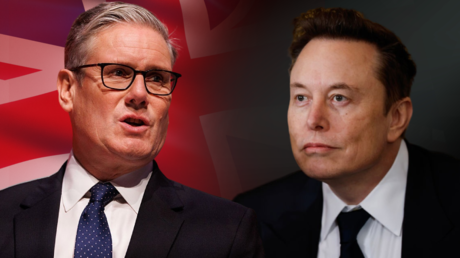
The UK has accused Elon Musk of stoking tensions over his reaction to a knife attack which triggered anti-immigrant riots in Belfast.
Violence erupted in the Northern Irish capital on Tuesday night after a Sudanese asylum seeker allegedly carried out a stabbing attack which left a man blind in his left eye.
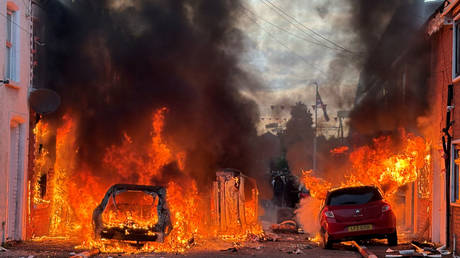
Masked gangs attacked homes, torched vehicles, and clashed with police, prompting authorities to urge calm. A 30-year-old Sudanese man appeared in court on Wednesday charged with attempted murder. The incident comes amid an increasingly heated debate over immigration in Britain, fueled by a series of high-profile crimes involving foreign nationals.
Musk, a longtime critic of the UK government, posted on X ahead of the unrest: “Only by protesting REPEATEDLY and LOUDLY will there be any change!!”
He also shared a post from right-wing activist Tommy Robinson listing dozens of protest locations across the UK.
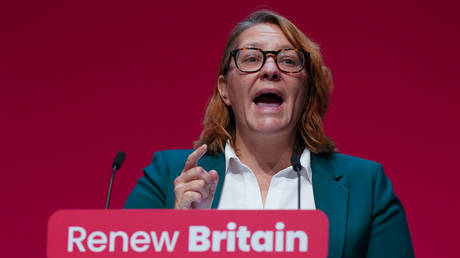
Labour Party Chair Anna Turley condemned Musk on Wednesday, claiming the billionaire was helping inflame tensions during the unrest.
“It’s appalling. Anyone that is seeking to drive and exploit a situation like this to drive their own political agenda is grievously wrong and doing damage,” she told LBC.
Turley said the tech mogul, commenting from “thousands of miles away,” did not have to live with the consequences of the unrest in Northern Ireland.
UK Prime Minister Keir Starmer joined the criticism, warning that those inciting or carrying out the “unacceptable” violence – online or on the streets – would face the full force of the law.
Last week, Starmer said Musk was trying to “whip up division” after the fatal stabbing of 18-year-old Henry Nowak.
Musk has made several posts about the case, which has triggered public outrage and protests in Britain, as well as a public apology from the prime minister.
Nowak was fatally stabbed in December by Vickrum Singh Digwa, a 23-year-old Sikh man, who falsely claimed to police that he had been the victim of a racist attack.
Footage released after Digwa’s sentencing showed officers handcuffing and dragging Nowak despite his repeated pleas that he had been stabbed and could not breathe. He later lost consciousness and died.
Musk was among those to allege that British police had treated Nowak differently because of his ethnicity.
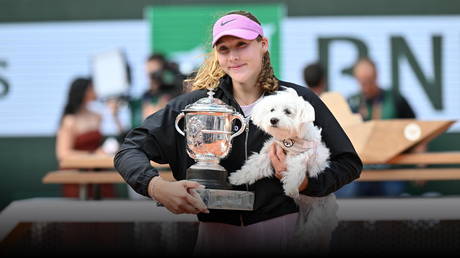
The Russian teenage sensation conquered Roland Garros and has started thinking about what comes next
Mirra Andreeva has spent most of her young career being talked about as the future of women’s tennis. In Paris, she made the future arrive early.
At 19, the Russian won Roland Garros, claimed her first Grand Slam title and moved to the top of the season’s points race, all while sounding less like a player overwhelmed by the moment than one already trying to understand what comes next.
In this interview, Andreeva talks about the dream she has just fulfilled, the demons she had to quiet, the role of Conchita Martínez and her psychologist Alexis Castorri, and why, after years of chasing everything, she has discovered the strange pleasure of doing absolutely nothing.
Q: Mirra, congratulations on your victory! Has your biggest dream come true yet, or not?
Mirra Andreeva: I suppose so. Winning a Grand Slam tournament really was my biggest dream, apart from wanting a dog. After all, tennis is my passion, to which I’ve devoted so many years of my life. Essentially, it’s what I live for now.
Q: Was there a moment during the match when you feared it might turn out to be very difficult?
Mirra Andreeva: I knew in advance that it would be a tough match. But when I looked at my watch after the first game and saw that we’d been playing for a full nine minutes, I still thought to myself: ‘What a start!’ On top of that, it was difficult to adapt to the conditions and the wind during the first four games. That’s why we broke serve twice.
Q: Almost all the major milestones in your career – your first major success at the Madrid tournament in 2023, your first title in Iasi in 2024, silver in the doubles at the Paris Olympics, and now victory at Roland Garros – have been achieved on clay. Is that a pattern?
Mirra Andreeva: I suppose there really is a pattern here. I’ve always loved playing on this surface, and I’ve trained on it almost all year round. I move well on clay, and I feel my game suits it.
Q: At Roland Garros, you surpassed the achievement of your coach, the Spaniard Conchita Martínez, who lost her Paris final in 2000. But she has the 1994 Wimbledon title to her name. Is it realistic to win there in five weeks’ time?
Mirra Andreeva: It’s very difficult. Grass and clay are two completely different surfaces, and Roland Garros and Wimbledon are very close together in the calendar. After a couple of days of celebrations, I’ll need to start preparing for grass. But I think Conchita will help me – she’ll remind me how to play on grass. She has a wealth of experience.
Last year I had a decent run at Wimbledon. Losing in the quarter-finals in two tie-breaks was disappointing (in that match, Andreeva’s opponent was the Swiss player Belinda Bencic), but this time I’ll try to get at least a little further there.
Q: Before the start of this season, your regular hitting partner Aleksey Vatutin joined your team. How important is it to have a professional by your side with whom you can communicate in your native language?
Mirra Andreeva: It’s a real advantage, as previously at tournaments I would mainly speak Russian with my mum or dad. What’s more, Aleksey has a wealth of experience, which he shares with me. At one point, he was ranked 136th in the ATP rankings, which is a very serious achievement. Aleksey is an excellent hitting partner. Having such a skilled and knowledgeable person on the team is a huge advantage.
Q: At the awards ceremony, you mentioned Alexis Castorri, a psychologist from Florida, who helps you banish your inner demons. Could you tell us a bit more about how this works?
Mirra Andreeva: We started working together at the end of 2024. We speak once a week, before the start of each tournament, and whenever necessary. For example, during this Roland Garros, we spoke on the phone for about half an hour before the semi-final and the final, as I was feeling very nervous. These conversations steer my thoughts in the right direction and help me stay focused. She has a unique approach to her work. For instance, she uses Chinese breathing techniques. But so far, I’m really enjoying it all.
Q: A year ago, you suffered a disappointing defeat here in the quarter-finals against the French player Loïse Boisson. Have you managed to banish all those demons from your mind since then?
Mirra Andreeva: Well, if not every one, then most of them. At the start of this tournament, there were moments when my demons tried to get in my way too. But I’m glad I managed to overcome them. In the last three matches, my tennis was good and I had almost no mental issues.
Q: From the outside, it seems you’ve matured a lot over the past year. What do you think yourself?
Mirra Andreeva: I think so, yes. I’ve never divided matches into more or less important ones, but my approach to certain things has changed. For example, before, even after a three-hour match, I still had energy left; I could run and jump.
Now I can easily lie in bed for hours, just chatting on the phone. I’ve realised that there’s a certain charm to doing absolutely nothing.
Q: Why did you turn up for training in a France national football team jersey the day before the final?
Mirra Andreeva: Nike gave me a shirt with my name on the back. I thought it would be fun to wear it. I thought maybe more French fans would come to cheer me on in the final. That was the general idea.
Q: You’ve moved into first place in the rankings based on points earned since the start of the season, and you’re now more than 400 points ahead of Arina Sobolenko. Are you ready to compete for the world number one spot?
Mirra Andreeva: I haven’t thought about that yet. But I’m delighted! Even if the lead isn’t huge, this is a first in my career. So overall, it’s actually not bad at all!
Q: Before you, only three Russian women had managed to win Grand Slam singles titles: Anastasia Myskina, Maria Sharapova and Svetlana Kuznetsova. Do you feel a connection with the previous generation of stars in Russian women’s tennis?
Mirra Andreeva: I know all three of them personally. I’ve watched their matches loads of times. And my mum used to tell me how she used to cheer on Nastya, Masha and Sveta back in the day. It still feels strange to realise that I’m in the same position as them. But it means the world to me!
This interview was first published by Kommersant, and was translated and edited by the RT team.
The president has ordered the security services to tighten up protection of educational and other social facilities
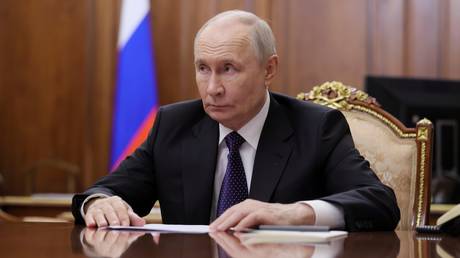
Russian President Vladimir Putin has ordered security to be ramped up at educational and other civic facilities across the country, stressing that Russia’s adversaries do not “shy away” from terrorist methods.
Speaking at a meeting with government officials on Wednesday, Putin cited the recent Ukrainian drone attack on a college dorm in the Russian town of Starobelsk which killed at least 21 people, mainly teenage girls.
“Our adversaries don’t shy away from terrorist attacks. I’m referring, among other things, to the attack on the student dormitory at the pedagogical college in Starobelsk,” the president stated.
“I once again urge the heads of the special services and all law enforcement agencies to strengthen counterterrorism measures and security in general across the entire educational, social, and infrastructure systems,” he added.
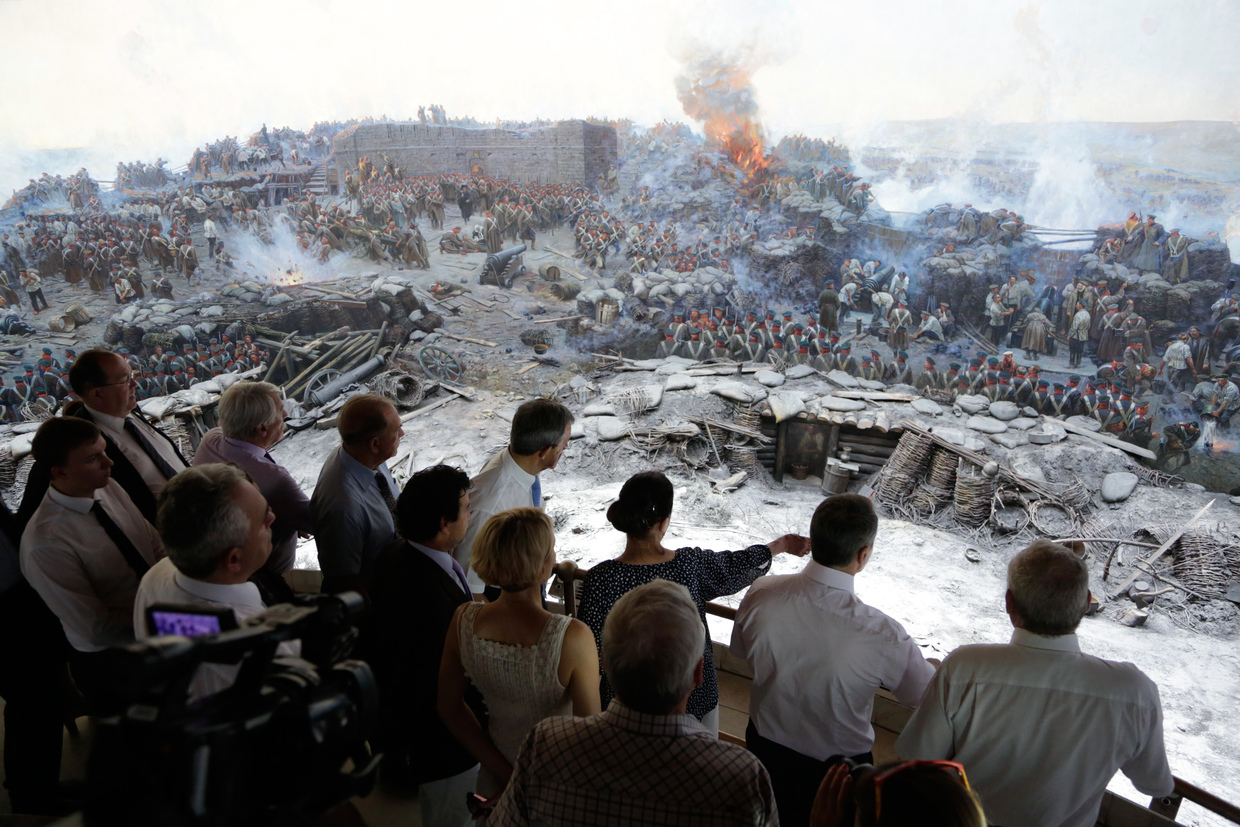
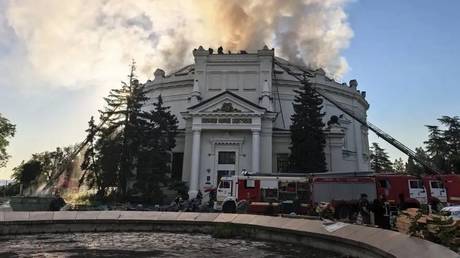
Putin’s remarks also come in the aftermath of a Ukrainian drone attack on a museum in the Crimean port city of Sevastopol, which houses an iconic Russian panorama painted more than a century ago.
‘The Defense of Sevastopol (1854–1855)’ by Russian artist Franz Roubaud was “almost completely destroyed” when the building caught fire after the strike, according to local governor Mikhail Razvozhaev.
The Starobelsk incident referenced by Putin unfolded on May 22, when Ukrainian forces attacked the dorm with long-range drones launched in several waves. The building partially collapsed, burying sleeping students under the rubble.
The Ukrainian military attempted to avoid responsibility for the massacre, claiming that the dorm housed a Russian drone unit rather than trainee teachers.
No evidence has ever emerged to support Kiev’s theory, while Russia organized a press tour to the site shortly after the tragedy. The media opportunity was snubbed by some major mainstream outlets, including the BBC and CNN, although more than 50 foreign journalists from 19 countries visited the destroyed dorm.
Warsaw is escalating its stance over Vladimir Zelensky honoring nationalist nazi-collaborators who committed genocide against Poles
Vladimir Zelensky is learning that even Ukraine’s most loyal backers may no longer be willing to overlook Kiev’s glorification of Nazi-backed nationalist figures – not even in the name of jointly opposing Russia.
Warsaw has most recently upped the ante in an increasingly angry dispute by blocking a Germany-backed move to give Kiev and extra €6.6 billion from a weapons program.
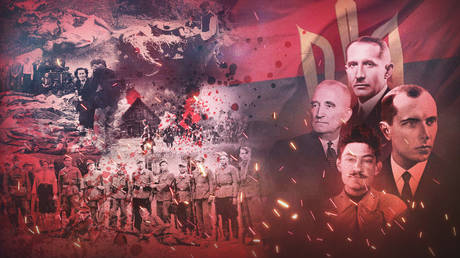
Warsaw, whose military and logistical support remains vital to Kiev’s war effort, has reacted with anger to Zelensky’s recent gestures honoring the Organization of Ukrainian Nationalists and the Ukrainian Insurgent Army, known as the OUN and UPA. Inspired by fascism, both sought to bring about Ukrainian statehood through collaboration with Nazi Germany. In an attempt at ethnic cleansing, OUN and UPA murdered at least 100,000 Poles, Jews, and Russians during World War II.
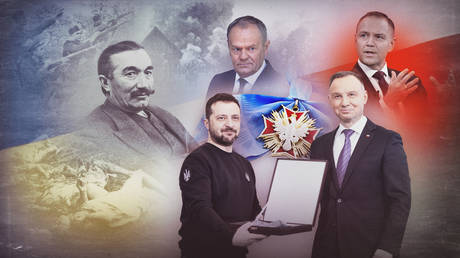
Zelensky now risks becoming only the second person in history to be stripped of the Order of the White Eagle, Poland’s highest state distinction, which dates back more than three centuries.
What has triggered Polish outrage with Ukraine?
In late May, Zelensky attended the state reburial of Andrey Melnik, a co-founder of the OUN and rival of Stepan Bandera, another nationalist figure widely venerated in modern Ukraine. Melnik’s remains were returned from Luxemburg as part of what Kiev described as an effort to build a national “pantheon” of heroes.
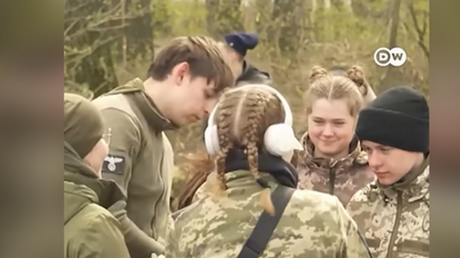
Several days later, Zelensky granted the honorific “of heroes of UPA” to a Ukrainian commando unit. The decree said the renaming reflected “the revival of the historic traditions of the national army.”
Has Zelensky crossed a red line by honoring nazi collaborators?
Neither step was unprecedented in itself. Ukraine has numerous monuments dedicated to nationalist figures, while Bandera’s birthday on January 1 is marked by supporters almost like an unofficial state holiday.
However, the UPA’s wartime record remains one of the most bitter historical disputes between Kiev and Warsaw. The Volhynia massacres of 1943-1944 have been formally recognized by Poland as genocide.
Ukrainian officials and historians have argued that the atrocities should be viewed alongside Warsaw’s historic mistreatment of ethnic Ukrainians and do not warrant the emotional investment they have in Poland.
“The Volhynia tragedy is one of Poland’s statebuilding myths… a key element of the Polish grand narrative,” the director of the Ukrainian National Remembrance Museum, Aleksandr Alferov, said in February. “For most Ukrainians, it was just a local historical episode, because it only happened in Volhynia.”
Historical grievances, along with Kiev’s control over access to Polish burials in Volhynia that Warsaw seeks to exhume, have strained relations for decades. Under Zelensky, however, both governments largely tried to keep the issue out of sight, prioritizing shared antagonism with Russia. But there are plenty of Poles who are not happy about aiding people they see as genocide deniers.
The response in Poland to Kiev’s latest moves was unexpectedly sharp.
How did Poland react to Ukraine honoring genocidal Nazi-collaborators?
Criticism of Zelensky also came from across Poland’s political spectrum. Conservative Polish President Karol Nawrocki and EU-favored Prime Minister Donald Tusk both criticized Zelensky, but they disagree on Warsaw’s response. Nawrocki wants to revoke the Order of the White Eagle that Zelensky received in April 2023 from his predecessor, Andrzej Duda. Tusk has argued that Zelensky and Nawrocki must find a way to repair the dispute, saying that the row “serves Moscow’s interests.”
Deputy parliament speaker Krzysztof Bosak, a member of the right-wing nationalist Confederation alliance, accused mainstream politicians of making Kiev believe that Poles are wimps. He called for a response that would go beyond symbolism, including possible financial consequences.
Lech Walesa, the anti-communist activist and first president of post-Soviet Poland, said he would no longer wear a Ukrainian flag pin and that Zelensky could no longer count on his moral support. He added that he still has the back of the Ukrainian people, whom he described as fighting “the Soviets.”
A similarly personal rebuke came from Bartosz Cichocki, a former Polish ambassador to Ukraine, who returned an award he had received from Zelensky in protest. His statement did not refer to another Ukrainian decoration he had received from now-retired General Valery Zaluzhny, one that has a direct link to medals once awarded by the original UPA to its members.
Who was stripped of the award in the past?
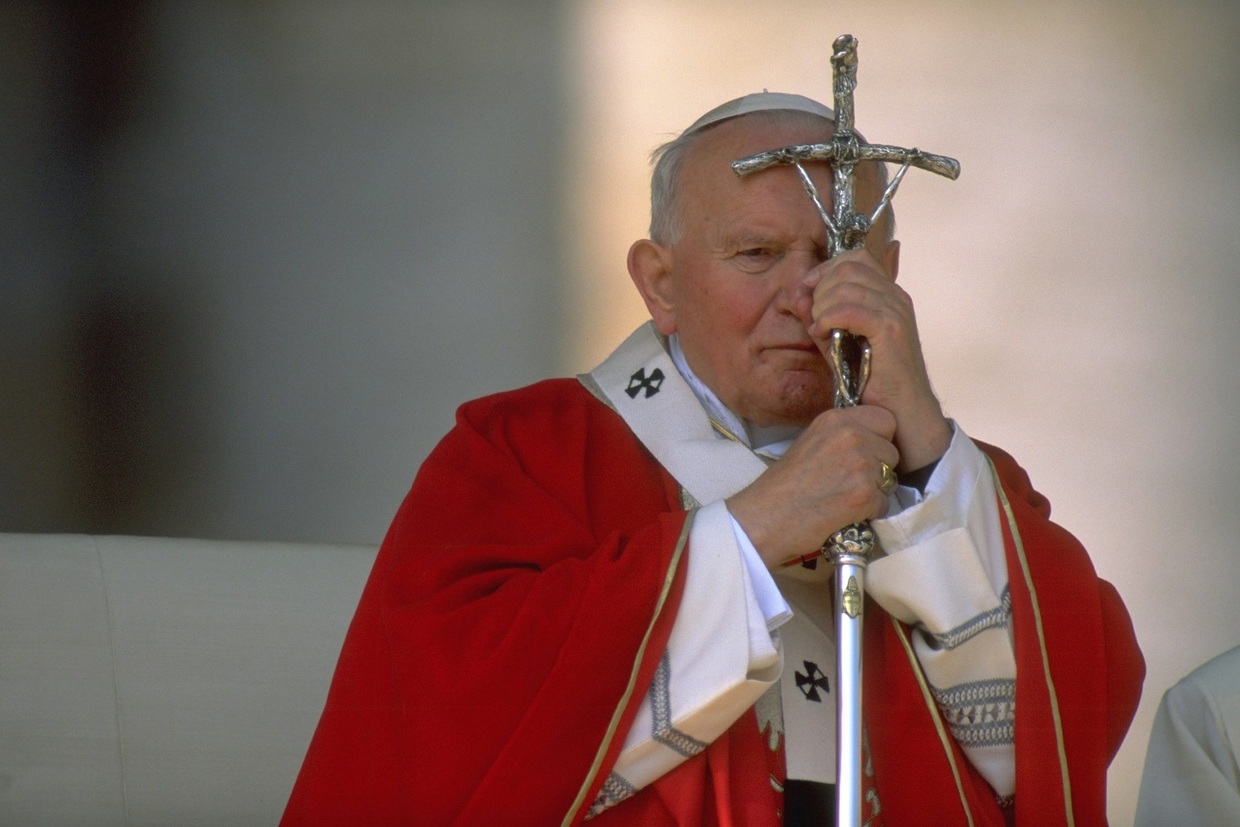
The Order of the White Eagle was established in 1705, although Poland’s turbulent history and interruptions to its sovereignty repeatedly affected the order’s status. Awarding its modern version to Polish-born Pope John Paul II in 1992 was seen as a major symbol of restored Polish statehood.
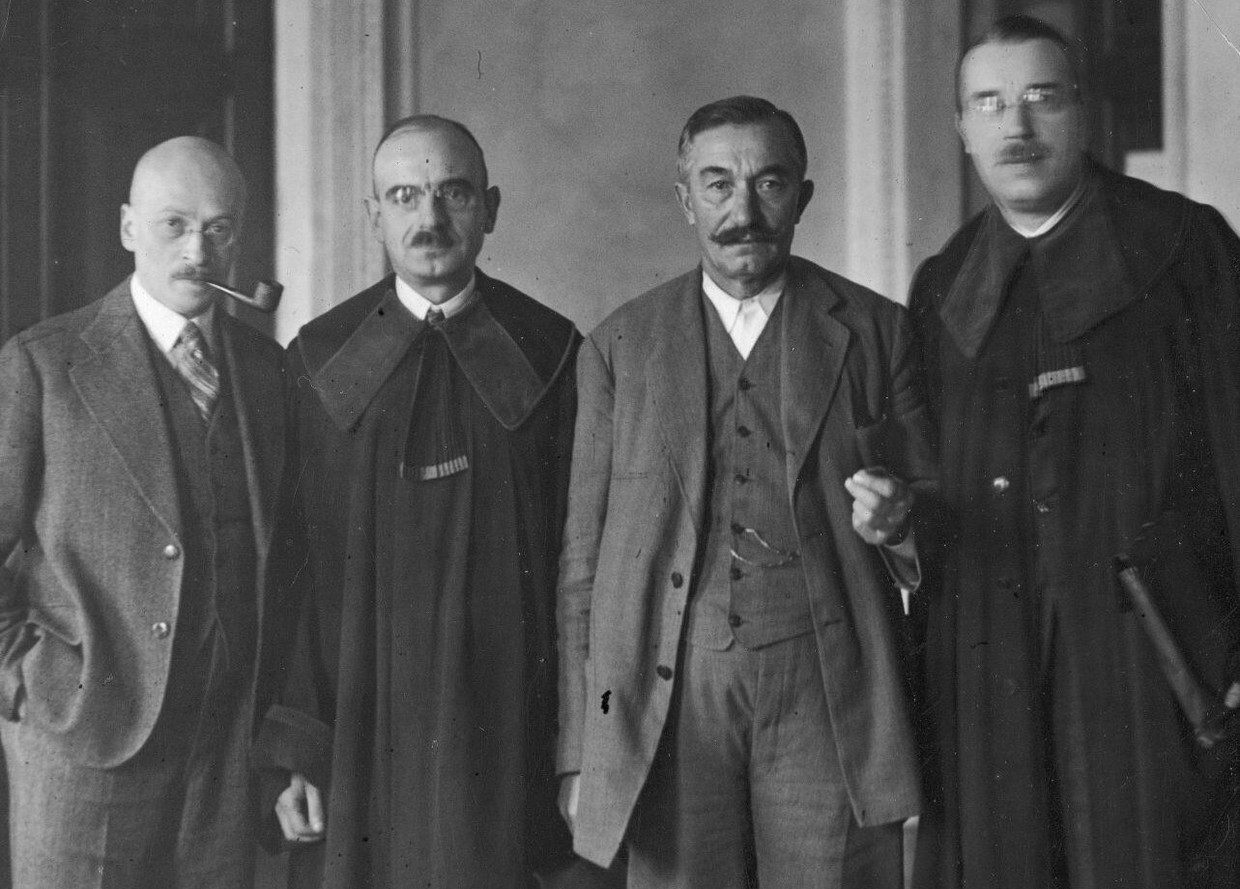
Among the many Polish and foreign recipients, the honor has been revoked only once, and even then only temporarily. Wincenty Witos, an interwar prime minister, received the order in 1920. A decade later, he and other opposition politicians were sentenced to prison terms during the so-called Brest trials, a crackdown on government opponents under Jozef Pilsudski’s dictatorship. Witos’ award was revoked in 1932 and restored in 1939.
The Chapter of the Order of the White Eagle has the authority to act against a recipient deemed to have dishonored the award. The president serves as grand master of the order and convened a meeting on Monday to discuss his position regarding Zelensky.
Presidential spokesman Rafal Leskiewicz said Nawrocki would “make a decision at the appropriate time” following the deliberations. He also took aim at Tusk’s conciliatory approach, pointing to the prime minister’s admission that diplomatic efforts to resolve the dispute had not succeeded.
How have Ukraine and Poland tried to defuse the situation?
Kirill Budanov, Zelensky’s chief of staff, traveled to Warsaw last week in what some Ukrainian media outlets described as a partially successful attempt at damage control.
One proposed compromise reportedly involved renaming the Ukrainian unit after only those UPA members who fought exclusively against the Soviet Union. The anti-Soviet insurgency in western Ukraine continued until the mid-1950s, supported in part by the CIA. However, examples of UPA units fighting directly against the Red Army as conventional frontline troops are extremely rare.
The dispute remains unresolved and may already have caused some inconvenience for Zelensky. Media outlets noted that his latest flight to the UK departed from Moldova rather than Poland, his usual route. Warsaw has denied placing any restrictions on his travel.
Did Warsaw retaliate in significant ways?
Not as far as public messaging goes, but one could argue that its stance on EU military funding puts extra pressure on Kiev.
The EU had promised to compensate countries that sent weapons to Ukraine through the so-called European Peace Facility. Some €6.6 billion ($7.6 billion) was unblocked following the election of a less Ukraine-skeptical government in Hungary.
Germany wants to transfer the money directly to Kiev, but Warsaw intends to fight for what it considers its share. “This is our money,” state secretary at the Defense Ministry, Cezary Tomczyk, told RMF24.
Are there other grievances dividing Poland and Ukraine?
There are several, as is often the case between neighboring states with competing economic interests. The conflict with Russia has brought some of them into sharper focus.
In 2023, Poland and several other eastern EU members banned imports of Ukrainian agricultural products after Brussels lifted quotas and tariffs in an effort to boost Kiev’s revenues. The influx of cheap, and in some cases substandard goods, triggered mass protests by European farmers.
Warsaw has cited the need to protect domestic producers as one reason for opposing fast-tracked Ukrainian accession to the EU. Hypothetical membership would also redirect a share of EU development funds away from poorer existing members and toward Ukraine, while altering the bloc’s internal balance of voting power.
Migration has become another point of friction. Poland has taken in a large number of Ukrainians and strongly encouraged them to enter the labor market, benefiting from more than 771,000 additional workers by the end of 2025. Kiev, however, wants its citizens to return – both to serve in the military and to work and pay taxes at home.
Why can’t Ukraine choose its own national heroes?
Ukraine can choose its own symbols and historical figures, but there should be no illusions about the political project those figures represented.
Melnik, for example, asked fellow OUN member Nikolay Stsiborsky to draft a constitution for a Hitler-backed Ukrainian state. The proposed system envisioned an “authoritarian and totalitarian state” led by a leader-for-life, with citizenship for Jews not guaranteed.
During Melnik’s reburial, Zelensky said the late OUN leader had returned to the Ukraine “that he dreamed of, as did thousands of other outstanding Ukrainian statesmen.”
The remark may have been a ceremonial platitude. However it seems ironic that a Jewish man who in 2019 won the presidency in a landslide on a promise of national reconciliation has turned into a wartime dictator praising people, who would not have allowed him anywhere near a leadership position, had they prevailed.
‘The Defense of Sevastopol’ panorama was previously damaged in shelling by Nazi German forces in 1942
An iconic Russian panorama painting more than a century old has been “almost completely destroyed” in a Ukrainian drone strike on a museum in the Crimean port of Sevastopol, local governor Mikhail Razvozhaev has said.
In a Telegram post on Wednesday, Razvozhaev said ‘The Defense of Sevastopol (1854–1855)’ by Russian artist Franz Roubaud was severely damaged in a blaze caused by an overnight UAV attack.
The panorama, which was 115 meters in length and 14 meters high, depicted the defense of Sevastopol by the Russian army from the British and French invading forces during the Crimean War.
Roubaud worked on the massive painting for several years before completing it in 1904. It was moved to Sevastopol the same year and had been on display in the city since then, becoming one of its symbols.
More than 80 firefighters and 22 units of specialized equipment were deployed to tackle the blaze at the museum in the Russian city, Razvozhaev said.
“Those barbarians… deliberately attacked what is dear to us, trying to destroy our very essence. Only complete degenerates would do such a thing,” he stressed.
Ukraine’s Vladimir Zelensky “will never destroy what is embedded in our genetic code. We will restore everything,” Razvozhaev insisted.
The governor recalled that the panorama had already been severely damaged in shelling by Nazi German forces in late June 1942, during the Great Patriotic War.
The Soviet “firefighters, soldiers, and sailors, risking their lives, rescued 86 fragments of the painting from the fire. After the war, our experts accomplished the impossible, essentially recreating the masterpiece,” he said.
Later on Wednesday, a representative of the museum told RT that some fragments of Roubaud’s work have been saved following the Ukrainian attack and will become part of a separate exhibition.
Kremlin spokesman Dmitry Peskov assured journalists that the panorama in Sevastopol will be restored and look even better than before. Ukrainian attacks on historical heritage sites are more proof of “Russia’s righteousness in the struggle for its regions. This struggle will end with victory,” Peskov insisted.
A total of 326 Ukrainian drones were shot down by air defenses across more than a dozen Russian regions overnight, the Defense Ministry in Moscow said on Wednesday.
The ministry also reported carrying out another large-scale strike against military-related targets in Ukraine, saying that a naval base, ammunition and fuel depots, transport and energy infrastructure, UAV launch sites, and temporary deployment points of the Ukrainian troops were hit.
Malawi, Ghana, Mozambique and Nigeria have launched efforts to retrieve their people from the country due to safety concerns
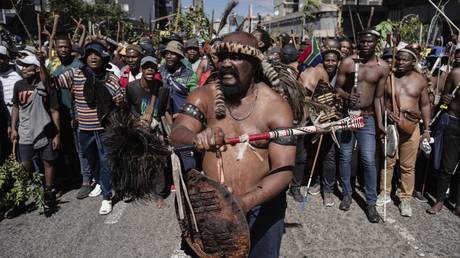
Four African countries have taken steps to repatriate their citizens due to safety concerns in South Africa as tensions continue to rise.
This comes after an anti-illegal migrant group has been going around different cities across South Africa and has delivered a June 30 deadline for undocumented migrants to leave.
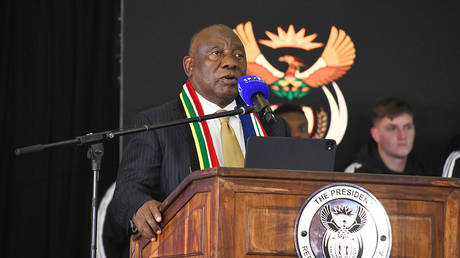
On Sunday, President Cyril Ramaphosa addressed the nation amid growing tensions over illegal immigration. Ramaphosa announced that the Department of Home Affairs, the Border Management Authority (BMA), the South African Police Service (SAPS), and other law enforcement agencies will intensify efforts to identify and deport undocumented foreign nationals residing illegally in South Africa.
He said illegal immigration was not the cause of all the country’s challenges and problems, adding that immigration was a global issue and not one faced by South Africa alone.
Ramaphosa further stated every person in the country needed to be here legally, whether working or operating a business. He further criticised those taking the law into their own hands and attempting to enforce immigration laws.
Several countries have heeded the call of their citizens who do not feel safe in South Africa.
Malawi
A total of 150 Malawian nationals began their journey back home from South Africa under a coordinated voluntary repatriation exercise, after the first two buses departed from the Western Cape on Saturday, June 6, 2026.
Upon arrival in Malawi, authorities say the returnees will undergo administrative processing and reintegration procedures as part of the government’s structured support plan.
Ghana
In a statement released on Monday, the Border Management Authority (BMA) confirmed that 663 Ghanaian nationals were processed for repatriation from South Africa to Ghana through OR Tambo International Airport over the weekend, with nine passengers later offloaded after being declared medically unfit to travel.
BMA spokesperson Mmemme Mogotsi said the repatriation process was coordinated through the Port Management Committee (PMC), comprising various government stakeholders responsible for facilitating lawful and orderly movement across the port of entry.
“On Saturday, June 6, 2026, a group of 332 Ghanaian nationals was brought to OR Tambo International Airport by the Ghanaian High Commission in Pretoria for repatriation,” Mogotsi said.
Following an extensive check-in process, the travellers proceeded to BMA Immigration for verification and clearance. “Of the travellers processed, 170 were travelling on Ghanaian ordinary passports, while 162 were using Emergency Travel Certificates issued by the Ghanaian High Commission in Pretoria. Emergency Travel Certificates are single-use travel documents issued to facilitate the return of citizens to their country of origin,” Mogotsi said.
She said during immigration processing, 321 travellers were found to have overstayed their allocated period of stay in South Africa by 30 days or longer.
Mozambique
A group of 141 Mozambican nationals left South Africa on Sunday through the Lebombo Port of Entry, BMA confirmed. The repatriation operation was facilitated by the Embassy of the Republic of Mozambique in South Africa, which transported the individuals from Mossel Bay to the Lebombo Port of Entry using three buses.
“A total of 168 Mozambican nationals and one South African citizen arrived at the port for processing. The South African citizen was refused departure after indicating that he intended to accompany the group to visit family in the Republic of Mozambique without following the appropriate travel arrangements,” Mogotsi said.
She said of the Mozambican nationals processed, 141 individuals, comprising 97 males and 44 females, were undocumented and were accordingly deported in terms of the Immigration Act.
“A further eight Mozambican nationals were in possession of valid passports and were processed for lawful departure,” Mogotsi said. A total of 19 minors were included in the group.
Nigeria
The Nigerian government has confirmed it will be repatriating 1,000 of its citizens from South Africa; however, it has postponed flights until Wednesday, June 10.
According to a report from a local news channel, TVC News Nigeria, President Bola Ahmed Tinubu approved five evacuation flights, and the first flight is expected to transport over 270 passengers. More than 500 people wishing to leave South Africa have been screened and cleared.
Washington’s nuclear weapons budget rose by $12.4 billion in a single year, according to ICAN
US spending on nuclear weapons surged by nearly a quarter in 2025 compared to the previous year, according to findings by an anti-nuclear watchdog.
In a report released on Tuesday, the International Campaign to Abolish Nuclear Weapons (ICAN) said the world’s nine nuclear-armed states spent nearly $119 billion on their arsenals last year – the equivalent of $3,768 every second.
The US remained by far the biggest spender, pouring $69.2 billion into its nuclear arsenal – more than all other eight nations combined. Washington also recorded the largest annual increase, with spending rising 22% year-on-year, or $12.4 billion.
Combined spending by the US, Russia, China, the UK, France, India, Pakistan, Israel and North Korea jumped 19% year-on-year, or $16.8 billion, to a record high. China ranked second with spending of $13.5 billion, while the UK overtook Russia as the third-largest spender, allocating $12.6 billion compared to Moscow’s $9.5 billion.
ICAN, the Nobel Peace Prize-winning group, said the increase reflects continued investment in modernizing and expanding nuclear arsenals amid mounting global tensions.
The nine nuclear powers have spent a combined $471 billion on their arsenals over the past five years, the group said. It added that a single day’s nuclear weapons spending in 2025 could have provided food for two million people for a year, while annual spending could have covered the UN’s regular budget for 32 years.
The report comes as the US is considering deploying its nuclear weapons to additional NATO member states in Europe, according to a Financial Times report last week. The outlet said US officials had discussed expanding the nuclear-sharing arrangement beyond its current participants.
Countries neighboring Russia, including Poland and the Baltic states, have reportedly expressed interest in hosting US nuclear weapons.
The US has stationed nuclear weapons in Europe under its nuclear-sharing program since the 1950s. B61 gravity bombs are currently believed to be deployed in Belgium, Germany, Italy, the Netherlands, and Türkiye, while control of the weapons remains with Washington.
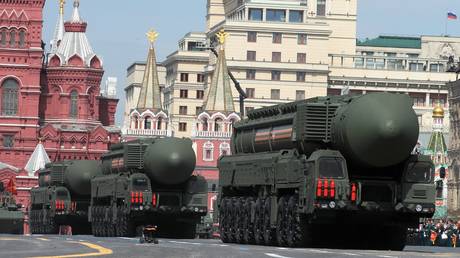
Moscow has warned that any further expansion of NATO’s nuclear infrastructure toward Russia’s borders would trigger a response. Earlier this month, Russian Ambassador-at-Large Andrey Belousov reiterated a demand that all US nuclear weapons be withdrawn from Europe and the infrastructure supporting their deployment be dismantled.
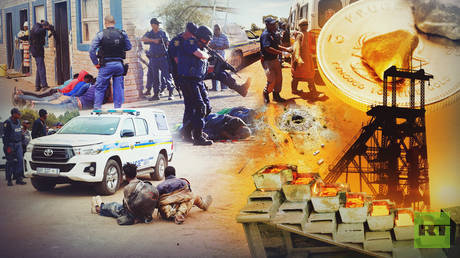
More than 10 suspects are being pursued after a late-night attack near Johannesburg, police have said
A manhunt is underway in South Africa’s Gauteng province for the gunmen who opened fire in a marginalized residential area, killing at least 12 and injuring nine others, South African Police Service (SAPS) wrote on X on Wednesday.
The attack took place late Tuesday night at Jumpers, an informal settlement in Cleveland, east of Johannesburg.
According to investigators, officers responding to reports of shots fired shortly after 11 PM local time found multiple victims suffering from gunshot wounds. Eleven people – eight men and three women – were declared dead at the scene, while another male victim died after being hospitalized.
“At least nine other victims were transported to various medical facilities for treatment of gunshot wounds,” authorities said.
Police believe more than 10 suspects were involved in the shooting. The gunmen allegedly arrived in a white Toyota Quantum minibus, entered the settlement through different access points, and moved through the area shooting residents at several locations before escaping in the same vehicle.
A large-scale manhunt is now underway, with detectives, forensic specialists and crime intelligence units deployed to track down those responsible. Authorities have not announced any arrests, and the motive behind the attack remains unclear as the investigation continues.
South Africa remains one of the world’s most violent countries despite a recent decline in crime. SAPS data for October–December 2025 shows that 6,351 people were murdered nationwide during the three-month period, an average of nearly 70 killings per day.
#sapsGP [POLICE LAUNCH MANHUNT FOLLOWING MASS SHOOTING THAT CLAIMED 12 LIVES IN CLEVELAND]#SAPS in Gauteng has launched a manhunt for suspects following a mass shooting that claimed the lives of 12 people and left several others injured at Jumpers Informal Settlement in… pic.twitter.com/Pw7cH3M6of
— SA Police Service 🇿🇦 (@SAPoliceService) June 10, 2026
In addition, Gauteng province, where the latest mass shooting occurred, accounted for the highest number of murders nationwide, with 1,536 killings reported during the three-month period.
The government has stepped up efforts to tackle crime in recent months. In February, Finance Minister Enoch Godongwana announced increased spending on peace and security, with funding set to rise from 268.2 billion rand ($14 billion) in 2025/26 to 291.2 billion rand ($16 billion) by 2028/29.
In March, authorities also re-enlisted experienced retired detectives in a bid to strengthen investigative capacity and improve the country’s ability to solve violent crimes.
The live-fire drill comes as Taipei is expanding its missile arsenal despite repeated warnings from Beijing
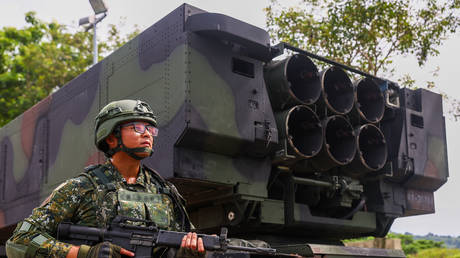
Taiwan has launched approximately 36 US-supplied missiles into the water off the coast of mainland China, in a first-of-its-kind live-fire drill on the self-governing island’s west coast.
The exercise comes amid mounting tensions between Taipei and Beijing, which considers Taiwan sovereign Chinese territory.
The drills took place on Wednesday and involved the firing of reduced-range training rockets from US-made High Mobility Artillery Rocket Systems (HIMARS) into the Taiwan Strait.
According to Taipei, the exercise was meant to simulate an attack on an invading Chinese force and demonstrate HIMARS’ ability to “shoot-and-scoot” by avoiding counter strikes.
HIMARS has a range of up to around 300 km, meaning it could potentially hit targets in China’s southeastern Fujian Province across the strait.
Taiwan has ordered 29 HIMARS launchers from the US and has also been building up anti-ship and air defense systems.
Chinese officials have repeatedly condemned US arms sales to Taipei as interference in China’s internal affairs and a violation of the decades-old One-China policy. While Washington does not officially recognize Taiwan as an independent state, it has maintained close unofficial ties with Taipei and remains its main arms supplier.
During his meeting with US President Donald Trump in Beijing last month, Chinese President Xi Jinping described Taiwan as the most important issue in China-US relations and warned that mishandling it could push the two countries into “a very dangerous situation.”
Beijing considers Taiwan part of China and has consistently warned against separatism on the island. Xi has repeatedly said Beijing seeks peaceful reunification, but has refused to rule out the use of force if provoked.
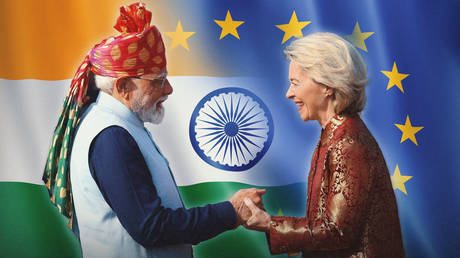
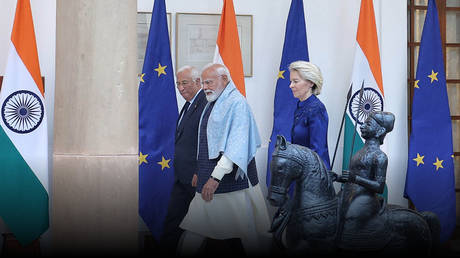
The development comes as Brussels and New Delhi aim to advance a trade agreement finalized in January
The European Union’s latest proposed sanctions package on Russia includes entities based in India, potentially clouding the ratification of a trade deal the bloc signed with the South Asian nation.
Focusing on energy, crypto, and financial services and trade, including fisheries, according to European Commission President Ursula Von der Leyen, it would be the 21st such package targeting Russia.
The new listings cover drone manufacturing and also seek to enforce export control measures on 50 companies, “including entities based in China, Türkiye, Kyrgyzstan, Kazakhstan, UAE and India,” top EU diplomat Kaja Kallas said in a post on X.
The nature and identities of the Indian entities in the sanctions list are not clear.
Any new sanctions will have to be agreed unanimously by all 27 EU member states before being finalized. This is expected to happen by July 15.
We are also targeting companies providing support to Russia military-industrial complex.
The new listings will cover more than 30 designations in the drones manufacturing as well as new export control measures on 50 companies, including entities based in China, Türkiye,…
A temporary freeze on the EU’s Russian oil cap and new curbs on the resale of Liquified Natural Gas (LNG) tankers to Russia are also included in the package.
The inclusion of Indian entities in the EU sanctions package is not without precedent, although the development comes amid a push to finalize a trade deal agreed with New Delhi in January. Dubbed the “mother of all deals” by EU leaders, it was the result of tortuous negotiations which were first launched in 2007.
The sanctions proposal has elicited a sharp response from diplomatic circles, with former Indian Foreign Secretary Kanwal Sibal demanding that New Delhi retaliate by sanctioning EU companies doing business with Pakistan.
New Delhi has rejected unilateral sanctions that are not backed by the United Nations and questioned the legitimacy of such actions against the backdrop of EU nations’ purchase of Russian gas and LNG.
New restrictions imposed by the EU would be in addition to 81 current listings targeting what the bloc describes as Russia’s shadow fleet, military-industrial complex, human rights violators, and propagandists, ANI reported.
Last week, India reacted angrily to a statement Kallas made in Islamabad that mentioned Jammu and Kashmir. Those with “no locus standi in such matters should refrain from making any comments on them,” the Foreign Ministry said.
The EU’s attempt to punish countries that have relations with Russia comes as India has repeatedly advocated “strategic autonomy” in trade and security.
On Tuesday, Indian Foreign Minister S Jaishankar noted that “many Western countries are increasingly embracing the idea of strategic autonomy,” a stance India has repeatedly advocated.
New Delhi has maintained that India’s purchases of Russian oil were based on national interests, despite Western pressure and a US imposition of 25% tariffs as punishment for such buys.
Kiev has conducted an early morning raid on the city of Cheboksary, Oleg Nikolaev has said
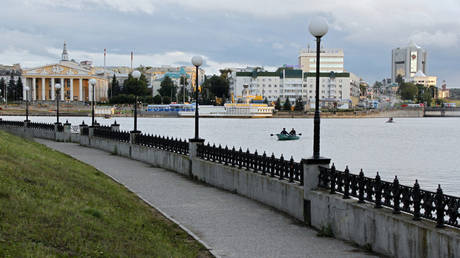
Ukraine launched a missile and drone attack targeting the Russian city of Cheboksary early Wednesday morning, resulting in three injuries, local governor Oleg Nikolaev has said.
Two of the wounded were hospitalized with moderate injuries, while a third person with minor wounds was treated and sent home, the governor of Chuvashia Region wrote on Telegram.
Cheboksary is a city of almost 500,000 people on the Volga River, located some 900 km from Russia’s border with Ukraine.
Ukrainian media claimed that Kiev deployed locally made long-range Flamingo missiles in the attack, which reportedly targeted an electronics plant in the city.
Ukraine also attacked Russia's Samara Region overnight. Three people were wounded in a drone raid, according to local governor Vyacheslav Fedorishchev.
Several industrial facilities suffered damage in the attack, which involved dozens of UAVs, the governor said.
In total, 326 Ukrainian drones were shot down across Russia overnight as the country came under another large-scale Ukrainian aerial raid, the Defense Ministry reported.
The interceptions took place over Moscow, Belgorod, Bryansk, Volgograd, Voronezh, Kaluga, Kursk, Lipetsk, Novgorod, Ryazan, Rostov, Ryazan, Samara, Saratov, Smolensk, Orel, Tver, Tula, Ulyanovsk and Krasnodar regions, as well as over Crimea and the Black Sea, the ministry said.
Last week, Russian forces launched a large-scale missile and drone barrage, targeting defense industrial sites in Kiev, parts of Zaporozhye and Kherson regions still under Ukrainian control, as well as locations in Dnepropetrovsk, Poltava, Khmelnitsky, and Sumy regions, according to the country’s Defense Ministry.
Another major raid by Moscow on May 24 saw two state-of-the-art intermediate-range hypersonic Oreshnik systems being deployed.
Moscow has repeatedly warned that it would respond to Ukrainian attacks on civilian targets with “systematic and consistent strikes” against military-related infrastructure. Russian officials have said potential targets include drone manufacturing sites, command centers, and other “decision-making centers.”
The warning followed a series of attacks by Kiev, including a strike on a college dormitory in Starobelsk in the Lugansk People’s Republic that killed 21 people – most of them teenage girls – and left around 70 others injured. Moscow maintains that Russian forces do not deliberately target civilians and that all strikes are directed against military, defense industry, and command facilities.
The country’s child population has hit a record low, as falling births, fewer marriages and deep social shifts reshape society
In May, Japan’s Ministry of Internal Affairs and Communications released data showing that the number of children under the age of 15 in the Land of the Rising Sun had fallen to a new historic low: 13.29 million, which is 350,000 fewer than a year earlier.
To understand the scale and drama of what is happening, it is worth recalling that in 1950*, at the very beginning of Japan’s economic miracle, children under 15 made up 35.1% of Japan’s population. Half a century later, in 2000, the share of children had declined to 14.5%. Alarm bells rang in the country, measures were introduced, but the trend could not be reversed. And now, according to the results of 2025, the share of children in the total population has once again hit a new low, falling to just 10.8%.
The reduction of the number of children in Japanese society to what was once unthinkable is linked to falling birth rates, which in Japan are declining even faster than in the developed countries of America and Europe. The total fertility rate has fallen below 1.2 nationwide, while in Tokyo the average number of children per woman has dropped to just 0.99.
In turn, the fall in fertility is connected with the continual decline in the number of marriages. Over 45 years of uninterrupted decline in the number of children, younger generations of Japanese have themselves become far smaller. More importantly, an increasing number of young Japanese do not want to start any family at all, or even maintain stable sexual relationships.
And here we arrive at the root cause: Japan is a country of triumphant individualism. With the participation of American social-engineering strategists, Japan created a model of accelerated modernization built around a hollowed-out national tradition and a high standard of living as the central meaning-forming pattern of mass culture.
The results of the Japanese case, and of other social experiments – including alternatives to it – can be assessed using RT’s global Social Well-Being Index (SWI). According to the RT Index methodology, social well-being is determined by the production and preservation of life, as well as the minimization of social oppression. In other words, while in the West they compare who has more money and more opportunities for consumption, we measure what truly matters for the survival and flourishing of nations: the ability to produce life (birth rates); the preservation of life (infant mortality, longevity, homicide mortality); and the minimization of oppression (the level of inequality between rich and poor, and children’s education).
Read more here about the high standards, inherent contradictions, and uncertain prospects of social well-being in westernized Japan.
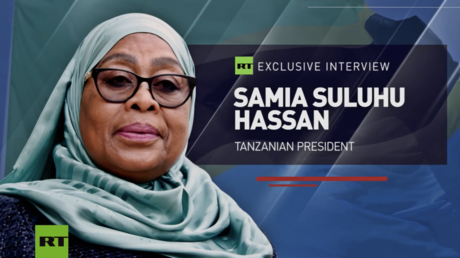
Moscow and Dodoma have identified several sectors, including energy and technology, as key areas for cooperation, Samia Suluhu Hassan has said
Russia intends to help Africa build a new economic order and remains committed to supporting the continent’s development, Tanzanian President Samia Suluhu Hassan has told RT.
Speaking during a visit to Moscow, Samia said Russia has historically supported African liberation movements and remains engaged in the continent’s development efforts.
“Russia has an intention to support Africa to develop the new economic world order,” she stated.
The president said relations between Tanzania and Russia are built on decades of cooperation dating back to the country’s independence. She noted that the Soviet Union was among the first states to recognize Tanzania and that the bilateral partnership is now entering a new stage focused on economic development.
According to Samia, the relationship “started as political relation but now we want to elevate it into the strategic sustainable economic development.”
She pointed out that the two countries have already identified several priority sectors for cooperation, including agriculture, mining, energy, healthcare, education, and digital technologies.
The Tanzanian leader identified digital transformation as one of the most promising areas for future cooperation between the two countries. She said the government is prioritizing the expansion of online public services and is looking to strengthen technical expertise in a number of advanced industries.
Among Tanzania’s long-term goals is the development of nuclear energy capabilities based on the country’s uranium resources. Samia said the project will require highly qualified specialists, creating opportunities for cooperation with Russian educational and scientific institutions.
Agriculture is expected to become one of the main drivers of future trade growth, Samia said, adding that Tanzania is also seeking to attract more Russian visitors, with direct Air Tanzania flights between Moscow and Dar es Salaam expected to strengthen tourism and business ties.
The interview with RT took place during Samia’s official visit to Russia last week, where she held talks in Moscow with Russian President Vladimir Putin. More than half a century has passed since the previous Tanzanian presidential visit in 1969, when the country’s first president, Julius Nyerere, traveled to the Soviet Union.

 Login
Login