At the mouth of the Carmel River, a teacher set up a spotting scope and let a boy look through it. The birds were the first thing he saw. The habit of looking came next. He saw that the world could be understood, though not quickly, and that its order did not reveal itself to those in a hurry. Later he would say he never recovered from that experience. The remark was light, but also true. A childhood near Monterey, with woods behind the house and the Pacific within walking distance, gave him the subject of his life. Robert “Bob” Ricklefs, who died on June 7th, a day after his 83rd birthday, spent that life asking how living things came to be where they are, and why they lived as they did. He became one of the most influential ecologists of his generation: an ornithologist, biogeographer, theorist, teacher, author and member of the National Academy of Sciences. His textbooks, Ecology and The Economy of Nature, shaped how thousands of students first encountered the field. Their authority came from clarity. He could take a tangled subject and find a usable path through it. Birds were his beginning. As a boy he joined weekend outings with the local Audubon Society and gained the status, modest but real, of a child with a serious interest. At Stanford he briefly followed the spirit of the space age into engineering, then returned to biology. At the University of Pennsylvania he entered the circle of Robert…This article was originally published on Mongabay
When invasive rats are removed from islands, the ecological benefits can ripple across both land and sea more quickly than scientists expected, according to recent research. Scientists have long assumed that meaningful recovery after the predators are eradicated would take decades. However, researchers with the U.S.-based NGO Island Conservation conducted a rat-removal experiment on Ulong Island in Palau, which provides the first experimental evidence that ecosystems can rebound far more quickly than previously expected. Until recently, rats, which are typically nocturnal, were so abundant on Ulong Island that they were regularly seen during the day. They were a nuisance to campers and deadly for wildlife. As opportunistic omnivores, rats readily prey upon seabird eggs and chicks, devastating nesting colonies on tropical islands. As a result, there were “very few nesting seabirds that we would find,” Coral Wolf, the conservation science program manager at Island Conservation, told Mongabay in a video call. To measure the effects of rat eradication, Wolf designed an experiment in which all the rats were removed from Ulong, while the rats on nearby Ngeruktabel Island remained, serving as a control site. Before the eradication, researchers collected baseline biodiversity data. On land, they recorded bird calls and took soil samples. In the surrounding water, they measured indicators like fish biomass and coral cover. One year after rats were removed, the team repeated the survey and found a dramatic improvement in the biodiversity. Freed from rat predation, seabird activity on the island surged. Detections of bridled tern (Onychoprion anaethetus) calls rose by…This article was originally published on Mongabay
The Bornean ferret badger is a small carnivore with the slinky body of a ferret and a face mask like a badger. A new study confirms that it lives only in the mountains of Sabah, a Malaysian state on the island of Borneo. Ferret badgers are nocturnal carnivores, widespread across Southeast Asia, but the Bornean ferret badger (Melogale everetti) lives only in a narrow mountain range on the island of Borneo. A group of researchers from the Bornean Carnivore Programme, part of the University of Oxford’s Wildlife Conservation Research Unit (WildCRU), Sabah Forestry Department, and Sabah Parks set out to understand the Bornean ferret-badger’s distribution within Sabah. Between 2021 and 2024, the research team set up 188 camera-trap stations across Sabah’s western highlands and recorded the badgers more than 400 times, discovering a new population in the process. The new population in the Nuluhon-Trusmadi Forest Reserve of Malaysian Borneo, expanded the known range of the species, but photo-traps and habitat modeling showed that Bornean ferret badgers are only found within the greater Sabah’s Kinabalu-Crocker-Trusmadi mountain landscape. “I grew up in Tambunan and had never seen or even heard of the Bornean ferret badger,” said Mohammad Aliyuddin bin Jaini, field manager of the Bornean Carnivore Programme in a press release. “I decided to place some camera traps around my family’s farm simply to see what wildlife might be there, and I was amazed when a Bornean ferret badger appeared in the photographs. To discover that an Endangered species found only in…This article was originally published on Mongabay
On June 6, nine female white rhinos arrived in Mozambique’s Zinave National Park following a two-day translocation. Their arrival marks the culmination of nearly 10 years of rhino reintroduction efforts in the park, aimed at rebuilding a viable breeding population of the mammals in Zinave after decades of local extinction. The white rhinos (Ceratotherium simum) were transferred from the Manketti Game Reserve in South Africa and join another 30 white rhinos and 22 black rhinos (Diceros bicornis) introduced to Zinave since 2022. “[The translocation] went fantastically well,” Antony Alexander, a regional manager for the conservation nonprofit Peace Parks Foundation, which manages Zinave and organized the translocation, told Mongabay by phone. “I’m sure they’re happy to be in the wild again.” Zinave, which covers around 4,090 square kilometers (1,580 square miles) in the southern province of Inhambane, has previously been called a “silent park” after decades of civil war wiped out much of its wildlife. “You could almost sense the very low levels of life with insects and birds and smells and sounds,” said Alexander, describing Zinave before wildlife restoration efforts began. “That’s changed dramatically over the last 10 years.” Among the species reintroduced since 2016 are the critically endangered black rhino and Selous’ zebra (Equus quagga selousi), as well as the endangered African savanna elephant (Loxodonta africana), vulnerable leopard (Panthera pardus) and spotted hyenas (Crocuta crocuta). The rhinos help maintain Zinave’s ecosystem as they are bulk grazers, eating a high volume of grass. This helps prevent fire risk, as overgrown…This article was originally published on Mongabay
VJOSA-NARTA, Albania — In late April, heavy machinery began moving into the Pishë Poro-Narta protected landscape on Albania’s Adriatic coast without permits or public notice. Bulldozers and excavators felled coastal pine trees, flattened sand dunes, and cut new roads through previously untouched habitat. Then, barbed wire fences went up along the shoreline. The incursion was the realization of a luxury resort development backed by Jared Kushner, U.S. President Donald Trump’s son-in-law. The development plans of Kushner’s Affinity Partners, a private equity fund, stretch from the uninhabited Sazan Island into the Vjosa-Narta Protected Landscape, the delta region of Albania’s Vjosa River that includes Pishë Poro-Narta. Roughly twice the size of Paris, the Vjosa-Narta area shelters flamingos, Dalmatian pelicans (Pelecanus crispus), loggerhead sea turtles (Caretta caretta) and more than 70 endangered species, among them the Mediterranean monk seal (Monachus monachus). Neither Affinity Partners nor the office of the prime minister of Albania responded to Mongabay’s requests for comment. Aerial drone video of demonstrators gathering at Dalan Beach on June 6 for a rally near the site of the original resort-construction site. Footage by Stefan Lovgren for Mongabay. When protesters arrived at the site, security guards confronted them. Video of a demonstrator being dragged across the dunes on May 30 near the village of Zvërnec went viral. Soon demonstrations erupted in Tirana, the Albanian capital, in what has since been dubbed the Flamingo Revolution. The protests have grown larger every day, with tens of thousands demanding accountability for corruption, an end to…This article was originally published on Mongabay
The rumble of ship traffic is drowning out the calls of long-finned pilot whales and potentially other marine species in the Strait of Gibraltar, a narrow strip of water between Morocco and Spain that separates the Atlantic Ocean from the Mediterranean Sea. Researchers who investigated this looked at near and long-distance communication between long-finned pilot whales (Globicephala melas), which are actually a species of large dolphin. They found the mammals were able to increase the volume of their calls used for short distances, but long-distance calling was more challenging, according to their recently published study. The dolphins may not be able to overpower noise pollution in the Strait of Gibraltar when calling pod mates far away, raising concerns that they could become lost and isolated from the group, the researchers said. Roughly 60,000 ships pass through the Strait of Gibraltar each year. “If they cannot communicate with one another, they may need to stay much closer together, or all that communication may become ineffective,” study co-author Renaud de Stephanis, director at the Spain-based organization CIRCE (Conservación, Información y Estudio sobre Cetáceos), told Mongabay by phone. Researchers focused the study on a small resident population of roughly 250 pilot whales in the strait. The team attached suction-cup recorders to the backs of 23 individuals. Later, they categorized more than 1,400 calls into four different categories. They found that pilot whales were able to adjust to the noise pollution for two types of calls, the high-frequency and short-pulsed calls, by simply raising…This article was originally published on Mongabay
Government officials in Malawi have applied to withdraw bribery charges against wildlife trafficking convict Lin Yunhua, which would pave the way for his release from prison. In July 2025, a presidential pardon set Lin, a Chinese national, free from a 14-year jail sentence he’d received in 2021 connected to illegally trading in wildlife parts such as ivory, rhino horn and pangolin scales. Malawian authorities had arrested Lin, his wife and 13 members of his transnational wildlife crime syndicate in 2019. While pardoned, Lin remained in prison on charges of bribing a prison official and a judge to influence his sentencing; offenses he allegedly committed while on trial for the wildlife crimes. The Director of Public Prosecutions (DPP) Fostino Maele, has now instructed the Anti-Corruption Bureau (ACB), which brought the bribery charges against Lin, to drop those charges. Maele was previously Lin’s lawyer. Environmental and anti-corruption activists demanded that he recuse himself from the case due to a conflict of interest. But Maele did not. At the time of publishing, Maele had not responded to questions from Mongabay about reasons for dropping the bribery charges and concerns of conflict of interest. “We have a serious contradiction here,” environmentalist Charles Mkoka told Mongabay in a phone interview. “We sit in one room and plan what to do to send a strong message to wildlife traffickers that we will not tolerate their crimes. In another room, some offices are scrapping off cases of those that are engaging in wildlife trafficking. This is regrettable.”…This article was originally published on Mongabay
From pollution to overfishing to the escalating effects of climate change, human activities are placing mounting pressure on the world ocean, fueling what U.N. Secretary-General António Guterres describes as a “deepening crisis.” Those warnings are detailed in the third U.N. World Ocean Assessment, released June 8 and authored by approximately 600 experts from 86 countries. Covering the period between 2021 and 2025, the report echoes concerns raised in the U.N.’s earlier World Ocean Assessments, published in 2015 and 2021, which describe a global ocean under immense strain due to human-driven pressures. The authors point toward progress in ocean governance through a review of 57 global treaties related to ocean protection, including the recently ratified high seas treaty, known more formally as the marine biological diversity of areas beyond national jurisdiction (BBNJ) agreement. However, they caution that existing frameworks generally remain “fragmented” and cannot fully address the scale of the challenges facing the ocean. Even so, the authors argue that it is imperative to continue strengthening conservation efforts, regulations and international cooperation to mitigate the damaging impacts of human activities and preserve marine ecosystems. Some 52.1 million metric tons of plastic waste enters the ocean each year, impacting more than 4,000 marine species, including seabirds. Image by NOAA Coral Reef Ecosystem Program via Flickr (CC BY 2.0). “The imperative for a healthy and resilient ocean has never been more urgent,” Rafael González-Quirós, director of the Oceanographic Centre of Gijón, Spain, who played a key role in coordinating the report, said in…This article was originally published on Mongabay
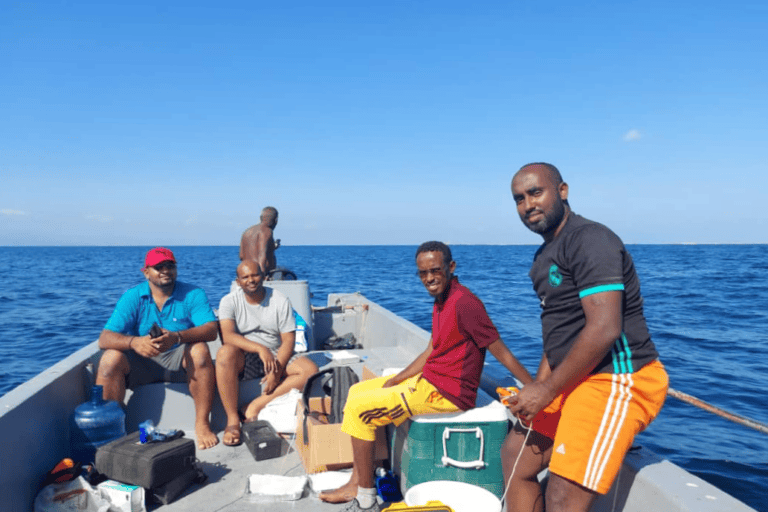
MTWAPA, Kenya — On a mid-morning in March, Mohamed Mwazigona, 58, had just landed a measly catch on the town beach in Mtwapa on Kenya’s north coast. His crew was preparing the boat for a second trip into the sea with hopes of better luck. As traders started trickling in to buy fish, Mwazigona sat on a broken upturned boat staring at the horizon beyond the sea. His morning trip had netted only 2 kilograms (4.4 pounds) of fish. He worried that his catches had decreased a lot in recent years. “The number of fishermen has gone up; we have become too many,” he said. That’s the reason he left his village of Shariani, 40 kilometers (25 miles) to the north, to base his fishing in Mtwapa, which he felt had fewer fishers and better access to markets. In Kenya, local beach management units (BMUs), like the Mtwapa BMU that Mwazigona belongs to, have a legal mandate to support collection of fisheries data for submission to the government: mainly the type of fish its members catch and the weight. These data are meant to inform government decision-making about small-scale fisheries so it can help reverse the competition for dwindling fish stocks that Mwazigona and his colleagues are experiencing. They are also meant to help fishers themselves make decisions on where and when to fish. However, the BMUs’ small-scale fisheries data have been inaccurate and inaccessible to stakeholders. To address this problem and improve the sustainability of Kenya’s small-scale fisheries, WorldFish,…This article was originally published on Mongabay
As human cases continue to climb in the latest outbreak of the deadly Ebola virus in the Democratic Republic of the Congo, concern is growing for the gorilla population, which have been devastated by the virus during previous outbreaks. On May 15, the Congolese Health Ministry announced a new outbreak of the lethal virus, which has struck the country at least 17 times over the past half-century; the World Health Organization (WHO) declared it a Public Health Emergency of International Concern. The U.S. Centers for Disease Control and Prevention confirmed 676 Ebola cases in the eastern DRC and 136 deaths as of June 10 — and continue to rise. In neighboring Uganda, 19 cases and two deaths have been reported, with no new cases in the last days. So far, the outbreak seems to be largely contained within the region. The Bundibugyo virus is the culprit, one of five Ebola viruses within the family Filoviridae that spark illness in people. It has no approved treatment or vaccine. As cases mount, virologists — as well as ecologists and primatologists — are warily monitoring its spread. First discovered in humans in 1976 along the Ebola River (where it got its name), Ebola is highly contagious, and this virus can also sicken and kill gorillas and other non-human primates. While some symptoms are flu-like — fever, vomiting and diarrhea — the disease can progress to a gruesome, often-fatal hemorrhagic fever, causing both internal and external bleeding. Previous outbreaks have exacted vast human death…This article was originally published on Mongabay
The East African Crude Oil Pipeline (EACOP), which stretches from oil fields in Uganda’s Lake Albert region to Tanzania’s port town of Tanga, is once again under scrutiny after a new report mapped out the biodiversity areas and wildlife habitats it runs through or passes by. Drawing data from maps and economic value estimates, the report by U.S.-based NGO Earth Insight shows that the 1,443-kilometer (990-mile) pipeline is close to areas that are important for livelihoods and water security for millions of people and serve as migration corridors for animals. The report concludes that the construction of the pipeline has already disturbed communities and the environment and that oil transportation will bring further long-term risks. EACOP is a joint project involving TotalEnergies (62% stake), the governments of Uganda (15%) and Tanzania (15%), and the China National Offshore Oil Corporation (CNOOC, 8%). EACOP will carry oil extracted from two oilfields in the Lake Albert region: Kingfisher, owned by CNOOC, and Tilenga, owned by TotalEnergies. According to Earth Insight, the project is nearing completion. Oil transportation through the pipeline is expected to start as early as October 2026. Construction of the East Africa Crude Oil Pipeline (EACOP) in Uganda. Image courtesy of Thomas Lewton. “It crosses right through endangered species ranges, the most important and critical one being the black rhino habitat range,” Earth Insight’s Katie Boston, the study’s main researcher, told Mongabay on the phone. She added that the pipeline could cause habitat fragmentation in the Kibale/Bukoora River Crossing area, where…This article was originally published on Mongabay
Deforestation in Brazil’s Amazon biome fell by 23.5% in 2025 compared with 2024, according to a new report from MapBiomas, a Brazil-based land-use mapping project. Reductions in deforestation were recorded across the board in all of Brazil’s biomes, culminating in a 21% nationwide decrease in forest loss. In total, nearly 985,000 hectares (2.4 million acres) of forested land was cut down in 2025, the report found. Of this, 289,478 hectares (715,315 acres) was deforested in the Amazon. The decline in deforestation likely reflects a combination of stronger environmental enforcement, improved satellite monitoring and growing market demands for sustainable production, Nathalia Crusco, a researcher with MapBiomas, wrote to Mongabay. Only 5% of deforested land overlapped with enforcement actions or clearing authorizations in 2019, compared with 65% over the 2019-2025 period, she added, based on MapBiomas data. Deforestation also fell by nearly 17% in the Cerrado savanna, where agriculture expansion is most aggressive. More than half of the Cerrado’s native vegetation has already been cleared. And while the rate of deforestation in the Cerrado declined, the majority of forest clearing in Brazil, 55%, took place in the Cerrado savanna, the report said. Much of the reduction in deforestation was within Indigenous territories. Clear-cut deforestation on Indigenous lands in the Brazilian Amazon fell by 25% in 2025, according to a technical memo shared with Mongabay by Brazil’s Indigenous agency, Funai. Funai’s Remote Monitoring Center compiled the recent report. A total of 30,128 hectares (74,450 acres) of clear-cutting on Indigenous land was recorded last…This article was originally published on Mongabay
Common medications that billions of people take for ailments like pain, fever and infections were detected in several sites along Djibouti’s Gulf of Tadjourah in East Africa, according to a recent study. Researchers found that untreated urban wastewater contained dangerous concentrations of anti-inflammatory medicine like ibuprofen, caffeine, and the antiepileptic drug carbamazepine, which were contaminating Djibouti’s coastal ecosystem. They also detected the presence of levofloxacin, an anti-tuberculosis antibiotic, and 12 other pharmaceutical and personal care compounds. The Gulf of Tadjourah is an important marine biodiversity hotspot that is home to coral reefs, mangroves and fish nurseries. Djibouti City, home to more than 70% of the country’s population, borders the gulf. “One particularly surprising finding was the relatively high ecological risk associated with some common everyday pharmaceuticals, especially ibuprofen and caffeine,” lead author of the study Abdillahi Elmi Adaneh, an environmental chemist at the regional Observatory for Research on the Environment and Climate (ORREC) in Djibouti, told Mongabay by email. “These compounds are often perceived as ‘ordinary’ substances, yet they were among the main contributors to ecological risk in the coastal waters we studied,” he added. Ibuprofen was among the most concerning substances detected, Adaneh said. At one sampling site, where urban and hospital wastewater are dumped in the water, the team found ibuprofen concentrations hundreds of times higher than levels considered safe for aquatic organisms. “[Ibuprofen] can disrupt several biological functions in marine organisms, including reproduction, growth, enzymatic activity, and physiological responses,” Adaneh said. “Invertebrates, fish, and algae are particularly…This article was originally published on Mongabay
The man’s cheekbones are painted with achiote, a red pigment extracted from the seeds of the Bixa orellana plant. He wears a thin headband over his gray hair, and a traditional green shirt with yellow and blue trim on the collar and sleeves. In his right hand, he holds a wooden spear, 2.5 meters long, or just over 8 feet, made from the chonta palm (Bactris gasipaes). He stares at the journalist. His dark eyes widen as he laments the occurrence of several cases of community residents, including children, suffering from fungal infections. “Even two people have already died from stomach pain, and at the hospital, they said: ‘Maybe it’s the water.’” The video was first broadcast on Sept. 28, 2024, on an Ecuadorian national news program. The man recorded is Galo Villamil, one of the leaders of the Capirona community, an Indigenous Kichwa resistance enclave in the Ecuadorian Amazon. One year before, in 2023, 22-year-old Joana Ashanga and her 2-year-old nephew, Ville Ashanga, were victims of what the community considers the fatal consequence of river pollution. “Despite the complaints, official reports from the [Ecuadorian] Ministry of Health made no mention of links between the pollution and the deaths, which generated distrust and outrage,” said Linda Tapuy, president of the Capirona community, before an audience at a university auditorium in Ecuador’s capital, Quito, two years after the deaths. The victims’ death certificates said the cause of death was “unknown.” For the Indigenous group, appearing in that television news story was…This article was originally published on Mongabay
Every April, eastern Nepal’s Tinjure-Milke-Jaljale region sees a rush of tourists, arriving for the vibrant spring bloom of rhododendrons, the country’s national flower. The flowers have now become more than a photo backdrop; they’re part of a new, unregulated market for a “souvenir:” Unlicensed rhododendron liquor. Sold openly in reused bottles with handwritten labels, the rhododendron alcohol market operates without health testing, official tracking or sustainability monitoring, Mongabay contributor Mukesh Pokhrel reports. The Tinjure-Milke-Jaljale (TMJ) region is home to at least 26 species of rhododendron (Rhododendron spp.). It has seen a massive post-pandemic tourism surge, with local officials estimating 500,000 visitors arrived from April 1-15 this year. For some families, the seasonal sale of flower-based alcohol provides supplemental income. “Tourists want something unique from here,” said Denga Lama, a resident who produces the liquor at their home. “People buy the alcohol because it reminds them of the flowers and mountains.” Forests within the TMJ region, where rhododendron plants occur, are largely managed as community forests. Nepal’s conservation laws prohibit commercial harvesting from community forests without approval. However, legal ambiguity regarding rhododendrons grown in private gardens has left officials uncertain about enforcement. When asked about bottled rhododendron liquor, Division Forest Officer Megh Raj Rai told Mongabay it was the first time he had heard about it. Rai said that if the liquor is being produced at large scales, the lack of oversight poses potential public health risks. Certain rhododendron species contain grayanotoxins, neurotoxins that can potentially be fatal; although, the risks…This article was originally published on Mongabay
A large property containing a unique wetland system in Australia’s Murray-Darling Basin was transferred into long-term Indigenous ownership in 2026 for conservation. The 33,000-hectare (81,545-acre) property contains most of the Great Cumbung Swamp, located at the end of the Lachlan River in the state of New South Wales. The swamp has a mix of open water and reed beds, bordered by river red gum (Eucalyptus camaldulensis) woodlands, and is an important habitat for waterbirds, frogs, fish and reptiles. The Nari Nari Tribal Council (NNTC), an Indigenous conservation land management organization, purchased the property in January 2026 following joint fundraising efforts by the conservation NGO The Nature Conservancy (TNC) and NNTC. James Fitzsimons of TNC recently wrote about the sale of the property in Oryx. Fitzsimons told Mongabay by email that the Great Cumbung Swamp “acts a refuge when the rest of the landscape is dry,” He added that it supports threatened species such as the Australasian Bittern (Botaurus poiciloptilus), Murray cod (Maccullochella peelii) and the southern bell frog (Litoria raniformis). Each year, approximately 11,500 waterbirds visit the swamp. The wetland is not only of local, state and national significance, but has been evaluated to be listed as a Ramsar wetland of international significance, Fitzsimons said. The property had experienced decades of logging and cattle grazing. In 2019, TNC and the Tiverton Agricultural Impact Fund jointly purchased it to prevent future agricultural intensification and further degradation of the ecosystem. Fitzsimons said grazing pressures have reduced since the purchase. This, combined with…This article was originally published on Mongabay
The countries of the Association of Southeast Asian Nations (ASEAN) have made an important commitment to environmental justice for the 680 million people who call this region home. Now comes the hard part: putting it into practice. Last October, ASEAN member states — Brunei, Cambodia, Indonesia, Laos, Malaysia, Myanmar, the Philippines, Singapore, Thailand, Timor-Leste, and Vietnam — adopted a Declaration on the Right to a Safe, Clean, Healthy and Sustainable Environment. They are currently in the process of drafting a regional plan of action to give it life. The right to a healthy environment as it’s usually called is now globally accepted as a fundamental human right. ASEAN first recognized this right in 2012 in the ASEAN Human Rights Declaration. In 2022, the United Nations General Assembly proclaimed the right in a virtually unanimous vote: 161 governments voted in favor, none against, and only eight abstained. At the national level, more than 100 countries now include it in their constitutions. Southeast Asia enjoys a rich natural heritage, like this coral reef in the Philippines, that supports the lives and livelihoods of millions of people. Image courtesy of Jett Britnell/Coral Reef Image Bank. At the same time, international tribunals and domestic courts have made strides in clarifying what the right requires. In July 2025, the International Court of Justice, also known as the World Court, issued an opinion on climate change in which it said the human right to a healthy environment is inherent and essential for other human rights, including…This article was originally published on Mongabay
A field experiment in Kenya shows that dung beetles disappear when the African elephants they depend on for their fecal food and shelter also vanish locally. This is the first time that coextinction, the disappearance of one species leading directly to the extinction of another species, has been demonstrated in a large-scale field experiment, according to a recent study. In 2008, the researchers built a set of 10,000-square-meter (2.4 acres) exclosures in Mpala, Kenya. The exclosures were a fenced area of natural savanna habitat that kept out certain animals. Some exclosures kept out elephants, simulating what would happen if elephants went extinct from the landscape. The research focused on the connection between elephants and dung beetles, which bury and consume the feces of larger animals. Dung beetles provide an essential ecosystem service of ensuring feces doesn’t pile up to contaminate the land and water, which reduces the density of biting flies. The beetles also help with nutrient cycling, which keeps the soil and ecosystems thriving. The researchers set out to see if removing elephant dung would affect the dung beetle community, and if it could lead to coextinction of some dung beetle species. The scientists, led by researcher Finote Gijsman, measured the dung preferences of 179 Kenyan dung beetle species and found that dung beetles love elephant dung. The team used modeling to predict that when elephants became locally extinct within the enclosures, 28% of dung beetle species would go extinct along with them. Their prediction was very close: 23%…This article was originally published on Mongabay
A ruling by Brazil’s Supreme Court has given new momentum to one of the most controversial infrastructure projects in the Brazilian Amazon: The Ferrogrão railway. The plan is to link Sinop, in the grain-producing state of Mato Grosso, to the port of Miritituba in Pará, a key commodity export hub on the Tapajós River. Conceived by the agribusiness sector to reduce grain transportation costs, Ferrogrão is a priority project for President Luiz Inácio Lula da Silva’s administration, despite warnings about its potential impacts on Indigenous territories and protected forests in an Amazon region already under significant socio-environmental pressure. In May, the justices upheld a 2017 law that removed 862 hectares (2,130 acres) from Jamanxim National Park, a conservation unit located in Pará state, to allow Ferrogrão to pass through the protected area. The initiative had been challenged on the grounds that Brazil’s Federal Constitution requires a formal law to reduce the size of protected areas, rather than the conversion into law of a provisional measure issued by the executive branch. “The STF decision does not give the green light to the Ferrogrão project, which still must undergo environmental studies and the licensing process,” said Alice Dandara de Assis Correia, an attorney at Instituto Socioambiental (ISA), a nonprofit that advocates for environmental and Indigenous rights. “But the courts have ruled that specially protected areas can be altered through an expedited process, an extremely dangerous shortcut that could pave the way for Congress to approve similar changes in other protected areas facing…This article was originally published on Mongabay
WASHINGTON (AP) — U.S. meteorologists say an El Nino has formed. That’s the natural warming of parts of the Pacific that changes weather around the globe. It is likely to a major factor in extreme and deadly weather across the planet for the next year or so. The one announced Thursday is expected to rival the record and costly 1997-1998 El Nino. It is usually strongest in the wintertime, and it makes it incredibly likely that 2027 will set a record for the hottest year globally. The United Nations secretary-general says El Niño conditions will pour fuel on the fire of a warming world. By Seth Borenstein, Associated Press Banner image: Joe Chyuwei, right, Addison Black, front center, James Black, front left, and back row from left, Helen Chyuwei, Jameson Black, Grace Chyuwei and Grayson Black watch the sunset in the heat at Zabriskie Point, Aug. 3, 2025, in Death Valley National Park, Calif. Image courtesy of John Locher via Associated Press. This article was originally published on Mongabay

 Login
Login