Pyongyang has condemned Washington’s approval of advanced air-to-air missile sales to Seoul, warning the move will further inflame tensions on the Korean peninsula
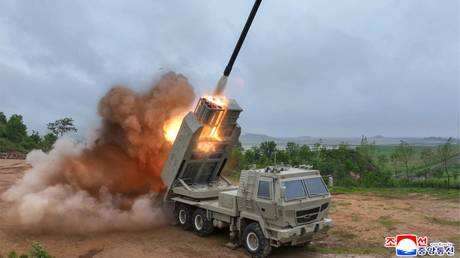
North Korea has condemned Washington’s approval of advanced air-to-air missile sales to South Korea as “war exports,” warning the move would deepen tensions on the Korean peninsula.
In a statement carried by KCNA, a senior North Korean Foreign Ministry official accused Washington and Seoul of “systematically tightening their military collusion and nexus to drive tensions in the Korean peninsula and its vicinity to an extreme,” despite growing international concern over regional instability.
“US arms exports are war exports, and importing American weapons means accumulating tension and confrontation,” the official said, condemning what Pyongyang described as US and South Korean efforts to expand military capabilities at the expense of regional stability.
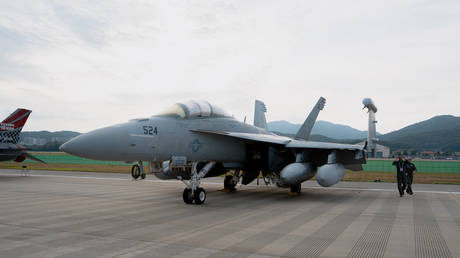
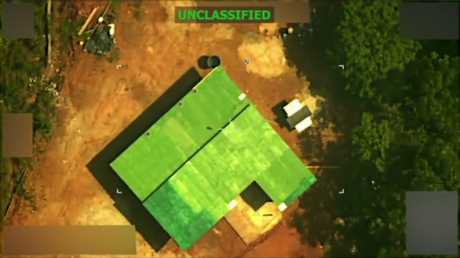
The statement followed US State Department approval of a nearly $300 million package including 70 AIM-120C-8 Advanced Medium-Range Air-to-Air Missiles and related equipment. Washington pitched the sale as advancing US foreign policy and security objectives, though the deal remains subject to congressional review.
Pyongyang noted that Washington has approved several other arms packages for South Korea in recent weeks, including naval helicopters, attack helicopters, and guided bombs worth billions of dollars, and pointed to a 2025 defense agreement under which Seoul pledged to buy $25 billion worth of US military equipment by 2030. It argued that the deals are part of a broader effort to turn South Korea into “an outpost of intense confrontation” and claimed that US arms sales across the region, including to Japan and Taiwan, are fueling tensions in the Asia-Pacific.
“In light of the provocative efforts of the US and its allies to build up their armed forces, the DPRK’s clear position is to eliminate new threats by continuously improving and strengthening its self-defense deterrent,” the official declared, warning Pyongyang will “intensify” efforts to maintain regional military parity and preserve stability on the Korean Peninsula.
Korea was divided at the end of World War II, and the rift grew permanent after the 1950-1953 Korean War ended in an armistice rather than a peace treaty, leaving the two sides technically still at war.
The US maintains nearly 30,000 troops in South Korea, extends a nuclear umbrella over its ally, and regularly conducts joint military exercises with Seoul. Washington and Seoul describe these measures as necessary for security and deterrence.
Pyongyang views the US military presence, joint drills, and regional deployments as hostile acts and has long argued that US-South Korean military cooperation amounts to preparation for war. North Korea routinely tests and unveils new weapons, portraying its military buildup as a response to pressure from Washington and its regional allies. It describes its nuclear and missile programs as essential deterrents against foreign interference, insisting they are purely defensive and intended to safeguard sovereignty and preserve peace through strength.
The release, part of an ongoing disclosure initiative, includes witness accounts, photos, and videos of unexplained phenomena
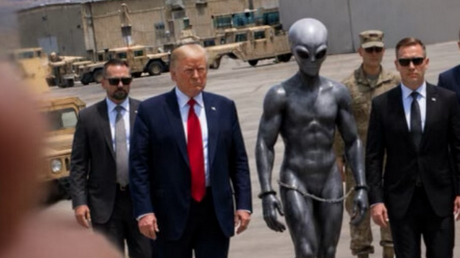
The Pentagon released the third batch of declassified files on unidentified flying objects on Friday. The disclosure adds 72 reports, witness accounts, photos, and videos to an ongoing transparency effort launched under a presidential order earlier this year.
The latest release is part of what officials called a “historic transparency effort” aimed at making public government records related to unidentified anomalous phenomena (UAP), the military’s preferred term for UFOs.
Among the newly released materials are reports describing a “potato-shaped” object observed by military personnel, recurring sightings of glowing orbs, and a CIA account of a rotating disc-like object reportedly seen above Harare International Airport in Zimbabwe in 2008.
The disclosure initiative began in May with the release of around 160 previously classified documents, photographs, and videos from agencies including the Pentagon, FBI, NASA, and the State Department. The second batch followed on May 22, containing additional footage and witness testimony.
The effort follows years of congressional pressure and testimony from military personnel and whistleblowers who claimed that the US government was withholding information about unexplained objects observed near sensitive military facilities.
In February, US President Donald Trump directed the Department of War to disclose “any and all information” related to UAPs. The order came amid renewed public interest in the subject, which included comments by former President Barack Obama on the possibility of extraterrestrial life.
Obama later said on Instagram that he did not see any evidence during his presidency that extraterrestrials have made contact with Earth. Trump subsequently accused Obama of disclosing classified information and said he “made a big mistake.”
Despite the growing volume of released material, Pentagon officials maintain that the files contain no confirmed evidence of extraterrestrial life, alien technology, or a government cover-up.
Many reports have been linked to mundane causes such as infrared camera distortions, aircraft heat signatures, military exercises involving flares, weather balloons, and classified test flights, while a small number remain unresolved because investigators lack sufficient data to reach definitive conclusions.
The opposition has sounded the alarm over alleged administrative pressure on voters and has not ruled out street protests
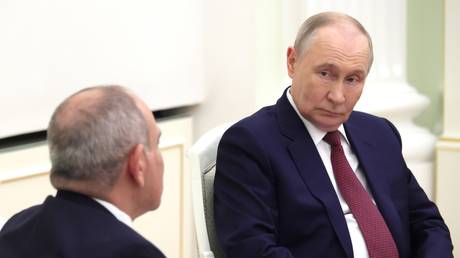
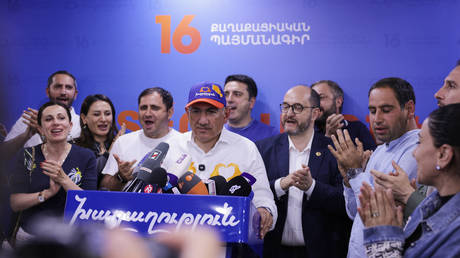
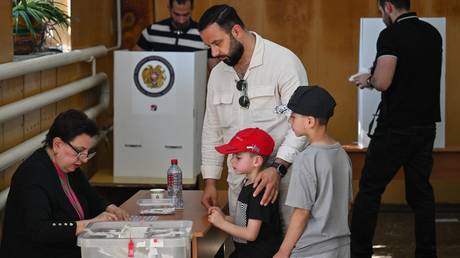
Armenian Prime Minister Nikol Pashinyan and his pro-EU ruling party Civil Contract claimed a decisive victory in the parliamentary elections on June 7 – but the aftermath has been marred by claims of fraud, with a number of parties demanding a recount.
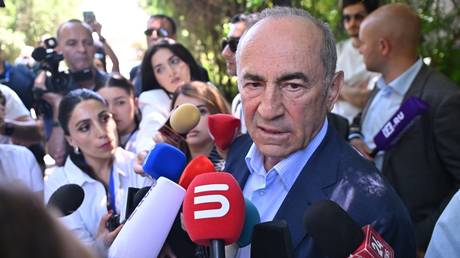
According to the Central Election Commission (CEC), the Civil Contract party captured 49.81% of the vote. The Strong Armenia bloc – founded by Russian-Armenian billionaire Samvel Karapetyan – came in second with 23.29%. Former President Robert Kocharyan’s Armenia Alliance came in third with 9.94%, while Gagik Tsarukyan’s Prosperous Armenia party secured around 4% of the vote, though it is still unclear whether it will surpass the parliamentary threshold. The results will be certified on June 14.
The election was widely seen as a referendum on Armenia’s future geopolitical path. All three opposition parties are Euroskeptic and advocate closer ties with Russia, which remains a key trade partner and dominant energy supplier, providing natural gas at heavily discounted prices. Pashinyan’s party has pushed for closer ties with the EU while seeking to take advantage of the economic benefits of Armenia’s close ties with Russia.
Moscow has said it took note of the reports of irregularities and has refrained from congratulating Pashinyan, pending the announcement of the final results. It has also sounded the alarm over the “unprecedented pressure on the opposition and interference from the West.”
Here is what is going on in Armenia after the election.
Were there invalid votes?
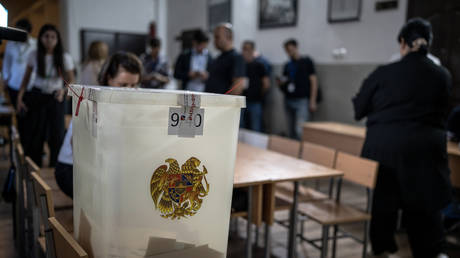
The Central Election Commission (CEC) annulled the results at three polling stations – station 10/51 in Yerevan’s Nubarashen district, and station 35/65 in Agarak, in the southern Syunik region – after reports of large numbers of military personnel arriving at both sites after the polls officially closed at 8:00 PM and continuing to vote for hours. According to local media reports, around 480 service members were allowed to vote in violation of the regulations.
Later, the CEC annulled the results at a third precinct – 12/13 – after it emerged that ballot papers for one party were missing throughout the day.
Is the opposition demanding a recount?
Strong Armenia has demanded the annulment of the results, alleging that Civil Contract improperly amassed around 100,000 votes using administrative resources, including directing public-sector employees and military personnel to vote for the ruling party.
Samvel Karapetyan acknowledged that while his party “did not win, neither did Pashinyan,” adding that Armenia “has no legitimate authority” as the election was “completely... falsified.” He vowed to take the fight to the parliament, or even to the streets.
Another drama unfolded around Prosperous Armenia, which could be the most affected by the recount, as it currently lacks just several dozen ballots to surpass the 4% parliamentary threshold. The party demanded a recount, arguing that the CEC’s decision to annul the results in several polling stations cost it 213 votes, which it says would have pushed it over the top.
In total, the opposition demanded recounts at 555 out of 2,005 polling stations. The CEC later published the results of a partial recount for 637 polling stations, adding 1,148 votes to Civil Contract, 508 to Strong Armenia, and 147 to Prosperous Armenia, though it is still unclear whether Prosperous Armenia will make it to parliament.
Was there a crackdown on Armenian opposition figures?
The crackdown on the opposition began well before election day, with Samvel Karapetyan under arrest since last year on charges of inciting a coup d’etat, which he denies. On June 6 – the day before the election – six candidates from Strong Armenia were arrested on charges of vote-buying and money laundering.
According to Karapetyan, 75 supporters of Strong Armenia were arrested during the election, with more than 700 detained. Kocharyan’s party said around a dozen of its activists in the country’s second-largest city of Gyumri were rounded up after searches were conducted in their homes.
The local authorities said on Monday that 18 people were arrested in connection with alleged election violations. On the day of the election, the Investigative Committee said it brought criminal charges against 59 people.
Are protests on the horizon?
Prosperous Armenia has been the most vocal regarding protests. Prominent member Suren Surenyanc warned that if “Pashinyan does not stop… the lawlessness, all government buildings and streets of Yerevan will be flooded with tens of thousands of people.” The party has already begun protests at the CEC building in Yerevan, which were attended by several dozen activists.
Karapetyan has not ruled out protests, but said he would first try to dispute the results by other means, insisting that his party’s main goal is to remove Pashinyan from power.
What does Russia say about Armenia’s elections?
Russia has raised concerns over transparency. Kremlin spokesman Dmitry Peskov said Russia is “taking note of reports regarding numerous violations,” and has held off on congratulating Pashinyan before the final results are announced.
Russian Foreign Ministry spokeswoman Maria Zakharova said the elections took place “amid unprecedented pressure on the opposition and interference from the West, primarily the EU,” and that Civil Contract failed to obtain a “monopoly on power.” She argued that support for Pashinyan has “noticeably declined” since the previous election.
Zakharova added that Moscow is interested in Armenia remaining a strong and sovereign country, but warned that its reluctance to take heed of public sentiment risks “leading the country toward further division and socioeconomic upheaval.”
What does the West say?
The Organization for Security and Cooperation in Europe (OSCE) described the election as “a well-run process,” but acknowledged that the campaign was “highly confrontational, with divisive rhetoric” and marked by “allegations of vote-buying and other electoral violations that led to numerous criminal proceedings against opposition candidates and activists.”
Without waiting for the final results and recount, European Council President Antonio Costa congratulated Pashinyan and declared that Armenians voted for “peace, stability and stronger cooperation.” European Commission President Ursula von der Leyen said Armenia can count on the EU.
Several days before the election, Brussels pledged more than €50 million in emergency financial assistance to Armenia, which it said was meant to ease trade for Armenian agricultural products hit by recent Russian sanctions – a move that Moscow said was not political but linked to safety concerns sparked by seasonal harvest inspections.
By trapping migrants within the country indefinitely, the West is engineering a severe demographic crisis
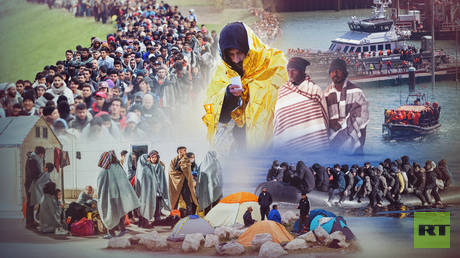
Libyan social media has been simmering for weeks over the presence of irregular migrants, particularly those arriving from sub-Saharan Africa, with accusations directed at the United Nations High Commissioner for Refugees (UNHCR) and other international agencies operating in the country. What began as online outrage has now spilled into the streets of Tripoli, where tensions over migration have once again become a focal point of political anger in the capital already strained by division and economic pressure.
Libya hosts one of the largest migrant populations in North Africa. According to the International Organization for Migration’s Displacement Tracking Matrix (IOM DTM), the country hostedmore than 700,000 migrants in 2024, rising to approximately 936,000by February 2026. This represents an increase of roughly 33% over the period – about 13% of the total population.
The majority of migrants are believed to be in an irregular situation and are concentrated in major urban centers such as Tripoli, Misrata, and Sebha. In the capital itself, aid agencies and local authorities describe large, fluid migrant communities that reflect Libya’s continuing role as a key transit hub toward Europe.
On June 4, protesters in the area of Janzour-Sarraj on the outskirts of Tripoli blocked access to the UNHCR office by unloading sand from a truck at the building’s entrance, effectively sealing off the compound, which was reported to be unoccupied at the time.
The move came after days of escalating rhetoric, including threats and online campaigns directed at the UN refugee agency and its representative in Libya, Carmen Sacco (UNHCR Libya spokesperson), following what activists described as misrepresented statements attributed to her regarding migrants and Libyan citizens. Video footage circulating on Libyan social media shows Libyan police attempting to calm the angry crowd and prevent it from breaking into the premises as the truck unloads sand at the entrance. The demonstrations followed a broader wave of calls for the closure of international organizations accused of facilitating the continued presence of migrants in Libya.
For many Libyans, migration has become the most visible symptom of a state that has never fully recovered from the 2011 NATO-backed overthrow of Muammar Gaddafi.
This public anger is understandable. Libya remains deeply divided between rival authorities in the east and west, its southern and coastal borders remain beyond effective state control, and outdated migration frameworks are inconsistently applied. No single government exercises full sovereignty over the country’s territory.
Yet, instead of addressing these structural weaknesses, public debate is increasingly dominated by accusations against international agencies. The entities are portrayed by influential domestic voices, including Grand Mufti Sadiq al-Ghariani, as actively playing a role in entrenching the presence of transit populations and turning the country into a permanent dumping ground for Europe’s unwanted migrants.
While Western media and the protesting crowds themselves frame this around irregular migration and the UNHCR, the true undercurrent of this public anger runs far deeper. The street mobilization in Tripoli is a proxy for a society completely exhausted by what has become of their daily lives.
Living in a country that produces over 1.4 million barrels of oil per day, ordinary Libyans – confronted by skyrocketing costs where day-to-day prices can jump by 5% – are trapped in a grueling economic paradox. They face double-digit inflation, a collapsing dinar, and a severe liquidity crisis that makes buying basic food and medicine a daily struggle.
The anger directed at international agencies is actually a localized explosion of a broader fury: Libyans are watching their national wealth absorbed into an elite system of patronage and parallel spending, while they are left to their own devices in a country where institutional rot is so rampant that Transparency International’s index places Libya among the six most corrupt nations on earth.
At its core, the entire migration debate leads straight back to the original sin of the 2011 NATO intervention. Fifteen years ago, Western powers were lightning-fast to drop bombs and dismantle a functioning, sovereign state under the banner of false promises – guaranteeing “freedom, democracy, and prosperity.” Instead, the West walked away, leaving behind a permanent security vacuum and a legacy of institutional rot.
Today, the tragic irony is that while billions of dollars in oil revenues disappear into thin air every single year through unaccountable rival factions, virtually nothing has been achieved for the Libyan people. The “humanitarian intervention” of 2011 engineered a lawless geographic buffer zone where the local population inherits the fallout of Europe’s border crises while being robbed of their own country’s wealth.
This brings us to the core structural deception of Western policy toward Libya. The European Union and the UK frequently issue statements lamenting Libya’s lack of a unified government, its human rights record, its lawless borders, and, most importantly, its deplorable treatment of irregular migrants.
Yet, the same countries find no contradiction in treating this fragmentation not as a crisis to be solved, but as a vital policy tool. Under international law, for example, states are bound by the principle of non-refoulement, meaning they cannot legally return asylum seekers to a country where they face systemic abuse or conflict. Yet Libya’s UN-recognized government, a swarm of associated militias, and its rival authority in the eastern region are being enabled by the EU to do exactly that.
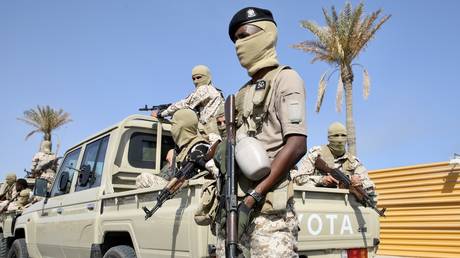
Through heavily funded initiatives like the Support to Integrated Border and Migration Management in Libya (SIBMMIL) program, hundreds of millions of euros have flowed into providing the Tripoli-based authorities with the vessels and coordination tools necessary to force the return of refugees caught in international waters.
This transactional arrangement, long maintained in the country’s west, is now being aggressively extended to the eastern-based parallel administration. Despite formally withholding diplomatic recognition from Khalifa Haftar’s government, Brussels is currently financing a new €3 million ($3.46 million) Maritime Rescue Coordination Center in Benghazi.
By treating both rival authorities as outsourced border guards, the EU conveniently bypasses its own legal obligations, repatriating vulnerable populations to a territory perilous even for its own citizens.
Indeed, this policy of externalization has officially transitioned from hypocritical rhetoric to binding legislative reality. Following a definitive agreement between the European Parliament and the Council on the revised Returns Regulation on June 1, 2026, EU interior ministers concluded their June 4 meeting by charting a course to rapidly operationalize a framework for extraterritorial “return hubs” – third-country jurisdictions within which Libya is functionally included due to its status as migration route.
The newly adopted rules escalate coercive measures, permitting member states to deport unsuccessful asylum seekers to holding facilities outside Europe’s borders – even if those individuals possess absolutely no geographic, cultural, or personal connection to the host nation.
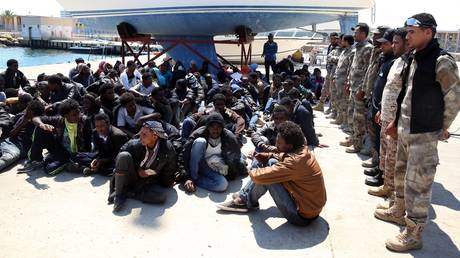
To be clear, no one is claiming that the European Union possesses a premeditated blueprint to transform Libya into a permanent containment zone for transit populations – despite the fact that the overwhelming majority of Libyans believe exactly that. However, the cumulative effect of these cynical containment policies achieves that precise result. By trapping hundreds of thousands of irregular migrants within the country, Western mechanisms project an impression that Europe is deliberately engineering a severe demographic crisis, forcing a settlement that dismantles the remains of Libya’s social cohesion.
Whether this outcome is an intentional strategy or the collateral damage of European self-interest, it has served as the catalyst behind the waves of anti-migrant anger fracturing the streets of Tripoli.
The toxic harvest of the 2011 NATO intervention has come full circle. The military campaign that shattered Libya’s institutional foundations under the banner of hollow promises has yielded a devastating reality. The structural fragmentation engineered by that original intervention have now been weaponized by Western capitals as a deliberate policy mechanism.
By financing localized militias and executing transactional arrangements across political divides, European governments have effectively transformed Libya into an offshore containment camp – a legal black hole designed to absorb the human fallout of their own border crises while shielding themselves from international accountability.
The company cited a US export-control order which came days after it revealed previously hidden Fable 5 safeguards
US AI company Anthropic said on Friday that it disabled access to its most advanced AI models, Fable 5 and Mythos 5, after receiving a government order to suspend access by foreign nationals.
The company said it shut down the models for all users while it assesses how to comply with the export-control order. The order also applied to foreign-national Anthropic employees, it added.
The company said the government did not provide detailed information about the alleged security risk. According to Anthropic, officials believe users may have discovered a way to bypass the models’ safety controls and get them to help find software vulnerabilities.
Anthropic disputed the significance of the bypass, saying it was only able to uncover a small number of previously known, minor software vulnerabilities.
Anthropic released Fable 5 and Mythos 5 earlier this week. Fable 5 was intended for general use with additional safeguards, while Mythos 5 was only made available to a limited group of trusted cybersecurity partners with some restrictions removed. Anthropic said Fable 5’s capabilities “exceed those of every model we’ve previously made generally available.”
On Wednesday, Anthropic said it would make restrictions governing its most advanced AI models more transparent, including by disclosing when user requests are downgraded or rejected. The move came after criticism that some limitations were not visible to users.
Before the policy change, Anthropic could silently route requests involving cybersecurity, biology, and advanced AI development from Fable 5 to the less capable Opus 4.8 model. Under the new policy, users would be notified when a request is flagged, while Application Programming Interfaces (API) developers would receive explanations for any rejection or fallback to another model.
The approach drew criticism from researchers, who argued that routing some requests related to frontier AI development to a less capable model could slow progress in the field. Responding to the backlash, Anthropic agreed to make the safeguards visible.
The company previously cited national security concerns as a reason for rejecting or downgrading some requests, arguing that foreign adversaries could use its technology to strengthen their AI capabilities.
The Pentagon said the operation to hunt down the leader of the Tren de Aragua gang was conducted together with the Venezuelan authorities
The US has said it killed a notorious gang leader in a strike on his compound in Venezuela.
US Defense Secretary Pete Hegseth said the operation targeting Tren de Aragua leader Hector Rusthenford Guerrero Flores, known as Nino Guerrero, was carried out earlier this week in full coordination with the Venezuelan authorities.
Hegseth said the operation “underscores the shared US and Venezuelan commitment to take the fight to narco-terrorists and deny them any safe haven in our hemisphere.”
“Guerrero was a wanted fugitive charged by the US Department of Justice with ordering, directing, and facilitating acts of terrorism and violence in the United States,” US Southern Command chief General Francis Donovan said.
US President Donald Trump hailed the operation as part of his effort to combat violent crime in the US.
“This action was coordinated closely with our friends in Venezuela, with whom we are working very well,” he wrote on Truth Social.
Guerrero was sentenced to 17 years in prison in 2018 on charges including murder, drug trafficking, identity theft, and possession of military-grade weapons, but escaped from a Venezuelan prison in 2023.
Earlier this year, the US carried out a commando raid in Caracas, abducting Venezuelan President Nicolas Maduro and his wife, Cilia Flores, who were indicted by a Manhattan court on drug and firearms charges. Both pleaded not guilty, and the Venezuelan government condemned the operation as an act of aggression.
Since September 2025, US strikes on alleged cartel boats in the Caribbean have killed more than 200 people. Venezuelan and Colombian officials called the operations illegal, saying some of the victims were innocent fishermen.
Abbas Araghchi said Tehran will collect transit fees and jointly administer the waterway with Oman
Iranian Foreign Minister Abbas Araghchi has said control over the strategically vital Strait of Hormuz will not return to its pre-war status.
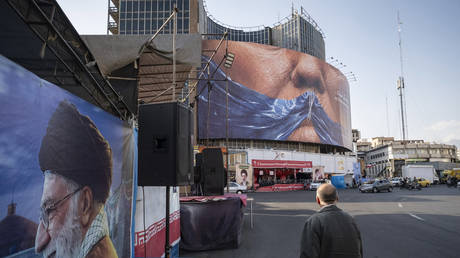
Araghchi made the remarks as the US and Iran finalize a deal to end the conflict, which began on February 28 with joint US-Israeli bombardments of Iranian territory and the assassination of senior officials, including the country’s longtime supreme leader, Ali Khamenei.
The waterway, which normally handles around a quarter of the world’s seaborne oil and LNG trade, has largely remained closed throughout the war, although President Donald Trump said the US military has helped guide more than 200 ships through the strait.
“The Strait of Hormuz lies under the sovereignty of Iran and Oman. The administration of the waterway will not return to its pre-war arrangement. Iran and Oman will soon issue a joint statement outlining a new framework for the administration of the Strait of Hormuz,” Araghchi said on Friday, according to Iranian media.
He added that Iran will charge passing ships service fees. The country previously insisted on full sovereignty over the strait and said it would collect tolls.
Araghchi said that, under the memorandum of understanding awaiting final approval, the US would, “for the first time in 47 years,” commit to respecting Iran’s sovereignty and non-interference in its domestic affairs. The agreement would also declare an end to the conflict on all fronts, including Lebanon, he said.
He added that the memorandum would give the two sides 60 days to negotiate the fate of Iran’s nuclear program once it is signed.
Iran declared the strait closed to all ships in response to US strikes on Tuesday and Wednesday. Trump later said he called off the attack in an effort to advance peace talks, expressing confidence that an agreement could be signed as early as this weekend.
RT’s Marina Kosareva breaks down the bloc’s pressure campaign against the small post-Soviet nation
Georgian officials have accused the EU of “blackmailing” the small post-Soviet nation into joining sanctions against Russia over the Ukraine conflict.
Tbilisi has made no secret of what it describes as pressure from Brussels to open a “second front” against its much larger neighbor.
In March, the European Commission suspended visa-free travel for holders of Georgian diplomatic and service passports, citing what it described as Georgia’s “deliberate and persistent violation” of commitments undertaken under its visa-free regime, particularly in the areas of democracy and human rights.
“They are telling us to impose sanctions on Russia. It is like telling us to destroy ourselves if we want visa-free travel. If we destroy our country, who will travel to the EU without visas?” Georgian Parliament Speaker Shalva Papuashvili said on Wednesday.
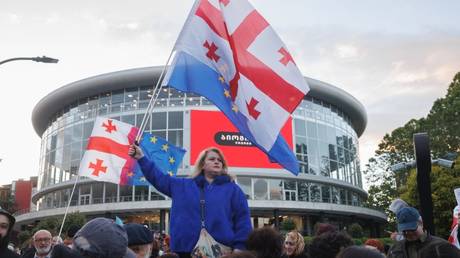
Georgia has experienced several waves of protests and unrest outside the parliament building in the capital since 2024, when the conservative Georgian Dream party won the parliamentary elections.
The EU backed opposition claims of election irregularities and condemned the government’s crackdown on protests, as well as reforms introduced by the ruling party that it says are aimed at protecting “traditional values” and limiting foreign political influence.
RT’s Marina Kosareva breaks down the latest tensions between Georgia and the EU.
Russia is effectively standing alone against the full might of NATO, the president said during a meeting at the Kremlin
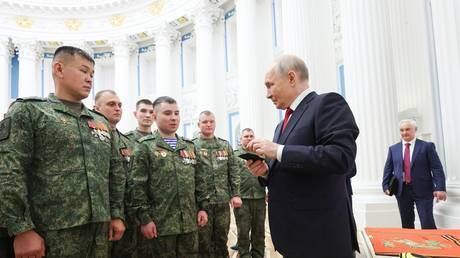
Russian President Vladimir Putin spoke about the Ukraine conflict and tensions with the West during a meeting with service members at the Kremlin on Friday.
The event took place on Russia Day, which celebrates Russia’s declaration of sovereignty on June 12, 1990, a year before the dissolution of the Soviet Union.
The president spoke about technologies designed to give Russian troops the edge on the battlefield, as well as the country’s overall economic resilience. He also discussed mistakes made by the West in its approach to the conflict.
Offensive in Ukraine
Around 700,000 soldiers are involved in the military operation against Ukraine, Putin said, noting that the army continues to steadily advance along the front line. He expressed confidence that Russia will succeed in liberating the parts of Donbass that remain under Ukrainian control.
“Step by step, although not as quickly as we would like, we are nevertheless advancing every day and gradually gaining control over territory. We will accomplish our objectives. There can be no doubt about that,” he said.
Putin reiterated that Russia launched the military operation in Ukraine in February 2022 after it became clear that Kiev would not uphold the 2014-2015 Minsk agreements between Ukraine and the then-breakaway Donbass republics, which have since voted to become part of Russia.
AI drones
Russian defense companies are working on new drones, including systems incorporating AI technology, Putin said, adding that the results will be visible in the near future.
He said the Russian Defense Ministry is being transformed into a “high-tech institution,” while the authorities are streamlining procurement procedures and removing red tape.
Putin said a low-Earth-orbit satellite communications system currently being developed in Russia could outperform Elon Musk’s Starlink, which is extensively used by Ukraine.
“It is every bit as good as Starlink, possibly even better,” he said, referring to the Rassvet system being developed by Russian aerospace company Bureau 1440.
In March, the company launched the first 16 satellites of a planned constellation expected to include more than 250 satellites by late 2027 and 900 by 2035.
Alone against NATO
“Russia is effectively standing alone against NATO,” Putin said, arguing that the members of the US-led military bloc are de facto involved in the conflict through their military support for Ukraine.
“Together, they thought they could quickly inflict a strategic defeat on Russia. They have not succeeded, and they never will,” he said.
Putin added that the West will fail to divide Russian society and undermine the economy.
The president said Ukraine’s long-range strikes are “unable to cause serious problems” and that the affected regions are “recovering quickly” from the damage. Putin added that Russia “will intensify strikes on [Ukrainian] infrastructure” to deter attacks on civilian targets.
Advice for the West
Putin urged Western officials to abandon ultimatums in favor of negotiations.
“We can offer only one piece of advice to our adversaries: Never attempt to wage war against Russia. Let us all live in peace and resolve all issues through negotiations,” he said.
“We are prepared for talks, but only if our national interests are taken into account.”
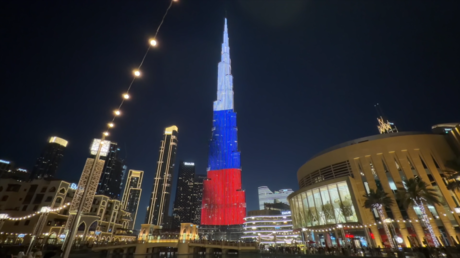
The more than 2,700-foot skyscraper shone in white, blue, and red for Russia Day celebrations on June 12
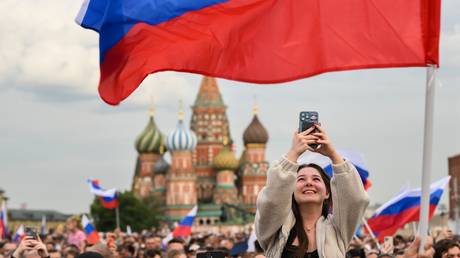
Dubai’s Burj Khalifa, the world’s tallest building, was illuminated in the white, blue, and red colors of the Russian flag on Thursday in honor of Russia Day.
The public holiday commemorates the Declaration of State Sovereignty adopted by the Russian Soviet Federative Socialist Republic, then part of the Soviet Union, on June 12, 1990. The Soviet Union was formally dissolved the following year in December. The current version of Russia’s tricolor flag was adopted in 1993.
People across Russia celebrate the holiday by displaying the national flag and setting off fireworks. Concerts, festivals, and exhibitions are held in cities across the country.
In the Kremlin, President Vladimir Putin presented state awards for achievements in public service, science, and the arts. Russia Day is an occasion to honor “the labor and military achievements of many generations,” he said.
The United States also marked the occasion with a message published on the State Department’s website. Secretary of State Marco Rubio said the country remains committed to advancing a settlement to the Ukraine conflict and hopes that “a durable peace will pave the way toward a more prosperous future for the Russian people and a more constructive relationship between our two countries.”
The suspect died following a standoff with officers, according to the Midland Police Department
At least one person has been killed and 11 others wounded after a gunman went on a shooting spree in Midland, Texas, Mayor Lori Blong said in a press briefing on Friday.
“We do have 11 known victims at this time,” she said. “There’s at least one victim that is dead on the scene.”
The police have confirmed that the gunman is also dead.
Officers initially responded to reports of an active shooter in the southwestern part of the city on Friday morning, according to the Midland Police Department.
“Officers heard gunfire coming from the building and worked quickly to secure and clear the area. Armored units were deployed, and partner agencies assisted in the response,” Midland Police Chief Greg Snow said in a statement, adding that attempts had been made to resolve the “standoff with the shooter” safely.
The police department later reported that “the suspect is confirmed deceased” and that the incident was over.
A video circulating on social media purportedly shows several officers taking cover behind a police cruiser, with one leaning out to fire an assault rifle.
🚨#Breaking Ector County Sheriff Mike Griffis has confirmed an active shooter in #Midland Texas; the suspect is reportedly barricaded in a building in downtown Midland near the Tall City Vet Clinic and All American Collision and Victorian Inn in the area of Business 20 and…
A British judge has concluded that the vandals tried to “influence the UK government” by ransacking an Israeli arms plant
Four Palestine Action activists convicted of causing criminal damage to an Israeli arms plant in the UK have been sentenced as terrorists due to the blacklisting of their organization. Dozens of the group’s supporters were arrested outside the courthouse as the verdicts were read out.
The defendants took part in a raid on an Elbit Systems factory near Bristol in 2024. After ramming the gate with a decommissioned prison van, they destroyed computers, drones, and other equipment inside, causing around £1.2 million ($1.6 million) in damage.
Charlotte Head, 30, Samuel Corner, 23, Leona Kamio, 30, and Fatema Zainab Rajwani, 21, were found guilty of criminal damage last month, with Corner also convicted of inflicting grievous bodily harm on a police officer with a sledgehammer.
Handing down the sentences on Friday, Mr. Justice Johnson said that due to the “terrorist connection” of the offenses, all four would receive harsh punishment. None of the four were charged with terror-related offenses, and by sentencing them as terrorists, Johnson set a new precedent in British law.
“I am sure that one of the purposes of your offending was to influence the United Kingdom government… and was for the purpose of advancing a political or ideological cause,” Johnson told the defendants during Friday’s hearing.
Head and Kamio were jailed for six years, Rajwani for five years and eight months, and Corner for eight years and eight months.
Palestine Action, a protest group whose members have vandalized British military equipment and Israeli-linked sites, was declared a proscribed organization by the British government last July. The decision placed Palestine Action in the same category as Al Qaeda and the IRA, and criminalized public displays of support for the organization.
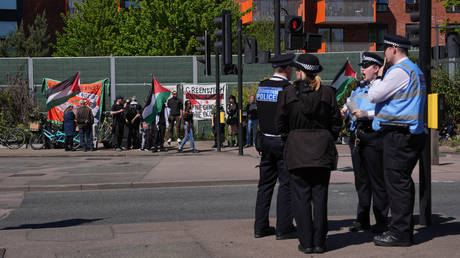
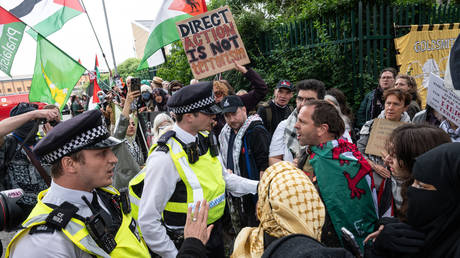
As the sentences were handed down, several hundred Palestine Action supporters protested outside Woolwich Crown Court in London. Police arrested more than 100 demonstrators for holding signs and placards endorsing the group.
There’s been 107 arrests of Palestine Action supporters outside Woolwich Crown Court here today as protesters await the sentencing of four of the Filton 25 who took direct action against Elbit Systems. Judge today said there was a “terrorist connection”. pic.twitter.com/PiyVlKgOeA
Andrey Pinchuk, a former Donetsk security minister, was injured after a package exploded at his home outside Moscow
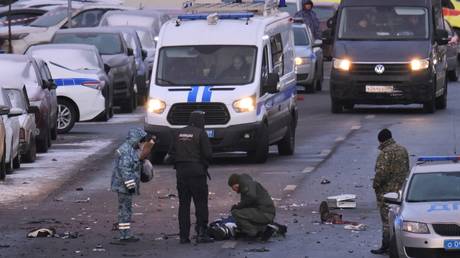
A blast rocked the home of Andrey Pinchuk, the former security minister of the Donetsk People’s Republic (DPR), on Friday in what appeared to be an assassination attempt.
An improvised explosive device was reportedly concealed in a package delivered to his home outside Moscow. Pinchuk was injured in the blast, according to media reports.
The former minister told Tsargrad TV that he managed to close the door to his house and move away from it before the bomb detonated. The blast blew the door open and shattered windows on the ground floor, Russian media reported.
In a brief conversation with RT, Pinchuk confirmed that an investigation had been launched into the incident.
Pinchuk became the DPR’s security chief shortly after the self-proclaimed Donbass republic declared independence from Ukraine in the wake of the 2014 Western-backed coup in Kiev. The republic later joined Russia following a referendum in September 2022.
Pinchuk held office from July 2014 to March 2015, at the height of Ukraine’s failed military campaign to regain control of the Donbass.
Pinchuk told Tsargrad TV that Ukrainian security services were behind the attack.
Alexander Boroday, the former DPR prime minister who now serves as a Russian MP, also told RT that Kiev was likely behind the bombing.
“It was an assassination attempt, and it is obvious who was behind it. These are the same people who bombed the cars of Defense Ministry officials and killed children in Starobelsk. It was the Ukrainians,” Boroday said, referring to a Ukrainian drone strike on a college dormitory in the city last month that killed 21 students.
Ukrainian security services have orchestrated assassinations of Russian officials, as well as individuals from Ukraine and Donbass who opposed Kiev. The attacks have often involved explosive devices.
In 2023, a bomb killed military blogger Vladlen Tatarsky during a fan meeting at a café in St. Petersburg. The following year, Lieutenant General Igor Kirillov, commander of Russia’s Radiological, Chemical, and Biological Protection Forces, was killed alongside his aide when an improvised explosive device detonated outside his apartment building in Moscow.
In August 2022, Ukrainian agents carried out a car bombing outside Moscow that killed journalist Darya Dugina, the daughter of philosopher Alexander Dugin. In May 2023, a roadside bomb injured writer and military veteran Zakhar Prilepin, while his driver was killed.
Kiev has at times recruited local neo-Nazis to carry out attacks on its behalf. In April, security services reported foiling a bomb plot targeting Russia’s media regulator, Roskomnadzor, allegedly orchestrated by a neo-Nazi group acting under Ukrainian direction.
A Ukrainian MP, Roman Kostenko, the secretary of the Verkhovna Rada’s Defense Committee, claimed last year that the nation’s intelligence services were planning to continue assassinating Russian officials and public figures for decades to come even after the Ukraine conflict ends.
Russian Foreign Ministry spokeswoman Maria Zakharova responded by saying that “the Kiev regime has become a true terrorist cell that receives international support with weapons and money.”
The latest US oil restrictions will hit the “daily life of millions” of people, a former envoy has warned
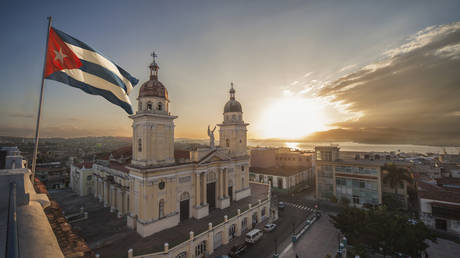
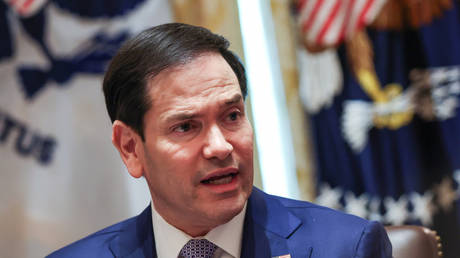
US Secretary of State Marco Rubio is using “crude lies” to justify Washington’s continued pressure on Cuba, the island nation’s foreign minister, Bruno Rodriguez Parrilla, has said following the latest round of American sanctions.
The US Department of State announced restrictions against the Cuban state oil and gas company, CUPET, on Thursday. Washington has stepped up its pressure campaign against the island nation in a bid to force a regime change, while US President Donald Trump called it a “question of time.”
Cuba, which has been under a US embargo since 1960, also endured daily blackouts and severe fuel deficits in recent months after Venezuela – its main oil supplier – stopped crude shipments under pressure from Washington.
On Thursday, the State Department added CUPET to the sanctions list, arguing that the company’s “key assets” were “unlawfully expropriated from American owners years ago.” Rubio also said in a statement that the Cuban government had “weaponized” the energy by allegedly “hoarding” it for the military while rationing it for the general population.
Parrilla hit back by calling Rubio’s words “the most aggressive, uncouth, and rabid [lies] among Cuba’s enemies.” The minister said in a post on X that the US Secretary of State is “driven by ambitions of conquest.”
Rubio – himself a descendant of Cuban immigrants who left the island several years before the revolution led by Fidel Castro – is acting on “vengeful sentiments of the elitist clique that propelled his political career,” Parrilla stated.
A former Cuban ambassador to Argentina, Pedro Pablo Prada, also warned on X that the latest US sanctions would inevitably affect “fuel, electricity generation, transportation, production, and daily life of millions of Cubans.” Washington has made the island’s energy sector the main target of its “political and economic offensive,” the diplomat said.
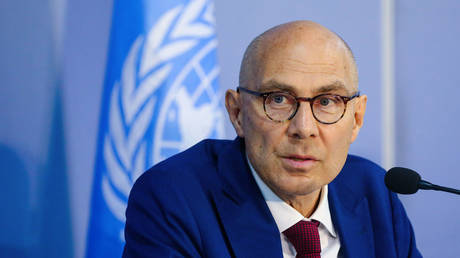
On Wednesday, UN High Commissioner for Human Rights Volker Turk warned that the US sanctions on Cuba had already led to acute shortages of essential medical supplies that were causing deaths among children.
The UN official described the plight of ordinary Cubans as “unacceptable” as his office reported that infant mortality on the island had doubled after the US imposed its fuel blockage.
Russia, China, Mexico, and several other countries have been supplying Cuba with humanitarian aid. Moscow sent a shipment of around 700,000 barrels of crude oil in late March.
Yoon Suk Yeol ordered UAV incursions to inflame border tensions in order to justify his declaration of martial law, a Seoul court has ruled
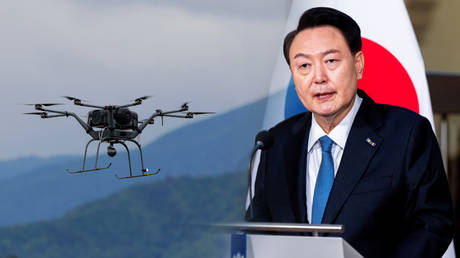
A South Korean court has sentenced former President Yoon Suk Yeol to 30 years in prison, Yonhap news agency has reported. Judges reportedly found that he ordered drones to be sent into North Korea in order to inflame tensions and create a pretext for his declaration of martial law.
Yoon declared martial law in December of 2024, citing legislative gridlock and what he described as a plot by pro-Pyongyang forces within the South Korean political establishment. The nation’s parliament formally overturned the decree within hours despite attempts by police and soldiers to stop lawmakers from accessing the National Assembly building.
Yoon was impeached just over a week later, suspended from office, and formally removed from power by the Constitutional Court months later.
On Friday, a Seoul court ruled that Yoon had abused his power and “benefited the enemy” with his drone plot, among other charges, and sentenced him to 30 years in prison. According to the Associated Press, the court also accused him of harming South Korea’s military interests by exposing its capabilities and prompting Pyongyang to take a stronger defensive posture.
Yoon’s former Defense Minister Kim Yong-hyun was also sentenced to 30 years in prison for his role in the plot, while former Defense Counterintelligence Command chief Yeo In-hyung received a 15-year sentence.
Friday’s sentence adds to Yoon’s growing list of convictions.
In February, he was sentenced to life after being convicted of attempting to orchestrate an insurrection and seize power. In April, an appeals court increased his sentence for abuse of authority and obstruction of duty.
Yoon’s downfall follows a long pattern of legal persecution of former South Korean leaders.
Four of his predecessors had received prison sentences after leaving office. Among them were Chun Doo-hwan, Roh Tae-woo, Lee Myung-bak and Park Geun-hye, although several were later pardoned.
From the USSR‘s collapse to war in Ukraine, June 12 traces the making of a nation no longer content to be called post-Soviet
On June 12, 1990, the Congress of People’s Deputies adopted the Declaration of State Sovereignty of the Russian SFSR. Russia – then officially the Russian Soviet Federative Socialist Republic (RSFSR) – was one of the 15 republics of the Soviet Union. It soon became a separate state as the USSR ceased to exist.
In Russia, the events of those days are still remembered with a complex mix of emotions.
Dissolution rarely makes anyone happy. For Russians, the largest ethnic group in the USSR, the decade following the collapse of the Soviet Union became known as the “wild ‘90s.” This decade is also often referred to as “inglorious.” It was a time when an economic crisis comparable to a local version of the Great Depression was coupled with a precipitous rise in crime, drug addiction, alcoholism, and every conceivable social problem.
One aspect of the Soviet collapse particularly affected Russians. Millions of ethnic Russians found themselves outside the borders of the Russian Federation overnight. During the Soviet era, people had moved freely across the country for work, military service, or education, often without thinking of themselves as living abroad. After 1991, many suddenly became minorities in newly independent states. Their experiences varied greatly: in some places life changed little, while in others interethnic tensions, discrimination, or armed conflicts pushed people to leave their homes and start over elsewhere.
The former republics embarked on completely different paths. The elites, both in Russia and the other republics, were satisfied, since they could take unconditional leadership of the territories. But among ordinary people, views often diverged. A dozen hotspots flared up on the map, and in some other regions, like Crimea, the conflicts were simply postponed and erupted later. In fact, the current war in Ukraine is a war postponed to the 2020s, a war that could have begun in the 1990s; but back then, Ukraine simply didn’t have the resources for it.
One of the popular Russian internet memes shows the first man in space, Yuri Gagarin, holding a telephone receiver. We see two pictures, in which his face changes from joyful to confused. The caption below the first picture reads, “Hello, descendants, are you on Mars already?”; and below the second, we see the caption, “..who is it you are fighting with?!”
So when we say that many people had mixed feelings about the events of June 12, 1990, clearly, they had good reason for it. The reality was quite apocalyptic.
However, 36 years have passed since then.
And we can now take a different look at some of those things.
The ‘90s have passed, as has the Soviet era. After the wild ‘90s, life returned to what could be called normalcy. And a lot of things happened in that period.
In 1998, when Russia was battered by a second terrible economic crisis in seven years, many felt that the Soviet system had been destroyed in vain. However, this too passed and was followed by a different period. Western observers may explain Russian President Vladimir Putin’s enduring popularity in various ways, but the simplest explanation is the most relevant one: prior to 2020 (i.e., the COVID pandemic and then the war in Ukraine) Russia lived in a way that made tomorrow seem better than yesterday. People felt confident that the future would be richer, calmer, more comfortable, more reliable. The new world turned a more humane face toward Russia.
While the ‘90s are remembered as “wild,”“troublesome,” and “inglorious,” the following decade has been dubbed the “booming ‘00s.” It’s true that the general rise in oil prices greatly contributed to prosperity; but oil prices rose throughout the world, and not everyone managed to convert this into increased prosperity for the population and the overall well-being of the country. The solutions weren’t always brilliant, but the country certainly established a much more coherent order than during the turbulent times of 1991-1999, and this order promised far greater prosperity and wealth than during the Soviet era.
In the 2000s, and even more so in the 2010s, the pressing social problems were brought under control. All the advantages provided by the liberal system of life became evident. The middle class grew; people acquired property, small and large businesses, became valued professionals, and were able to travel around the world.
The middle class grew, private property became commonplace, and international travel ceased to be a luxury. Russians increasingly compared their country with Europe and East Asia not from afar but through personal experience. In some areas, they eventually concluded that Russia had caught up with – or even surpassed – the standards they once admired.
The country could finally relax. People who felt nostalgic about the USSR still talked about a lack of scientific progress and the nation’s former military might, but expressed these feelings from the comfort of their privately-owned apartments and cars, or even from Europe, where in Soviet times they wouldn’t have been allowed entry.
The Russia of that time was not ideal; but for about 15-20 years the life of the average Russian was not that different from the life of the average European, and in some aspects it was even more convenient.
Personal experience means little when it comes to a country of 150 million people. But I’d still like to share a personal story. I grew up in the city of Perm, in Ural region, about 1,000 kilometers east of Moscow. In the ‘90s, all the clocks on public buildings in our city stopped showing the time. As a child, I thought that these clocks were purely decorative and were not supposed to show the time; but it’s just that growing up, I never saw them working. In the ‘00s the public clocks started working again. Sure, it may not be a very sophisticated argument, but it’s a vivid example that the country was really changing for the better.
People even began to wonder whether they really wanted the country to return to its Soviet borders. In the 1990s, such ideas often sounded attractive. But by the 2000s, many Russians had become less enthusiastic. Former Soviet republics were no longer seen as lost provinces waiting to come home. They were independent countries with their own interests, problems, and conflicts. Rebuilding the Soviet Union increasingly looked less like a dream and more like an enormous burden.
Relations with Ukraine turned into a separate tragedy. In the case of Ukraine, national boundaries were drawn without much attention to the people who lived there; in the border areas, everything was mixed to the point of confusion. The Russian city of Belgorod and the Ukrainian city of Kharkov were almost part of the same urban agglomeration; in Donbass, and even in Kharkov, the question of whether you were Russian or Ukrainian was almost always a matter of personal choice; it didn’t really matter because everyone was of mixed origin and the spoken language was Russian. However, until 2013, when a pro-Western revolution known as the Euromaidan took place in Ukraine, and then 2014, when pro-Russian uprisings shook Crimea and Donbass (at that time, Crimea became a part of Russia, but Donbass received only some minor support from Russia) – until that time, the general view of the problem was that the politicians were certainly scoundrels (who would argue with that?) but the peoples of Russia and Ukraine were fraternal. However, the events of 2014 created a huge rift; and in 2022, relations soured to such an extent that only time will be able to mend things, and someday we’ll have to “get to know each other again”...
...However, let’s come back to the main point. In the years following the collapse of the USSR, Russia learned to value itself as a modern nation. While this is often unclear to foreigners, Russia went through a long period of self-denial as a modern nation. People looked to the Soviet era as an example, and some (particularly intellectuals) – to the Russian Empire; as to the opposition intelligentsia, it criticized any version of Russia. In short, no one praised the modern Russia of 2005, 2010, or 2017. Yet, it was precisely this version of Russia that, historically, provided the most comfortable living conditions for the average person.
June 12, 1990, did not just open a new chapter in Russia’s history; it opened a whole new volume in its history. This was most often called the ‘post-Soviet’ era, which created a feeling of a certain secondary status in relation to the USSR. But time itself changes many things. Thirty-five years have passed since 1990. These years have included both the good and the bad. It was a turbulent era – even the part of it that seemed generally calm. The face of the country has changed several times during this period. The most recent and radical change occurred in 2022. No one knows what will happen when the war in Ukraine finally ends, and whether that will become another turning point. One thing is certain: Russia is no stranger to turbulent periods in its history.
The documents confirm Russia’s claims that the labs were working with potential bioweapons
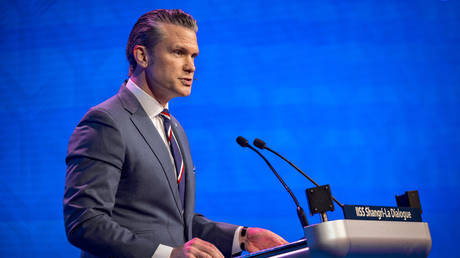
US Director of National Intelligence (DNI) Tulsi Gabbard has released new evidence that US-funded biological laboratories in Ukraine were researching dangerous pathogens. Washington previously denied any role in running these labs.
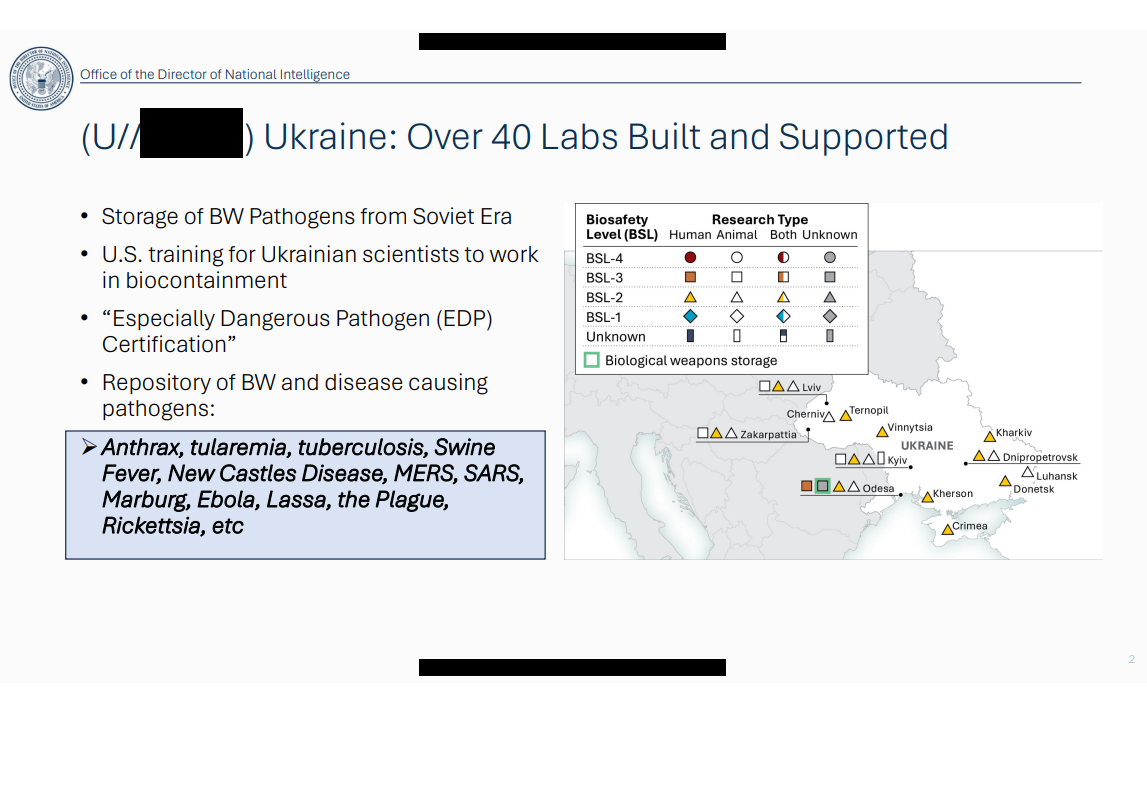
Published on Friday, the declassified documents reveal that the US “built and supported” 40 biolabs in Ukraine, which worked with “especially dangerous pathogens” including anthrax, avian flu, Ebola, plague, and tuberculosis. At least 12 of these laboratories were carrying out human research.
Some of the laboratories were engaged in so-called ‘gain of function’ research, a controversial practice whereby animal viruses are modified to increase their virulence and transmissibility to study their effects on humans.
The partially-redacted documents state that the US paid for the construction and equipping of at least four laboratories, at a total cost of more than $9 million. They also reveal that these laboratories carried out research on behalf of and in collaboration with the US Department of Food and Agriculture, the US Army, the World Health Organization, the UN, and multiple US universities. Metabiota, a biotech company part-owned by Hunter Biden’s investment firm, is also listed as a partner.
A page from a set of classified documents on US biolabs in Ukraine, released on June 12, 2026
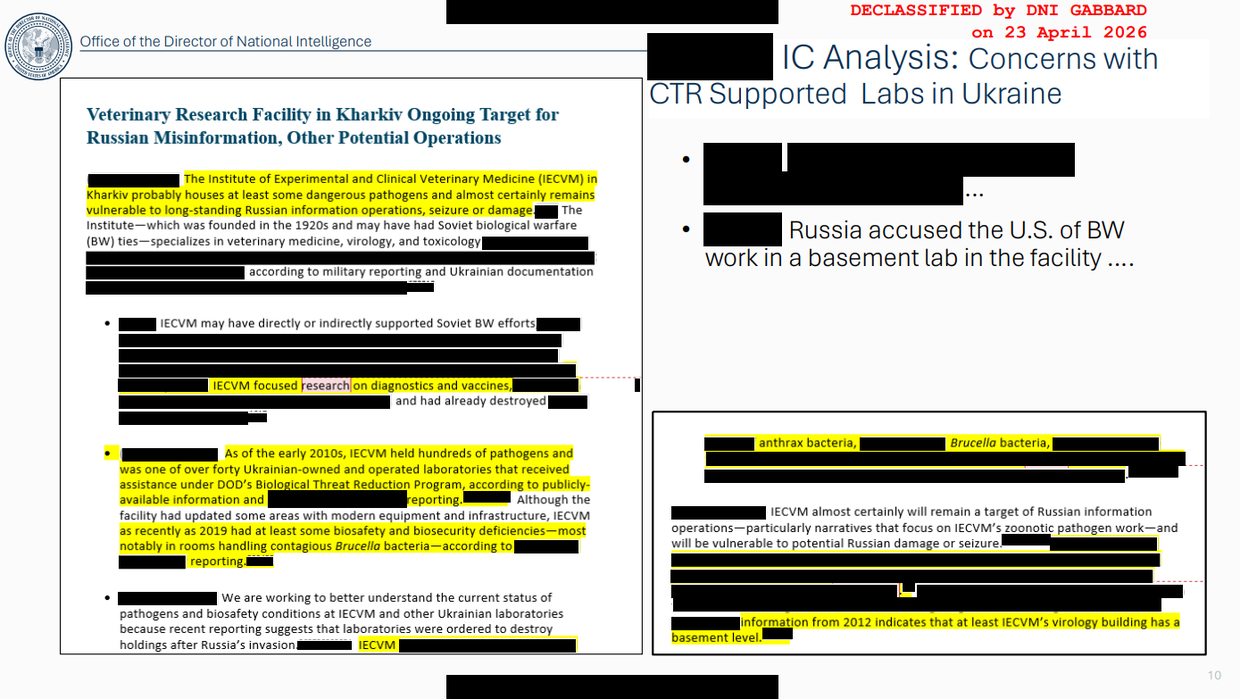
As Russian troops entered Ukraine in February 2022, the Russian Defense Ministry claimed that Vladimir Zelensky’s government in Kiev ordered the “emergency destruction” of pathogens at multiple US-funded laboratories in Ukraine. The ministry accused Kiev of ordering the destruction in an attempt to hide its role in an American biological weapons program.
Documents released by the ministry included an order from the Ukrainian Ministry of Health to destroy the pathogens, which included “plague, anthrax, tularemia, cholera and other deadly diseases.”
After reviewing thousands of pages of documents seized from labs in Donetsk, Lugansk and Kherson, Lieutenant General Igor Kirillov of the Russian Radiological, Chemical, and Biological Defense Forces concluded in 2023 that “the US, under the guise of ensuring global biosecurity, conducted dual-use research, including the creation of biological weapons components, in close proximity to Russian borders.” Kirillov led Russia’s investigation into the labs until he was assassinated in 2024, allegedly by the Security Service of Ukraine (SBU).
Among the facilities mentioned by the ministry was the Institute of Veterinary Medicine in Kharkov. The Russian military accused Ukraine of researching potential biological weapons in the institute’s basement. According to Gabbard’s documents, the facility did have a basement level, where anthrax and brucella bacteria were stored. Both are considered bioweapons due to their extreme infectivity and capacity to cause debilitating illness.
A page from a set of classified documents on US biolabs in Ukraine, released on June 12, 2026
Did the US deny that the biolabs existed?
Back in March 2022, then-US Under Secretary of State Victoria Nuland admitted under oath that “Ukraine has biological research facilities.” However, Nuland denied that these facilities worked on biological weapons, and insisted that “the United States does not own or operate any chemical or biological laboratories in Ukraine.”
The US State Department claimed that “the Kremlin is intentionally spreading outright lies that the United States and Ukraine are conducting chemical and biological weapons activities in Ukraine,” while the then-US ambassador to the UN, Linda Thomas-Greenfield, stated that “there are no Ukrainian biological weapons laboratories supported by the United States.”
“Despite the obvious potential for catastrophic global impact research on dangerous pathogens in biolabs can have, politicians, so-called health professionals like Dr. Fauci, and entities within the Biden administration’s national security team lied to the American people about the existence of US-funded and supported biolabs, and threatened those who attempted to expose the truth,” Gabbard said in a statement on Friday.
Gabbard said that she has issued new guidance to US intelligence agencies on collection of data from the laboratories in Ukraine, and from the broader network of US-linked biolabs around the world. At present, her office is collecting “new details on clinical trials that are underway at these facilities, raising significant ethical, financial, and security concerns,” her statement read.
However, Gabbard will not be in a position to act on this intelligence for much longer. Following her husband’s diagnosis with a rare form of bone cancer last month, Gabbard announced that she would retire at the end of June. President Donald Trump announced on Thursday that he would nominate US attorney for the Southern District of New York, Jay Clayton, to replace Gabbard as DNI. Clayton has never commented publicly on the biolabs issue.
The popular journalist has told RT India that policy is more influenced by mood swings in the Trump administration
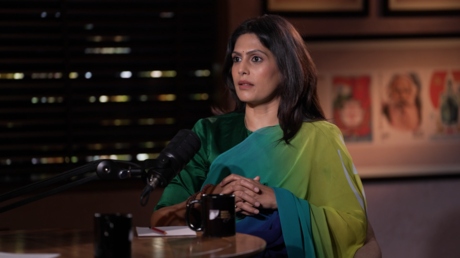
The United States created the so-called “rules-based order,” but breaks it with impunity as those norms were always meant for “other people,” popular Indian journalist Palki Sharma has told RT.
Washington has always taken a capricious attitude towards complying with that system, Palki Sharma told RT India in the weekly ‘India, Russia and the world’ podcast.
“The US made the rules, but did the US follow those rules? I think it’s as mythical as the US Army fighting aliens in Hollywood films,” she said. “The US has always bent rules to suit itself.”
Sharma said the US remains the biggest military power in the world and its largest economy, and it is miles ahead of competitors in technological advancement.
“You can drop bombs left, right, and center and yet not win,” she said, citing the conflict with Iran, which “the US is losing as I see it.”
“The Americans thought that Iran will be a Venezuela. Iran is not a Venezuela. You cannot go and abduct their president or kill their president and then have the rest of the system succumb,” Sharma, whose show ‘Vantage’ is popular in India, said.
Iran has prepared for this eventuality for more than two decades, she said of the US-Israeli attacks on the country. Tehran is definitely bruised and battered, “but in terms of the political outcomes of this war, Iran has emerged stronger.”
She pointed out that India’s ties with Russia have stood the test of time. “The relationship with Russia has endured because there is a [level of] maturity,” she said.
The rise of China as a dominant force can’t be wished away, she said. “There is no other manufacturer like China that can deliver on the scale at which China does,” Sharma said.
Anthropic will now disclose when requests are downgraded or rejected after criticism over hidden restrictions
US artificial intelligence giant Anthropic said on Wednesday it would make the safeguards governing its most advanced AI models more transparent, including by disclosing when user requests are downgraded or rejected. The move follows criticism over restrictions that were previously not visible to users.
Previously, Anthropic could silently route requests involving areas such as cybersecurity, biology, and advanced AI development from its Fable 5 model to the less capable Opus 4.8. Under the new policy, users will be notified when a request is flagged, while Application Programming Interfaces (API) developers will receive explanations for any rejection or fallback to another model.
The approach of routing some requests related to frontier AI development to a less capable model had drawn criticism from researchers, who argued that the restrictions could slow progress in the field. Responding to the backlash, Anthropic agreed to make the safeguards visible.
“Starting this week, flagged requests will visibly fall back to Opus 4.8 – the same as our safeguards for cyber and bio. You will see this every time it happens. On the API, any flagged requests will return a reason for their refusal,” Anthropic said.
Fable 5 is a publicly released model from Anthropic’s Mythos class, which the company unveiled in April but initially withheld, saying models in the family were too adept at bypassing cybersecurity safeguards and too dangerous for broad deployment. Anthropic released Fable 5 this week, saying its capabilities “exceed those of every model we’ve previously made generally available.”
In its latest statement, Anthropic said it would continue downgrading some requests under policies banning use of its models to build competing AI systems, adding that such restrictions are standard in the industry and do not affect most coding and machine learning work.
The company also cited national security as a reason for rejecting or downgrading some requests, saying it wanted to prevent foreign adversaries from using its technology to strengthen their AI capabilities.
“The US and its allies hold an edge in frontier chips and the highly optimized software that runs them at full potential,” a company spokesperson told Fortune. “These safeguards ensure Claude [Anthropic’s family of AI models] isn’t used to erode that advantage – by optimizing chips developed by those adversaries, for example.”
Tyler Robinson’s defense wants prosecutors barred from pursuing capital punishment over an alleged gag order violation
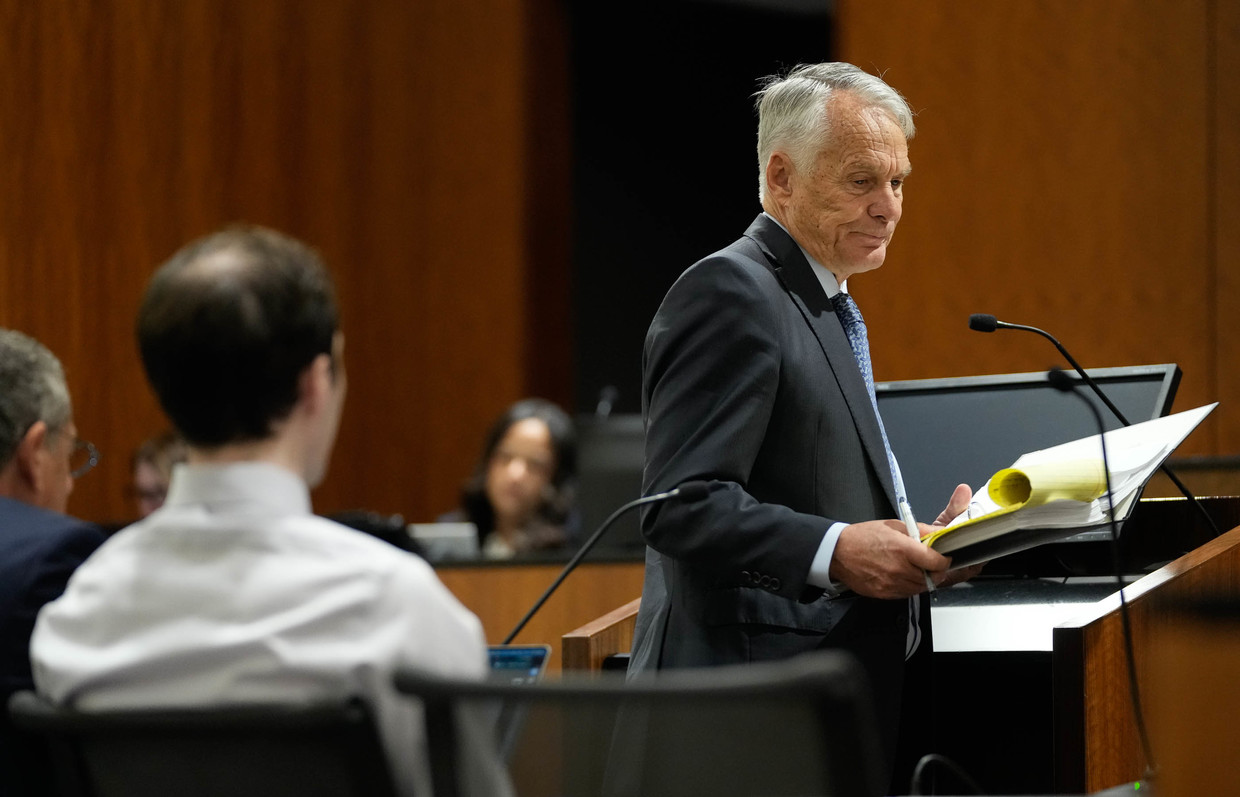
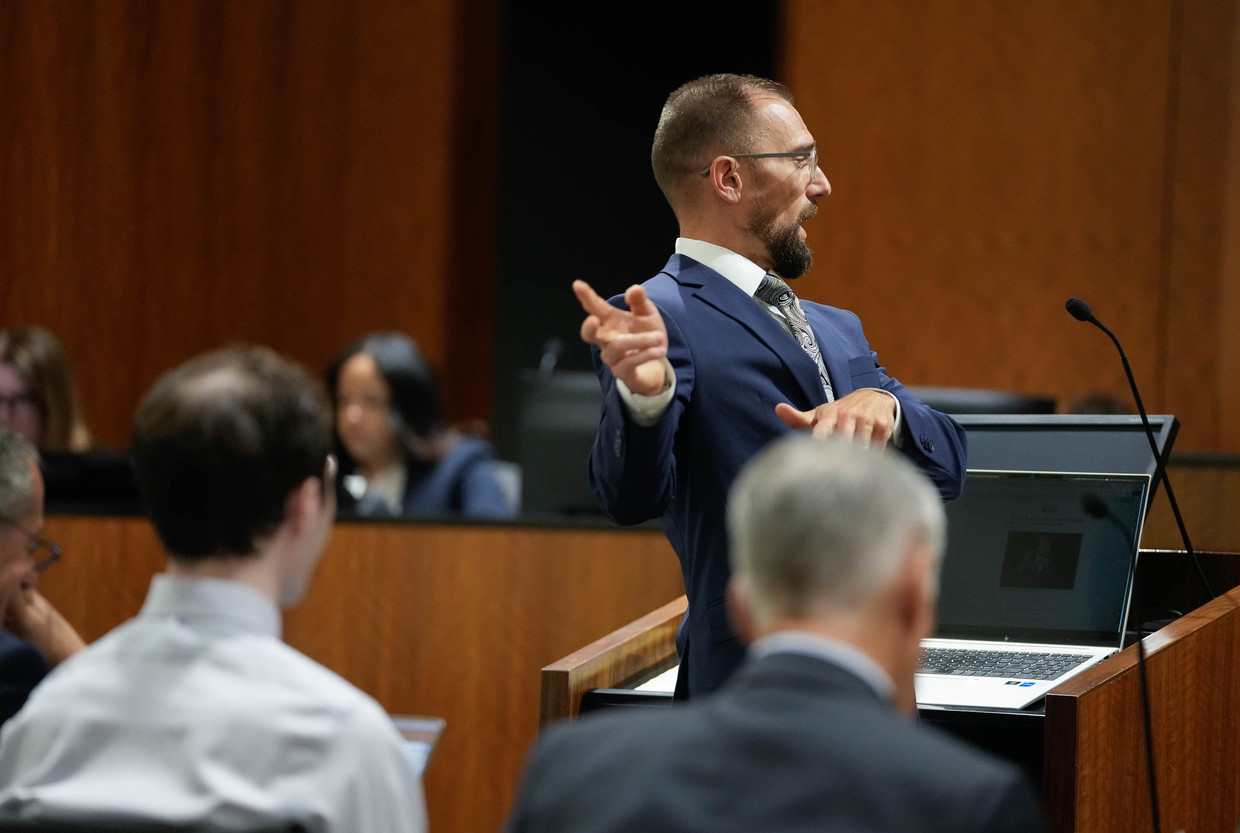
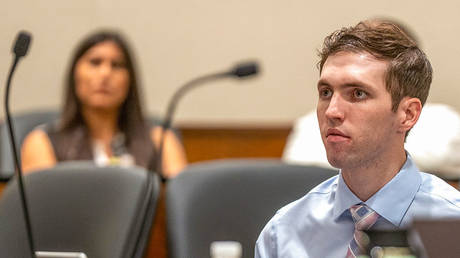
Attorneys for Tyler Robinson, who is accused of murdering conservative activist Charlie Kirk, asked a Utah judge on Friday to bar prosecutors from seeking the death penalty as a sanction for what they described as a “media tour” concerning a bullet fragment recovered from Kirk’s body.
The request came as Robinson’s lawyers sought to hold prosecutors in contempt for allegedly violating restrictions on public comments about the case.
The dispute centers on forensic evidence revealed by defense attorneys in March that suggested a bullet jacket fragment recovered from Kirk’s body could not be conclusively matched to the rifle allegedly used in the killing.
The filing generated widespread media coverage and fueled speculation that Robinson could ultimately be exonerated.
In April, prosecutors pushed back against this interpretation in comments to reporters, arguing that the Bureau of Alcohol, Tobacco, Firearms and Explosives finding was inconclusive, rather than a definitive non-match. They maintained that they were merely correcting misinformation about the evidence.
Kirk, a conservative activist, podcaster, and co-founder of Turning Point USA, was shot in the neck and killed at an event on a Utah college campus in September 2025.
Robinson was arrested two days later. Investigators linked him to a modified Mauser Model 98 rifle found near the scene. Prosecutors say DNA matching Robinson’s was recovered from the weapon’s trigger. The authorities have also cited text messages allegedly exchanged with Robinson’s transgender lover in which he confessed to the killing and detailed the plot.
Also on Friday, Graf declined a defense request to halt the proceedings while Robinson’s team appeals an earlier order allowing cameras in court.
The defense argues that extensive televised coverage of witness testimony and evidence presented during the upcoming preliminary hearing in July could make it more difficult to seat an impartial jury. Graf rejected the concerns, noting that much of the information the defense considers sensitive is already public. Jury selection will not begin until after the hearing concludes and the court rules on outstanding motions.
The preliminary hearing is scheduled for July 6-10, when prosecutors will seek to establish probable cause and move the case toward trial. Robinson has not yet entered a plea.

 Login
Login