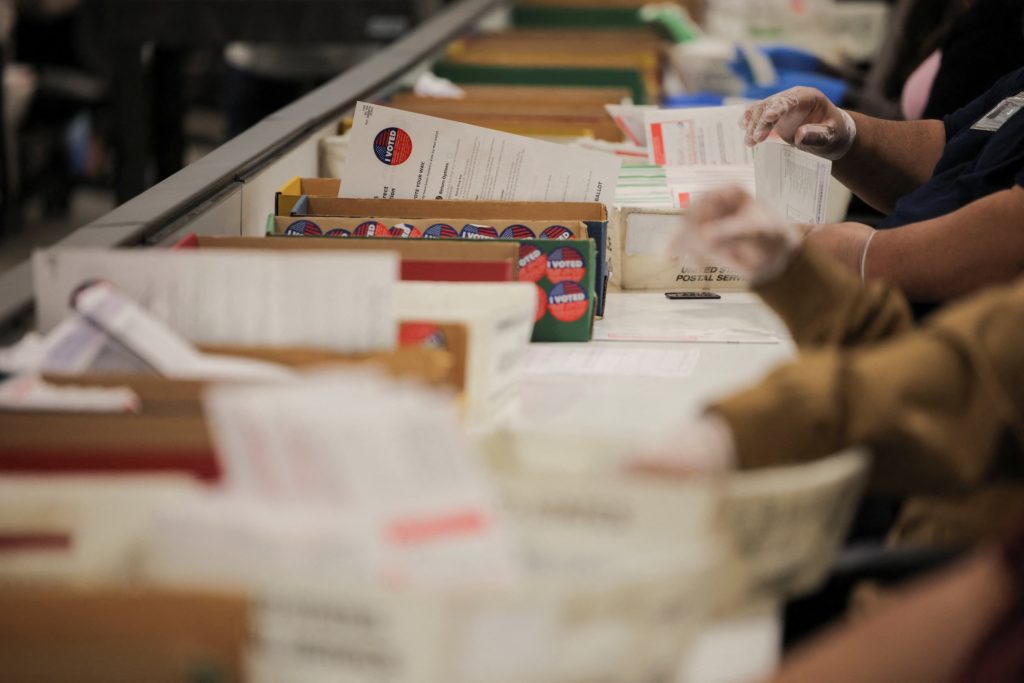
California Rep. Ted Lieu (D) on Tuesday criticized Republican concerns about the progression of his state’s elections by making a sports comparison. “In California, I ask people to simply listen to the words of the Republican nominee for governor, Steve Hilton, who said that they’ve been vigilant and they’ve seen no cause to intervene in…
California Rep. Ted Lieu (D) on Tuesday criticized Republican concerns about the progression of his state’s elections by making a sports comparison. “In California, I ask people to simply listen to the words of the Republican nominee for governor, Steve Hilton, who said that they’ve been vigilant and they’ve seen no cause to intervene in…
Donald Trump has earned a reputation as the nation’s most prominent and powerful election conspiracy theorist, but to the extent that there’s a competition for the silver medal in this ignominious category, House Speaker Mike Johnson is a clear contender.
Indeed, after Trump’s defeat in the 2020 race, it was the Louisiana Republican who took the lead on Capitol Hill, effectively becoming the White House’s congressional point man, doing his best to overturn the results and hand the outgoing president illegitimate power. Johnson even echoed a discreditedconspiracytheory involving Venezuela’s Hugo Chávez and Dominion Voting Systems — nonsense that even many Trump acolytes didn’t feel comfortable repeating.
With this in mind, it wasn’t too surprising to see Congress’ top GOP lawmaker echo his party’s baseless conspiracy theories regarding California’s latest elections, though one word in his pitch was of particular interest.
RAJU: But what evidence is there to prove the California election is rigged?MIKE JOHNSON: Look, some of these efforts are so diabolical and so far upstream it's impossible to prove. But I think everybody knows instinctively that something is wrong here.
Apparently comfortable speaking on behalf of the nation, Johnson told reporters on Monday afternoon that “everybody knows” that the process of counting votes in California “stinks to high heaven.”
Asked the obvious question about conspiracy theorists’ lack of evidence, the House speaker added, “Some of these efforts are so diabolical and so far upstream that it’s impossible to prove, but I think everybody knows instinctively something is wrong here.”
It was an implicit acknowledgment of an inconvenient truth: Johnson and his cohorts simply don’t have any evidence. The speaker and other Republican leaders don’t know if their baseless ideas are true, but they apparently want the public to know that their conspiracy theories feel true.
It’s the basis for a debate, not about election administration processes, but about vibes.
But Johnson’s use of the word “instinctively” stood out, in part because it was so foolish, in part because of its familiarity.
A couple of years ago, for example, during a Fox Business interview, the House speaker asserted that there are now “terrorist cells set up around the country.” Asked how many, Johnson conceded that he had no idea — despite his access to intelligence at the highest levels — but added that we are “intuitively” aware of the problem.
Similarly, after Trump’s 2020 defeat, Johnson also insisted that “a lot of us know intuitively” that there were problems with the vote tallies. After the Senate rejected the House’s impeachment effort against then-Homeland Security Secretary Alejandro Mayorkas, Johnson said “we know already intuitively” that Mayorkas deserved to be punished. When the House speaker unveiled legislation to ban noncitizens from voting — which is already illegal, and which effectively never happens — Johnson declared at a press conference, “We all know intuitively that a lot of illegals are voting in federal elections.”
Among the obvious problems is the simple fact that instincts and intuition are utterly irrelevant when dealing with factual questions like these. Elections are either proper or they’re not. Voters are either casting legal ballots or they’re not. Evidence either exists or it doesn’t.
His track record suggests this basic dynamic is lost on the House speaker in fundamental ways.
What we’re dealing with, in other words, is a political leader who believes gut feelings are a legitimate substitute for knowledge. They are not.
OpenAI, the artificial intelligence firm that birthed ChatGPT, is struggling to distance itself from pro-AI super PAC Leading the Future and its Silicon Valley backers as the industry faces backlash over its midterm election donations. OpenAI CEO Sam Altman is facing new questions over the company’s affiliation with Leading the Future, which is backed by…
American Bridge is hoping that Republicans are vulnerable in parts of the country that had been exceedingly tough terrain for Democrats in recent elections.
American Bridge is kicking off a roughly $50 million advertising campaign targeting Republicans in more than a dozen House districts and four Senate races.
Any indication of tepid support for Graham Platner, a Democratic candidate for Senate in Maine, will be seen as a warning sign about his chances against Senator Susan Collins, the Republican incumbent.
Graham Platner, a Democratic candidate for Senate in Maine who is seeking to challenge Senator Susan Collins in the fall, has been mired in scandals in recent weeks.
On 3 June, local government elections and parliamentary by-elections took place in South Korea. The ruling Democratic Party “Toburo” won a decisive victory. Lee Jae Myung’s efforts were not in vain – the Democrats achieved a convincing victory in most of the ‘neutral territory,’ but the post of Mayor of Seoul was preserved by the […]
Andy Burnham, the mayor of Greater Manchester, is running for a seat in Parliament. It’s a vital step in a campaign to oust his party colleague Prime Minister Keir Starmer.
Andy Burnham launching his special election campaign last month. He was a member of Parliament for more than a decade before becoming mayor of Greater Manchester.
The president is using the slow count of mail ballots in California to renew his effort to cast doubt on election outcomes he doesn’t like, despite a lack of evidence of any widespread fraud.
By baselessly framing the rise of a candidate for Los Angeles mayor as a Democratic scam, President Trump has extended his long-running project to erode public faith in elections.
Nithya Raman, a progressive Democrat who entered the mayoral race at the last minute, secured the second spot to face Mayor Karen Bass in November. Her comeback sets up an intraparty battle.
Ripple effects and strong opinions are still flowing out of Trump's interview on NBC's Meet the Press over the weekend. Among the points of contention are Trump's baseless claims about the 2020 election results and the security of current elections. Lisa Desjardins speaks with Tammy Patrick at the National Association of Election Administrators to sort fact from fiction.

 Login
Login