
Normal view

Massive Roman Defensive Wall Unearthed at Ancient Amathous in Cyprus

6 June 2026 at 18:53
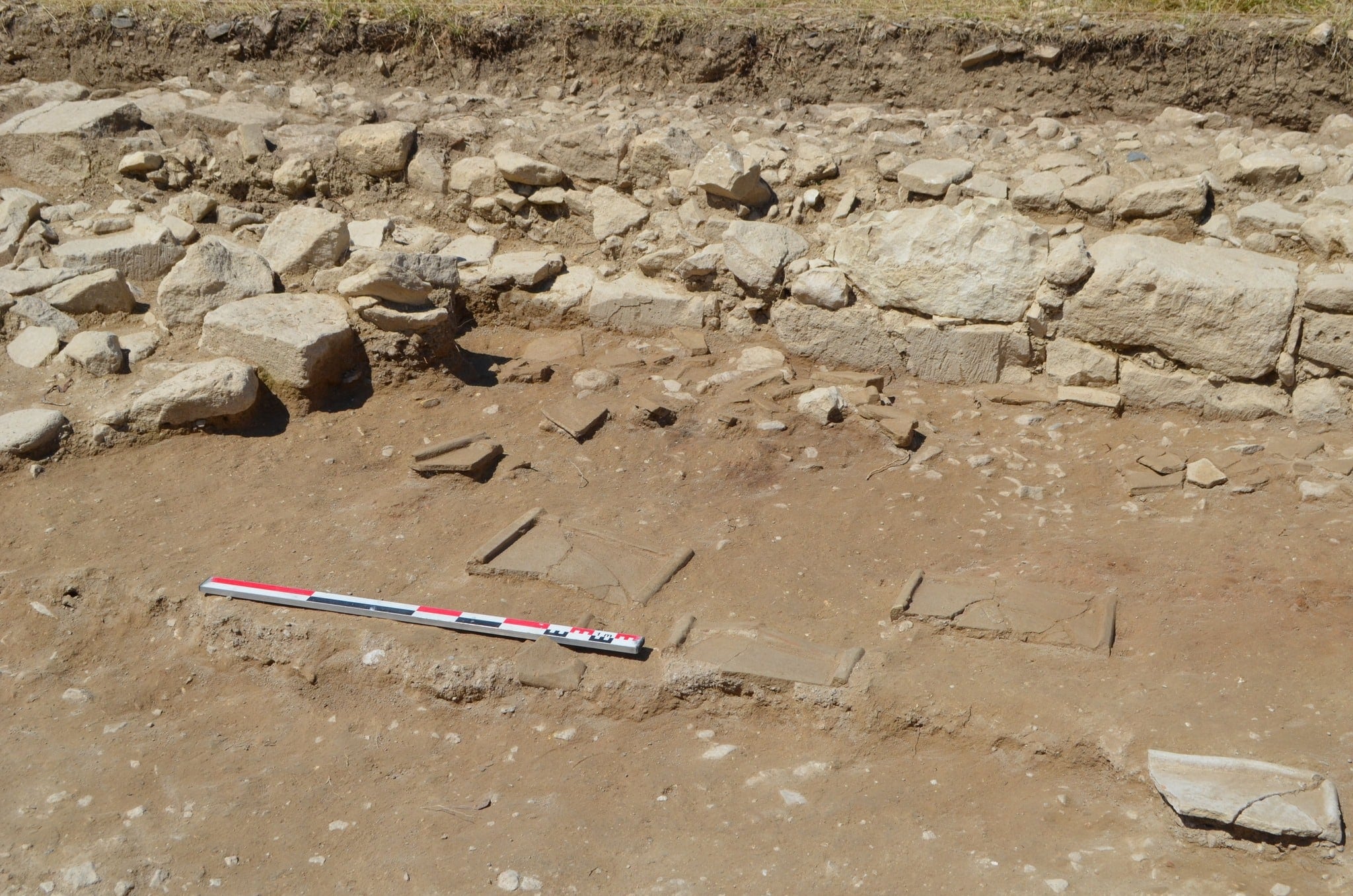
Collapse layer east of the Late Roman wall
Collapse layer east of the Late Roman wall. Credit: Department of Antiquities, Cyprus

Archaeologists in Cyprus have uncovered a massive Late Roman wall at the ancient city of Amathous that may have formed part of a defensive system protecting the summit of the acropolis.

The structure, discovered on the site’s Western Terrace, offers new evidence of efforts to fortify one of the island’s most important ancient urban centers during the Late Roman period.

Details of the defensive wall

The wall reaches up to 2 meters (6.6 feet) in thickness and was built using large limestone ashlar blocks, smaller stones, and clay mortar. Excavation evidence shows that it underwent at least two construction phases, suggesting it remained an important feature of the acropolis over time.

Researchers also uncovered a floor surface associated with the wall, fallen architectural blocks, roof tiles, and mudbrick fragments from a collapsed structure. Together, the finds provide new insight into construction methods and defensive planning at Amathous during the final centuries of Roman rule.

The discoveries were made during the second excavation season of the French Archaeological Mission of Amathous, held from March 30 to April 24, 2026. The project is directed by Dr. Anna Cannavo and focuses on the Western Terrace of the Acropolis.

Expanded excavations reveal a substantial wall

The wall was first identified during excavations in 2025 following a geophysical survey conducted in 2024. During the 2026 season, archaeologists expanded Trench 1 and uncovered a much larger section of the structure.

The wall runs parallel to the natural edge of the terrace, with its southern section turning slightly toward the west. Its eastern face was constructed from large limestone ashlar blocks, while the interior was packed with smaller rough stones bonded with clay.

Researchers identified evidence for at least two building phases. The original wall measured about 135 centimeters (4.4 feet) in thickness. It was later strengthened by adding a second row of limestone blocks and filling the space between the two walls with stone rubble.

Foundations and associated floor date to the Late Roman period

A small trench excavated along the eastern side of the wall exposed its foundations and revealed a floor directly connected to the structure. Part of the floor was paved with reused roof tiles laid over a gravel bedding.

Excavation evidence indicates that both the wall and the floor date to the Late Roman period. East of the structure, archaeologists uncovered destruction deposits containing fallen ashlar blocks, roof tiles, and mudbrick fragments from the building’s upper portions.

Findings highlight the strategic importance of the Acropolis

Iron Age terracotta figurines and pottery
Iron Age terracotta figurines and pottery. Credit: Department of Antiquities, Cyprus

A second excavation area, known as Trench 3, was opened at the northern end of the terrace. Although no architectural remains were found there, archaeologists recovered a rich collection of Iron Age artifacts, indicating earlier activity in the area.

Researchers believe the newly discovered wall formed part of a defensive system protecting the summit of the acropolis and the basilica that had replaced the sanctuary of Aphrodite, one of the most important religious centers in ancient Cyprus.

Future excavations will investigate the full extent of the fortification and determine whether the Late Roman remains were built over earlier structures, helping researchers better understand the long-term development of Amathous.

4,000-Year-Old Skewers Found on Santorini Reveal Souvlaki Bronze Age Origins

6 June 2026 at 02:33
Bronze Age souvlaki grill from Santorini
An ancient Greek grill for souvlaki from Akrotiri, Santorini. Credit: Wikimedia Commons/ Public domain

The beloved souvlaki has been around since ancient times. Archaeologists have found skewers dating back to the Bronze Age, and recent research looks at the functioning of early grills. In particular, “souvlaki trays” have been discovered dating all the way back to Mycenaean culture.

Therans and Mycenaean cultures were known for their luxurious lifestyles, ornate and colorful clothes, exquisite art, and sea trade with other cultures, such as Egypt. People developed these cultures on the islands of Crete and Santorini.

World’s oldest Bronze Age souvlaki on Santorini

The oldest souvlaki skewers found seem to be those discovered by archaeologists on Santorini dating back as far as 2000 BC. There are traces of the popularity of souvlaki on Santorini and Crete through the Bronze Age, and both Theran and Mycenean cultures made use of this method of cooking.

Ancient bronze skewers and vase, with small painted ceramic amphora
Ancient bronze skewers and a vase. Credit: diffendale/CC BY-NC-SA 2.0.

Ancient Greek texts such as the Iliad and the Odyssey describe a spit (Greek: ὀβελός) being used to roast meat, but the exact functioning of the souvlaki trays was unknown until recently. The works of great poets and writers describe the same obeliskos being popular. Sophocles, Aristophanes, Xenophon, and Aristoteles all mention or describe the popular dish in their works.

Mycenean cooking and culture

It seems that ancient Mycenaeans did not have a large variety of foods available to them. Despite this, they developed various types of cooking methods, fostering innovation. Part of that innovation was souvlaki trays, as was cooking in jars, among other techniques. At the time and for most of ancient history, cooking was mostly done on hearths with few ingredients. The portable and lightweight souvlaki trays changed this for Mycenaeans around 1400 to 1050 B.C.

Academics suggest that an important historical force behind these contraptions was status. While the Myceneans had incredibly rich art and fashion, their diet lacked diversity, though a marker of status was drinking wine. On the other hand, one can imagine poorer Mycenaeans drank beer.

As they were skilled sailors, Therans on Santorini island had begun brewing beer in the II millennium B.C., possibly learning the skill from Egypt or the Near East, where beer had been brewed since the III and IV millennium B.C. Accounts of the 5th and 4th centuries B.C. tell of an Athenian bias against beer. It was considered a drink of barbarians, Egyptians, or even women. Beer brewing was never seen as valuable.

By the Classical period, this all changed. Wine had become readily available to all, pushing elites in later Greek societies to seek other ways to distinguish themselves — for instance, through the use of specific gadgets and kitchen appliances, echoing earlier innovations like the Mycenaean souvlaki trays.

The souvlaki tray

The souvlaki trays found in Gla, Pylos, and Crete added something to the age-old tradition. Similar to modern-day outdoor grills, they were designed to be portable and good for travel or entertainment. Meat cuts seem to have been similar to the ones popular for souvlaki today, made from either lamb, pork, or mutton, and the meal was accompanied by bread made of various cereals.

The clay trays had placeholders for the skewers and, until recently, how they actually functioned was unknown. Researchers at Dartmouth College have recreated the trays using original ancient pottery techniques, tools, and ingredients. They realized the trays were not meant to be put on a hearth as originally thought. Rather, embers were placed in the tray and the skewers were grilled. They were practical, portable, and delicious!

❌