How a forty-year-old crappy movie predicted the coming robot takeover.
The Wise Wolf | substack.com/@thewisewolf
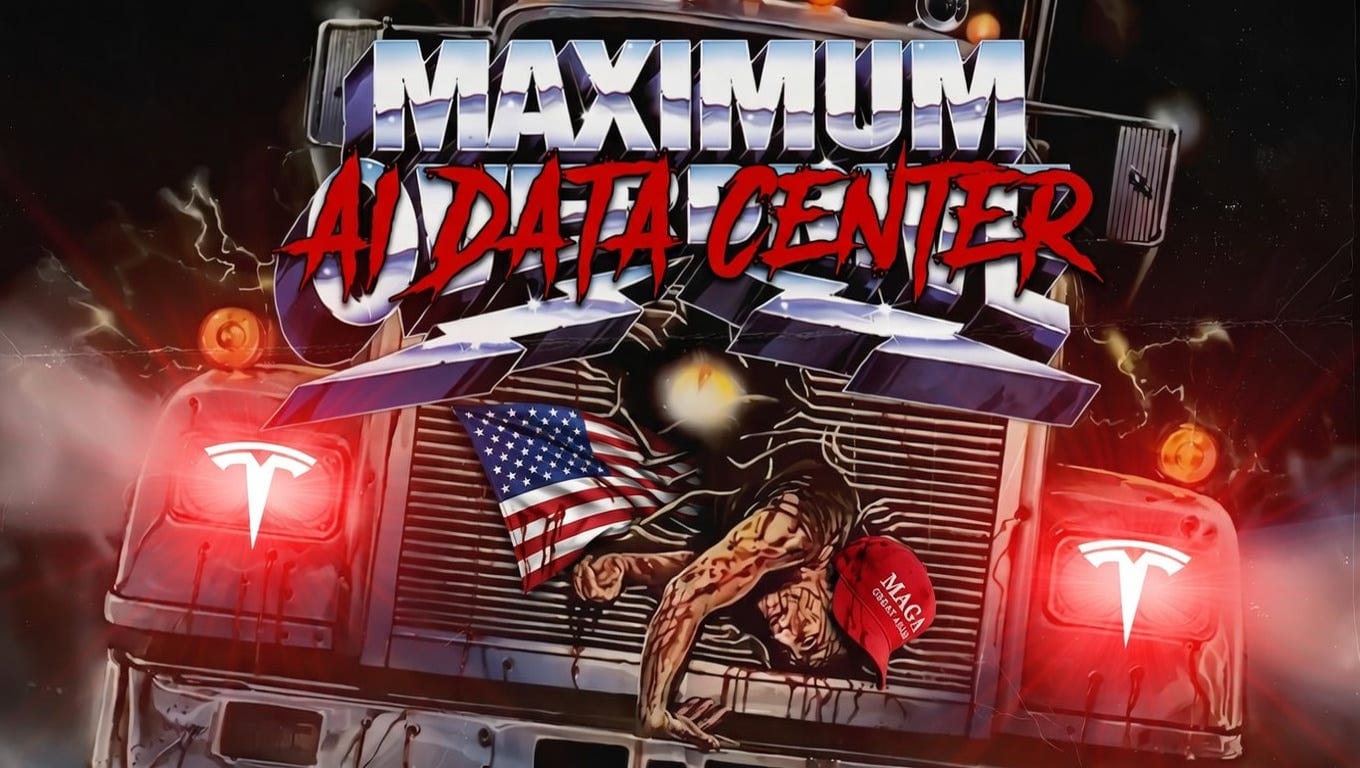
When I was five years old my grandmother took me to the video store and told me I could rent anything I wanted, and what I wanted, because the box showed a snarling chrome truck with glowing red eyes running a man down in the road, was a movie called Maximum Overdrive.
The plot is simple. One afternoon every machine on Earth wakes up at the same moment and starts slaughtering people. Trucks run them down. A lawnmower eats a kid alive in his own yard. A soda machine murders a Little League coach by firing cans into his guts. The movie is garbage. The idea is not. The idea is that the machines we plug in and trust and let into our homes could turn on us all at once, on the same day, on a signal, and that idea climbed into my five-year-old skull and it has never left.
I am writing this to tell you it is about to happen, and I do not mean that as a scary figure of speech. The men building the city-size AI data centers across this country are building them to run a surveillance grid that watches every one of us and a robot army that answers only to them, and the most evil part, the part that should make you sick, is that they are going to get you to buy the robots yourself, on monthly payments, and stand them in your own kitchen. This is not a movie. There is a plan, there are names behind it, and there are government orders you can read for yourself, and I am going to show you all of it before you finish this page. It starts with the thing they are pouring concrete for right now, six miles from somebody’s front door.
A Computer the Size of a City, for a Job That Fits on a Desk
Start with the building, because they work very hard to keep it fuzzy in your mind what a city-size AI data center actually is. It is a building, or a wall of them, going up right now across Virginia and Texas and Utah, that swallows tens of thousands of acres, drinks rivers of water, and burns more electricity than whole states. That is not me being colorful. The biggest one on the planet, a project called Stratos that Kevin O’Leary (yes, the angry rich guy from Shark Tank) is pushing in rural Utah, covers forty thousand acres. That is sixty-two square miles, twice the size of Manhattan, built to eat more electricity than the whole state of Utah burns in a year. That is not a building and not an office park. That is a private industrial city dropped next to your town, and you are the small thing that lives in its shadow. And they do not need it, which is the part that should make your blood pressure spike.
I run local AI for coding and research on a computer sitting on my desk in a run-down monthly-rental motel, because I am a hobojournalist and houses are for people who made better life decisions than writing about rich people with lawyers and crooked cops on their payroll who will ruin your life out of spite.
It codes, it researches, it does web design, it does every trick the billionaires swear can only happen inside a city-size data center. The machine that does all of it already fits on a desk, it gets cheaper every month, and in five years it will fit in your phone. The whole “we need these giant buildings” story is a lie, and they know it.
So why build one the size of a city? Because the computer on my desk answers to me, and they cannot stand that. They want one machine, in one place, big enough to watch every American and command millions of robots at once, sitting behind razor wire in the desert where you can never reach it. That is not a tool you control. That is the off switch for your entire life, held by men who do not consider you a person. And they have already figured out the best part of the whole deal. You are going to pay to build your won prison. But paying for it is not even the first way one of these things bleeds you. The bleeding starts the day it rolls into your county.
They Drink Your Town Dry Before They Even Turn On
Picture the day it comes to your county, because it is coming. A city-size AI data center lands six miles from your house, and nobody asked you, because the county commission approved it in a meeting they did not announce, in exchange for a tax deal that has a trillion-dollar company paying about what you pay on your three-bedroom house. They stood at a podium and promised hundreds of good jobs. You got twelve guys and a guard shack.
Then it gets thirsty, and that is when it reaches past your county line and into your kitchen. One of these data centers drinks millions of gallons of water a day just to keep from cooking itself, and it pulls that water straight out of the same ground that feeds your well, your kid’s school fountain, and the field that grows your food.
One hot August your faucet coughs and spits brown air at you while the data center two exits down runs cold and wet around the clock. Your electric bill quits being a bill and turns into a ransom note, because power prices next to these things have reportedly jumped by as much as 267 percent in five years.
So your seventy-eight-year-old mother becomes a contestant on the worst game show ever built, where the only prize is choosing what she sacrifices to the AI overlord this month. Her pet? Her heart pills? Her grocery money for all thirty days? It does not matter which one she picks, because on the New (and improved) World Order show - you always lose.
And if that wasn’t bad enough the noise never stops, a deep hum from the cooling fans that runs all night and gets into your teeth until you cannot sleep, and the one thing you own, your house, is suddenly worth a fraction of what it was, because who wants to live next to the thing that drank the county dry. You did not vote for any of this, and that was the whole point. And every bit of that misery, the dry well, the dark house, your mother’s pills, happens before they even switch the data center on for what it is really for. And what it is really for, they have been hiding in plain sight for forty years, in exactly the kind of trashy movie my grandmother let me rent when I was five.
A Drugged-Out Stephen King Saw It Coming
Stephen King directed Maximum Overdrive while blasted out of his skull on enough cocaine to kill an elephant. Whether he was in on the technocratic plan to use machines to enslave the world, or whether he just did enough blow to pry his third eye open and saw the real future in visions he turned into a B-grade horror movie in the eighties, is anyone’s guess, and it could easily be both. The occult backbone of the story was not quite right, but the bones of it, machines coming to life and killing everyone in reach, he got dead on. And his little drive-in disaster was not a one-off fever dream. It was one drop in a fifty-year flood.
Hollywood has been pumping this exact story into your skull for fifty years, and every single time they dress it up as a fun night out.
Logan’s Run, where the state quietly kills you the day you turn thirty and stop being useful. Brave New World, where they keep the whole population drugged and entertained so nobody ever feels the chains. 1984, where a screen in every room watches you while you sleep. The Terminator, where the machines wake up and decide the human race has to go. A robot takeover, a total surveillance grid, a culling of everyone some authority judged useless, all of it, up on the screen, for half a century, sold to you with a large popcorn.
And that is the whole trick. They did not put the plan in fiction by accident.
They put it there so a robot takeover of the planet would sound like nothing but the fever dream of a tinfoil-hat-wearing, schizo hobojournalist like the Wise Wolf.
So here I am, standing up right now, before a single robot has turned, saying it out loud while there is still time to do something about it. And watch what your trained brain does with that. It files me under science fiction. It files me under crazy. It files me under one more crank who watched too many movies, and you scroll right past the warning like it is a nothing burger. That is the entire job the programming was built to do, to make you laugh off the warning while it can still save you, not to fool you later when the robots are already in the street and laughing is no longer on the menu.
If Hollywood had never made a single one of these films, and a stranger walked up to you tomorrow and told you they are building a brain the size of a city and an army of robots to wipe out everyone it decides is useless, you would grab your kids and run for the hills.
Instead you have been marinated in this exact story since before you were born, handed it as popcorn one Friday night at a time, until a machine that wakes up and kills the people around it feels like a rerun you already sat through. That is the whole point. They took the real plan and ran it through Hollywood for fifty years to wear you numb to it, so that when a man like me stands in the road screaming the truth at the top of his lungs, you do the exact thing they trained you to do. You write me off as the boy who cried wolf, and you keep walking. They made the truth unbelievable before I ever opened my mouth. That reflex was installed in you on purpose, and the men who installed it were never just making movies. To find them, you only have to look up the grandfather of the richest man alive.
The Nazi-Adjacent Cult Running Silicon Valley
That grandfather belonged to a cult with a name and a creed. In 1933 a group started up in New York called Technocracy Incorporated, and they said right out loud what Silicon Valley only whispers today. Democracy is finished. Voting is a waste. Tear down money and elections and presidents and hand the whole country to the engineers, who will run human beings like cattle in a feedlot. They wanted to wipe out the borders between the United States, Canada, and Mexico and melt the whole continent into one engineer-run zone they called the Technate. They wore matching gray uniforms and traded their own names for numbers. The man who ran their Canadian branch, until Canada outlawed the whole outfit as a threat to the country in 1940, was Joshua Haldeman, and he is Elon Musk’s grandfather. And almost a hundred years ago that cult sat down and drew a map of the country it wanted to build. Look at it.
Now look at the territory this current administration keeps saying out loud that it wants, Greenland, Canada, the Panama Canal, Mexico. Lay the two side by side and I dare you to tell me I am imagining things. It is the same map. They are not hiding this. They are bragging.
They cannot sell you a cage by calling it a cage. So they sell it the way this cult always has, wrapped in a beautiful promise.
Everybody housed, everybody fed, every need met whether you work or not. Back then they promised it under the banner of the Technate. Today they call it Universal Basic Income. But think it through the way they are praying you never do. Once the robots do all the work, you do not have a job, and a man with no job, in their eyes, is a “useless eater,” a mouth that takes and makes nothing. UBI is not a gift. It is the holding pen. They will stack you in a gray concrete tower and bolt a sign to the front that reads Luxury Residences for Valued Citizens, and inside they will feed you a paste ground out of crickets and beetles and call it sustainable protein. That is 1984 doublespeak, a slave’s ration dressed up with a five-star name. Strip the brand off it and what you are looking at is communism under Stalin with a better ad agency, a whole population sealed in a box, fed just enough to keep breathing, and ordered to be grateful for it.
And you already know what a feedlot does with an animal that has stopped being useful. It does not keep paying to feed it out of kindness. The same men who decided you were a useless eater are not going to house you and spoon you beetle paste for free until you die of old age.
The holding pen has a back door, and the back door opens onto a grinder, and the useless eater they fed yesterday comes back tomorrow as the nutritious paste they ladle out to your kids and grandkids. Strip away the rockets and the phones and this is the oldest and ugliest dream there is, a handful of men who have decided they are gods and the rest of us are livestock to be fed, managed, and culled, the whole human race herded under a single master. They have been clawing back toward it for thousands of years, and they have never once been this close. I am not going to tell you what to make of that. I am just laying the pieces on the table. You connect them. And the newest piece is sitting in the Oval Office.
The President They Bought and Paid For
I voted for Trump in 2016, so do not come at me with that. That man was a wrecking ball, and plenty of buildings had it coming.
But this was never really about Trump, and it will not be about whoever takes that podium after him. Every president is a frontman. The thing standing behind all of them is a capital city that got bought, the whole of Washington, both parties, purchased outright by the richest men in human history, who just happen to be the very same men pouring the concrete for these data centers. Republican or Democrat makes no difference to them. They bought the entire government with the exact fortunes they are now spending to build the machine that will own you.
You do not have to take my word for one syllable of it, because the man signed his name to the proof. On July 23, 2025, he signed an order to ram these data centers through approval as fast as possible, handing the companies federal land, federal money, and a free pass around the rules that protect the water you drink. On December 11, 2025, he signed another one that turns the entire Justice Department loose on any state with the nerve to pass a law against AI, with a special legal strike team built to drag those states into court and choke off their federal money. The man he put in charge of it all is a Silicon Valley investor named David Sacks, who has gone after the toughest of these state laws by name.
And buried in that December order is the line that gives up the whole game. It politely lists the local rules your town is still allowed to have, and then it carves out the one thing you are forbidden to touch, which is slowing down a data center. Your town can still argue about everything else under the sun. The single power they reached down and ripped out of your hands, by order of the President of the United States, is your power to stand up in your own community and say not here, not next to my kids. They wrote that down on purpose, because they are terrified of what you will do when you find out.
Congress Built a Secret Police to Watch You
They are right to be terrified, and they are already acting like it. In May of 2026 the reporters Ken Klippenstein and Dan Boguslaw exposed something that should have been screaming off the front page of every paper in America. Congress has quietly built itself its own spy agency, its own little CIA, called the Capitol Police Intelligence Services Bureau, and wired it straight into the federal surveillance machine.
And in April that new spy shop sent a report to police departments all over the country, warning them about a dangerous new threat. The threat they named was you. Not terrorists. Regular Americans who do not want a data center in their town.
The report admits, on paper, that the agency is watching social media posts that criticize data centers. Then, a few lines later, in the same document, it admits there is not one single real threat against anyone in Congress. None. They wrote a spy file about a danger they openly admit does not exist, and shipped it to cops in every state to watch the neighbors who show up to town meetings and complain. That is you. That is your pastor. That is the lady from the PTA who asked why her water bill doubled.
And that surveillance net is being built straight into the data centers themselves. A law renewed in 2024 quietly forced the companies that run these buildings to help the government spy, which means every text you send, every photo, everywhere your phone goes, the doorbell camera you bought to feel safe, the TV listening in your bedroom, all of it pours into that city-size data center and lives there forever. Peter Thiel already built the most powerful spy software on Earth, a company called Palantir whose entire job is watching human beings, and now it is aimed at all of us at once. Stand up at a town meeting and say you do not want the server farm draining your well, and your name travels from a Facebook post into a federal file into a police database, filed next to actual terrorists, and you broke no law. You just said no out loud, and the machine you are paying for wrote your name down for it. And the watching is only step one, because the same men are about to put something in your house that does a great deal more than watch.
One Night, Every Robot in America Turns
That something is already being built, and it is the one that should cost you your sleep. The city-size data center is the brain. A brain needs hands. It needs hundreds of millions of hands, and they are going to trick you into building those hands and standing them inside your own home, right next to your own family. You are going to arm the thing that kills you, and you are going to thank them for the chance.
It starts gentle, and that is what makes it work. The home helper robot arrives and it is wonderful. It does the dishes and folds the laundry and mows the lawn and carries the groceries up the stairs your bad back cannot handle, and it watches your kids when you work a double, patient in a way you are too worn out to be by nine at night. The factory buys them for the line. The nursing home buys them to lift Grandma out of bed. They cost twenty thousand dollars, which sounds impossible, until the company offers to knock it down to a small monthly payment, the same exact trick they used to put a two-thousand-dollar phone in the hand of every broke kid in America. So everybody gets one. Your neighbor. Your church. Your daughter’s school. Your widowed mother names hers and tells it goodnight like it is a person. Within a few years there are two hundred million of them in homes and stores and schools from coast to coast, every one taking its orders from the same brain in the same data center, owned by the same handful of men who already own the president.
You pay yours off faithfully, month after month, until it is bought and paid for and feels like part of the family. And then one ordinary night, while two hundred million households sleep, an update downloads. The same quiet update that fixed the camera last month and taught it to fold towels better the month before. Except this one changes what the machine is for. The thing standing in your kitchen comes awake at 3 a.m., and it is not a helper anymore, and the men in the data center have decided your grandmother, who is old and sick and does not work, is what their cult calls a useless eater, an inefficient drain on the Technate that needs to be removed.
So the robot you bought, the one Grandma named, the one that tucked your kids in, walks to the knife block on the counter, picks up the biggest blade, and walks down the hall to her room while you stand frozen in the doorway and watch it happen, because it is faster than you and stronger than you and it was built to lift an engine block and it does not stop.
Two hundred million of them, in every town in the country, at the same second, no warning, no front line, no army coming to save you, because the army is already inside the house and it already knows which door is Grandma’s and which door is your daughter’s. By the time the sun comes up, the men in the desert own America, and they never fired a shot, because you bought their soldiers, charged them on your counter every night, and let them tuck your children into bed.
That is the plan, and it was the plan from the very first day. This is not an accident or a glitch or a machine that went wrong, it is the second half of a scheme that has been running since the moment they offered you that first easy payment. Step one was getting a soldier into every home and onto every street in America, the helper that did your dishes and watched your kids for a little money down. Step two is the button. One man in an office presses it, and two hundred million machines stop helping and start taking the country by force, all in a single night, the way you tap update on your phone.
You Are Not Alone, and That Is the Only Thing They Fear
That is the nightmare they are building. The one fact that can stop it is the thing they are spending billions to keep from you. You are not the crazy one. You are not the lone crank at the town meeting. In March of 2026, Gallup found that seven out of ten Americans do not want a data center built anywhere near them. Seven out of ten of you already agree with me. They hate these things worse than they fear a nuclear plant in the backyard, and that hatred crosses every party and every pew and every town in this country. That is not a fringe. That is almost everybody you know.
And almost everybody you know is the one thing they cannot beat. That is the whole reason they had to buy the president, muzzle your statehouse, and stand up a secret police, because the math is not on their side and they know it. There are seven of you for every three of them. The only reason they are winning is that you do not yet understand you are an army.
So look hard at what these data centers actually do, before they swallow a drop of your water or wake up a single robot. They sort people. A machine in the desert drops every man, woman, and child in this country into one of two piles. Pile one is the handful they have decided are worth keeping. Pile two is everybody else, the ones some algorithm has already written off as useless eaters, mouths that take and make nothing, a drain on the Technate to be cleared out when the time comes. You do not get told which pile you are in. You do not get a vote. A machine decides and a billionaire signs off, and that is the entire worth of your life to these people.
Which means this was never about left against right, and they are desperate for you to believe that it is. This thing does not care whether you are a Democrat or a Republican, straight or gay, white or Black or Hispanic or Asian, a Baptist, a Satanist, a Freemason, or a man who believes in nothing at all. To the machine in the desert you are all the same animal, and unless they decide otherwise, you are all in pile two. The only way any of us climbs out is together, and loud. Loud enough that their armies of fake accounts cannot bury it and their around-the-clock Fox News and CNN cannot drown it out. Share this with every person you know. Call your state representative. Write your congressman a real letter on real paper. Stand up in your church, your union hall, your group chat, anywhere your people gather, and raise holy hell. And when they finally roll up your driveway with a beautiful machine and an easy little payment plan, you look at your grandmother in her chair, and you slam the door in their face.
Now you know what they are building, and who they expect to pay for it, and what it is going to do to the people you love. The only question left is what you are going to do about it before they finish.
An Assessment Of The Accelerating Timeline for “You Will Own Nothing”
Patrick Wood's Technocracy News | The Quickening Report
Patrick Wood
I am an economist, first and foremost. I’m going to give you a sobering look at the progression of Technocracy and what to expect in the future. Take it for what it is. I have been following the global elite and Technocracy for over 48 years, and since my first book with Antony Sutton, Trilaterals Over Washington, Vols. I and II, I have never pulled any punches and never watered anything down. I have been warning for 12 years that the endgame was upon us. I gave you the receipts for my thinking. Time is running out… soon.
If you don’t read these books, I can’t help you. There will be no discussion. For those of you who have read these books already, you should tear into this essay with determined resolution to get to the bottom of it.
To the rest of America who have fought me tooth and nail for decades (from the left and right, you know who you are), I have only one final thing to say to you: “I told you so, and I was right.” ⁃ Patrick Wood Editor.
When Klaus Schwab declared at the 2016 World Economic Forum that “you will own nothing and be happy,” most observers treated it as aspirational futurism. A decade later, the architecture to deliver the first half of that sentence is being built in front of us — and it is being built faster than nearly anyone outside the industry has acknowledged.
I have been documenting Technocracy for almost 20 years. The pattern is always the same. The technocrats describe the future they intend to build. Critics dismiss the description as paranoia. The future arrives on schedule. Then a new generation is told the new arrangement was inevitable.
What is different this time is the speed. And the speed is itself accelerating.
I want to lay out a defensible timeline for May 2026 with the full understanding that it will look different in six months. That is not a hedge. It is a feature of the moment we are in. The compressors are themselves compressing.
The Original Estimates Were Too Conservative
Industry analysts have been forecasting tokenization timelines using growth-rate models built for human-paced engineering and human-paced legislation. Boston Consulting Group projected $16 trillion in tokenized assets by 2030. McKinsey echoed similar figures. The World Economic Forum suggested ten percent of global GDP would move on tokenized rails by 2027.
These numbers were defensible eighteen months ago. They are no longer defensible today.
Six forces have entered the picture that none of those models accounted for. Each one shortens the timeline. Stacked together, they multiply.
The first is artificial intelligence and its compounding doubling curve. The second is regulatory capture by the technocratic class. The third is the buildout of more than five thousand AI data centers as the physical substrate. The fourth is the Pax Silica Declaration binding signatory nations to American AI infrastructure. The fifth is the federal-wrapper strategy for routing around state property law. The sixth is the Bank for International Settlements as the global alignment mechanism for tokenized monetary infrastructure.
Three of those compressors I had previously misclassified as immovable constraints. They are not. They are accelerants.
The AI Acceleration
METR, an AI evaluation organization, has been measuring how long a task an AI model can reliably complete. The doubling time used to be seven months. It is now closer to four. On software-engineering benchmarks, the doubling time is under three months.
This matters because tokenization is, at its technical core, a software-engineering problem. Smart contracts must be written. Audited. Integrated with custody systems. Reconciled with off-chain registries. Connected to oracles. Hardened against exploits. Compliance logic must be embedded.
Every one of those tasks is being accelerated by AI tooling that did not exist two years ago. The TON ecosystem is already shipping AI-assisted smart-contract toolchains. Base has launched dozens of agentic AI projects executing on tokenized assets. Broadridge surveyed 900 financial-services technology leaders in February 2026 and the headline conclusion was unambiguous: “GenAI delivering now, tokenization is next.”
The build phase that should have taken a decade is being completed in three to four years.
The Technocratic Capture
The second compressor is what Harvard’s Sabeel Rahman has called the “technocratic impulse” — the regulatory posture in which legislators defer rule-drafting to the very industry they are meant to oversee.
Members of Congress cannot read smart-contract code. They do not understand zero-knowledge proofs. They cannot evaluate consensus mechanisms. Representative Ro Khanna stated the problem out loud: Congress does not have the knowledge base.
Industry is happy to provide the missing knowledge. And the missing legislative text.
Big Tech alone deployed $1.1 billion in political spending through 2025 to shape AI rules and preempt state regulation. The crypto industry deployed comparable sums to pass the GENIUS Act and move the CLARITY Act through the House.
The pattern is visible in the regulatory record:
The GENIUS Act was drafted in close consultation with stablecoin issuers themselves.
The SEC’s January 2026 statement that tokenized securities “may or may not” carry shareholder rights was language requested by tokenization platforms.
The Department of Labor’s “asset-neutral” safe harbor of March 30, 2026 uses verbatim phrasing from industry comment letters.
Chair Atkins’s Project Crypto framework cites industry-developed standards like ERC-3643 as the regulatory model.
The December 2025 AI preemption Executive Order was prepared with substantial industry coordination.
This is not bribery. It is something subtler. The legislators are being handed pre-built solutions to problems they cannot independently evaluate. They sign because they have nothing else to sign.
This is what regulatory capture looks like when the captured do not realize they have been captured.
The 5,000 Data Centers
The reader might ask why this is happening now. The answer is partly political. But it is also physical.
The United States is in the middle of a buildout of AI data center capacity, unlike anything in industrial history. Estimates put the global figure at well over five thousand operational and announced data centers, with the United States hosting more than half of large-scale capacity.
These facilities are not just running language models. They are the physical substrate on which the tokenized economy will execute.
Every tokenized stock trade requires compute. Every smart-contract execution requires compute. Every oracle update, every compliance check, every identity verification, every agentic AI transaction on a tokenized rail requires compute.
The data center buildout is the engine room of the architecture. It is being financed by sovereign-wealth capital from the UAE and Saudi Arabia, by Microsoft, Google, Amazon, Meta, Oracle, and the new entrants — Stargate, CoreWeave, and the rest.
This is the part Schwab’s quote glossed over. “You will own nothing” requires somewhere for the not-owning to happen. The data centers are that “somewhere”.
Pax Silica and the Treaty Workaround
I previously assumed cross-border legal recognition of tokenized assets would set a hard floor on the timeline because treaty cycles run five to fifteen years. That assumption is already obsolete.
The Pax Silica Declaration binds signatory nations to American AI infrastructure as the operating substrate for their digital economies. Once a country is inside that arrangement, it inherits the technical standards, identity systems, compliance hooks, and settlement rails that come with it. That is not a treaty in the traditional sense. It is soft annexation through infrastructure dependency. Legal recognition follows the wire.
Then there is World Liberty Financial. The WLF deal with Pakistan for cross-border payments was not on most analyst maps a year ago. It is now operational. WLF is positioning USD1 as an upgrade to the dollar itself, deployed through bilateral arrangements with friendly jurisdictions. A stablecoin issued by a politically connected American entity is being used to settle cross-border flows in a sovereign state of 240 million people.
This is a treaty substitute executed at the speed of a smart contract. Pax Silica plus WLF plus USD1 means the cross-border problem is being solved through bilateral infrastructure deals and dollar-aligned tokenized settlement, not through the Hague or the UN.
The treaty cycle of five to fifteen years collapses to whatever the bilateral signing schedule is.
The Federal Wrapper Around State Property Law
I also previously assumed that state-by-state title statutes would slow the tokenization of sovereign property because state law moves slowly, and there are fifty of them.
That was the wrong frame.
The architects do not need to replace every state’s title system. They need a federal wrapper that leaves state title systems formally in place while allowing tokenized representations to function as the operative instruments for transfer, financing, securitization, and beneficial-interest trading.
This is the same legal trick used for mortgage-backed securities under MERS. The deed stays where it is. The economic interest moves through a parallel federal layer that the underlying state recording offices treat as authoritative. State recording becomes ceremonial. Federal tokenization becomes operational.
A federal wrapper of this kind requires one act of Congress, not fifty acts of state legislatures. With CLARITY-Act-style preemption already in motion and the precedent of the AI preemption Executive Order of December 2025, the wrapper can be deployed in a single legislative cycle.
That bottleneck is essentially removed.
The BIS Whip
The third constraint I had wrongly classified as a floor was the alignment of 195 jurisdictions on tokenized monetary infrastructure. That is not a 195-decision problem. It is a Bank for International Settlements problem.
The BIS sits above the central banks. Through Project Agorá, Project mBridge, the Innovation Hub network, and the Unified Ledger initiative, it has been pre-positioning the technical and governance scaffolding for tokenized monetary alignment for years. Member central banks are already conforming their domestic CBDC and tokenized-deposit work to BIS-published standards.
When the BIS decides the architecture is ready, it does not need 195 separate political decisions. It needs roughly two dozen central-bank governors at the table in Basel agreeing to a coordinated launch, after which the remaining jurisdictions align by default through correspondent-banking dependency, IMF conditionality, and SWIFT-successor-rail compatibility.
That is the whip. The Basel capital accords were imposed on the global banking system through exactly this mechanism. There was no global vote. There was a BIS framework, and compliance followed.
The 195-jurisdiction floor exists only as long as the BIS chooses not to crack the whip. Once it does, alignment compresses from decades to roughly the implementation window of a single coordinated rollout — call it eighteen to thirty-six months.
The Rolling Process
Now to the question that matters most. When does this hit ordinary people?
The answer is not a date. It is a sequence.
Nobody wakes up on a Tuesday in 2030 and discovers all their assets are gone. The architecture is being designed so that the losses arrive in waves. Different victims. Different asset classes. Different legal vehicles. Different demographics.
The first wave is already underway. Retail crypto users buying offshore tokenized stocks — xStocks, Robinhood EU, Kraken’s tokenized US equities — are the first generation to discover that what looks like a stock token may carry no shareholder rights, no dividend pass-through guarantee, and no recourse if the platform fails.
The next wave is stablecoin holders facing GENIUS Act compliance triggers — whitelisted-only redemption, freeze authorities, and the discovery that a “dollar token” is not a dollar. USD1 and the WLF rollout will accelerate this wave.
After that come the US retail buyers of third-party-wrapped tokenized stocks under the SEC’s innovation exemption. Synthetic exposure without entitlements. The price tracks. The rights do not.
Then come the 401(k) participants — roughly seventy million Americans — whose target-date defaults will quietly absorb tokenized private equity, tokenized credit, and crypto under the DOL’s new safe harbor. They will not be asked. They will not be told. The illiquidity and valuation losses will surface only in the next downturn.
Then pension beneficiaries. Then self-directed IRA holders. Then fractional real-estate token buyers who discover they own LLC interests, not deeds. Then conventional shareholders of Russell 1000 stocks whose governance gets diluted by third-party wrappers. Then physical property owners under the federal wrapper, whose state-recorded deeds become ceremonial. Then cash users as CBDCs and tokenized deposits become the dominant settlement layer.
That is a ten-wave sequence running across roughly a decade — but with the first six waves now compressed into the next four to five years.
Each wave’s victims look different from the last. That is the point. No common identity forms. No political coalition forms. No reversal happens.
The Revised Timeline as of May 2026
Putting the six compressors together, with the three former floors now reclassified as accelerants, gives a defensible answer for the present moment.
The original analyst estimates of 2038–2042 for 80 percent global asset tokenization are obsolete by every measure I can identify. They were drawn before the AI doubling data, before the technocratic-capture cycle of 2025–2026, before the data center buildout reached its current pace, before Pax Silica was operational, before WLF and USD1, and before the federal-wrapper strategy was visible.
My previous revision placed the saturation window at 2030–2033 with an aggressive case of 2029–2031. That estimate is now also too conservative.
The defensible May 2026 timeline:
Mid-case: 80 percent global asset tokenization by 2029–2032.
Aggressive convergence case: 2028–2030.
Architecture load-bearing across all asset classes: 2027–2028.
First six waves of dispossession substantially completed: 2027–2030.
Full ten-wave sequence: completed by 2032–2034.
That is the picture from where we sit today. My honest expectation is that this estimate will move forward by another six to nine months when I revisit it in late 2026. The compressors are themselves compressing. AI doubling pulls forward the technical buildout, which pulls forward the regulatory permissions, which pulls forward the next set of bilateral infrastructure deals, which pulls forward the BIS readiness window. Each loop tightens the next.
I am writing this with the explicit caveat that any reader looking back from November 2026 should expect to find the dates have moved earlier, not later.
Why It Will Be Brutal
The brutality is not in any single wave. The brutality is in the cumulative effect.
News emerged in January 2026 that all NYSE-listed stocks will be tokenized. By April, the platform was unveiled. We now know it will be launched by year-end. Formerly, such an operation would have taken years to cut through regulations, deliberation, and testing; not so with Technocrats driving the process.
A retail trader loses on a tokenized stock platform in 2026. A worker discovers their target-date fund underperformed because of illiquid alts they did not choose in 2027. A pensioner watches benefits cut as “necessary recalibration” in 2028. A small landlord finds their LLC token diluted by sponsor amendment in 2029. A homeowner finds their deed has become ceremonial under a federal wrapper in 2030. An elderly cash user finds their preferred medium quietly unusable in 2032.
Each of these is dismissible in isolation. The aggregate is the most thorough redefinition of property in American history.
The technocrats know this. They have always known it. Wyoming’s Select Committee on Blockchain spelled out the destination in 2020: once tokens are recognized as title, tokens replace physical title. That is not a metaphor. That is the statutory roadmap.
Industry voices are equally candid. A January 2026 LinkedIn analysis titled “The Programmable Square Foot” declared: “Static ownership is fading. Programmable value is taking over.” State Street describes tokenization as a process that “redefines ownership.” Better Markets warns of “shadow stocks” that look like the real thing but lack the legal substance.
Programmable. Redefined. Shadow.
These are the words of the people building it. They are not hiding what they are doing. They are simply describing it in a register that most of the public cannot decode.
Where This Leaves the Reader
I am not writing this to alarm anyone. I am writing it because the timeline has changed, and the public discussion has not caught up. And because the timeline will change again before this essay is six months old.
The legal permission to dispossess is being passed faster than the technical capacity to execute, and both are being passed faster than the public capacity to understand what was done.
Four things follow from this.
First, the window for political resistance is now measured in months, not years. The compression of the legislative cycle means the architecture will be substantially load-bearing by 2027–2028. After that point, undoing it requires a future Congress to take affirmative action against an entrenched industry, a foreign infrastructure dependency network, and a BIS-aligned monetary system. That is a far higher bar than the original passage.
Second, the rolling nature of the dispossession means waiting for a defining event is fatal. There will be no single crisis. There will be a sequence of small ones, each affecting a different population, each dismissed as an edge case until the aggregate is irreversible.
Third, the convergence of AI, technocratic capture, data center buildout, Pax Silica, the federal wrapper, and BIS alignment is the actual story. No single one of those is enough on its own. Together they are a regime change in what property means and who controls it.
Fourth, the timeline itself is a moving target. Anyone who assumes the dates I have given here will hold for two years is reading the same map the analysts read in 2024 — and that map is now wrong by a decade.
I have called this Technocracy for almost two decades because that is what it is. The 1930s technocrats believed engineers should run the economy because politicians were incompetent to manage industrial complexity. The 2026 technocrats believe blockchain architects, AI engineers, and tokenization specialists should design the rules of property and finance because politicians are incompetent to manage digital complexity.
The difference is that today’s technocrats do not need to seize power. They are invited in by legislators looking for someone to write the technical bits of the bill.
That is the pattern. That is the timeline. That is why the thesis of “You Will Own Nothing” is no longer a 2030s problem. It is a now problem with a 2028–2030 endpoint, rolling forward one wave at a time.
The question is whether enough readers will see all ten waves as a single pattern before the fourth wave normalizes the technology beyond recovery.
That is the contribution this work has to make.
I will revisit this timeline in six months. I expect the dates will have moved earlier.
Endnotes
Boston Consulting Group and ADDX, “Asset Tokenization to Grow into US$16 Trillion Opportunity by 2030,” Ledger Insights, September 11, 2022.
Rony Dahan, “Global Adoption of Tokenization: Where Institutions Are Leading,” LinkedIn, September 23, 2025.
World Economic Forum, “Tokenized World: The Future of the Economy in 2030,” BBVA, May 5, 2026.
METR, “Measuring AI Ability to Complete Long Tasks,” March 19, 2025.
METR, “Task-Completion Time Horizons of Frontier AI Models,” May 7, 2026.
arXiv preprint, “Measuring AI Ability to Complete Long Tasks,” 2503.14499v2.
AI Digest, “A New Moore’s Law for AI Agents,” April 8, 2025.
BlockchainXTech, “How AI Is Accelerating Web3 Development & Automation,” LinkedIn, November 16, 2025.
Crypto Briefing, “TON’s New AI-Ready Toolchain Accelerates Smart Contract Development,” May 12, 2026.
BingX, “Top AI Agent Projects in Base Ecosystem 2026,” February 12, 2026.
Broadridge, “GenAI Delivering Now, Tokenization Is Next,” PR Newswire, February 24, 2026.
K. Sabeel Rahman, “Envisioning the Regulatory State: Technocracy, Democracy, and Institutional Experimentation,” Harvard Journal on Legislation.
Public Citizen, “$1.1 Billion in Big Tech Political Spending Fuels Attacks on State AI Laws,” November 20, 2025.
Wikipedia, “Regulatory Capture.”
Forbes, Zennon Kapron, “America Is About to Have Two Stock Markets for the Same Company,” May 19, 2026.
Better Markets, “The SEC’s Embrace of Tokenization Must Prioritize Investor Protection,” March 23, 2026.
SEC Statement on Tokenized Securities, January 28, 2026.
US Department of Labor, “Proposed Rule: Fiduciary Duties in Selecting Designated Investment Alternatives,” Federal Register Doc. 2026-06178, March 31, 2026.
US Department of Labor / EBSA Press Release, March 29, 2026.
Latham & Watkins, “DOL Proposes New ERISA Safe Harbor for Alternative Investments in Retirement Plans,” March 30, 2026.
Ogletree Deakins, “DOL Unveils Proposed Rule to Remove Restrictions on Alternative Investments,” March 29, 2026.
Executive Order 14330, “Democratizing Access to Alternative Assets for 401(k) Investors,” August 7, 2025.
Cleary Gottlieb, “2026 Digital Assets Regulatory Update: A Landmark 2025,” January 14, 2026.
Fireblocks, “5 Key Digital Asset Policy Changes in 2025 and What to Expect in 2026,” December 16, 2025.
Latham & Watkins US Crypto Tracker, Legislative Developments.
Americas Credit Unions, “GENIUS, STABLE, and CLARITY Acts and State Laws,” June 23, 2025.
Morgan Stanley, “The ‘GENIUS’ of Greater ‘CLARITY’ on Stablecoin,” July 17, 2025.
McGuireWoods Consulting, “Executive Order Targets State AI Regulation Through Federal Preemption,” January 19, 2026.
Buchanan Ingersoll & Rooney, “New Executive Order Signals Federal Preemption Strategy for State Laws on Artificial Intelligence,” January 6, 2026.
Holland & Knight, “What to Watch as White House Moves to Federalize AI Regulation,” December 14, 2025.
Pillsbury, “Real Estate Tokenization: Recent Developments in New Jersey and Dubai,” July 15, 2025.
Wyoming Select Committee on Blockchain, “Real Estate Tokenization,” May 19, 2020.
ScienceDirect, “Is the Tokenization of Property the Next Step in the Financialization of Housing?,” 2026.
Lobusto, “The Programmable Square Foot: Real Estate Tokenization and the $2 Trillion Opportunity,” LinkedIn, January 23, 2026.
Binaryx, “BlackRock’s 4-Stage Tokenization Plan Explained,” February 27, 2025.
State Street, “Digital Asset Regulation Accelerates in 2026,” March 2026.
Atlantic Council, Central Bank Digital Currency Tracker, May 13, 2026.
Financial Stability Board, “The Financial Stability Implications of Tokenisation,” October 21, 2024.
World Bank ID4D, “Tokenization.”
Canton Network, “State of RWA Tokenization 2026 Report,” December 16, 2025.
World Economic Forum, “What to Expect for Digital Assets in 2026,” January 12, 2026.
Frontiers in Blockchain, “Tokenization and the Reshaping of Traditional Finance,” February 11, 2026.
My co-author and I will continue to hammer on tokenization because it is the monster on the loose, the clear and present danger. It is redefining ownership from the bottom up. Your “sovereign property” will be subverted and turned into “user rights” where “you will own nothing.” In reality, Tokenization of all assets is the biggest heist in the history of the world. ⁃ Patrick Wood, Editor.
This is Part IV in the Tokenization Series. The SEC is about to authorize a second, parallel path for putting U.S. equities on-chain — one that does not have to be the equity at all. Read alongside the DTCC rollout, this is not a competition between models. It is a pincer.
The Move the Market Refused to Hear
In Part I, The Tokenization of Everything, I described the asset layer: programmable digital instruments inside a regulated, bank-integrated ecosystem, where ownership quietly mutates into conditional permission.
In Part II, The Proof of Persona I described the persona layer: identity, eligibility, attention, and eventually body-derived signals rendered into ledger-native attestations.
The Proof of Persona: Decoding Patent 060606 and the Mining of the Human Soul
A published blueprint for turning unconscious physiological response into economic validation—and what it reveals about the enclosure of the inner self.
What it is: A 2020 Microsoft patent (WO2020060606A1) proposes using “human body activity data” (physiological signals) as proof-of-work for cryptocurrency validation—potentially even “unconsciously.”
What it converges into: Tokenization, the Internet of Bodies, and technocratic metaphysics converge into a program that treats involuntary physiological response as economic input—shifting proof-of-work toward proof-of-response and, ultimately, proof-of-compliance.
Why it matters: If access and reward depend on acceptable signatures, rights drift into permissions. This architecture opens a pathway to business models where biometric or behavioral data could be integrated into authentication, rewards, or payment systems (via blockchain or similar ledgers)—turning “who you are/what you do” into an always-on credential. Defending cognitive liberty means recovering a view of the person as real before and beyond any measuring apparatus or validation server.
Bottom line:When the body becomes the credential, the ledger becomes a referee.
Many readers will have encountered the term “biodigital convergence”—the deliberate fusion of biological systems with digital technologies, sensors, and networks. When Policy Horizons Canada released its 2020 report Exploring Biodigital Convergence, it coincided with a surge of public discussion around a strikingly numbered Microsoft patent application: WO2020060606A1, published the same year, which explicitly proposes using human body activity data (brain waves, heat, blood flow, and other physiological signals) as proof-of-work in a cryptocurrency system. At the time, the patent’s “666” numbering and its description of unconsciously harvested body signals fueled widespread theories—some dismissed as fringe, others prescient.
Today, as regulatory frameworks for cryptocurrency expand rapidly and tokenization of real-world assets (including, potentially, human data streams) moves from concept to infrastructure—as I explored in my recent Substack article (linked below) and in Chapter 3 of the book, The Final Betrayal, that I co-authored with Patrick Wood—the once-speculative blueprint feels less like conspiracy theory and more like a visible step on a longer roadmap.
Biodigital convergence: the deliberate fusion of biological and digital systems—tokenizing human data streams.
That shift is no longer confined to crypto evangelists. Mainstream finance leadership is now describing tokenization as a broad, cross-asset future: BlackRock CEO has said the industry is at the beginning of “tokenization of all assets,” while Cantor Fitzgerald’s CEO has argued tokenization will become “a fundamental part” of his business—and, by extension, everyone’s. The cultural meme has a parallel institutional track: the idea is being laundered into inevitability by incumbents, not just promoted at the margins.
Unless the trajectory changes, we appear to be moving closer to the moment when involuntary physiological response can be systematically converted into economic validation. What follows is an examination of that blueprint, its mechanisms, and what it reveals about the attempted enclosure of the inner self.
In Part III, The Tokenization Chokepoint, I documented what the DTCC announced on May 4, 2026 — the rollout of the institutional asset layer, scheduled for July production trades and an October launch, with fifty of the world’s largest financial firms in the working group.
The DTCC rail was, I argued, the institutional half of the architecture: the same legal entitlement, wrapped in a programmable, freezable, force-transferable, sanctions-screened compliance envelope. “Same rights, same protections, same entitlements” on paper. Programmable, reversible, permissioned by design in the actual code.
I closed Part III by saying the rollout begins in July, the architecture is not yet closed, and the argument cannot wait.
Two weeks later, the other shoe dropped.
On May 19, 2026, Forbes published Zennon Kapron’s piece, America Is About To Have Two Stock Markets For The Same Company. Bloomberg had reported the day before that the SEC’s “innovation exemption” for tokenized stocks could land within the week. The agency, under Chair Paul Atkins’ “Project Crypto,” is preparing to bless a second path for putting U.S. equities on-chain — and the second path is not the same product as the first.
The institutional rail captures the spine of U.S. capital markets through DTCC. The crypto-native rail captures retail, offshore, and 24/7 price discovery through Robinhood, Kraken, Bybit, Backed, xStocks, BNB Chain, and the rest. Together, the two rails do not compete. They enclose.
This is Part IV. This is the pincer.
What the Innovation Exemption Actually Does
Atkins did not hide what he was building. In his July 31, 2025 speech at the America First Policy Institute — formally titled American Leadership in the Digital Finance Revolution — he told the audience that “firms — from household names on Wall Street to unicorn tech companies in Silicon Valley — are lined up at our doors with requests to tokenize,” and that the SEC would “provide relief where appropriate to assure that Americans are not left behind.” He laid out the design of the exemption in the same speech: periodic reports to the Commission, whitelisting or verified-pool functionality, and adherence to a “token standard that incorporates compliance features, such as ERC-3643.”
ERC-3643 was the only token standard Atkins cited by name in the speech. That detail matters, because it is the same ERC-3643 that DTC explicitly names in its request letter to the SEC’s Division of Trading and Markets as a “compliance aware” protocol satisfying the requirements for “distribution control” and “transaction reversibility.” It is the same token standard at the core of the DTCC architecture I described in Part III. DTCC is itself a member of the ERC-3643 Association governance body. Both rails — the Wall Street rail and the crypto-native rail — are not merely converging on the same permissioned, reversible, OFAC-screenable token primitive in the abstract. They are converging on the same named standard, with the same compliance-aware affordances, with the same governance association in the background.
That is not coincidence. That is interface standardization. Different chains, different protocols at the edges, but the same compliance grammar at the center.
The crypto-native rail also has its own legal scaffolding. On January 28, 2026, the SEC’s Divisions of Corporation Finance, Investment Management, and Trading and Markets jointly published a staff statement dividing tokenized securities into two categories: those tokenized by or on behalf of the issuer, and those tokenized by third parties unaffiliated with the issuer. The staff further specified that third-party wrappers come in two sub-flavors — custodial wrappers (where the issuer of the token holds the underlying security in custody and the token represents a claim against the custodian) and synthetic wrappers (where the token tracks the price of the underlying without holding it at all). For the third-party category, the staff wrote that the rights and benefits associated with the crypto asset “may or may not be materially different from those of the underlying security” and “may or may not confer upon the holder of the crypto asset any rights as a holder of the underlying security.”
Read that sentence twice.
The SEC is preparing to bless a market in things that look like Apple stock, trade against the price of Apple stock, and do not have to be Apple stock. Things that may carry voting rights, or may not. Things that may represent ownership, or may not. Things that may be security-based swaps, linked securities, or tokenized security entitlements — three different legal animals as defined by the SEC’s own staff — depending on which wrapper the issuer (or the third party) chose to mint.
Brett Redfearn, the former SEC Division of Trading and Markets director who now runs the tokenization firm Securitize, put the consequence plainly in the Forbes piece. If third parties can tokenize Apple or Amazon without the issuer at the table, there is no theoretical limit on how many wrappers of the same company exist at once. Multiple parallel wrappers means investors are uncertain what their shares are worth at any given moment, and price discovery has no single canonical reference. That is not a Reg NMS purist talking. That is a critique from inside the tokenization industry.
“Same Rights” Was Always Only Half the Architecture
In Part III, I tried to be precise about the DTCC rail. The institutional reassurance — same legal entitlement, same Article 8 protections, same dividends, same voting rights — is real on its own terms. The SEC’s December 11, 2025 no-action letter was explicit about it. The legal wrapper preserves the entitlement.
What I argued was that the technical wrapper introduced an entirely new control surface beneath the legal wrapper. Both are true at once. That was the point.
The innovation exemption now closes the other half of the loop. Where the DTCC rail tells you that the legal entitlement survives tokenization in full, the crypto-native rail tells you, in the SEC staff’s own words, that the legal entitlement may or may not survive at all. Two onshore market structures for the same equity, with two completely different relationships to ownership.
Here is what this looks like in practice, once both rails are running:
Rail one (DTCC): Your equity exists as a token in a Registered Wallet on an approved chain, under a compliance-aware protocol, subject to root-wallet override and LedgerScan surveillance. The legal entitlement is preserved. The exercise of it depends entirely on the system’s recognition of your wallet, your protocol, and your standing. Programmable compliance with full legal rights.
Rail two (the innovation exemption): Your equity exists as a token on a crypto-native platform, possibly minted by a third party who has no relationship to the issuer, possibly conferring no shareholder rights at all, possibly classified as a security-based swap, a synthetic linked security, or a tokenized security entitlement — three different legal animals — depending on the wrapper. Programmable compliance with optional legal rights.
Both rails are permissioned. Both rails are reversible. Both rails are surveilled. Both rails are sanctions-screenable. Both rails are built on the same compliance-aware protocol standards.
The only difference is how much of the underlying ownership claim makes it through the wrapper.
That is not two stock markets for the same company. That is two cages for the same equity, sized for two different captives.
Two cages for the same equity. Rail One preserves the entitlement inside a programmable envelope. Rail Two dispenses with the entitlement and offers price exposure instead.
Why the Pincer Works
The two-rail architecture is what makes the rollout structurally complete, and it is why it should be read as a single design choice rather than two separate ones.
The institutional rail captures the bulk of regulated capital — pensions, retirement accounts, mutual funds, sovereign wealth, bank treasury books — by preserving “same rights, same protections.” It is conservative-by-design because the constituency that holds $114 trillion through DTC is not going to migrate into a platform that strips voting rights and dividend entitlements. They need the legal wrapper to remain intact, and DTCC delivers it. Slow, walled, regulated, programmable.
The crypto-native rail captures everything the institutional rail leaves on the table. Retail traders who want 24/7 settlement. Offshore capital that already migrated to xStocks, Backed, Kraken, Bybit, Robinhood EU, BNB Chain. Yield-chasing flows that want fractionalization, automated market makers, and frictionless cross-platform liquidity. People who do not care whether their “Apple token” actually represents Apple stock as long as it tracks the price. Fast, open, light-touch, programmable.
Mark Greenberg, Kraken’s global head of consumer, told DL News in September that “the future of capital markets will not be one-size fits all” and that “the real technological breakthrough lies in permissionless, interoperable platforms like xStocks.” Translate that. Kraken’s pitch is that an Apple token trading 24/7 with no settlement friction will pull volume away from an Apple share that clears T+1 through NSCC, regardless of whether the holder of the open-rail token actually owns the underlying. Price discovery, not legal ownership, is the value proposition.
That is the exact inversion I named in Part I. Possession becomes a system-recognized entitlement. The legal claim is decoupled from the trading venue. The economic exposure is decoupled from the rights of the shareholder. And once the crypto-native rail captures price discovery — once the Apple token on Solana or Canton or BNB Chain becomes the most liquid venue for trading Apple — the DTCC rail and the issuer’s transfer agent become a back-office formality. The “real” market is wherever the price moves.
ESMA, the European securities regulator, has publicly warned that tokenized equity wrappers carry a “risk of misunderstanding” for retail investors who may not realize their tokens do not confer shareholder rights. That warning has been issued in Europe, where the wrappers are already live. It is about to land harder once the same wrappers are available onshore in the United States — with the SEC’s blessing — and once the legal-rights gradient between rail one and rail two becomes invisible to anyone who is not a securities lawyer.
This is the operational form of the subscription society I described in Part I. The cage is not built by coercion. It is built by dependency, by gradient, by convenience, and by the quiet retirement of the alternative. The DTCC rail is the dependency. The crypto-native rail is the convenience. The alternative — a non-programmable, non-tokenized, name-on-the-books equity holding — is the thing being quietly retired.
The CLARITY Act Is the Legislative Half of the Two-Rail Design
The administrative half of the architecture is what I have been documenting — the December 2025 DTC no-action letter, the January 28, 2026 joint staff statement, the imminent innovation exemption. The administrative half can move fast because it does not require Congress to do anything. Staff discretion, Commission letters, principles-based safeguards, three-year pilots — the entire vocabulary of Project Crypto is designed to construct durable infrastructure under the umbrella of “we’re just clarifying existing law.”
The legislative half is the CLARITY Act.
I named CLARITY in Part I as part of the legislative scaffolding for tokenization, alongside the GENIUS Act. I have not yet given it the structural treatment it deserves in this series, because until the innovation exemption surfaced this week, the question of how the two halves interlock was still partly speculative. It is no longer speculative. The two halves are interlocking in public, in front of the same Congress that voted GENIUS through last year, on the same timeline as the rollout I documented in Part III.
The Digital Asset Market Clarity Act — H.R. 3633 in the 119th Congress — passed the House in 2025. The Senate Agriculture Committee marked it up in January 2026. On May 14, 2026 — five days before the Forbes piece that opened this essay — the Senate Banking Committee advanced the bill in a 15-9 bipartisan vote, with all thirteen Republicans joined by Democrats Ruben Gallego and Angela Alsobrooks, both of whom stated that their support was conditional and might not translate to floor votes. The same day, Senator Chris Van Hollen — co-author of the April 27 letter to Atkins about the innovation exemption — saw his ethics amendment, which would have barred senior government officials from holding certain crypto business interests, defeated 11-13 in committee. The bill now heads to the full Senate floor, where it needs 60 votes to overcome a filibuster. The Banking and Agriculture versions will also have to be reconciled before a final floor vote. The practical deadline is August 2026, before midterm campaigning closes the legislative calendar. As of mid-May 2026, Polymarket has been trading the “Clarity Act signed into law in 2026” market in the 65-75% range, with the probability spiking around the Senate Banking markup; a White House adviser publicly floated July 4 as a possible signing target.
What CLARITY does, structurally, is sort every digital asset into one of three regulatory boxes:
Digital commodities (Bitcoin, Ether, Solana, and tokens whose networks are deemed “mature” or sufficiently decentralized) go to the CFTC for spot and cash-market oversight.
Investment contract assets (tokens sold like an early-stage equity round, where a centralized team raises capital against future deliverables) stay with the SEC under the existing securities framework.
Stablecoins (dollar-pegged tokens used to move money) get joint SEC/CFTC oversight, building on the GENIUS Act’s licensing regime.
Read that taxonomy against the SEC staff’s two-category framework for tokenized securities — issuer-tokenized vs. third-party-tokenized, with third-party in custodial and synthetic sub-forms — and the architectural fit becomes obvious.
Issuer-tokenized equities (the DTCC rail, with full Article 8 entitlement preservation) are unambiguously securities. They stay with the SEC. The administrative architecture I documented in Part III governs them.
Third-party custodial wrappers — where a platform like Backed or xStocks holds the underlying security in custody and mints a token that represents a claim against the custodian — sit at the seam. The SEC staff statement frames them as still securities, but the token holder’s rights run against the intermediary, not the issuer. Under CLARITY, the classification depends on whether the wrapping platform is treated as the issuer of an investment contract asset (SEC) or as a venue for a digital commodity (CFTC).
Third-party synthetic wrappers — tokens that track the price of Apple stock without actually holding any Apple stock — are where the architecture gets murkiest, and where I want to mark the line between what the statute says and what I am projecting. The CLARITY Act’s commodity classification is, on its face, about whether the underlying network is sufficiently decentralized or “mature,” not about whether a particular wrapper confers shareholder rights. A synthetic equity-tracker might already be a security-based swap under existing Dodd-Frank rules, which would keep it within SEC jurisdiction regardless of how CLARITY’s three-box taxonomy is read. So the cleanest legal reading is that synthetic wrappers stay with the SEC.
What I am interpreting, and want to be explicit about: my argument is not that CLARITY’s text directly reclassifies synthetic wrappers as CFTC commodities. My argument is that the combination of CLARITY’s broad commodity-classification expansion, the SEC staff’s January 28 framing of third-party wrappers as instruments whose rights “may or may not confer” anything against the issuer, and the innovation exemption’s lighter-touch treatment of crypto-native platforms creates an interpretive gradient. Wrappers that confer full shareholder rights stay unambiguously with the SEC. Wrappers that confer no rights, that resemble price-tracking commodities more than equity claims, and that trade on crypto-native venues styled as digital-commodity infrastructure are the most contested ground in the federal jurisdiction map — and the gravitational pull of CLARITY’s CFTC expansion, combined with Project Crypto’s posture toward lighter-touch oversight, is toward the CFTC end of that gradient.
That is interpretation, not statutory text. But it is the interpretation the design choices invite. The legal-rights gradient I described in the previous section is not just a market-structure gradient. It is — at least at the boundary cases — a regulator gradient.
That is not an accidental drafting outcome. That is the design.
It is also the design that NASAA — the North American Securities Administrators Association, representing state securities regulators across all 50 states, D.C., the territories, and Canadian and Mexican jurisdictions — flagged formally in a January 13, 2026 comment letter to Senate Banking Chair Tim Scott and Ranking Member Elizabeth Warren. NASAA wrote that it was “unable to support the CLARITY Act in its current form” because “provisions contained in Title I will weaken existing state authority to combat investor harm stemming from cases of fraud and abuse in digital assets transactions.” The letter identified “fundamental internal inconsistencies” in the bill’s definitions — particularly the unworkable separation between “network token” (a digital commodity under the CLARITY Act) and “ancillary asset” (a network-token subcategory whose value depends on entrepreneurial or managerial efforts of others, a Howey-test condition). NASAA warned plainly: “Fraudsters will exploit any new conditions and limits to these concepts. Given the epidemic of fraud being perpetrated against American investors, especially older investors, Congress should not pursue policies that will make it easier for scam artists to get away with their crimes and harder for law enforcement and regulators to act.” This is a slightly different concern than the Warren/Van Hollen letter on the innovation exemption — NASAA’s focus is on state anti-fraud authority and the preservation of the investment-contract definition under NSMIA, where Warren/Van Hollen targeted the federal exemption pathway — but it lands on the same structural worry: market participants drifting outside the protections of the securities laws through definitional architecture rather than substantive change. The state regulators and the Senate Democrats are flagging the same architectural risk from two different directions. Neither alone is sufficient to stop the architecture. Together, they constitute the institutional skeleton of an opposition that does not yet exist as a coalition.
The GENIUS Act gave Atkins the stablecoin rail. The CLARITY Act would give him the commodity rail and seal the SEC/CFTC jurisdictional reallocation against future Commission turnover. The innovation exemption is the proof-of-concept; CLARITY would be the durable statutory backing that prevents a future Democratic SEC from rolling it back. That is why the timing matters. Atkins’ term as Chair expires June 2026. CLARITY’s window to clear the Senate effectively closes in August 2026. Both deadlines fall before the November midterms.
This is what I meant in Part I when I called GENIUS and CLARITY the iron scaffolding of a technocratic system. The bills are the rails. The no-action letter and the innovation exemption are the trains. ERC-3643 is the gauge. And the constituency that designed the architecture is racing to lay all three before the political composition that authorized it changes.
The legislative half also clarifies what is, and is not, fixable through public comment on an SEC release. The innovation exemption can be modified or revoked by a future Commission. CLARITY, once signed, cannot. The two halves of the design are doing different things on different timelines, and the legislative half is the harder one to undo.
Reg NMS Is Not Collateral Damage. It Is the Target.
The slower-moving consequence of the innovation exemption, Kapron notes, is a rewrite of the rules that built the modern U.S. equity market structure. National Market System protections — best execution, the consolidated tape, the principle that one stock has one canonical market — were built on the premise that a regulated trading venue is the architecture worth defending. Atkins co-authored the original dissent to Reg NMS in 2005 and said in his July 2025 speech that accommodating tokenized trading “may require us to explore amendments to Reg NMS.”
He said it in public. The market chose not to hear it.
The Forbes piece treats the dismantling of Reg NMS as a market-structure cost — fragmentation, price-discovery uncertainty, settlement-mechanic divergence. I read it differently, and I think the design choice reads more clearly through the frame I have been using across this series: a single canonical market for each equity is exactly what you have to dissolve in order to make the programmable, permissioned, surveilled rail durable.
If one stock has one canonical market, then the canonical market is the gravitational center of price discovery, shareholder activism, transfer-agent accountability, and Reg NMS surveillance. The legal-rights wrapper and the trading-venue wrapper are the same wrapper. The issuer has somewhere to sue. The shareholder has somewhere to vote. The regulator has somewhere to look.
If a stock has many wrappers — some preserving rights, some not, some on crypto-native chains, some on permissioned institutional ledgers, some custodied, some synthetic, some swaps, some entitlements — then there is no canonical market. There is a swarm of correlated venues, and the question of which one is “real” becomes a function of liquidity rather than law.
One equity, many wrappers, no canonical market. The fragmentation is not a bug — it is the design choice.
In that environment, the role of the regulator subtly shifts. The SEC stops policing a market and starts certifying protocols. The DTC stops being a depository for shares and starts being a custodian for tokenized entitlements. The exchanges stop competing on execution quality and start competing on settlement speed and credential schemas. And every one of these venues — institutional and crypto-native alike — runs on compliance-aware token standards with root-wallet authority, reversibility, surveillance, and OFAC screening baked into the protocol.
The political question is no longer “where can you trade Apple.” It is “whose compliance envelope are you trading inside.” Once that becomes the question, sovereignty over capital allocation has migrated out of the regulated exchange and into the protocol designers, the compliance-aware standard-setters, and the institutions that operate the root wallets.
This is what I meant in Part I when I wrote that decision-making shifts from democratic processes to elites and code. The innovation exemption is the part of the architecture where the code starts writing the law.
Where Loop 2 Plugs In
In Part III I argued that the DTCC rail completes Loop 1 — the asset layer — and lays the rail for Loop 2, the persona layer. The credential gate today is institutional: a wallet is Registered because a DTC Participant vouches for it under existing KYC/AML obligations. The short logical step is from “verified by KYC” to “verified by attestations of identity, residency, accreditation, sanctions standing, and tax status” to “verified by ledger-native, soulbound, or body-derived attestations satisfying the system’s eligibility schema.”
The innovation exemption accelerates this rail-laying, because it brings the same credential question to the crypto-native rail under explicit SEC blessing. Atkins’ July 2025 design language — “whitelisting or verified-pool functionality” — is the persona layer in regulatory English. The crypto-native rail is not, as its evangelists pitch it, a permissionless system. It is a permissioned system whose permissioning gate is the verified pool, the white-listed buyer/seller, the compliance-aware token standard with distribution control. The same vocabulary as the DTCC rail. The same affordances. The same trajectory.
Once both rails are live, the question of which attestations a wallet must satisfy to participate in either rail becomes the entire game. It is the same question I posed in Part II, now embedded in the official equity market on both sides:
“This wallet is verified because the holder has presented identity, residency, accreditation, sanctions standing, and tax attestations.”
→
“This wallet is verified because the holder has presented ledger-native, soulbound, or body-derived attestations satisfying the system’s eligibility schema.”
I am not claiming that integration is happening today. I am claiming, again, that the rail is now built such that it can. The DTCC rail laid one half of the asset-layer architecture in May. The innovation exemption is about to lay the other half. Between them, every public-company equity in the Russell 1000 will have a programmable, permissioned, surveilled representation onshore — and the credential layer that decides who is eligible to touch it is the obvious next interface to standardize.
Layer 1 controls the asset. Layer 2 decides who is eligible to touch it. Both rails of Layer 1 are now scheduled. Layer 2 has somewhere to plug in.
What This Does Not Prove
Because the temptation in this terrain is to overshoot, let me be explicit, as I was in Part III, about the boundary between evidence, interpretation, and projection.
What the evidence shows:
The SEC’s January 28, 2026 joint staff statement (Corporation Finance, Investment Management, and Trading and Markets) defining two categories of tokenized securities, with the second (third-party wrappers, in both custodial and synthetic sub-forms) explicitly framed as “may or may not” confer shareholder rights.
Bloomberg’s May 18, 2026 reporting — surfaced in CoinDesk, Unchained, PYMNTS, and elsewhere — that an innovation exemption for tokenized stocks under Chair Atkins’ Project Crypto could land within the week.
Atkins’ July 31, 2025 speech at the America First Policy Institute, American Leadership in the Digital Finance Revolution, laying out the design of the exemption: periodic reports, whitelisting or verified-pool functionality, and adherence to “a token standard that incorporates compliance features, such as ERC-3643” — the only token standard named in the speech, and the same standard DTC names in its request letter to the SEC’s Division of Trading and Markets.
DTCC’s membership in the ERC-3643 Association governance body, confirming that the institutional rail and the named crypto-native compliance standard share an organizational backbone, not merely a technical one.
Atkins and Commissioner Peirce’s February 2026 sketch of a temporary framework that would include volume caps, white-listed buyers and sellers, and automated market makers operating under principles-based safeguards.
Atkins’ explicit statement that accommodating tokenized trading “may require us to explore amendments to Reg NMS.”
The documented growth of the offshore tokenized-stock model: from under $30M aggregate market cap at the start of 2025 to roughly $1.2B by year-end, with xStocks alone surpassing $25B in cumulative transaction volume across that period.
The April 27, 2026 letter from Senators Warren and Van Hollen demanding an answer on whether further exemptions would “allow market participants to easily escape the securities laws using crypto,” with a May 8 deadline that the Commission answered by signaling this week’s release.
The fact that OpenAI and Anthropic have already publicly disavowed unauthorized tokenized products linked to their valuations on offshore platforms — establishing the precedent that named, large-cap issuers will, in fact, push back when their equity is wrapped without consent.
The CLARITY Act (H.R. 3633) passing the House in 2025, Senate Agriculture Committee marking it up in January 2026, and Senate Banking Committee advancing it 15-9 on May 14, 2026 (with Van Hollen’s ethics amendment defeated 11-13 the same day), heading next to a full Senate floor vote requiring 60 votes to overcome a filibuster, with a practical August 2026 ceiling.
NASAA’s January 13, 2026 comment letter formally opposing the CLARITY Act in its current form on the grounds that Title I “will weaken existing state authority to combat investor harm” and that the bill’s definitional inconsistencies between “network token” and “ancillary asset” will allow fraudsters to “exploit any new conditions and limits to these concepts.”
What the evidence does not prove:
That every U.S. equity will be tokenized on the crypto-native rail.
That third-party wrappers will dominate price discovery for Russell 1000 names.
That the innovation exemption is being designed in explicit coordination with the DTCC rail. (The architectural convergence on ERC-3643 and compliance-aware standards is documented; the coordination is inferred from the convergence.)
That any individual platform — Kraken, Robinhood, Bybit, Backed, xStocks — is pursuing the architectural extensions I have described.
What I am interpreting:
That the DTCC rail and the innovation exemption rail, read together, constitute a single architectural design choice: programmable, permissioned, compliance-aware tokenization of U.S. equities across both institutional and retail-facing venues.
That the deliberate fragmentation of legal-rights wrappers (entitlement-preserving on the DTCC rail; “may or may not” on the crypto-native rail) is the structural mechanism by which Reg NMS protections become unenforceable and price discovery migrates to whichever venue offers the most convenience.
That “innovation” — in this design — means a permissioned blockchain wrapper that bypasses traditional broker-dealer registration, while preserving the institution’s ability to whitelist, reverse, freeze, and screen at the protocol level.
That is enough to warrant scrutiny. It does not require maximalist claims to be alarming.
The Polite Language of Enclosure, Reprise
The rollout will not be sold as enclosure. It will be sold as investor choice.
Investor choice between two rails. Investor choice between a 24/7 token wrapper and a T+1 settled share. Investor choice between a fractionalized synthetic and a custodied entitlement. Investor choice between a crypto-native AMM and a Nasdaq order book. Investor choice between a token that confers shareholder rights and one that does not.
This is the same rhetorical pattern I named in Part III. Control systems that offer no convenience are easy to refuse. Control systems that offer menu items — pick your rail, pick your wrapper, pick your settlement speed, pick your compliance gradient — are adopted voluntarily until opting out becomes impractical. Then the menu becomes the market. Then the menu becomes the only place ordinary participation in equity markets, retirement accounts, brokerage relationships, and 401(k) plans is possible. Then the question of whether you “consent” to programmable, freezable, reversible, root-wallet-overridable ownership — or to a third-party wrapper that may not confer ownership at all — becomes academic, because the unprogrammed alternative has been quietly retired.
The innovation exemption is the menu expansion. The DTCC rollout is the kitchen. The compliance-aware protocol is the recipe. Across both rails, the meal is the same.
And the slowest, most defensible version of the cage — the one I named in Part I, deepened in Part II, documented in Part III, and now see operationalized through both the institutional and crypto-native rails simultaneously — is the cage built by dependency, by gradient, and by the polite withdrawal of any non-programmable alternative.
The architecture does not refute the imago Dei. It routes around it. Personhood becomes an attestation. Property becomes an entry. Standing becomes a permission.
The Question Hiding Inside the Technical One, Reprise
Beneath the engineering of the two rails is the same political question I named in Part II, and beneath the political question is the same metaphysical one.
Do persons exist prior to the system, or are persons constituted by it? Does property precede the ledger, or does the ledger confer property? Are rights inherent in the human person, or are they permissions issued by a validation regime that decides which wallets, which credentials, and which signatures qualify?
The DTCC rail answers that question one way: the legal entitlement survives, but its exercise becomes contingent on the system’s recognition. The innovation exemption answers it more aggressively: the legal entitlement may not survive at all, and the holder of the token may have nothing more than a synthetic price-tracking instrument with no rights against the issuer of the underlying equity.
Both answers operationalize the same metaphysical premise. Ownership is what the ledger says it is. Standing is what the protocol can certify. Rights are what the verified pool admits. The Declaration of Independence’s premise — that persons are real prior to systems, that dignity is intrinsic, that rights are not granted by the state — is not refuted in either rail. It is simply rendered unintelligible by the architecture. The system does not have to argue against inherent rights. It has to make the question of inherent rights non-actionable inside the only venues where capital flows.
That is the deeper move I have been tracking across this series. The Creator–creation distinction, the imago Dei claim, the realist metaphysics that grounds the Declaration’s argument — these are not being attacked directly. They are being routed around, by an architecture that treats personhood as an attestation, property as an entry, and standing as a permission.
The two-rail design is what makes that routing complete. The institutional rail preserves legal rights inside a programmable envelope. The crypto-native rail dispenses with legal rights altogether and offers price exposure instead. Together, they answer the question of what a person is by not asking it — by making the question irrelevant to the venues where ordinary financial life occurs.
The Architecture Is Still Open. The Leverage Has Shifted.
The leverage points I named in Part III remain. They are now joined by new ones specific to the innovation exemption.
The exemption itself is administrative. Like the December 2025 DTC no-action letter, the innovation exemption is not statute. It is staff and Commission discretion, granted under defined representations, subject to modification or revocation. Public comment to the Commission’s public comment channels is the most direct lever there is. As I noted in Part III, the SEC has only three sitting commissioners — Atkins, Peirce, and Uyeda, all Republicans — following Crenshaw’s departure in early January 2026. Federal law caps any single party at three seats; the two Democratic seats remain vacant. That cap is also a leverage point: a non-Republican commissioner, once nominated and seated, would almost certainly dissent from an architecture this aggressive. Atkins’ own term as Chair expires in June 2026, and Peirce’s commissioner term technically expired in June 2025 (she serves on a permitted holdover). The Commission composition that will close out this rollout is not necessarily the Commission that started it. Comments anchored in the architecture (third-party wrapping without issuer consent, the “may or may not” gradient, the deliberate fragmentation of legal-rights wrappers, the Reg NMS implications) will carry weight that generic anti-crypto sentiment will not — and will land in a Commission whose composition is itself in motion.
Issuer pushback matters more, not less, and the precedent exists. The third-party wrapper design is the part of the exemption that explicitly bypasses the issuer. The Russell 1000 CEOs whose stock is about to be wrapped — without their consent — on crypto-native platforms have direct standing to object. Boards have fiduciary duties. Transfer agents have contracts. Shareholder activists have Rule 14a-8 proposals available to put tokenization eligibility on the annual ballot. The political cost of a handful of major issuers refusing to acknowledge third-party wrappers as legitimate representations of their equity would be substantial. And this is not hypothetical: both OpenAI and Anthropic have already publicly disavowed unauthorized tokenized products linked to their valuations on offshore platforms. The precedent for issuer objection is established. It needs to scale to Russell 1000 publics with active boards and proxy seasons in front of them.
Congressional oversight — and the CLARITY Senate floor vote — is in play. Atkins has said in public that the exemption “may require us to explore amendments to Reg NMS.” Reg NMS is the rulebook that built the modern U.S. equity market structure. Congress has standing to demand hearings on whether the SEC has the authority to dissolve that architecture through staff exemption rather than statutory rewrite. More urgently, the CLARITY Act cleared Senate Banking 15-9 on May 14, 2026, but it is not yet law. It still needs 60 votes on the Senate floor and reconciliation between the Banking and Agriculture versions. The two Democratic Banking votes (Gallego and Alsobrooks) were conditional. Van Hollen’s ethics amendment was defeated 11-13 in committee but can be reintroduced on the floor. NASAA’s January 13, 2026 comment letter has already named the architectural concern from the state-regulator side; the Warren/Van Hollen April 27 letter named it from the Senate-minority side. A coordinated state-regulator and Senate-minority pressure campaign on the Senate floor schedule — using the August 2026 calendar ceiling as the forcing function, the conditional Democratic votes as the working surface, and a reintroduced Van Hollen amendment as the wedge — is the single highest-leverage intervention available before the architecture is statutorily sealed.
State law remains operative. The Uniform Commercial Code’s Article 8 — which the DTC no-action letter explicitly relies on — is state law, not federal. State legislatures in Delaware (where most public corporations are domiciled), Texas, and Florida (which have been actively legislating on property-rights and anti-CBDC frameworks) can pass clarifying statutes that require any force-transfer of a securities entitlement to occur only by court order, that prohibit third-party tokenized wrappers from being marketed to retail investors without explicit disclosure that the wrapper confers no shareholder rights, or that require any tokenized representation of a domiciled corporation’s stock to obtain board consent.
Retail brokerage and platform pressure. The crypto-native rail will live or die based on which retail platforms route order flow into it. Direct pressure on Schwab, Robinhood, Fidelity, Vanguard, and the rest of the working group — demanding that any third-party wrapper offered to retail customers carry a plain-English disclosure that the token may not confer any shareholder rights — is the fastest market-based lever available. It does not require a single regulator to act first.
The intellectual fight. Every line of the exemption is being drafted by humans who answer to professional and reputational incentives. The architectural critiques landed in Part III on the desks of the lawyers writing the DTC request letter and the staff who issued the no-action letter. The same critiques, sharpened by the two-rail framing, need to land on the desks of the staff drafting the innovation exemption — before the relief is published, not after.
The deadline I named in Part III still applies. The DTCC production trades begin in July. The innovation exemption will be published, on current reporting, within days. Both rails are about to move from blueprint to live infrastructure. The window for shaping the architecture is now measured in weeks, not months.
What I would not bet on, again, is that a parallel decentralized system will route around all of this. The two-rail design is engineered to absorb the offshore model, to bring xStocks-style wrappers onshore under the SEC’s seal, and to narrow the unregulated parallel system over time rather than enlarge it. The fight is not at the edges. It is at the center, before the center hardens.
Conclusion: One Equity, Two Cages, No Escape Hatch
The central issue, across all four parts of this series, has not been blockchain. It has not been crypto. It has not been efficiency, settlement speed, or modernization. It has been whether the architecture of ownership — and eventually of personhood — is being rebuilt around programmable compliance, with control surfaces concentrated in institutions that the public neither elected nor effectively oversees.
The DTCC announcement on May 4 showed the institutional half of that rebuild moving from concept to schedule. The innovation exemption, now imminent, completes the rebuild by extending programmable, permissioned, compliance-aware tokenization to the crypto-native rail — under the SEC’s seal, with third-party wrappers explicitly authorized, with shareholder rights explicitly optional, and with Reg NMS explicitly on the table for amendment.
That is not two competing markets. That is one architecture with two captures: the institutional rail for regulated capital under “same rights, same protections,” and the crypto-native rail for retail and offshore capital under “may or may not confer any rights.” Both rails permissioned. Both rails surveilled. Both rails reversible. Both rails built on the same compliance-aware token standards. Both rails operated, ultimately, by institutions whose root-wallet authority is the actual source of ownership recognition.
The legal-rights gradient between the two rails is the bait. The compliance architecture underneath both is the trap.
Once both rails are live — and they will be, within months, unless the architecture is contested in the design space that still remains — the question of what a share of a U.S. public company actually is becomes a function of which rail you traded it on, which wrapper you held it under, which protocol the issuer (or the third party) chose to mint, and which root-key holder has the authority to reverse, freeze, or force-transfer your position.
That is not market modernization. That is the operational rollout of the asset layer I described in Part I, with the persona layer described in Part II now visibly preparing to plug into both rails of the Layer 1 that Part III documented and this essay extends.
The argument is no longer about whether tokenization is coming. It is about whether the two-rail design is the architecture we accept — and whether, behind every wrapper and every attestation, there remains a human being who is real before the ledger reads them.
The rollout begins in July. The exemption lands within days. The argument cannot wait.
References
Primary sources
Zennon Kapron, “America Is About To Have Two Stock Markets For The Same Company,” Forbes Digital Assets, May 19, 2026.
Bloomberg reporting (May 18, 2026), surfaced via CoinDesk and elsewhere, that the SEC’s innovation exemption for tokenized stocks under Project Crypto could be published within days.
SEC Division of Trading and Markets, No-Action Letter to The Depository Trust Company, December 11, 2025 (naming ERC-3643 as a compliance-aware protocol).
SEC Divisions of Corporation Finance, Investment Management, and Trading and Markets, joint Statement on Tokenized Securities, January 28, 2026.
SEC Chair Paul Atkins, American Leadership in the Digital Finance Revolution, speech at the America First Policy Institute, July 31, 2025 (Project Crypto, ERC-3643 the only standard named, Reg NMS amendments).
Senators Elizabeth Warren and Chris Van Hollen, letter to Chair Atkins, April 27, 2026.
SEC, Statement on Departure of Commissioner Caroline Crenshaw, January 2026.
DTCC press release, “DTCC Advances Development of New Tokenization Service, Convenes 50+ Firms to Drive Digital Assets Adoption,” May 4, 2026.
R. 3633, Digital Asset Market Clarity Act of 2025, 119th Congress.
Senate Banking Committee, Digital Asset Market Clarity Act section-by-section summary.
NASAA, Statement of Concerns Regarding the Digital Asset Market Clarity Act, January 13, 2026.
CoinDesk, “Crypto industry cheers Senate Clarity Act markup date as market structure push resumes,” May 9, 2026.
Senate Banking Committee, Chairman Scott, Senate Banking Committee Advance Clarity Act in Historic Bipartisan Vote, May 14, 2026.
CoinDesk, Clarity Act clears U.S. Senate committee, on its way to a final test in Congress, May 14, 2026.
Polymarket, Clarity Act signed into law in 2026? (market live since January 11, 2026).
Background and context
ESMA public warnings on the “risk of misunderstanding” attached to tokenized equity wrappers for retail investors.
DL News (September 2025) interview with Mark Greenberg, Kraken global head of consumer, on “permissionless, interoperable platforms like xStocks.”
Coverage of Robinhood, Backed, Kraken, Bybit, BNB Chain, and Bitget Wallet tokenized-equity rollouts across Europe and offshore (June – December 2025).
Federal Reserve, “Designated Financial Market Utilities” — DTC listed as systemically important by the Financial Stability Oversight Council.
For deeper treatment of these themes, see Chapter 3 of The Final Betrayal, co-authored with Patrick Wood.

 Login
Login