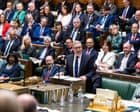
Reform UK leader has been unusually quiet in recent weeks – at great cost to the party during a crucial byelection
Fake images of Nigel Farage have been ubiquitous online lately – but the real politician has proved far more elusive since it was revealed seven weeks ago that he took a £5m personal gift from a crypto billionaire.
Keir Starmer’s closest aides are “war-gaming” how to win a leadership contest ahead of Andy Burnham’s much-anticipated return to Westminster if he wins the Makerfield byelection, the Guardian understands.
Downing Street sources said the prime minister had taken the last fortnight to think seriously about his future but was now “hellbent” on fighting any contest. His team is working through various scenarios, including sacking ministers who publicly support Burnham.
Hadi Alodid refused legal representation and made no reply to charges which were put put to him through an Arabic interpreter as he appeared in court charged with attempted murder following the Belfast knife attack, the Press Association reports.
The 30-year-old, with an address at Duncairn Avenue in Belfast, appeared before the city’s magistrates’ court on Wednesday morning.
He is charged with the attempted murder of Stephen Ogilvie on Monday, with threatening to kill an NHS radiographer on the same day and with the possession of a knife.
Survey in run-up to byelection also finds support for water renationalisation, wealth tax and cap on political donations
A majority of voters in Makerfield say they would be less likely to vote for an election candidate if they have posted offensive content on social media, polling shows.
The polling for the campaign group 38 Degrees, undertaken by Survation, asked 518 voters in the Makerfield constituency for their views on a range of issues, with 55% saying they would be less likely to vote for a politician who has posted offensive material online.
As the Makerfield byelection and a potential leadership challenge loom, there is a sense the PM is looking to create impacts that last
As the weeks ticked down to her departure from Downing Street in 2019, Theresa May had a plan. Not only did she want to put a net zero target into law, but she wanted the UK to be the first major economy to do so. And that meant beating the French.
“It required the machinery of government to move more quickly than the French parliament,” a No 10 official from the time recalls. And it worked: the UK target came into force in June 2019, six weeks before May handed over to Boris Johnson, and five months before the French. She had her legacy.
Former safeguarding minister says if ban came into force properly it could ‘basically eliminate’ problem
The government has highlighted work done by the internet safety firm SafeToNet as showing that the technology is already in place that would allow tech companies to stop children using phones to take naked pictures of themselves, or other people. The Home Office says:
Measures to protect children already exist within smartphones and tablets, but are applied inconsistently, often switched off by default and only blurring content rather than blocking it. But the government is working closely with technology companies — some of whom, like Apple, have already taken steps to implement protective features — to make this goal a reality.
Companies must introduce these measures without threatening privacy or collecting any data. The device should simply block harmful content across all apps and services. Over-18s will still be able to view adult content by providing proof of age.
The government is right to act. Children have been failed for too long. This news will be welcomed by parents across the UK and hopefully, will inspire other countries to follow the UK’s lead.
We can put an end to so much online misery with this approach. SafeToNet’s HarmBlock technology is a proven example that it is possible to make the device safe by default and not as some optional add-on.
The changes will apply to UK devices, including both existing and newly sold smartphones and tablets. Legislation could cover operating system providers and others in the supply chain, such as retailers, and will not affect the use of devices owned and used by adults who verify their age …
Apple recently introduced age checks for iPhone users, making it the first company to activate safety features by default for those who are not verified as over 18. This is a significant step forward following the government’s commitments to work with industry, and one this announcement builds on.

 Login
Login