Global oil giant Shell continued operating a compromised pipeline in Nigeria’s Niger Delta despite knowing it posed a pollution risk in the surrounding coastal wetland environment, newly disclosed internal company communications reveal. The emails and memos, reviewed by Mongabay, show senior leadership knew of the poor conditions of the 97-kilometer (60-mile) Nembe Creek Trunk Line as early as 2008. Despite concerns it was operating outside technical integrity standards and proposals to shut it down, a top executive decided to keep pumping oil through the line. Carrying 150,000 barrels of oil per day to the export terminal at Bonny Island Rivers state, the Nembe Creek Trunk Line is a critical oil artery in Nigeria. Throughout the years, theft from the pipeline using illegal connections caused spills into the vast mangrove ecosystem of true (Rhizophora sp.) and flowering black (Avicennia sp.) tree species. An internal 2013 Shell document coded such tampered lines as “red,” requiring either their immediate shutdown or immediate action to remove all illegal connections. Locals from the nearby riverine Bille community said the oil spills killed about 2,000 hectares (4,900 acres) of mangrove swamps around the village while impacting an area of 13,200 hectares (32,600 acres). The contaminated waterways and degraded ecosystem, they told Mongabay, killed fish and other aquatic life. Satellite imagery surrounding the village shows massive degradation of the mangroves. “The aquatic life is gone. Our people can no longer go to the river and catch reasonable fish — they can’t even find the fish in the…This article was originally published on Mongabay
Leoncia Ramos has lived her 65 years in the lush Dominican Republic town of La Piñita, but now says she is fearful for her health and wants to leave. She’s among 450 families asking the government and the company behind the Pueblo Viejo gold mine to be relocated because of concerns of pollution from the nearby mine. They allege the site, controlled by Canadian giant Barrick Mining Corp., is harming their health and the environment, and fear that if a tailings dam about a kilometer away were to collapse, it would be disastrous. Ramos’s community has spent 15 years fighting to have its concerns addressed and now says Canada, where Barrick Mining is headquartered, could play a role. In 2019, the Canadian government created an office of an ombudsperson to handle complaints from communities like Ramos’s. But the government has left the role vacant for the past year, and its work has seemingly come to a standstill. Canada is home to about half of the world’s publicly traded mining and mineral exploration companies, with operations both in Canada and overseas, including some of the world’s largest miners, like Barrick Mining. The government created the office of the Canadian Ombudsperson for Responsible Enterprise (CORE) in 2019 to address human rights complaints about Canadian companies’ operations overseas. But the office has now been without an ombudsperson since May 2025, and advocates say its work has stalled at a critical moment, as demand for transition minerals and a changing geopolitical climate are driving…This article was originally published on Mongabay
More than a decade ago, conservationists began working to preserve a unique population of desert pampas cats that has adapted to the mangroves of Peru’s northern coast. This small, isolated population roams the San Pedro de Vice dry mangroves, a Ramsar Site and South America’s southernmost mangrove ecosystem. “This is a very unique population, because as far as we know, [it] is the only Pampas cat population that lives in a mangrove [habitat],” Alvaro Garcia, co-coordinator of the Pampas Cat Working Group and the Peruvian Desert Cat Project, told Mongabay in an email. The desert pampas cat (Leopardus garleppi), distinctive for its broad face, ranges along a relatively thin band snaking southward from Colombia through Peru and Bolivia, to northern Chile and Argentina. The species is acclimated to dry conditions, so inhabits deserts, grasslands and dry forests, and isn’t found living in mangroves anywhere else aside from this region of Peru. Dry mangrove forests, also called scrub or dwarf mangrove forests, grow in highly saline soils in upper intertidal zones, so lack regular daily flushing by ocean tides. At first, it was thought the dry mangrove-acclimated cats were faring well: “[I]n the mangrove [habitat], we put cameras out for a week, and we got tons of photos,” whereas in other parts of the felid’s range, conservationists barely capture one desert pampas cat image per month, said Cindy Hurtado, co-coordinator of the Pampas Cat Working Group and the Peruvian Desert Cat Project. Based on the photos, the research team assumed the…This article was originally published on Mongabay
SARLAHI, Nepal — Dhruba Prasai, a farmer from Sarlahi district in Nepal’s southern plains, says he’s exhausted from lack of sleep. Every year, nilgai antelopes, wild boars, deer and Asian elephants raid his fields, and if left unguarded at night, they not only feed on standing crops, but also stored harvest. “There is a forest to the west, and our fields are right next to it,” Prasai tells Mongabay. “The nilgai eat the maize, and the deer can’t even stand the sight of wheat and oat grass, they eat it all. If people stay up at night to guard the fields, they run away; otherwise, they come and destroy everything.” Farmers such as Prasai across Madhesh province, considered the country’s breadbasket because of its fertile land, are struggling with growing crop losses from wildlife, but complex procedures and policy gaps make access to relief, which is already limited, difficult. From mid-July 2024 to mid-July 2025, 14,821 cases of ‘human wildlife conflict’ were reported in Madhesh, according to government figures. A total of 134 people and 457 animals lost their lives. Last year, a wild boar ate three tand (storage racks) of maize stored in Prasai’s house. Although forest authorities told him to get a recommendation letter from the local municipal ward office to apply for relief, he didn’t do it. “I haven’t done it; we simply don’t have the time,” he says. Even those who did fill out the forms around the same time have yet to receive relief, he…This article was originally published on Mongabay
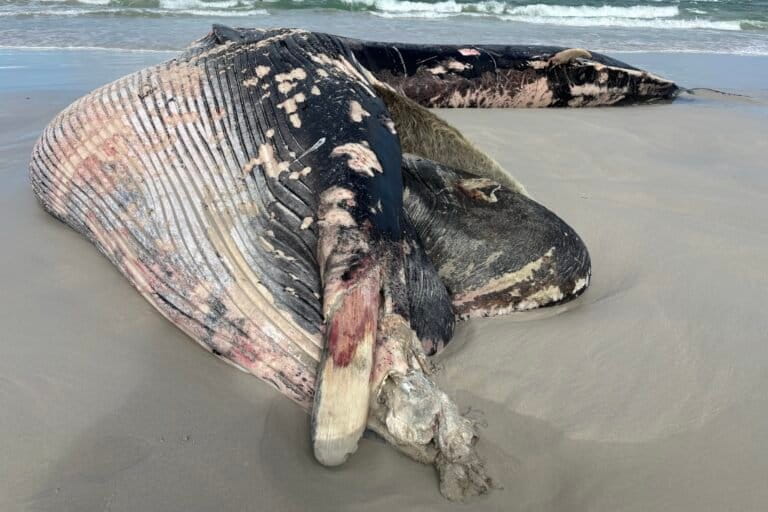
In April this year, two Bryde’s whales washed-up dead-on Dyer Island, a small nature reserve located a few kilometers off the coast of Gansbaai in South Africa’s Western Cape province. Both whales carried severe injuries; their vertebrae had been shattered. “It was very clear that it was [vessel] strikes, because both those whales were snapped in half, and you can also see the propeller marks,” Loraine Shuttleworth, head of research at the Dyer Island Conservation Trust, told Mongabay. Two whale strandings linked to ship strikes in one month alone is an unusually high number, Shuttleworth said. A new risk assessment has linked the increase in risk of ships striking whales to the rerouting of maritime traffic around South African coast. Due to the Houthi rebels attacks on ships traversing the Red Sea, which started in 2023, and the more recent fallout from the blockade of the Strait of Hormuz, many cargo companies have rerouted their vessels around the Cape of Good Hope. With greater shipping traffic comes a growing threat to marine species inhabiting the region: collisions with large, fast-moving vessels. Between December 2023 and December 2024, the number of large vessels traveling through South African waters at average speeds above 15 knots (28 kilometers per hour) has quadrupled, satellite data show. The scale of the increased maritime traffic struck scientist Els Vermeulen from the University of Pretoria’s Mammal Research Institute Whale Unit, on a flight into Cape Town in 2025. “It was a beautiful day, and there were just…This article was originally published on Mongabay
The United States is not approaching collapse because it lacks power. It is approaching collapse because it has too often mistaken power for wisdom. Its armed forces remain unmatched in reach, its financial system remains central to global commerce, and its technology sector continues to shape the future. Yet these advantages can conceal a more […]
On May 31, Lebanese Prime Minister Nawaf Salam gave a televised address in which he condemned Israel’s invasion and intensified attacks on southern Lebanon as a dangerous escalation, warning that a “scorched-earth policy” will never bring security to Tel Aviv: “Israel must understand that with its scorched-earth policy, collective punishment, and the bulldozing of villages and […]
BANGKOK — Seven hundred days after activists from the environmental group Mother Nature Cambodia were imprisoned on charges widely regarded as retaliatory for their activism, 73 international and Cambodian civil society organizations have renewed calls for their unconditional release. After a trial lasting just over a month, 10 activists from Mother Nature Cambodia were sentenced on July 2, 2024, to between six and eight years in prison. Only five of the defendants attended the hearings, which saw Long Kuntha, 28, Ly Chandaravuth, 26, Phuon Keoraksmey, 25, and Thun Ratha, 34, each sentenced to six years behind bars for plotting against the government; fellow activist Yim Leanghy, 36, received an eight-year sentence for both plotting against the government and insulting the king. The five activists who did not attend the trial were sentenced in absentia. The appeals hearing for all 10 convicted activists was slated to take place on June 2, but has been postponed indefinitely by the Phnom Penh Court of Appeals. “The MNC5 are incarcerated in prisons in overcrowded and harsh living conditions, separated from each other and spread out all across Cambodia, hundreds of kilometers away from their families and legal counsel,” wrote the 73 NGOs in an open letter addressed to Prime Minister Hun Manet. “The … NGOs who have signed this letter sincerely request you take immediate action to ensure the unjust convictions of these five activists are reversed either prior to or at their upcoming appeals court hearing in Phnom Penh, and that their freedom…This article was originally published on Mongabay
As offshore wind farms expand rapidly in the global renewable energy transition, scientists are studying how these large marine infrastructure projects affect ecosystems beneath the waves. Research from Wageningen University & Research in the Netherlands suggests that offshore wind may bring both risks and benefits for sharks and rays, known collectively as Elasmobranchii, which are highly sensitive to electromagnetic fields (EMFs). A six-year project called “Elasmopower” examined how EMFs from subsea power cables in offshore wind farms affect bottom-dwelling sharks and rays. These species depend on natural electric and magnetic fields for key behaviors such as navigation, prey detection, habitat use and long-distance movement, particularly in low-visibility environments. The studies conducted as part of the Elasmopower project have been published in four papers, with three additional papers currently undergoing peer review. Sharks and rays have specialized electroreceptors called ampullae of Lorenzini. The jelly-filled sensory canals around the head and snout can detect even extremely weak EMFs from prey and predators, water movement, and the Earth’s geomagnetic field, Erwin Winter, a scientist at Wageningen, told Mongabay. This system is central to hunting and orientation, making Elasmobranchii especially relevant for studying EMF exposure from offshore energy infrastructure, Winter added. Erwin Winter, a researcher with the Elasmopower project, presented findings on offshore wind, electromagnetic fields and bottom-dwelling sharks and rays at the Sharks International 2026 conference in Colombo, Sri Lanka, in May. Image by Malaka Rodrigo for Mongabay. During a presentation on a summary of the Elasmopower research at the Sharks International 2026…This article was originally published on Mongabay
The existence of the “polluter pays” principle (PPP) in Bangladesh, at least on paper, dates back to 1992, ever since the country endorsed the Rio Declaration. However, Bangladesh has made little progress in implementing the principle so far. A statement by the incumbent minister for environment, forest and climate change, Abdul Awal Mintoo, saying that regulatory authorities recovered less than half of the total compensation imposed on polluters over the past 16 years, exposed the structural loopholes in environmental governance behind failures in implementing the principle. The minister pointed out that polluters can delay the compensation recovery by applying their right to appeal against the regulatory authorities’ orders. that Mongabay spoke to said that loopholes in the judicial system, weak evidence and economic analysis on pollution, and polluters’ influence must be addressed if the country really wants to implement the PPP. Environmentalist and Dhaka University’s zoology professor Mohammad Firoj Jaman told Mongabay, “Delays in implementation of laws against polluters aggravate environmental pollution, and the hope of reaping the benefits of environmental justice falls flat.” Shanties stand along the bank of Buriganga River in Hazaribagh, Dhaka district, Bangladesh. The area is known for tanneries, the waste from which fill the surrounding land and water. Image by Abir Abdullah/Asian Development Bank via Flickr (CC BY-NC-ND 2.0). Compensation recovery undermines the PPP The PPP binds polluters to bear the costs of managing and remedying the harm they have done to the environment. The concept of PPP was first mentioned in the recommendations of…This article was originally published on Mongabay
CHIRADZULU, Malawi — Diana Sitima’s farm on the outskirts of Malawi’s commercial capital, Blantyre, is both example and an exception. Where neighboring farmers have planted mostly maize for food and for sale in nearby markets, people drive out to buy sweet potato, pigeon peas and vegetables, bananas and avocado, and eggs produced on Sitima’s 3.5-hectare (8.6-acre) property. Sitima started farming in 1993. Unlike her neighbors, farming was a side hustle to begin with: she worked as an office assistant in Blantyre and her husband had a good job with a bank. Over the next seven years, she and her husband took out a series of micro-loans, renting small parcels of land and hiring people from the village to grow tomatoes for sale in the city. Sitima’s efforts went well, and because her family did not have to rely on their harvest for food or an income at that time, she was able to save the money she earned to take a next step. She quit her office job and acquired a farm of her own in Chiradzulu district, 15 kilometers (9 miles) east of the city. “That’s how I made money to be able to buy this land when it was put up for sale in 2006,” she says. While she was still a part-time farmer, Sitima attended several workshops, where she picked up ideas about agroecological farming — an approach combining crops, agroforestry, fish ponds, poultry and livestock, in a self-reinforcing system that protects soil health and reduces the…This article was originally published on Mongabay
Since May 23, more than 200 primates housed at the Lwiro Primates Rehabilitation Center (LPRC) in South Kivu province in the eastern Democratic Republic of Congo (DRC) have been placed under confinement due to the Ebola outbreak. This measure follows the death of a man who tested positive for the virus on May 21. This individual, a resident of Kahungu, located just 2 km (1.2 miles) from the town of Lwiro, where the center is situated, had traveled in early May to neighboring Ituri province. Ituri is the epicenter of the outbreak, which, as of May 27, is linked to more than 200 suspected deaths. A threat for humans and apes The LPRC houses at least 129 chimpanzees and 108 monkeys of various species, including olive baboons (Papio anubis), yellow baboons (Papio cynocephalus), L’Hoest’s monkeys (Cercopithecus l’hoesti), blue monkeys (Cercopithecus mitis), agile mangabeys (Cercocebus agilis) and others. Parrots, turtles and porcupines can also be found there. These primates, rescued from poaching and the illegal wildlife trade, are being kept in confinement even though “for the moment, no cases of Ebola virus transmission from a human to a great ape have been reported,” primatologist Liz Williamson explained in an email to Mongabay. According to the World Health Organization, the Ebola virus is transmitted to humans through close contact with the blood, secretions, organs or other bodily fluids of infected animals. A chimpanzee at the Lwiro Primates Rehabilitation Center, located in South Kivu province in the eastern Democratic Republic of Congo. Image…This article was originally published on Mongabay
Sat Born, 56, recalls freezing at the forest’s entrance when he first saw it. “Its head was this big,” he says, wide-eyed, spreading his hands to show the animal’s size. Recollecting that eventful morning in 2001, Born, who now farms bananas and durians, retraces his steps from his home in Trapeang Chheu Trav village in the rainforests of the Cardamom Mountains in southwestern Cambodia. As he walks up a hill rising above the forest canopy, he points to a spot on the road. “It’s over here. When I saw the tiger, it was 9 a.m.,” he says. “I was really shocked … I couldn’t tell if the tiger was coming towards me.” In 2007, just six years after this fleeting encounter, Cambodia’s last confirmed tiger sighting was logged by a camera trap. In the 1990s, the country was estimated to host hundreds of wild Indochinese tigers, but decades of poaching pressure took a heavy toll. In 2016, tigers (Panthera tigris) were formally declared extinct in Cambodia. That may be set to change with the imminent translocation of a small population of Bengal tigers from India. Although many reintroductions are success stories, this one raises some serious concerns. Why would Cambodia bring in a nonnative tiger? Have the people living in these areas been adequately consulted? Will these translocated tigers be able to adapt to this new habitat? Is there enough prey to sustain them, and if not, how will the government address predation when hungry cats feed on livestock? With…This article was originally published on Mongabay
Reprinted with permission from Trita Parsi’s Substack. “You’re fucking crazy. You’d be in prison if it weren’t for me. I’m saving your ass. Everybody hates you now. Everybody hates Israel because of this.” According to Axios, this is what Donald Trump said to Israeli Prime Minister Benjamin Netanyahu in “an expletive-laden call” earlier today. Trump […]
NATO partisans in both Europe and the United States are perpetual optimists about Ukraine’s prospective fortunes in its war against Russia. Lately, there has been yet another inundation of such accounts in Western news media outlets. Many of them emphasize that Moscow’s latest military offensive against Ukrainian ground forces has come to a halt with […]
Thomas Crowther begins his book with a snakebite that was not, in any conventional sense, dangerous. The danger came from interpretation. A misidentified species, a surge of fear, and a body that responded as if the threat were real: numbness spread, panic intensified, and the situation escalated until a second opinion dissolved it almost instantly. The episode is more than an anecdote. It sets the terms of Nature’s Echo, a book that treats cause and effect not as linear sequences so much as loops that can amplify themselves in either direction. Thomas Crowther That idea—feedback loops as the underlying architecture of the natural world—is the organizing principle of the book. Crowther traces it from cosmology to ecology to human psychology, moving across scales with considerable ambition. The early chapters move outward from the origin of matter, suggesting that the same reinforcing processes that allowed stars to form also underpin biological evolution and social behavior. It is an ambitious framing. At its best, it brings a sense of coherence to subjects that are often treated separately. At times, the scope of the framework requires readers to travel across very different domains and scales of thought. The structure reflects that expansiveness. The table of contents alone signals the range: from “Cause and Effect” and “Feedback Loops” through “Resilience and Tipping Points” and into “The Story We Tell Ourselves.” The progression is deliberate. Crowther starts with physical systems, moves into ecological stability, and then into the social and psychological domains where perception begins…This article was originally published on Mongabay
In the global debate over tropical deforestation, the usual cast of villains is well established: agribusiness, global supply chains, cattle ranchers, and governments granting land concessions for political support. One actor rarely appears in this narrative yet has played a consequential role in transforming the South American lowland frontier: The Mennonite agricultural colonist. For more than five decades, Mennonite communities have functioned as systematic agents of agricultural frontier expansion in the Gran Chaco and Andean Amazon, methodically clearing forests, draining wetlands, and catalyzing waves of deforestation that extend far beyond any individual colony. Mennonite communities operate within the law. They purchase land through formal channels, build permanent communities, and transfer agronomic knowledge to surrounding populations. Their values emphasize hard work, communal solidarity, and a theological relationship to land as stewardship. None of this changes the ecological outcome: Wherever a Mennonite colony is established, forests fall. Faith, mobility and colony formation Mennonites are an Anabaptist denomination rooted in the 16-century Reformation, distinguished by pacifism, communal life, and cultural separation from mainstream society. Conservative congregations — whose ancestors moved from Russia to Canada, then to Mexico, Belize and South America — are organized around a local congregation that functions simultaneously as a religious community, governance structure, credit cooperative and social welfare system. When a colony is established, it is an orderly community with collective decision-making, shared infrastructure, and a coherent plan for the future. Forest being cut, burned, and prepared by a Mennonite colony before planting crops. Image courtesy of Mario Silvero.…This article was originally published on Mongabay
The French government recently announced it has greenlit a plan to send its last captive cetaceans — two orcas and 12 dolphins — to zoos and entertainment parks in Spain. These cetaceans live in the Marineland Antibes park on the French Riviera, which closed in 2025. In 2021, France passed a law banning the breeding and keeping of cetaceans in captivity for entertainment shows, which will come into effect on Dec. 2, 2026. The orcas and dolphins at Marineland were the primary draw for visitors. The two orcas (Orcinus orca), Wikie, aged 25, and her son, Keijo, aged 12, were born at Marineland Antibes on the French Riviera and spent all their lives in concrete tanks and performing in display shows. They will now be moved to Loro Parque, a zoo and entertainment park in Tenerife on the Canary Islands. The dolphins will be split up between two parks in Valencia and Málaga on the Spanish mainland, with plans for some of them to return to France’s Beauval Zoo, when it’s ready to have them, according to reporting by Le Monde. A court-appointed expert team found in February 2026 that the concrete tanks in which the orcas lived at Marineland Antibes were in advanced structural decline, and if the mammals weren’t moved soon, they would have to be euthanized. “Faced with this emergency, we are acting to avert the worst,” Mathieu Lefèvre, France’s minister delegate for ecological transition, said in a statement, explaining the rationale for the decision. “Loro Parque…This article was originally published on Mongabay
Katelynn Delos Reyes thought she knew what to expect when Typhoon Sinlaku slammed into Saipan in April. As a lifelong resident of the island, Delos Reyes had survived frequent storms, including Super Typhoon Yutu, the second-strongest in U.S. history. Eight years ago, Yutu’s 274-kmph (about 170-mph) winds devastated her village in the southern end of Saipan. Just three years before that, she survived Typhoon Soudelor. But Sinlaku was different. “At the beginning, it was OK. But later on it wasn’t,” said Delos Reyes, who is Chamorro, Indigenous to the Mariana Islands. A few days before it hit the Commonwealth of the Northern Mariana Islands, or CNMI, on April 14, Sinlaku had tropical-storm winds. That made it what is known in the Marianas as a “banana typhoon” because such storms level banana trees but leave others standing. Then over the weekend, the typhoon rapidly intensified by 120 kmph (75 mph) in just 24 hours before becoming a 298-kmph (about 185-mph) monstrosity and the strongest storm on Earth so far this year. Delos Reyes and her family had done what they could to prepare. They boarded up the windows. They bought gallons of drinking water and filled plastic drums to use in the shower and toilet. Then the storm hit, and Delos Reyes grew scared. The winds, which had weakened to 240 kmph (about 150 mph), ripped the wood from a window. Rainwater gushed through the ceiling and soaked their belongings, including Delos Reyes’ mattress. She and her partner, her mother, her…This article was originally published on Mongabay

 Login
Login