The East African Crude Oil Pipeline (EACOP), which stretches from oil fields in Uganda’s Lake Albert region to Tanzania’s port town of Tanga, is once again under scrutiny after a new report mapped out the biodiversity areas and wildlife habitats it runs through or passes by. Drawing data from maps and economic value estimates, the report by U.S.-based NGO Earth Insight shows that the 1,443-kilometer (990-mile) pipeline is close to areas that are important for livelihoods and water security for millions of people and serve as migration corridors for animals. The report concludes that the construction of the pipeline has already disturbed communities and the environment and that oil transportation will bring further long-term risks. EACOP is a joint project involving TotalEnergies (62% stake), the governments of Uganda (15%) and Tanzania (15%), and the China National Offshore Oil Corporation (CNOOC, 8%). EACOP will carry oil extracted from two oilfields in the Lake Albert region: Kingfisher, owned by CNOOC, and Tilenga, owned by TotalEnergies. According to Earth Insight, the project is nearing completion. Oil transportation through the pipeline is expected to start as early as October 2026. Construction of the East Africa Crude Oil Pipeline (EACOP) in Uganda. Image courtesy of Thomas Lewton. “It crosses right through endangered species ranges, the most important and critical one being the black rhino habitat range,” Earth Insight’s Katie Boston, the study’s main researcher, told Mongabay on the phone. She added that the pipeline could cause habitat fragmentation in the Kibale/Bukoora River Crossing area, where…This article was originally published on Mongabay
Global oil giant Shell continued operating a compromised pipeline in Nigeria’s Niger Delta despite knowing it posed a pollution risk in the surrounding coastal wetland environment, newly disclosed internal company communications reveal. The emails and memos, reviewed by Mongabay, show senior leadership knew of the poor conditions of the 97-kilometer (60-mile) Nembe Creek Trunk Line as early as 2008. Despite concerns it was operating outside technical integrity standards and proposals to shut it down, a top executive decided to keep pumping oil through the line. Carrying 150,000 barrels of oil per day to the export terminal at Bonny Island Rivers state, the Nembe Creek Trunk Line is a critical oil artery in Nigeria. Throughout the years, theft from the pipeline using illegal connections caused spills into the vast mangrove ecosystem of true (Rhizophora sp.) and flowering black (Avicennia sp.) tree species. An internal 2013 Shell document coded such tampered lines as “red,” requiring either their immediate shutdown or immediate action to remove all illegal connections. Locals from the nearby riverine Bille community said the oil spills killed about 2,000 hectares (4,900 acres) of mangrove swamps around the village while impacting an area of 13,200 hectares (32,600 acres). The contaminated waterways and degraded ecosystem, they told Mongabay, killed fish and other aquatic life. Satellite imagery surrounding the village shows massive degradation of the mangroves. “The aquatic life is gone. Our people can no longer go to the river and catch reasonable fish — they can’t even find the fish in the…This article was originally published on Mongabay
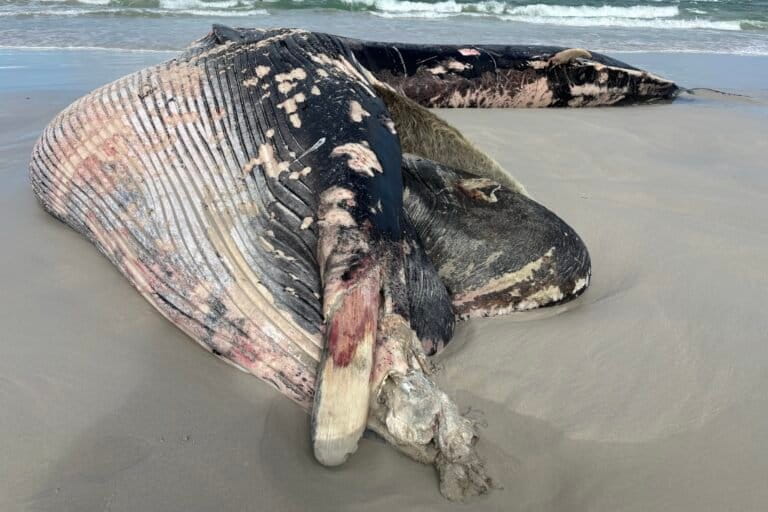
In April this year, two Bryde’s whales washed-up dead-on Dyer Island, a small nature reserve located a few kilometers off the coast of Gansbaai in South Africa’s Western Cape province. Both whales carried severe injuries; their vertebrae had been shattered. “It was very clear that it was [vessel] strikes, because both those whales were snapped in half, and you can also see the propeller marks,” Loraine Shuttleworth, head of research at the Dyer Island Conservation Trust, told Mongabay. Two whale strandings linked to ship strikes in one month alone is an unusually high number, Shuttleworth said. A new risk assessment has linked the increase in risk of ships striking whales to the rerouting of maritime traffic around South African coast. Due to the Houthi rebels attacks on ships traversing the Red Sea, which started in 2023, and the more recent fallout from the blockade of the Strait of Hormuz, many cargo companies have rerouted their vessels around the Cape of Good Hope. With greater shipping traffic comes a growing threat to marine species inhabiting the region: collisions with large, fast-moving vessels. Between December 2023 and December 2024, the number of large vessels traveling through South African waters at average speeds above 15 knots (28 kilometers per hour) has quadrupled, satellite data show. The scale of the increased maritime traffic struck scientist Els Vermeulen from the University of Pretoria’s Mammal Research Institute Whale Unit, on a flight into Cape Town in 2025. “It was a beautiful day, and there were just…This article was originally published on Mongabay

 Login
Login