Normal view

Trump asking Congress for symbolic expunging of his two impeachments

President is first in US history to be impeached twice, over abuse of power and inciting an insurrection

Donald Trump is pressing Congress to erase one of the darkest chapters of his political career, urging Republicans to pass a resolution that would symbolically nullify the two impeachments he suffered during his first term in office.

The effort, first reported by the Wall Street Journal and confirmed by a White House official, would allow Trump to claim a symbolic victory on a key grievance from his first term. But experts say it would have little legal significance, since the constitution provides no procedure for undoing an impeachment.

Continue reading...

© Photograph: Stephanie Keith/Getty Images

© Photograph: Stephanie Keith/Getty Images

© Photograph: Stephanie Keith/Getty Images

Republicans prioritize effort to ‘expunge’ Trump’s impeachments from the record

12 June 2026 at 15:48

There are roughly seven months remaining in the current Congress, and the Republican majorities in the House and Senate still have an opportunity to try to govern and pass worthwhile legislation that the American public might like.

As is too often the case, GOP leaders’ focus apparently lies elsewhere. The Wall Street Journal reported:

President Trump and his allies have discussed pushing lawmakers to pass a resolution aimed at voiding his first-term impeachments, according to people familiar with the matter.

The resolution would allow Trump to claim a symbolic victory on a matter that has dogged him since his first term, part of a broader effort to burnish his presidential legacy. It would have little legal significance, however, because the Constitution provides no procedure for undoing an impeachment, according to experts.

This is not simply a matter of backroom chatter and whispers from Capitol Hill hallways. Trump explicitly told the Journal, in reference to the efforts to “expunge” the record, “It should be done because I did nothing wrong.”

House Speaker Mike Johnson similarly told the newspaper that he believes the effort “makes a lot of sense.” The Louisiana Republican, who called the president’s impeachments a “sham” and “a hyperpartisan attack job,” added, “It is a priority and something that Congress should make right.”

Before we dig in on what might actually happen with this effort, it’s important to understand how we arrived at this point.

On Feb. 5, 2020, Trump’s first impeachment trial concluded in the Senate. On Feb. 7, 2020, the president first broached the subject of trying to “expunge” the record, calling the effort to hold him accountable a “hoax.”

His message resonated with some of his allies. Indeed, then-Rep. Markwayne Mullin — years before the Oklahoma Republican moved up to the Senate, and more recently the White House Cabinet — introduced a resolution that would have declared Trump’s first impeachment “expunged.” Soon after, Mullin also took aim at Trump’s second impeachment, and that effort gained the support of, among others, Republican Rep. Elise Stefanik of New York, who made some amazingly misguided arguments in support of the idea.

The effort was largely ignored by the Democratic majority in the House, but as 2023 got underway, then-Speaker Kevin McCarthy said he was willing to take a look at the idea, adding, “I would understand why members would want to bring that forward.”

Several GOP members endorsed the move and unveiled legislation soon after. To the president’s chagrin, the last Congress nevertheless failed to take action on this.

History buffs may recall that a related effort happened nearly two centuries ago. Lawmakers censured President Andrew Jackson in 1834, only to have his allies “expunge” the censure from the record in 1837 after control of the Senate switched party hands.

The point at the time was for partisans to say that the congressional action happened, but for the sake of the historical record, it didn’t really count. Trump and his acolytes appear to have similar intentions now.

Indeed, as recently as two months ago, Republican Rep. Darrell Issa of California introduced a measure to undo both of the president’s impeachments, which coincided with assorted items Trump posted on his social media platform endorsing the broader effort. The same week, as part of an effort that appeared quite coordinated, Director of National Intelligence Tulsi Gabbard used her office to also take aim at the legitimacy of Trump’s first impeachment.

Just so we’re all clear, this is entirely about Trump’s ego and hurt feelings. There is no mechanism in place that allows for a president to be unimpeached. But Trump sees this as a stain on his record, and he’s eager to have sycophantic GOP members do his bidding, rewrite the recent past, symbolically wipe the slate clean and make him feel better about himself.

Whether such a campaign could generate majority support, however, remains to be seen. Watch this space.

The post Republicans prioritize effort to ‘expunge’ Trump’s impeachments from the record appeared first on MS NOW.

After Trump became a problem for Cornyn, Cornyn may soon become a problem for Trump

12 June 2026 at 13:58

Republican Sen. Bill Cassidy of Louisiana spent a year and a half trying to avoid Donald Trump’s wrath, in the hopes that it might help save his career. It didn’t work: The president, still enraged by Cassidy’s 2021 impeachment vote, helped orchestrate the senator’s primary defeat in mid-May.

Newly liberated, the Louisianan wasted little time showing renewed independence, defying the White House’s wishes on several issues.

Roughly a week after Cassidy’s loss, a similar dynamic unfolded in Texas, where incumbent Republican senator John Cornyn went to even greater lengths to stay on the president’s good side, only to see Trump back his primary rival and ensure his defeat.

An obvious question soon followed: After Trump became a problem for Cornyn, would Cornyn become a problem for Trump? An answer is starting to come into focus. The New York Times reported:

Now the Trump administration might find itself having to come to terms with Mr. Cornyn as he flexes new political freedom, joining a handful of other Senate Republicans not seeking re-election or defeated in primaries at Mr. Trump’s behest who now have added room to maneuver.

“I think it is going to be a pretty bumpy ride for the next seven months,” Mr. Cornyn said during a wide-ranging conversation in his Capitol office as he reflected on the tumultuous Texas election and his nearly quarter-century in Washington.

To be sure, there are key qualitative differences between Cornyn and Cassidy: The Texan is clearly to the Louisianan’s right. Even if Cornyn were to decide to ignore party pressures and the White House’s wishes altogether and simply vote his conscience on every matter, he’d still rarely buck the party line.

That said, it’s been interesting to see some unsubtle shifts in recent days. Before Trump endorsed his primary challenger, for example, the Texan launched an effort to rename a highway after the president. In the wake of Trump helping end Cornyn’s career, the senator decided the highway project was no longer a priority.

Similarly, when the president announced that Bill Pulte, the highly controversial director of the Federal Housing Finance Agency, would serve as the acting director of national intelligence, Cornyn was among the first GOP senators to say publicly that Pulte was unqualified for the position.

But the Times’ report highlighted an issue of even greater significance.

After Trump withdrew his outlandish $10 billion lawsuit against the IRS last month, he received two scandalous rewards from his own administration. The first was the creation of a nearly $1.8 billion compensation fund, while the other was an IRS audit shield, unveiled by his Justice Department, granting Trump, his family and his controversial businesses immunity from all existing IRS tax audits.

Of the two rewards, the former appears to have been discarded in the face of overwhelming bipartisan opposition, while the latter remains intact.

Cornyn, however, is opposed to both.

“I think that’s a terrible mistake,” Cornyn told the Times, referring to the audit shield. “The president needs to be treated like everybody else.”

Whether the Texas Republican actually intends to do anything about this belief remains to be seen, but his newly stated position keeps the issue alive and at least opens the door to potential congressional action.

As for the big picture, Cornyn went on to tell the Times, in reference to Trump, “If he would do that to me, he would do that to anybody. There’s never going to be good enough for him, other than 100%, you know, slavish adherence to whatever he wants. But obviously that’s not what the senator’s role is supposed to be, especially in terms of checks and balances.”

Putting aside the question of why it took a full decade for Cornyn to recognize this problem, he has a unique opportunity to partner with the so-called YOLO caucus with six months remaining before his involuntary exit from Capitol Hill. Watch this space.

The post After Trump became a problem for Cornyn, Cornyn may soon become a problem for Trump appeared first on MS NOW.

Crowd gathers at Kennedy Center after court denies Trump’s emergency appeal to keep his name on building – as it happened

This live blog is now closed.

Donald Trump and his allies have discussed pushing lawmakers to pass a resolution aimed at voiding his first-term impeachments, the Wall Street Journal reported last night, citing people familiar with the matter.

It should be done because I did nothing wrong,” Trump said when asked about the resolution in a phone call this week with the Journal. “It was a rigged deal — it was a whole rigged situation.”

Continue reading...

© Photograph: Jonathan Ernst/Reuters

© Photograph: Jonathan Ernst/Reuters

© Photograph: Jonathan Ernst/Reuters

A powerful US surveillance law is set to expire – what happens now?

12 June 2026 at 11:00

Congress has failed to reauthorize section 702 of Foreign Intelligence Surveillance Act amid questions over its future

Donald Trump’s bid to install a controversial ally as the country’s leading intelligence official has shone a light on the wide reach of a powerful surveillance law, and raised questions over its future.

Privacy advocates say it deserves scrutiny, and reform, regardless of who the US president appoints as director of national intelligence (DNI).

Continue reading...

© Photograph: Ken Cedeno/Reuters

© Photograph: Ken Cedeno/Reuters

© Photograph: Ken Cedeno/Reuters

Republicans split on following Trump’s demands for restrictive voting bill

US president urges congressional Republicans to use budget reconciliation procedure to enact his priorities

Donald Trump has demanded that congressional Republicans get to work on a party-line measure that would ensure defense spending reaches its highest level in decades and also make a likely fruitless attempt to impose a host of new restrictions on voters nationwide.

In a post on Truth Social on Wednesday, the president said he was “calling on Republicans in Congress to IMMEDIATELY advance and pass the forthcoming $350 Billion Reconciliation Bill”, which would also include the Save America Act, a rightwing makeover of elections that his allies in Congress have sought to pass for months, without success.

Continue reading...

© Photograph: Aaron Schwartz/Pool/Aaron Schwartz - Pool/CNP/Shutterstock

© Photograph: Aaron Schwartz/Pool/Aaron Schwartz - Pool/CNP/Shutterstock

© Photograph: Aaron Schwartz/Pool/Aaron Schwartz - Pool/CNP/Shutterstock

Democrats demand Trump ‘guarantee’ Bill Pulte will not serve as acting intelligence director after Clayton nomination – as it happened

This live blog is now closed.

The US supreme court has published its opinions, but none of the cases we’ve been watching for were part of the decisions today.

In comments reported by NBC News, House speaker Mike Johnson has said it is “stunning” to him that “House Democrat leadership has put out a statement saying that they’re willing to allow the number one national security tool to go dark over some political disagreement over a very short-term temporary appointment”.

Continue reading...

© Photograph: Michael Nagle/Bloomberg via Getty Images

© Photograph: Michael Nagle/Bloomberg via Getty Images

© Photograph: Michael Nagle/Bloomberg via Getty Images

Pulte unqualified for DNI role, but FISA must be extended, Rep. McCaul says

10 June 2026 at 23:40
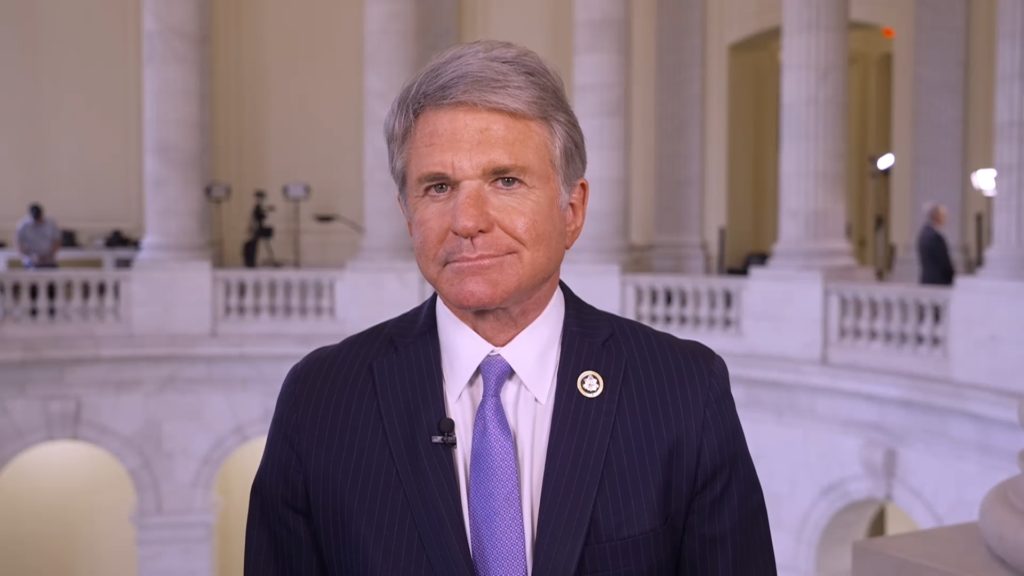
Friday is the deadline for Congress to reauthorize a key tool for collecting foreign intelligence. Critics on the left and the right argue that the Foreign Intelligence Surveillance Act is prone to abuse. Others say they won't back it until President Trump pulls his pick to oversee the intelligence community. Amna Nawaz discussed more with Republican Rep. Mike McCaul of Texas.

AI firms craft state rules as White House, Congress stall

10 June 2026 at 22:36
Major artificial intelligence labs are done waiting on Washington to pass a national standard for AI, turning to state bills to carve out their own policy lines while Congress tries to catch up.  Most AI labs support a national safety framework for AI that would eliminate the patchwork of state regulations, but they are also…

AI firms craft state rules as White House, Congress stall

10 June 2026 at 22:36
Major artificial intelligence labs are done waiting on Washington to pass a national standard for AI, turning to state bills to carve out their own policy lines while Congress tries to catch up.  Most AI labs support a national safety framework for AI that would eliminate the patchwork of state regulations, but they are also…

The more lawmakers go around Mike Johnson, the more obvious his weakness becomes

10 June 2026 at 21:22

For months, Rep. Gregory Meeks of New York, the top Democrat on the Foreign Affairs Committee, had championed legislation to send additional security aid to Ukraine as it defends itself against Russia’s invasion. The proposal, however, was stuck: House Republican leaders refused to consider it, and so the bill languished.

Last month, however, it became unstuck: Proponents of the legislation managed to go around the GOP leadership thanks to a discharge petition — a tactic that allows members to bring a bill to the floor if it’s formally endorsed by a majority of the House. As MS NOW reported last week, the Ukraine aid package cleared the House with 226 votes, including 18 Republicans.

This week, it happened again. NBC News reported:

The House tonight passed another Democrat-led bill that made its way to the floor after a group of Republicans bucked their party’s leadership and joined Democrats in forcing a vote.

The Faster Labor Contracts Act, which would force employers to start negotiating with a newly certified union within 10 days of receiving the request, passed with the support of 20 Republicans and all Democrats.

Critics will note that both this bill and the Ukraine aid still have to clear the Senate, where the measures’ fate remains uncertain, and they would still need Donald Trump’s signature to become law. It’s a fair point.

But let’s not miss the forest for the trees. Republican Rep. Brian Fitzpatrick of Pennsylvania said in an online written statement, “If the House Floor was managed properly, discharge petitions would never be needed. A successful discharge petition is clear and direct evidence of a poorly managed House Floor — because it demonstrates that the will of the majority of the People is being thwarted by the privileged few.”

Fitzpatrick didn’t mention House Speaker Mike Johnson by name, but given the context, he didn’t have to.

Indeed, it might not be immediately obvious just how embarrassing these latest developments are for the Louisiana Republican and his leadership team.

In the past century or so, successful discharge petitions have been very rare. The reason is simple: Such petitions have long been seen as a slap in the face of a sitting House speaker.

As New York magazine’s Ed Kilgore recently explained, “Indeed, prior to Johnson’s ascent to the Speakership, only two 21st-century discharge petitions achieved the 218 signatures needed to trigger a floor vote.”

This roughly once-per-decade average has undergone a dramatic revision under the Louisiana Republican’s tenure. In the last Congress, which ended in early January 2025, there were two successful discharge petitions, which was itself a significant total. Meanwhile, in the current Congress, which is far from over, there have been six successful discharge petitions, which The Hill accurately described as “extraordinary.”

The first came in March 2025, and it dealt with proxy voting for new parents serving in Congress. In November 2025, another discharge petition advanced the Epstein Files Transparency Act; five days later, a measure to repeal an executive order that gutted federal workers’ union rights also received 218 signatures.

The list grew longer as discharge petitions related to extending Affordable Care Act subsidies, providing temporary protected status for Haitian migrants and extending aid to Ukraine all crossed the necessary threshold.

Usually, members embarrass Johnson by ignoring his wishes and voting against legislation he has urged them to support. But this flurry of successful discharge petitions, which has no modern precedent, makes the House speaker appear even more diminished.

Kilgore’s recent piece added, “Signs of weakness invite further revolts by House members who fear voters more than this mild-mannered former backbencher from Louisiana, whose authority is totally dependent on Trump’s backing, which can be erratic during times when the president is distracted by nonlegislative matters like ending wars and naming things after himself. Politicians, like guard dogs, can smell fear and irresolution.”

The question, then, is less whether we’ll see more successful discharge petitions and more a question of when, as Johnson’s weak hold on power unravels further.

This post updates our related earlier coverage.

The post The more lawmakers go around Mike Johnson, the more obvious his weakness becomes appeared first on MS NOW.

With increasing frequency, GOP’s Thune and Trump are not on the same page

10 June 2026 at 18:04

In the weeks leading up to Jan. 6, 2021, Senate Republican leaders knew that Donald Trump was pressuring their members to reject certification of Joe Biden’s victory, but they pleaded with GOP senators to discard the outgoing president’s wishes. In fact, Senate Republican leaders told members there wasn’t even any point in trying, since the radical scheme wouldn’t work anyway.

Republican Sen. John Thune of South Dakota, the then-majority whip, publicly conceded in December 2020 that the plan to reject election certification “would go down like a shot dog.”

Trump wasn’t pleased. In fact, the defeated president labeled Thune a “RINO” — “Republican in Name Only” — on social media, adding, “South Dakota doesn’t like weakness. He will be primaried in 2022, political career over!!!”

In 2022, Thune ran unopposed — in both the primary and the general election. What’s more, his career was far from over, and he became the Senate majority leader early last year.

In 2026, there’s a relative détente between Thune and Trump, though in recent weeks, it’s become increasingly clear the two Republican leaders are not on the same page.

“Thune has to say ‘no’ to Trump a lot,” Punchbowl News reported. “And second-term Trump clearly doesn’t like this at all.”

Consider the developments from the past few weeks:

  • Trump tapped Bill Pulte as the acting director of national intelligence, and Thune made his dissatisfaction known.
  • Trump announced a $1.776 billion compensation fund, widely panned as a “slush fund,” and Thune told reporters he was “not a fan” of the provisionally discarded idea.
  • Trump endorsed Ken Paxton in Texas’ Senate race, and Thune again made his dissatisfaction known.
  • Trump peddled new election conspiracy theories, and Thune said anyone touting such theories needs to “prove if there was cheating.”
  • Trump told Thune to fire Senate parliamentarian Elizabeth MacDonough, to eliminate the filibuster, to end the chamber’s “blue-slip” practice and to pass the anti-voting SAVE America Act — and Thune ignored all these directions.

To be sure, the president hasn’t thrown any recent tantrums about the South Dakotan, but with the way things are going, it’s hard not to wonder if the dam might soon break.

The post With increasing frequency, GOP’s Thune and Trump are not on the same page appeared first on MS NOW.

The data brokers Congress forgot to regulate

10 June 2026 at 18:00
The SECURE Data Act and the GUARD Financial Data Act offer a potential solution to the lack of federal regulation of data brokers, but both bills leave significant gaps in protecting consumers from the misuse of their personal data.

❌