
 Login
Login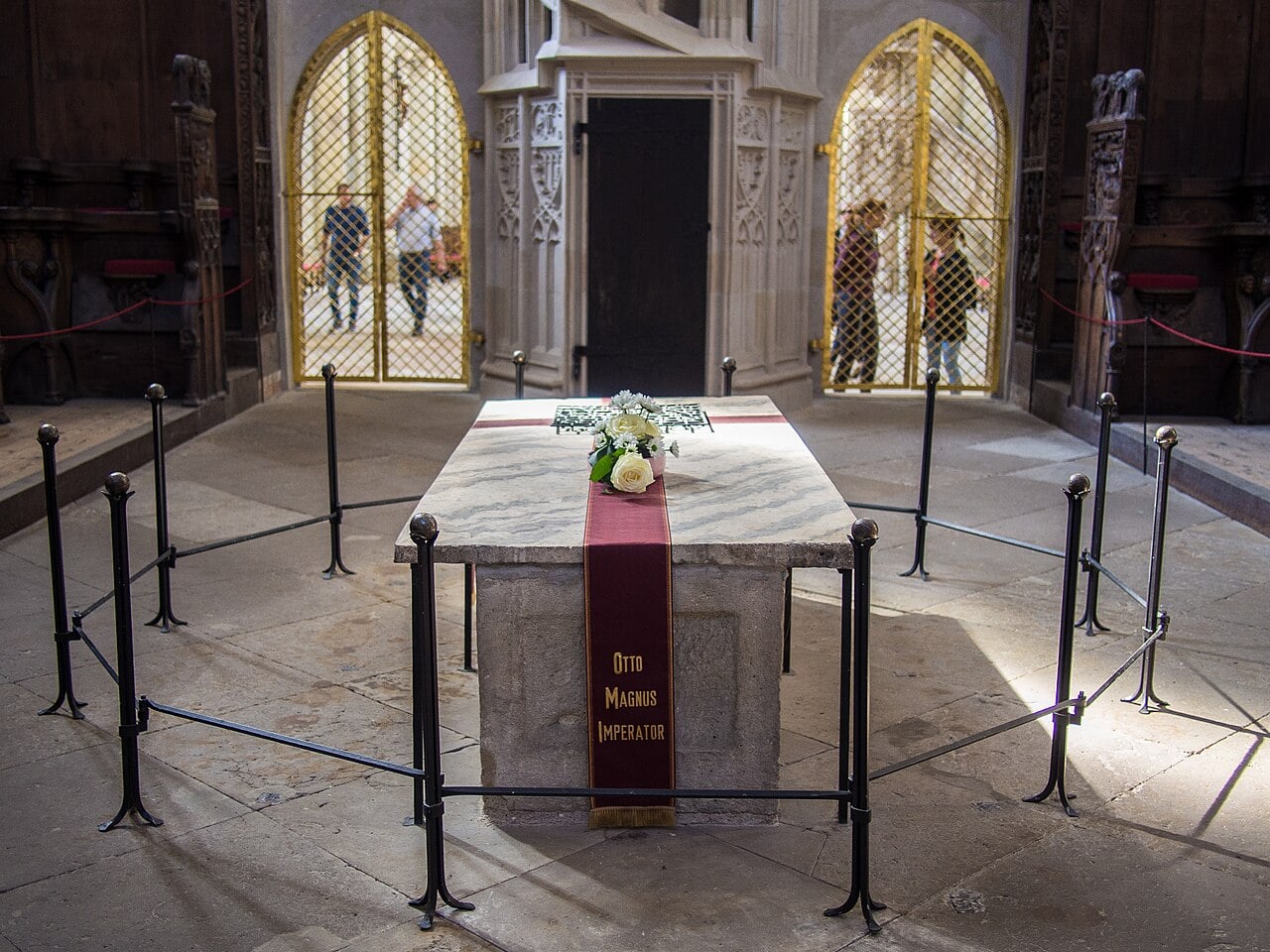

Emperor Otto the Great’s Tomb Yields New Clues During Cathedral Restoration

Conservation experts and archaeologists are uncovering new details about the tomb of Emperor Otto I while carrying out an extensive restoration project at Magdeburg Cathedral.
Since January 2025, the Saxony-Anhalt Cultural Foundation and the State Office for Heritage Management and Archaeology have led efforts to preserve the heavily damaged burial site of Otto the Great, the 10th-century ruler who laid the foundations of the Holy Roman Empire.
Excavations uncover clues to the tomb’s history
The relocation of the sarcophagus also allowed archaeologists to investigate its foundation for the first time. Excavations revealed large sandstone blocks beneath the tomb, including reused building stones marked by late medieval stonemasons. The findings suggest that the sarcophagus was moved several times over the centuries.
Excavations produced numerous artifacts, including coins, glass beads, ceramics, roof tiles, clothing pins, and fragments of painted plaster from earlier cathedral structures. Researchers also uncovered a lead bullet beneath the floor, reflecting Magdeburg’s turbulent history.
Archaeologists restoring the tomb of Emperor Otto I in Magdeburg Cathedral have uncovered medieval foundations, underground passages and centuries-old artifacts. pic.twitter.com/B1PNeRTlwq
— Tom Marvolo Riddle (@tom_riddle2025) June 12, 2026
Researchers also uncovered layers of rubble linked to medieval and early modern construction activities in the cathedral’s High Choir. A network of underground passages, some possibly dating to the Middle Ages, was also documented.
Despite the discoveries, archaeologists found no evidence showing whether Otto I’s tomb occupied the same location in an earlier cathedral that once stood on the site. The original placement of the emperor’s burial, therefore, remains uncertain.
Damage prompted conservation efforts
Otto I, who was crowned emperor in 962, established one of medieval Europe’s most powerful empires. His tomb in Magdeburg Cathedral is considered one of Germany’s most important medieval monuments.
The project began after routine inspections in 2024 revealed serious deterioration in the emperor’s tomb. Researchers identified several threats to the monument, including corroded iron fittings, rising moisture from the ground, and fluctuating humidity levels inside the cathedral.
Scientific analyses confirm the emperor’s remains
As part of the conservation work, experts carried out extensive non-invasive documentation of the sarcophagus and its surroundings. The marble cover slab, weighing about 300 kilograms (660 pounds), was removed so researchers could examine the damaged wooden coffin inside.
Anthropological and genetic analyses later confirmed that the human remains belonged to Otto I, supporting centuries-old historical accounts of his burial at the cathedral.
The emperor’s remains are scheduled to be reinterred on Sept. 1, 2026, in a newly designed coffin currently being created through a competition organized by the Saxony-Anhalt Art Foundation.
Restoration work addresses long-term damage
To protect the monument for the future, conservation teams moved the limestone sarcophagus from its original location in early 2026 using a specially designed transport structure. The sarcophagus now sits inside a secure enclosure within the cathedral, where restoration work is underway.
Specialists are removing corroded iron nails and clamps, many believed to date to the 19th century. As the metal rusted over time, it expanded and placed pressure on the stone, increasing the risk of cracking. Conservators are also removing harmful iron residues from the marble cover slab.
Cathedral remains open during conservation work
Church services continue as normal during the project, while visitors can still view major features of the cathedral, including the High Choir and its famous 13th-century sculptures. Officials said the public will continue to receive updates as restoration and research progress.


.jpg)