Normal view

The 2,500-Year-Old Machine That Helped Ancient Greeks Fight Corruption

10 June 2026 at 18:30
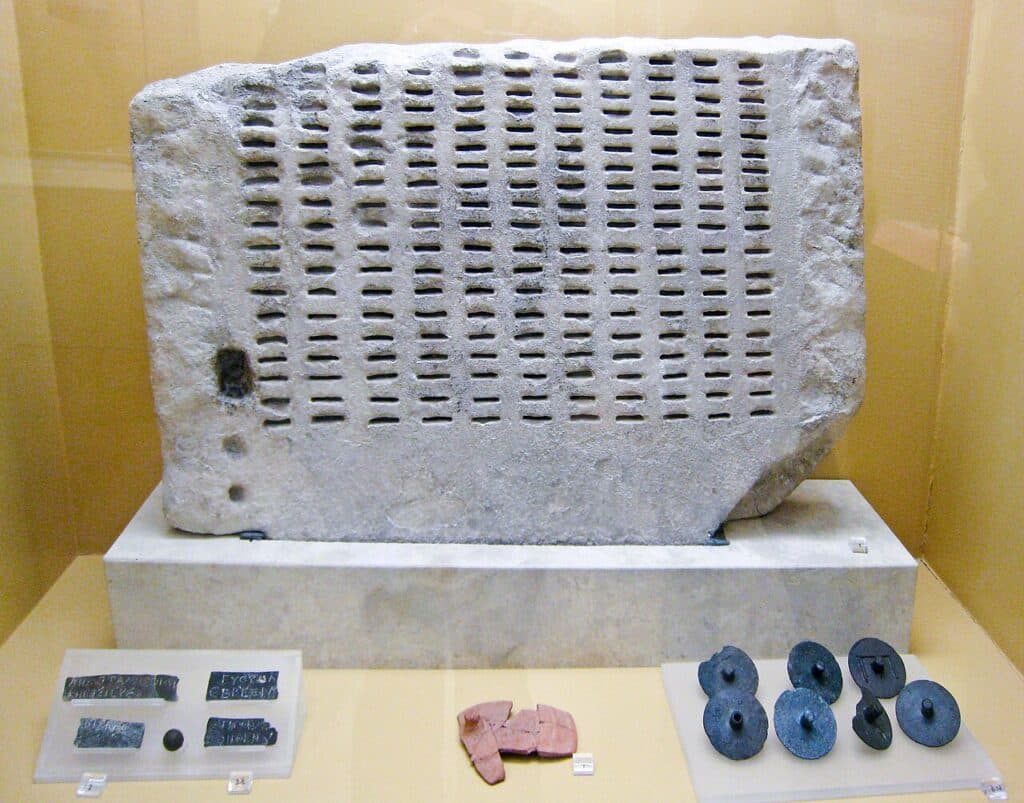
Kleroterion made of marble with identification tickets (pinakia) that were inserted in the slots to indicate eligible jurors in a system of democracy. Exhibited at the Ancient Agora Museum in Athens.
Kleroterion made of marble with identification tickets (pinakia) that were inserted in the slots to indicate eligible jurors. Exhibited at the Ancient Agora Museum in Athens. Credit: Sharon Mollerus Flickr CC BY 2.0

One of the most remarkable inventions of Ancient Athenian democracy was a device used to randomly select citizens for public duties such as jury service and public office.

The kleroterion consisted of a stele with horizontal rows of slots on its front and a vertical metal tube attached to the side. Prospective jurors inserted small, flat bronze tokens known as pinakia into these slots, each engraved with their name, their father’s name, and their deme (municipality). Black and white metal spheres were then placed into a funnel and released into the tube in a randomized sequence.

Candidates whose pinakia aligned with a white sphere were selected as jurors, while those aligned with a black sphere were not. Multiple kleroteria (plural) were installed in front of each court to handle the selection process.

Developed in Classical Athens during the 5th century BC, the kleroterion embodied a radical principle for its time: that ordinary citizens, rather than elites or hereditary rulers, should take part in governing the state through equitable civic participation. Within the broader framework of Ancient Athenian democracy, it represented a systematic effort to formalize political equality.

Although the process may appear simple by modern standards, it was highly innovative in the ancient world. Instead of elections shaped by wealth, family influence, or popularity, the Athenians relied heavily on sortition, or selection by lottery. The kleroterion mechanized this system and significantly reduced opportunities for corruption. Eligible citizens would arrive at the court and place their pinakia into the appropriate slots of the kleroterion, with each column representing a tribe and reflecting the political organization of Athens established after the reforms of Cleisthenes around 508 BC.

Archaeological discoveries, particularly from the Athenian Agora, have confirmed ancient written accounts and revealed the sophistication of the system. The kleroterion ultimately illustrates how deeply equality, civic participation, and safeguards against corruption were valued within Athenian democracy.

The foundations of Athenian democracy and the kleroterion

The foundations of Ancient Greek democracy in Athens were established through the reforms of Cleisthenes in 508–507 BC and later expanded during the 5th century BC under leaders such as Pericles. During this period, Athens actively sought to prevent the concentration of political power in the hands of aristocratic elites. One of the key mechanisms used to achieve this goal was random selection. As Aristotle explains in Politics (Book IV, 1294b), the distinction between democracy and oligarchy was clear and fundamental: “It is accepted as democratic when public offices are allocated by lot; and as oligarchic when they are filled by election.”

This statement highlights the ideological importance of the kleroterion within Athenian democracy. Elections tended to favor wealthy and influential citizens who already possessed reputation, education, and good social networks. Random allotment, by contrast, gave ordinary citizens an equal opportunity to participate in governance. The Athenians believed that political equality, or isonomia, depended on broad participation from the citizen body rather than dominance by a small elite.

The kleroterion was particularly significant in the selection of jurors for the dikasteria, the large popular courts of Athens. Each day, thousands of jurors were chosen to hear legal and political cases. Aristotle also describes this procedure in The Constitution of the Athenians (63): “Each juror, after presenting his ticket, receives a staff and enters the court to which the lot assigns him.”

Random selection in the courts was designed to make bribery and manipulation far more difficult. Because no one could predict who would serve on a given jury, corrupt politicians and wealthy litigants found it harder to influence outcomes in advance. In this way, the kleroterion functioned as a safeguard against corruption and tyranny in Ancient Athenian democracy. In a society deeply wary of concentrated power, randomness itself became an essential democratic instrument.

The randomization process in Ancient Athenian democracy

The randomization process operated in several stages. Citizens first inserted their tokens into the designated slots of the kleroterion. Colored balls were then released from the attached tube in a randomized sequence. A white ball typically indicated that a corresponding row had been selected, while a black ball signaled rejection. Citizens whose tokens aligned with the selected rows would then serve on juries or councils.

This system helped ensure a fair distribution of civic responsibility across different tribes and social groups. Over the course of their lives, thousands of Athenians could participate directly in governing roles. Thus, political participation was understood not merely as a privilege but as a civic duty requiring active engagement.

Regular rotation of officeholders also helped limit the emergence of entrenched political elites. Ancient historians often emphasized the active role of ordinary citizens in Athenian political life. Thucydides, in his account of Pericles’ Funeral Oration in History of the Peloponnesian War (II.37), captures this democratic ethos: “Our constitution is called a democracy because power is in the hands not of a minority but of the whole people.”

Through the kleroterion, this ideal of collective governance was translated into practical reality. Ordinary citizens could be selected to serve on juries or councils at any time. A farmer, craftsman, or merchant might suddenly find himself serving alongside fellow citizens, reinforcing civic identity and strengthening a shared sense of responsibility for the polis.

Modern classicists on the significance of the kleroterion in Ancient Athenian democracy

Modern historians have long recognized the revolutionary nature of the kleroterion system. The classical scholar M. H. Hansen writes in The Athenian Democracy in the Age of Demosthenes: “The Athenians regarded sortition as the most democratic method of selecting officials because it gave every citizen an equal chance of holding office.”

Hansen’s observation underscores how differently the Athenians understood democracy compared to most modern states. Today, democracy is commonly associated with representative elections, but in Athens, elections were often viewed as less democratic precisely because they enabled wealth, status, and rhetorical skill to dominate political life. In contrast, the kleroterion directly challenged social hierarchy by affirming that ordinary citizens were fully capable of public service.

Hansen also emphasizes that the system reflected confidence in collective civic wisdom rather than reliance on specialized expertise. Offices assigned by lot were typically short in duration, and officials were subject to scrutiny both before and after their terms of service. This structure helped reduce the risks associated with inexperience while maintaining broad participation. In practice, Athenian governance depended less on professional politicians and more on the continual rotation of citizens through public duties.

Another modern scholar, Paul Cartledge, highlights the symbolic dimension of the kleroterion in Democracy: A Life, writing: “The allotment machine was democracy made stone.” Cartledge’s phrase captures the broader cultural significance of the device. The kleroterion functioned not only as an administrative tool but also as a physical embodiment of democratic equality. Each citizen’s bronze token occupied an identical slot, with no distinction between aristocrat and laborer once the allotment process began. In this sense, the machine itself stood as a tangible symbol of political fairness and civic equality.

Ordinary citizens in public office

The kleroterion also reflected broader Greek ideas about fate, equality, and civic order. Although the use of chance in political selection may seem unusual to modern observers, the Athenians believed that sortition helped prevent factionalism and personal ambition from undermining the state. Because officeholders could not easily manipulate or predict their selection, the process reduced political competition and eased social tensions.

As historian Josiah Ober explains in his book Mass and Elite in Democratic Athens, “Lottery selection was intended to institutionalize political equality and to minimize elite domination.” Ober argues that Athenian democracy succeeded in part because it actively integrated ordinary citizens into the institutions of the state. The kleroterion was central to this integration. By opening public roles to a broad cross-section of the citizen body, it encouraged loyalty to the polis and helped reduce the alienation often associated with political exclusion.

At the same time, the system had clear limitations. Citizenship was restricted to free adult males born to Athenian parents, while women, enslaved people, and foreigners were excluded from participation. As a result, the democracy supported by the kleroterion was limited according to modern standards. Even so, within the citizen body itself, it pursued political equality to a remarkable degree. The idea that ordinary individuals could collectively govern was profoundly innovative in the ancient world.

The decline of Athenian democracy in the 4th century BC and the subsequent rise of Macedonian power led to the reduced use of institutions such as the kleroterion. Nevertheless, its intellectual legacy endured. Political philosophers and modern democratic theorists continue to debate the value of sortition, and some contemporary scholars have even proposed reintroducing forms of random selection to modern governments as a way to counter corruption, polarization, and elite dominance. In several modern democracies, citizens’ assemblies selected by lot reflect renewed interest in these ancient practices.

Archaeological evidence has further enriched modern understanding of the kleroterion. Excavated examples, now displayed in museums, reveal the advanced administrative organization of Athens. These carefully constructed stone devices demonstrate the seriousness with which democratic participation was approached. Far from being primitive or chaotic, Athenian democracy relied on highly structured procedures to ensure fairness, accountability, and broad civic involvement.

Study of Athens’ Oldest Coins Reveals Unknown, Ancient Silver Trade

8 June 2026 at 10:23


Athens oldest coins silver trade
Wappenmuznen circa 545-525 BC. Credit: Classical Numismatic Group CC BY-SA 3.0 via Wikimedia Commons

Ancient Athens’ oldest coins, minted in the period of the Athenian tyranny in the lead up to democracy in the 6th century BC, were created from ores such as silver originating around the world, a recent study suggests, revealing a previously unknown ancient global trade.

The study, published in the journal Archaeological and Anthropological Sciences, sheds light on how exiled Peisistratus, who ruled ancient Athens as a tyrant three times, managed to set up silver mining operations in spite of the fact that hostile local tribes controlled the regions and its mines. It has long been argued that Peisistratus sourced the silver from the districts of Mount Pangaion and the Strymon river in northern Greece, followed by the exploitation of mines in Lavrion, near Athens.

Athenian coinage was instigated by Peisitratus, who ruled Athens from 546 to 510 BC. This first series of coins in ancient Athens is known as Wappenmunzen, referring to an array of silver and electrum coins, of which the most important were the ‘horse,’ the ‘gorgon,’ and the ‘wheel,’ each of which had their own variations. They were later replaced by the long-lasting and emblematic design for which Athens’s coinage became best known—the owl of Athena.

Researchers studied 22 ancient coins from Peisistratus’ time, 16 from the Numismatic Museum in Athens and six from the British Museum in London. Apart from silver, the coins contain a mixture of other elements, including copper, zinc, gold and lead. They rubbed these pieces on paper strips to obtain a small quantity of the metals, then used a chemical analysis technique known as gas chromatography (a separation technique using gas flow through a glass or metal column that separates compounds). Lead mined from around the world has different isotopic signatures, reflecting those locations. Therefore the researchers were able to match the coins’ signatures to those held on a lead isotope database, allowing them to pinpoint where the material came from.

The analysis of the data researchers collected shows that the Athenians used a wide and unexpected variety of ore sources for the minting of their first series of coins, ranging from Spain in the west to the south of France, through to Turkey in the east and the Rhodope mountains and Romania in the north—the key finding of the study. Lavrion ores, according to the findings of the researchers, were not found in the 22 sampled Wappenmunzen. 

The authors suggest that Peisistratus must have tapped international connections to mint coins under his rule, while the overall analysis points to undocumented trading relationships and a much more interconnected ancient world.

Peisistratus, the ancient Greek tyrant loved by the people of Athens, on a chariot
Peisistratus enters Athens with fake goddess Athena. Credit: Public Domain

Athens under Peisistratus, minter of Athens’ first coins

Peisistratus was an ancient Greek statesman who ruled Athens three times as a tyrant. His reforms laid the foundations for the city’s later supremacy in Greece.

Born around 600 BC, he first came to power with a coup in 561 BC and ruled Athens as a tyrant two more times, from 559 to 556 BC and again in 546 until his death in 528 BC. He was very popular with Athenians.

His defense of the lower class of Athens is an early example of populism. While in power, he confronted the aristocracy and significantly reduced their privileges, confiscating their estates and giving them to the poor.

He also funded many religious and artistic programs in order to improve the economy and distribute wealth more equally among Athenians.

Peisistratus’ legacy includes the unification of Attica, the organization of the Panathenaic Games and the first attempt to produce a definitive edition of Homer’s epics (until then hand-written copies were available only to the rich).

The Athenian ruler promoted the cults of Athena and Dionysus and began the construction of the temple to Athena on the Acropolis. He also promoted a number of other public works, including the Lyceum, temples to Apollo and Zeus, and the Fountain of the Nine Springs.

Furthermore, he supported literature and the arts, and the city’s Dionysia festival flourished during his time. The Athenian coinage had been introduced by about 550 BC and may reflect a policy of his, though there is no clear reference of this in contemporary documents.

The Strange Ox Sacrifice Held at the Acropolis of Athens

7 June 2026 at 02:29
Marble sculpture of a sacrificial ox from the Parthenon.
In ancient Athens, there was a custom of sacrificing an ox in the Sanctuary of Zeus Polieus. Credit: Capillon, Public Domain

In ancient Greece, the killing of an ox was prohibited by law due to its vital role in daily life. However, a peculiar and ‘unlawful’ custom saw priests performing the sacrifice of an ox at the Sanctuary of Zeus, the king of the gods, located on the hill of the Acropolis, just a few meters from the Parthenon.

The Diipoleia, also known as Buphonia, was an ancient festival of the Athenians held towards the end of every June. It was also celebrated separately in other Greek cities during antiquity.

The Buphonia ritual and its origin

According to tradition, to justify the sacrifice, a group of oxen was led to the temple. There, the priest would place a type of bread offering made of wheat and barley on the altar. The first ox to eat from this area would be considered to have committed blasphemy, as it was believed to have consumed the offering meant for the god, and therefore had to be killed.

The priest chosen to perform the killing did so in isolation, without any witnesses present, and would then flee the city.

However, since ox sacrifices were forbidden at the time, an “investigation” was launched to identify the culprit. When the rest of the priests gathered to determine who had performed the sacrifice, the guilty priest was missing. In the end, the only evidence left would be the axe used for the killing, which would eventually be thrown into the sea.

How the ritual was performed

Ancient Greek geographer and traveler, Pausanias, provides further details in his account:

“There is a statue of Zeus—one by Leochares and another called Polieus. Concerning the established practices for the sacrifice and the reason said to justify them, I will not record them here.

For Zeus Polieus, they would place barley mixed with wheat on the altar without any kind of guard. The ox, which they have prepared for the sacrifice and kept under watch, approaches the altar and begins eating the grain. A member of the Thalonid family sacrifices the animal that eats from the sacred offerings with a double-headed axe.

They then summon a priest, called the ‘ox-slayer’ (buphonos), who kills the ox and, in accordance with the law, throws away the axe and flees. Since the identity of the person who committed the act remains unknown, they bring the axe to trial instead. Afterwards, they enter the temple that they call the Parthenon.”

The Buphonos and the trial of the axe

It was believed that the ancestor of the Thalonids, Thalon, was the first to strike the ox. Neoplatonic philosopher Porphyry, attributes the first buphonia to a foreigner named Sopater. He also provides a shorter version of the story, in which the priest of Zeus, Diomos,  “murdered” the animal.The others then cut up the sacrificial victim and ate it.

Afterwards, they would hold a trial to determine the guilty party responsible for the killing. The buphonos (ox-slayer) did not appear, while those who participated in the sacrifice accused one another. They shifted responsibility for the killing from one man to the other.

The participants included the water carriers who brought water for the sacrificial tools, those who sharpened the knife and axe, as well as individuals responsible for carrying the tools.

Ultimately, they would accuse the knife, condemn it, and toss it into the sea. The ox’s hide was stuffed with straw and yoked to a plow. They did this to create the illusion that the animal was still alive.

The entire ritual permeated participants with intense feelings of guilt over the slaughter of the animal, and it was regarded as an act of murder.

Sacrifices in Ancient Greece
The entire ritual permeated participants with intense feelings of guilt over the slaughter of the animal. Credit: Wikimedia commons, Public Domain

Rituals, beliefs, and symbolism

It is noteworthy that, according to Porphyry, after the buphonos Sopater fled to Crete and before the establishment of the festival in Athens, a plague struck the city. The plague only ceased after Sopater’s return and the institution of the festival.

Additionally, as part of the measures to address the plague, the Oracle of Delphi deemed the establishment of the ritual involving the stuffing of the animal’s hide as necessary.

To avoid the pollution (miasma) of the murder, they made efforts to eliminate the act of murder itself. When this was not sufficient, they attempted to justify the act, for example, by claiming that the defilement resulted from impiety.

Finally, they shifted human responsibility by attributing the miasma to an inanimate tool, which became the scapegoat of the entire ritual. This object absorbed the miasma and was then removed from the city.


An animal sacrifice.
The ox, which they have prepared for the sacrifice and kept under watch, approaches the altar and begins consuming the grain. A member of the Thalonid family sacrifices the animal that is fed from the sacred offerings with a double-headed axe. Credit: Wikimedia Commons, Public Domain

Spiritual significance and agricultural connections

According to ancient Greek philosopher Theophrastus, the remains of the ox were buried. Presumably, this was so as to prevent its spirit from seeking revenge on the city. It is important to note that, in this ritual, the value attributed to the spirit of the animal is equivalent to that given to a human.

British classical scholar and linguist Jane Harrison, connects the use of offerings to attract the animal to the altar with the rites of Dionysus Zagreus and Isodaites. Furthermore, the yoking of the stuffed hide of the ox to the plow associates the festival with fertility rituals, which pertain to chthonic deities.

This ritual of purification and averting evil was initially connected to the need to ensure an abundance of game in a pre-agricultural society. Later on, an agricultural society adopted it, shifting the focus to the fertility of the land.

Draco: The Harshest Lawgiver of Ancient Athens

5 June 2026 at 08:11
Greece parthenon made by Greeks
The Parthenon of Athens. Credit: Barcex/Wikimedia Commons/ CC BY-SA 3.0

Ancient Athens is renowned to this day as the birthplace of democracy and cradle of philosophical debate, but few know the story of the city state’s harshest lawgiver.

Draco, also spelled Drako or Drakon, was Athens’ first recorded democratic legislator. Draco was called upon by his fellow Athenian citizens to establish a comprehensive legal code for the city.

Many Athenians were surprised by the harshness of the laws introduced by Draco and baulked at the Draconian constitution that bore his name. Nevertheless, the Draconian constitution introduced several important innovations, namely the transition from oral laws to written laws.

Who was Draco?

Draco was an Athenian aristocrat born sometime during the 7th century BC. Despite his importance to the city’s history, Draco’s biographical details remain incredibly sketchy and little is known about his life beyond the laws that he imposed.

Indeed, as the historian Chis Carey points out in an academic paper published in The Cambridge Classical Journal, “Already for Greeks of the Classical period, Drakon was a shadowy figure. We get no patronymic, no biography; he simply emerges fully formed as a legislator.”

“He may be wholly or in part a fiction,” Carey continues. Crucially, however, Carey sees no reason to dispute the dates given by the ancient Athenians for the introduction of Draco’s laws between 624 and 620 BC.

So, whether or not Draco was a real individual, or perhaps a mythologized stand-in for a specific Athenian lawgiver or collective of legislators, the Draconian institution itself was introduced in the 7th century BC as recorded by the Athenians in the view of modern historians.

Draco’s new Athenian laws

Draco’s most important contribution as a legislator was the introduction of Athens’ first written constitution, the so-called “Draconian Constitution”.

This was an important legislative and legal innovation because the laws had previously been recorded orally. This meant that there was far too much room to arbitrarily interpret or apply the laws. A written system meant that the law was much fairer and more universally interpreted.

So that everyone would be made aware of the new laws – or at the very least, those who were literate – the laws were made visible in the city on wooden tablets called axones. These were presented on rotatable four-sided pyramids called kyrbeis.

One of Draco’s chief aims as a legislator was to bring an end to the blood feuds plaguing the city. He introduced laws that differentiated between homicides and accidental killings and specified punishments for each crime. The translations below provide some perspective:

  • “He who kills another Athenian, without a purpose or by accident, should be banished from Athens forever. If the killer apologizes to the family of the murdered man and the family accepts the apology, then the murderer may stay in Athens.”
  • “A relative of a murder victim, can hunt and take into custody the murderer and thus hand him to the authorities where he will be judged. If a relative kills the murderer he will not be allowed to enter the Athenian Forum (agora), or participate in competitions or set foot into sacred places…”

Athens’ harshest lawgiver?

As a lawgiver Draco was innovative and his changes made the legal system in Athens clearer and more consistent. However, his laws were also deemed to be excessively harsh and were subsequently repealed by Solon in the early 6th century BC.

Severe punishments were often dealt out for relatively minor crimes. For example, a thief might be sentenced to death for stealing a cabbage.

The lawgiver and his code also attracted infamy for its bias in favor of the elite over commoners in Athens. For instance, a debtor unable to honor his debts to a higher-class creditor could be sold into slavery, whereas punishments for higher-status individuals indebted to lower-status creditors were more lenient.

The English word “draconian”, meaning “excessively harsh” or “very severe” is derived from the Draconian Constitution, which is remembered for its severity.

❌