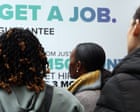
Report says confidence among 16- to 21-year-olds has fallen sharply as they doubt hard work will be rewarded
Young people in England are increasingly “losing faith in their futures” according to a report, as record numbers fear long-term unemployment.
Analysing survey data, including from the Office for National Statistics, the Institute for Public Policy Research (IPPR) said 16- to 21-year-olds were less confident about being successful than a decade ago.
One-off programme to begin in July after recent MenB outbreaks in Kent, Dorset and Berkshire killed three people
Teenagers in their final school year and young people starting university will be offered two doses of a vaccine to protect them against meningitis B, the government has announced.
The one-off vaccination programme, which will begin in late July, comes after an unprecedented outbreak of meningitis B in Kent earlier this year along with clusters of cases in Dorset and Berkshire that, together, led to the deaths of three young people.
Some of the UK’s biggest retailers are planning to write to the prime minister urging him to tackle the youth unemployment crisis, with signatories expected to include the bosses of Marks & Spencer, Sainsbury’s and Tesco.
Lobby group the British Retail Consortium said it had drafted a letter to Keir Starmer calling for action, and is circulating it among its 200 members, which include all the main UK retailers (with the exception of Games Workshop) as well as smaller shops. The letter is expected to be published on Wednesday.
Gabriel Raimondo put his A-levels on hold to run in Channel Islands and ‘represent the younger voice’
Most politicians who win an election in Jersey are probably satisfied with a pat on the back from their supporters and a mention in the local newspapers.
But after becoming one of the youngest politicians in the world, Gabriel Raimondo received a message of congratulations from Donald Trump.
In today’s newsletter: With Keir Starmer expected to announce Australia-style restrictions, further problems – including AI chatbots - are on the horizon
Good morning. Keir Starmer’s expected speech next week about young people’s access to social media will be analysed as much for how it benefits the outcome of a certain byelection, as its safeguarding of children’s synapses.
After issuing an ultimatum to tech firms yesterday to block children’s phones from sharing nude images, the government is expected to make another major announcement about social media within days. Briefings suggest it will stop short of a blanket ban on under-16s accessing social media. But it will still amount to radical regulation, with Downing Street insisting that Starmer is up for a fight with big tech.
UK politics | Volodymyr Zelenskyy has revealed that he plans to invite King Charles on a state visit to Ukraine as early as this year, which would make him the most senior royal to travel to Kyiv since Russia’s full-scale invasion.
Middle East | Fears of a return to a full-scale regional war in the Middle East eased on Monday as Israel and Iran said they had halted attacks on each other after an appeal from Donald Trump to “immediately stop shooting”.
UK news | A report has found “widespread and concerning evidence” of bias and victim-blaming in the family courts – primarily disadvantaging women.
US news | Donald Trump was loudly booed when he was shown on the video screens at Madison Square Garden on Monday night at the NBA finals.
Unemployment | A government-funded pilot of “hyperlocal” job support in 10 neighbourhoods across England has shown “promising early signs of effectiveness”, including for young people, and could be scalable nationwide, a new evaluation has shown.
A government-funded pilot of “hyperlocal” job support in 10 neighbourhoods across England has shown “promising early signs of effectiveness”, including for young people, and could be scalable nationwide, a new evaluation has shown.
The JobsPlus scheme, backed by the Department for Work and Pensions (DWP) and the Youth Futures Foundation, an independent non-profit organisation, focuses intensive support in a small area of predominantly social housing. Echoing a similar, long-established scheme in the US, “community champions” at each site help to engage hard-to-reach people in the local area.
Molly Rose Foundation says government should instead set strict safety standards for apps
A rushed under-16s social media ban in the UK could unravel and families would be left to count the cost, a leading child safety charity has warned.
The Molly Rose Foundation (MRF) said an age limit on the use of tech platforms could unravel, after it was reported that the prime minister, Keir Starmer, would announce a ban on under-16s accessing “harmful” social media apps.
Former safeguarding minister says if ban came into force properly it could ‘basically eliminate’ problem
The government has highlighted work done by the internet safety firm SafeToNet as showing that the technology is already in place that would allow tech companies to stop children using phones to take naked pictures of themselves, or other people. The Home Office says:
Measures to protect children already exist within smartphones and tablets, but are applied inconsistently, often switched off by default and only blurring content rather than blocking it. But the government is working closely with technology companies — some of whom, like Apple, have already taken steps to implement protective features — to make this goal a reality.
Companies must introduce these measures without threatening privacy or collecting any data. The device should simply block harmful content across all apps and services. Over-18s will still be able to view adult content by providing proof of age.
The government is right to act. Children have been failed for too long. This news will be welcomed by parents across the UK and hopefully, will inspire other countries to follow the UK’s lead.
We can put an end to so much online misery with this approach. SafeToNet’s HarmBlock technology is a proven example that it is possible to make the device safe by default and not as some optional add-on.
The changes will apply to UK devices, including both existing and newly sold smartphones and tablets. Legislation could cover operating system providers and others in the supply chain, such as retailers, and will not affect the use of devices owned and used by adults who verify their age …
Apple recently introduced age checks for iPhone users, making it the first company to activate safety features by default for those who are not verified as over 18. This is a significant step forward following the government’s commitments to work with industry, and one this announcement builds on.

 Login
Login