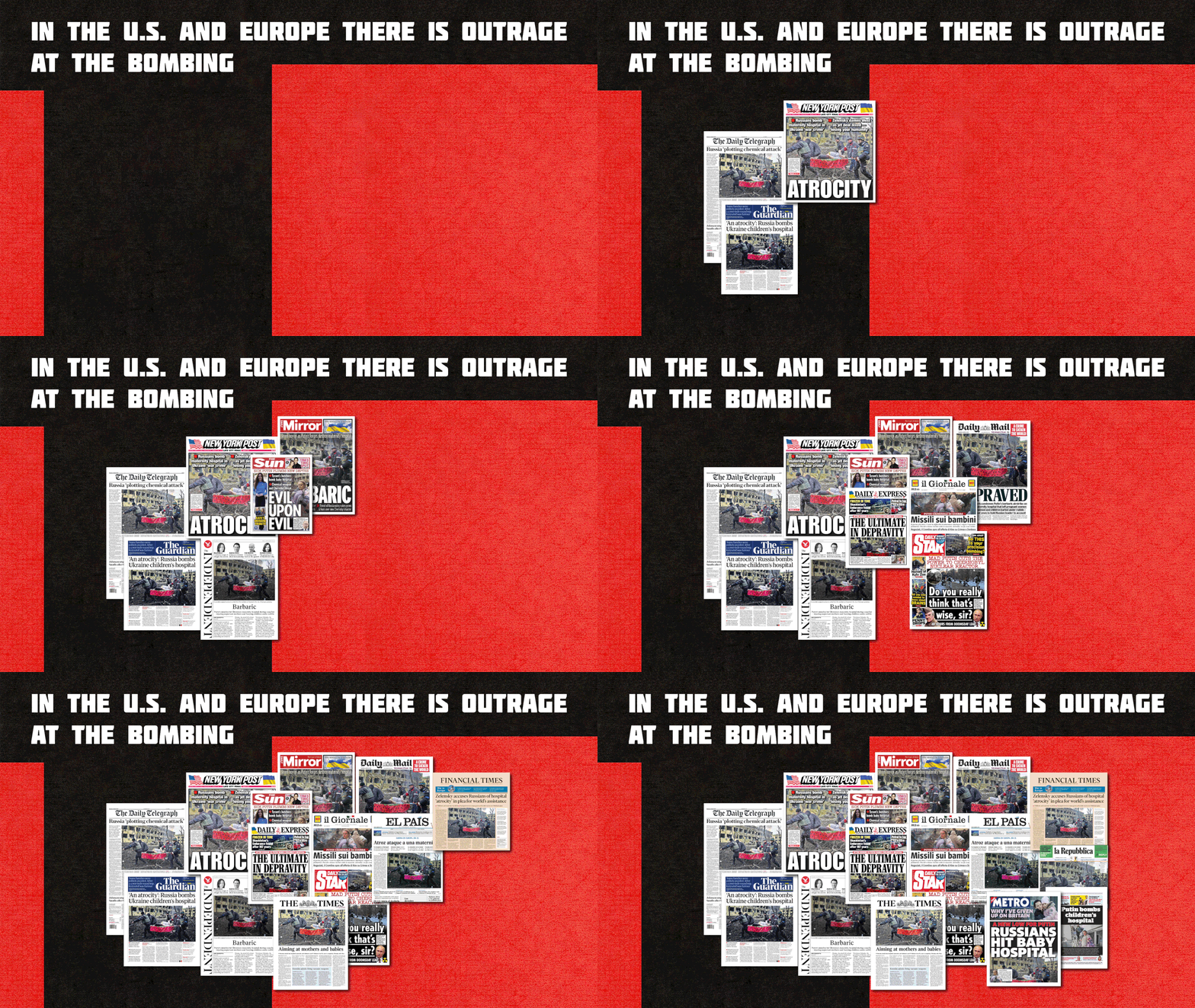
Russian officials and propagandists built cover stories for war crimes before those crimes were committed. Lawyers call this an information alibi. And they think it's prosecutable.
Credits
Thanks to research by Global Rights Compliance with The Reckoning Project
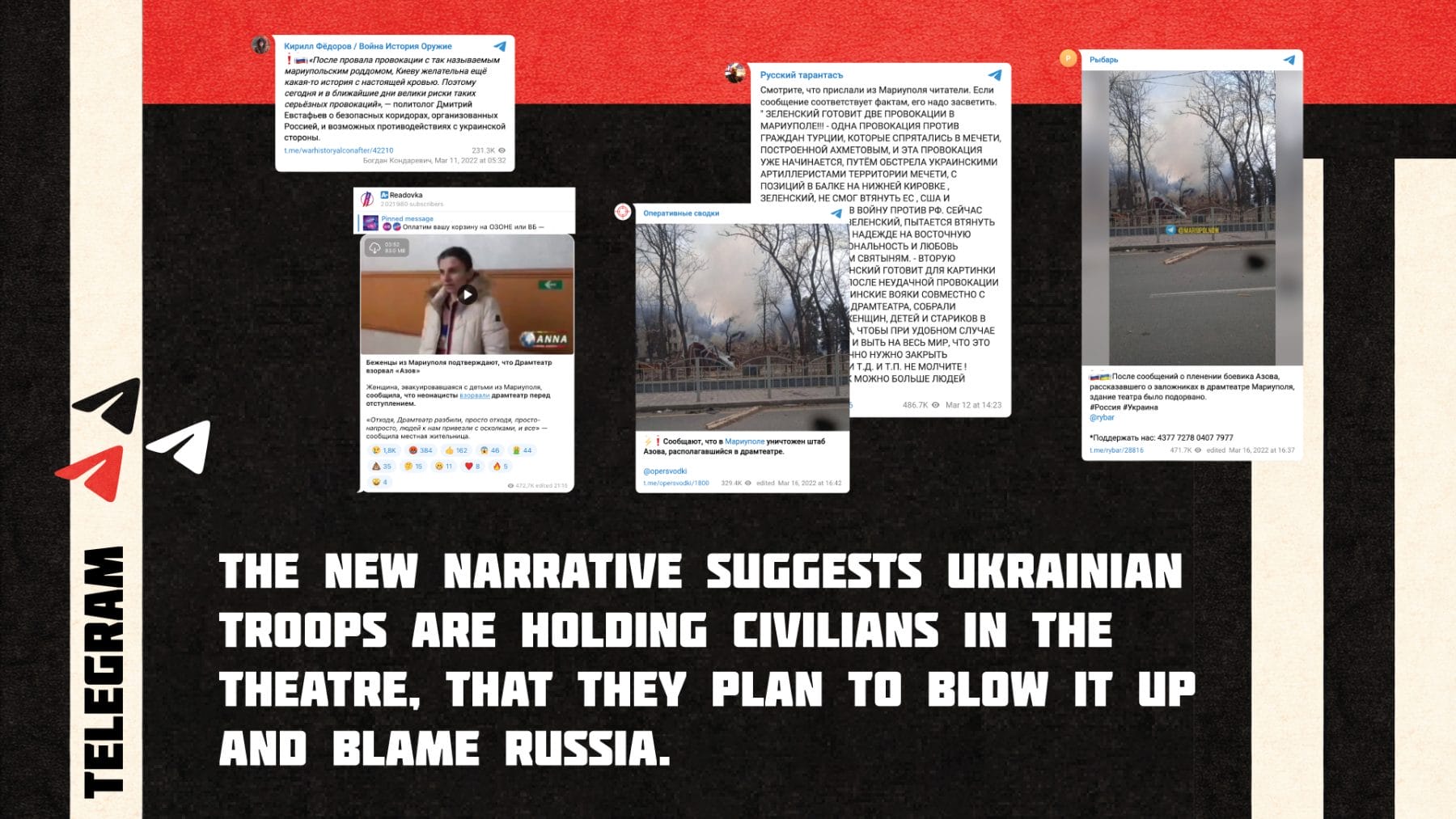
Two days after the attack on the maternity ward, new warnings appear on Russian social media channels.
The focus this time: Mariupol’s Drama Theatre.
Hundreds of Ukrainians are sheltering there from Russian airstrikes.
At 10 a.m. on March 16, 2022, the theatre is hit by Russian airstrikes. Initial estimates suggest hundreds of people are killed.
It’s the same pattern as the airstrike on Mariupol’s Maternity Ward:
Russian media outlets and officials lay the groundwork for a potential attack.
The attack happens.
Media outlets and officials deny that Russia is to blame, and instead blame Ukraine.
“Whenever you're looking at war crimes, crimes against humanity, there's always the excuse that this is a one-off, there's a bad apple, one person did something. When you see it as a pattern, when you see the actors repeating, then you can go, okay, this is part of a consistent behavior, part of a plan, and it becomes like a character trait for a criminal in a court case.“
Peter Pomerantsev
The Reckoning Project Co-Founder
The Syrian civil war morphed out of the pro-democracy Arab Spring protests of 2011, when demonstrations against President Bashar al-Assad's authoritarian government were met with violent repression.
The country fractured into a complex conflict involving government forces, armed opposition groups, and jihadist factions including Al Qaeda and Islamic State.
Russia entered the Syrian civil war at the request of President Assad in late 2015.
Syrian forces had already used chemical weapons against civilians by the time Russia entered the war. By 2016, their use was ‘widespread and systematic,’ according to Human Rights Watch.
By 2018, as Syrian government forces continue to carry out chemical attacks against civilians, a pattern emerges in Russia’s behavior.THE PATTERN:
Russian officials say Syrian rebels are planning to fake a chemical weapons attack and blame it on the Syrian army. Several weeks later an attack takes place.
Dozens of civilians are killed.
Syrian rebels and Western governments blame Syrian government forces. Russia denies the accusations
And then blames others.Investigation by the OPCW later confirmed that Syrian government forces carried out the attack.
But it took five years.
By then the same pattern was being repeated in Ukraine. For months, Russia warned that Ukraine planned to destroy the dam and flood communities downstream.
On June 6 2023, the dam was destroyed.
More than 30 people were killed.
A joint assessment by the UN and the Government of Ukraine finds that the flooding damaged more than 37,000 residential properties, 37 educational institutions and 11 health facilities.
Total losses were more than $13 billion.
Russia denies involvement. It blames Ukraine. In May 2022, Russian blogs and Telegram channels start discussing captured Ukrainian soldiers, held at Olenivka prison. They say the Ukrainian POWs are “confessing” to “war crimes committed by the Ukrainian Army,” and Ukrainian authorities are planning to silence them.
On July 29, an explosion kills at least 53 Ukrainian POW and injures hundreds.
Russia denies involvement. It says Ukraine killed its own soldiers to keep them quiet.
A week before the attack, Russian channels warn Ukraine will use civilians as ‘human shields’ in Kramatorsk. On April 8, at 10.28 A.M., a ballistic Tochka-U missile hits Kramatorsk railway station. It’s equipped with a cluster-munition warhead which disperses 50 small bombs across the station.
At least 58 civilians are killed.
Russia denies involvement. It says Ukraine bombed its own citizens. There’s something curious about the Kramatorsk attack though. According to The Ukrainian Centre for Strategic Communications, Russian state-owned news agency RIA Novosti posts about the attack at 10:25 A.M.
That’s three minutes BEFORE the attack takes place.
The tweet is now deleted, but screenshots were taken before it was removed.
"One of the possible mistakes the Russian info alibi machine could have made was to publish information about a strike on the Kramatorsk railway station before it actually took place.
It's a sort of sloppy mistake that you always want the criminal to make. Without all the other evidence, I don't think we'd be seeing the important patterns that we're looking into, but it's always good for a lawyer if the criminal ends up leaving a shoe at the crime scene.”
Peter Pomerantsev
The Reckoning Project Co-Founder
Photo Credits: 1.Mohammed Khair/Anadolu Agency/Getty Images. 2.Stringer/AFP via Getty Images. 3. White helmets/Handout/Anadolu Agency/Getty Images. 4. Louai Beshara/AFP via Getty Images. 5. Hamza Al-AjwehAFP via Getty Images. 6. Satellite image (c) 2023 Maxar Technologies. 7. Andriy Zhyhaylo/Obozrevatel/Global Images Ukraine via Getty Images. 8. Fadel Senna/AFP via Getty Images. 9. Grzedzinski for The Washington Post via Getty Images.
Russia, Disinformation, and the Syrian Civil War
Russia repeatedly attacked the credibility of the OPCW (Organisation for the Prohibition of Chemical Weapons) which determined that the Syrian regime was carrying out chemical attacks.
Michael Weiss, of The Insider, is writing a history of the GRU (Russian military intelligence) and reports that the unit hacked the OPCW as part of its information warfare operations:
Read more
Why did they want to exfiltrate data from the OPCW? So that they could see this is what the West is preparing to say, and this is how we have to muddy the waters. So here are the counterfactual narratives that we should be putting out. One of them was ‘there was no attack, it was all just manufactured, it was a stage play by crisis actors who feigned asphyxiation and symptoms of being exposed to chlorine.’ Or ‘it was a chemical attack but it was done by the other side.’
The Syria Civil Defence, better known as the White Helmets, was another major target of Russian disinformation. This volunteer rescue organisation documented the attacks on the ground, and their footage and physical evidence proved critical to international investigations. Networks of bots and trolls linked to Russia attacked the White Helmets repeatedly. Russia’s ambassador to the UN submitted one such blogger's report as formal evidence to the Security Council.
To identify suspects, investigators need to map out the landscape of Russia’s information operations.
At the heart of the alibi machine are real people — government officials, media executives, reporters and bloggers.
“Understanding the system depends in part on knowing who participates in it. So firstly, we have to identify a hierarchical network involved in a particular information operation. This may include senior political leaders, media organizations, and social media influencers… We have to prove that there were some orders or instructions that were given by more senior groups to less senior groups.”
Nadiia Vaskivska,
Legal Advisor at Global Rights Compliance
They distribute the talking points — called “temniki” — directly to editors-in-chief of Russia’s biggest state media outlets: TASS, Channel One, Rossiya, RIA Novosti.
We asked Alexey Kovalev — a Russian journalist in exile who once worked inside one of those outlets — to describe how it functions.
“The presidential administration intervenes with specific instructions. It has a kill switch that can immediately blacklist any coverage in Kremlin-controlled media of any unwanted, undesirable topics, like protests, for example. The presidential administration is like the central nervous system of the beast.”
Alexey Kovalev
The Kremlin ‘brain’ doesn't only issue orders. It also enforces silence. Russia's official censorship body, Roskomnadzor, can red-flag content and suspend licences. The effect, Kovalev says, is a system that rarely needs to give explicit instructions because everyone already knows the rules.
"You should instinctively know what things to cover, what things not to cover, and from which angle. Do what you think is expected of you."
Alexey Kovalev
These are the people whose job it is to take Kremlin narratives and project them onto the world stage. As well as Sergei Shoigu, Minister of Defense, and Foreign Minister Sergey Lavrov, several names crop up regularly in the information alibis we’ve looked at:
Igor Konashenkov, spokesman for the Russian Ministry of Defense — the military's public voice, whose briefings provide official cover for Russian military actions.
Maria Zakharova, Russian Foreign Ministry spokesperson, who amplifies narratives across international media from behind her podium.
Vasily Nebenzia, Russia's Ambassador to the United Nations, who takes the alibi to the Security Council, where it can be delivered with diplomatic immunity and broadcast live to the world.
“The Russian mission to the UN plays a very central role in this ecosystem. It picks up and amplifies disinformation that has been seeded in more esoteric parts of the internet and gives it a global platform.”
Peter Pomerantsev
The words of these officials have the full weight of the state behind them. And that helps achieve one of the key goals of the information alibi.
“The Russian use of info alibis has to be seen in their general kind of strategy of ultimately avoiding responsibility and giving their allies enough “implausible” deniability about what the Russians are up to… It gives allies at the UN, for example, a way to go ‘well, we just don't know what happened, maybe this was an accident, maybe the Ukrainians bombed themselves.’”
Peter Pomerantsev
The Reckoning Project Co-Founder
This includes organizations that look independent, but which are actually funded by and have direct links to the Russian state.
ANO Dialog and the Social Design Agency — both now sanctioned by the U.S., UK and EU — are the engine room of this layer.
ANO Dialog — reportedly directly linked to Sergey Kiriyenko and the Presidential administration — distributes billions of rubles in grants to social media creators. Its network of social media channels started spreading fakes about Ukraine from the start of the invasion. One of the examples — a pseudo fact-checking Telegram channel War on Fakes, with over 400k subscribers.
“It's a way to ensure that every content creator is hooked on the government money… The ‘don't bite the hand that feeds you’ mentality.”
Alexey Kovalev
The Social Design Agency (SDA) operates differently — it focuses on creating and spreading Russian disinformation abroad.
“The Social Design Agency is industrialized disinformation, and it can be terrifyingly effective because explicitly pro-Kremlin narratives created by the SDA were shared by people like Elon Musk and Marjorie Taylor Greene. The stuff that they're creating is really bleeding into mainstream Western discourse.”
Alexey Kovalev
An investigation by RFERL found that this meme denigrating President Zelensky, and shared by Elon Musk, was created by the SDA.
Prominent MAGA voice and noted conspiracy theorist Marjorie Taylor Greene also repeated SDA narratives, including about child abductions and organ harvesting in Ukraine. Beyond the funded networks lies the wild west of the information ecosystem: Telegram channels run by so-called “voyenkory” — “war correspondents” — and “Z-bloggers” — activists and war supporters with an estimated audience of approximately 10 million.
They share each other's content, amplify each other's narratives, and give the impression of a spontaneous, grassroots consensus.“Their value to the state is that they create the appearance of organic grassroot support, and can be disowned if something goes wrong.” - Alexey Kovalev
Their “disposable” nature is also what makes them so difficult to pin down and prosecute.
Let’s take the Mariupol hospital attack as an example.
It appears that bloggers and Telegram channels were the first to point to maternity wards being used as firing positions.
A week before the attack, DPR People's Militia channels were claiming that maternity wards were being used as firing positions. Pro-war Telegram channels amplified it within hours.
It was after that, that official spokespeople reinforced the message:
Igor Konashenkov, Defense Ministry spokesman, accused the Ukrainian army of turning hospitals into firing positions.
Vasily Nebenzia, UN Ambassador told the Security Council that Ukrainian forces had placed a firing position in a Mariupol maternity ward before the attack, and reminded them of his warning two days after the attack.
Maria Zakharova, Foreign Ministry spokesperson — remember the briefing she gave just four hours before the bombs fell on the maternity ward?
And then, almost before the dust had settled, the bloggers and Telegram channels echoed the narrative the spokespeople had told the world.
So, as far as who’s leading who, Vasily Gatov, former Russian media strategist and disinformation researcher, thinks it’s a two-way street. Some indications come from the Kremlin, other initiatives are launched from the bottom.
“My opinion is that most of these information operations are created in small groups, mostly people with very limited knowledge of psychology and especially media effects. Some are military, maybe military intelligence. Some are journalists, war journalists. And most of them are people who make their living from telling the Kremlin they're doing a great job.”
Vasily Gatov
Alexey Kovalev agrees that, in his experience as a journalist, there are rarely detailed instructions flowing from the top. Each individual is expected to use their own judgment, as long as it’s favorable to the Kremlin.
“It's a way of controlling by omission that you should not say under any circumstances, and that is anything that is not on the Russian defense ministry's website. Steer clear from any Ukrainian perspective. It doesn't matter. Ukrainians don't have agency. Flood the zone with shit, with a million conflicting narratives. It doesn't really matter that they don't make any sense or it falls apart at the slightest scrutiny. Seeds of doubt have been sowed.”
Alexey Kovalev
“We can tell when an info alibi is peaking. We can look at the online patterns and see how it's spiked. We can see so many telltale signs that this is not organic activity, but part of a planned operation. The technology is a double-edged sword and I think this war is going to be a game changer globally for holding propagandists accountable.”
Peter Pomerantsev
The Reckoning Project Co-Founder
Russia's Disinformation Agencies and their links to the Kremlin
1. The “Doppelganger” case
In 2024, an FBI agent’s affidavit submitted to the Eastern District of Pennsylvania reported that Sergei Kirienko and Sofia Zakharova, both employed with the Russian presidential administration, played key leadership roles in a disinformation campaign named “Doppelganger”.
Read more
In this campaign, entities including the SDA and ANO Dialog created and spread deep fakes about the war, between at least 2022 and 2024.
2. The Dmitri Simes case
Another indictment, filed in 2024 by US prosecutors in the case against Channel One host Dimitri Simes, also reports direct involvement of Russian executive bodies in disinformation operations.
3. Investigations like this one established the impressive width of ANO Dialog’s network of over 100,000 social media pages, as well as regional governance centres and direct links to the Ministry of Defense.
Scott Martin, International Lawyer at Global Rights Compliance
Scott Martin: There's nothing wrong in general with propaganda, disinformation, information operations — they're a common form of any military operation. But when something helps to contribute to the perpetration of a crime, if it helps to conceal crimes or if it obstructs investigations, it shouldn't be seen as background support of propaganda but actually an operational aspect of a kinetic military action. And legally relevant as a consequence.
Free speech is a protected right. Don’t you risk infringing on that right?
SM: This report was done by a group of human rights lawyers with a firm commitment to an expansive understanding of freedom of expression or freedom of speech. However, the right to speak, the right to freely express yourself, ends when speech becomes a tool of a crime. Propaganda is lawful. Information operations are lawful. Participation in a crime is not.
So what exactly is the crime? Which law would you use to bring a case?
SM: It's called Article 25(3)(d) [of the Rome Statute] and it relates to the criminalization of contributions to a crime by a group acting with a common purpose.
Can you break down what exactly a prosecutor would need to show?
SM: - Show that an international crime was perpetrated.
- Show that the perpetrators of the crime were part of a group that acted with a common purpose.
- Then demonstrate that the person disseminating the false narrative made a significant contribution to the commission of that crime.
And what counts as a ‘significant contribution’ to the crime?
SM: If the contribution led to impunity for the crime, because the narrative disseminated in advance was strong enough to conceal the perpetration of a crime or otherwise obstruct accountability investigations, then you should be able to argue that that could be a significant contribution.
How do you prove a group is working with ‘common purpose?’ In the information ecosystem, rumours circulate all the time, they get picked up and passed on, details may change as the story mutates. It doesn’t have to mean there’s coordination between the people involved.
SM: I wouldn't think you'd need to show that here's this group sitting together saying ‘here's how we're going to attack and Vlado this is your responsibility, and Sergei this is your responsibility.’ And international criminal law is a lot like this because we don't have access to many of the conversations that went into a plan. What you do is you draw inferences. And then from there you hopefully will be able to see: Is it accidental? Do we have a group acting together pursuant to a common purpose?
Is that why you need to show a pattern of behavior?
SM: This pattern is important principally for legal reasons. It helps to show that this attack wasn't isolated. It wasn't a mistake. It wasn't opportunistic. It's taking place repetitively in Ukraine. It [the pattern] shows integration between the information operation and the military operation. The speech wasn't just incidental to the military action. It was functionally connected. And as a consequence, maybe providing a material contribution to the crime that takes place and the obfuscation afterwards.
Wouldn’t you need to show direct links between the security services and the people conducting the information operations?
SM: We need to show a full integration and plan of the information operation within the kinetic military action because that's what connects it to the crime. And if we can show that a high-ranking political or diplomatic official in Russia was participating from the beginning, during and after the attack, it leads you to believe that this was being done. But we still must work to ensure an unassailable direct link between the disinformation and the crime that took place. The way it normally comes, in international crimes work, is through an insider who was present at a particular moment and she or he can testify that this information operation was integrated into the military operation as an information alibi.
What gives you confidence a prosecution of Russian propagandists could ever be brought using this law? It’s never been done before.
SM: Its legal coherence is jumping off the page. There was no stretching of definitions. There was no creating new ideas or practices. This was, ‘here's what the law says and here's how it fits and here is supporting jurisprudence.’
There have been plenty of conversations about whether any Russian interference campaigns that they launch online, or these types of disinformation operations can be elevated to a crime. And while a lot of it remains and ought to remain protected speech, when you're looking at it through a human rights lens, in this case, I think we found a very clear example where it should be investigated as a contribution to a crime and perhaps even prosecuted as such.
March 2022 Ukraine’s port city of Mariupol is under siege.
400,000 civilians are trapped as the Russian Army and its local allies, the so-called Donetsk People’s Republic People’s Militia, blockade the city.
Over the following weeks senior officials, state-backed TV channels and news agencies, war reporters and bloggers echo a version of the same story.
The details don’t always match.
Some reports say the maternity ward was used by Ukrainian soldiers, and was therefore a legitimate target.
Others say the attack was “staged” — that Ukrainian forces carried it out and made it look as though Russia had done it.
But the conclusion is always the same: Russia is not to blame for this attack.
“Sometimes things are just chaotic because war is chaotic. At other times, spreading many, many, many different versions of the same event is a very classic Russian tactic to blur the reality of what happened… This is the way you undermine the very idea of truth and belief and just create a sort of a haze around what really happened.”
Peter Pomerantsev
The Reckoning Project Co-Founder
Independent investigations have determined that the hospital was clearly identifiable and operational.
There was no evidence of Ukrainian military positions.
The OSCE calls the attack a "clear violation of international humanitarian law" and a "war crime."
“The narratives were planted well in advance. And I can essentially break them down into:
1 - “We didn’t do it.”
2 - “We warned you that Ukraine was planning to do it.”
3 - “Even if we did it, the maternity ward was a legitimate target.”
They create so many alternative versions of the truth that if you are having at least some doubt you can pick and choose the one that suits you the most and go with it.”
Anastasiia Vorobiova
Legal Advisor at Global Rights Compliance
The mystery of the “Mariupol Madonna” who became the face of Russian propaganda
You might remember this woman, who in the first days after the maternity ward attack appeared on front pages of the media worldwide.
Read more
Her name is Mariana Vyshemirskaya. She’s a Ukrainian blogger, who was about to deliver her baby in that maternity ward.
In the first days after the attack, images of her, taken by Evgeniy Maloletka and Mstyslav Chernov, heavily pregnant, her terrified face covered in blood, made her a symbol of Russian brutality.
Meanwhile, an intense propagandist campaign against Mariana was happening in Russian media.
“She’s an actress” they said. “The blood is fake. She’s not really pregnant.”
Soon after, an interview with the blogger appeared in ChVK media, in which she repeated the Russian version of events: the hospital had been used by Ukrainian military, and Russia had nothing to do with the attack. Vyshemirskaya has since become a well-known blogger inside Russia, collaborated with Russian media and continued to support the government's agenda.

 Login
Login