
Normal view

The Ring of Legendary King Minos: A Tale of Intrigue and Deception

8 June 2026 at 19:31
Ring King Minos
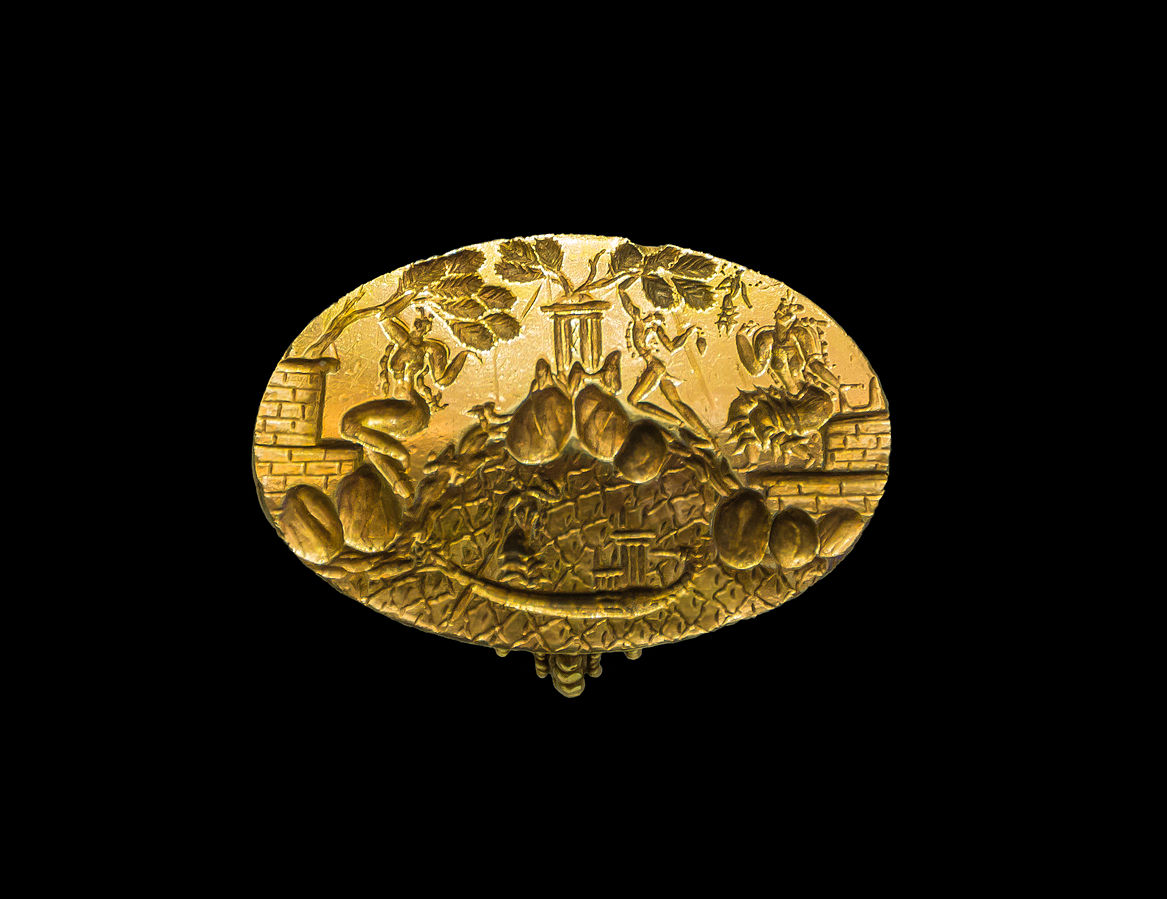
Ring of Minos Heraklion. Credit: Wikipedia/Jebulon/Public domain

The story of the ring known as the “Ring of King Minos” sounds like a tale made in Hollywood. It is a mix of ancient Greek history, mythology, and a plot involving a poor boy, a cunning priest, an English archaeologist, and hidden treasure.

The story begins in 1928, when a boy, Michalis Papadakis (1918-1974), accidentally found a ring at the archaeological site of Knossos. The place of discovery alone meant that the ring certainly had a very long history attached to it probably even going back to the Minoan civilization.

Indeed, several decades later, the shiny, gold, seal ring proved to be 3,500 years old (1,500 to 1,400 BC), as archaeologists assured him, and his was the most significant discovery of Minoan Civilization.

The boy’s father, a destitute farmer named Emmanouil, for some unknown reason, hid the ring from his wife and, for another unknown reason, two years later, he handed it over to the village priest, Father Nikolaos Polakis. Yet, before giving it away, he carved a line on the ring with his knife in order to mark its originality.

Father Polakis initially presented it to English archaeologist Sir Arthur Evans with the intention of selling it. However, there was no deal struck between the two since the priest demanded an astronomical amount of money.

In 1933 or 1934, Father Polakis decided to take the ring to the Heraklion Museum. At the time, the distinguished archaeologists, Nikolaos Platon and Spyridon Marinatos, were on the staff of the institution. Platon decided that the ring was genuine while Marinatos believed the ring was a fake.

Since the two archaeologists could not come to an agreement, they decided it was best to return the ring to the priest.

Ring King Minos
The King Minos Ring at the Heraklion Archaeological Museum. Credit: Twitter/Bokeras

However, Platon kept a copy of the ring by casting it in plasticine. The cast was later located in Platon’s archive. Several years later, he manifested a new interest in the ring and returned to the priest to ask for it. Father Polakis told him that he had given it to his wife for safekeeping, but she had lost it.

Minos ring depicts three themes

Platon wrote a treatise on the ring saying that it depicts three themes: the Minoans’ rule of the seas (“thalassocracy”), tree worship (dendrolatry), and a goddess descending from heaven to earth and getting into a row boat.

There are other, more recent interpretations of the depictions of the ring including the worship of goddesses, such as Mother Dimitra, and offerings to the Great Mother Rhea and the Great Mother Artemis.

For some time, the ring remained lost. The only information about the ring came from the copies that had been made and a number of archaeological reports which were associated with those copies.

Many years later, when Father Polakis was in his final days, he felt great regret about the “disappearance” of the precious ring. He called Evangelia Papadakis, the wife of the farmer Emmanouil, and apologized for lying to her family. He admitted that he had actually sold the ring to Evans, the English archaeologist, for 100,000 drachmas back in 1938.
However, that was one last lie by the cunning priest. What he had actually sold to Evans was a fine replica of the ring.

Evans had returned to England with the belief that he had bought the actual ring, along with a copy, and donated both, along with other precious artifacts, to the Ashmolean Museum. Today, two replicas of the legendary ring continue to be exhibited at the Ashmolean.

The story of the ring was forgotten for decades, but in the early 2000s, Giorgos Kazantzis, a retired police officer, inherited the house of the priest who was the last person in Greece who had had possession of the priceless artifact.

During renovation work, Kazantzis found a jar hidden inside the wall next to the fireplace. Inside the jar was a ring, which indeed proved to be the original Ring of King Minos. It even had the scratch made by Papadakis over seventy years ago.

Kazantzis delivered the precious artifact to the state, and in 2002, the Central Archaeological Council and a panel of expert archaeologists confirmed the authenticity of the ring. The actual monetary value of the ring was estimated to be €400,000 although its cultural value is incalculable.

Yet, for finding the ring and promptly delivering it to the appropriate authorities, Kazantzis was given a measly finder’s fee of €440.

Today, the priceless, gold Minoan ring is exhibited in all its splendor at the Heraklion Archaeological Museum.

What Was the Ancient Name of the Minoans?

8 June 2026 at 02:30
Bronze Age Minoan inscriptions written in Linear A from Phaistos
Bronze Age Minoan inscriptions written in Linear A from Phaistos. Credit: Wikimedia Commons, Zde, CC-BY 4.0

The Minoan civilization was a rich and relatively advanced culture centered on ancient Crete during the Bronze Age. However, they did not refer to themselves as the Minoans. This is a modern name coined by British archaeologist Sir Arthur Evans in the early 20th century. What was the ancient name of the Minoans? What did they call themselves, and what did other nations call them?

Ancient Greek name for the Minoans

There are no Greek historical texts which describe the Bronze Age Minoan civilisation. However, texts from the Archaic Period, such as Homer’s Odyssey, mention a people on Crete called the Eteocretans.

This name means ‘true Cretans’. Later writers, such as the historian Diodorus of the first century BCE, viewed them as the native inhabitants of Crete. Therefore, it is likely that the Eteocretans were the descendants of the Minoans.

The foundation of this term can be traced back to the Bronze Age. A Linear B inscription from Pylos dating to c. 1300 BCE refers to Crete as ‘Ke-re-te’, reconstructed as ‘Kretes’.

Given that this dates from long after the Mycenaean Greeks had conquered Minoan Crete, this cannot be used to show what the Mycenaean Greeks called the Minoans, nor what they called their island.

The Bible’s name for the Minoans

Let us now consider what the Bible calls the Minoans. In the Book of Genesis, the tenth chapter contains the famous Table of Nations. This shows the genealogy of the world’s nations. Included among this list is a reference to Caphtorim, one of the sons of Mizraim.

Mizraim, according to his name and family members, is considered the forefather of the Egyptians. His son Caphtorim is meant to be the forefather of a nation that resided in a place called Caphtor in the Hebrew Scriptures.

Biblical references to Caphtor make it an island and the homeland of the Philistines. Archaeological evidence clearly shows that the Philistines originated from the region of the Aegean Sea.

This is further supported by the fact that the Bible associates the Philistines with a nation called the Cherethites. The latter ethnonym appears to be synonymous with ‘Cretans’, since the Greek Septuagint translated it as such.

Therefore, given this information, it is evident that the island of Caphtor in the Bible is Crete. Therefore, the Caphtorim, or people of Caphtor, is the Bible’s name for the Minoans. Since the reference to the Cherethites only appears in accounts set after the Mycenaean Greeks had conquered Minoan Crete, it is impossible to say whether ‘Cherethites’ is another name for the Minoans or a name for the Greeks of Crete instead.

What other Middle Eastern nations called the Minoans

Were the ancient Hebrew Scriptures of the Bible alone in using this term, Caphtorim, for the Minoans? The evidence shows that they were not. We find variations of this ethnonym in the records of several other Middle East nations.

An 18th-century BCE document from the city of Mari in Syria refers to the island as Kaptara. It uses this term in various contexts, including referencing “Caphtorite fabric.” This suggests that the island was well known by that name in the 18th century BCE, at least within Syria.

However, was this just the name of the island itself? One of the records in the Mari Tablets uses this term referring to a certain man’s ethnicity. This suggests that the ancient inhabitants of Syria, just as in the Bible, used this term for the Minoans as a people, and not merely as the name of the island.

In later centuries, the same term appears in Assyrian records, dating long after the fall of the Minoans. This shows that it was not limited to one particular civilization. Rather, it seems to have been used (at least among some nations) for the inhabitants of Crete regardless of ethnicity.

Egyptian records

In Egyptian records, we find the name ‘Keftiu’ used about Minoan Crete. This is used for Crete in general, even long after the Mycenaean Greeks had conquered it. The fact that this was the term for Crete is clear from the itinerary lists found in Egypt in the New Kingdom period.

Amenhotep III directly associated Keftiu with the place names ‘Knossos‘ and ‘Amnissos’, two of the most prominent cities on Bronze Age Crete. This leaves no doubt that Keftiu was the Egyptian name for that island.

The name ‘Keftiu’ is very similar to ‘Caphtor’ and ‘Kaptara’. The only substantial difference is the absence of the ‘r’ at the end of the Egyptian version. Nevertheless, this Egyptian form is so similar to the others that most scholars recognise that they must be cognate with each other.

In other words, ‘Keftiu’ is the Egyptian spelling of the same word recorded in the Bible as ‘Caphtor’ and in other Middle Eastern records as ‘Kaptara’.

What did the Minoans call themselves?

Unfortunately, we cannot be completely sure what the Minoans called themselves. The reason is that Minoan records use a script called Linear A. Linguists have not yet been able to decipher it, meaning that we cannot read the Minoan inscriptions.

This does not mean that there is no indication as to what they called themselves. The fact that nations as far apart as Egypt and Syria used a form of the same term for Crete is highly significant.

This strongly suggests that Keftiu/Capthor/Kaptara was not a name invented for Crete by any one of those outside nations. Rather, to account for this consistency across that part of the world, it seems far more likely that this came directly from the Minoans’ name for themselves.

When we consider the Egyptian evidence more closely, it becomes more likely that the Egyptians correctly preserved the name of the island. As previously noted, Egyptian records link Keftiu with the place names ‘Knossos’ and ‘Amnissos’, which were the Minoan names for those sites on Crete. If the Egyptians were able to maintain the names of those sites, it is plausible that they similarly preserved the name of the island as a whole.

Therefore, although we cannot be completely sure, it does seem very likely that the Minoans called themselves something similar to the Bible’s ‘Caphtorim’ or ‘Caphtorite’.

❌