Normal view

The 72 Breads of Ancient Greece You’ve Never Heard Of

13 June 2026 at 09:01
ancient Greek bread
Ancient Greek woman taking bread out of the oven. Terracotta figure . 5th century BCE found in Tanagra. Exhibited at the Louvre Museum. Credit: Marie-Lan Nguyen CC BY 2.5

The ancient Greeks used to make a wide variety of breads, as they considered it to be of great importance in their eating habits.

Wheat, considered a gift from the goddess Demeter, was highly valued by the Greeks, who particularly preferred the hulled varieties. Barley, however, thrived in larger regions of mainland Greece. The varieties of wheat and barley with hulls had to be dried to separate the grain before they could be ground. Most Greeks, however, even in areas where wheat cultivation was economically unprofitable, were fond of wheat bread.

Bread made from hulled barley and porridge formed the basis of the ancient Greeks’ diet. The bread was enriched with olive oil and flavored with herbs, spices or honey.

Athenian bread was renowned for its excellent quality and was a source of pride for the Athenians, who imported wheat as the soil of Attica was unsuitable for its cultivation. Thearion, an Athenian of the 5th century BCE, had the honor of being considered the inventor of bakery ovens, and probably of the first bakeries.

Plato mentions Thearion the baker as one of the three people who “were the best caretakers of the human body.” The other two were Mithaecus, a Sicilian, the first known cookbook writer, and Sarambus, a famous wine maker.

The ancient Greeks showed great ingenuity and skill in the art of baking. Athenaeus cites many serious studies on the subject and lists over seventy different types of bread.

Breads were distinguished according to the grain used in their preparation: wheat, rye, millet and spelt. The last three were used only out of necessity, as everyone preferred wheat.

There was bread made from various types of flour: white bread made from finely sifted flour, black bread made from wholemeal flour, which was healthier. Nevertheless, ancient Greeks preferred white bread, because they considered it more refined and better tasting.

Bread was leavened with or without yeast and could be differentiated according to the baking method: oven bread, bread baked on embers or in a pan over the fire into which they put a filling and then dipped it in wine. Delicious, if we believe the praises of the poets: “bread spread from embers, a soft and delightful combination.” Also, some baked the dough on a spit.

The various liquids, fats and spices added to the flour could vary the density and taste of the bread. Wine, milk, cheese and honey, separately or combined in some way, as liquids, oil, ghee or lard as fats, but also poppy seeds, sesame and linseed are most often mentioned as spices.

Finally, the bread would be filled with various types of cheese, raisins and other nuts, sweet or savory ingredients. The bread was often served as a plate, on which meat or fish was placed.

Bread history and stories

The staples of the ancient Greeks were bread, vegetables, cheese and olives. In the Mycenaean era, each house made its own bread and was equipped with its own hand-operated mill which turned wheat into flour.

Bread was kneaded and baked in homes, seasoned with sea salt for better taste.

In the Great Dionysia festivals, participants brought with them baskets containing wine, water and bread, which was needed for the sacrificial offerings. Ancient texts show that the Greeks offered bread to the gods, which they called the Gods’ Breads (Θειαγόνους Άρτους).

In the temple of Demeter in Eleusis, during the Thesmophoria feast, a large loaf of bread was offered to the goddess. The festival got its name Megalartia (meaning large bread) from the bread offering.

There was fierce competition among ancient Greek cities for which one produced the best bread. Athens boasted of Thearion, its best baker, whose name was found in the writings of many authors.

At weddings in ancient Macedonia, the bride’s parents cut the bread in two and the future husband tasted both portions. The custom was followed at the wedding of Alexander the Great to Roxane.

In ancient times, Cyprus was one of the granaries of the Greek world. According to Pliny, the wheat of Cyprus produced a famous brownish-yellow bread.

According to Diogenes Laertius, the smell of fresh, warm bread kept the wise man Democritus alive for three days so that his sister could take part in the Thesmophoria festival, in honor of Demeter. Thus, Democritus “hosted death in his house for three days and treated him to fresh, warm bread.”

Hippocrates mentions various types of bread made from wheat flour, sifted or not, with or without leaven, with bran, with bulgur, with honey and cheese, oil, poppy seeds and sesame seeds.

In the German Bread Museum in the city of Ulm, the most beautiful exhibits are four Greek figurines with female figures from the 5th century BCE, originating from Boeotia. The figurines depict the grinding of wheat in a mortar, the shaping of dough, the baking of bread, and the loaves ready for sale and eating.

In Rome, bread became popular and in 500 BCE, when the well-off Romans insisted on expensive white bread. Bread also played an important role in Roman weddings. In ancient Roman wedding ceremonies, the two families that were joining ate bread together.

Types of ancient Greek breads

There were at least 72 types of ancient Greek breads, named after the added ingredients used or the kneading, preparation method or baking procedure. Several of them are still made today in slight variations.

Alifatitis (Αλιφατίτης): a well-known bread made with added oil. It also contained animal fats. Similar to today’s puff pastry made with butter, a bread recipe of the ancient Greeks according to Larousse Gastronomique encyclopedia.

Artolaganon or laganon (Αρτολάγανον or λάγανον): a flavored bread with the dough rolled out thinly like a small pita and fried in oil. Artolaganon was the ancestor of today’s lagana which Greeks eat on Clean Monday. It was made with good quality flour.

Atabyritis (Αταβυρίτης): a round-shaped bread of the ancient Greeks that had a lot of crumb, and was particularly nutritious and fattening.

Vlomiaios bread (Βλωμιαίος άρτος): a ​​bread with notches to make it easier to divide into pieces. Vlomiaios bread was usually octavlomos, that is, divided into eight pieces (vlomos: a small piece of bread).

Egrides (Εγκρίδες): made with soft dough like pancakes that was dipped in oil and honey.

Thridakini (Θριδακίνη): bread with the dough mixed with wild lettuce.

Plytos or Vasinias (Πλυτός or Βασυνίας): boiled bread. When boiled, it floats in the water. It is made in Crete (boiled buns) and is the ancestor of the Jewish bagel. There are mentions  of this bread offering to goddess Iris on Delos island.

Krivanitis (Κριβανίτης): bread baked in a krivanos, that is, in a mobile clay oven.

Obelias (Οβελίας): it got this name because it was baked in special molds, the “obelisks” (spits) and because it was sold for an obol (όβολο), a small value coin.

Chondritis (Χονδρίτης): bread made from coarsely ground cereals.

Paxamas (Παξαμάς): a type of hard rusk. The name belongs to the baker (Paxamos) who had introduced it. The rusk was baked twice.

Plakountas (Πλακοῦς): was a sweet that had similarities to the modern cheesecake-type dessert. The sweet consisted of several layers of dough filled with honey and soft cheese. Its main ingredients were flour, cheese and honey. The dough of the plakountas was enriched with milk, fat, herbs and spices.

Pyritis bread (Πυρίτης): hulled wheat bread, from the ancient Greek word πυρός meaning the heart of the wheat seed.

Streptikios (Στρεπτίκιος): bread kneaded with milk, oil and honey. It was prepared by twisting the dough with the shape of the Easter tsoureki.
Skiathos Revives Its Winemaking Legacy

9 June 2026 at 10:14
Skiathos. What is its wine-making legacy?
Image of Skiathos. Credit: Greek Reporter

The island of Skiathos in Greece, renowned for its picturesque beaches and vibrant atmosphere, is reviving its ancient wine production as it gains recognition as a gastronomic destination in the Sporades.

Mayor Thodoris Tzoumas has highlighted the island’s unique culinary identity, emphasizing the harmonious blend of fresh seafood and local produce. In speaking to Greek Reporter, he mentioned dishes such as shrimp with wild greens, octopus with zucchini, and distinctive soups featuring foraged greens. The island’s beloved “pita,” both oven-baked and fried, also holds a special place in its culinary heritage.

The return of wine to Skiathos

Skiathos vineyards
Skiathos vineyards. Credit: Greek Reporter

A pivotal development in Skiathos’ burgeoning gastronomic scene is the establishment of its first modern winery, Parissi Winery. This enterprise signifies a profound reawakening of the island’s long-dormant winemaking tradition.

Historically, Skiathos boasted a flourishing viticultural landscape, with vineyards thriving until the mid-20th century. However, a combination of prolonged drought and shifting economic priorities led to a decline in wine production, with many locals turning to olive cultivation instead.

According to Maria Koutseri, co-owner of Parissi Winery, a key element defining Skiathos wines is the island’s unique terroir. Many of their vineyards are strategically situated in secluded areas in close proximity to the sea. This coastal influence imparts a subtle yet distinctive salty, savory characteristic to their wines. This intriguing quality echoes historical accounts of “Stratis,” an ancient Skiathian wine rumored to have incorporated seawater during its production, a practice believed to have enhanced its flavor and appeal among the Romans.

Parissi Winery is dedicated to reclaiming this forgotten legacy. Despite the inherent challenges of cultivating vineyards on a highly tourist-driven island, they are demonstrating the immense potential for producing high-quality, distinctive wines.

The winery operates on a small scale, meticulously cultivating 45 strains of exclusively Greek grape varieties. Their focus is unwavering on showcasing the indigenous flavors of Greece, including Roditis, Assyrtiko, Malagouzia, Alexandria Muscat, Xinomavro, and Limniona. From these, they craft a select range of offerings: four dry whites, one rosé, one red, and a sweet wine, all of which are sold exclusively on Skiathos.

An assortment of wines on Skiathos
An assortment of wines. Credit: Greek Reporter

A wine-making legacy reclaimed

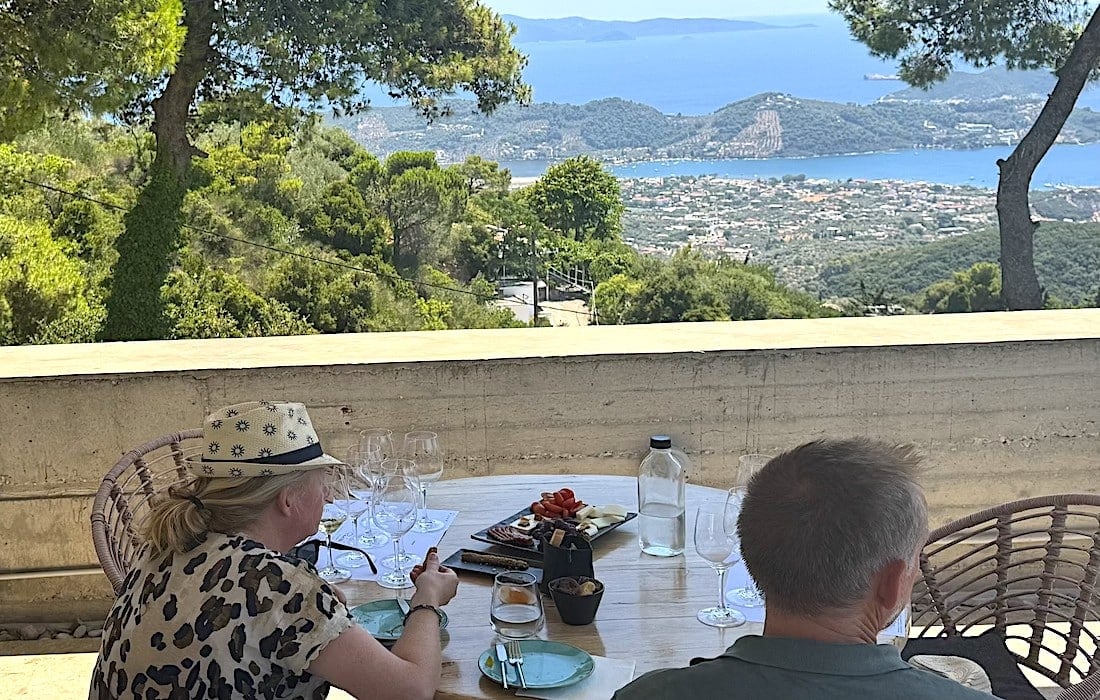
Perched at one of the island’s highest points, Parissi Winery not only offers a taste of its unique wines but also commands breathtaking panoramic views of Skiathos town. Visitors are invited to embark on an immersive experience, beginning with a guided tour of the vineyards, where they learn about the cultivation process and specific grape varieties.

The journey continues into the production area, providing firsthand insight into the meticulous winemaking journey. The experience culminates in a dedicated tasting session, allowing guests to savor the distinctive flavors of Skiathos and take home a piece of its revitalized wine heritage.

Maria Koutseri expresses her heartfelt hope that Parissi Winery will serve as a catalyst, encouraging others to join in this revival. She envisions a future where Skiathos’ rich winemaking tradition is fully restored and celebrated, thereby adding a lasting and sophisticated dimension to the island’s growing reputation as a premier gastronomic destination.

RelatedSkiathos Navigates Tourism Growth With Focus on Sustainability, Quality

4,000-Year-Old Skewers Found on Santorini Reveal Souvlaki Bronze Age Origins

6 June 2026 at 02:33
Bronze Age souvlaki grill from Santorini
An ancient Greek grill for souvlaki from Akrotiri, Santorini. Credit: Wikimedia Commons/ Public domain

The beloved souvlaki has been around since ancient times. Archaeologists have found skewers dating back to the Bronze Age, and recent research looks at the functioning of early grills. In particular, “souvlaki trays” have been discovered dating all the way back to Mycenaean culture.

Therans and Mycenaean cultures were known for their luxurious lifestyles, ornate and colorful clothes, exquisite art, and sea trade with other cultures, such as Egypt. People developed these cultures on the islands of Crete and Santorini.

World’s oldest Bronze Age souvlaki on Santorini

The oldest souvlaki skewers found seem to be those discovered by archaeologists on Santorini dating back as far as 2000 BC. There are traces of the popularity of souvlaki on Santorini and Crete through the Bronze Age, and both Theran and Mycenean cultures made use of this method of cooking.

Ancient bronze skewers and vase, with small painted ceramic amphora
Ancient bronze skewers and a vase. Credit: diffendale/CC BY-NC-SA 2.0.

Ancient Greek texts such as the Iliad and the Odyssey describe a spit (Greek: ὀβελός) being used to roast meat, but the exact functioning of the souvlaki trays was unknown until recently. The works of great poets and writers describe the same obeliskos being popular. Sophocles, Aristophanes, Xenophon, and Aristoteles all mention or describe the popular dish in their works.

Mycenean cooking and culture

It seems that ancient Mycenaeans did not have a large variety of foods available to them. Despite this, they developed various types of cooking methods, fostering innovation. Part of that innovation was souvlaki trays, as was cooking in jars, among other techniques. At the time and for most of ancient history, cooking was mostly done on hearths with few ingredients. The portable and lightweight souvlaki trays changed this for Mycenaeans around 1400 to 1050 B.C.

Academics suggest that an important historical force behind these contraptions was status. While the Myceneans had incredibly rich art and fashion, their diet lacked diversity, though a marker of status was drinking wine. On the other hand, one can imagine poorer Mycenaeans drank beer.

As they were skilled sailors, Therans on Santorini island had begun brewing beer in the II millennium B.C., possibly learning the skill from Egypt or the Near East, where beer had been brewed since the III and IV millennium B.C. Accounts of the 5th and 4th centuries B.C. tell of an Athenian bias against beer. It was considered a drink of barbarians, Egyptians, or even women. Beer brewing was never seen as valuable.

By the Classical period, this all changed. Wine had become readily available to all, pushing elites in later Greek societies to seek other ways to distinguish themselves — for instance, through the use of specific gadgets and kitchen appliances, echoing earlier innovations like the Mycenaean souvlaki trays.

The souvlaki tray

The souvlaki trays found in Gla, Pylos, and Crete added something to the age-old tradition. Similar to modern-day outdoor grills, they were designed to be portable and good for travel or entertainment. Meat cuts seem to have been similar to the ones popular for souvlaki today, made from either lamb, pork, or mutton, and the meal was accompanied by bread made of various cereals.

The clay trays had placeholders for the skewers and, until recently, how they actually functioned was unknown. Researchers at Dartmouth College have recreated the trays using original ancient pottery techniques, tools, and ingredients. They realized the trays were not meant to be put on a hearth as originally thought. Rather, embers were placed in the tray and the skewers were grilled. They were practical, portable, and delicious!

Mastiha Cocktails: The Greek Summer Experience

4 June 2026 at 13:26
Mastiha cocktails
That first sip of the cocktail washes away the heat and leaves you feeling cool and invigorated. Credit: Greek Reporter

Mastic or mastiha from the Greek island of Chios is getting traction on social media as the basic ingredient for summer cocktails.

Many bartenders and amateur connoisseurs are uploading videos of how to use the “white gold” of Chios to make flavorful and refreshing cocktails ideal for the summer.

Until recently, Greece’s mastiha liqueur hasn’t been as popular as other aperitifs. Thanks to new brands’ premiumization of the category and further education on its benefits, however, mastiha is starting to gain a cult following.

The myriad mastiha coctails

Here is a take on a cocktail called “Cleopatra”:

@drinkkleos

KLEOS Mastiha Spirit’s signature cocktail (The Kleo-Patra) is your Greek vacation in a glass 🇬🇷☀ This cocktail is super crushable and absolutely refreshing. PLUS there’s only 110 cal. and 4g of sugar in the full cocktail 😌 Yia Mas 🥂#earnyourkleos #mastiha #kleostakemeaway #chios #mykonos #mixology #mixologist #mixologytiktok #athens #travelgreece #skinnycocktails #lowcal #lowsugar #cocktailrecipes #superfood #luxury #luxlife #cocktailtok #garnishgame #greeksummer #summercocktail

♬ Taste It – TELL YOUR STORY music by Ikson™

According to the following video by Nikki’s Modern Mediterranean, apart from one ounce of mastiha, you will need the following ingredients to make a summer cocktail: One ounce of peach vodka, peach nectar juice, grenadine, ice, and orange and cherry for garnish.

Another version is the rum, mastiha, and coffee cocktail:

Until recently, mastiha was actually considered a peasant spirit or liqueur often sipped after meals in Greece. This reputation is partly due to how it was made and the fact it wasn’t highly consumed outside of Greece.

@jackiesfooddiary

Have you tried Mastiha?! Officially my summer cocktail #mastiha #chios #liqueur #cocktail #cocktailrecipes #greek #drinkideas #summercocktails

♬ gimme gimme gimme – ·:*¨༺ ♱✮♱ ༻¨*:·

Now, with society’s growing interest in niche global spirits, mastiha spirit has come into the spotlight, and it’s becoming more common on menus at high-end Greek beach clubs as well as restaurants and global cocktail bars from New York to Los Angeles.

Here is yet another version of mixing mastiha with liquor:

@kforkalliopi

@Cello Liqueur & I made this delicious Mastiha cocktail using their Melon Liqueur 🧡 (you’ll have to excuse the banter, I gave him a headache for an hour 😂) #cocktail #drink #mixologist #cocktails #italy #italian #greek #greekgirl #fyp #foryoupage #liqueur

♬ original sound – 🎀 Kalliopi 🎀

Mastiha of Chios, Greece’s ‘White Gold’

Mastiha, often referred to as the “Tears of Chios” or the “White Gold of Greece,” is a product made exclusively on the Greek island of Chios. Since antiquity, this sticky resin, which seeps from the bark of mastic trees, has been harvested not only for its flavor but its therapeutic value.

Although the mastic tree, also called “lentisk,” is native to many areas in the Mediterranean, its bark only “bleeds” mastic on the island of Chios, making it a truly unique and nearly miraculous product.

Mastic is used as flavoring in many sweets and drinks, most famously in Mastiha, a digestive liquor from Chios. The mastic “tears,” or small bits of hardened tree sap, can also be chewed like gum, a practice dating back thousands of years. Its healing properties include prevention and treatment of stomach pains and gastric disorders as well as rejuvenation of the skin.

Its rarity has made mastic highly sought-after throughout history. Even to this day, mastic is considered a precious commodity not to be wasted. The European Union has designated it a “protected designation of origin” product, confirming that only Chios may produce authentic mastic.

The Oldest Greek Company Still Makes Chocolate

4 June 2026 at 11:21
The oldest Greek company, Pavlidis chocolates
“Health chocolate,” made by Pavlidis, the oldest Greek company. Credit: #PavlidesYgeias Facebook

The oldest Greek company is chocolate maker Pavlidis, which started off as the first confectionery shop in Athens more than 180 years ago.

It was 1840 when Spyridon Pavlidis, the son of a successful manufacturer of munitions used in the Greek War of Independence, established a printing house at the corner of Aiolou and Vissis streets in downtown Athens. It was where he published the works of intellectuals who opposed the autocratic regime of King Otto. He also printed a volume of the History of the Greek Nation.

However, Pavlidis was not satisfied with his business. He was an ambitious man and was not content running a printing house. Thus, he passed the printing business on to another member of his family while he himself moved on to new adventures.

His plan to establish a confectionery in 1841 was pioneering at the time. In the same space as his printing house, he opened the Pavlidis Confectionery, the first such business in Greece. Hence, it is the oldest Greek company.

The little sweets shop was the foundation of the largest chocolate company in Greece. This was the same year that the first Greek bank, the National Bank of Greece, was established.

The Pavlidis Confectionery soon became the talk of the town, offering Athenians sweets such as baklava, loukoumia, and koufeta. It became the meeting point not only for residents of the newly established capital but also for foreigners, mainly military and diplomatic personnel.

Pavlidis discovers chocolate in Europe

Following the success of his confectionery, Pavlidis decided to travel to Europe for innovative ideas and confection production machinery. He spent several months in Paris, Vienna, Rome, Amsterdam, and Madrid, among other cities. Coming from Greece, which had gained its independence only a few years ago, he was impressed by the technological advancements and innovations in the field of production he saw in Europe.

It was in Europe that he discovered a product unknown to the Greeks of the time. This was chocolate. He was so impressed by the dark brown confection that he rushed to buy the proper supplies and take his newly acquired knowledge of chocolate and confection making back to Athens.

In 1852, conditions were ripe for the introduction of the new, irresistible confection, chocolate, to his Athenian customers, who embraced it warmly right from the very beginning. Pavlidis had brought with him a manual coffee grinder and a good supply of chocolate to offer the new confection as a hot beverage.

Convinced of its nutritious qualities, Pavlidis also promoted chocolate for its medicinal qualities, calling it “health chocolate” (Greek: σοκολάτα υγείας). To this day, dark chocolate in Greece is referred to as “health chocolate” regardless of the manufacturer.

Seeking ways to upgrade the quality of his chocolate and make it more widely accessible, Pavlidis began making chocolate bars of great quality. International awards were won, and these were added to the famous blue wrapping still in use today.

The “health chocolate” was loved by Greeks, and in 1865, the dark delicacy won gold in an international chocolate fair in Paris. Eighteen more awards, featured on the blue wrapping of the chocolate bars, followed in European confectionery competitions.

The oldest Greek company and its “health chocolate”

Without resting on his laurels, Pavlidis sent employees abroad to introduce them to the world of chocolate. Their mission was to return with innovative ideas. In 1867, he chose to participate in the Paris World Affair, the largest exhibition in Europe. It is said that it cost him more than 21,000 francs to participate, but his effort was rewarded, as his “health chocolate” won two bronze awards.

The next innovation came in 1871, when, in an effort to renew the manufacturing machinery, he introduced the first steam-powered chocolate production machine. As his descendant, Dimitrios Pavlidis, described: “The event was considered grand and the Athenians gathered forming endless queues in front of the workshop to admire or…be frightened by the steam engine.”

Indeed, the steam-powered chocolate production machine was a technological wonder of the time. It completely changed the making of the famous health chocolate and the oldest Greek company defined a new era in the country’s industry.

The next landmark year for the Pavlidis family was 1876, when production moved to the Piraeus Street factory to cover the great demand for the now world-famous chocolate. The renovated factory remains in the same spot today.

The year 1876 ​​is noteworthy. The Pavlidis chocolate factory was established and began its operations in the Piraeus Street factory, where it continues to stand to this day. The aroma of chocolate looms over Piraeus Street when the machines are running.

Two years later, Dimitrios Pavlidis succeeded his father and founder Spyridon Pavlidis until the family business passed on to Alexandros Pavlidis in 1895.

Pavlidis chocolate enters the 20th century

In the new century, the oldest Greek company grew further, and the factory produced mass quantities of “health chocolate.” Dimitrios Pavlidis renovated and modernized the Pavlidis chocolate factory on Piraeus Street, making it a model industrial unit of the time.

The premature death of Alexandros Pavlidis at the age of 54 was a great loss for the company, as he was a notable figure in the corporate world.

During the German occupation (1941-1944) the factory was commandeered by the German army to produce jams and pharmaceuticals.

Following the war, the last member of the family to take over the management of the business was Dimitrios A. Pavlidis. He constructed the building on Aiolou Street immediately after the occupation, as the factory remained closed for quite some time due to lack of raw materials.

His wife, Eleni Pavlidis, took over the management of the business. As a dynamic woman with a flair for business, she made the company a limited liability one. Eleni was then succeeded by her son Dimitrios.

Dimitrios Pavlidis proceeded to expand the factory premises on Piraeus Street and create a new unit at Oinophyta, Viotia. He updated factory machinery and concentrated on expanding the company so as to also export products.

When Dimitris Pavlidis passed away in 1986, the presidency of the company was successively held by Aspasia A. Pavlidis and Georgios X. Pavlidis. In 1988, the oldest company in Greece and the most historic Greek sweets industry passed on to the hands of the Swiss group Jacobs Suchard, one of the largest multinational confectionery, chocolate, and coffee groups in the world market.

In 1991, Pavlidis was acquired by food giant Kraft. The new owner renovated the Piraeus Street factory, which was completed in 2000 in its current state as a chocolate museum.

Beyond the Gyro: Why Vegetarians Love Greece

3 June 2026 at 14:06
A plate of salad in Greece, which has a cuisine based on fresh seasonal vegetables and fruit, grains, legumes, and greens.
Greek cuisine is based on fresh seasonal vegetables and fruit, grains, legumes, and greens. Credit: Pxhere/Public Domain

Greece offers vegetarians a large variety of highly nutritional, delicious dishes to choose from. Using fresh ingredients, prepared with age-old recipes, Greek cuisine is full of delightful surprises for which your taste buds will be thankful.

Greek cuisine is based on fresh seasonal vegetables and fruit, grains, legumes, and greens—the perfect combination for vegetarians and vegans.

Across Greece, you will find a large variety of wholesome and flavorful but meat-free dishes for your palate to savor. It goes to show that Greek food is not just comprised of souvlaki, moussaka, or roasted lamb on a spit.

Vegetarianism as a practice, the idea of nonviolence to animals, has its roots in Ancient Greece as well as Ancient Indian civilizations. Ancient Greek historian Plutarch could be considered the first outspoken vegetarian in the West, as he believed that it was “immoral” to eat animal flesh.

In his book Morals, Plutarch devoted an entire chapter on meat-eating. Therein, he wrote that since man has access to so many fresh fruits, vegetables, and nuts, the fact that he is forcing himself to eat bloody animal flesh while “trying to cover the taste of blood with thousands of spices” is inconceivable.

Appetizers, salads, and dips for vegetarians

Choriatiki is quite a popular Greek salad made with freshly cut thick wedges of tomatoes, cucumber and onion slices, feta cheese, flavorful olives, virgin olive oil, and crushed, dried oregano leaves. It’s the perfect starter that will whet your appetite for the main course.

Traditional Greek salad
Choriatiki, the traditional Greek salad. Credit: Creative Commons Attribution 2.0/Wikipedia

Dakos salad is a Cretan salad, which contains round, water-dampened barley rusk topped with chopped fresh tomatoes, crumbled feta or myzithra cheese, olive slices, capers, and a sprinkle of dried oregano A useful tip is to allow the juices to soak the rusk for a few minutes.

It is highly recommended that one try the following tempting mezedes (appetizers or side dishes): fried or grilled vegetables or cheese, including such delicacies as fried tomato balls, green vegetable patties, and saganaki cheese (fried feta or hard yellow cheese). Sliced zucchini can be boiled or fried, while zucchini is also used to make delicious patties (mixed with herbs and/or cheese). The sweet-tasting fried slices of eggplant and the rice and herb-stuffed zucchini blossoms are two must-try dishes, mostly served in the summer and autumn.

Tzatziki dip
Tzatziki dip. Credit: Nikodem Nijaki, Creative Commons Attribution-Share Alike 3.0/Wikipedia

Accompany your vegetarian appetizers with some great-tasting dips:

  • Taramosalata: A mousse salad made from fish roe blended with lemon, bread, and olive oil
  • Melitzanosalata: A puree of grilled or smoked aubergines with olive oil, garlic and vinegar
  • Tzatziki: The most famous Greek appetizer around, made with creamy Greek yoghurt, grated cucumber and garlic, and finely chopped dill, blended with oil, vinegar and salt.
  • Skordalia: A vegan dip made with mashed potatoes or bread, garlic, olive oil, vinegar, salt and pepper. It usually accompanies fried cod and boiled beets (patzaria in Greek).

Main courses in Greece for vegetarians

Legumes & pulses

Pulses have been an essential part of the Greek diet since antiquity. Yellow split peas, gigantes (large dried white runner beans), broad beans, lentils, black-eyed peas, and chickpeas all hold an important place in the Greek cuisine and are an essential part of the Mediterranean Diet. Pulses are cooked in hot nourishing soups in the winter. Tey are also great in salads mixed with herbs and vegetables in the summer.

Northern Greece yields top quality pulses, as the soil is rich in potassium, an element that makes them more flavorful and contributes to shorter boiling times. Among these are beans from the Lake Prespes area, lentils from Voio, Kozani, yellow split peas from Feneos, Korinthia, and Santorini, lentils from Eglouvi, Lefkada, and chickpeas from Larisa or Grevena. These are all well-known, top quality produce on account of each area’s favorable microclimate.

Ladera (meaning cooked with olive oil)

Olive oil has always been a product precious to Greeks, one that has been considered sacred since ancient times. Ladera dishes are colorful and flavorful. Vegetables are cooked either fresh or dried in the pot at low to medium temperatures so as to best retain their shape and flavor.

Below are some tasty Greek vegetarian dishes for you to try:

  • peas and okra (stewed with tomatoes)
  • artichokes (cooked with potatoes, carrots, lots of finely chopped dill, and lemon juice—the “a la polita” dish)
  • zucchini, potatoes, carrots, bell peppers, eggplant, and onions baked with tomato sauce and spices (a dish called “briam”)
  • eggplant cooked with tomatoes, onions, garlic, parsley, dill, and spices (a dish called “imam”)
  • oven-baked stuffed tomatoes, peppers, zucchini, and eggplant filled with a mixture made of rice, the flesh of the above vegetables, herbs, and spices (a heavenly dish called “gemista”).

Pies, the vegetarian way in Greece

Pies hold a special place in the country’s cuisine, as they are among the oldest, simplest, and most delicious dishes one can find in Greece. There are so many variations of ”pites,” as they are known in Greek, that it may be nearly impossible to determine precisely how many different kinds of Greek pies there are out there.

Spanakopita
Spanakopita. Credit: Tanya Bakogiannis/Wikimedia Commons/CC BY 3.0

Pies are very popular among Greeks, and they come in all sorts of variations: savory, sweet, dressed with phyllo sheet or flaky pastry (called “sfoliata”), round, triangular or coil-shaped with either few ingredients or more elaborate ones. Age-old household management rules point towards the optimum use of seasonal produce, resulting in a large variety of tasty creations. Pies can be served as a main or side dish or as a healthy and tasty snack during the day.

Pie filling variations depend only on the maker’s imagination and the local bounty of nature. Practically everything can be included in a pie: cheese, greens, pasta, rice, trachanas, and vegetables, among other things. Greek ingenuity has led to a large number of pie creations, including cheese pie, spinach pie, leek pie, nettle pie, mushroom pie, onion pie, cabbage pie, potato pie, pasta pie, pumpkin pie, and many more.

Greek Pasta

You can find Greek pasta in many a shape and size. Some types contain milk and eggs. They can be a simple yet very tasty mixture of durum wheat or semolina, water, and salt.

The pasta-making tradition is kept alive mostly by women living in the countryside who usually prepare the pasta and allow it to dry out in the sun during the summer. They also participate in regional cooperatives, producing and selling a large variety of artisan pasta.

Greece vegetarians
A bowl of trachanas. Credit: Vangelisg4, Creative Commons Attribution-Share Alike 4.0/Wikipedia

Such regional co-ops exist all over Greece on the mainland and islands alike. In these co-ops, you will find popular Greek pasta such as:

  • chylopites (noodles that come in two basic shapes, namely small squares or thin, fettuccine-like strips)
  • kritharaki (orzo)
  • trachanas (a granular pasta made with semolina flour, wheat flour, or cracked wheat, kneaded with milk, yoghurt, buttermilk)
  • lazania (broad strips of egg pasta)
  • fides (angel hair)
  • astraki (a small star-shaped pasta)
❌