Normal view

Save Europe Act Nears 100K Signatures as Initiative Demands Reversal of Mass Immigration

1 June 2026 at 23:34

The newly launched Save Europe Act is on the verge of reaching its first major milestone after attracting nearly 100,000 signatures in less than two days.

Spearheaded by Dutch political commentator and activist Eva Vlaardingerbroek, the campaign has been billed as the “first patriotic European Citizens’ Initiative,” seeking to unite supporters across the continent behind a platform focused on strengthening border security, restoring national sovereignty, and preserving Europe’s historic cultural identity.

The campaign, which seeks to establish a “sovereign, free, and safe Europe,” has garnered over 98,000 signatures since its launch just days ago, and is likely to hit its 100,000 milestone later today.

“We need one million signatures from European patriots from 27 nations for the Citizens’ Initiative to pass,” campaign organisers said. “As a first milestone, we want to reach 100,000 signatures before officially filing.”

“The Time for Talking Is Over”

Vlaardingerbroek said the campaign was launched because many Europeans believe conventional political channels have failed to address mounting concerns about migration and demographic change.

“The time for talking is over; the time for action is now,” she said.

Vlaardingerbroek argued that preserving Europe’s historic peoples and cultures must become a central political priority.

“Acknowledging the ethnocultural continuity of Europe’s peoples as crucial for the preservation of Europe, we demand an immediate and total halt to immigration and the creation of a comprehensive European Remigration system,” she said.

“To achieve that, we need your help. With a million signatures, the European Commission must meet with us face-to-face and take a stance on remigration and the future of Europe as a whole.”

“We, The People of Europe”

The initiative itself opens with a declaration addressed to the European Commission.

“We, the People of Europe”, are “motivated by a deep love and sense of responsibility for our nations, descendants and shared civilisation.”

The declaration continues by affirming that Europe’s native peoples possess “an inalienable right to preserve their collective identity, heritage and way of life.”

The initiative argues that “replacement migration, both legal and illegal, over recent decades has violated that right by causing significant damage to the social cohesion, public services, security, and ethnic and cultural continuity of the European nations.”

The proposal warns of “the imminent reality that the native peoples of Europe risk becoming minority populations in their own homelands if radical changes to the asylum and migration system are not made.”

The Plan

The Save Europe Act then translates those concerns into policy demands that are aimed at fundamentally reshaping European migration policy for the better.

Among its proposals are a moratorium on new non-European immigration channels, major reforms to asylum procedures, stronger border security measures, accelerated deportation and remigration programs, and the removal of welfare incentives that encouraged further migration.

The campaign argues that Europe must prioritise the well-being of its own people.

“A sovereign Europe must prioritise the well-being, security and demographic continuity of its own peoples above policies that effectively replace and harm the native populations,” the initiative states.

It further rejects the notion that mass immigration is necessary to solve Europe’s demographic and economic challenges, arguing that migration “does not solve the ageing population crisis, but instead places further strain on European welfare systems and worsens the fundamental problem of low birthrates among the native populations.”

A Europe Worth Defending

Campaign organisers say the movement is intended to unite patriotic Europeans across national boundaries around a “Europe worth defending.”

“The Save Europe Act condenses the demands of European patriotic movements and parties into one powerful mandate.”

Organisers acknowledge that the formal legal initiative cannot address every issue they believe is important to Europe’s future, including family policy, demographic renewal, cultural continuity, and constitutional questions surrounding national self-preservation.

“Their absence from the legal text of the initiative does not mean that they are secondary,” the campaign explains. “It means only that the instrument of a European Citizens’ Initiative does not allow every necessary question to be included within one formal submission.”

Momentum Builds

With the campaign now approaching 100,000 signatures within days of launch, supporters believe the Save Europe Act has tapped into a sentiment shared by millions across the continent: that Europe’s future, identity, and civilisational inheritance deserve protection.

The campaign has also drawn the support of prominent political and cultural figures, including Dominik Tarczynski, Member of the European Parliament, and Rupert Lowe, Great Yarmouth MP and leader of Restore Britain.

You can learn more about the campaign by visiting Save-Europe-Act.com

New Australian Christian Freedom Index Sounds Alarm on Erosion of Civil Liberties

31 May 2026 at 23:16

Australia’s Christian freedoms are under quiet but measurable threat — and a landmark new index is sounding the alarm with evidence, urgency, and a 42-point blueprint for action.

Launched last week, the Australian Christian Freedom Index (ACFI) is a much-needed precision smoke detector signalling alarm.

Where there’s smoke, there’s fire.

What the ACFI report does is prove that Australia’s Christians are the proverbial canary in the coal mine.

As the impressively compiled index shows, the slow erosion of civil liberties isn’t a “far-right” conspiracy. It’s a fact grounded in reality.

Australia’s cherished freedoms, poorly protected by assumption rather than hard constitutional law, can no longer be treated as immune to infection.

The luxury of assuming that the reign of terror witnessed elsewhere “could never happen here” no longer exists.

For this reason, ACFI’s content is sharply relevant and articulately well-argued.

Particular standouts included the way the ACFI team utilised Floyd Brobbel’s persecution metre to state that there’s something a little off in what is still a relatively free society.

The first report of its kind also reminds readers of Australia’s Christian history.

This includes a refreshing contribution from Indigenous Australians, without the grievance politics endemic to the far-left’s Marxian Woke industrial race-baiting complex.

When the Process Is the Punishment

By far the most shocking example of the downgrade to freedoms is the persecution of former ADF member and dedicated Christian Bernard Gaynor.

He was left with a $1 million bill because of vilification accusations from LGBTQ+ activists, who misused Australia’s laws in a culture war of attrition.

Gaynor fought and won against every accusation. Yet, because the process is the punishment, the litigation left him with no choice but to sell his family home.

It’s this example, and others like it within the ACFI report, that are sure to grab attention.

The report’s list of 42 recommendations is something else that takes this project to the next level.

It’s proactive and leaves its hearers without excuse for not acting.

In Canberra, Warwick Marsh, CEO of the Canberra Declaration, launched the report alongside Indigenous Australian Pastor James Dargin.

Aptly timed for the conclusion of Reconciliation week, Ps Dargin spoke of forgiveness and Christianity’s essential role in bringing all the tribes together to form one nation under God.

A Sobering Wake-Up Call

Helping with the inaugural launch, Australian Christian Lobby CEO Michelle Pierce described its findings as both “sobering and concerning.”

“Workplaces emerged as one of the most hostile environments, particularly in education and healthcare.”

For example, “only 8% of Christians working in healthcare felt safe to openly share their Christian beliefs.”

In other words, Peirce said, “92% of Christians working in healthcare don’t feel safe to do so.”

“This is not about Christians claiming victimhood. This is about defending the freedoms that allow our society to flourish.”

Such as, the ACL boss said, “Freedom of belief, freedom of speech, freedom of conscience and freedom of association.”

“We constantly hear that tolerance and inclusivity are the highest of Australian values, but increasingly, inclusivity seems to stop at the point of including Christians.”

In effect, Pierce argued, there is something really wrong if Christians cannot speak freely, in a free society, without fear of “intimidation, lawfare or professional punishment.”

Noting the 42 recommendations, Pierce explained that this is why the Australian Christian Freedom Index’s report exists.

As such, she continued, the ACFI is asking for “conscience protections for medical professionals, and the restoration of religious hiring protections for faith-based institutions.”

Pierce added that the coalition is asking for “reforms to anti-discrimination and conversion therapy laws, and positive protections of fundamental freedoms in Australian law.”

This could be through a referendum to attach a bill of rights to the constitution, or through a “freedoms act.”

“Freedom,” Peirce concluded, “is not a threat to social cohesion. It is the foundation of it.”

A Clarion Call, Not a List of Grievances

Lead author of the ACFI report, and Daily Declaration Senior Editor, Kurt Mahlburg, called on Australia’s Christians to “no longer take their freedoms for granted.”

For example, Mahlburg said, since the year 2000, 74 laws have been passed restricting Christian freedom.

“Christianity has always sought to be a public faith,” he added.

“Salt for the world. Salt for the earth. Light for the world, and a city on a hill.”

“Take that freedom away,” the ACFI author warned, “and you have hollowed out Christianity and stripped it of its culture-shaping, life-transforming power.”

The AFCI, he declared, “is not primarily a list of grievances. It’s a clarion call to restore the country we all love.”

Mahlburg then urged Australia’s leaders to read the index and take its recommendations seriously.

Speakers for AFCI’s launch included Professor Gabriël Moens, Citizen Go’s George Christensen, and Justine Sims.

This lineup included One Nation’s Malcolm Roberts, Labor Senator Deborah O’Neill, Lou O’Brien, and representatives from Aid to the Church in Need, FamilyVoice Australia, and Australian Family Coalition.

Would He Have Cried “Racism” If He Didn't Believe the System Was Against His Victim?

29 May 2026 at 22:48

The story of Henry Nowak’s brutal murder is both horrific and revealing for several reasons. But one of the most disturbing aspects — and one that has received far less attention than it should — is the mindset revealed in the killer’s initial response.

After stabbing an 18-year-old student five times, Vickrum Digwa’s instinctive defence was to accuse his dying victim of the one ‘crime’ he likely knew carries unique force when levelled against White men, and White men alone: racism.

It is this accusation that suggests an awareness that, in today’s cultural climate, charges of racism carry extraordinary power — so powerful, in fact, that they can instantly invert perceptions of victim and aggressor.

And evidently, powerful enough that a migrant could stab a White teenager multiple times and still apparently persuade police, at least initially, that the dying victim was the one who posed the real threat.

Thus, the killer’s accusation suggests his belief that the system is biased enough to assume his innocence and his victim’s guilt based on nothing more than their ethnicity. As such, the allegation of “racism” has often become the decisive factor, even before the facts are properly established.

In many Western nations now, this new form of racial politic functions like a secular doctrine of original sin, where Whiteness itself signals inherent guilt and suspicion. The assumption of White guilt is so serious that it can overshadow almost every other consideration.

And it is this poisonous mindset that appears to have influenced the killer’s immediate response. Reports suggest that police initially treated the attacker’s allegation that he had been the victim of racial abuse with greater urgency than the victim’s account that he had been the victim of a stabbing.

As such, White-on-brown racism appears to have been more believable than brown-on-White violence. Whether intentional or subconscious, the presumption appears to have fallen against the White victim first.

And it is that perception that makes this case even more disturbing in the minds of many observers. It creates the sense that the system no longer operates according to equal standards of justice, but according to ideological categories of “White oppressor” and “non-White oppressed.”

But the issue is not only the response by authorities, but also the apparent assumption on the part of the attacker that he could simply cry “racism” as a meaningful defence. It would seem he believed the system was already against his victim, and that was something he could use.

So, what makes this case so chilling is not only the brutality of the crime, but the possibility that the killer understood the moral psychology of the system around him well enough to believe that a simple accusation of racism might shift sympathy in his favour.

And to be completely honest, he wasn’t wrong. The charge did work in his favour—at least, long enough for his victim to bleed to death.

Police Apologise After Dying Student Was Handcuffed Following False Racism Claim

29 May 2026 at 03:24

Police have issued a public apology after officers mistakenly arrested an 18-year-old university student who was fatally wounded in a stabbing attack in Southampton.

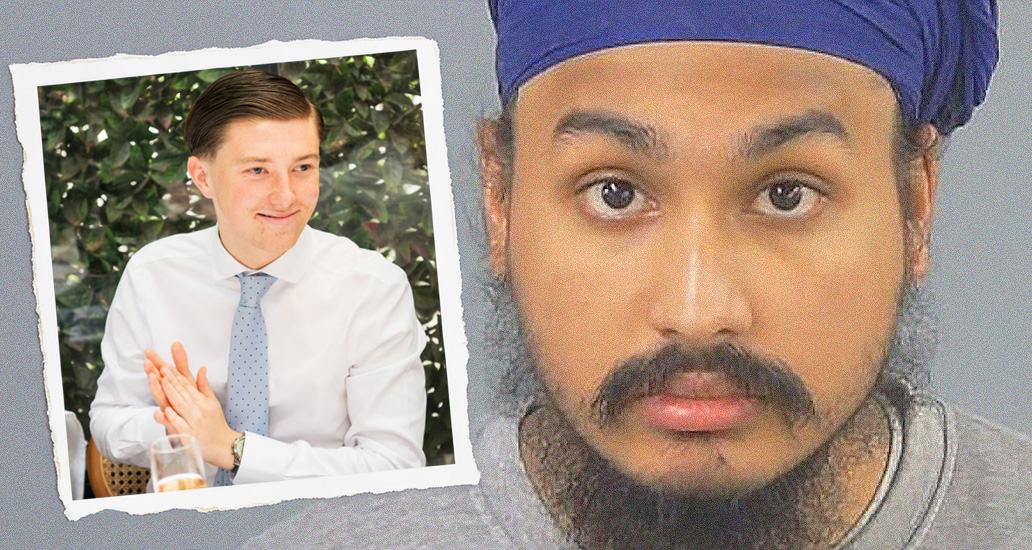
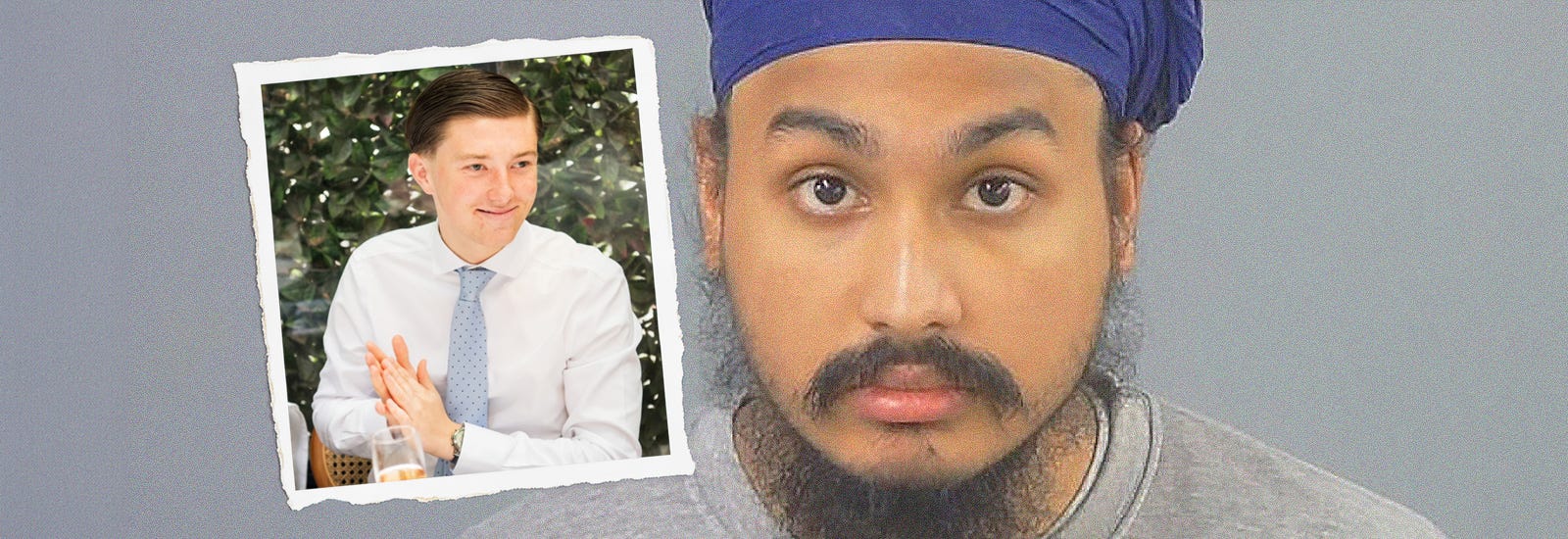
Hampshire Constabulary issued the apology following the conviction of 23-year-old Vickrum Digwa, who was found guilty of murdering first-year finance student Henry Nowak on 3 December 2025 with a Sikh kirpan ceremonial knife featuring an eight-inch (21cm) blade.

During the incident, Digwa allegedly told officers he had been the victim of a racist attack and failed to disclose that he had stabbed Nowak five times. As a result, responding officers initially handcuffed and arrested the teenager while he was suffering from severe internal injuries.

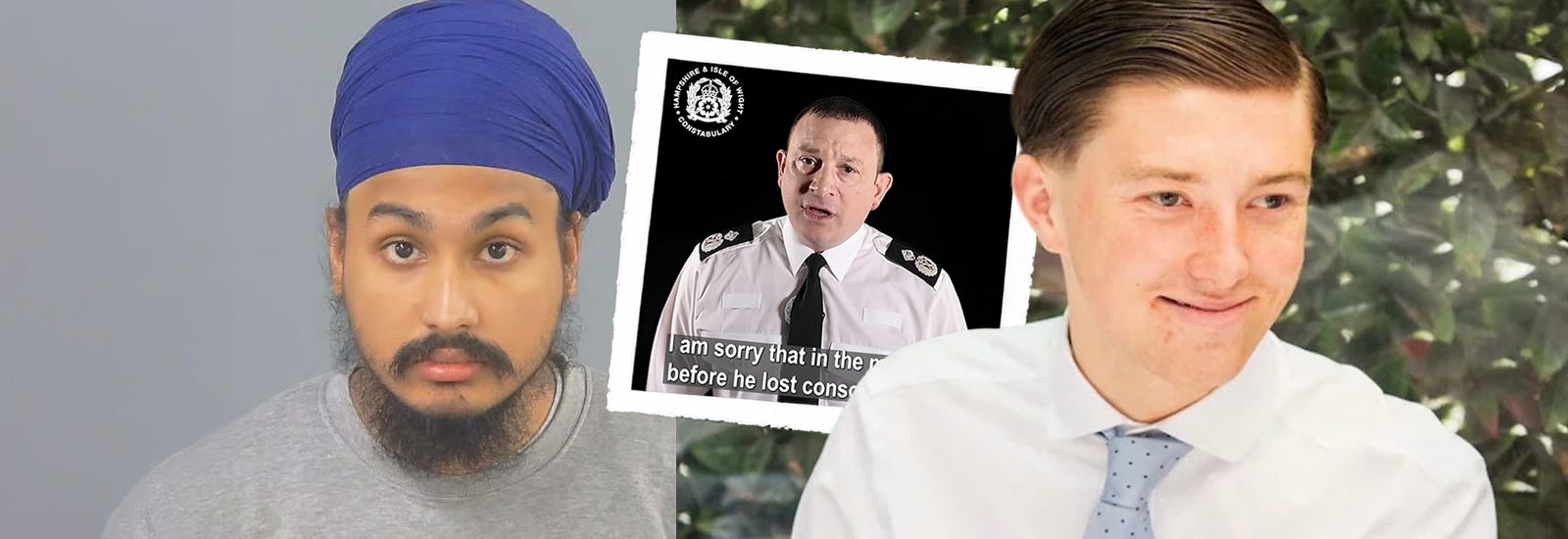
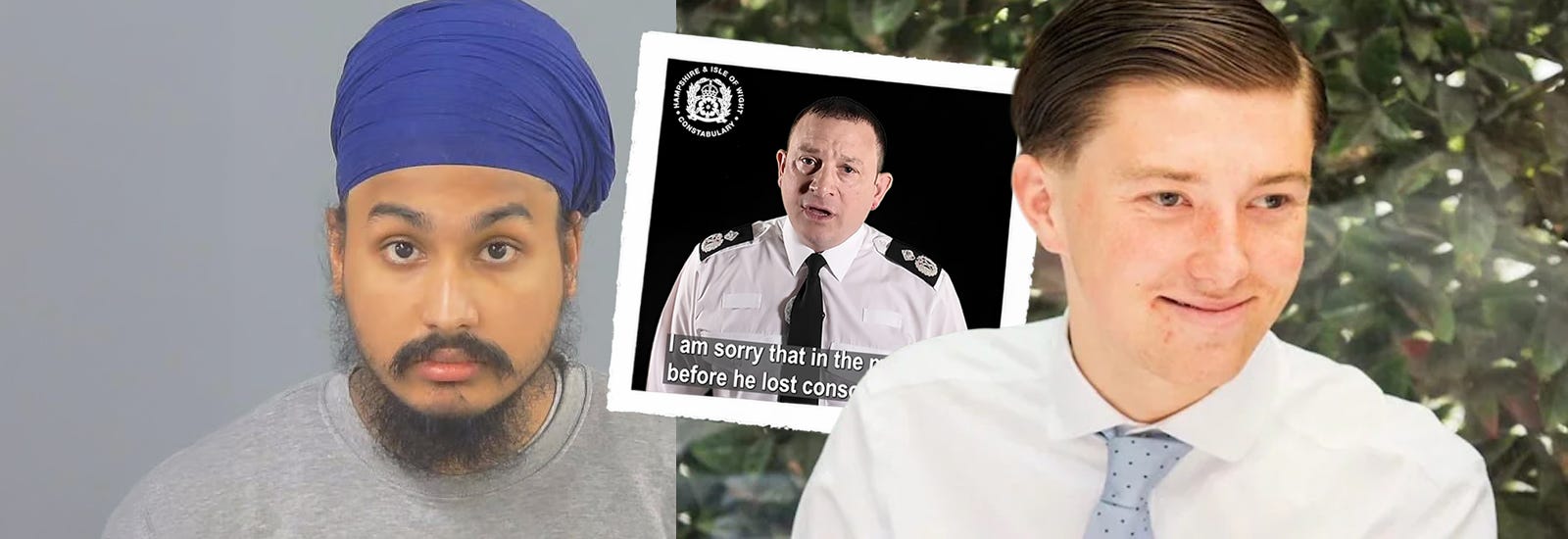
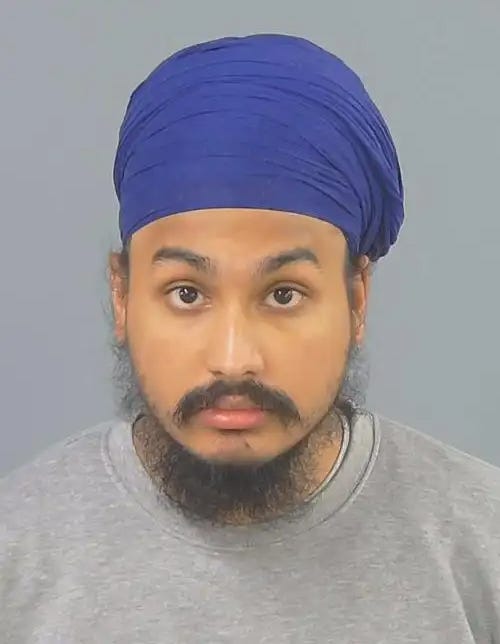
Killer Vickrum Digwa.

Temporary Deputy Chief Constable Robert France said the force was “deeply sorry” for what occurred.

“First and foremost, this is an unspeakable tragedy, and I cannot begin to imagine what Henry’s family have suffered,” DCC France said in a statement released on social media following the verdict.

“I am deeply sorry that Henry could not be saved. I’m sorry that in the moments before he lost consciousness, he had been handcuffed and arrested.”

No photo description available.
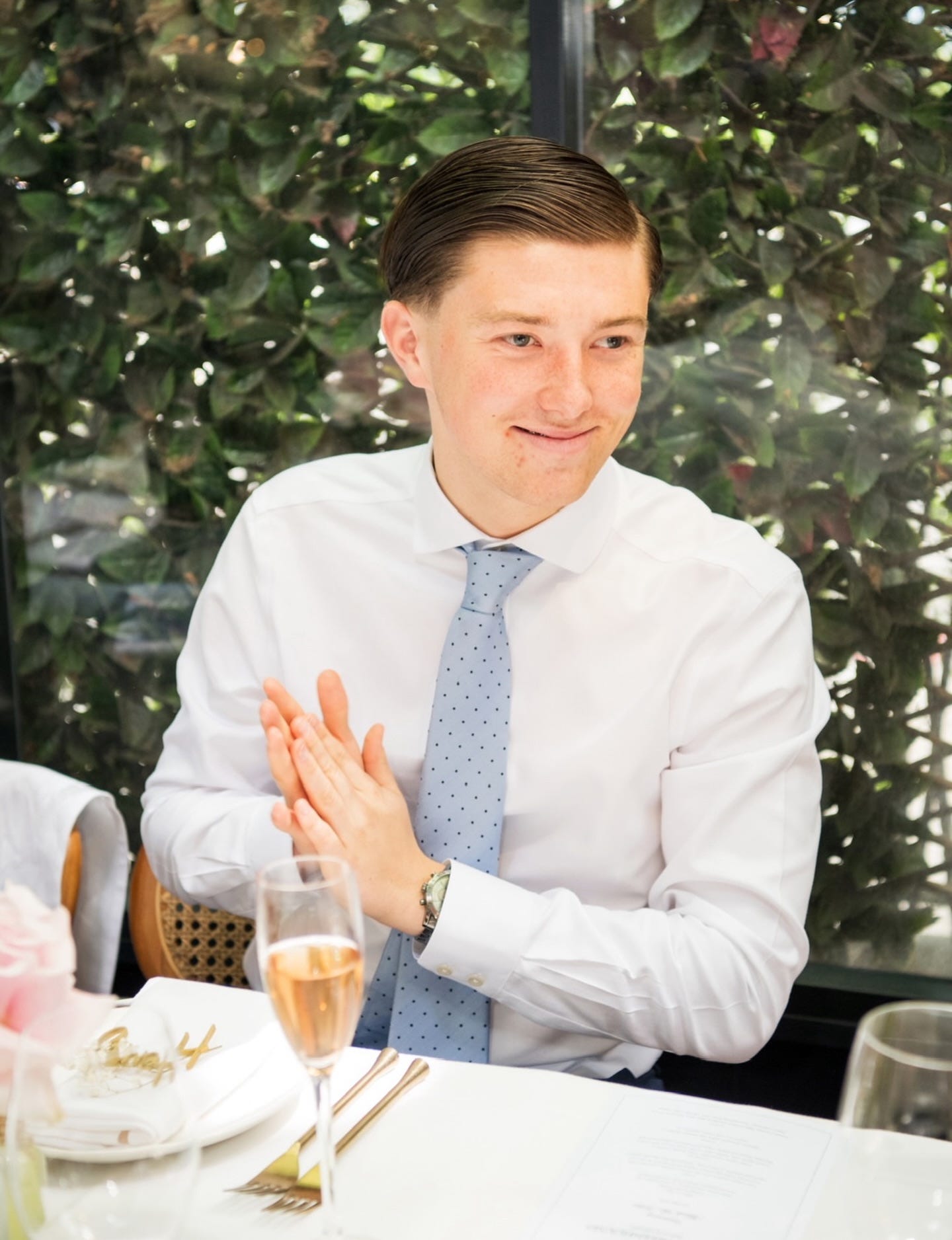
Victim Henry Nowak was stabbed five times before being handcuffed.

DCC France said officers arriving at the scene had been misled by Digwa, who “continued to divert the blame, obstruct our inquiries, and never admit the serious harm which had been done.”

“The facts heard in court should leave no doubt in anyone’s mind who was lying to officers that night and why,” he said.

Police said officers were initially responding to reports of an assault and had been informed that a man was being detained at the scene. Acting on the information available at the time, officers attempted to secure what DCC France described as “a complex situation”.

“The attending officers sought to take control of a complex situation,” he said. “And based on what they had been told, they placed Henry in handcuffs and told him he was under arrest.”

However, when Nowak lost consciousness, officers realised the seriousness of his condition.

“But within three minutes of arriving, they realised the severity of his condition,” DCC France said. “The handcuffs were removed, an ambulance was called, and they started CPR.”

According to evidence presented in court, Nowak’s injuries were largely internal and difficult to detect immediately.

“The horrendous injuries Henry suffered were internal,” DCC France said. “The pathologist evidence at court was clear. Sadly, nothing we could have done that night would have saved him.”

He added that the wound “was difficult to find and had caused a significant amount of internal bleeding.”

Three people were arrested at the scene, including Digwa, while a fourth person was later arrested at a nearby address.

DCC France defended the actions of officers, saying they “responded swiftly to a situation which was confusing and unclear” and quickly moved to provide first aid once they understood the extent of Nowak’s injuries.

The force referred the incident to the Independent Office for Police Conduct the following day, with an independent investigation into the police response still ongoing.

“We are committed to acting on their findings,” DCC France said.

Paying tribute to the victim, he added, “Henry Novak was an 18-year-old who had his whole future in front of him. That future has been cut short through a senseless attack. Today, the person who’s responsible for killing Henry has rightly been convicted of his murder.”

WATCH:

History’s Horrors Do Not Condemn Christianity but the Deviation from It

29 May 2026 at 00:01

“What about the Crusades? The Inquisition? The Salem witch trials?” These are just a few of the accusations commonly levelled against Christianity by its critics.

Figures throughout history who are said to have committed atrocities or acted unjustly are often presented as acting in the name of the Christian faith, as though their behaviour flowed naturally from an overly zealous commitment to biblical teaching. The underlying aim is to appeal to the horrors of history in order to portray Christianity itself as inherently dangerous and immoral.

Today, there is an expectation that the heirs of Christendom ought to be ashamed of their spiritual heritage and even apologetic for the sins of earlier generations of professing believers. Yet this is a standard to which no other demographic is held. As such, it is a game Christians ought not to entertain. Not because Christians shouldn’t acknowledge sins—we should be the first to do that—but because the blame is entirely misplaced.

When an injustice is carried out by a professing Christian, or even in the name of Jesus, it does not follow that Jesus thereby endorses that injustice—any more than a criminal committing a crime in your name implicates you in their wrongdoing.

That is to say, if a professing Christian is out of step with the Bible, they are no longer acting consistent with their professed faith. At its heart, Christianity is a profession that Christ is Lord, and that profession implies the professor is Christ’s obedient subject. Thus, to profess to be a Christian, to profess that Christ is your Lord, while acting inconsistently with the Lord’s commands, is to deny with your actions what you profess with your mouth. It is, in essence, proof that your profession is not genuine and that you are, in fact, guided by another ideology and religion.

As such, whenever an injustice or atrocity is committed by a Christian or in the name of Christ, the question that must be asked is this: Is the injustice or atrocity consistent with the teaching and instruction of the Bible? Of course, those who seek to denigrate Christianity have little interest in honestly asking that question, since the answer would not only vindicate Christianity but also condemn them.

What they would find is that an injustice is only ever committed when one ventures beyond the bounds of Christianity. That is to say, the injustice is not an indication that the perpetrator was too Christian, but rather, not Christian enough.

In that sense, when an injustice or atrocity is committed by a professing Christian, they are ideologically closer to those who reject the Bible as their ultimate moral standard than to Christianity itself, which is defined by and confined to the bounds of Scripture. As such, Christianity doesn’t need to apologise for injustices orchestrated by professing Christians, because every injustice ever committed is carried out contrary to Christianity.

We must make no mistake: The horrors of history, and the horrors of the present, bear witness, not to the cruelty of Christendom, but to the cruelty of humanity when people deviate from Jesus’ commands to love your enemies and do good to those who hate you.

Every abuse and injustice, even those carried out in the name of the Church, is preceded by an explicit rejection of the New Testament.

What this means is that if anyone is to give an account for past acts of injustice, for historical atrocities and acts of cruelty against others, it is not the Christian who calls for stricter observance of Christian instruction, but the non-Christian who dismisses the Bible and attempts to operate outside the bounds and authority of God’s Word.

So it is not Christianity that must answer for historical injustices, but those who seek to live consistently with the ideological assumptions of the perpetrators—not the teaching of the Bible, but the rejection of it, even if it’s only in part.

Calls Grow for Early Federal Election as Frustration Mounts Across Australia

28 May 2026 at 08:52

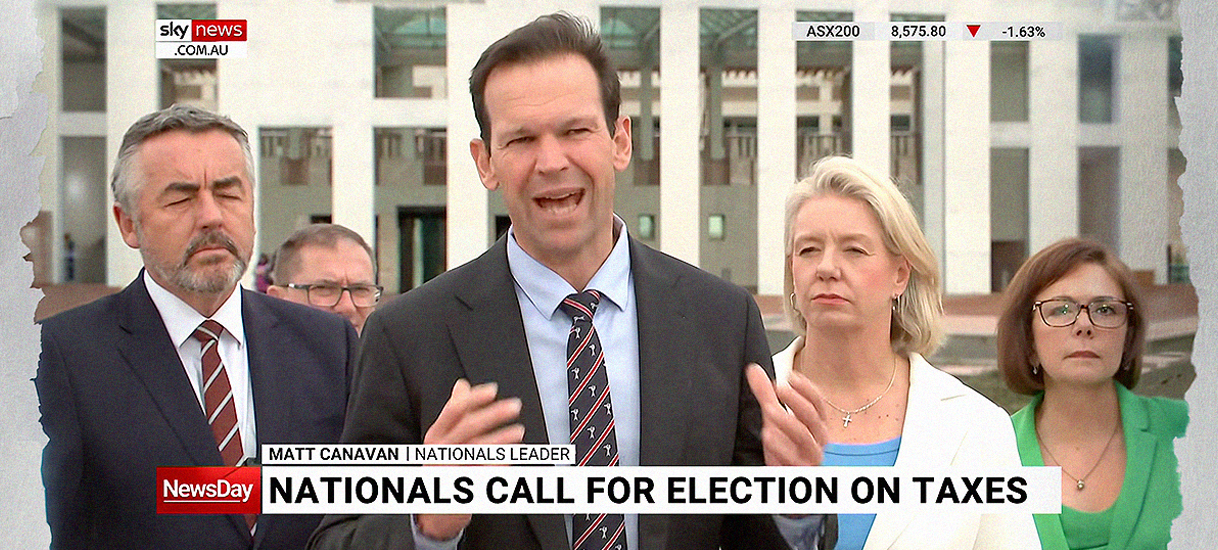
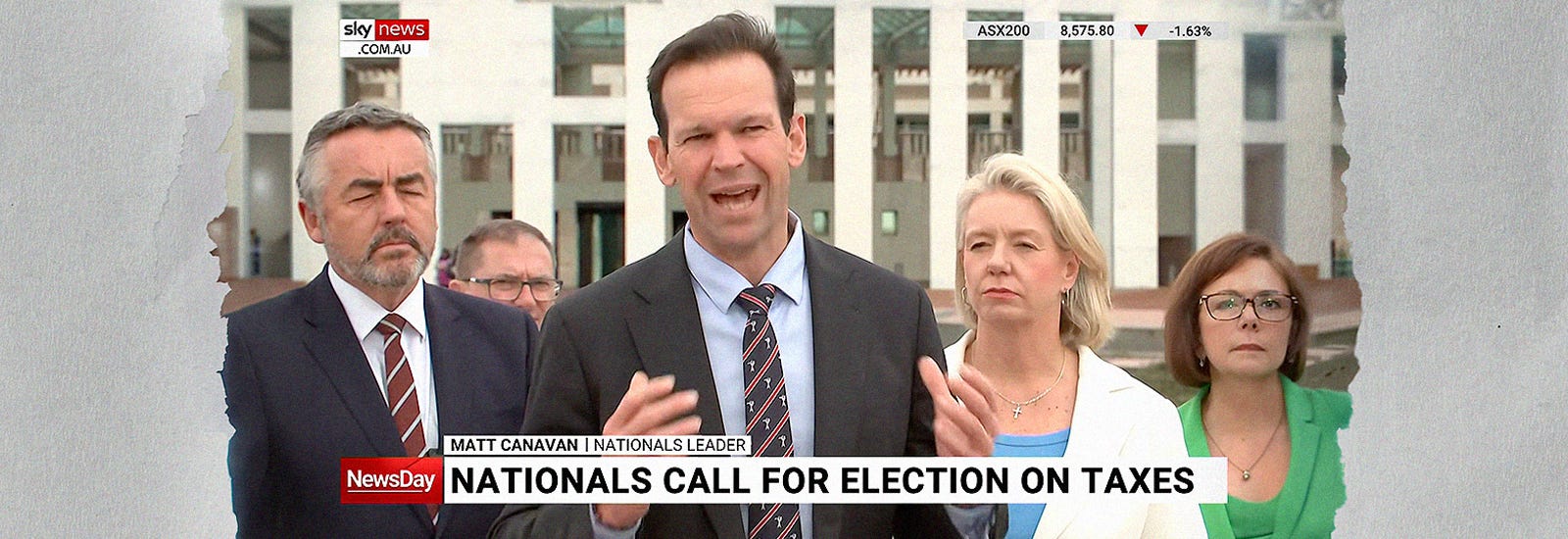
Pressure is mounting on Prime Minister Anthony Albanese to call an early federal election as growing numbers of Australians express frustration over rising living costs, record immigration levels, the housing crisis, and controversial new tax reforms.

Nationals Senator Matt Canavan has added his voice to the demand, calling for Australians to return to the polls, slamming the Albanese government for introducing sweeping tax changes that were never put before voters at the last election.

Speaking outside Parliament House in Canberra, Canavan said, “The Prime Minister should take his biggest tax increases in a generation to an election.”

The Queensland senator said the government had failed to secure public support for its proposed reforms and accused Labor of avoiding the will of the people.

Posting on X, Canavan said:

Today is a sad day for Australian democracy because Labor has introduced the biggest tax changes in a generation without a mandate from the Australian people.

That’s why The Nationals are today demanding the Prime Minister call an election.

This morning we made that call outside the People’s House, outside the Parliament. Your Parliament should not impose more taxes on you without your consent.

An early election would give the Australian people a real choice.

A choice between a Labor party that wants to impose the biggest ever tax increase on Australians, or the Liberal and Nationals who will cut taxes, scrap net zero and reduce migration.

Canavan issued the challenge despite polling suggesting an early election could prove politically suicidal for both major parties. According to a large-scale analysis conducted by RedBridge Group and Accent Research and published by the Australian Financial Review, Pauline Hanson’s One Nation could potentially secure as many as 59 seats if an election were held today, pushing Labor deep into minority government while devastating Coalition support across most states and territories.

The report described the findings as a “worst-case scenario” for the major parties and suggested the Nationals could be entirely wiped out electorally.

“Unlike the Prime Minister, I and my Nationals colleagues have the guts to be subject to the will of the people,” Canavan said. “Blind Freddy can see right now that it’s tough for us. No doubt it is.

Public dissatisfaction has also extended beyond politics, with several high-profile Australians openly calling for an early election.

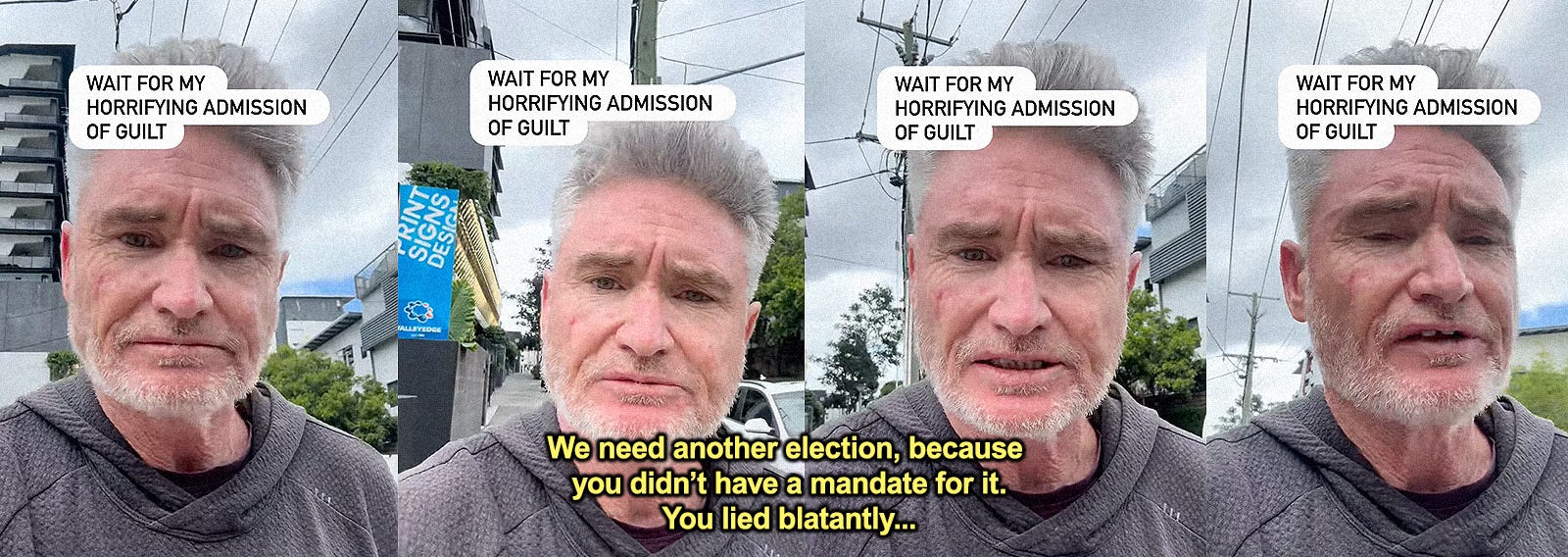
Last week, comedian Dave Hughes joined the growing chorus calling for an early election, expressing frustration over proposed changes to property and investment taxation, particularly reforms to capital gains tax.

In a series of videos posted to Instagram, Hughes accused the government of failing to seek voter approval for the changes before introducing them.

“Your bumbling, fumbling, idiotic performance when questioned this week by both Albo and Chalmers, and every other minister in that f***ing stupid government, just solidified the fact that we need another election,” Hughes said.

“You didn’t have a mandate for it. You lied blatantly, so it’s not valid. So let’s go to the polls again. Put it to the people.”

Adding to the pressure on the Albanese government, former federal MP George Christensen recently launched an online petition calling for the dissolution of Parliament and an immediate federal election.

The petition, titled “Albo Must Go,” has attracted over 20,000 signatures and accuses the government of presiding over soaring inflation, record migration, worsening housing affordability, and increasing censorship measures while ignoring the concerns of ordinary Australians.

The campaign also encourages Australians to send formal letters to both the Prime Minister and the Governor-General, urging the immediate dissolution of Parliament and a return to the polls.

The next Australian federal election must be held on or before 20 May 2028 for a simultaneous House of Representatives and half-Senate election. Because Australia does not operate under a fixed-date system federally, the Prime Minister has the flexibility to recommend an earlier election date to the Governor-General.

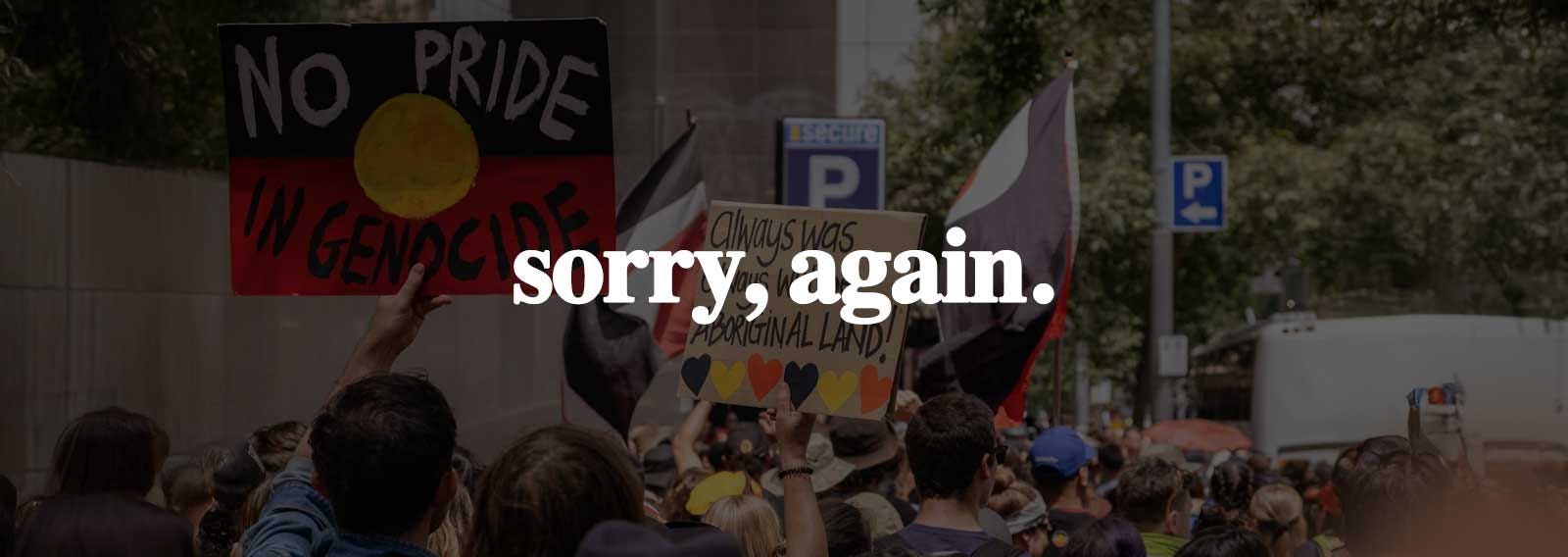
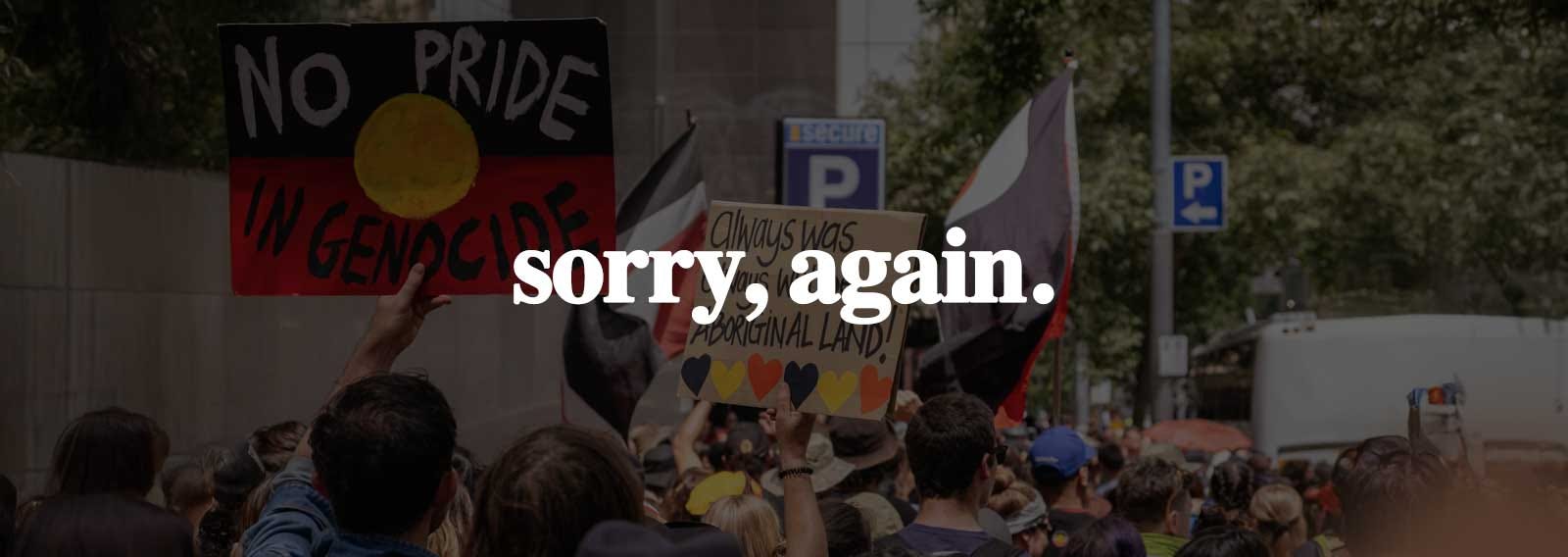
National Sorry Day and the Return to Yearly, Insufficient Sacrifices

26 May 2026 at 23:00
Image

Yesterday was “National Sorry Day,” an annual observance in Australia on May 26 that commemorates the “historical mistreatment” of Aboriginal and Torres Strait Islander peoples, with a particular focus on the so-called Stolen Generations.

It’s a day on which White Australians are expected to acknowledge and confess the sins committed by their White ancestors, offering apologies on their behalf, year after year, without any clear endpoint or lasting reconciliation in sight.

As such, it is a distinctly un-Christian observance. Not only because it bears false witness by ascribing sin and guilt where there is none, but also by suggesting that even where sin may be present, it must be acknowledged and confessed endlessly—as if Christ’s atoning sacrifice were not sufficient to cover it once for all time.

But let’s grant, for the sake of argument, that guilt remains—and set aside, for a moment, the plain teaching of Scripture: “The son shall not suffer for the sins of the father” (Ezekiel 18:20). Even then, the Bible is clear that once sin is genuinely acknowledged and confessed, the Christian’s calling is to trust in the sufficiency of God’s forgiveness.

To dredge it up and confess it again and again every year, multiple times a year, is not an act of repentance but a demonstration of unbelief in Christ’s finished work. It is the definition of unbelief. It is a denial of the Gospel.

Consequently, annual acknowledgments of past sins are an insult to the finished work of Christ. The practice itself echoes the insufficiency of the Levitical priesthood, where a sacrifice was offered every year because the previous year’s atonement was insufficient to perfect wrongdoers.

Rather than removing sins or cleansing the conscience, the yearly sacrifices under the Levitical order actually reinforced awareness of guilt. Each year, the people were reminded that sin was still an unresolved problem. Hence, the Levitical ritual served as an annual confession that the people’s sins remained and had not yet been fully dealt with.

As the author of Hebrews explained:

“For since the law has but a shadow of the good things to come instead of the true form of these realities, it can never, by the same sacrifices that are continually offered every year, make perfect those who draw near. 2 Otherwise, would they not have ceased to be offered, since the worshipers, having once been cleansed, would no longer have any consciousness of sins? 3 But in these sacrifices there is a reminder of sins every year. 4 For it is impossible for the blood of bulls and goats to take away sins.” Hebrews 10:1-4

In effect, the Day of Atonement served as Israel’s own “National Sorry Day.” It was observed annually to underscore that the sacrifices offered were insufficient to fully atone for sin. If the blood of bulls and goats had been truly effective, there would have been no need for repeated offerings year after year. The very repetition was a stark reminder of their inadequacy.

Annual acknowledgments of past sins are an insult to the finished work of Christ. The practice itself echoes the insufficiency of the Levitical priesthood, where a sacrifice was offered every year because the previous year’s atonement was insufficient to perfect wrongdoers.

So, what is implied when Christians participate in annual “sorry” days? Is the so-called sin they acknowledge truly forgiven, or not? Even more troubling is that this practice has found its way into many churches without any regard for what it suggests about the finished work of Christ. What else does this annual message convey except that Christ’s blood is no more sufficient than the blood of bulls and goats? At least, in regard to the sins of White Christian men.

Now, some may argue that “National Sorry Day” is not about unresolved guilt, but rather an acknowledgment of the ongoing consequences of past sins on Indigenous peoples. But this distinction fails to hold. Nearly all sins have lasting consequences—that is part of what makes sin so grievous. To single out one set of sins for perpetual remembrance, while claiming to rest in God’s forgiveness for others, creates a double standard.

What else does this annual message convey except that Christ’s blood is no more sufficient than the blood of bulls and goats? At least, in regard to the sins of White Christian men.

Worse still, it implies that sins committed by White men against Black men are more serious or more enduring than the sins all people commit against a holy God. Such an implication is not only theologically flawed—it, once again, distorts the Gospel itself by diminishing the gravity of sin against God and the sufficiency of Christ’s atonement to forgive those sins.

By embracing such annual national rituals, Christians undermine the very Gospel they claim to profess, casting doubt on the sufficiency of Christ’s once-for-all sacrifice. As such, it’s a ritual that needs to be not only rejected by Christians, but condemned as un-Christian.

Craig Kelly Calls for Public Apology From Nine Over COVID Coverage

26 May 2026 at 00:34

Australian broadcaster Nine Entertainment is facing a barrage of criticism online following a recent report highlighting Australians injured by COVID-19 vaccines.

The network played an active role in promoting vaccination in Australia through its “This is Our Shot” campaign. Launched in 2021, the initiative featured prominent Australian personalities encouraging the public to get vaccinated to help Australia return to normal life.

Initially, the advertisement drew criticism, not for promoting experimental medications, but for being “too White.” The network launched a revised version two days later, editing several “non-White” figures.

One of the network’s most widely shared segments aired on the Today Show, when co-host Allison Langdon clashed with former federal MP Craig Kelly.

Langdon, who strongly defended Australia’s vaccine rollout during the COVID-19 pandemic, confronted Kelly in a now-infamous on-air exchange, criticising him for promoting alternative approaches to the measures mandated by state and federal governments.

“All our hopes are riding on a vaccine,” Langdon told Kelly. “You need to be quiet.”

Kelly, who was heavily criticised and censored throughout the “pandemic” for his opposition to vaccine mandates and advocacy of alternative treatments, has since been entirely vindicated in the minds of most Australians.

This is especially the case following recent reports, including one presented by Langdon on Nine’s A Current Affair, highlighting individuals suffering alleged vaccine-related injuries linked to the same medical treatments she publicly supported.

Responding to the report on X, Kelly accused Nine and Langdon of promoting “shameless propaganda” and said both the network and Langdon owed the Australian public a grovelling apology.

“They pocketed blood money to flood the airwaves with shameless propaganda, relentlessly pushing an unsafe, defective, and experimental medical treatment onto trusting Australians,” he said.

“Now [they] are running tragic stories about those catastrophically injured — the very victims they helped create by shilling these shots for years while silencing critics.

“The rank hypocrisy is utterly disgusting,” he added.

Kelly went on to say that countless people took the vaccine on their advice and have since had their lives ruined by the side effects. “Many dead,” he said.

Langdon’s co-host at the time, Karl Stefanovic, recently apologised for his role in promoting the state’s measures, saying he regrets not questioning government mandates and scientific advice more closely.

Stefanovic made the comments in March on his new podcast, The Karl Stefanovic Show, during an interview with former Queensland senator Gerard Rennick, a long-time critic of draconian state health measures, such as lockdowns, vaccine mandates and mRNA vaccines.

During the podcast, Stefanovic said:

“The one thing they say about me is that I supported the COVID jab and I have regrets from that time. And I am definitely sorry for the role I played in not questioning the science, in not questioning more the government mandates. And I feel like I isolated people because of that.

“And I don’t think the media should be involved in that kind of messaging. What I do believe is that we should have been there to offer some sort of education, but we shouldn’t have taken that step further and been part of a campaign. And I’m legitimately sorry for that, because I don’t know how that would have felt for people out there.”

Kelly said media organisations should contribute financially to compensation efforts for individuals suffering alleged vaccine injuries.

“The mainstream media didn’t just fail Australia—they betrayed the nation,” he said.

“They helped inflict this harm, covered it up, and now pretend to care. It’s time they apologised and handed back every cent pocketed.”

The Abolitionist Who Rejected Incrementalism

24 May 2026 at 23:25
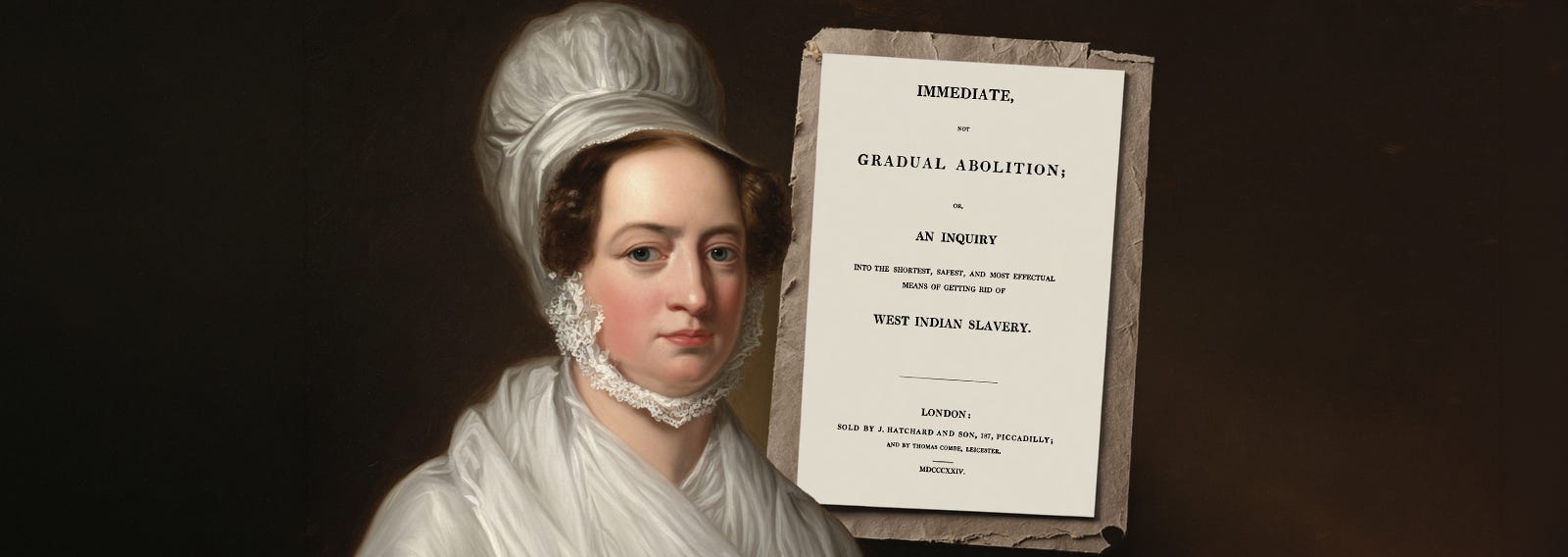
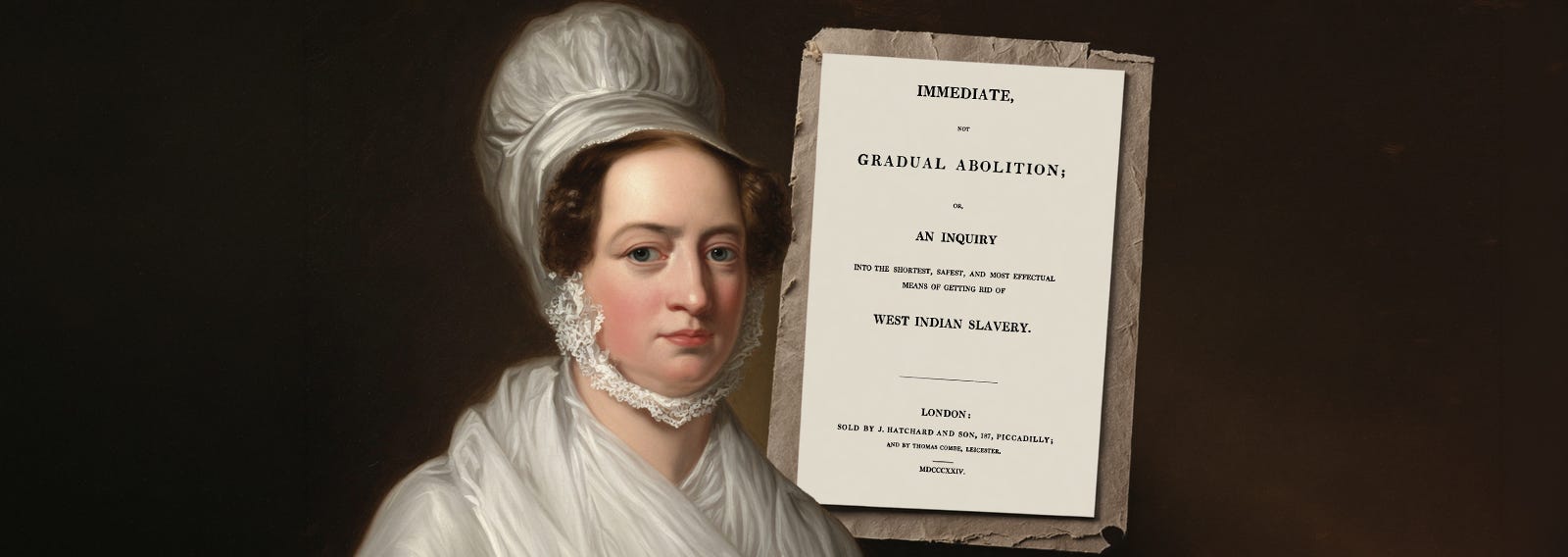
Elizabeth Heyrick, 1769—1831

Incrementalism versus immediate abolition is not a modern debate. The two approaches were fiercely contested among opponents of the slave trade itself. While some slavery opponents argued for gradual reforms and incremental improvements, others insisted that anything short of immediate abolition was itself a moral compromise with evil.

Elizabeth Heyrick (1769—1831) was among the earliest and most influential abolitionists to demand what became known as “immediatism.” Heyrick argued that slaveholders had effectively manipulated abolitionists into accepting the idea that emancipation must come gradually, while, at the same time, discouraging them from demanding anything more.

The strategy, she warned, was intentional. For Heyrick, calls for gradual emancipation would inevitably produce a gradual indifference to emancipation itself. But to compromise with such evil, she said, was “the very masterpiece of satanic policy.”

Heyrick's concern was that once people could be persuaded to tolerate slavery for “one year, or for one month,” they could just as easily be conditioned to tolerate it indefinitely.

If Christians could accept, even temporarily, the stripping away of a man’s humanity, rights, and dignity, then they had already surrendered the moral principle entirely.

In Immediate, Not Gradual Abolition, Heyrick writes:

By converting the cry for immediate, into gradual emancipation, the prince of slave holders, ‘transformed himself, with astonishing dexterity, into an angel of light,’ and thereby ‘deceived the very elect.’ He saw very clearly, that if public justice and humanity, especially if Christian justice and humanity could be brought to demand only a gradual extermination of the enormities of the slave system; if they could be brought to acquiesce, but for one year, or for one month, in the slavery of our African brother, — in robbing him of all the rights of humanity, — and degrading him to a level with the brutes; that then, they could imperceptibly be brought to acquiesce in all this for an unlimited duration.

Heyrick went on to argue that Satan understood “the most effectual way” to crush a righteous cause was simply to delay it — to postpone action to “a more convenient season,” until the original conviction of duty had cooled.

Over time, she said, zeal fades, sympathies grow dull, and the difficulties of the task begin to outweigh the sense of urgency. Familiarity with violence, misery, and outrage gradually dulls the conscience, until what once provoked horror eventually produces indifference, she said.

“If the great work… be not now accomplished…it may be despaired of,” she said.

What’s more, Heyrick warned that gradualism assumes a kind of guaranteed continuity of moral resolve across generations, which may not exist. As such, the incremental approach assumes that future generations will continue to advance the ground already gained, rather than gradually surrendering it.

One obvious objection Heyrick faced was the accusation that she was aiming too high. Pursuing “perfection” in an imperfect world is an endless and impossible pursuit, according to critics. The oppressors, they say, will never concede—you are asking too much of them.

Although emancipation in the British Empire would eventually occur through staged legislation and transitional arrangements, Heyrick believed such measures weakened the moral stance of the abolitionist cause by treating justice as something negotiable and indefinitely postponable.

For Heyrick, however, the notion that justice must wait upon the willingness of the oppressors is itself a moral inversion, as though wrongdoing could only be corrected once its perpetrator consents.

In her view, abolitionists had erred in granting too much consideration to the “interests and prejudices” of slave-owners, thereby allowing perpetual compromises and delay to define the entire movement’s strategy.

The abolitionists have shown a great deal too much politeness and accommodation towards these gentlemen... The spirit of accommodation and conciliation has been a spirit of delusion. The abolitionists have lost, rather than gained ground by it; their cause has been weakened, instead of strengthened. The great interests of truth and justice are betrayed, rather than supported, by all softening qualifying concessions.

In contrast, Heyrick argued that a direct appeal to the enslaved person’s right to freedom, grounded in moral and Christian principles, would have been more effective in sustaining public sympathy, demand, effort, and sacrifice than the gradualist measures could ever muster.

Ultimately, Heyrick argues that gradual emancipation is not an effective or realistic compromise, but the principal obstacle to meaningful progress. It is, she said, a “grand marplot”1 that prolongs injustice, dulls the sense of moral urgency, and risks normalising what should be immediately condemned. Immediate emancipation, she argued, is both the only just course and the most effective means of securing genuine change.

And yet for those who may accept the moral principle of her position, yet remain sceptical that it could ever gain sufficient support to achieve its aim, Heyrick offers the following consideration:

Should your example not be followed; should it be utterly unavailing towards the attainment of its object; still, it will have its own abundant reward; it will be attended with the consciousness of sincerity and consistency,—of possessing ‘clean hands,’ of having ‘no fellowship with the workers of iniquity;’ still, it will be attended with the approbation of conscience,—and doubtless, with that of the Great Searcher of hearts, who regarded with favourable eye the mite cast by the poor widow into the treasury, and declared that a cup of cold water only, administered in Christian charity, ‘shall in no wise lose its reward.’

In essence, Heyrick argued that even if individual action failed to bring about the wider social reform she hoped for, it was obedience to Christ, nonetheless. Integrity, she argues, is not measured by outcomes alone but by fidelity to conscience and obedience to God’s word.

You can learn more about Elizabeth Heyrick in this short video from Proud Of Us UK:

1

“Grand marplot” is an old English expression meaning the chief spoiler or principal person who ruins a plan or scheme.

Dave Hughes: “We Need Another Election”

23 May 2026 at 08:23

Australian Comedian Dave Hughes has added his voice to a growing chorus of Australians calling for an early election following the release of the 2026-27 Federal Budget by Treasurer Jim Chalmers earlier this month.

Hughes is among many frustrated Australians upset with major changes to property and investment taxes, particularly the reforms to capital gains tax (CGT). Taking to Instagram, Hughes expressed his anger at the Labor government in a series of videos, with his latest clip taking aim at CGT reforms specifically.

“If I had known they were going to do that, I wouldn’t have voted for them,” Hughes said in a video published Saturday. “I voted for Albo and Chalmers. They didn’t have a mandate for changing the capital gains tax. It’s now the highest in the world. No one is going to want to invest in Australia. What the f*** are you doing?

“This affects every working Australian, everyone who actually pays tax, because we all have to have Super, which is investments. And you’ve just doubled the f***ing take on it to waste, because you’re f***ing incompetent.

“Your bumbling, fumbling, idiotic performance when questioned this week by both Albo and Chalmers, and every other minister in that f***ing stupid government, just solidified the fact that we need another election, because you didn’t have a mandate for it.

“You didn’t have a mandate for it. You lied blatantly, so it’s not valid. So, let’s go to the polls again. Put it to the people.”

Under the current system, Australians who hold investments such as property or shares for more than a year pay tax on only half of the profit when selling. The new budget plans to scrap that 50% discount from July 2027 and instead tax profits based on inflation-adjusted gains, alongside a new minimum 30% tax on capital gains.

The government argues the reforms are fairer, as they tax only “real” profits after inflation. However, critics argue the changes will ultimately increase taxes in practice and discourage investment.

Earlier this month, former federal MP George Christensen launched an online petition calling for the dissolution of the Australian Parliament and an immediate federal election.

The petition, titled “Albo Must Go,” has attracted close to 20,000 signatures and accuses Prime Minister Anthony Albanese and the Albanese government of presiding over soaring inflation, record migration levels, and increasing censorship measures while ignoring the concerns of everyday Australians.

The campaign also encourages Australians to send formal letters to both the Prime Minister and the Governor-General, urging the immediate dissolution of Parliament and a return to the polls.

UK Bishop Calls for Counter-Terror Probe Into Peaceful Protesting ‘Christ is King’ Clergy

22 May 2026 at 21:18

Comments from a British Bishop who accused clergy of being potential terrorists for protesting to Save Britain have resurfaced online.

The October 5, 2025, remarks posted to X specifically called for PREVENT—the UK’s left-leaning counter-terrorism thought police—to investigate clergy attending Tommy Robinson’s “Unite the Kingdom” protests.

Author Bishop Matthew Firth of the Free Anglican Church (FCE) described their presence as “disturbing.”

His X repost was in response to news that police were being given further powers to squash marches following repeatedly violent “river to the sea,” “pro-Palestinian” protests.

Clearly suggesting that “right-wing” clergy should be considered potential terror suspects, Firth, who is also seemingly conservative, wrote,

“A wise move. I hope this also applies to the repeated ‘Tommy Robinson’ hate rallies.”

To this, he then added, “It would also be wise for Prevent & the relevant LADO to investigate those disturbing cases where clergy attended the rallies. They are working with vulnerable people at risk of radicalisation.”

Statements like this also have firm implications for “Christ is King.”

A declaration of unity used by Christian dissidents opposed to the deification of the State, and the march of the Marxian Woke mind virus.

By inference, Firth seems to be suggesting that “Christ is King” is the same as screaming “Allah Akbar.”

By extension, the bishop’s support for a crackdown on clergy also suggests strong support for suppressing the use of the phrase “Christ is King” at conservative protests.

Resurfacing Firth’s October 2025 X post, Reverend Canon Brett Murphy, drew from the same conclusions.

Murphy, an ordained Anglican Priest in the Confessing Anglican Church (CAC), slammed his former FCE colleague’s accusations, calling them repugnant.

“The people of the UK,” Murphy declared, “are desperate for hope, for the church to stand firm on the Christian foundations of our nation and to preach the true and unadulterated gospel.”

“Men like Firth want to suck up to the godless political elites while the country burns.

“If you are a patriot, if you love the UK and support TR, then it seems Bishop Firth considers you a hateful extremist.

“I consider it my Christian duty,” the good Reverend added, “to warn other Christians and those seeking Christ for the first time about ungodly clergy and toxic sects that pose as legitimate biblical churches to lure in the unsuspecting and naive.

“Do not lose hope,” he asserted, “there are emerging churches which preach the true gospel, practice full-fat Christianity without apology and desire to see this nation won for Christ again.”

“Men like Bishop Dewar, Pastor Chris Wickland, Dominic Muir, Canon Phil Harris, Aaron Edwards and others are making a stand, cross in one hand, Union Jack in the other with the love of Christ in their hearts.”

Murphy then stated, “The repugnant views of men like Bishop Firth should be made infamous; saints, I urge you to share this far and wide!”

Bishop Matthew Firth isn’t the only priest demanding that Christians cancel their “Christ is King” presence at pro-British protests.

This fact makes a noteworthy footnote.

Weeks before Firth’s post on X, Arun Aroa, Anglican Bishop of Kirkstall, ironically used his pulpit privileges to accuse fellow Christians of preaching hate.

In a September 2025 sermon, Aroa “called on Christians to reclaim the flag and their faith from right-wing activists, saying both were being desecrated by people seeking to divide the nation.”

As reported by The Guardian, Aroa, who is the Church of England’s “co-lead on racial justice,” made the comments in a sermon protesting the use of “Christ is King”, recitations of the Lord’s Prayer, in protests that urged people to defend “God, faith, family, homeland”.

Resharing a video posted by the left-wing Trade Union Congress, which was complete with LGBTQ+ flags in the user’s profile, Bishop Aroa subtly repeated his 2025 accusations last weekend.

Aroa’s apparent endorsement of the video seems to be aimed at falsely painting “racism” and “hate speech” all over the peaceful “Unite the Kingdom” marches.

Captioned “This is real patriotism,” the video stars Luton priest, Lucas Larner.

Larner ridicules the sanctity of the Union Jack while claiming that genuine patriotism was about the land, not about excluding people.

He then accuses Tommy Robinson of being a puppet for millionaires like Donald Trump, who, Larner claimed, were sowing hatred and division.

The priest even targets Elon Musk as a funder of what Larner implies is “false patriotism.”

Of course, the “rules” preached by Larner don’t seem to apply to his own behaviour.

Despite appearing in the Trade Union video calling out hatred and division, the Luton priest reposted an image inciting both Tommy Robinson and Katie Hopkins’ assassination.

Caldron Pool has reached out to both Bishop Firth and Lucas Larner for comment.

Don't Care

21 May 2026 at 23:04

The political class and the mainstream media have long relied on false accusations of “far-right,” “extremism,” and “racism” as weapons of intimidation. The goal is to frighten ordinary people away from “unapproved” movements, organisations, or individuals that threaten their power and influence on the public by making association socially costly. It’s not about debate, but demonisation.

And too often, it works.

People genuinely fear the label more than they’re willing to challenge the lie behind it. And that fear is exactly what gives the accusation all of its power. Everyone is terrified of the social consequences of being publicly branded a socially unacceptable name. But how are these smear campaigns to be handled? Well, there is one exceptional figure currently giving a masterclass in how to deal with these tired accusations, namely, Rupert Lowe.

Since launching his new political party, Restore Britain, Lowe has been called virtually every name in the book. But how does he respond? Not with defensiveness or apology, but with something that’s proving far more effective: indifference.

When accused of being “racist” or “far-right,” many instinctively scramble to defend themselves. They begin listing all the reasons why they are not the things they’ve been accused of being. They explain themselves endlessly in hopes that their accusers will suddenly become fair-minded.

That’s understandable, but not always helpful because it’s a response that already concedes too much.

What I mean is that it implies the accusation is legitimate enough to warrant a serious defence. It suggests the problem lies in one’s own poor choice of words, or a failure to properly articulate one’s position. It treats the critics as though they would surely change their minds if only they had all the facts — facts which, evidently, you have somehow failed to provide.

But this assumes the accusations are made in good faith. They rarely, if ever, are. The point isn’t to understand you. The point is to stigmatise you. The point is to make you an “untouchable.”

As previously noted in an article titled, The Demonisation of the Right:

Healthy politics relies on healthy debate. Competing and contradictory ideas are tested through reasoned argument. But when argument fails, when a political faction can’t justify its policies or defend its record, it’s forced to either abandon its position or else abandon persuasion, and instead opt for intimidation.

It’s an old tactic, really. If you can’t convince people not to choose an alternative, make them afraid to choose it. If you can’t lure them over, force them to flee.

In recent years, we’ve seen this play repeatedly. Rather than engage populist or right-leaning movements on policy grounds, opponents simply seek to frame them as dangerously compromised. Bad names replace good arguments. “Far-Right” is now synonymous with everything slightly right of centre-left. “Nationalist” is now akin to “fascist” and “racist.” Anyone who isn’t committed to the establishment’s vision for the nation is basically a “Nazi.” Of course, the goal clearly isn’t to debate, but to stigmatise—to make a movement appear untouchable.

Once a movement is successfully branded socially heretical, ordinary citizens hesitate to associate with it—not necessarily because they’re convinced by the scare tactics, but because they fear the social consequences of associating with the socially ostracised.

Accusations of “far-right,” “Nazi,” and “racism” are instruments of control, deployed to frighten ordinary people from challenging an approved narrative. The accusation is the weapon, but your fear determines the force of the blow.

Cowards distance themselves from the falsely accused—some have done it to us at Caldron Pool. Others will burn their time and energy attempting to answer every allegation, as though their accusers are sincerely interested in the truth. But they are not trying to represent you accurately. They’re trying to misrepresent you. That’s the whole point.

So, why treat unserious accusations seriously?

This is what makes Lowe’s approach so effective, and worthy of imitation. He doesn’t agonise over the bad names he’s called. He doesn’t grovel for approval. He refuses to play the game altogether, often with a two-word response we’d all do well to employ more: “Don’t care.”

Let me give you a sampling from his X account:

21 May 2026”: “Restore Britain has been labelled an ‘openly far-right’ party by The Guardian. If being ‘openly far-right’ means deporting foreign rapists/scumbags, whilst not allowing our country to descend further into a third world hellhole, then yes, sign us up—that’s Restore Britain.

28 April 2026: “Banning foreigners from claiming benefits is not racist, but even if for some mad unknown reason you think it is? I really don’t care.”

20 March 2026: “I’ve been called racist and Islamophobic hundreds of times today for outlining Restore Britain’s policy on banning halal slaughter, the burqa, sharia law, cousin marriage, and plenty more. I want to be really clear about our party’s official response: We don’t give a sh*t.”

25 November 2025: “I get called a racist on a daily basis - that word has entirely lost all meaning now. It only has any power if you believe it does. Don’t cower. Don’t apologise. Don’t squirm. There is one appropriate response: I don’t care.”

1 October 2025: “Get called a racist? Xenophobe? Islamophobe? Far-right? Who cares. Honestly, it doesn’t matter. Trust me. They are now just meaningless words. Don’t moan. Don’t bite. Don’t care. Don’t give those words, and those who use them so flippantly, power over you. This is the way.”

30 October 2025: “If supporting mass deportation of foreign rapists, sex offenders and murderers means I’ll be called a racist, then so be it. I honestly don’t care. I just want my country back.”

29 May 2025: “All non-stun slaughter should be banned - that very much includes halal. In Britain, animals should be treated as humanely as possible - not killed in cruel and brutal ways. You can call that racist or whatever else, I don’t care.”

17 February 2025: “Don’t EVER let them make you feel racist, far right, selfish, cruel, unloving or whatever else for opposing uncontrolled mass immigration. It has made our country more deprived, more dangerous, and more divided. We are right, and THEY are wrong. Never forget that.”

13 January 2025: “Let me be abundantly clear here. You can call me a racist, fascist, whatever else. I do NOT care.”

Lowe’s tactic is brilliant, because it completely disarms the false accuser. These labels only work when people fear them. Once that fear is gone, the weapon becomes entirely useless.

“I don’t care.” “Who cares?” “We don’t give a sh*t.” “Those words have lost all meaning.”

And he’s exactly right.

These terms have been used so widely, recklessly, and indiscriminately that they no longer have any serious weight. They’re political scare-words, deployed against anyone who challenges the establishment orthodoxy on immigration, national identity, crime, multiculturalism, and social cohesion.

Those who so readily hurl these insults do not genuinely care about the issues themselves, which is why people so often point out the blatant hypocrisy of the accusers. But notice how unfazed they are when the same labels are thrown back at them. You can call them racists, fascists, or extremists, and the insults roll off them like water off a duck’s back.

Why? Because the words hold no power over them. They do not fear the labels because they do not genuinely care about racism, extremism, or injustice in any meaningful sense. These terms are simply weapons to be used against people who do fear them — and that is usually ordinary people on the Right—conservatives, Christians.

The fact is, we handed them this power ourselves.

These false accusations only dominate public life because people remain terrified of social condemnation. So long as the people fear being called bad names, their behaviour will remain confined within the boundaries set by their opponents.

This is control. And the only way to break free from it is to stop caring about the bad names bad people call you. Not because truth does not matter, but because bad-faith smears and unserious accusations do not deserve to be met with good-faith engagement or serious argument.

As Lowe has repeatedly demonstrated, the most potent response is not endless self-defence. It’s to brush off the false allegations, put your head down, and get back to work.

Learn to say: “Don’t care.”

“I Can’t Breathe”: Police Handcuffed Dying Teen After Attacker Accused Him of Racism

21 May 2026 at 00:33
Henry Nowak.

“I can’t breathe.”

These are not just the final words of George Floyd, the drug-impaired career criminal whose death the world was forced to watch on endless repeat for months. These are the final words of 18-year-old British student Henry Nowak after being stabbed four times and then handcuffed by police because his immigrant attacker accused him of being racist.

On December 3, 2025, in Southampton, Henry, a first-year student at the University of Southampton, was allegedly repeatedly stabbed by 23-year-old Indian migrant Vickrum Digwa using a 21cm “ceremonial” Sikh blade.

When police arrived at the scene, Digwa played the race card, and accused his victim of using racially abusive words. Officers then handcuffed Henry, despite his repeatedly telling officers that he had been stabbed. “I don’t think you have, mate,” a male voice on police body camera footage can be heard saying.

The implication is that police accepted Digwa’s claim that Henry was a racist, while dismissing Henry’s repeated claims that he had been stabbed. In other words, police appeared to find it more believable and more contemptible that a White teenager was a racist than a victim, and that may well have cost Henry his life.

Officers reportedly only began administering first aid after he collapsed unconscious. Henry died at the scene, drowning in his own blood.

While the attack itself was not directly witnessed, neighbours nearby reportedly heard Henry crying out that he had been stabbed and was dying while attempting to escape his attacker by climbing over a fence. A blood trail shown in court suggested that Henry had already suffered a fatal injury. Prosecutors allege Digwa then “chose to aggressively pursue him.”

Rather than seeking medical help for the teen he allegedly stabbed four times, Digwa stole his phone and accused him of racism. The court heard Henry’s phone was later found in Digwa’s pocket.

Digwa’s mother was also allegedly filmed removing the knife from the scene and taking it back to the family home, where police later recovered it.

Chances are, you haven’t heard much about this story—or anything at all. Not unless you’re on social media and someone brought it to your attention. The media has largely ignored it. Something we certainly know they would not do if the attacker were White and the victim brown.

What’s more, there’s been no global protests, no state-funded memorials, no endless new cycles, and no international hashtag campaign against brown-on-White violence.

And why is that? Because this case, like many similar stories, cuts directly against the narrative the media and political establishment have been peddling for years: “White man bad.” As such, they’re often averse to presenting White people as victims and non-Whites as aggressors.

In fact, it appears to be such a non-event that even the police officers who allegedly handcuffed the teen while he bled to death are reportedly still employed, with no arrests, charges, or identifiable consequences.

Compare that with the aftermath of George Floyd’s death in the United States. All four Minneapolis police officers involved were fired, prosecuted, and convicted in state and federal courts. Derek Chauvin received 22.5 years on state charges and 21 years federally. Tou Thao received 4.75 years on state charges and 3.5 years federally. J. Alexander Kueng received 3.5 years on state charges and 3 years federally. Thomas Lane received 3 years on state charges and 2.5 years federally.

So, what’s the difference? Henry Nowak wasn’t a career criminal with a history. He was White, and a brown man accused him of saying something “racist.”

Well, the silence over Henry’s death has sparked growing anger online. Today, Elon Musk has drawn attention to the case with a series of posts on his social media platform X.

“There were massive international protests over George Floyd, and those police involved were severely punished with long prison sentences, yet the police responsible here did not even lose their jobs,” Musk wrote. “An incredibly unjust double-standard.”

He also reposted another comment that claimed that police acted out of racial prejudice against “the White indigenous populations of Europe,” responding simply: “Absolutely.”

To date, no officers’ names have been publicly released, and there are no confirmed reports of suspensions, criminal charges, or disciplinary outcomes.

Who Gets the Credit for Western Civilisation: Christianity or Europeans?

20 May 2026 at 00:19

Western civilisation is often regarded as the greatest and most successful civilisation the world has ever known. It’s a claim that few would seriously dispute. Even today, its appeal is still evident in global migration patterns. There’s a reason why the flow only ever goes one way.

And yet, whenever the success of the Western world is discussed, there is, at times, a disagreement over who alone deserves the credit. Is the greatness of Western institutions, the justice in Western law, the beauty in Western art, and the appeal of Western culture, a product solely of the Native European mind, or is it the exclusive result of the Christian faith that the Europeans embraced?

I’d suggest that both options are wrong because neither the European nor the Christian religion can claim complete and total responsibility. Rather than either/or, it’s both/and. Western civilisation is the product of the Christian religion working on the European peoples for more than 1,500 years. As such, it is the accumulated work of successive Christian generations, labouring to reshape and sanctify their laws, institutions, and cultures in accordance with the faith they profess.

When Christianity was first introduced in Europe, it did not erase the European people and everything they were and loved. Instead, the Christian faith worked within and alongside them, refining their distinctive traits, customs, culture, and communities, and orienting them towards what is good and beautiful.

Christianity by itself does not make beautiful art, write moving music, or build grand cathedrals. Human beings, created in the image of our creative God, do all of these things. And Europeans, in particular, produced works of profound beauty, even prior to Christianisation. Consider the Parthenon (c. 447 BC), the Winged Victory of Samothrace (c. 190 BC), the Augustus of Prima Porta (c. 20 BC), the Villa of the Mysteries Frescoes (c. 60 BC), the Battersea Shield (c. 350 BC), the Gundestrup Cauldron (c. 200 BC), or the Nebra Sky Disc (c. 1600 BC), to give but a few examples.

Thus, Christianity does not erase a civilisation’s creativity; it redeems it. As the Christian faith transforms and sanctifies the individuals, so the individuals transform and sanctify the wider society. Sanctified societies work to sanctify the nation. And so, as we’ve seen throughout European history, Christianity has worked by progressively restraining sin’s distorting effects, reorienting what already exists towards a higher end. Where once ornate temples were constructed for the worship of demon gods, a Christianised Europe built in their stead awe-inspiring cathedrals for the worship of the True and living God. The beauty of European art was refined, rightly ordered, and perfected by Christianity—not replaced by it.

Of course, those who argue that Western civilisation is solely the product of Christianity will often portray any acknowledgment of Europe’s formative role as “supremacist.” But this is a far more problematic posture that’s not as humble as it first appears.

If Western civilisation is, indeed, the sole product of the Christian faith, and not a mixture of that faith working on a particular people, then one must assume that “Christian civilisation” completely replaced pre-Christian civilisations in Europe.

That might not seem objectionable until you realise that this position elevates the total of Western civilisation itself to Christianity’s cultural and civilisational standard. It is to assume that the Christianisation of China can be measured by the extent to which it conforms to Western norms. It is to say that if India were Christianised, its culture and customs would progressively mirror Westernisation. There would be some overlap in practices adopted, but that would be the moral point at which both civilisations met Christianity.

In each case, Christianity would take root among distinct peoples with their own cultural practices and customs, producing expressions of the faith that, while morally unified, would be expressed through differing cultural, artistic, and social forms.

The idea that the ethnic people group is irrelevant in determining the culture a Christian people produces is itself a form of supremacy, because it ultimately makes European Christianity, that is, Western civilisation, the standard of all Christian culture and social expression. But Christianity is far broader and far more diverse than the Western world. That’s diversity worth appreciating—including our own.

Ultimately, the beauty of Western civilisation is not reducible to Christianity alone, nor to Europeans alone, but to Christianity’s long-formative influence upon a particular people. As a civilisation that has undergone over a millennium of Christianisation, it’s no wonder that today, it is subject to militant defacement, shame, and every effort to reverse the effects of Christ working on that collective.

The Western world would not survive the loss of Christianity, nor would it survive the loss of the peoples among whom it historically took root. Western civilisation is the product of the former shaping and forming the latter. Lose one, and you lose the other.

Rubio: “The Soul of Our Nation Has Always Been Rooted in the Christian Faith”

18 May 2026 at 22:17

At a time when Western leaders are embarrassed to speak openly of Christianity, Marco Rubio has boldly proclaimed Christ before the world, declaring that the soul of America has always been rooted in the Christian faith.

In a speech delivered for the Rededicate 250 National Prayer Jubilee, the United States Secretary of State said America’s identity and greatness cannot be understood apart from Christianity.

“From our country’s beginning,” Rubio said, “for as long as America has embodied freedom and exceptionalism, the soul of our nation has been rooted in the Christian faith.”

Rubio described the gathering as a continuation of the kind of national prayer and repentance that has marked America’s founding. He noted the Continental Congress’ 1775 call for prayer and fasting prior to the Revolutionary War, and said the founders publicly humbled themselves before God even as war with the British Empire loomed.

“In three and a half months’ time,” Rubio said, “the colonists would be in open revolt against the most powerful empire in the history of the world.”

The founders, he explained, understood the enormous cost of what they were doing. Referencing Benjamin Franklin’s famous remark after the signing of the Declaration of Independence, Rubio said: “We must indeed all hang together or most assuredly we shall all hang separately.”

Despite the danger, Rubio explained the founders did what Christians have always done in times of uncertainty.

“With the dark storm clouds of war looming on the horizon,” he said, “they did what Christians have always done across place and time for 2,000 years. They turned their eyes to heaven and placed their fate in the hands of God.”

Rubio argued that Christianity fundamentally shaped Western civilisation and, in particular, America’s sense of purpose in history.

“Our faith calls us outwards into the limitless darkness of the unknown,” Rubio said. “It tells us to go forth and preach the Gospel to the world as a witness unto all nations unto the ends of the earth.

“From that command came America,” he added.

Throughout the speech, Rubio traced the influence of Christianity through key moments in American history. He referenced John Winthrop’s famous “city upon a hill” sermon, frontier missionaries spreading the Gospel westward, and Samuel Morse sending the first telegraph message with the words: “What hath God wrought?”

Rubio concluded by warning Americans not to forget the spiritual roots that shaped the nation.

“America is still a young nation measured against the record of history,” he said. “But the soul of our nation has always been rooted in an ancient faith.”

At a time when many Western leaders are abandoning the Christian foundations that once shaped their nations and institutions, Rubio’s speech stood as a reminder to the world that America still has the potential to be Winthrop’s “city upon a hill” — a nation that serves as an example to the world of what a people grounded in faith, morality, and divine providence ought to be.

Of course, America is far from perfect, and much work remains to be done. Yet on the global stage, it is increasingly one of the few Western nations still willing to acknowledge the moral and spiritual direction in which a nation ought to face.

WATCH:

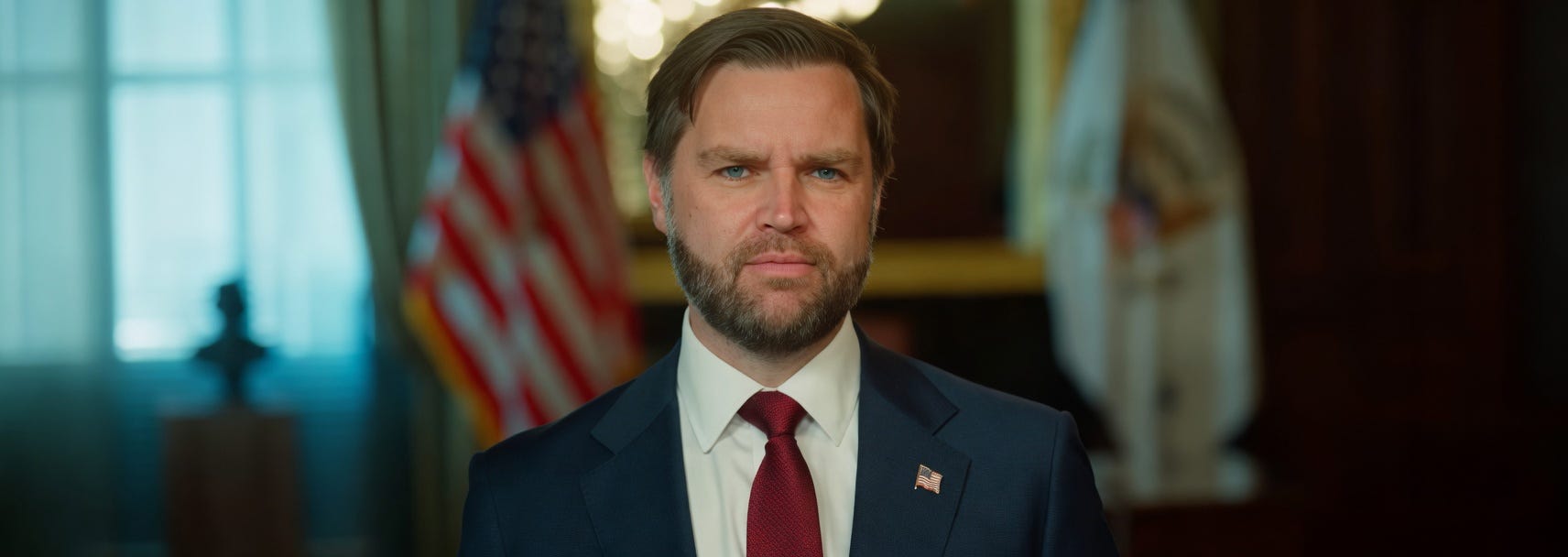
JD Vance: America Is a Christian Nation

18 May 2026 at 22:15

United States Vice President JD Vance has said that America’s identity is inseparable from its Christian inheritance.

During an address delivered for the Rededicate 250 National Prayer Jubilee, Vance traced America’s spiritual foundations from the Pilgrims and the Continental Congress to George Washington’s 1789 Thanksgiving proclamation.

It was in that proclamation that Washington called on all nations to “acknowledge the providence of Almighty God, to obey his will, to be grateful for his benefits, and humbly to implore his protection and favor.”

As such, “The duty Washington described to honour, obey, and give thanks to our Creator was woven into America’s character long before the founding,” Vance said, arguing that the United States has always been “a nation of prayer.”

Quoting John Adams, Vance also noted that the Constitution was “made only for a moral and religious people,” and insisted that America’s system of justice, liberty, and civic virtue flows directly from its religious — and specifically Christian — inheritance.

Quoting Charlie Kirk, the Vice President also emphasised the religious morality underpinning law and society, stating—as we have many, many times—that “all law reflects a morality,” and that both morality and law ultimately rest on religion.

“The morality and religion that formed the American consciousness were decidedly Christian,” he said.

As America marks 250 years, Vance called on citizens to pray not only in crisis, but continually — asking for wisdom and courage for national leadership, and for God’s guidance over the nation’s future.

WATCH:

Australia: Always Was, Always Will Be a Christian Nation

18 May 2026 at 09:02
Image

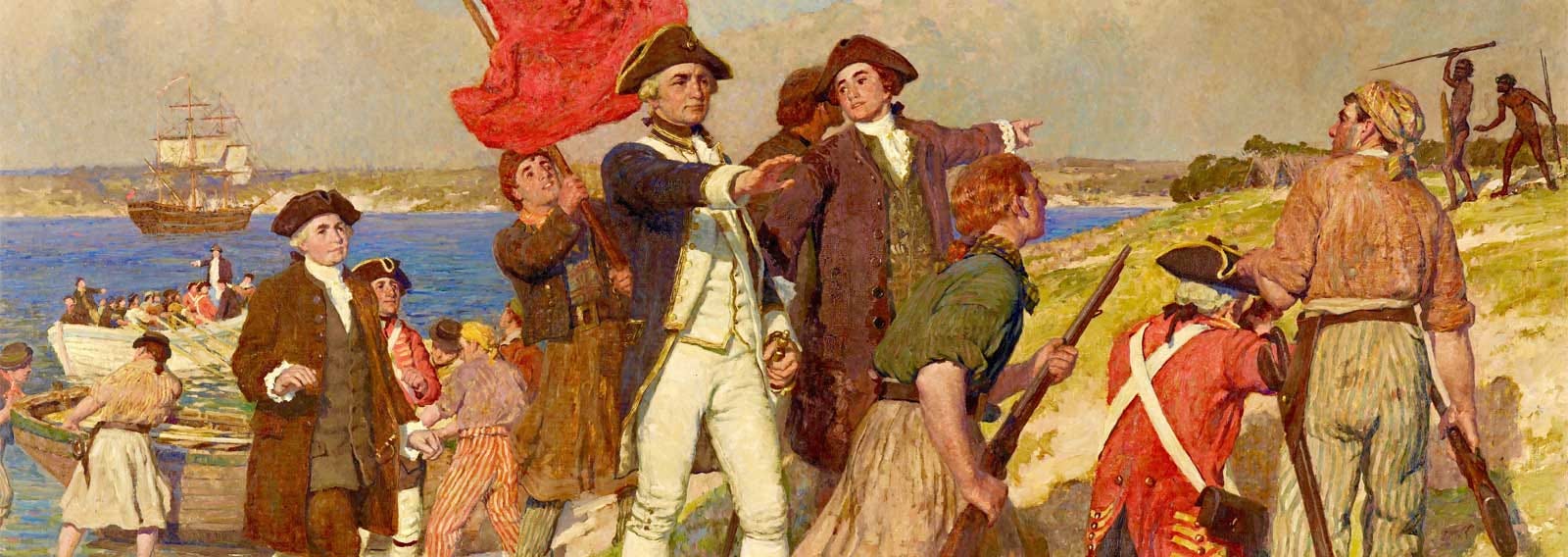
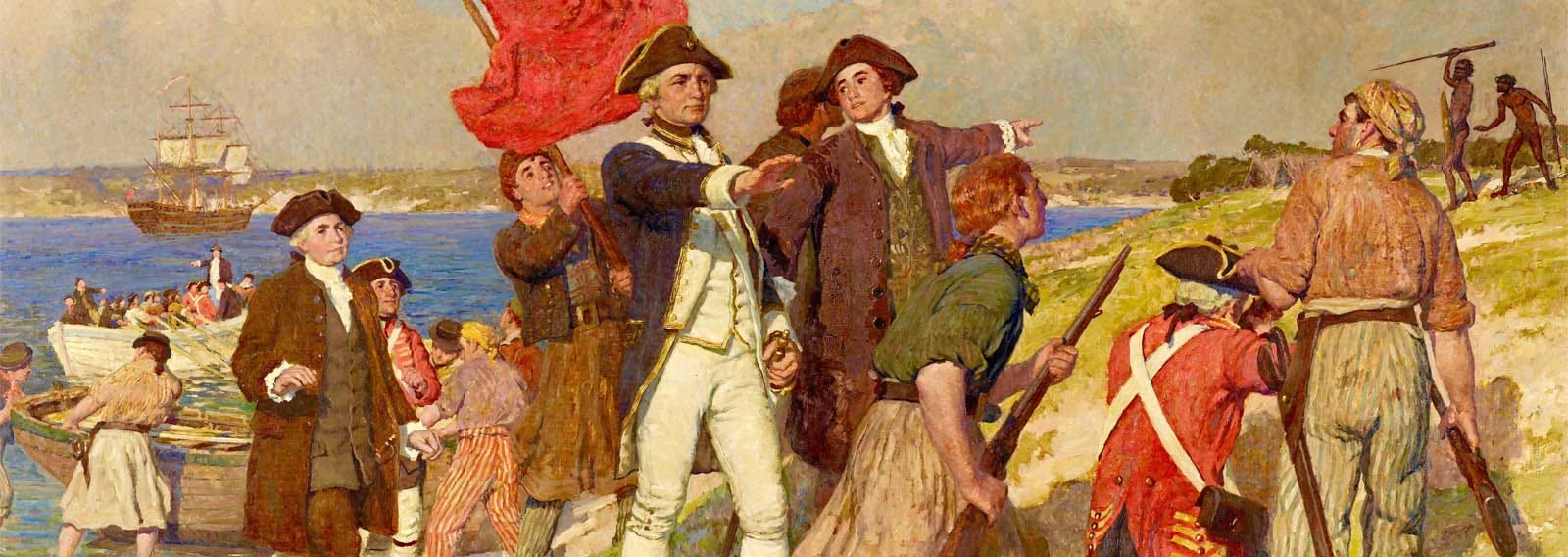
From the very first moment European settlement began in 1788, Christianity was deeply woven into the social, cultural, and political fabric of Australia. The Christian faith has shaped institutions, laws, public life, and national identity for more than two centuries.

Undoubtedly, Christianity formed the backdrop against which Australian society developed, whether through the arrival of the First Fleet’s chaplain, the overwhelming Christian demographics at Federation, or the early establishment of schools, Christian education, charities, and religious civic norms.

Here are fifteen historical markers that trace how Christian belief and practice informed Australia’s constitutional language, parliamentary traditions, welfare systems, education framework, and cultural landscape, demonstrating the central role Christianity played in shaping the nation.

1. Arrival with European Settlement (1788)

The First Fleet, which established the British colony in New South Wales, brought Christianity to Australia. Reverend Richard Johnson, a Church of England cleric, held the first Christian service on February 3, 1788, and was tasked with promoting public morality, health, and education in the colony.

2. Dominant Religion at Federation (1901)

At the time of Australia’s federation, approximately 96% of the population identified as Christian (40% Anglican, 23% Catholic, and the rest other Protestant denominations). This make-up reflected the overwhelmingly Anglo-Celtic settler society derived from Christian Britain.

3. Acknowledgment of God in the Constitution

The preamble to the Australian Constitution (1901) states that the people “humbly relying on the blessing of Almighty God” agreed to unite. Thus, the nation explicitly acknowledged divine providence in a document influenced by Christian framers and conventions, which also opened with prayer.

4. Parliamentary Traditions

Both federal and most state parliaments open daily sessions with the Lord’s Prayer (or Christian prayers). This is a practice dating back to federation and reflects the nation’s historical Christian underpinnings.

5. Christian Public Holidays

Major national holidays like Christmas and Easter (including Good Friday and Easter Monday) are enshrined in law as public holidays.

6. Role in Education

For much of Australia’s history, Christian churches, especially Anglican, Catholic, and later others, established and ran the majority of schools. Even today, a significant portion of non-government schools (about one-third of students) are Christian-affiliated, with historical state aid to church schools dating from the 19th century.

7. Welfare and Social Services

Christian organisations pioneered hospitals, aged care, orphanages, and charities. Groups like the Salvation Army, St Vincent de Paul, Anglican and Catholic welfare agencies, and missionaries (e.g., John Flynn’s Flying Doctor Service) provided foundational social infrastructure across the country, much of which the nation still relies on today.

8. Legal and Ethical Foundations

Australia’s common law system, inherited from Britain, is deeply rooted in Christian principles, including concepts of human dignity, justice, and morality—all influenced by the Bible, and Jesus’ teaching in particular.

9. Cultural and Architectural Landscape

Churches, cathedrals (e.g., St Mary’s in Sydney, St Paul’s in Melbourne), and Christian monuments dominate historic town centres and skylines. These serve as visible testaments to Christianity’s central role in community-building from colonial times onward.

10. Historical Majority and Influence Until Recent Decades:

Christianity remained the affiliation of over 88% of Australians as late as the 1960s census, shaping national identity, politics (e.g., sectarian divides between Protestants and Catholics), and public discourse well into the 20th century, with Christian leaders influencing policy on issues like education, welfare, and morality.

11. Christian Moral Framework in Early Colonial Governance:

Early governors explicitly relied on Christian moral teaching to guide penal reform, social order, and expectations for public behaviour. Sermons, chapel attendance, and moral instruction were considered essential to “civilising” the colony and reforming convicts. This reflected the belief, inherited from Britain, that Christianity was absolutely necessary for a stable society.

12. Missionary Activity and Indigenous Engagement:

Christian missionaries were among the first non-military Europeans to establish long-term settlements across the continent. Figures such as Lancelot Threlkeld, Samuel Marsden, and later the Australian Inland Mission saw their work as foundational to the moral and social development of the colony. Their presence created early schools, farms, hospitals, and written records of Indigenous languages.

13. Christian Influence on Early Social Norms and Law:

Even before Federation, colonial legal codes embedded Christian assumptions on marriage, Sabbath observance, oaths of office, blasphemy, charity obligations, and public morality. Courts routinely referenced biblical ethics, and judges assumed a Christian moral order as the baseline for legislation—an inheritance from English common law.

14. The Central Role of Churches in Community Formation:

Christian institutions were woven into the formation of civic life. In almost every emerging settlement, the first public buildings erected after basic shelters were churches. They served not only as places of worship but also as community centres, town halls, early schools, and venues for public meetings.

15. Christian Symbols and Language in Early National Identity:

Throughout the 19th century, politicians, newspapers, and public figures routinely described Australia as a Christian society. Public events opened with prayer, Christian hymns were played in national celebrations, and political speeches frequently invoked divine providence or biblical themes. Even debates over immigration, morality, and governance assumed a shared Christian cultural framework.

Taken together, these historical realities show that Christianity was not merely present in Australia’s development but foundational to it. From the Constitution’s acknowledgment of God to the dominance of Christian social institutions, public holidays, legal concepts, and community life, Australia grew within a distinctly Christian cultural framework that persisted well into the modern era.

Is it any surprise that Australia adopted overt Christian symbolism for its national flag? As Dr Francis Nigel Lee notes, “It needs to be remembered that the Australian flag unites the three Christian crosses of England, Ireland, and Scotland in the Union Jack – the Christian crosses of St George, St Patrick, and St Andrew – with the Southern Cross. Indeed, it is hard to imagine the flag of any country with a more graphic Christian significance.”

Many Australians today champion the “separation of church and state” and a secular public square—principles rooted not only in the Bible but also in Australia’s founding—yet over the past half-century, these ideas have devolved into a version that would be unrecognisable to previous generations, let alone the nation’s founders, conflating the separation of church and state institutions with a separation of Christianity from politics.

For Sir Robert Gordon Menzies (1894–1978), founder of the Liberal Party and Australia’s longest-serving Prime Minister, and as for Australia’s founders, secularism did not mean a separation of Christianity and politics, but rather ensuring that no particular Christian denomination was favoured by government, while still assuming that the Christian faith and religion would influence the political landscape.

Menzies maintained that, although Christianity should not be expressed in party political terms, it was the duty of all citizens to examine their politics through a Christian lens, noting: “To be a good Liberal, to be a good Labor man, to be a good Country Party man, you will be all the better if you are a Christian.” Christianity is, after all, what Australia is built upon.

Crossway Removes Kevin DeYoung Audiobooks from Canon+ After One Week

17 May 2026 at 23:59

Crossway Publishing has removed its audiobooks from Canon+.

According to Canon Press, the move came just one week after the Christian streaming platform announced the addition of Kevin DeYoung’s audiobooks to its catalogue.

In an email to subscribers, Canon Press CEO Brian Kohl said that shortly after the announcement, Crossway instructed the audiobook distributor to stop making the titles available to Canon+ subscribers.

Kohl stated that Canon Press had contacted Crossway’s head of licensing directly regarding the decision but had yet to receive a response.

“We are not holding our breath,” Kohl remarked.

Crossway has not yet publicly explained the reason for the removal. However, DeYoung has previously criticised Douglas Wilson and the broader culture surrounding Wilson’s ministry in Moscow. In particular, DeYoung drew attention to what he described as the “Moscow Mood,” a phrase originating from his critique published on Clearly Reformed.

In response to Kevin DeYoung’s article, Douglas Wilson and his supporters argued that institutions such as The Gospel Coalition and 9Marks had become overly cautious, soft, and “respectability-driven” in their engagement with modern cultural decline, which explains why more muscular and confrontational voices have gained influence.

DeYoung’s criticism was viewed by many of Wilson’s supporters as a form of evangelical gatekeeping, aimed at policing tone and vibe just as Wilson’s influence was significantly growing, particularly among younger men drawn to his more direct, culture-war framing.

Joe Rigney, Fellow of Theology at New Saint Andrews College in Moscow, Idaho, also responded to DeYoung’s criticisms. Rigney’s reply can be read here.

Notably, Crossway’s audiobooks remain available on major mainstream godless platforms, and Canon Press closed its statement to subscribers with an apt remark to disappointed listeners, noting that those unable to finish DeYoung’s audiobooks on Canon+ could still find them on “Amazon, Apple, Spotify, and other Babylonian outlets.”

TPAUS Petition to End ASIO Amendment to Terror Laws That Will Supercharge the Surveillance State

15 May 2026 at 23:33

Turning Point Australia (TPAUS) is urging the Australian Senate to keep the sunset clause for counter-terror laws.

Under the Labor proposal, Australia’s 2003 add-ons to the Australian Security Intelligence Organisation Act 1979 would become permanent.

This means that ASIO’s extraordinary powers for the “War on Terror” will no longer have a use-by date.

Since their inception, Australia’s precision post-9/11 policing laws have had the necessary parliamentary review, review, review, accountability.

Labor wants the Senate to ditch this stopgap.

The bill, called the Australian Security Intelligence Organisation Amendment Bill (No. 2) 2025, will also increase the reach of the Attorney-General.

He or she is the only one with the power to issue “compulsory questioning warrants” (QW) against both suspects and non-suspects.

Under current counter-terror QW laws, no judge is required.

Naturally, under the Sussan Ley “opposition,” the Liberals helped pass the bill through the House of Representatives in February.

The battle to save judicial oversight and keep Australia from permanently becoming a police state is now in the hands of the Senate.

As Senator Alex Antic noted, this should concern every “Australian who values freedom under the law.”

Speaking about the temporary nature built into the law by design, Antic said,

“Instead of respecting that original intent, this bill seeks to remove that safeguard entirely.”

There are three main areas of concern.

First, these extraordinary powers for policing terrorism become permanent.

Second, it supercharges the policing powers of a politician.

Third, the reasons a person can be dragged in for compulsory questioning expand to include “incitement,” and potentially (so-called) “hate speech.”

As I explained in the Daily Declaration on Friday,

“Compulsory questioning warrants (QW) have granted ASIO the power to question and detain anyone, regardless of whether or not they are a suspect.

Questioning warrants apply to both adults and minors who “are at least 14” (see here).”

Keep in mind here the absence of a bill of rights in Australia.

Rights are, for the most part, considered “implied rights.”

Protections for Australian civil liberties largely come under Australia’s commitment to uphold international law.”

For these reasons, the expansion of “war on terror” powers should have churches, not just civic and civil rights groups, deeply concerned.

This is why Turning Point Australia isn’t just raising awareness; they’re firmly opposing the amendments, and asking Australians to do the same.

TPAUS see the dangers as clear and present.

Such as there being no right to remain silent. Even access to a lawyer, and the lawyer’s ability to do his or her job, is significantly restricted.

Additionally, if questioned or detained by ASIO, regardless of whether a person is a suspect or not, there is the threat of 5-years in prison for talking about the incident.

The amendment cements this denial of due process into Australian law.

Indirectly backing TPAUS, the Law Council of Australia has said – and I referred to this in the Daily Declaration – that they are seriously concerned.

Consequently, they said, “We do not support the removal of the sunset clause for these powers.”

“This is because of a longstanding failure to strike an appropriate balance between responding to the gravity of evidenced threats to national security with compliance with the rule of law, Australia’s obligations under international law, and respect for human rights obligations.”

Because of the law’s huge potential for abuse, the Law Council said policing of the legislation requires constant review.

Regular scrutiny of powers that restrict rights, and scrutiny of how that power is wielded, matters.

“Periodic opportunities to publicly make the case that exceptional powers that trespass on fundamental rights are necessary and proportionate,” the Law Council argued.

The use-by date provides “an essential democratic oversight function and should not be surrendered.”

“We maintain,” they added, “that ASIO must be required to regularly demonstrate to the Australian public that these powers continue to be both necessary and proportionate to the threat environment.”

To date, TPAUS have helped Australians send over 580,000 emails asking the Senate to save the sunset clause by voting against the ASIO amendment.

Debate was set for Friday. That date has since been pushed back to June.

Noting the reprieve, TPAUS said, Australians now have a renewed opportunity to raise awareness and act on widespread concerns.

You can join with them in telling the Senate to boot the bill by tapping here.

❌