Starting in 2018, gray whales began regularly stopping in California’s San Francisco Bay, where they are vulnerable to ship strikes in one of the busiest ports in the United States. In response, researchers have deployed a monitoring network of thermal cameras and AI software to alert ships when whales are present in the bay to help them avoid whale collisions. Gray whales (Eschrichtius robustus) have one of the longest migrations of any mammal species, roughly 19,000 kilometers (12,000 miles) from their feeding grounds in Alaska to their breeding grounds in Mexico, and back again. Climate change is making their feeding grounds in Alaska less productive, leaving the whales hungry as they head south to breed. Scientists believe that’s why gray whales have started stopping in San Francisco Bay to eat along their migration route. But the new pit stop brings whales into busy shipping zones, where more than 20 were killed by ship collisions in 2025, according to a news release. Whale biologists at the Benioff Ocean Science Lab, WhaleSpotter, and the Marine Mammal Center have developed thermal cameras that can detect the heat signature of whale spouts and bodies when the whales surface. “Next a trained human confirms the detection and will help classify the species when possible,” Rachel Rhodes, a project scientist with the Benioff Ocean Science Lab told Mongabay in an email. Then the information is, “posted publicly on [the] Whale Safe website, which is accessed by mariners in the Bay Area including Vessel Traffic Service and…This article was originally published on Mongabay
TORONTO (AP) — Canada’s government endorsed a plan Wednesday to move the last remaining captive whales from a shuttered theme park in Ontario to aquariums in the United States and Spain — a plan that could save them from mass euthanasia if the deal goes through. There are 30 belugas and four dolphins left in the Marineland park and zoo in Niagara Falls, Ontario, which announced in early 2023 that it was for sale and closed to the public in late summer 2024. No sale has yet been announced. The former tourist attraction has since worked to move the park’s remaining animals and sell the sprawling property near Horseshoe Falls. In 2024, Marineland was found guilty under Ontario’s animal cruelty laws in a case related to its care of three black bears. The Department of Fisheries and Oceans has issued the first batch of permits to move the whales and is set to issue different permits closer to the move, expected to take place in the next few months. It recently issued permits for the whales and dolphins under the Convention on International Trade in Endangered Species of Wild Fauna and Flora, otherwise known as CITES permits. “I think this is a positive step forward,” Fisheries Minister Joanne Thompson said. “There’s still more work to be done, but it’s a step forward.” Twenty whales — 19 belugas and one killer whale — have died at Marineland since 2019, according to provincial government data obtained through freedom-of-information laws and official statements. Thompson’s office said…This article was originally published on Mongabay
As offshore wind farms expand rapidly in the global renewable energy transition, scientists are studying how these large marine infrastructure projects affect ecosystems beneath the waves. Research from Wageningen University & Research in the Netherlands suggests that offshore wind may bring both risks and benefits for sharks and rays, known collectively as Elasmobranchii, which are highly sensitive to electromagnetic fields (EMFs). A six-year project called “Elasmopower” examined how EMFs from subsea power cables in offshore wind farms affect bottom-dwelling sharks and rays. These species depend on natural electric and magnetic fields for key behaviors such as navigation, prey detection, habitat use and long-distance movement, particularly in low-visibility environments. The studies conducted as part of the Elasmopower project have been published in four papers, with three additional papers currently undergoing peer review. Sharks and rays have specialized electroreceptors called ampullae of Lorenzini. The jelly-filled sensory canals around the head and snout can detect even extremely weak EMFs from prey and predators, water movement, and the Earth’s geomagnetic field, Erwin Winter, a scientist at Wageningen, told Mongabay. This system is central to hunting and orientation, making Elasmobranchii especially relevant for studying EMF exposure from offshore energy infrastructure, Winter added. Erwin Winter, a researcher with the Elasmopower project, presented findings on offshore wind, electromagnetic fields and bottom-dwelling sharks and rays at the Sharks International 2026 conference in Colombo, Sri Lanka, in May. Image by Malaka Rodrigo for Mongabay. During a presentation on a summary of the Elasmopower research at the Sharks International 2026…This article was originally published on Mongabay
The existence of the “polluter pays” principle (PPP) in Bangladesh, at least on paper, dates back to 1992, ever since the country endorsed the Rio Declaration. However, Bangladesh has made little progress in implementing the principle so far. A statement by the incumbent minister for environment, forest and climate change, Abdul Awal Mintoo, saying that regulatory authorities recovered less than half of the total compensation imposed on polluters over the past 16 years, exposed the structural loopholes in environmental governance behind failures in implementing the principle. The minister pointed out that polluters can delay the compensation recovery by applying their right to appeal against the regulatory authorities’ orders. that Mongabay spoke to said that loopholes in the judicial system, weak evidence and economic analysis on pollution, and polluters’ influence must be addressed if the country really wants to implement the PPP. Environmentalist and Dhaka University’s zoology professor Mohammad Firoj Jaman told Mongabay, “Delays in implementation of laws against polluters aggravate environmental pollution, and the hope of reaping the benefits of environmental justice falls flat.” Shanties stand along the bank of Buriganga River in Hazaribagh, Dhaka district, Bangladesh. The area is known for tanneries, the waste from which fill the surrounding land and water. Image by Abir Abdullah/Asian Development Bank via Flickr (CC BY-NC-ND 2.0). Compensation recovery undermines the PPP The PPP binds polluters to bear the costs of managing and remedying the harm they have done to the environment. The concept of PPP was first mentioned in the recommendations of…This article was originally published on Mongabay
CHIRADZULU, Malawi — Diana Sitima’s farm on the outskirts of Malawi’s commercial capital, Blantyre, is both example and an exception. Where neighboring farmers have planted mostly maize for food and for sale in nearby markets, people drive out to buy sweet potato, pigeon peas and vegetables, bananas and avocado, and eggs produced on Sitima’s 3.5-hectare (8.6-acre) property. Sitima started farming in 1993. Unlike her neighbors, farming was a side hustle to begin with: she worked as an office assistant in Blantyre and her husband had a good job with a bank. Over the next seven years, she and her husband took out a series of micro-loans, renting small parcels of land and hiring people from the village to grow tomatoes for sale in the city. Sitima’s efforts went well, and because her family did not have to rely on their harvest for food or an income at that time, she was able to save the money she earned to take a next step. She quit her office job and acquired a farm of her own in Chiradzulu district, 15 kilometers (9 miles) east of the city. “That’s how I made money to be able to buy this land when it was put up for sale in 2006,” she says. While she was still a part-time farmer, Sitima attended several workshops, where she picked up ideas about agroecological farming — an approach combining crops, agroforestry, fish ponds, poultry and livestock, in a self-reinforcing system that protects soil health and reduces the…This article was originally published on Mongabay
Since May 23, more than 200 primates housed at the Lwiro Primates Rehabilitation Center (LPRC) in South Kivu province in the eastern Democratic Republic of Congo (DRC) have been placed under confinement due to the Ebola outbreak. This measure follows the death of a man who tested positive for the virus on May 21. This individual, a resident of Kahungu, located just 2 km (1.2 miles) from the town of Lwiro, where the center is situated, had traveled in early May to neighboring Ituri province. Ituri is the epicenter of the outbreak, which, as of May 27, is linked to more than 200 suspected deaths. A threat for humans and apes The LPRC houses at least 129 chimpanzees and 108 monkeys of various species, including olive baboons (Papio anubis), yellow baboons (Papio cynocephalus), L’Hoest’s monkeys (Cercopithecus l’hoesti), blue monkeys (Cercopithecus mitis), agile mangabeys (Cercocebus agilis) and others. Parrots, turtles and porcupines can also be found there. These primates, rescued from poaching and the illegal wildlife trade, are being kept in confinement even though “for the moment, no cases of Ebola virus transmission from a human to a great ape have been reported,” primatologist Liz Williamson explained in an email to Mongabay. According to the World Health Organization, the Ebola virus is transmitted to humans through close contact with the blood, secretions, organs or other bodily fluids of infected animals. A chimpanzee at the Lwiro Primates Rehabilitation Center, located in South Kivu province in the eastern Democratic Republic of Congo. Image…This article was originally published on Mongabay
Sat Born, 56, recalls freezing at the forest’s entrance when he first saw it. “Its head was this big,” he says, wide-eyed, spreading his hands to show the animal’s size. Recollecting that eventful morning in 2001, Born, who now farms bananas and durians, retraces his steps from his home in Trapeang Chheu Trav village in the rainforests of the Cardamom Mountains in southwestern Cambodia. As he walks up a hill rising above the forest canopy, he points to a spot on the road. “It’s over here. When I saw the tiger, it was 9 a.m.,” he says. “I was really shocked … I couldn’t tell if the tiger was coming towards me.” In 2007, just six years after this fleeting encounter, Cambodia’s last confirmed tiger sighting was logged by a camera trap. In the 1990s, the country was estimated to host hundreds of wild Indochinese tigers, but decades of poaching pressure took a heavy toll. In 2016, tigers (Panthera tigris) were formally declared extinct in Cambodia. That may be set to change with the imminent translocation of a small population of Bengal tigers from India. Although many reintroductions are success stories, this one raises some serious concerns. Why would Cambodia bring in a nonnative tiger? Have the people living in these areas been adequately consulted? Will these translocated tigers be able to adapt to this new habitat? Is there enough prey to sustain them, and if not, how will the government address predation when hungry cats feed on livestock? With…This article was originally published on Mongabay
For nearly 20 years, the blue-spotted bamboo shark, found only in Madagascar, went scientifically undetected and unrecorded. But researchers have now found four new records of the “lost” shark while surveying fishing villages and a Malagasy university’s fish collection. These recent records, and interviews with fishers, suggest the species may be more common than previously thought, according to a new report in Oryx. The blue-spotted bamboo shark (Chiloscyllium caeruleopunctatum), so named for the blue-white spots on its brown body, was first described based on a specimen caught off Madagascar in 1914. A second record of the species came 92 years later — a photograph of a shark caught in 2006. Since then, the species largely went unconfirmed, until researchers began surveying fish markets and landing sites in Madagascar in September 2025. Report’s lead author Tsarahasina Fanomenzana, a young Malagasy intern from the NGO Madagascar Whale Shark Project, was showing photos of sharks and rays he’d seen at a fishing village on the east coast to shark expert and co-author David Ebert. “One of the photos was of the blue-spotted bamboo shark,” Ebert told Mongabay by email. “He didn’t think too much of it as there were some other images of shark and ray species he thought were more interesting.” However, Ebert said he was “more than excited,” because the pictures confirmed the blue-spotted shark was still around. He was in Madagascar for the Lost Sharks project, supported by the Save Our Seas Foundation, which aims to find and raise awareness…This article was originally published on Mongabay
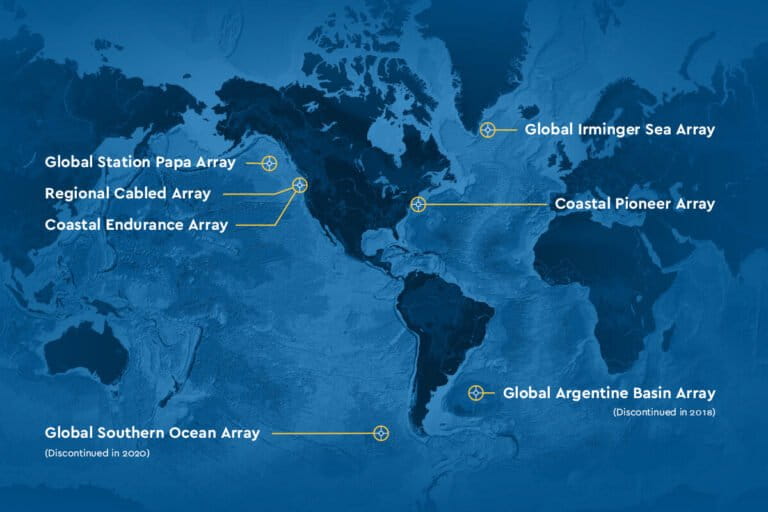
Over the next 15 months, major sensor arrays that have provided crucial, decade-long observations of the ocean, marine ecosystems and climate change will be dismantled. These sensors are part of the Ocean Observatories Initiative (OOI), a $386 million network of more than 900 instruments funded by the U.S. government’s National Science Foundation (NSF), which has provided real-time data on the world’s oceans for more than a decade. The sensors are distributed across both the Atlantic and Pacific oceans to monitor coastal environments, marine ecosystems, and ocean currents that influence the global climate. The decision to end OOI, described by the foundation as a “descoping,” will remove nearly all in-water infrastructure located off the states of Alaska, Washington, Oregon and North Carolina, and the Irminger Sea, an area between Iceland and Greenland. As the instruments are recovered, data streams from those areas will go dark, Jim Edson, principal investigator of the initiative, said in a statement. “However, all previously collected OOI data will remain accessible through the OOI Data Center.” The OOI was designed as a 25-to-30-year project specifically to capture long-term climate signals, which scientists say require at least three decades of continuous data to be meaningfully detected. The network has achieved just 10 years of observations. While satellites can monitor the ocean’s surface, the OOI arrays provided a rare look into the deep sea, measuring low-oxygen zones, carbon absorption, and currents critical to regulating weather patterns. The Associated Press (AP) reported that the removal comes at a particularly sensitive…This article was originally published on Mongabay
Small-scale gold mining is a major cause of deforestation in the Amazon, and researchers found that in Guyana it destroys dung beetle communities and prevents their recovery for decades. Gold mining causes 90% of the deforestation in the Guiana Shield, which contains a quarter of the Amazon rainforest as well as large gold deposits, according to a recent study. Most of the gold mining in this region, including in Guyana, is artisanal, driven by small-scale mining rather than large industrial mines. To understand the long-term “ecological legacy” of such mining, a team of researchers measured dung beetle communities at 16 abandoned small-scale gold mine sites in northwest Guyana. They choose dung beetles, because the insects are easily sampled and play key roles in rainforest functions like nutrient cycling, seed dispersal and pollination. For control, the team monitored dung beetle communities at five nearby intact forests. At every mining site, the researchers sampled dung beetles at three locations: the center of the mine where vegetation was regrowing, at the edge where the mine met the forest, and about 100 meters (328 feet) away into the forest. They trapped dung beetles using human feces as bait. Study lead author Sean Glynn from the University of Kent, U.K., told Mongabay by email that because they were camping remotely, they didn’t have reliable access to feces from other animals to use as bait, “however, human seems to always be the best.” The team also recorded air temperature and vegetation structure at each of the…This article was originally published on Mongabay
Researchers have found a new-to-science species of a tiny sea slug with black and yellow spots resembling “scattered sesame seeds.” Measuring just three millimeters long (0.1 inches long), the researchers have named it Thecacera sesama, according to a recent study. Study lead author Ho-Yeung Chan first spotted the sea slug during a recreational dive in the coastal waters of Keelung, northern Taiwan, in 2019. At the time, he was still an undergraduate student and did not realize the animal was unknown to science until he consulted an expert on Facebook, according to a statement. To formally identify the species, researchers collected six specimens of the sea slug during diving expeditions conducted between May 2021 and June 2025. Between May and September, typhoons can make diving risky. The research team then examined the specimens’ structure and appearance and analyzed their DNA to confirm that it was a new-to-science species. T. sesama is the seventh Thecacera species to be described, and the first one to be named in the genus in nearly three decades. Despite its small stature, T. sesama is visually striking, the researchers wrote. It has a translucent white body covered in small black and yellow spots that look like sesame seeds. While the species looks similar to another sea slug Thecacera pennigera, which has black and orange spots, T. sesama is significantly smaller and genetically distinct. The researchers found that T. sesama lives on and feeds exclusively on bryozoans, small aquatic invertebrates known as “moss animals” that live in…This article was originally published on Mongabay
Thomas Crowther begins his book with a snakebite that was not, in any conventional sense, dangerous. The danger came from interpretation. A misidentified species, a surge of fear, and a body that responded as if the threat were real: numbness spread, panic intensified, and the situation escalated until a second opinion dissolved it almost instantly. The episode is more than an anecdote. It sets the terms of Nature’s Echo, a book that treats cause and effect not as linear sequences so much as loops that can amplify themselves in either direction. Thomas Crowther That idea—feedback loops as the underlying architecture of the natural world—is the organizing principle of the book. Crowther traces it from cosmology to ecology to human psychology, moving across scales with considerable ambition. The early chapters move outward from the origin of matter, suggesting that the same reinforcing processes that allowed stars to form also underpin biological evolution and social behavior. It is an ambitious framing. At its best, it brings a sense of coherence to subjects that are often treated separately. At times, the scope of the framework requires readers to travel across very different domains and scales of thought. The structure reflects that expansiveness. The table of contents alone signals the range: from “Cause and Effect” and “Feedback Loops” through “Resilience and Tipping Points” and into “The Story We Tell Ourselves.” The progression is deliberate. Crowther starts with physical systems, moves into ecological stability, and then into the social and psychological domains where perception begins…This article was originally published on Mongabay
In the global debate over tropical deforestation, the usual cast of villains is well established: agribusiness, global supply chains, cattle ranchers, and governments granting land concessions for political support. One actor rarely appears in this narrative yet has played a consequential role in transforming the South American lowland frontier: The Mennonite agricultural colonist. For more than five decades, Mennonite communities have functioned as systematic agents of agricultural frontier expansion in the Gran Chaco and Andean Amazon, methodically clearing forests, draining wetlands, and catalyzing waves of deforestation that extend far beyond any individual colony. Mennonite communities operate within the law. They purchase land through formal channels, build permanent communities, and transfer agronomic knowledge to surrounding populations. Their values emphasize hard work, communal solidarity, and a theological relationship to land as stewardship. None of this changes the ecological outcome: Wherever a Mennonite colony is established, forests fall. Faith, mobility and colony formation Mennonites are an Anabaptist denomination rooted in the 16-century Reformation, distinguished by pacifism, communal life, and cultural separation from mainstream society. Conservative congregations — whose ancestors moved from Russia to Canada, then to Mexico, Belize and South America — are organized around a local congregation that functions simultaneously as a religious community, governance structure, credit cooperative and social welfare system. When a colony is established, it is an orderly community with collective decision-making, shared infrastructure, and a coherent plan for the future. Forest being cut, burned, and prepared by a Mennonite colony before planting crops. Image courtesy of Mario Silvero.…This article was originally published on Mongabay

 Login
Login