Manas National Park in India’s Himalayan foothills was once home to some 100 Indian rhinos, almost all of which were wiped out by poaching by the late 1990s. After a campaign to reintroduce them, the population is growing and several calves have been born. But their recovery still needs active support, reports contributor Sneha Mahale for Mongabay India. Researchers followed the fate of 42 greater one-horned rhinos (Rhinoceros unicornis) reintroduced to Manas in the state of Assam from 2006-2021. The rhinos arrived there in one of two ways: 22 wild rhinos were translocated from other protected areas in Assam, and 20 injured or orphaned rhinos were rescued and rehabilitated at a center, then released into Manas. The rhino reintroduction program is showing hopeful signs, the decade-long study found. Between 2012 and 2022, the researchers recorded 35 rhino births in Manas: 19 calves from translocated females, and nine from rehabilitated individuals. First-generation rhino females, born in Manas, also birthed five calves; the mothers of two more calves remained unidentified. “Breeding and calving are among the most important indicators that reintroduced rhinoceroses have adapted well to their new environment,” study lead author Deba Kumar Dutta, a wildlife biologist and member of the Asian Rhino Specialist Group at the IUCN, the global wildlife conservation authority, told Mongabay India. The study also found the two groups of rhinos settled in different parts of the national park. Translocated rhinos spread out over a larger area, often using remote or less-disturbed parts of the park, while…This article was originally published on Mongabay
The intersection of environmental breakdown, climate change and economic instability has emerged as a primary threat to the resilience of smallholder farmers in Indonesia, according to researchers and local entrepreneurs who spoke at a recent convention. During the 2026 Asia Grassroots Forum, held in Jakarta on June 3 and 4, Alex Arnall, an associate professor for environment and development at the University of Reading, U.K., said climate change has become an “agent of exclusion,” creating a “double exposure” for farmers who must simultaneously navigate global market volatility and erratic weather. The Asia Grassroots Forum focused on building sustainable business ecosystems for smallholders. Previous research showed extreme weather events can affect farmers in southeast Asia by damaging crops, agricultural infrastructure like irrigation systems and farm equipment, and by increasing operational costs and reducing revenues. A 2024 report found that every 1% increase in average temperature raises the price of food production by 1% to 2% across Indonesia, Thailand, Vietnam, Malaysia and the Philippines. Researchers have also noted that smallholder farmers in the region face a massive financing gap, with less than one-third of the $100 billion needed annually for climate-smart adaptation, leaving them in urgent need of better access to credit, insurance and targeted financial support Drawing on his work with salt farmers in Thailand, Arnall described how even highly-skilled, traditional producers are seeing their knowledge “undermined” by sea-level rise and coastal change. “Farmers in many places … are losing trust in the weather patterns as they become more unpredictable,” Arnall…This article was originally published on Mongabay
Founder’s Briefs: An occasional series where Mongabay founder Rhett Ayers Butler shares analysis, perspectives and story summaries. The platypus offers a useful lesson in conservation: before acting, it helps to know where the animal still lives, and where risks are growing. Australia’s best-known oddity is also difficult to count, reports contributor Paul Harvey for Mongabay. It feeds around dawn and dusk, spends much of its life underwater in rivers, and leaves few obvious signs. That makes its decline harder to measure and harder to manage. The IUCN Red List classifies the species as near threatened, based on an estimate of about 50,000 animals, though researchers say the true number is uncertain. That uncertainty has become more important as pressure on rivers increases. Drought can shrink the pools where platypuses feed. Bushfires can damage riverbanks and nearby vegetation. Floods can inundate burrows before animals can escape. Pollution from wastewater, mining, industry, and urban runoff can reduce the aquatic invertebrates that make up much of their diet. There is room for optimism because scientists have now developed a framework for deciding when to help platypuses where they are and when animals may need to be moved. Zoos are also preparing for a clearer role in emergencies, including temporary care for animals stranded by drought, fire, or flood. Citizen science can help close the information gap. Projects that map sightings show where platypuses are still being seen. Environmental DNA, collected from water samples, can detect their presence without needing to trap or even…This article was originally published on Mongabay
Researchers have identified three new-to-science species of snake mantises, two from Australia and one from Papua New Guinea, and figured out their distribution and behavior with the help of citizen scientists. Matthew Connors, a Ph.D. candidate at James Cook University in Australia, led the effort to revisit the taxonomy of Kongobatha, a little-studied group of praying mantises known as snake mantises for the snake-like patterns on their wings. They’re also referred to as leaf-planking mantises, because they press their bodies against leaves to camouflage. The blending in helps because they are both predators of insects, including flies and mosquitoes, and prey themselves. “They have this special organ right on their chest that is a sensory thing, and it helps them flatten themselves down really nicely against a leaf, so that they’re really hard for a predator to see,” Connors said in a news release. Previously only two species of Kongobatha were known: one from Australia and another from Papua New Guinea. Now, there are three more, named K. serpens, K. spinosistyla and K. rufilinea. To describe these three species, Connors collected new specimens of the mantises and sourced others from Australian and international museums and private collections. He examined them under a microscope, focusing on male anatomical features called styli, which are a pair of small appendage-like structures located on the end of the abdomen, and may function in mating, although this remains a “mystery,” Connors told Mongabay by email. The styli of snake mantises have many spines on them,…This article was originally published on Mongabay
Researchers in Nepal have confirmed a rare Chinese pangolin living in a small community forest considered sacred by locals, according to a recent study. It may also be the first video evidence of the pangolin in Nepal’s Sunsari district, researchers said. The Chinese pangolin (Manis pentadactyla), listed as critically endangered on the IUCN Red List and protected under Nepalese laws, is threatened by both habitat loss and poaching. This makes every verified population, especially those outside protected areas, important for conservation, study lead author Tujin Rai with Tribhuvan University in Nepal told Mongabay by email. Chinese pangolins are found across Nepal. However, verified records of the species in eastern Nepal remain poor, the authors wrote. Previous research has found indirect signs such as pangolin burrows and footprints in Panchakanya community forest in Sunsari district. The community forest, spanning just 0.56 square kilometers (0.22 square miles), is located “within a mosaic of villages, agricultural lands, transportation infrastructure, and the Sewti River,” Rai said. To verify the presence of the pangolin in the forest, Rai and his colleagues installed camera traps on trails and around recently dug burrows in January 2025. On Jan. 21, 2025, the cameras recorded a male Chinese pangolin. Rai told Mongabay that during field surveys they also recorded nearly 30 pangolin burrows and other signs, especially in areas with abundant ant and termite colonies, which pangolins like to eat. These observations suggest the forest possibly supports more than a single individual; however, right now the team can only…This article was originally published on Mongabay
While on a deep-sea expedition in the Galapagos in 2015, scientists found a golf-ball sized, short-armed blue octopus. In a recent study, they confirmed that it’s new to science. The newly described octopus, named Microeledone galapagensis, was first sighted with a remotely operated vehicle (ROV) near an underwater mountain, roughly 1,773 meters (5,800 feet) below the Pacific Ocean surface close to Darwin Island. Expedition researchers from the Charles Darwin Foundation and the Galápagos National Park Directorate collected it with their ROV. They saw two more octopus individuals on video. The body of the collected specimen was preserved and sent to octopus expert Janet Voight at the Field Museum in Chicago, Illinois, U.S. Voight and colleagues at the museum scanned the octopus using computed tomography (CT) to create a 3D model of the individual. The researchers then used the CT model to examine its internal organs and mouth parts. “When you describe a new species of octopus, you have to look at all the parts, including the mouth, the beak, and the teeth. And to see those things, you have to cut the specimen open. We only had the one specimen, so I didn’t want to take it apart,” Voight said in a press release. A comparison of the blue octopus’ parts with those from other octopus species revealed that it was a new-to-science species. Unlike many octopuses, Microeledone galapagensis is small, squat, and has short, stubby arms with few arm suckers. “One of the interesting questions about…This article was originally published on Mongabay
Severed tissue from a cold-water sea cucumber can survive, heal, and even move independently for years in natural seawater, researchers recently found. Some animals have the ability to regenerate tissues and body parts. Certain lizards can regrow their tails, for example. Some sea stars and sea cucumbers, including Psolus fabricii that live in the cold waters of the Atlantic and Arctic oceans, can regrow their severed arms or halves. However, researchers in the study showed that the discarded parts of a sea cucumber, instead of dying, can also remain viable for long periods of time. “It’s like a lizard that loses its tail,” study co-author Rachel Sipler from Memorial University of Newfoundland in Canada, said in a statement. “We know some lizards can grow new tails; we’re talking about whether the tail can grow a new lizard.” Sipler and her colleagues removed parts of tentacles, feet and the main body from three Psolus fabricii individuals and placed them in natural seawater in the laboratory. The tissues showed active immune responses, cell diversification, and the ability to absorb nutrients (amino acids) dissolved in the seawater. Even when the researchers stopped the experiments after three years, the tissues continued to survive. “We haven’t grown a new, complete sea cucumber yet, but we are seeing pretty stunning growth and diversification of cells literally years after this tissue was removed,” Sipler said in the statement. Cell lines that are “immortal” and can perpetuate indefinitely are crucial for biomedical research. However, most such “immortal” cell…This article was originally published on Mongabay
For nearly 20 years, the blue-spotted bamboo shark, found only in Madagascar, went scientifically undetected and unrecorded. But researchers have now found four new records of the “lost” shark while surveying fishing villages and a Malagasy university’s fish collection. These recent records, and interviews with fishers, suggest the species may be more common than previously thought, according to a new report in Oryx. The blue-spotted bamboo shark (Chiloscyllium caeruleopunctatum), so named for the blue-white spots on its brown body, was first described based on a specimen caught off Madagascar in 1914. A second record of the species came 92 years later — a photograph of a shark caught in 2006. Since then, the species largely went unconfirmed, until researchers began surveying fish markets and landing sites in Madagascar in September 2025. Report’s lead author Tsarahasina Fanomenzana, a young Malagasy intern from the NGO Madagascar Whale Shark Project, was showing photos of sharks and rays he’d seen at a fishing village on the east coast to shark expert and co-author David Ebert. “One of the photos was of the blue-spotted bamboo shark,” Ebert told Mongabay by email. “He didn’t think too much of it as there were some other images of shark and ray species he thought were more interesting.” However, Ebert said he was “more than excited,” because the pictures confirmed the blue-spotted shark was still around. He was in Madagascar for the Lost Sharks project, supported by the Save Our Seas Foundation, which aims to find and raise awareness…This article was originally published on Mongabay
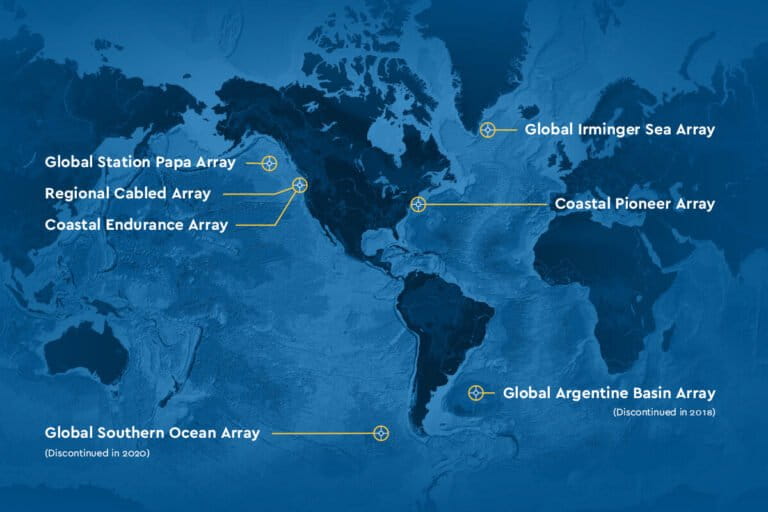
Over the next 15 months, major sensor arrays that have provided crucial, decade-long observations of the ocean, marine ecosystems and climate change will be dismantled. These sensors are part of the Ocean Observatories Initiative (OOI), a $386 million network of more than 900 instruments funded by the U.S. government’s National Science Foundation (NSF), which has provided real-time data on the world’s oceans for more than a decade. The sensors are distributed across both the Atlantic and Pacific oceans to monitor coastal environments, marine ecosystems, and ocean currents that influence the global climate. The decision to end OOI, described by the foundation as a “descoping,” will remove nearly all in-water infrastructure located off the states of Alaska, Washington, Oregon and North Carolina, and the Irminger Sea, an area between Iceland and Greenland. As the instruments are recovered, data streams from those areas will go dark, Jim Edson, principal investigator of the initiative, said in a statement. “However, all previously collected OOI data will remain accessible through the OOI Data Center.” The OOI was designed as a 25-to-30-year project specifically to capture long-term climate signals, which scientists say require at least three decades of continuous data to be meaningfully detected. The network has achieved just 10 years of observations. While satellites can monitor the ocean’s surface, the OOI arrays provided a rare look into the deep sea, measuring low-oxygen zones, carbon absorption, and currents critical to regulating weather patterns. The Associated Press (AP) reported that the removal comes at a particularly sensitive…This article was originally published on Mongabay
Small-scale gold mining is a major cause of deforestation in the Amazon, and researchers found that in Guyana it destroys dung beetle communities and prevents their recovery for decades. Gold mining causes 90% of the deforestation in the Guiana Shield, which contains a quarter of the Amazon rainforest as well as large gold deposits, according to a recent study. Most of the gold mining in this region, including in Guyana, is artisanal, driven by small-scale mining rather than large industrial mines. To understand the long-term “ecological legacy” of such mining, a team of researchers measured dung beetle communities at 16 abandoned small-scale gold mine sites in northwest Guyana. They choose dung beetles, because the insects are easily sampled and play key roles in rainforest functions like nutrient cycling, seed dispersal and pollination. For control, the team monitored dung beetle communities at five nearby intact forests. At every mining site, the researchers sampled dung beetles at three locations: the center of the mine where vegetation was regrowing, at the edge where the mine met the forest, and about 100 meters (328 feet) away into the forest. They trapped dung beetles using human feces as bait. Study lead author Sean Glynn from the University of Kent, U.K., told Mongabay by email that because they were camping remotely, they didn’t have reliable access to feces from other animals to use as bait, “however, human seems to always be the best.” The team also recorded air temperature and vegetation structure at each of the…This article was originally published on Mongabay
Researchers have found a new-to-science species of a tiny sea slug with black and yellow spots resembling “scattered sesame seeds.” Measuring just three millimeters long (0.1 inches long), the researchers have named it Thecacera sesama, according to a recent study. Study lead author Ho-Yeung Chan first spotted the sea slug during a recreational dive in the coastal waters of Keelung, northern Taiwan, in 2019. At the time, he was still an undergraduate student and did not realize the animal was unknown to science until he consulted an expert on Facebook, according to a statement. To formally identify the species, researchers collected six specimens of the sea slug during diving expeditions conducted between May 2021 and June 2025. Between May and September, typhoons can make diving risky. The research team then examined the specimens’ structure and appearance and analyzed their DNA to confirm that it was a new-to-science species. T. sesama is the seventh Thecacera species to be described, and the first one to be named in the genus in nearly three decades. Despite its small stature, T. sesama is visually striking, the researchers wrote. It has a translucent white body covered in small black and yellow spots that look like sesame seeds. While the species looks similar to another sea slug Thecacera pennigera, which has black and orange spots, T. sesama is significantly smaller and genetically distinct. The researchers found that T. sesama lives on and feeds exclusively on bryozoans, small aquatic invertebrates known as “moss animals” that live in…This article was originally published on Mongabay
Founder’s Briefs: An occasional series where Mongabay founder Rhett Ayers Butler shares analysis, perspectives and story summaries. The European wildcat is not one conservation story, but several. In the Czech Republic’s Lusatian Mountains, the signs are encouraging. Conservationists have found a male and female wildcat, which they named Jonáš and Tonka, the first recorded in the region in nearly a century. Tonka has since given birth to at least three kittens. For a species once pushed out by habitat loss, persecution, and the spread of domestic cats, that is a meaningful foothold, reports contributor Sean Mowbray for Mongabay. The animal itself is easy to overlook. The European wildcat (Felis silvestris) is roughly the size of a large housecat and lives mostly out of sight in forests. The species, found across Europe, is listed as least concern on the IUCN Red List. That label can make the picture look simpler than it is. Yet its fortunes vary sharply from place to place. In parts of Central Europe, wildcats are moving back into former habitat as forests recover and hunting pressure has fallen. Germany and France show what can happen when habitat protection, legal safeguards, and time line up. Italy, too, has seen enough progress for the species to be downlisted nationally. Elsewhere, the picture is much more fragile. In Scotland, the wildcat was declared functionally extinct in the wild in 2018. A breeding and release program in Cairngorms National Park, in the Scottish Highlands, is now trying to rebuild a population…This article was originally published on Mongabay
Wildlife monitoring in Australia could get a boost from a new platform that uses AI and computer vision to speed up the processing of millions of camera trap images being collected across the country. The national initiative named the Wildlife Observatory of Australia (WildObs) is a way to collect, store and share camera trap data at scale, while improving collaboration between scientists, governments and environmental groups, according to the WildObs website. The platform is being developed by researchers at the University of Queensland (UQ), with backing from the Australian Research Data Commons, Queensland Cyber Infrastructure Foundation and the Terrestrial Ecosystem Research Network. Camera traps are commonly used to monitor wildlife globally: they’re easy to set up and can be left at locations for long periods, providing an invaluable window into the natural world. Across Australia, thousands of projects collect millions of images, Matthew Luskin, associate professor at the UQ School of the Environment and director of WildObs, said in a statement. However, processing the images and identifying species takes time, money and computing power. WildOBS plans to speed it up. “In conservation, timing matters and detecting problems early can mean the difference between recovery and extinction,” Luskin said. WildObs requires users of the platform to upload images, which get stored and processed in the cloud. The platform’s models have been trained specifically to identify species found in Australia and can help track biodiversity trends, monitor invasive species and identify conservation priorities, according to the UQ statement. “In one collaborative space,…This article was originally published on Mongabay
Peatlands are boggy wet ecosystems found from boreal forests in the Russian Arctic to the tropics of central Africa. Typically, when vegetation decomposes it releases carbon dioxide into the atmosphere. However, when that same organic matter falls in a bog and is covered with water, carbon gets trapped and becomes sequestered there, sometimes for millennia. This makes peatlands essential for the world’s carbon balance. Even though they cover just 3% of the Earth’s terrestrial surface, they store nearly a third of the world’s carbon. On this World Peatland Day, June 2, here’s a look at some of Mongabay’s recent peatland reporting: ‘Ancient’ carbon leaking from Congo Basin lakes The largest tropical peatland in the world, located in Africa’s Congo Basin, was only mapped about a decade ago. Scientists believe the Cuvette Centrale peatlands are roughly the size of England and hold some 30 billion metric tons of carbon. Researchers recently found some lakes in the Cuvette Centrale are slowly releasing ancient carbon. Using statistical modeling they estimated that much of the carbon being emitted locally is between 2,000 and 3,500 years old. “[I]t surprised us that almost half was coming from ancient peat carbon,” lead author of the study Travis Drake told Mongabay’s John Cannon. Scientists don’t yet know if the released carbon is a natural phenomenon or a result of something altering the system. Preserving Arctic peatlands with Indigenous knowledge In the frigid Arctic, melting permafrost from climate change is a big driver of carbon emissions from peatlands. Now,…This article was originally published on Mongabay
“I think the international community really does need to put more pressure on Australia to do better,” says Euan Ritchie, a professor of wildlife ecology and conservation at Deakin University in Australia, in a recent episode of Mongabay’s Newscast. From animals like kangaroos, koalas and platypuses, to plants like waratah, kangaroo paw and climbing heath, Australia has exceptionally high biodiversity, with a unique assemblage of wildlife found nowhere else on the planet. The Australian government claims the country is on track to meet many of its targets under the Kunming-Montreal Global Biodiversity Framework, the landmark agreement that aims to halt and reverse the decline of biodiversity, and ensure the sustainable use of biodiversity equitable sharing of benefits, among other goals, by 2050. However, Ritchie, who’s also the president of the Australian Mammal Society and a councilor for the country’s Biodiversity Council, argues that “Australia is failing miserably” on all those measures. This is despite Australia being one of the wealthiest nations on Earth in terms of GDP per capita, with a “huge number of really knowledgeable scientists,” he tells Newscast host Mike DiGirolamo. “If we look at the number of threatened species in Australia, it’s more than 2,200 now, and that list continues to increase,” Ritchie says. “We have ecosystems that are collapsing, 17 in total within Australia and two more further south into sub-Antarctic and Antarctic regions that are collapsing.” The iconic koala (Phascolarctos cinereus) is also now endangered in the states of Queensland and New South Wales, and…This article was originally published on Mongabay
As millions of Muslims gather for the Hajj pilgrimage in Mecca, Saudi Arabia, a new scientific analysis warned the “safe window” for the event is shrinking, with increased risk of heat exhaustion and heat stroke due to human-induced climate change. The report was released by the World Weather Attribution (WWA), an initiative that analyses the role of climate change in extreme weather events. The Hajj follows the Islamic lunar calendar, which is 10-15 days shorter than the more commonly used solar Gregorian calendar. This means dates of the Hajj shift earlier each year. Historically, the month of May in Saudi Arabia had milder temperatures compared to the summer months of June to September. Researchers from the WWA found May temperatures in Mecca now mirror the intense summer heat typical of the 1980s. Climate change has led to average May temperatures in Mecca surging by roughly 3.5°Celsius (6.3°Fahrenheit) compared to a pre-industrial climate, before the accelerated release of human-triggered greenhouse gases. Peak temperatures for May are now about 2°C (3.6°F ) hotter. “Climate change has once again shown us that expectations based on a climate that no longer exists can be thrown out of the window,” report co-author Clair Barnes , a research associate at Imperial College London, said in a statement. “Our analysis shows very clearly that less of the year is now safe for the millions of Muslims who wish to undertake the Hajj.” The risks are acute for pilgrims who spend 20 to 30 hours outdoors, often walking long…This article was originally published on Mongabay
In what was described as the largest bear farm rescue in Southeast Asia, authorities in Laos in conjunction with the international NGO Free the Bears freed 27 Asiatic black bears from a foreign-owned illegal bear bile farm in Laos. All 27 rescued bears were transferred to the Luang Prabang Wildlife Sanctuary, operated by Free the Bears, the organization said in a press release. “No animal should endure such cruelty,” Matt Hunt, Free the Bears CEO, said in a statement. “And we’re so glad we can now bring these 27 bears to the safety of our sanctuary where they can join more than 150 other bears rescued over the past 23 years.” The NGO said the bear bile facility was owned and operated by a Chinese national and was registered as a zoo to evade regulatory oversight, while operating as a commercial bile extraction site. During the raid, rescuers discovered infrastructure designed to hold up to 200 bears, suggesting a planned industrial-scale expansion that was thwarted. The rescued bears, aged between 1 and 3, are believed to have been poached from the wild as cubs, the NGO said. Bear bile farms across Southeast Asia often keep Asiatic black bears (Ursus thibetanus), sometimes referred to as moon bears, in tiny cages, where their bile is extracted from their gallbladders for use in traditional medicine. “However, much of the use of bear products appears to be based more on traditions and beliefs than on actual medicinal values,” Chris Shepherd, senior conservation advocate for…This article was originally published on Mongabay
On the Greek islet of Formicula, researchers have found rare Mediterranean monk seals will take refuge in an air-filled “bubble cave,” according to a recent study. This type of hidden chamber, accessible via underwater passages, allows the seals to breathe, and possibly hide from tourists, the researchers said. Mediterranean monk seals (Monachus monachus), the world’s rarest pinniped, are the only seals found in the Mediterranean Sea. Fewer than 1,000 of them remain, according to the IUCN, the global wildlife conservation authority. Historically, these seals hauled out on open coastal beaches to rest, molt and give birth to pups. But with increasing human disturbance from tourism, fishing and land development, they retreated to marine caves along the Mediterranean coastline to rest and breed. Study lead author Joan Gonzalvo of the Ionian Dolphin Project at the Tethys Research Institute in Italy described the “ideal cave” to Mongabay as one with a pool, a dry beach for hauling out, an entrance corridor and protection from adverse weather and choppy seas. Typically, these caves are accessible by entrances above or below water level. During a habitat assessment in the Inner Ionian Sea Archipelago, the team was setting up a camera to monitor one of these “comfortable” marine caves on Formicula when they discovered that an underwater corridor connected to it led to a second smaller chamber. This “bubble cave” had water and a pocket of air on top, but no dry beach or platform to haul out. The team placed an underwater camera in the…This article was originally published on Mongabay
Founder’s Briefs: An occasional series where Mongabay founder Rhett Ayers Butler shares analysis, perspectives and story summaries. Conservation journalists are facing a new issue: AI-generated wildlife imagery. The issue is not just that fake images exist. That has long been true. What has changed is how convincing synthetic wildlife photos and videos have become, how cheaply they can be made, and how quickly they can spread. A clip can move through Facebook, WhatsApp, TikTok, or even LinkedIn before anyone has checked whether it shows a real animal, a real place, or a real event. That matters because wildlife images carry an implicit claim. A photograph of a rare animal, a camera-trap still, or a video of unusual behavior usually tells the viewer: this happened. As generative AI improves, that assumption needs more scrutiny. The risks are not theoretical. False videos of animal attacks can deepen fear in places where human-wildlife conflict is already difficult to manage. Fabricated images of wild animals behaving like pets can feed demand for the exotic pet trade. Misleading footage of rare species can absorb the time of researchers, journalists, NGOs, and public agencies that have to determine whether an event actually occurred. It also changes the work of newsrooms. At Mongabay, we now spend more time looking at sourcing, provenance, metadata, reverse-image searches, forensic tools, and whether a photographer, researcher, or institution is known and trusted. AI detectors can occasionally help in some cases, but they cannot settle the question. False positives and false negatives…This article was originally published on Mongabay

 Login
Login