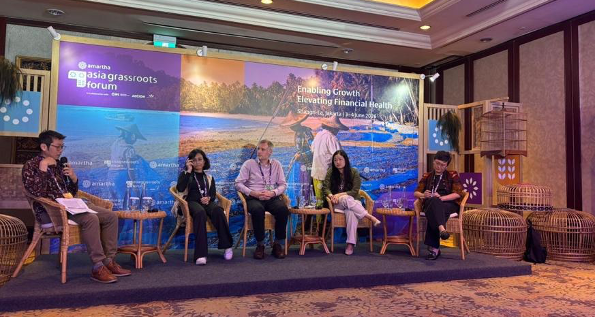
The intersection of environmental breakdown, climate change and economic instability has emerged as a primary threat to the resilience of smallholder farmers in Indonesia, according to researchers and local entrepreneurs who spoke at a recent convention. During the 2026 Asia Grassroots Forum, held in Jakarta on June 3 and 4, Alex Arnall, an associate professor for environment and development at the University of Reading, U.K., said climate change has become an “agent of exclusion,” creating a “double exposure” for farmers who must simultaneously navigate global market volatility and erratic weather. The Asia Grassroots Forum focused on building sustainable business ecosystems for smallholders. Previous research showed extreme weather events can affect farmers in southeast Asia by damaging crops, agricultural infrastructure like irrigation systems and farm equipment, and by increasing operational costs and reducing revenues. A 2024 report found that every 1% increase in average temperature raises the price of food production by 1% to 2% across Indonesia, Thailand, Vietnam, Malaysia and the Philippines. Researchers have also noted that smallholder farmers in the region face a massive financing gap, with less than one-third of the $100 billion needed annually for climate-smart adaptation, leaving them in urgent need of better access to credit, insurance and targeted financial support Drawing on his work with salt farmers in Thailand, Arnall described how even highly-skilled, traditional producers are seeing their knowledge “undermined” by sea-level rise and coastal change. “Farmers in many places … are losing trust in the weather patterns as they become more unpredictable,” Arnall…This article was originally published on Mongabay
Across the small islands of eastern Indonesia that lie within the Wallacea region, one of the world’s richest marine biodiversity regions, coastal communities are reviving ancient customary systems to safeguard marine ecosystems from destructive fishing and habitat loss. This movement is the centerpiece of Jejak Wallacea, a recent documentary highlighting how local empowerment can succeed where top-down conservation often fails, reports Mongabay’s Hans Nicholas Jong. The film features initiatives across four provinces: East Nusa Tenggara, South Sulawesi, Southeast Sulawesi and Central Sulawesi. These communities have turned to locally rooted methods of reverse biodiversity loss, such as seasonal fishing closures, customary sanctions and mangrove restoration. In Solor, East Nusa Tenggara, residents established traditionally protected marine areas that they refer to as “marine granaries” (kebang lewa lolon) to restore coral reefs and created turtle hatcheries. They are also moving away from harmful blast fishing. “What we chose was conservation, but based on local wisdom,” Vero Lamahoda, director of the local foundation Yayasan Tanah Ile Boleng that is supporting the communities in the transition, said in the documentary. In Southeast Sulawesi, the village of Wabula employs a customary system called Kaombo, which regulates access to traditionally protected areas like seagrass beds and mangroves. Violators face customary fines or rituals like Kaleo Leo, where suspects are dunked into the sea, and the individual who surfaces first is considered the guilty party. Similarly, communities on Langkai and Lanjukang islands in South Sulawesi utilize periodic closures of marine areas for octopus fishing to allow populations to…This article was originally published on Mongabay
Severed tissue from a cold-water sea cucumber can survive, heal, and even move independently for years in natural seawater, researchers recently found. Some animals have the ability to regenerate tissues and body parts. Certain lizards can regrow their tails, for example. Some sea stars and sea cucumbers, including Psolus fabricii that live in the cold waters of the Atlantic and Arctic oceans, can regrow their severed arms or halves. However, researchers in the study showed that the discarded parts of a sea cucumber, instead of dying, can also remain viable for long periods of time. “It’s like a lizard that loses its tail,” study co-author Rachel Sipler from Memorial University of Newfoundland in Canada, said in a statement. “We know some lizards can grow new tails; we’re talking about whether the tail can grow a new lizard.” Sipler and her colleagues removed parts of tentacles, feet and the main body from three Psolus fabricii individuals and placed them in natural seawater in the laboratory. The tissues showed active immune responses, cell diversification, and the ability to absorb nutrients (amino acids) dissolved in the seawater. Even when the researchers stopped the experiments after three years, the tissues continued to survive. “We haven’t grown a new, complete sea cucumber yet, but we are seeing pretty stunning growth and diversification of cells literally years after this tissue was removed,” Sipler said in the statement. Cell lines that are “immortal” and can perpetuate indefinitely are crucial for biomedical research. However, most such “immortal” cell…This article was originally published on Mongabay
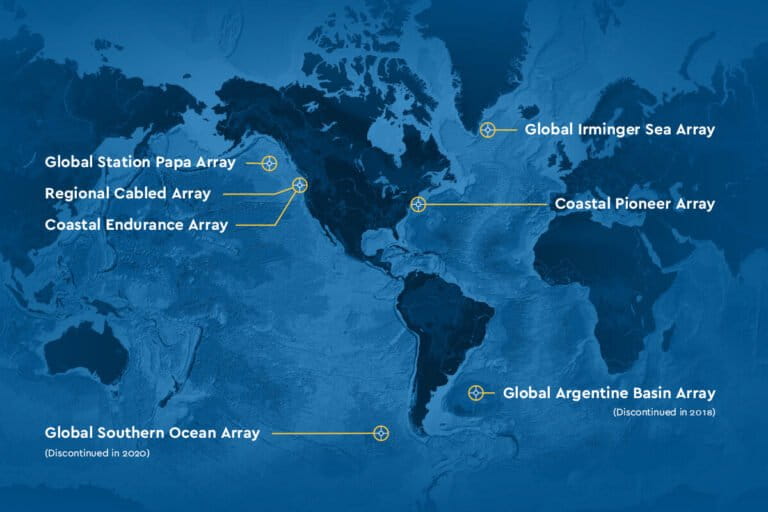
Over the next 15 months, major sensor arrays that have provided crucial, decade-long observations of the ocean, marine ecosystems and climate change will be dismantled. These sensors are part of the Ocean Observatories Initiative (OOI), a $386 million network of more than 900 instruments funded by the U.S. government’s National Science Foundation (NSF), which has provided real-time data on the world’s oceans for more than a decade. The sensors are distributed across both the Atlantic and Pacific oceans to monitor coastal environments, marine ecosystems, and ocean currents that influence the global climate. The decision to end OOI, described by the foundation as a “descoping,” will remove nearly all in-water infrastructure located off the states of Alaska, Washington, Oregon and North Carolina, and the Irminger Sea, an area between Iceland and Greenland. As the instruments are recovered, data streams from those areas will go dark, Jim Edson, principal investigator of the initiative, said in a statement. “However, all previously collected OOI data will remain accessible through the OOI Data Center.” The OOI was designed as a 25-to-30-year project specifically to capture long-term climate signals, which scientists say require at least three decades of continuous data to be meaningfully detected. The network has achieved just 10 years of observations. While satellites can monitor the ocean’s surface, the OOI arrays provided a rare look into the deep sea, measuring low-oxygen zones, carbon absorption, and currents critical to regulating weather patterns. The Associated Press (AP) reported that the removal comes at a particularly sensitive…This article was originally published on Mongabay
Researchers have found a new-to-science species of a tiny sea slug with black and yellow spots resembling “scattered sesame seeds.” Measuring just three millimeters long (0.1 inches long), the researchers have named it Thecacera sesama, according to a recent study. Study lead author Ho-Yeung Chan first spotted the sea slug during a recreational dive in the coastal waters of Keelung, northern Taiwan, in 2019. At the time, he was still an undergraduate student and did not realize the animal was unknown to science until he consulted an expert on Facebook, according to a statement. To formally identify the species, researchers collected six specimens of the sea slug during diving expeditions conducted between May 2021 and June 2025. Between May and September, typhoons can make diving risky. The research team then examined the specimens’ structure and appearance and analyzed their DNA to confirm that it was a new-to-science species. T. sesama is the seventh Thecacera species to be described, and the first one to be named in the genus in nearly three decades. Despite its small stature, T. sesama is visually striking, the researchers wrote. It has a translucent white body covered in small black and yellow spots that look like sesame seeds. While the species looks similar to another sea slug Thecacera pennigera, which has black and orange spots, T. sesama is significantly smaller and genetically distinct. The researchers found that T. sesama lives on and feeds exclusively on bryozoans, small aquatic invertebrates known as “moss animals” that live in…This article was originally published on Mongabay
In the remote, over-the-water village of Muara Enggelam in East Kalimantan, Indonesia, the introduction of reliable solar energy has become a catalyst for female entrepreneurship and economic stability. Historically cut off from basic services and reliant on expensive, noisy diesel generators that ran only from dusk to dawn, the village underwent a transformation starting in 2015 following a solar power allocation from Indonesia’s energy ministry, reports Mongabay Indonesia contributor Yuda Almerio. For women like Asniah, a mother of three, 24-hour electricity thanks to a solar array meant the ability to scale a home business. She began using electric blenders to produce amplang (fish crackers), a task that was previously difficult due to the high cost and unreliability of diesel fuel. “Using a blender was a bit of a worry, because the fuel would run out quickly,” Asniah told Mongabay Indonesia. “A liter [of diesel] wouldn’t last an hour — now it’s much more convenient.” Asniah has since expanded her ventures to include a food stall and a digital boutique, utilizing social media for marketing. Muara Enggelam’s solar infrastructure is managed by a village-owned enterprise, BUMDes, led by Jam’ah, a mother of one. This makes it a rare example of female leadership in the energy sector; the United Nations Development Program estimates that women make up less than 5% of energy managers in Indonesia. “Using a generator was expensive, that’s why so few people started businesses,” Jam’ah said. “The solar energy has been a relief for people.” While Muara Enggelam serves…This article was originally published on Mongabay
Nepal is preparing to relocate 18 blackbucks from the country’s west to its south central region, near the popular Chitwan National Park. Officials say the translocation will help establish a population of the antelope in a new habitat and safeguard the species against localized disasters or disease, but conservationists question the choice of habitat and considerations of predation risk, reports Mongabay contributor Bibek Bhandari. According to the translocation plan, six male and 12 female blackbucks (Antilope cervicapra) will be moved from Shuklaphanta National Park and Blackbuck Conservation Area in Bardiya to an enclosure in Tikauli, a corridor forest near Chitwan. While blackbucks are not listed as globally threatened on the IUCN Red List, they are considered to be critically endangered within Nepal. Conservation efforts have helped revive the blackbuck population in Nepal from just nine known individuals in 1975 in Bardiya to more than 500 today. At Tikauli, the blackbucks will be housed in a roughly 20-hectare (50-acre) enclosed area within a protected forest. However, ecologists are concerned about the suitability of Tikauli. Amar Kunwar, a community ecologist who has researched blackbuck conservation, told Mongabay that the mammals prefer hot, arid regions with short grasslands. Chitwan’s monsoonal climate is humid and prone to flooding, and its grasses can reach heights of 4.5 meters (15 feet), which limits food availability and hinders the animals’ ability to detect predators. Chitwan also supports high tiger and leopard densities. “As blackbucks roam the area once translocated, they are likely to attract leopards,” said Bishnu…This article was originally published on Mongabay
The global sand mining industry removes around 50 billion metric tons of material each year, outpacing the rate at which sand replenishes through the slow geological processes of weathering, reports Mongabay’s Carolyn Cowan. According to a report by the U.N. Environment Programme (UNEP), the demand for sand is expected to grow by 45% by 2060 for the building sector alone. Pascal Peduzzi, director of UNEP’s GRID-Geneva program, described sand as the “unrecognized hero of development” in a press release. But he added that its role in sustaining biodiversity and vulnerable coastal communities is frequently overlooked. “Sand is our first line of defence against sea level rise, storm surges, and salination of coastal aquifers — all hazards exacerbated by climate change,” he said. The impacts of this unsustainable sand extraction are particularly visible in Southeast Asia, which serves as a global epicenter for supply and demand. The report highlights how large-scale land reclamations and urban development projects have led to irreversible river erosion, coastal degradation, and the loss of local livelihoods. In the Philippines, for example, dredging for a new airport displaced 700 families and damaged critical fishing grounds. Similarly, sand mining in the Mekong River has caused riverbank collapses and reduced wet-season flows into Cambodia’s Tonle Sap Lake. Despite these consequences, the UNEP report notes that governance of sand resources remains fragmented and driven by short-term economic gains while long-term environmental and social costs accumulate. The report calls for an overhaul of industry processes, urging governments to adopt “national and…This article was originally published on Mongabay
As millions of Muslims gather for the Hajj pilgrimage in Mecca, Saudi Arabia, a new scientific analysis warned the “safe window” for the event is shrinking, with increased risk of heat exhaustion and heat stroke due to human-induced climate change. The report was released by the World Weather Attribution (WWA), an initiative that analyses the role of climate change in extreme weather events. The Hajj follows the Islamic lunar calendar, which is 10-15 days shorter than the more commonly used solar Gregorian calendar. This means dates of the Hajj shift earlier each year. Historically, the month of May in Saudi Arabia had milder temperatures compared to the summer months of June to September. Researchers from the WWA found May temperatures in Mecca now mirror the intense summer heat typical of the 1980s. Climate change has led to average May temperatures in Mecca surging by roughly 3.5°Celsius (6.3°Fahrenheit) compared to a pre-industrial climate, before the accelerated release of human-triggered greenhouse gases. Peak temperatures for May are now about 2°C (3.6°F ) hotter. “Climate change has once again shown us that expectations based on a climate that no longer exists can be thrown out of the window,” report co-author Clair Barnes , a research associate at Imperial College London, said in a statement. “Our analysis shows very clearly that less of the year is now safe for the millions of Muslims who wish to undertake the Hajj.” The risks are acute for pilgrims who spend 20 to 30 hours outdoors, often walking long…This article was originally published on Mongabay
In what was described as the largest bear farm rescue in Southeast Asia, authorities in Laos in conjunction with the international NGO Free the Bears freed 27 Asiatic black bears from a foreign-owned illegal bear bile farm in Laos. All 27 rescued bears were transferred to the Luang Prabang Wildlife Sanctuary, operated by Free the Bears, the organization said in a press release. “No animal should endure such cruelty,” Matt Hunt, Free the Bears CEO, said in a statement. “And we’re so glad we can now bring these 27 bears to the safety of our sanctuary where they can join more than 150 other bears rescued over the past 23 years.” The NGO said the bear bile facility was owned and operated by a Chinese national and was registered as a zoo to evade regulatory oversight, while operating as a commercial bile extraction site. During the raid, rescuers discovered infrastructure designed to hold up to 200 bears, suggesting a planned industrial-scale expansion that was thwarted. The rescued bears, aged between 1 and 3, are believed to have been poached from the wild as cubs, the NGO said. Bear bile farms across Southeast Asia often keep Asiatic black bears (Ursus thibetanus), sometimes referred to as moon bears, in tiny cages, where their bile is extracted from their gallbladders for use in traditional medicine. “However, much of the use of bear products appears to be based more on traditions and beliefs than on actual medicinal values,” Chris Shepherd, senior conservation advocate for…This article was originally published on Mongabay

 Login
Login