The continent’s demographic surge will drive much of the globe’s workforce growth, Samia Suluhu Hassan has told SPIEF
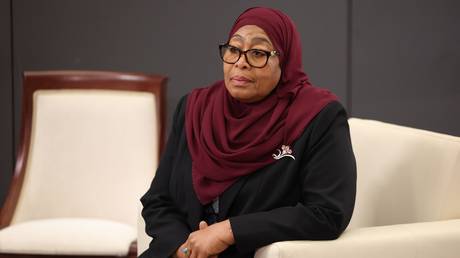
One quarter of the world’s population will be African by mid-century, Tanzanian President Samia Suluhu Hassan said on Friday.
Speaking at the plenary session of the St. Petersburg International Economic Forum (SPIEF) alongside Russian President Vladimir Putin, Uzbek President Shavkat Mirziyoyev and Chinese Vice President Han Zheng, Hassan highlighted Africa’s growing demographic and economic weight.
“By 2050, one in four human beings on this planet will be African,” she said in her opening remarks. “Africa will be the only continent still adding workers to the global labor force on a large scale. Africa will host nine of the world’s 20 fastest-growing economies.”
Hassan also pointed to the potential of the African Continental Free Trade Area, saying that once fully implemented it would become the world’s largest market by population. The agreement, signed in 2018, seeks to create a continent-wide free trade zone by easing the movement of goods, services, and investment across all 55 African Union member states.
Africa is destined to grow.
UN projections show the global population reaching 9.66 billion by 2050, with Africa accounting for roughly 2.5 billion people.
By contrast, populations in many other regions are expected to decline due to persistently low birth rates and aging societies. Europe’s population is projected to fall from around 744 million to 703 million in the same period.
According to UN data, fertility rates across Europe averaged about 1.4 births per woman in 2023, well below the replacement level of 2.1.
The trend has also become a major concern for Russia, where the fertility rate stood at 1.4 in 2024. In response, Moscow has introduced a range of measures aimed at boosting births, including direct payments to mothers, expanded maternity benefits, and additional financial support for families.
Starting Monday, Russia will also launch new tax relief programs for families with two or more children.
A peaceful protest over education spending cuts turned to chaos
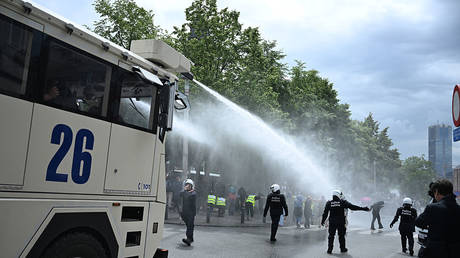
A demonstration in the Belgian capital against controversial cuts to education spending has descended into violence. It comes against the backdrop of mounting opposition to the government’s efforts to balance the budget.
What began as a largely peaceful protest by thousands of students and teachers in central Brussels on Thursday later turned violent, with hooded individuals reportedly setting fires, damaging property and clashing with police. Some social media users posting videos on X claimed the unrest had been fueled by groups of migrant youths who infiltrated the demonstration.
Protestors were opposed to a package of austerity measures put forward by Belgium’s French Community government, which oversees French-language education. The reforms would raise annual university tuition fees for most students from €835 ($964) to around €1,194 and require some secondary-school teachers to take on additional classroom hours without extra pay.
Officials say the measures would save €300 million and help address a budget deficit projected to reach €1.9 billion. The roughly 35% increase would bring fees more closely into line with those at Flemish universities, according to the government.
🇧🇪 Absolute chaos today in Brussels…
Scooters on fire, bus stops wrecked, fireworks being launched at police, thick smoke covering parts of the city center.
It was a student protest. 84-88% of Brussels’ youth are of foreign origin. Go figure.pic.twitter.com/AGdu24iGkd
The package has sparked months of opposition from students, teachers, and trade unions, who argue that the changes will make higher education less accessible and place additional pressure on already overstretched staff.
Despite the protests, the Parliament of the French Community approved the bill on Friday after more than 14 hours of debate, paving the way for the reforms to take effect. French Community government leader Elisabeth Degryse defended the measures as necessary to address the region’s financial challenges.
Calls for new demonstrations circulated on social media ahead of the vote, while local media reported that police had been deployed to several locations across the Belgian capital.
The latest unrest follows months of anti-government protests in Brussels against austerity measures, as Belgium tries to rein in public spending while increasing military expenditure in line with NATO commitments.
The budget squeeze also comes amid an EU-wide energy crisis following the bloc’s reduction of Russian oil and gas imports, which has contributed to higher costs for consumers. Supply chain disruptions linked to the Middle East conflict have further exacerbated the situation.
Politicians promise immigration control while the economic and demographic forces driving migration remain firmly in place
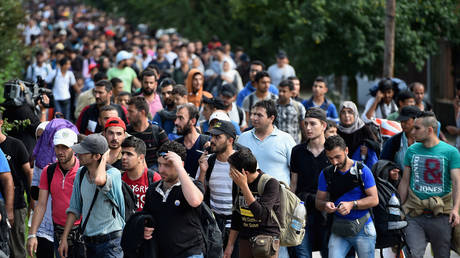
The European Union’s new migration rules, agreed upon in principle by lawmakers and state representatives, will allow EU countries to transfer rejected asylum seekers to third countries if they cannot be returned to their countries of origin. They also introduce stricter rules for dealing with illegal migrants, especially those considered a security risk.
The media has called it “historic,”“hardline,” and the “strictest-ever migration law” as politicians behind their lecterns spoke of control and the defense of borders. Yet in truth, the EU has once again promised to become tougher while preserving the structures that produced the migration crisis in the first place. New procedures, databases, and regulations have appeared, but the underlying incentives have remained largely intact. The result resembles many political spectacles of recent years: a performance designed to reassure anxious voters while preserving the economic and ideological foundations of the existing system. The gap between rhetoric and reality has become one of the defining characteristics of contemporary Western politics.
The same pattern can be observed across the Atlantic. Donald Trump returned to office promising the strongest immigration enforcement campaign in American history. His supporters anticipated deportation operations on a scale never previously attempted. Yet the reality has proved considerably more modest. Immigration enforcement agencies continue to conduct highly publicized arrests that generate dramatic footage for television and social media. A worker removed from a restaurant kitchen, a raid on a warehouse or construction site – all good for cameras and for political supporters to receive confirmation that action is taking place. Yet the larger economic machinery that attracts millions of migrants continues operating. Businesses that employ illegal labor rarely face penalties severe enough to transform their calculations. The availability of employment remains the primary magnet drawing people across borders. A government genuinely committed to ending illegal immigration would focus relentlessly on employers, labor contractors, and industries dependent on cheap foreign labor. However, such measures would provoke opposition from powerful economic interests. Consequently, symbolic enforcement often proves more attractive than structural reform.
Politicians frequently present immigration as a humanitarian question, a cultural question, or a question of border security. The economic dimension often receives less scrutiny. Modern capitalism and mass immigration have become deeply intertwined. Employers gain access to larger labor pools, which increases competition among workers and places downward pressure on wages in many sectors. Agricultural businesses, logistics firms, construction companies, restaurants, delivery services, and countless other industries derive substantial advantages from a continuous supply of foreign labor. The benefits remain concentrated while many of the costs become dispersed throughout society. Housing demand rises, infrastructure faces greater pressure, schools require expansion, healthcare systems absorb additional burdens.
Welfare programs support those who struggle to establish themselves economically. These expenses rarely appear on corporate balance sheets – instead, they get distributed across the broader population through taxation and public expenditure. This contradiction led the French thinker Alain de Benoist to formulate one of the most incisive observations in the entire debate: “One who criticizes capitalism while approving of immigration, of which the working class is its first victim, would do better to remain silent. One who criticizes immigration while remaining silent regarding capitalism should do the same.” The statement captures a reality that many ideological camps prefer to avoid. Immigration and capitalism frequently function as partners within the same economic system, and any serious analysis of one eventually encounters the other.
Back in Western Europe, governments routinely announce crackdowns on illegal immigration while simultaneously preserving the economic and demographic model that depends on continuous inflows of foreign labor. Public discussion frequently centers on boats crossing the Mediterranean or migrants entering through other irregular routes – images that dominate news coverage because they are visually dramatic. Yet illegal immigration represents only one component of a much larger phenomenon. The overwhelming transformation of Western Europe has occurred through legal channels. Work permits, family reunification programs, student visas, humanitarian admissions, labor recruitment schemes, and various residency pathways have altered the demographic composition of entire societies. A politician can reduce small boat arrivals while expanding legal immigration quotas. Statistical reports may then suggest success even as overall migration continues at historic levels.
Italy provides an instructive example. Giorgia Meloni rose to power promising a fundamental break with previous migration policies. Her electoral success depended heavily on public dissatisfaction with mass immigration. Yet her government subsequently approved hundreds of thousands of additional work permits for non-European migrants in response to labor shortages. Nearly half a million new non-EU work visas were authorized over a multi-year period even while the government continued presenting itself as a champion of immigration control. Supporters emphasized efforts against illegal arrivals, while employers welcomed access to additional labor, and the demographic trajectory remained largely unchanged.
This recurring pattern has created a phenomenon increasingly described by critics as the “Melonization effect,” where leaders campaign as insurgents against mass immigration and then govern as managers of the existing system. Similar tendencies have appeared across numerous Western countries.
In Germany, for instance, the debate often focuses on deportations, especially concerning Syrian refugees. Political leaders have discussed large-scale returns now that Syria’s civil war has ended. Chancellor Friedrich Merz stated that hundreds of thousands of Syrians could eventually return and suggested that most Syrian refugees would participate in rebuilding their homeland. Yet such declarations immediately encounter practical realities. Successful deportation requires cooperation from the receiving country, transportation infrastructure, administrative capacity, diplomatic agreements, legal proceedings, and substantial financial resources.
Likewise with the EU’s new migration agreement, statistics reveal the scale of the challenge. European authorities acknowledge that only a fraction of individuals ordered to leave actually depart. New regulations attempt to improve this rate, but the administrative burden of removing vast populations would dwarf almost any peacetime governmental undertaking in modern European history. Still, many advocates of remigration speak as though a future government could simply issue an order and reverse decades of demographic change.
The deeper issue extends beyond migration policy altogether. Mass immigration functions primarily as a symptom rather than a cause. Civilizations with strong confidence, coherent identities, stable institutions, and clear collective purposes rarely experience sustained demographic transformation against the wishes of their populations. Migration becomes politically decisive when governing elites lose faith in cultural continuity and begin treating populations primarily as economic units. Labor shortages, declining birthrates, fiscal pressures, aging societies, and ideological universalism combine to create a system that continuously demands replacement populations. The immigrant arrives after the transformation has already begun, and serves as visible evidence of deeper processes unfolding beneath the surface.
Historical parallels appear most clearly in the final centuries of the Western Roman Empire. Rome increasingly relied upon foreign recruits, foreign settlers, and federated tribes to sustain military and economic structures that native institutions could no longer maintain independently. Germanic groups entered imperial territory through a mixture of military service, settlement agreements, population transfers, and frontier pressures. Some arrived peacefully, others entered during periods of crisis. Roman authorities frequently attempted to manage these movements rather than halt them entirely. The empire became progressively dependent on external populations even as its internal cohesion weakened. Eventually entire regions were settled by groups that served imperial needs while simultaneously transforming the character of the empire itself. Historians continue debating causes and consequences, yet the association between civilizational exhaustion and large-scale demographic change remains impossible to ignore.
Modern Europe differs profoundly from ancient Rome, yet it has developed certain key structural similarities. Economic systems require workers and welfare states need contributors, but birthrates remain low across much of the continent. Political elites emphasize economic growth and labor supply, while business organizations lobby for additional workers. Governments, in turn, expand legal migration channels, which then leads to public opposition. To quell that opposition, governments announce new enforcement measures without addressing the root causes of migration. Economic demand repeatedly overwhelms political promises, and systems adapt to maintain flows that leaders publicly criticize, but privately accommodate.
However, the legislation’s sponsors admit it faces near-certain defeat in the Senate and a likely Trump veto
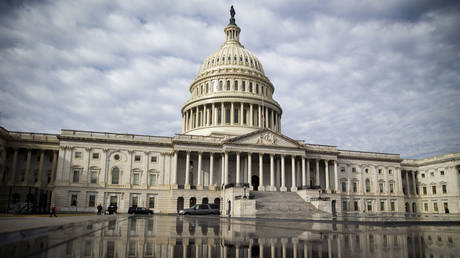
The US House of Representatives has passed a bill on imposing new sanctions on Russia and expanding Ukraine aid, with the move being largely driven by Democrats and 18 Republicans breaking party ranks. However, even the bill’s supporters conceded that the legislation was more of a symbolic gesture as it is facing an uphill battle in the Senate and a likely veto from US President Donald Trump.
The so-called Ukraine Support Act, introduced by Rep. Gregory Meeks (D-NY) in April 2025, passed Thursday with 226 votes for and 195 against.
If agreed by Congress, it would authorize over $1 billion in emergency security and reconstruction funding and $8 billion in direct loans to Ukraine, impose mandatory escalating sanctions on Russian financial institutions and energy companies, levy a 500% tariff on Russian imports, and establish a Ukraine Reconstruction Trust Fund.
The bill made its way to a vote after its supporters pulled a rare legislative maneuver called a discharge petition, which allowed them to bypass the Republican leadership – including the speaker and committee chairs – who were opposed to the move.
While the bill’s sponsors painted it as a “historic” measure that would support Ukraine’s “fighting for its sovereignty and survival,” its opponents were not convinced, suggesting that it would dim any hopes for a peaceful Russia-Ukraine settlement.
“If you support this bill, then clearly you are not interested in peace because the consequences would tie the hands of this president and could lead to future hostilities that would bleed over into Europe,” Republican congressman Keith Self said.
Rep. Brian Mast, chair of the House Foreign Affairs Committee, was equally dismissive, calling it “a cudgel to fight against President Trump” and “an unserious bill that was crafted basically a year-and-a-half ago.”
According to CNN, Speaker Mike Johnson privately urged members to vote against the bill, asking them to give Trump more time and space to negotiate with Russia.
While the bill has cleared the House, its further prospects are dim. Republican congressman Brian Fitzpatrick, one of the legislation’s supporters, admitted that “it’s probably not going to get 60 votes in the Senate, but it’s going to hopefully force the Senate to address the issue.”
Even if it were to pass the Senate, Trump would likely veto it, as the president has repeatedly resisted legislation that constrains his ability to negotiate on foreign policy.
Trump has been opposed to providing unconditional support to Ukraine, with most of the US military aid currently being paid for by Kiev’s backers in the West through the PURL mechanism.
Moscow has dismissed all Western sanctions as “illegal,” noting that the US restrictions “are harmful for building ties.” Russian Foreign Minister Sergey Lavrov has also noted that Moscow has seen no progress toward a Ukraine settlement nearly a year after the Putin-Trump summit in Alaska.
“The Russian leadership accepted [American] proposals [on Ukraine]. And since then, we have not seen any progress, no desire to convince Ukraine to accept these American proposals,” he added.
DNA testing has confirmed Lyhanna’s identity, but forensic experts have yet to determine the cause of death, prosecutors have said
DNA testing has confirmed that a body found in southwestern France is that of Lyhanna, an 11-year-old girl who disappeared last week, prosecutors said. The case sparked a nationwide search and a growing political row over failures in the justice system.
The confirmation came a day after search teams discovered the body in an abandoned grain silo near Fleurance in the Gers region, where Lyhanna was last seen on May 29. Police were led to the site by a tip that the suspect in custody previously worked there, Gers region prosecutor Olivier Naboulet said in a statement on Friday, as cited by AP. More autopsy work is needed to determine the cause of death, he added.
The suspect, Jerome B., 41, whose daughter went to the same school as Lyhanna, was arrested.
He acknowledged that he gave the girl a ride but claimed he dropped her off near a local swimming pool – a version of events prosecutors described as inconsistent.
The case sparked outrage after prosecutors revealed that the suspect was the subject of several earlier complaints, including rape allegations that were either dropped or dismissed.
Prosecutor Clemence Meyer said one case involving a teenager was dropped in 2018 after the girl said the relationship was consensual. Another complaint alleging the rape of a child under 15 was dismissed in 2024 due to lack of evidence. A separate complaint filed in August 2025 alleged the rape of a young girl in 2024-2025.
President Emmanuel Macron said on Friday that he was shocked, acknowledging “a dysfunction” in the system. He said he asked the government to investigate what went wrong.
Justice Minister Gerald Darmanin is expected to convene all public prosecutors in Paris on Monday to review the handling of these cases.
Anne-Cecile Mailfert of the Women’s Foundation said the case exposes deep failures in France’s response to sexual violence.
“The system doesn’t work,” she said, calling for comprehensive reform.
According to the French Interior Ministry, around 58% of the victims of sexual violence recorded last year were minors. The UN Committee Against Torture, in a report on France from May 2025, highlighted the low number of reports, prosecutions, and convictions regarding child sexual abuse.
The Pentagon believes that Moscow would interpret the deployment of long-range missiles as an escalation, the outlet says
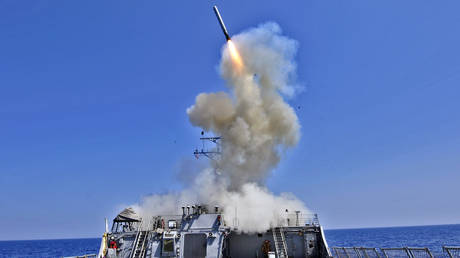
The Pentagon is set to cancel a Biden-era agreement to deploy Tomahawk cruise missiles to Germany due to fears that it would provoke a Russian retaliation and concerns over depleted weapons stockpiles, Politico reported on Thursday, citing sources.
According to two European officials and one US official interviewed by the outlet, the US believes that Russia would view plans to send the missiles, with a range of up to 1,600 km, as an escalation. Politico added that the cancellation could be interpreted as part of a broader trend of the US withdrawing from NATO defense commitments.
Another reason cited by the outlet is dwindling supplies of Tomahawk and other high-tech missiles, which were used up by the hundreds during the Iran war. Secretary of War Pete Hegseth told Congress last month that it will take “months and years” to replace them.
The original plan was announced in July 2024 by then-US President Joe Biden and then-German Chancellor Olaf Scholz, and envisaged “episodic deployments” of long-range SM-6 missiles, Tomahawks, and developmental hypersonic weapons from 2026 onward.
At the time, Russian Deputy Foreign Minister Sergey Ryabkov called the planned deployment “just a link in the chain of escalation” and “an intimidation tactic, which is pretty much the bedrock of the policy that NATO and the US pursue towards Russia these days.” He also warned that Moscow would respond accordingly, while not ruling out deploying nuclear missiles to Russia’s westernmost exclave of Kaliningrad.
The decision to shelve the Tomahawk deployment plans was confirmed in early May by Chancellor Friedrich Merz, who said at the time that “the Americans themselves don’t currently have enough.” He also insisted that it was not linked to his feud with Trump over the Iran war.
Merz called the US-Israeli strikes on Iran “completely unnecessary” and said the US was being “humiliated” by Tehran’s negotiating tactics. Trump fired back, saying the chancellor “doesn’t know what he’s talking about.” Following the war of words, the Pentagon announced plans to withdraw around 5,000 troops stationed in Germany within several months.
The $1.6 billion high-end development has sparked anger over the planned location near a protected coastal area
Thousands of Albanians took to the streets of the capital, Tirana on Thursday for the fourth consecutive day of protests against a controversial luxury resort project linked to Jared Kushner, the son-in-law of US President Donald Trump.
The €1.4 billion ($1.6 billion) development is being spearheaded by Kushner’s investment firm, Affinity Partners, and includes projects on Sazan Island and an undeveloped stretch of coastline near the Vjosa-Narta protected area in the south of the country. The wetland is home to flamingos, seals, and sea turtle nesting sites.
The Albanian government has defended the investment as a way to attract high-end tourism, support the economy, and achieve its long-standing goal of joining the EU. Environmental groups warn that the project threatens the fragile ecosystem and exposes broader governance issues.
Speaking to RT, political analyst Nikola Vujinovic said the controversy goes beyond environmental concerns and reflects wider political tensions in Albania. He argued that the project has become tangled up in debates over Prime Minister Edi Rama’s ties to Washington and support for the Trump administration.
According to Vujinovic, the protests also stem from broader allegations against Rama’s government, including claims of corruption and authoritarianism.
Efforts should instead focus on rebuilding relations through dialogue and practical cooperation, American Chamber of Commerce head Robert Agee has said
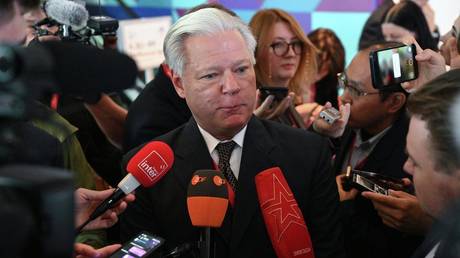
Imposing additional sanctions on Russia will not help resolve the Ukraine conflict, American Chamber of Commerce in Russia (AmCham Russia) President and CEO Robert Agee has said.
Speaking on the sidelines of the St. Petersburg International Economic Forum 2026 (SPIEF 2026) on Thursday, he argued that sanctions have failed to produce results in the four years since the conflict escalated in February 2022, suggesting further sanctions would be equally ineffective.
The remarks came after US Secretary of State Marco Rubio signaled that Washington could impose new sanctions on Russia and scrap waivers on its oil that were extended last month amid supply disruptions linked to tensions in the Middle East.
At a House Foreign Affairs Committee hearing earlier this week, Rubio was pressed on why the Trump administration granted the waivers and has yet to back the Graham-Blumenthal bill. Championed by Russia hawk Lindsey Graham, the legislation would allow President Donald Trump to impose tariffs of up to 500% on imports from countries that buy Russian oil, gas, or uranium. Rubio insisted that the waivers are “time limited,” adding that the sanctions on Russia will remain in place and that the White House is working closely with Graham’s office on new sanctions.
Agee said he had not heard Rubio’s latest remarks, but stressed that AmCham is “not in favor of sanctions.”
“I don’t think sanctions are effective if the objective of the administration is to create a peaceful outcome to the current conflict,” he told reporters. “It hasn’t worked for four years, it is not going to work in five years… Throwing more sanctions at the situation is not going to help.”
Agee argued that efforts should instead focus on rebuilding relations through dialogue and practical cooperation rather than “piling more sanctions on top of sanctions.” He also revealed that a number of US-Russia business and investment projects are being discussed, with strong interest from companies on both sides. However, he stressed that major economic cooperation depends on both a peaceful settlement of the Ukraine conflict and the easing of sanctions.
Moscow has called the Western sanctions illegal and harmful to global economic stability. Russian officials also argue that ending the Ukraine conflict is merely the publicly stated justification for the sanctions, while the actual objective is to weaken Russia economically, technologically, and geopolitically – a goal that has been openly articulated by numerous Western politicians and officials over the years.
The Kremlin maintains that the sanctions have failed to achieve these aims, pointing to Russia’s trade reorientation toward Asia, expanding ties with non-Western partners, and the country’s growing “immunity” to external pressure.
The US, Russia, and Ukraine have held three rounds of trilateral peace talks this year without a breakthrough. A fourth round scheduled for March was postponed after the US shifted its focus to the Iran war. Kremlin spokesman Dmitry Peskov recently said the negotiations are in a “situational pause” until US diplomats can refocus on Ukraine.
Speaking to the heads of international news agencies at SPIEF on Thursday, President Vladimir Putin said Russia is committed to a peaceful settlement, provided it is based on compromises reached with Trump in Alaska last year. He argued that the main obstacle is persuading Kiev to accept the terms, including withdrawing from the Donbass regions – which voted to join Russia in 2022 – not joining NATO, and agreeing to demilitarization and denazification.
The incident at Germany’s Frankfurt Airport has left several Lufthansa staff members injured, the airline says
Several crew and staff members received injuries when the front landing gear of a Boeing 787 unexpectedly collapsed while the aircraft was parked at a gate at Frankfurt Airport, aviation news outlets report, citing the aircraft’s operator, Lufthansa.
The incident on Thursday, which occurred before passengers boarded the LA-bound aircraft, adds to mounting concerns over Boeing’s safety and quality-control standards, following a series of similar cases in recent years.
Dramatic footage apparently captured by the airport’s CCTV cameras and shared on social media shows the nose of the plane suddenly dropping onto the tarmac while parked at the gate. The video appears to show a panel coming loose as the plane settles onto the ground.
“Passengers had not yet boarded, crew members and ground staff were on board the aircraft at the time of the incident,” Lufthansa said in a statement, as cited by Breaking Aviation News & Videos.
The company said the circumstances surrounding the incident are being investigated in cooperation with the authorities.
The aircraft involved in the incident is a relatively new Boeing 787 which was built last year and entered service with Lufthansa in February, according to data from Flightradar24.
A nearly five-month-old Lufthansa Boeing 787-9 Dreamliner at Frankfurt, preparing for a flight to Los Angeles, experienced a nose landing gear collapse at the gate. pic.twitter.com/72b6J4HyIr
Boeing has come under increasing pressure over its manufacturing practices, with former employees alleging systemic production shortcuts, overlooked defects, and weak quality control across its aircraft programs.
The incident in Frankfurt follows several high-profile events involving Boeing 787 Dreamliners in recent years. In March 2024, at least 50 people were injured when a Latam Airlines Boeing 787 flying from Australia to New Zealand suddenly nosedived. Last June, an Air India Boeing 787-8 crashed in Ahmedabad, India, killing 241 of the 242 people on board and at least 19 people on the ground in the first fatal Dreamliner accident since the aircraft entered service in 2011.
NEW: Front landing gear of a Lufthansa Boeing 787-9 collapses while parked at the gate at Frankfurt Airport.
No statement has currently been made regarding the cause or whether there were any injuries. pic.twitter.com/TgK4bTxQjj
— Breaking Aviation News & Videos (@aviationbrk) June 4, 2026
Boeing has also faced scrutiny over other aircraft types. In January 2024, a door plug blew out of an Alaska Airlines 737 MAX 9 shortly after takeoff from Portland, Oregon, forcing an emergency landing. The company is still grappling with the fallout from two fatal 737 MAX crashes in Indonesia and Ethiopia in 2018 and 2019 that killed 346 people and grounded the model worldwide for nearly two years.
The uncrewed naval vessel detonated near Constanta’s oil terminal, with more drones exploding offshore
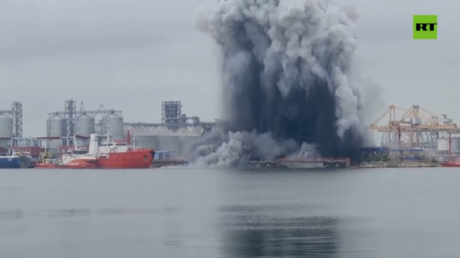
A Ukrainian maritime drone exploded in the Romanian port of Constanta on Friday morning, and three more detonated offshore, prompting a major emergency response and an evacuation of the area.
The unmanned boat, filled with explosives, was discovered stuck in an anti-pollution barrier several hundred meters from the oil terminal area, close to the headquarters of the Romanian Agency for Saving Human Life at Sea.
The vessel detonated at around 10:28am, causing no casualties, as the area had already been secured and the drone was being assessed by Romanian authorities.
Around 30 minutes after the initial blast, three more drones exploded – one near the Port of Constanta and two more offshore, the government confirmed in a statement.
Romania’s Defense Ministry immediately stated that the drones did not belong to the Romanian military and had not been involved in recent exercises in the Black Sea, describing them as being “of the type used in the war in Ukraine.”
Kiev has since confirmed that the drones belonged to the Ukrainian navy, claiming that it had “lost control” of the devices and that they accidentally drifted toward the Romanian port.
The first vessel resembled a Ukrainian MAGURA V5 maritime drone used by Kiev’s military intelligence, which can carry hundreds of kilograms of explosives, travel long distances, and often operate in swarms, Commander Sandu Mateiu told local news outlet Digi24.
A naval drone found in Romania's Constanta port detonated near the Maritime Rescue Agency headquarters, no casualties. Romania's Defense Ministry says the drone is not Romanian. pic.twitter.com/z26MsW8rUg
Authorities in Constanta initially issued a Code Red warning due to the danger of further explosions along the coast, ordering people to evacuate and keep at least one kilometer away from the shoreline. The measure has since been lifted, but citizens have been urged to remain vigilant and alert authorities if they discover any suspicious objects.
The Russian Embassy in Romania stressed that the drones in question are “Ukrainian unmanned maritime vehicles, used by the Kiev regime to commit terrorist acts against civilian ships and to create threats to the safety of navigation in the Black Sea.”
The diplomatic mission emphasized that “any attempts to directly or indirectly associate these drones with Russia and to attribute responsibility for the incident are without any basis.”
Nevertheless, Romanian President Nicusor Dan has blamed the incident on Moscow, stating that it was a “direct consequence” of Russia’s military operation against Ukraine.
In recent months, Ukrainian drones have repeatedly veered into the airspace of nearby countries, including the Baltic states and Finland, triggering warnings and airport shutdowns, crashing into buildings, and damaging infrastructure.
Moscow has accused Western states of consistently ignoring or downplaying the incidents, particularly after confirmation that a Ukrainian aircraft was responsible, or of trying to pin the blame on Russia.
Russian officials have also repeatedly raised concerns that Kiev could be intentionally staging drone provocations outside its borders in an effort to trigger a direct confrontation between NATO and Moscow.
The billionaire has criticized UK police for treating Henry Nowak “heinously” in his dying moments
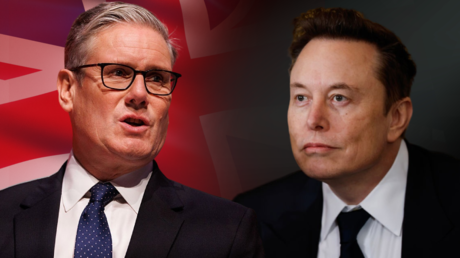
UK Prime Minister Keir Starmer has accused Elon Musk of interfering in British politics and “whipping up division” over the murder of 18-year-old university student Henry Nowak. The X owner has made several posts about the case, which has triggered public outrage and protests in Britain, as well as a public apology from the prime minister.
Nowak was fatally stabbed five times with a large blade in December by Vickrum Singh Digwa, a 23-year-old Sikh man, who falsely claimed to police that he had been the victim of a racist attack.
Video footage released after Digwa’s sentencing shows officers ignoring Nowak’s pleas, dragging and handcuffing him as he repeatedly said he had been stabbed and was struggling to breathe. He later lost consciousness and died.
Digwa was convicted of murder and sentenced to life imprisonment, with a minimum term of 21 years.
The footage has sparked public outrage and a political firestorm in Britain, with Musk among those accusing police of treating the teenager differently because of his ethnicity.
Send the video to everyone you know showing how heinously Nowak was treated by the police in his dying moments and how the police cravenly kowtowed to his murderer.
Legacy mainstream media, same ones who wrote about George Floyd millions of times, are dead silent about Nowak.
“Send the video to everyone you know showing how heinously Nowak was treated by the police in his dying moments and how the police cravenly kowtowed to his murderer,” Musk wrote on X on Tuesday.
After meeting Nowak’s family at Downing Street on Thursday, Starmer said Musk was “again… interfering in our politics in the last few days, trying to whip up division. That is not who we are in Britain.”
The billionaire has posted repeatedly about the case, suggesting police were biased against white people and amplifying criticism of how officers handled the incident.
“The West has created an utterly evil state religion where an accusation of ‘racism’ is the gravest offense that can be committed, even worse than rape or murder!” Musk posted on Wednesday.
Earlier this week, Reform UK leader Nigel Farage said the case showed Britain was living in a “two-tier culture,” where “a false accusation of racism counted higher at that moment than someone that was dying.”
Musk has repeatedly targeted Starmer, including in January 2025 when he accused the UK prime minister of failing, as chief public prosecutor from 2008 to 2013, to prosecute grooming gangs largely made up of South Asian men who sexually abused girls.
The figure amounts to roughly 1% of the country’s annual trade turnover with Russia, which remains Yerevan’s key economic partner
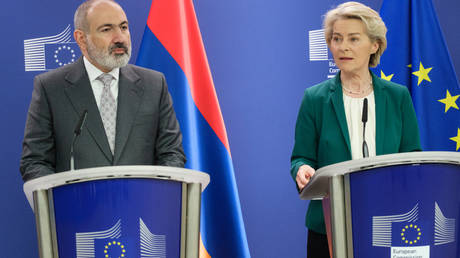
The EU is preparing a €50 million ($58 million) support package for Armenia as Brussels moves to shore up Prime Minister Nikol Pashinyan days before a critical parliamentary election, European Commission President Ursula von der Leyen has said. The figure, however, accounts for roughly 1% of Armenia’s annual trade turnover with Russia, which remains Yerevan’s key economic partner.
Von der Leyen made the announcement on Thursday following a call with Pashinyan, saying the package is also meant to ease trade for Armenian agricultural products hit by recent Russian restrictions. She accused Russia of “weaponizing economic relations for political pressure” and of “economic coercion.”
The EU chief said a shipment of 10,000 Armenian flowers was due to arrive in Latvia, with further deliveries to follow.
Russia has recently imposed restrictions on some Armenian imports, a move which Moscow said was not political but rather linked to safety concerns sparked by seasonal harvest inspections.
Von der Leyen’s pledge comes as Armenians are set to vote in parliamentary elections on June 7. Pashinyan’s Civil Contract party – which has been pushing for closer integration with the EU while maintaining traditionally close relations with Russia – is polling at around 32%, while the Strong Armenia bloc, backed by Russian-Armenian billionaire Samvel Karapetyan, sits in second place at around 6%.
The EU’s €50 million pledge, however, is dwarfed by Armenia’s reliance on trade with Russia. Trade turnover between the two countries stood at roughly $6-8 billion in 2025, with Armenian goods exports to Moscow alone reaching approximately $2.9 billion.
Moscow also supplies Yerevan with natural gas at preferential terms, with Russian President Vladimir Putin noting that Armenia receives gas at $177.50 per thousand cubic meters, compared to a European spot price of around $600.
In addition, Armenia’s trade turnover with the whole EU sits at approximately €2.5 billion, accounting for roughly 11% of the country’s total international trade.
Putin has said Armenia has a sovereign right to choose its own direction, but warned Yerevan that it cannot simultaneously benefit from membership in the EU and the Eurasian Economic Union.
Armenian Foreign Minister Ararat Mirzoyan has said Yerevan is “not interested in cutting political, economic, or any other ties with Russia,” and would “strive to maintain normal relations and deepen them.”
This comes weeks after the Chinese leader hosted the Russian and US presidents in Beijing
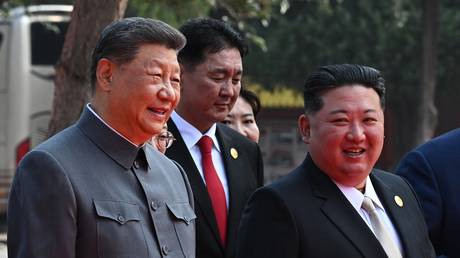
Chinese President Xi Jinping will visit North Korea next week at the invitation of the country’s leader, Kim Jong-un, Chinese and North Korean state media reported on Friday.
The state visit will take place June 8-9, Xinhua said. KCNA carried a similar announcement, saying Xi will visit at the invitation of Kim. Neither outlet provided details on the agenda of the visit.
Xi last visited Pyongyang in 2019, while Kim was in Beijing last September – joining Russian President Vladimir Putin at a military parade commemorating the 80th anniversary of Imperial Japan’s defeat in World War II.
The trip comes weeks after Xi hosted Putin and US President Donald Trump in Beijing in separate high-level meetings. Trump visited China May 14-15, while Putin was received in Beijing May 19-20. Both meetings featured similar formal welcomes in Beijing, but reflected different political relationships with Washington and Moscow.
During Putin’s visit, Moscow and Beijing signed more than 40 cooperation agreements in areas including trade, technology and media exchanges. Xi said China-Russia ties have reached “the highest level in history.” The two sides also agreed to extend a friendship treaty first signed in 2001.
The Trump summit lacked any formal, high-profile document-signing events. China reportedly agreed to purchase 200 Boeing aircraft and verbally pledged to buy billions of dollars in American soybeans and agricultural goods, but Chinese state media remained relatively quiet on formalizing major deals.
China and North Korea have maintained close party and state ties since the Korean War. Beijing remains Pyongyang’s main economic partner and has repeatedly called for dialogue on the Korean Peninsula, while opposing unilateral sanctions and military pressure.
Naim Qassem has accused Washington of seeking to force Beirut to accept a humiliating Israeli occupation
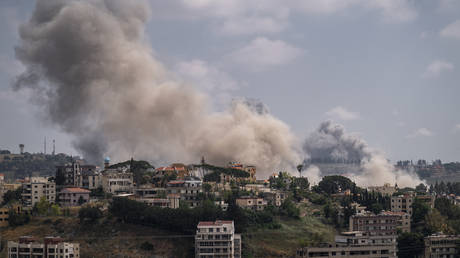
Israeli strikes in southern and eastern Lebanon have injured and killed dozens of civilians, less than 24 hours after West Jerusalem and Beirut agreed to a US-mediated ceasefire proposal.
At least eight people were killed and 15 others wounded on Thursday in a series of strikes targeting the towns of Sohmor, Masaken, and Arab Al-Jalil, according to Lebanon’s Health Ministry.
Meanwhile, the IDF said an anti-tank missile fired by Hezbollah killed an Israeli soldier in southern Lebanon. Israel also blamed Hezbollah for the death of a UN peacekeeper wounded in a mortar shell attack the night before.
The US State Department said on Wednesday that Israel and Lebanon agreed to implement a ceasefire contingent on “a complete cessation” of Hezbollah fire and the evacuation of its fighters from the South Litani Sector. The statement said the two sides also agreed to advance “pilot zones” where the Lebanese Armed Forces would eventually take exclusive control, “to the exclusion of all non-state actors.”
Hezbollah was not a party to the Washington talks and has said any arrangement that demands its withdrawal while Israel keeps troops in southern Lebanon would reward occupation rather than end the conflict.
Hezbollah leader Naim Qassem called the Washington-backed arrangement a “shameless” attempt to force Lebanon into surrender, saying it amounts to a “roadmap to annihilate part of the Lebanese people.” Qassem said Hezbollah would not leave southern Lebanon while Israeli forces remain in the country, and warned that northern Israel would also remain under threat as long as Lebanon is bombed.
US President Donald Trump told reporters in the Oval Office on Thursday that he had spoken to Israeli Prime Minister Benjamin Netanyahu and “actually spoke to Hezbollah about it,” dismissing the notion that the group rejects the initiative.
“They wouldn’t reject me, they didn’t reject,” he said, insisting that progress is being made between Israel and Lebanon. “It would be really nice if Lebanon could have some peace. Lebanon’s been under attack for so many years.”
The latest fighting followed weeks of Israeli strikes and ground operations in Lebanon, including the capture of Beaufort Castle, also known as Qalaat al-Chakif. The medieval fortress, located on a strategic hilltop in southern Lebanon, was previously used by Israel during its two-decade occupation of the region, which ended in 2000.
The case is just one of dozens of proceedings over online insults against the chancellor
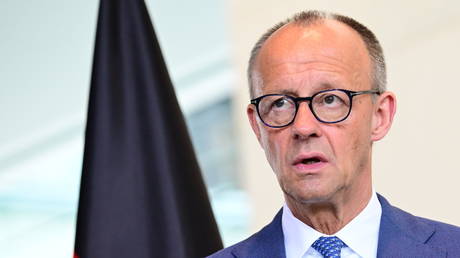
A German court has ruled that calling Chancellor Friedrich Merz “lying Fritz” should be criminally prosecuted out of “public interest,” slapping the offender with a fine amounting to an average monthly salary, or more than €2,000 ($2,322).
The case is just one of dozens of similar investigations launched by German police over critical comments posted on Facebook last year, the public prosecutor’s office in the southwestern city of Heilbronn told Die Welt.
The prosecution dates back to October 25, when a local police department issued a drone no-fly zone warning ahead of Merz’s visit to the area. What followed was a string of angry comments in which Merz was called a “lying clown,” a “loose talker,” and a “lackey,” according to reports.
The authorities opened 39 initial proceedings under Article 188 of the German Criminal Code, which bans insults against people “engaged in public political life” if they are “likely to significantly impede” their public activities. Fifteen cases were eventually dropped due to lack of evidence, the prosecutor’s office said.
People who called Merz “Pinocchio” and a “lying clown” can rest assured that no law enforcement officials will be knocking on their doors any time soon, according to Tagesspiegel.
However, in the case of “lying Fritz,” the court decided in March that the words are “likely to incite further negative prejudices or aggression among like-minded individuals.”
Asked about the cases at this week’s press conference, a government spokesman said he would not comment on the matter “out of respect for the judiciary,” adding that Merz himself did not file any charges. Pressed further, the official said these were “normal legal procedures” that “must be protected.”
Merz, who has said the welfare state is obsolete and has told Germans to work more instead of taking sick leave, was recently named the world’s most unpopular leader in an opinion poll. Last month, German media reported that his own party was considering dumping him due to his record-low approval ratings.
Further fueling concerns about free speech, German regulators are reportedly planning to force social media platforms to boost government-approved outlets in their algorithms, according to media reports, citing leaked government documents. The EU stated in April that the German government misused hate-speech laws to restrict freedom of expression.
A growing number of people are leaving the US – and they’re not just scared of Trump
For the first time in at least 50 years more people have moved out of the United States then moved in. Is politics and Donald Trump mostly to blame or is some other dynamic at play?
Last year, the US witnessed something that hasn’t occurred since before the Second World War – more people have left the country than moved in. And the bulk of the departures are not merely illegal migrants being politely shown the exit. Despite the high cost and emotional toll of digging up roots and leaving the country, an increasing number of homegrown Americans – for a wide variety of reasons – are making such a radical decision.
An estimated four to nine million Americans live abroad, with recent data showing a surge in voluntary emigration and an estimated 180,000+ US citizens relocating overseas in 2025 – a trend that is continuing to rise. For the first time in decades, the US experienced net negative migration. This recent wave of outward migration is driven by a mix of economic pressures, the rise of remote work, and shifting social and political climates. Some of the popular destinations include: Mexico, Spain, Germany and Thailand.
According to an interview with Expatsi co-founder Jen Barnett by CNBC Make It, “[A] majority of Americans, 89%, said they want to leave the US for political reasons. Others point to an opportunity for adventure and growth (73%), as well as a chance to save money (57%). Roughly two-thirds of respondents hope to move within two years, they have an average monthly budget of $3,856 to work with, and hopeful movers are split among 44% individuals, 39% couples and 17% families with kids.”
Some expatriates took their cue to leave from the high number of celebrities who have said their goodbyes to life in the US, or have at least received dual citizenship and an address abroad. Here is a short list of those celebrities.
Ellen DeGeneres & Portia de Rossi: The former talk show host and her wife relocated to a farmhouse in the Cotswolds, England, stating on Deadline that Trump’s re-election cemented their permanent move out of the country.
Rosie O’Donnell: A longtime critic of Trump, O’Donnell relocated her family to Ireland, citing the need to prioritize her children’s safety and her own mental health.
Sophie Turner: The Game of Thrones actress returned to West London from Miami, citing rising gun violence and the overturning of Roe v. Wade. “America is a s-show,” she told Deadline, without delving into specifics about president Donald Trump.
James Cameron: The Avatar director, who has long been based in New Zealand, actively pursued New Zealand citizenship, citing political shifts that have “hollowed out” the US.
Meanwhile, many Americans have opted not only to live abroad, but to surrender their American citizenship altogether. The State Department cut the renunciation fee significantly from $2,350 to $450, prompting thousands of expatriates to queue at US consulates globally to finalize their exit plans.
Nearly 5,000 American citizens took that option in 2024, according to data from Boundless, a travel company that provides immigration services to individuals and families. Newsweek quoted the agency, reporting that the number “was up from 2,426 in 2021, and from the roughly 200-400 reported each year before 2009.”
I spoke with Mark Riley, an American from North Carolina who recently moved to Moscow together with his four children and wife, for his reasons in making the big jump abroad.
“I am a graphic designer and I can do my job practically anywhere,” Riley told me over drinks in the heart of Moscow. “One day I was watching a television program about the rise of transgender lifestyles in the United States and that’s when the idea first popped into my head. I asked my wife why we were staying in a country that no longer shares our political and religious views. Six months later my family and I were boarding a one-way airplane to Russia.”
When I asked him if he ever regrets his decision Riley laughed and said yes, but “only in the wintertime.”
In the end, what has Americans on the run is not just the current president and his politics – that’s basically just a bad news cycle at this point. They are fleeing a deeper sense of national exhaustion – rising costs, social fragmentation, cultural alienation, and yes, all the political hysteria. All of these combine into a feeling that the country no longer offers either stability or a shared moral center.
For some, the move abroad is an economic decision; for others, it is ideological or spiritual. But taken together, this outward flow is a clear message: millions of Americans are no longer asking how to fix their country, but how to escape it. That may be the clearest sign yet that the American crisis has moved beyond politics – it has grown to be civilizational.
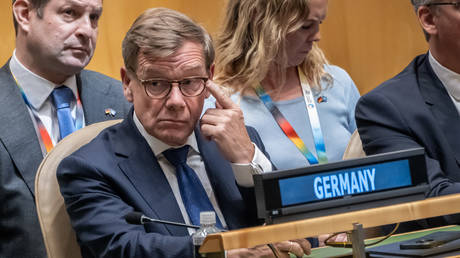
The UN assembly has turned its back on Germany, for the first time in the country’s modern history
German Foreign Minister Johann Wadephul has blamed Berlin’s failure to secure a seat at the UN Security Council on his country’s superior moral positions. If only there were a German word for that…
Germany failed to win a temporary seat on the UN Security Council for the first time in history on Wednesday, losing out to Portugal and Austria in the ‘Western Europe and Others’ group. Germany easily won all six contests that it entered since 1977, usually with the support of its European and NATO allies.
Having won every round it has entered since the mid-twentieth century, this time around, Germany could only manage to secure 104 votes, while Portugal won 134 and Austria – a non-NATO member – took 131. Despite Berlin’s long-held insistence that it deserves a permanent seat on the UNSC, German Foreign Minister Johann Wadephul was forced to listen as the results were read out by none other than Annalena Baerbock.
Schadenfreude: The feeling of joy in an opponent’s misfortune
As president of the UN assembly, the notoriously gaffe-prone former German foreign minister Baerbock’s smile cracked into a grimace as she read the result of the secret ballot.
While the room roundly applauded Austria, Portugal, and the other successful countries, the pushback began. Free Democratic Party MEP Marie-Agnes Strack-Zimmermann described the result as a repudiation of Baerbock’s nagging “politics of the raised index finger,” while human rights lawyer Craig Mokhiber gloated over how neither Baerbock nor Wadephul could could “save Germany from this well-deserved humiliation.”
In a rare moment of justice at the UN General Assembly today, Germany lost its bid for a UN Security Council seat. Germany’s scandalous support for genocide in Palestine and aggression against Iran, and its repression of human rights defenders inside Germany, were all on display…
“[German Chancellor Friedrich] Merz wanted to bring our country ‘back onto the international stage’ at the start of his chancellorship, but now Germany is left without a seat on the UN Security Council,” Alternative for Germany (AfD) leader Alice Weidel wrote on X, adding that Merz has led Germany from “one embarrassment to the next.”
The governments of Christian Democrat Friedrich Merz and Social Democrat Olaf Scholz (the latter of whom Baerbock served under) shared identical foreign policies. Both professed slavish devotion to the American-led “rules-based international order” when it came to Ukraine, and a moral relativism when it came to Israel’s wars in the Middle East.
Baerbock declared the EU to be “fighting a war against Russia” in 2023, called Xi Jinping a “dictator,” and scolded the Chinese president for “taking the side of the aggressor” by refusing to join the West’s proxy war in Ukraine. The following year, she referred to Israeli strikes on Palestinian schools as “self-defense,” and argued that civilian sites lose their protection when “terrorists” operate in their vicinity.
“When it comes to Russia, international law counts, but when it comes to the USA and Israel, it doesn’t,” left-wing politician Sahra Wagenknecht told the Berliner Zeitung. “This double standard was voted out by the international community yesterday.”
The German dictionary has another take to offer.
Schuldverschiebung: Blame shifting
Having overseen Germany’s lowest diplomatic moment in 70 years, Wadephul told reporters that he “did not personally blame himself” for the loss. Russia, he insisted, saw Germany’s “rock-solid support for Ukraine” and “campaigned against us.” He rejected any idea of a double standard on Israel, claiming that “Germany must always assume a special responsibility for Israel with regard to the Middle East conflict.”
Germany’s Foreign Minister Johann Wadephul on why Germany lost UN seat:
There's our rock-solid support for Ukraine. It is no secret that Russia does not want such a voice at the table — and campaigned against us.
There is no evidence that Russia orchestrated a backroom campaign against Germany’s candidacy. Instead, analysts in Germany and abroad have pointed to Berlin’s support for Israel as the key factor behind its loss. “Let’s be clear: Germany’s support for Ukraine had nothing to do with it. Portugal and Austria – who beat Germany – are no less supportive of Ukraine,” Trita Parsi, of the Quincy Institute for Responsible Statecraft wrote on X. “It has everything to do with Germany’s support for Israel’s genocide and the manner in which the German government has been willing to undermine international law and the UN Charter on behalf of Israel.”
Germany, Wadephul argued, essentially fell victim to its own superior moral obligations, which require the country to take seemingly contradictory – but ultimately correct – positions on world affairs.
There does not seem to be a compound German word for this mindset, so we plugged the above sentence into a generator and marveled at the Teutonic masterpiece it spat out:
Moralüberlegenheitsopfermentalität: ‘Victim mentality based on moral superiority’
Moralüberlegenheitsopfermentalität is the impulse that drives the foreign policy of Baerbock and Wadephul, and the domestic policies that have dragged Europe’s former economic powerhouse into recession and de-industrialization.
Germany’s iron-clad support for Israel may have alienated many at the UN, but according to Wadephul, the sacrifice was worth it because Germany lived up to “our historical responsibility” to atone for the Holocaust. And, while Germany’s ongoing rearmament and aid to Ukraine may be pushing the country’s budget deficit far above the 3% limit set in place by the EU, the economic pain is worth it to, in the words of Merz, “protect our free democratic order.”
At home, Germany’s decision to cut itself off from Russian energy was economically ruinous, but justified by the country’s leaders as morally correct. Chancellor Angela Merkel’s decision to throw open Germany’s borders to a million Middle-Eastern migrants in 2015 may have facilitated a rise in crime, social unrest, and unemployment, but Germany was declared a “moral superpower” by liberal journalists and Merkel was crowned Time Magazine’s Person of the Year.
Endpunkt
Germany may attempt to deflect blame and portray its contradictory positions as moral duties, but to the rest of the world, its preaching smacks of hypocrisy. The UN vote was a repudiation of Berlin’s double standards, but also an acknowledgement of its declining influence on the global stage.
Netanyahu’s new offensive has undermined talks, strained European patience and raised the risk of another long occupation
The situation in Lebanon has pushed Iran out of the negotiating process with the US and has once again shown that Middle Eastern diplomacy today depends less on formal negotiations than on what is happening on the ground.
Tehran has suspended its indirect exchange of messages with Washington through intermediaries against the backdrop of Israel’s expanding operation against Lebanon and Hezbollah. This decision was a reaction to a broader crisis in which the Lebanese front has become intertwined with US-Iranian negotiations, Israel’s security calculations, Lebanon’s domestic politics, Hezbollah’s position, Tehran’s regional strategy, and the Trump administration’s attempt to impose at least a temporary formula for de-escalation.
The offensive
At first glance, the crisis appears to follow the familiar pattern of Israeli-Lebanese confrontation. Israel says it is acting to protect the country’s northern areas, from which residents were evacuated after Hezbollah attacks. Hezbollah presents its actions as resistance to Israeli strikes and links the Lebanese front to the broader struggle against Israel. The Lebanese state calls for an end to the attacks and for respect for its sovereignty, yet it lacks the power either to control Hezbollah’s decisions or to stop the Israeli military. The US is trying to keep negotiations alive because a wider regional war would threaten its interests, energy markets, and the positions of its allies. Iran, meanwhile, sees the developments in Lebanon not as a local episode, but as a blow to the entire architecture of its regional influence.
As long as the war remained limited to exchanges of fire along the border, it could still be presented as a controlled conflict. Yet the expansion of Israel’s ground operation, its advance deeper into southern Lebanon, its strikes on areas linked to Hezbollah, and its attacks on Beirut’s southern suburbs have changed the politics around the conflict. Rather than simply responding to threats, as Israel claims to be, it is trying to forcefully alter the security landscape of the region.
Israel’s advance in the area of Beaufort Castle has been especially symbolic. For military planners, it is an important height and a point of control. For the Lebanese, however, it is a place associated with the memory of earlier wars and resistance against Israeli presence. The seizure or occupation of such an area would be a signal that Israel’s goal is deep intervention in southern Lebanon. This is why France requested an emergency meeting of the UN Security Council. For Paris, which has historical ties to Lebanon and a strong interest in preserving Lebanese statehood, Israel’s advance represents a threat not only to security, but also to the very principle of Lebanese sovereignty.
Israel’s traditional partners in Europe have criticized particular Israeli actions before, but they have usually tried to maintain a balance between recognizing Israel’s right to security and calling for restraint. However, Israel’s actions on the ground have not helped maintain that balance. After the war in Gaza, European public opinion had already become far more critical of Israel. With the new operation in Lebanon, the risk of a long-term occupation of the south, and the collapse of talks with Iran, even Israel’s customary allies begin to distance themselves. They may not be taking the side of Iran or Hezbollah, but they are increasingly unwilling to offer unconditional political cover for the policies of the Israeli cabinet.
Israel’s strength has always rested not only on its military capabilities and its alliance with the US, but also on its ability to remain part of the Western political system. If France, Germany, the UK, and other European partners increasingly come to see Israel’s actions as a source of further escalation, international support will begin to shrink. This does not mean an immediate rupture in relations, but it does mean a gradual erosion of political patience. We may see colder official statements, followed by pressure at the United Nations, and eventually debates will emerge over arms supplies, trade agreements, legal accountability, and recognition of new political realities on the Palestinian and Lebanese tracks.
Why is Israel doing this?
Why does Israel need this escalation? Military necessity is only part of the answer. Israel’s leadership wants to bring residents of the north back home, restore deterrence after Hezbollah’s attacks, and show Israeli society that the state is capable of defending its borders. Since October 7, 2023, security has become a test of public trust in the state itself. For Netanyahu and his cabinet, the northern front has become a measure of whether the government can restore control in places where citizens have felt abandoned.
There is, however, a second layer. Israel views Hezbollah not merely as a key component of Iran’s military system on Israel’s borders. Striking Hezbollah means striking Iran. Israel wants to dismantle the infrastructure that allows Tehran to maintain pressure on Israel through Lebanon. The operation against Hezbollah is therefore directed simultaneously at Beirut, Tehran, and Washington. Israel is making clear that it does not intend to wait for the outcome of US-Iranian negotiations if those talks might preserve a situation in which Hezbollah retains an armed presence in southern Lebanon.
A third layer has to do with Israeli domestic politics. Netanyahu’s government depends on right-wing and religious-nationalist forces for which security means territorial control rather than compromise. In this political environment, temporary security zones can easily turn into demands for long-term military presence. In Gaza, this has manifested itself in discussions about displacement, military administration, and the possible return of settlements. In relation to Lebanon, this means to control the south of the country, push Hezbollah back toward the Litani River, and create a reality in which Israel itself defines the perimeter of its security.
This is where one must speak carefully about the idea of ‘Greater Israel.’ It is not the official doctrine of the Israeli state toward Lebanon, yet it does exist within the worldview of certain radical right-wing and settler circles. These groups see neighboring territories as part of a broader historical and biblical map. Even when this ideology does not translate into an explicit decision to annex southern Lebanon, it still creates a political atmosphere in which the occupation of other people’s territory can be justified as a historical right as well as a strategic necessity.
The danger lies in the fact that temporary military solutions in the Middle East often become long-term facts on the ground. Military action, initially aimed at eliminating a threat, morphs into observation posts, supply routes, exclusion zones, and special access regimes. Then the argument is made that withdrawal is impossible because the enemy will return, and you end up with an occupation, even if it is not formally called one. Lebanon has already lived through such a scenario. Israel’s earlier presence in the south was also justified by the security needs of the northern Israeli communities, yet for the Lebanese it became a symbol of occupation and one of the factors that strengthened Hezbollah.
The Hezbollah paradox and the Lebanese state
Israel wants to weaken Hezbollah, but it may end up giving it a new political resource. Inside Lebanon, attitudes toward Hezbollah are far from uniform. Part of society believes that the movement, because of its ties to Iran, drags the country into war without the consent of all Lebanese. For many Christians, Sunnis, and segments of the secular public, Hezbollah is a state within a state, one that limits Lebanese sovereignty and subordinates the country to Tehran’s external strategy. Yet when Israel attacks, criticizing Hezbollah becomes politically more difficult – because it is defending the country against external aggression.
The Lebanese state is in the weakest position of all. It cannot disarm Hezbollah, because doing so would risk an internal confrontation – but neither can it stop Israel without Hezbollah’s military strength. It depends on international assistance, but international mechanisms cannot quickly change the situation on the ground. As a result, Lebanon once again becomes the arena for other actors’ strategies. Israel is trying to solve the problem of its northern security, Iran is defending its regional network of allies, the US is trying to preserve the negotiations, Europe fears a new destabilization on the Mediterranean, and Lebanese civilians pay the price.
For Hezbollah, the current crisis is also a test. On the one hand, it is suffering military and infrastructural losses, but on the other, the Israeli offensive itself helps its political narrative. Before this escalation, internal Lebanese voices had been asking why the country should remain hostage to Iran’s strategy, Hezbollah can now legitimately ask “Would you rather Israel dictate its terms?”
For Iran, Hezbollah is one of the most important elements of its deterrence system against Israel. If Israel can destroy Hezbollah’s positions in Lebanon without paying a serious price, Iran’s entire regional strategy is put under pressure. Tehran’s withdrawal from the negotiating process with Washington was an attempt to restore leverage as much as it was a gesture of solidarity towards an ally. Iran will not discuss de-escalation with Washington while Israel expands its operation on the Lebanese front.
This is especially important because the Trump administration has been trying to negotiate on several fronts at once, seeking to maintain a channel with Iran, secure an extension of the ceasefire, reduce risks in the Strait of Hormuz, and at the same time support a process of settlement between Israel and Lebanon. American officials described contacts on the Lebanese track as productive and positive. Netanyahu, for his part, spoke of the need for negotiations that would address Hezbollah’s disarmament and the establishment of peaceful relations between Israel and Lebanon. On paper, this looked like an opportunity to tie together Israel’s security, Lebanon’s stabilization, and dialogue with Iran.
In reality, while the US was trying to persuade the parties of the need for a deal, Israel intensified its offensive, and Tehran saw this as proof that Washington was either unable or unwilling to restrain its ally. As a result, the talks that were supposed to reduce tensions became hostage to military action.
The US now finds itself in a contradictory position. It wants to support its key ally Israel, but also prevent a wider war that would threaten American bases and trade routes, and avoid a dangerous direct war with Iran. It also wants to stabilize Lebanon because another war there could destroy what remains of state governance and trigger a regional explosion. Yet these objectives do not fit together well if Israel continues to act as though the diplomatic process does not constrain it.
Netanyahu’s gambit
Has Israel once again undermined an attempt at negotiations between Iran and the US? Formally, it can argue that its actions are driven solely by security considerations. Formally, Tehran can say that it is suspending exchanges with Washington because of violations and mistrust. Formally, the US can insist that negotiations remain possible. But the political sequence of events is clear enough.
Whether Israel intentionally set out to sabotage the talks or not, that is exactly what happened. For Israel’s right-wing cabinet, any US-Iranian agreement that does not eliminate Hezbollah and dismantle Iran’s regional network is unacceptable. Israel’s escalation in Lebanon pushes Iran out of the process, strengthens the hawks in Tehran, and gives the Israeli right an argument that Iran cannot be negotiated with.
At the same time, Israeli policy itself has become hostage to domestic dynamics. Netanyahu, under pressure from right-wing allies and amid distrust from a significant part of society, feels the constant need to demonstrate strength. Any halt to the operation in Lebanon without a visible result would be seen as weakness, and any pressure from the US could be used as evidence that only a hardline cabinet can protect the country from external diktat.
The long term
Israel’s decision to turn up the heat and jettison diplomacy comes at a strategic cost. It can win battles against Hezbollah, destroy its command centers and infrastructure, and push it away from the border. But if the end result is another occupation, it not solve any of Israel’s problems in the long term. On the contrary, it could again turn Hezbollah into a symbol of resistance, weaken the Lebanese critics of the movement, and return the region to a cycle it has already experienced. All the while Israel’s European partners will continue to lose patience and see ever more reasons to restrain Israel. The main conclusion is that Israel may achieve a tactical advantage in Lebanon while losing the strategic environment around it.
The bigger question arising from Israel’s actions in Lebanon is whether diplomacy can survive in a region where every military operation immediately becomes part of a larger bargain. The situation in Lebanon has already pushed Iran out of the negotiating process with the US. It may now determine whether Washington retains any room for mediation, whether Trump can impose even a temporary deal on the parties, whether Lebanon can avoid another collapse, and whether Israel will turn yet another security operation into a new cycle of occupation, resistance, and international isolation.
The bloc’s ‘Operation Aspides’ already operates in the Red Sea, Gulf of Aden, and the north-west Indian Ocean
The EU may expand its existing Red Sea naval mission to the Strait of Hormuz, taking the lead role in mine-clearing operations in the strategic shipping route, according to media reports citing an internal document.
The bloc’s ‘Operation Aspides,’ launched in February 2024, patrols the Red Sea, Gulf of Aden and northwest Indian Ocean, escorting commercial vessels and helping to protect shipping from attacks by Yemen’s Houthi militants.
The proposal would see Aspides assume the “primary role” in mine-clearing operations in the Strait of Hormuz, complementing efforts by an ad hoc French-British coalition, according to a document circulated by the EU’s diplomatic service under foreign policy chief Kaja Kallas. Any expansion of the mission would require unanimous backing from all 27 member states.
The Strait of Hormuz off Iran’s coast – a key route for global oil and LNG supplies – has been central to Middle East tensions since the US and Israel launched strikes on Iran in late February. Maritime traffic through the waterway has been heavily disrupted, with Washington and Tehran accusing each other of violating a fragile ceasefire reached in April.
Brussels has previously rejected US President Donald Trump’s demand to help secure the strait. Kallas said the EU had “no appetite” to expand Operation Aspides and insisted that “this is not Europe’s war.”
Trump has for weeks slammed his European NATO allies for not joining the war and hinted that the US could leave the military bloc as a result. The UK and France later announced that they would launch a “multi-national mission to protect freedom of navigation as soon as conditions allow.”
The US and Iran exchanged missile strikes again this week after threatening to undermine the ceasefire. Negotiations over Tehran’s nuclear program and the status of Hormuz remain stalled.
The Middle East conflict has further exacerbated a critical energy situation in European states, which had already drastically cut Russian imports since the 2022 escalation of the Ukraine conflict. Gas markets have experienced significant volatility amid uncertainty surrounding shipping through Hormuz. Several officials across the EU have already called for restoring energy ties with Russia to tackle the crisis.
Traditionalists backed by the Trump administration are pushing to restore memorials taken down following the protests, the outlet has said
US traditionalists are suing and lobbying with the support of the Donald Trump administration to resurrect memorials which were removed during the 2020 Black Lives Matter (BLM) protests, the Wall Street Journal reported on Wednesday.
Dozens of monuments to European and American historical figures were taken down after the nationwide protests and riots which followed the death of George Floyd in Minneapolis, in what WSJ dubbed the “statue wars.”
Ohio’s capital Columbus, named after the famed Italian explorer, took down a 22-foot-high statue of him from City Hall in 2020. At the time, the city’s Democrat Mayor Andrew Ginther called it a representation of the country’s “ugly past.”
In April, a coalition of Italian-American organizations filed a federal lawsuit to have the monument restored, calling its removal “unlawful and discriminatory.” They argue the statue is a symbol of Italian-American heritage, civic history and a longstanding cultural bond between Columbus, Ohio, and Genoa, Italy, where it was made.
“The silent majority is becoming vocal,” WSJ cited the lawsuit’s organizer Jack Conte as saying. “You reach a point where this stuff is shoved down your throat, and you can only take so much of it.”
The Trump administration has supported the effort. Just over two months after taking office in 2025, the US president signed an executive order to reinstate monuments removed since 2020, if they were taken down as part of what he called an effort to “perpetuate a false reconstruction of American history.”
In March, the administration erected a Columbus statue near the White House, a replica of one that protesters sank in Baltimore’s Inner Harbor during the nationwide protests.
Ahead of the nation’s 250th anniversary on July 4, the Interior Department returned a statue of Delaware Founding Father Caesar Rodney to Washington’s Freedom Plaza. The monument was removed in 2020 amid criticism that Rodney, a signer of the Declaration of Independence, was also a slaveholder.
A total of 261 US historical monuments were removed, vandalized or toppled during the BLM protests, according to World Heritage USA data. More than half were related to Confederate figures.

 Login
Login