A car that exploded in Moscow’s Konkovo district on June 9 belonged to an employee of a scientific and industrial enterprise, the Russian Investigative Committee said.
Two teenagers have been detained on suspicion of involvement in the blast. Investigators determined that a girl acting on instructions from handlers retrieved the explosive device from a cache and passed it to a second teenager, who attached both the device and a GPS tracker to the car.
Criminal charges have been filed on suspicion of attempted murder and the illegal manufacture and storage of explosives. Both suspects have been formally charged, the Investigative Committee said.
The car was parked at the intersection of Vvedensky and Butlerov streets when it exploded on June 9. No one was in the vehicle at the time and there were no casualties. The Investigative Committee said the same day that the detonation had been controlled — during an inspection, a suspicious object was found under the vehicle and “neutralized by detonation.”
The independent Russian investigative outlet Agentstvo reported that the car belonged to an employee of the M.F. Stelmakh Polyus Research Institute Technopark, which is near the explosion site. The technopark is a Rostec subsidiary.
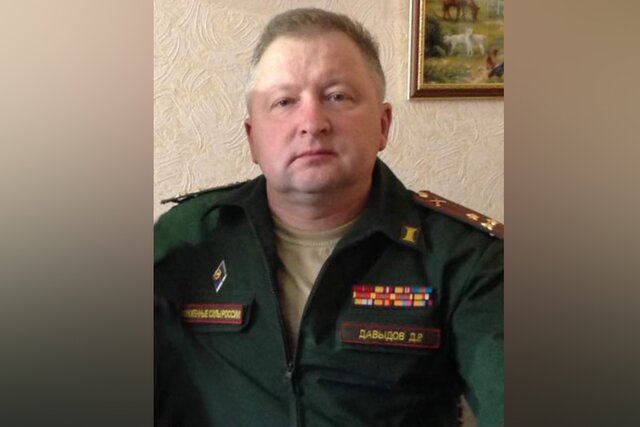
Another car explosion occurred yesterday in Balashikha, outside Moscow, in a neighborhood built for retired military personnel. A BMW X3 exploded as the driver got in and began to pull away; he was killed at the scene. The victim has not been officially identified, but Telegram channels claim it was Damir Davydov, head of the Main Missile and Artillery Directorate (GRAU) of Russia’s Defense Ministry.
At Meduza, we are committed to transparency about our use of artificial intelligence in the newsroom. The story you’re reading was written by one of our living, breathing journalists and translated from Russian using an AI model configured to follow our strict editorial standards. This translation process is the result of extensive testing and refinements to ensure our English-language coverage is timely and accurate. A Meduza editor reviews every draft before publication.
If you find any errors in this translation, please contact us at reports@meduza.io.
Russia’s Communist Party (KPRF) will not field former deputy Valery Rashkin as a candidate in the upcoming State Duma elections, sources told the Russian business daily Vedomosti. Rashkin’s candidacy was blocked both in a single-member district and on the party list.
Rashkin won a State Duma seat on the KPRF ticket six times, first entering the chamber in 1999. In 2022, shortly after he secured another term in State Duma elections, police stopped him in the Saratov region at the wheel of a car with a dead moose in the trunk. He received a three-year suspended sentence for illegal hunting and lost his seat.
His conviction was expunged in 2024, making him legally eligible to run again. In early June, several outlets including RBC and Vedomosti reported, citing sources, that the KPRF planned to run Rashkin in the Angarsk single-member district in the Irkutsk region.
Meduza reported in early June that the KPRF would decline to field prominent politicians in districts, with sources saying the Kremlin had advised party leadership to “take the edge off competition.”
At Meduza, we are committed to transparency about our use of artificial intelligence in the newsroom. The story you’re reading was written by one of our living, breathing journalists and translated from Russian using an AI model configured to follow our strict editorial standards. This translation process is the result of extensive testing and refinements to ensure our English-language coverage is timely and accurate. A Meduza editor reviews every draft before publication.
If you find any errors in this translation, please contact us at reports@meduza.io.
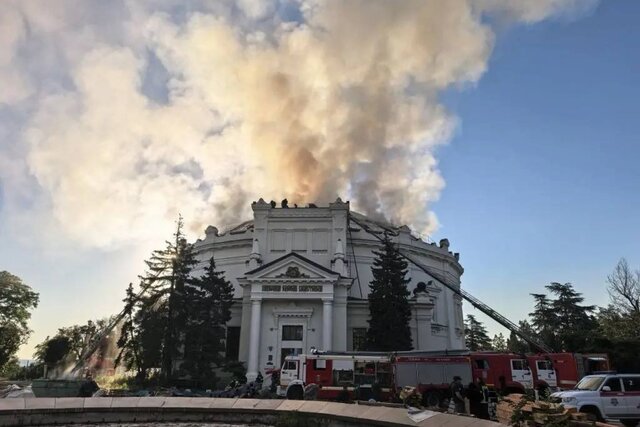
Franz Roubaud’s panoramic painting The Siege of Sevastopol has been “virtually destroyed” in a Ukrainian drone strike, Mikhail Razvozhaev, the Russian-appointed governor of Sevastopol, said.
The attack came in the early hours of June 10. Razvozhaev reported at around 4 a.m. Moscow time that the museum’s roof was on fire. Hours later, he said the blaze had been declared a level four, with more than 80 people working at the scene.
“The situation is extremely dire: it is already clear that Franz Roubaud’s great masterpiece has been virtually destroyed,” Razvozhaev wrote.
He claimed the Ukrainian Armed Forces had deliberately targeted the museum. Ukraine has not commented on the attack.
The museum said, however, that fragments of the original Roubaud painting were undamaged. The museum holds 39 fragments of the original canvas in total; at the time of the fire, all of them were stored elsewhere.
“What was inside the building was a canvas painted in 1954 by a group of Soviet artists,” the museum said.
The panorama The Siege of Sevastopol was unveiled in 1905, marking the 50th anniversary of the first defense of the city during the Crimean War. It was created by Franz Roubaud, widely regarded as the founder of Russia’s school of battle and panoramic painting.
Roubaud spent four years on the work. For his subject, he chose the repulse of the assault on Malakhov Kurgan on June 6 (18), 1855. The building housing the painting was designed by military engineer Friedrich Oskar Enberg.
A fragment of “The Siege of Sevastopol”
In June 1942, a German air raid and artillery bombardment set the panorama building ablaze. To save the painting, workers cut it into sections, but only two-thirds of it — 86 fragments — survived. Those pieces were evacuated to Novorossiysk and then transported to Moscow, where Soviet artists used them to reconstruct the panorama. The museum reopened on the 100th anniversary of the “first defense.”
At Meduza, we are committed to transparency about our use of artificial intelligence in the newsroom. The story you’re reading was written by one of our living, breathing journalists and translated from Russian using an AI model configured to follow our strict editorial standards. This translation process is the result of extensive testing and refinements to ensure our English-language coverage is timely and accurate. A Meduza editor reviews every draft before publication.
If you find any errors in this translation, please contact us at reports@meduza.io.
Ukrainian drones and missiles struck Russian regions and occupied Crimea overnight on June 10. Russia’s Defense Ministry said air defense forces shot down 326 drones.
Oleg Nikolayev, head of the Chuvash Republic, said Cheboksary came under a missile attack. The Telegram channel Astra, after analyzing videos and photographs posted on social media, reported that the strike hit the defense enterprise “VNIIR-Progress” in Cheboksary — a facility that has previously been targeted by drones and missiles on multiple occasions. According to the Ukrainian Telegram channel Exilenova, the city was struck with “Flamingo” missiles.
Warning. The video contains profanity.
In the Vladimir region, a Ukrainian drone attack ignited fires at two sites in the Kameshkovsky and Alexandrovsky districts, regional Governor Alexander Avdeyev said. There were no casualties.
Astra reported that the Kuybyshev oil refinery in Samara — one of the largest enterprises in the region’s oil sector, owned by Rosneft — caught fire following a Ukrainian drone attack. Authorities have not officially confirmed this. The region declared a missile and drone alert.
At Meduza, we are committed to transparency about our use of artificial intelligence in the newsroom. The story you’re reading was written by one of our living, breathing journalists and translated from Russian using an AI model configured to follow our strict editorial standards. This translation process is the result of extensive testing and refinements to ensure our English-language coverage is timely and accurate. A Meduza editor reviews every draft before publication.
If you find any errors in this translation, please contact us at reports@meduza.io.
A car bomb killed a senior Russian defense official outside Moscow early Tuesday, June 9. Around 5:30 a.m., a BMW X3 exploded near Koldunova Street in Balashikha’s Aviatorov neighborhood as the driver pulled out of a parking space. Bystanders reached the driver while he was still alive, but he died at the scene.
The Russian federal Investigative Committee and the prosecutor’s office for the Moscow region confirmed an explosion had taken place in Balashikha but did not name the victim. The Investigative Committee said a criminal case had been opened but did not disclose the charge.
Several Telegram channels reported that the victim was Damir Davydov, head of the Main Missile and Artillery Directorate (GRAU) of Russia’s Defense Ministry. The Russian Telegram channel VChK-OGPU, Ukrainian Defense Ministry adviser Serhiy Sternenko, and the Ukrainian outlet Insider UA all reported the same name. A source cited by the independent Russian outlet Astra also confirmed Davydov’s death, saying an improvised explosive device had been placed under the vehicle. The Russian business daily Kommersant reported that the device had the explosive force of up to 500 grams of TNT.
Davydov was listed in the Myrotvorets database. According to Ukrainian sources, Davydov was 57 and grew up in the closed city of Penza-19, also known as Zarechny. His father, Rafail Davydov, worked at the Start production association, which manufactured nuclear missiles. Shot, a Russian Telegram channel with ties to law enforcement, put his age at 62.
A December 2009 article in the Defense Ministry newspaper Krasnaya Zvezda identified Davydov as commander of the Central Test Technical Bureau attached to the 51st Arsenal of the Defense Ministry’s Main Missile and Artillery Directorate, with the rank of colonel. He appeared again in a 2019 article, which placed him in a Russian Defense Ministry delegation to Kazakhstan — by then serving as head of a GRAU directorate.
By the evening of June 9, neither Russian law enforcement nor state media had officially named the victim. The independent Russian investigative outlet Agentstvo noted that in earlier cases involving senior military figures, the victims had been publicly named the same day.
The Aviatorov neighborhood, where the explosion occurred, was originally built as a residential district for military retirees, Agentstvo reported. In April 2025, Lieutenant General Yaroslav Moskalik, deputy head of the Main Operations Directorate of the Russian Armed Forces General Staff, was killed when a bomb destroyed his car in the same neighborhood. The Investigative Committee opened a terrorism case, alleging that the attack was carried out on the orders of Ukraine’s Security Service, and arrested the alleged perpetrator, Ignat Kuzin. In November 2025, Kuzin was sentenced to life in prison.
At Meduza, we are committed to transparency about our use of artificial intelligence in the newsroom. The story you’re reading was written by one of our living, breathing journalists and translated from Russian using an AI model configured to follow our strict editorial standards. This translation process is the result of extensive testing and refinements to ensure our English-language coverage is timely and accurate. A Meduza editor reviews every draft before publication.
If you find any errors in this translation, please contact us at reports@meduza.io.
Last month, four Russian military satellites — Kosmos-2610, Kosmos-2611, Kosmos-2612, and Kosmos-2613 — altered their orbits and moved toward ICEYE-X36, a radar satellite that has been supplying data to Ukraine’s military since 2022, according to a May 22 report by the analytics firm Integrity ISR.
The dangerous maneuvers came several months after the Finnish-American satellite operator ICEYE and Ukraine’s Defense Ministry signed a new cooperation agreement. Under its terms, Ukraine’s armed forces received expanded access to high-quality radar satellite imagery.
Unlike optical reconnaissance satellites, ICEYE’s satellites use synthetic aperture radars — known as SAR — to capture images.
This allows for high-quality surface imaging regardless of weather or time of day.
What do we know about these “hunter” satellites?
They were launched on April 17 at 2:17 a.m. Moscow time from the Plesetsk Cosmodrome aboard a Soyuz-2.1b rocket. As is standard with military launches, Roscosmos disclosed nothing about the payload beyond confirming that “spacecraft in the interests of Russia’s Defense Ministry” had successfully reached orbit. The agency did not disclose how many spacecraft were aboard.
The U.S. Space Force, which tracks all artificial objects in orbit, logged the launch in its Space-Track catalog. That data — also analyzed by independent researchers — shows that a Volga upper stage separated from the rocket after launch. Cosmos-2609 separated from the stage approximately two hours later; two hours after that, five additional spacecraft — Cosmos-2610, Cosmos-2611, Cosmos-2612, Cosmos-2613 and Cosmos-2614 — simultaneously entered independent flight.
No information about the type, purpose, or characteristics of these satellites is available from open sources. Bart Hendrickx, an independent researcher of the Russian space program, told Meduza that these may be a new type of satellite, since the combination of the Soyuz-2.1b launch vehicle and the Volga upper stage is unusual. Previously, the Volga upper stage was used with Soyuz-2.1v rockets, and only once with a Soyuz-2.1a.
What happened in orbit?
The first satellite, Kosmos-2609, was placed into orbit from the upper stage at an altitude of 495–500 kilometers, with an inclination of 98.25 degrees. The others were placed at 547 kilometers, with an inclination of 96.95 degrees.
Between May 14 and 20, the satellites began maneuvering: their orbital inclination shifted by 0.8 degrees. As a result, they ended up in the same orbit as ICEYE-X36, at an altitude of 550 kilometers and an inclination of 97.8 degrees.
Changes in orbital inclination of the Kosmos satellites and ICEYE-X36
By May 29, the satellites had closed in to near-maximum proximity. Four such episodes were recorded between Kosmos-2614 and ICEYE-X36 over two and a half hours. In two of them, the gap between the satellites shrank to roughly 13 kilometers. In the other two, to 16 and 18 kilometers.
According to Space-Track and the public portion of the TAROT Saber Astronautics platform, the Kosmos satellites remain in the same orbit as the Finnish satellite, leaving them positioned to close in again at any time.
According to Integrity ISR, the Russian satellites remain in the same orbital plane with similar inclinations and a small difference in a measurement known as the right ascension of the ascending node, or RAAN. While inclination measures the tilt of a satellite’s orbit relative to the equator, RAAN marks where that orbit crosses the equatorial plane, which can occur at any of 360 degrees. The Cosmos satellites and ICEYE are within 0.01 to one degree of each other on that scale, an extremely tight margin for low Earth orbit.
The behavior of these satellites follows a pattern consistent with so-called inspector satellites — spacecraft that Russia and other nations have long tested and deployed for eavesdropping on, surveilling, and possibly even destroying other spacecraft. Meduza has previously reported on such spacecraft and their potential use for surveillance and sabotage in orbit.
Why this particular satellite? Why now?
ICEYE has been supplying high-quality satellite imagery to government agencies and private firms since 2014. The company’s satellites can capture images at resolutions as fine as 25 centimeters; some newer models can achieve 16.
ICEYE’s satellites and those of similar companies use SAR (synthetic aperture radar) technology. Rather than an optical camera, an antenna sends a radio beam toward Earth and records its reflection from the planet’s surface. Unlike a conventional optical camera, SAR can render precise terrain contours. And because the radio beam penetrates clouds and reflects regardless of lighting conditions, high-precision images can be captured several times a day — at nearly any hour — and changes on the ground can be tracked throughout the day.
ICEYE says that its unique phased array means the antenna does not need to rotate mechanically, which greatly increases the field of view, imaging speed, and the ability to switch between different modes. The technology is used for a wide range of purposes — monitoring sea ice and tracking oil spills, among others — and it is nearly indispensable for military applications.
ICEYE has launched 70 satellites, with Space-Track showing 54 as currently active. The company has contracts with military organizations from several Western nations, including the United States, Poland, Germany, and Finland.
Since the start of Russia’s full-scale invasion of Ukraine, ICEYE has signed an agreement with the Serhiy Prytula Charitable Foundation. Under the terms of the deal, the foundation funded full access for Ukraine’s armed forces to one of ICEYE’s radar satellites.
Ukraine’s Main Intelligence Directorate later said it had obtained more than 4,000 satellite images of Russian military facilities, including airfields, oil refineries, naval ports, and other infrastructure. In 2025, ICEYE chief executive Rafał Modrzewski attended a meeting that included Ukrainian President Volodymyr Zelensky and Finnish President Alexander Stubb and defense industry representatives.
But is this really pursuit? Could the satellites have ended up close to each other by coincidence?
Not all experts agree that the Russian satellites are deliberately pursuing the ICEYE satellite.
Astronomer and space program researcher Jonathan McDowell has suggested that the Russian satellites’ entry into the same orbit as ICEYE-X36 may simply be coincidence. The 500-to-550-kilometer altitude range is extremely popular for all kinds of satellites. In an emailed comment to Meduza, McDowell noted that for the Russian satellites to be tracking ICEYE-X36, they would need to maintain a stable distance of no more than a few hundred kilometers from it. “The orbital data shows that nothing of the sort is happening,” he said.
Fellow astronomer and spy-satellite researcher Marco Langbroek also cast doubt on the space-war theory. Because ICEYE operates more than 40 satellites, he explained, the Russian satellites’ proximity to one of them is more likely coincidental. “Until we see more Kosmos satellites placed into the orbital plane of other ICEYE satellites, I would say this is interesting, but not proven,” Langbroek wrote.
Still, there are reasons to think the close approach is intentional:
First, the artificial satellite nearest to the Kosmos cluster in the same orbital plane is ICEYE-X36 itself. That is the contention of Greg Gillinger, a space intelligence specialist who analyzed the satellites’ coordinates using the Saber Astronautics platform.
Second, after reaching orbit, the Russian satellites changed their orbital inclination using their own engines rather than being inserted directly into the target orbit. This is unusual for spacecraft, since any fuel use shortens their operational lifespan. Estimates suggest the maneuver required a delta-v comparable to what would be needed to raise an orbit by 160 kilometers.
Third, one ICEYE satellite is known to have been dedicated exclusively to intelligence tasks for Ukraine — something the company has publicly disclosed. This could explain the motive for targeting one particular satellite. It should be noted, however, that ICEYE has not publicly disclosed which specific satellite in its constellation performs these tasks. Russian intelligence may possess that information — or it may regard the targeting of one of the satellites as a “symmetrical response.”
In 2022, Konstantin Vorontsov, the deputy head of Russia’s UN delegation, declared at the United Nations that the use of commercial satellites in space could make them a “legitimate target”: “Quasi-civilian infrastructure could turn out to be a legitimate target for a counterstrike.” Russia also possesses anti-satellite weapons: both anti-satellite missiles and satellites equipped with sub-satellites designed to destroy other spacecraft. Such systems are being developed at the Lavochkin Research and Production Association and the Central Scientific Research Institute of Chemistry and Mechanics.
Bart Hendrickx, the Russian space program researcher, told Meduza that there remains a high probability the satellites ended up in the same orbit by chance. Whereas Russian inspector satellites typically track classified American spacecraft, the motive for monitoring a commercial satellite is less clear — why track a satellite whose design and capabilities are publicly known?
“It’s more likely that the Cosmos satellites ended up in this orbit by chance. If you wanted to study the ICEYE satellite or somehow affect its functioning, why would you need five satellites?” Hendricks reasoned. “For now, we should watch what the Russian satellites do in the coming days and weeks. Then we’ll be able to say with confidence whether there’s a link to ICEYE-X36.”
Oleg Terlyakov, a senior official at Roskomnadzor, Russia’s federal media regulator, said at a meeting with IT industry representatives that his agency had successfully blocked Telegram. When challenged, he dismissed the concern.
The details came from Ashmanov, an entrepreneur and developer. His wife, Natalya Kaspersky — a co-founder of Kaspersky Lab and president of the InfoWatch group of companies — had attended the meeting.
On June 9, Ashmanov published an unofficial transcript of the meeting on his Substack newsletter. According to the transcript, the following exchange took place between Terlyakov and Kaspersky:
Terlyakov: Whether people like us or not — that’s beside the point. We do our job. We have a task, and we’ll get it done. With or without you.
Kaspersky: And are there any results from the blocking? For example, did you block Telegram?
Terlyakov: Yes, of course.
Kaspersky: Colleagues, raise your hands — who is still using Telegram? [Everyone raises their hands.] Well?
Terlyakov: But then what are you worried about, if everything works for you? That means Roskomnadzor isn’t so bad after all.
Ashmanov later deleted the post and published a new one — also behind a paywall — under the headline: “Self-Censorship Again.”
In the deleted post, as the Russian business outlet The Bell reports, Ashmanov assessed the outcome of the meeting “skeptically.” He said Roskomnadzor refused to identify which agencies order the blockings (describing them only as “other agencies, whose identities everyone here understands”) and that it would continue its current course.
At Meduza, we are committed to transparency about our use of artificial intelligence in the newsroom. The story you’re reading was written by one of our living, breathing journalists and translated from Russian using an AI model configured to follow our strict editorial standards. This translation process is the result of extensive testing and refinements to ensure our English-language coverage is timely and accurate. A Meduza editor reviews every draft before publication.
If you find any errors in this translation, please contact us at reports@meduza.io.
Ukrainian President Volodymyr Zelensky said he achieved his goal by publishing an open letter to Vladimir Putin.
“I had a goal when I sent the letter to Putin. I think I got the result I needed,” the Ukrainian president said at a press conference after his meeting with Baltic leaders.
He clarified that he could not yet say what exactly that result entailed, but added that the letter was meant to show Ukraine’s allies who is ready for peace and who is not.
Zelensky also addressed a separate letter to Donald Trump. Commenting on it, the Ukrainian president explained that he had different goals. “For example, in addressing the United States, I really wanted to do everything possible to at least somewhat shift their attention from the Middle East to the situation in Ukraine,” Zelensky said, adding that the country needs “serious missile defense capabilities.”
On June 4, Zelensky published an open letter to Vladimir Putin in which he proposed ending the war “through direct dialogue” and a personal meeting. Russia’s president responded the following day during a plenary address at the St. Petersburg International Economic Forum. Putin described Zelensky’s letter as rude, claiming that he’s never refused meetings. He also repeated that the Ukrainian president is “welcome to come to Moscow.” Putin concluded his response with a message to Russian troops: “Get to work, brothers.”
At Meduza, we are committed to transparency about our use of artificial intelligence in the newsroom. The story you’re reading was written by one of our living, breathing journalists and translated from Russian using an AI model configured to follow our strict editorial standards. This translation process is the result of extensive testing and refinements to ensure our English-language coverage is timely and accurate. A Meduza editor reviews every draft before publication.
If you find any errors in this translation, please contact us at reports@meduza.io.
A district court in St. Petersburg banned three films: “Love, Simon,” “Kill Your Darlings,” and “Call Me by Your Name.”
The court ruled that the films carry a “destructive ideology” and “generate interest in non-traditional sexual relationships.” It further argued that the films aimed to shift “negative attitudes toward [non-traditional sexual relationships] to positive ones through the imposition of information.”
“Call Me by Your Name,” directed by Luca Guadagnino, was released in 2017, starring Timothee Chalamet, and won the Academy Award for Best Adapted Screenplay the following year. Based on Andre Aciman’s novel of the same name, the film follows 17-year-old Elio as he falls in love with his father’s research assistant, a young American scholar.
“Kill Your Darlings,” directed by John Krokidas, was released in 2013. It dramatizes a formative period in the lives of Beat Generation writers, including Allen Ginsberg, William S. Burroughs, and Jack Kerouac.
“Love, Simon,” directed by Greg Berlanti, was released in 2018. Based on Albertalli’s 2015 novel “Simon vs. the Homo Sapiens Agenda,” it follows an American high school student who keeps his homosexuality secret.
At Meduza, we are committed to transparency about our use of artificial intelligence in the newsroom. The story you’re reading was written by one of our living, breathing journalists and translated from Russian using an AI model configured to follow our strict editorial standards. This translation process is the result of extensive testing and refinements to ensure our English-language coverage is timely and accurate. A Meduza editor reviews every draft before publication.
If you find any errors in this translation, please contact us at reports@meduza.io.
Damir Davydov, head of the Main Missile and Artillery Directorate of Russia’s Defense Ministry, was killed by a car bomb in Balashikha, near Moscow, the Telegram channel VChK-OGPU and Ukrainian blogger Anatoly Shariy reported, without providing specific sources.
Meduza could not independently confirm this information.
According to Myrotvorets (an unofficial Ukrainian online database of people accused of colluding with Russia or participating in pro-Russian separatist movements), Davydov lived on Kozhedub Street in Balashikha. The street intersects with Koldunov Street, where the car exploded.
The explosion in Balashikha occurred around 5:30 a.m., just after Davydov got into his car and drove off. Kommersant, citing sources, reported that an explosive device containing the equivalent of up to 500 grams of TNT detonated beneath the vehicle. Russia’s Investigative Committee opened a criminal case, though no charge was specified.
In April 2025, Lieutenant General Yaroslav Moskalik, deputy chief of the Main Operational Directorate of the Russian Armed Forces General Staff, was killed in a car bombing in Balashikha. In November 2025, a court sentenced Ignat Kuzin to life in prison for planting an explosive in Moskalik’s car on Ukrainian intelligence’s orders, according to the FSB.
At Meduza, we are committed to transparency about our use of artificial intelligence in the newsroom. The story you’re reading was written by one of our living, breathing journalists and translated from Russian using an AI model configured to follow our strict editorial standards. This translation process is the result of extensive testing and refinements to ensure our English-language coverage is timely and accurate. A Meduza editor reviews every draft before publication.
If you find any errors in this translation, please contact us at reports@meduza.io.
Russia’s State Duma passed, on second and third readings, legislation that will fine website owners who allow users to log in using foreign services such as Google and Apple.
Individuals face fines of 10,000 to 20,000 rubles, company officials 30,000 to 50,000 rubles, and legal entities 500,000 to 700,000 rubles.
The law banning registration on Russian websites through foreign email accounts was enacted in 2023, but lawmakers had not set any fines for noncompliance.
Users who had registered on Russian websites using a foreign email address before the law took effect were permitted under the law to retain their existing login credentials.
At Meduza, we are committed to transparency about our use of artificial intelligence in the newsroom. The story you’re reading was written by one of our living, breathing journalists and translated from Russian using an AI model configured to follow our strict editorial standards. This translation process is the result of extensive testing and refinements to ensure our English-language coverage is timely and accurate. A Meduza editor reviews every draft before publication.
If you find any errors in this translation, please contact us at reports@meduza.io.
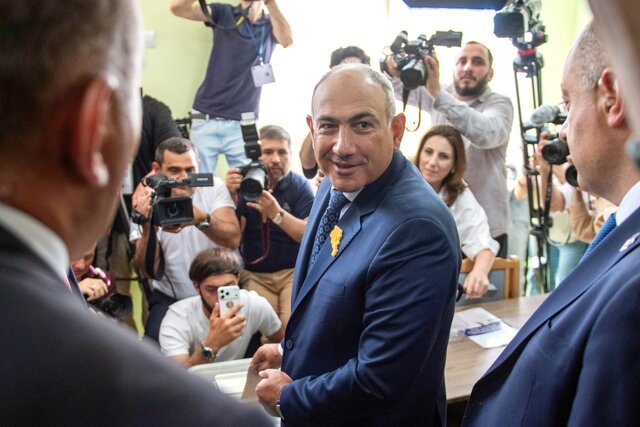
He won — with a caveat. Pashinyan’s Civil Contract party took 49.8% of the vote, enough to secure a parliamentary majority and form a government without coalition partners, but short of the supermajority needed to call a referendum on constitutional amendments. Pashinyan needs that referendum to sign a peace treaty with Azerbaijan: Baku is demanding that Yerevan strip its Constitution of all references to reunification with Nagorno-Karabakh. At 65% or above, Civil Contract could have called the vote unilaterally. Instead, the party will have to court allies among Armenia’s pro-Russian opposition that has no interest in holding such a vote.
Probably not. In the run-up to the vote, Moscow mounted a pressure campaign against Yerevan, accusing Pashinyan of moving closer to the West. Russian authorities banned imports of Armenian fruit, demanded a referendum on the choice between the EU and the Eurasian Economic Union, and threatened to raise gas prices and repeat the Ukrainian scenario. Pashinyan trolled Vladimir Putin but said he had no intention of choosing between Europe and Russia. After the election, he repeated that position, though in a more conciliatory tone. Analystsexpect him to continue building ties with the West while trying not to antagonize Moscow. Armenia’s economy is too dependent on Russia to risk that relationship for a still-nascent rapprochement with Europe.
At Meduza, we are committed to transparency about our use of artificial intelligence in the newsroom. The story you’re reading was written by one of our living, breathing journalists and translated from Russian using an AI model configured to follow our strict editorial standards. This translation process is the result of extensive testing and refinements to ensure our English-language coverage is timely and accurate. A Meduza editor reviews every draft before publication.
If you find any errors in this translation, please contact us at reports@meduza.io.
Russia’s Digital Development Ministry said in early June it had reached an agreement with Roblox on the conditions required to protect Russian users’ rights and interests.
“The corporation acknowledged that its existing technologies for protecting children from information harmful to their lives and health were ineffective,” the ministry said.
Roblox has committed to introducing a set of measures to better protect children from “harmful and dangerous information” and from unwanted behavior by other users, the ministry said. Starting in June, access to games will be restricted by age group. The platform will also work to combat the spread of content that “harms children’s health and development.”
The Digital Development Ministry and Roskomnadzor have asked the relevant law enforcement authorities to support lifting the restrictions on access to Roblox in Russia.
The gaming platform Roblox was blocked in early December 2025. Russia’s communications regulator, Roskomnadzor, said the move was due to the spread of “extremist” content and “LGBT propaganda.” The block affected millions of Russian gamers, and in some regions residents protested the restrictions.
Shortly afterward, Roskomnadzor said the platform’s management had expressed willingness to “gradually bring its operations into compliance with Russian law.”
At Meduza, we are committed to transparency about our use of artificial intelligence in the newsroom. The story you’re reading was written by one of our living, breathing journalists and translated from Russian using an AI model configured to follow our strict editorial standards. This translation process is the result of extensive testing and refinements to ensure our English-language coverage is timely and accurate. A Meduza editor reviews every draft before publication.
If you find any errors in this translation, please contact us at reports@meduza.io.
Russia’s State Duma passed a law tightening state oversight of people and organizations designated as “foreign agents” in Russia, approving it in both the second and third readings in a single session.
What the adopted amendments say:
Banks will be required to provide the Justice Ministry with information about the financial transactions, accounts, and deposits of “foreign agents” within three days of a request.
Social advertising is banned from the websites and platforms of “foreign agents,” who are also prohibited from commissioning it. Previously, the ban applied only to commercial advertising.
If authorities refuse to remove a “foreign agent” from the registry, that person or organization may not reapply until a year after the refusal. This does not apply to individuals being added to the registry for the first time.
“Foreign agents” will be required to submit reports to the Justice Ministry electronically rather than on paper, as is currently the case. The human rights project Department One notes that lawmakers still required one reporting form to be submitted in paper form.
“Foreign agents” have been stripped of the protections afforded by the law on mandatory requirements, which shields businesses, organizations, and individuals from surprise inspections and excessive government demands. Inspecting “foreign agents” will now be easier, Department One concludes.
As of 2026, more than 1,200 individuals and organizations have been added to Russia’s “foreign agents” list. According to OVD-Info, 178 individuals and 37 organizations were designated in 2025 alone.
According to Russia’s deputy justice minister Oleg Sviridenko, only 4% of those designated as “foreign agents” in 2025 were found to have received foreign funding. Since 2022, a law in Russia has allowed authorities to label anyone a “foreign agent” for being “under foreign influence,” even without receiving foreign funding.
At Meduza, we are committed to transparency about our use of artificial intelligence in the newsroom. The story you’re reading was written by one of our living, breathing journalists and translated from Russian using an AI model configured to follow our strict editorial standards. This translation process is the result of extensive testing and refinements to ensure our English-language coverage is timely and accurate. A Meduza editor reviews every draft before publication.
If you find any errors in this translation, please contact us at reports@meduza.io.
Georgia’s Interior Ministry has drafted legislation that would tighten the rules for granting temporary and permanent residency to foreign students and spouses of Georgian citizens.
Under the proposed changes, applicants and students would be required to submit a certificate showing they passed a language exam — in Georgian or a foreign language, depending on their program — or to take such an exam inside the country as a condition of enrollment. Educational institutions would face quotas on foreign students, and universities would be required to notify authorities promptly when a foreign student is expelled, under threat of fines or loss of accreditation.
Spouses of Georgian citizens would no longer be able to obtain permanent residency immediately, as is currently the case. They would first receive a temporary residence permit on the basis of marriage — a new ground for residency under the proposal — and a special commission would verify that the marriage is not fictitious before issuing the document.
Sham marriages entered into for the purpose of obtaining citizenship or another basis for staying in Georgia would become a criminal offense. Foreign nationals could face deportation and a ban on entering the country for two to 10 years, up to two years in prison, house arrest for one to two years, or a fine.
Georgia’s parliament will consider the package of amendments on an expedited basis on June 23, according to The Moscow Times.
In March 2026, Georgia introduced additional restrictions on the employment of foreign nationals, banning them from working without the appropriate visa or residence permit. Foreign sole proprietors registered in the country are now also required to obtain work permits.
The Georgian authorities say the tighter rules are aimed at combating illegal migration. By their estimates, around 20,000 people are living in the country without legal status. As Novaya Gazeta Europe reported in April, about 32,000 Russian citizens — mostly students — hold residence permits in Georgia. There are no precise figures on the total number of Russian nationals in the country, but it is believed to be at least 50,000.
At Meduza, we are committed to transparency about our use of artificial intelligence in the newsroom. The story you’re reading was written by one of our living, breathing journalists and translated from Russian using an AI model configured to follow our strict editorial standards. This translation process is the result of extensive testing and refinements to ensure our English-language coverage is timely and accurate. A Meduza editor reviews every draft before publication.
If you find any errors in this translation, please contact us at reports@meduza.io.
A member of the Social Protection Party’s supreme council urged St. Petersburg’s Legislative Assembly to petition Vladimir Putin to strike Ukraine with nuclear weapons.
The proposal came from Viktor Perov, who had been invited to address the assembly alongside other politicians not represented in the legislature.
Perov used his remarks to address the Russia–Ukraine war. In his view, “the criminal regime of Zelensky under the patronage of the European Union” had attacked Russia with the goal of “establishing a bandit Banderite neo-Nazi regime.” That is why Putin “was forced” to launch the ”SVO,” but “things did not go as planned,” he said.
That is why I believe that you, as deputies, must appeal to the president with a petition to begin using nuclear weapons and strike the supporters of Bandera and Shukhevych with them, which will bring Ukraine’s leadership to sign a peace agreement and end the SVO.
His microphone was cut off before he could finish, the Telegram channel Rotonda notes.
On June 3, the Supreme Court of the Russian Federation, at the request of the Ministry of Justice, dissolved the Social Protection Party, founded in 2012. Perov joined the party in 2018; over the years he has been a member of the Communist Party of the Russian Federation and the Communists of Russia party.
At Meduza, we are committed to transparency about our use of artificial intelligence in the newsroom. The story you’re reading was written by one of our living, breathing journalists and translated from Russian using an AI model configured to follow our strict editorial standards. This translation process is the result of extensive testing and refinements to ensure our English-language coverage is timely and accurate. A Meduza editor reviews every draft before publication.
If you find any errors in this translation, please contact us at reports@meduza.io.
Anti-drone nets have been strung over truck parking areas in the Valdai district of Novgorod region. Oleg Kashin published photographs of the barriers June 7 in his Telegram channel, saying readers had sent him the images.
The independent Russian investigative outlet Agentstvo analyzed the photographs and concluded they were taken on a highway roughly 9 kilometers (5.6 miles) from Russian President Vladimir Putin’s residence at Valdai. Military analysts told Agentstvo that such nets are used at the front and can protect against small drones or munitions dropped from unmanned aerial vehicles.
Ruslan Leviev, founder of the investigative project Conflict Intelligence Team (CIT), suggested the nets “are not there to protect the trucks from drones — as at the front — but the other way around: to protect against the trucks.”
Leviev recalled that in Ukraine’s Spider Web operation, drones were concealed inside trucks. As the vehicles approached their targets — military airfields — the trucks’ roofs opened, the drones flew out, and struck.
At Meduza, we are committed to transparency about our use of artificial intelligence in the newsroom. The story you’re reading was written by one of our living, breathing journalists and translated from Russian using an AI model configured to follow our strict editorial standards. This translation process is the result of extensive testing and refinements to ensure our English-language coverage is timely and accurate. A Meduza editor reviews every draft before publication.
If you find any errors in this translation, please contact us at reports@meduza.io.
The Russian aerospace company Bureau 1440 has lost one of the 16 production satellites it launched into orbit in March 2026, according to spacecraft monitoring websites, the Russian business daily Kommersant reported.
Bureau 1440 confirmed the loss to the outlet, saying six experimental Rassvet-1 and Rassvet-2 spacecraft and 15 satellites from the first launch remain in low Earth orbit.
Journalist Anatoly Zak had reported the satellite loss as early as June 6.
On March 24, Bureau 1440 announced it had placed the first 16 production satellites of the Rassvet orbital communications constellation into orbit, calling the launch “a transition from experiments to building a communications service.”
Bureau 1440 is developing a low-Earth orbit satellite system — a Russian analogue to Starlink — for high-speed broadband data transmission. By the end of 2030, the constellation is expected to include 292 satellites, with a total of 383 planned for launch.
The project to build Russia’s broadband satellite network is being financed as part of the national “Data Economy” program. It is expected to receive 102 billion rubles from the federal budget and 329 billion rubles from the company’s own funds.
At Meduza, we are committed to transparency about our use of artificial intelligence in the newsroom. The story you’re reading was written by one of our living, breathing journalists and translated from Russian using an AI model configured to follow our strict editorial standards. This translation process is the result of extensive testing and refinements to ensure our English-language coverage is timely and accurate. A Meduza editor reviews every draft before publication.
If you find any errors in this translation, please contact us at reports@meduza.io.
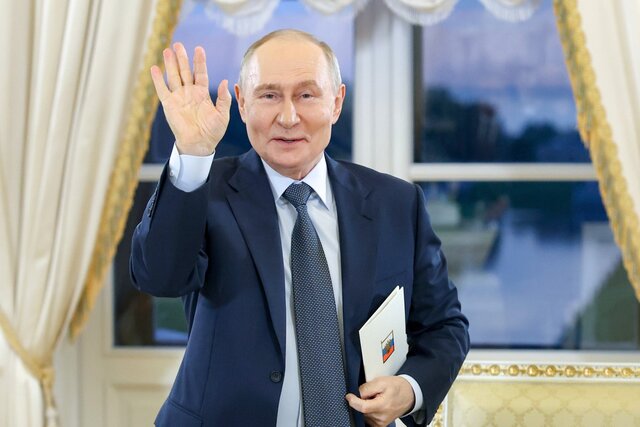
Putin after meeting with foreign journalists at the St. Petersburg International Economic Forum. June 4, 2026
Vladimir Putin made noticeably more public appearances in April and May than he had in the first three months of 2026, according to the independent Russian political newsletter Faridaily, which reviewed Kremlin press service reports on the president’s participation in events.
Based on those reports, Putin took part in 60 public events in April and May, compared with just 55 in January through March — pre-recorded bilateral meetings and certain other sessions excluded. He also held two meetings with “ordinary people”: his former schoolteacher and a now-grown Chinese boy who had met the Russian president in 2000. Putin also traveled abroad in April and May, visiting China and Kazakhstan.
The surge in public activity, Faridaily writes, may reflect the Kremlin’s desire to shore up Putin’s image amid declining official approval ratings. Both the Public Opinion Foundation (FOM) and the Russian Public Opinion Research Center (VTsIOM) continue to record falling approval ratings for the Russian president. VTsIOM changed its polling methodology, but the adjustment did not produce a sustained rise in the ratings.
Putin almost never travels around Russia. From January through May inclusive, he officially left Moscow only twice — both times to St. Petersburg. In the same period last year, Putin made eight trips to the regions; in 2024, he made 14.
A Faridaily source close to the Kremlin said Putin stopped traveling to the regions for security reasons. Ensuring security from an infrastructure standpoint is easier in the capitals of China and Kazakhstan than in, say, Ryazan or Kemerovo, the source said. During his visit to Kazakhstan, Putin was accompanied by an armored vehicle with a spot for a gunner on the roof.
Faridaily and the independent Russian investigative outlet Agentstvo drew attention in March to the fact that Putin had been appearing in public far less frequently. Concerns about the Russian president’s security were believed to be behind the withdrawal.
In early May, the intelligence service of one of the European countries reported that Russia’s Federal Protective Service (FSO) had significantly stepped up measures to protect Vladimir Putin because he fears a possible assassination attempt. The media outlet “Mozhem obyasnit” reported that officials had been banned from wearing wristwatches to meetings with the Russian president.
In early June, the Financial Times reported that Russian security services had temporarily shut down a special surveillance system designed to protect Vladimir Putin and other senior officials following the killing of Iran’s Supreme Leader Ali Khamenei. Israeli intelligence services prepared a successful assassination of Khamenei by accessing data from road surveillance cameras.
At the same time, Faridaily’s sources said, Putin’s reduced public presence does not mean he has been working less. A source in the government who regularly attends events with Putin said the Russian president’s “priorities may have shifted.” Putin holds many private meetings with participants in the war with Ukraine and with the widows of those killed, “personally getting involved in the work of helping them adapt to civilian life,” the source said. Putin is also “very actively” holding meetings related to high technology and artificial intelligence, the source added. What exactly is discussed at such meetings was not specified.
At Meduza, we are committed to transparency about our use of artificial intelligence in the newsroom. The story you’re reading was written by one of our living, breathing journalists and translated from Russian using an AI model configured to follow our strict editorial standards. This translation process is the result of extensive testing and refinements to ensure our English-language coverage is timely and accurate. A Meduza editor reviews every draft before publication.
If you find any errors in this translation, please contact us at reports@meduza.io.
This year’s St. Petersburg Economic Forum turned from a showcase of Russian achievements into a mirror reflecting the problems the full-scale war has created for the country. Officials showed no signs of panic — aside from the usual controlled outbursts. On the contrary, Putin assuredinvestors that the economy was in fine shape and that the slowdown in growth was a deliberate, controlled process. Meanwhile, the budget has begun to feel the effects of the oil price spike and the VAT increase. But the gap in the treasury will still end up larger than the government planned by year’s end. And as the war continues, the economy’s structural problems will only deepen.
Budget update: the only good news is for the war machine
Russia’s federal budget deficit for January through May reached 6.01 trillion rubles — 2.6% of GDP and one and a half times the full-year target of 3.8 trillion rubles (1.6%). Even so, the pace at which the deficit expanded in May slowed sharply — the first positive trend the budget has shown since the start of the year.
Revenue grew year-on-year, lifted by higher oil prices driven by the war with Iran and a VAT hike to 22%.
Spending slowed in May for the first time since the start of the year, though overall expenditures for the first five months rose 17% year-on-year, reaching nearly half the annual plan — even though the federal budget calls for growth of just 4.2% in 2025.
The positive trend is unlikely to last: Russian authorities plan to increase spending this year. Finance Minister Anton Siluanov explained in an interview with the Russian business daily Kommersant that the increase reflects the need to concentrate additional resources on important priority areas.
In recent years, that has meant financing the war and its costs. Spending under the “National Defense” and “National Security” line items already accounts for nearly 40% of all expenditures approved in this year’s budget — 16.8 trillion out of 44.1 trillion rubles — just below the post-Soviet record of 41% set in the 2025 budget.
The spending increase will push the final 2026 deficit above the planned 1.6% of GDP. The government does not intend to cover the shortfall by expanding domestic borrowing — which Siluanov said will stay at 5.5 trillion rubles — or by drawing on the National Wealth Fund, which has shrunk by more than half from its level before the full-scale war. “Reserves are not infinite,” Siluanov acknowledged. The money will come from “budget carry-overs” and from “asset sales and so on,” the Finance Minister said.
“Spending in 2026 will be increased, but only modestly, and the draft budget for 2027–2029 will show a schedule of planned expenditures that does not fall in nominal terms but does fall in real terms over three years,” a leading economist at a Russian analytical center told Meduza. “The goal [facing the Finance Ministry] is probably to produce a [budget] plan that is workable both with the continuation of the war and with its end. With an [escalation of the war], I don’t think there are any scenarios.”
The Finance Ministry plans to lower the cutoff price in the budget rule starting in 2027, which will automatically reduce budget spending. Given the continuation of the war, civilian spending — unrelated to combat operations — will be cut first.
According to sources cited by the Russian business news outlet RBC, the government is discussing lowering the cutoff from the current $59 to $50 per barrel for Russian Urals crude — a move that would leave less oil revenue in the budget and channel more into National Wealth Fund reserves. Specific figures will not be available until the fall, when the draft budget package for 2027–2029 is submitted to the State Duma, the lower house of Russia’s parliament.
Economic update: authorities sacrifice growth to hold down prices — which the war keeps pushing up
The Economic Development Ministry cut its GDP growth forecast for Russia threefold — to 0.4% from the 1.3% projected as recently as September 2025. Growth came in at 0.2% year-on-year for January through April, according to the ministry’s estimate.
Speaking at the St. Petersburg forum, Vladimir Putin called the slowdown “deliberate,” saying the authorities were prioritizing the fight against rising prices: “We don’t want inflation, hyperinflation, to be at 60–70%, like in some countries. We are fighting for the health of the Russian economy as a whole.”
He did not mention that inflation is being driven by massive military spending, which has forced Russia’s central bank to keep its benchmark rate in double digits — currently 14.5%, with the regulator’s next rate-setting meeting scheduled for June 19. Credit remains expensive, and civilian sectors are the first to suffer. If the authorities’ real priority were the “health” of the economy, the obvious first step would be to end the war.
Annual inflation as of June 1 stands at 5.4%. The Economic Development Ministry expects the figure to come in at 5.2% for the full year — the same number Putin cited in St. Petersburg. Russia’s Central Bank, for its part, kept its 2026 inflation forecast in the range of 4.5–5.5% at its April meeting.
The latest industrial data show that growth is being sustained almost exclusively in war-related sectors, while civilian industries contract.
Output of construction materials and ferrous metals, according to estimates by CMASF, remains 10–20% below the average monthly level of 2024.
Automobile production in April was 18% below the average monthly level of 2024 and 37% below the 2021 level, before the full-scale war. Meanwhile, imports of Chinese vehicles rose 41% year-on-year in the first quarter, from $2.62 billion to $3.69 billion, according to data from China’s Customs Administration — Russia has classified its foreign trade statistics since 2022.
The planned increase in military spending will only widen the gap between the war economy and the civilian economy. The defense industry — producing shells, drones, semiconductors, radar equipment, and the like — is growing rapidly on the back of state defense orders. It is draining resources, including labor, from sectors not directly connected to the war by offering above-market pay, which pushes up wage figures across the country without any corresponding increase in labor productivity. Subsidized loans for defense enterprises are covered preferentially from the budget. Russian Railways prioritizes their freight.
And the demands on resources will only grow. The war machine will keep burning money taken from productive sectors of the economy. Where this dangerous experiment ultimately leads remains impossible to predict.
At Meduza, we are committed to transparency about our use of artificial intelligence in the newsroom. The story you’re reading was written by one of our living, breathing journalists and translated from Russian using an AI model configured to follow our strict editorial standards. This translation process is the result of extensive testing and refinements to ensure our English-language coverage is timely and accurate. A Meduza editor reviews every draft before publication.
If you find any errors in this translation, please contact us at reports@meduza.io.

 Login
Login